Lace and Trim Textiles

A series of decorative textile trims showcasing intricate lace patterns from the 17th to 18th century, featuring floral and geometric designs.
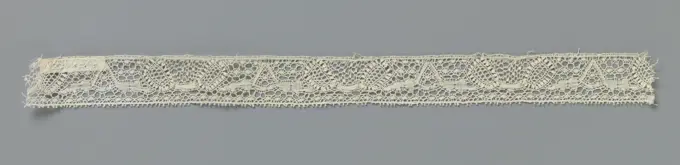
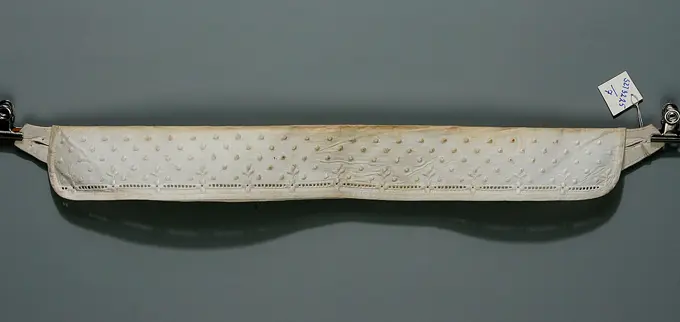
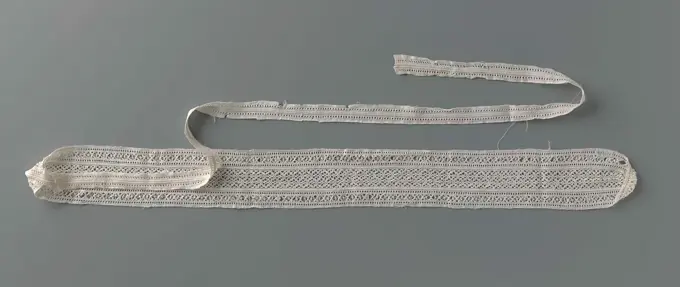
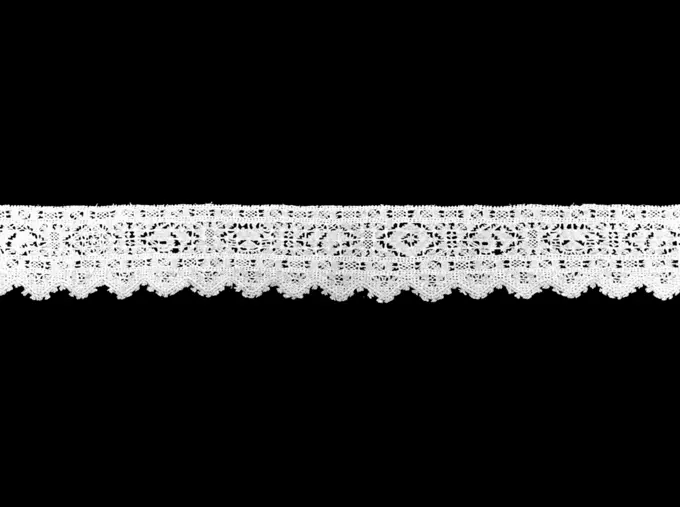
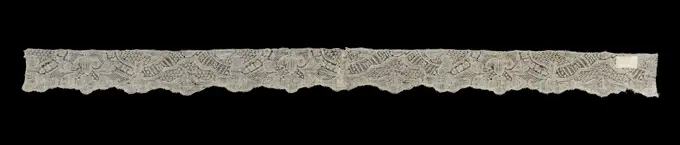
Strip bobbin with triangle and two bragged ovals, anonymous, c. 1900 - c. 1909  Strip of natural-colored bobbin, binche side. The pattern consists of two symmetrical compositions. One composition consists of a triangular motif with a ringed snowflake in the center. The other composition consists of two of each other alternated and schuinge -placed ovals, which are connected to each other on the underside by a slightly bent strap. The triangular motif is connected on the underside to the sluinga -plateed ovals due to a slightly wider strap of three connected round shapes. The straps and contours of the triangle are made in linen battle. The contours of the ovals are made in form. The motifs are connected by a decorative land, a ringed snowflake land. As a decorative land, a Paris soil has been used in the oval and a lace-hole-grid foundation is decorated between the ovals with staging motifs. Top and bottom of the strip are straight finished, with the bottom with picots. Normandy linen
Strip bobbin with triangle and two bragged ovals, anonymous, c. 1900 - c. 1909 Strip of natural-colored bobbin, binche side. The pattern consists of two symmetrical compositions. One composition consists of a triangular motif with a ringed snowflake in the center. The other composition consists of two of each other alternated and schuinge -placed ovals, which are connected to each other on the underside by a slightly bent strap. The triangular motif is connected on the underside to the sluinga -plateed ovals due to a slightly wider strap of three connected round shapes. The straps and contours of the triangle are made in linen battle. The contours of the ovals are made in form. The motifs are connected by a decorative land, a ringed snowflake land. As a decorative land, a Paris soil has been used in the oval and a lace-hole-grid foundation is decorated between the ovals with staging motifs. Top and bottom of the strip are straight finished, with the bottom with picots. Normandy linen
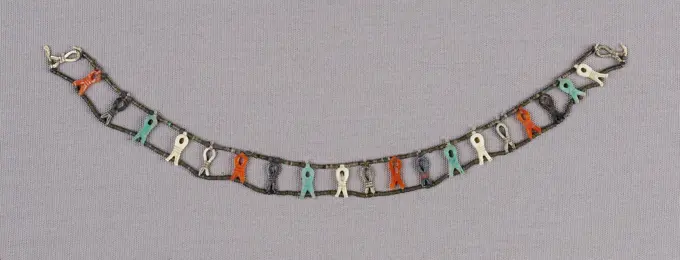
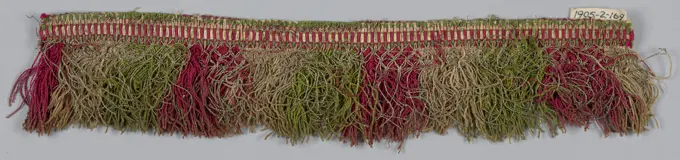
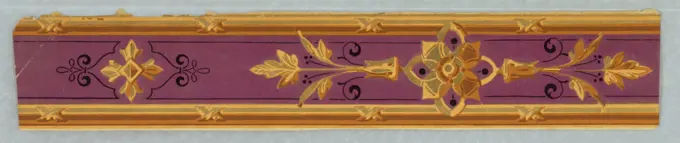
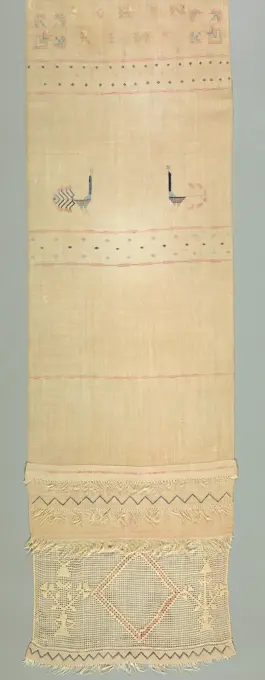
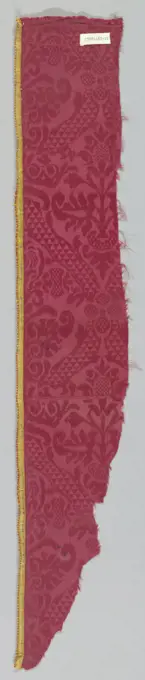
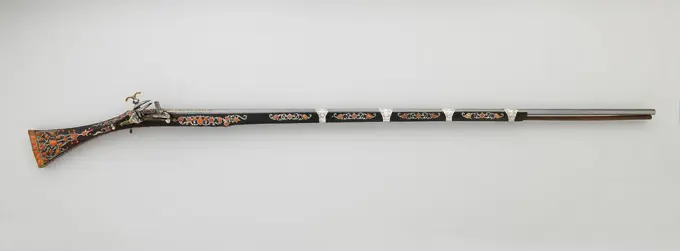
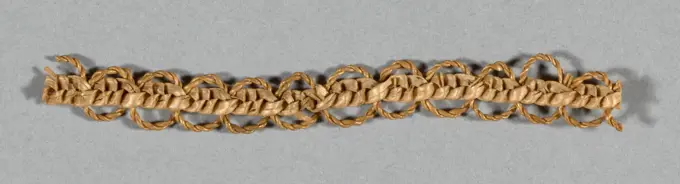
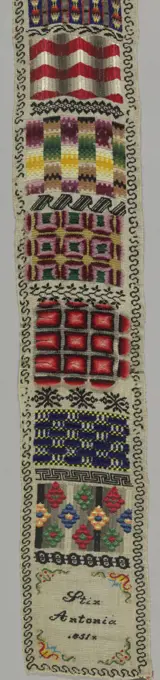
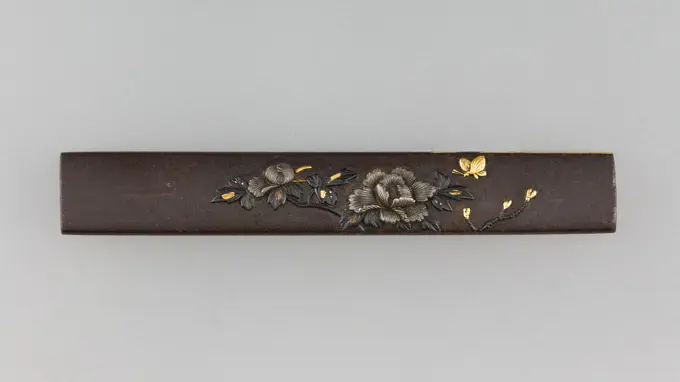
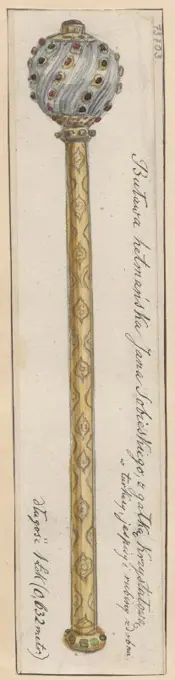
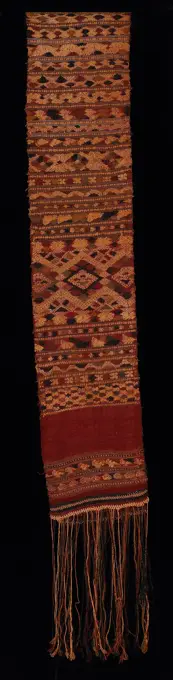
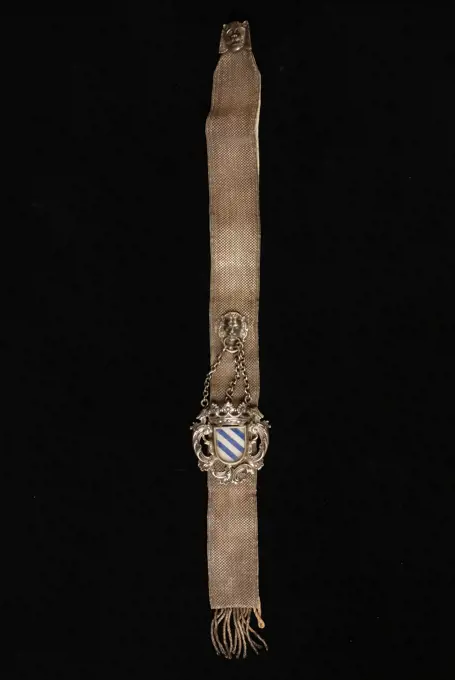
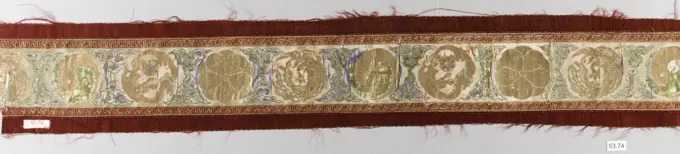
Border; medium:; 1974-52-28Border, Medium: linen Technique: bobbin lace, Brussels style, Border with a pattern of densely placed floral and foliated forms., Belgium, 1700-1750, lace, BorderWomen's non -circle;  beginning of the 20th century (1901-00-00-1910-00-00);gift (provenance), collarFragment, Medium: linen Technique: bobbin lace, Fragment of Lille-type lace with small powdered floral sprays., France, late 18th century, lace, FragmentBarbed Point 3rd century B.C.-A.D. 2nd century Vicús. Barbed Point 315502Belt -Galloon 17th-18th century Unknown. Galloon. Unknown. 17th-18th century. Metal thread. Textiles-TrimmingsStrip embroidery., Anonymous, 1700 - 1725 Strip with golden embroidery on karmozijnrode, velvet soil.  velvet (fabric weave). Strip with golden embroidery on karmozijnrode, velvet soil.  velvet (fabric weave).Suspenders early 19th century European. Suspenders 102531Trimming, Medium: silk Technique: woven, Yellow and blue trimming fragment in a design of an open flower with chevron-like leaves at either side., France, 1800-1810, trimmings, TrimmingBracelet, Pearls, gold, Six bands of gold, each ornamented with six half-pearls and a vine design in colored gold, crossing four flexible strans of gold. Clasp closing concealed in one band. Two half pearls and small chain at clasp are missing., France, 19th century, jewelry, Decorative Arts, BraceletFragment, Medium: silk Technique: cut supplementary warp pile (velvet), Small triangular fragment with a pink ground covered in tiny floral sprays of green, black and white. Bound on three sides with blue silk ribbon., France, 18th century, woven textiles, FragmentTowel Cover; cotton on linenFragment, Medium: silk Technique: 5-harness satin damask, Red damask with an ogee lattice formed by a decorated vine with small triangles enclosing two types of flowering plants; the blossom in the major ogee resembling lilies. Crowns encircle the points of the two major shapes from end to end, and four lobed rosettes join the major shapes side to side., Italy or Spain, late 16th-early 17th century, woven textiles, FragmentBand (Italy); linen; Bequest of Marian Hague; 1971-50-300Miquelet Gun. Culture: lock and stock, Algerian; barrel, European. Dimensions: L. 76 1/2 in. (194.4 cm); L. barrel 60 1/4 in. (153.0 cm); Cal.64 in. (16.3 mm); Wt. 10 lb. 9 oz. (4799.0 g). Date: lock and stock dated A.H. 1172/A.D. 1758-59; barrel, 18th century.Coral-inlaid firearms were a specialty of Algerian and Tunisian gunmakers in the eighteenth century. Shaped coral plaques were fitted into a silver framework to create a colorful decoration. The dey of Algiers presented examples to European rulers as part of his nation's trade negotiations, and the bey of Tunis presented one to President Thomas Jefferson in 1805. The barrels of these guns are of European manufacture intended for the North African market. Museum: Metropolitan Museum of Art, New York, USA.Lappet (one of a pair) 18th century Flemish, Brussels. Lappet (one of a pair) 222787Fragment (Italy); silkGalloon French 18th centuryChasuble Made 1501-1600 Italy. Silk, warp-float faced 3 1 'S' twill weave with supplementary pile warps forming cut solid velvet; Orphrey silk, warp-float faced 7 1 satin weave; embroidered with silk and gilt-metal-strip-wrapped silk in satin, split, stem and straight stitches; couching; edged with gilt-metal-strip-wrapped linen diamond twill and gilt-metal-strip-wrapped silk plain weave tapes .Edging with Fringe, 16th century. Italy, 16th century. Knotted lace; average: 4.8 x 22.9 cm (1 7/8 x 9 in.).Bobbin Lace Edging, 19th century. Russia, 19th century. Lace, bobbin; average: 5.1 x 86.4 cm (2 x 34 in.).Sotck exchange. Mid -19th. GAL1960.63.8Galloon 18th century French. Galloon 214049Border. Date/Period: Early 18th century. Border. Medium: linen. Technique: bobbin lace. Author: UNKNOWN.Piece 18th century Flemish. Piece 212870Part of a window frame. Staked pilaster of gilded wood in the form of a half -column with composite capital., Anonymous, 1500 - 1550 Staked pilaster of gilded wood in the form of a half -column with composite capital. The upper part of the shaft is articulated vase and shows mascarons with hanging garlands. Together with a second pilaster and a profiled cornice, forms a window frame. See also: BK-16892-B & -C. Coming from the garden room of the Villa van Mannheimer (current desk). Spain wood (plant material). gilding (material) gilding Staked pilaster of gilded wood in the form of a half -column with composite capital. The upper part of the shaft is articulated vase and shows mascarons with hanging garlands. Together with a second pilaster and a profiled cornice, forms a window frame. See also: BK-16892-B & -C. Coming from the garden room of the Villa van Mannheimer (current desk). Spain wood (plant material). gilding (material) gildingFragment of lace. unknown, authorTussenzetsel van kloskant tussen twee stroken werk met uitgetrokken draden afkomstig van een kussensloop.Natural climbing side intersection between two strips work with pulled out wires. The ends of the strip are finished in a point. A narrow strip is attached to one end that consists of a double strip of work with pulled out wires.Fan Holder 18th-19th century China. Fan Holder 68851Fragment, Medium: silk Technique: supplementary warp pile in a satin foundation (velvet), Fragment of narrow panel of white satin ground with central yellow satin stripe. Over this is velvet in goemetric zigzag in pink and black. Cut from a large frabirc or else sevages removed., possibly Spain, 18th century, woven textiles, Fragment. Strola of yellow silk satin with embroidery in silk and in high relief with gold and silver wire with a performance of Greek cross. Stola is part of a couple (BK-2008-176-A to E).Fragment, Medium: linen Technique: bobbin lace, Fragment of Valenciennes lace has isolated stems with flowers, buds and leaves. Round mesh., France, late 18th century, lace, FragmentFragment, Medium: silk () Technique: velvet, Fragment of black and white velvet in a mottled pattern suggesting fur. Cut in a scarf shape and lined with tan and black striped taffeta., France, late 19th century, woven textiles, FragmentFragment (China); silkFragment of Galloon late 17th century Korea. Fragment of Galloon 69980Border, Medium: linen Technique: bobbin lace, Eastern Europe, 19th century, lace, BorderSuspenders 19th century European. Suspenders 98249Headdress 19th century Indian This collection of largely ethnographic jewelry includes examples from cultures in South America, North America, Europe, Asia, and Africa and dates from the Pre-Columbian period to the twentieth century. Owned by renowned art collector and fashion enthusiast Muriel Kallis Newman, the collection represents her knowledge and appreciation of a wide range of jewelry design and making traditions. Numerous items in her collection are composite artifacts made from various cultures and time periods reappropriated as modern jewelry creations by or for Muriel. It is important to note that Newman wore many of the pieces in the collection, interpreting them to suit and express her own singular, often avant-garde style.. Headdress 141495"Hopi Brocade" Style Dance Sash, c. 1874-1885. America, Native North American, Southwest, Pueblo (Hopi), Post-Contact, Late Classic Period. Plain weave with supplementary weft wrap; wool (handspun, Germantown, and bayeta); overall: 118.5 x 51.2 cm (46 5/8 x 20 3/16 in.).Leather case for smartphone isolated on white background.Band, Medium: linen Technique: machine made, Band with large blossom forming tabs in red, blue and natural linen., Russia, 19th century, lace, BandPiece 16th century Japan. Piece 71079Belt -Fragment of a Wall Revetment 50 BCE-100 CE Roman Empire. In ancient Rome, there was a high demand for colorful glass that could dazzle banquet guests alongside the expensive silver and gold serving wares meant to impress. Fragments like this one would have once been a part of larger mosaic dishes. The mosaic pattern was made by sagging molten glass into bowl-shaped molds, a technique used on many of these fragments is similar to millefiori, ìthousand flowersî in Italian, a modern glass-making method in which tiny rods of colored glass are bundled together, wrapped in a sheet of glass, fused, and then thinly sliced to reveal swirls of a flower-like patterns. They were arranged side by side, sometimes together with bits of colored glass, and fused together with heat.. Glass, mosaic glass technique . Ancient RomanGalloon 17th-18th century Italian or French. Galloon 214077Belt -Trimming, Medium: silk Technique: cut supplementary warp pile in a satin foundation (velvet), Red, yellow, green and white trimming fragment in a design of green and yellow leaves placed diagonally and bordered with red and yellow bands., France, 19th century, trimmings, TrimmingOplegstuk van gehaakte kant imitatie grove Venetiaanse kant.V-shaped image of natural-colored Irish crochet side, imitation coarse Venetian needle side. The long sides of the V are finished with a copied bow edge. The short side is not finished.Embroidered Neck Border 4th-3rd century B.C. Paracas. Embroidered Neck Border 308055Embroidered Border Fragment 5th-2nd century B.C. Paracas. Embroidered Border Fragment. Paracas. 5th-2nd century B.C.. Camelid hair. Peru. Textiles-WovenFringe ca. 1750 Italian. Fringe 225063Border Made 1875-1900 Italy. Linen, plain weave; embroidered with silk floss in buttohole, double hem, hem, and overcast stitches; cut and drawn work with silk in needle lace filling stitches .Needlepoint (Drawnwork) Lace Collar, 19th century. Italy, 19th century. Lace, needlepoint: linen; average: 8.3 x 40.1 cm (3 1/4 x 15 13/16 in.).Bead or amulet ca. 1950-1804 B.C. Middle Kingdom-Early New Kingdom. Bead or amulet 559328Band (Spain); linen; Bequest of Richard Cranch Greenleaf in memory of his mother, Adeline Emma Greenleaf; 1962-50-123-aMiser's Purse (France); silk, metal; L: 31 cm (12 3/16 in.)Bobbin Lace Edging, 18th century. Belgium, Binche, 18th century. Lace, bobbin: linen; average: 3.9 x 52.1 cm (1 9/16 x 20 1/2 in.).Fragment of the lace;  2. PO. 19th century (1851-00-00-1900-00-00);Tours, Blaise, Gabriel, Altar table, set up during the Exposition Rétrospective of 1873 in Tours, France, photomechanical print, page, photos, photographically illustrated books, height 72 mm, width 180 mm, French, 1827 - 1897-09-04, maker, manufacturer, 1873 - 1873, paper, Woodbury typeBand (Spain); silk, metallic threadsBliej Kultury unknownGarters 1822 European. Garters 122960Bobbin Lace Edging of Points, second half of 16th century. Italy, Venice, second half of 16th century. Lace, bobbin; average: 4.2 x 20.7 cm (1 5/8 x 8 1/8 in.).Lappet. Culture: Flemish. Date: 1740-70.Although these joined lappets are not originally designed lappets, but rather were made from a length of lace, the lace is fine and delicate and the 18th century devotion to naturalism is embodied in the floral motif. Museum: Metropolitan Museum of Art, New York, USA.Embroidered Border Fragment 4th-2nd century B.C. Paracas. Embroidered Border Fragment 308071Upholstery trimming, Medium: silk Technique: woven, Woven heading with a cord carried through to form scallops with ornaments of silk floss knotted and fringed in multicolored silks., France, 19th century, trimmings, Upholstery trimmingFragment, Medium: silk Technique: plain compound satin, brocaded, Small fragment with scrolls and flowers in green and blue on an orange and yellow background., China, 18th century, woven textiles, FragmentFragment (Italy), 17th century; linen, cottonBand Fragment; s-spun undyed linen weft, s-spun undyed wool warp and weftsixty years old gold comb, india Copyright: xMxAmirtham/DinodiaxPhotoxFringe, Medium: silk Technique: woven, Fringe with a green and yellow checkerboard heading. Skirt threads are arranged in stripes., Spain, 17th century, trimmings, FringeMosaic tiles decorative border 6Fragment (Bonnet Trim) Made 1850 Europe. Straw, three-dimensional braid laced with straw yarns .34 Blows. Joel Shapiro; American, born 1941. Date: 1971. Dimensions: 15.2 x 285.8 x 3.2 cm (6 x 112 1/2 x 1 1/4 in.). Copper. Origin: United States. Museum: The Chicago Art Institute, Chicago, USA.Length of Textile, early 1700s. France or Italy, early 18th century. Silk with supplementary weft brocading; overall: 6.5 x 56.8 cm (2 9/16 x 22 3/8 in.).Piece 17th century Japan. Piece 71154Collar ca. 1870 American. Collar 169929Fringe (Italy); silk, metallic thread (gold strips wound on a silk core)Fragment; silk, metallic; 1896-32-1-a,bCope second half 17th century French. Cope. French. second half 17th century. Silk and metal thread on linenContainer(Bungkan)Sampler, Technique: various embroidery stitches., A band of rectangles, with each rectangle showing different embroidery stitches, patterns and colors. The patterns are seperated by narrow patterns done in black., Germany, 1851, embroidery & stitching, SamplerKnife Handle (Kozuka) late 18th century Japanese A kozuka is a handle of a by-knife that is part of a sword mounting. It is kept in a slot on the reverse of a katana scabbard, often with a matching kōgai (hairdressing tool).. Knife Handle (Kozuka) 29785Sterlet or Acipenser ruthenus, vintage engraved illustration. Trousset encyclopedia (1886 - 1891).Canopy for Bed Set Made 1701-1800 France. Cotton, plain weave; block printed and painted .Grants with 2 flowing. XIXth. GAL1960.63.5Vivatband, Vivat our glorious army, War welfare office , Red Cross , War aid office  -  , Alfred Offner -, DraftBorder ca. 1600 Italian. Border 217964Stole. Culture: Spanish. Dimensions: 42 in. (106.7 cm). Date: early 18th century.The embroidery that covers the entire surface of this stole carries a strong visual impact and would have taken many hours of skilled labor to produce. The naturalistic rendering of the flowers is fresh and exuberant and would have contributed to an impressive presence within the context of worship. The staggered, opposing lengths of the front bands of this stole and its complement (2009.300.2271) suggest that they were made to be worn by two priests who were appearing next to each other during a service. Museum: Metropolitan Museum of Art, New York, USA.Border (France); block-printed and flocked on paper, polished ground; 48 x 8.5 cm (18 7/8 x 3 3/8 in.)Knife Handle (Kozuka) late 17th-early 18th century Got Tsj Japanese This kozuka features a design of a river with flowers.. Knife Handle (Kozuka). Japanese. late 17th-early 18th century. Copper-gold alloy (shakud), gold, silver. Sword Furniture-KozukaHetmans mace of John III Sobieski from c. 1665 from the collection of the treasury of Jasna Góra in Częstochowa. Lesser, Aleksander (1814-1884), draughtsman, cartoonistTrimming (France); silkSash, 20th century, 64 5/16 x 7 13/16 in. (163.35 x 19.84 cm) (without fringe), Silk; needlework, Laos, 20th centuryNecklace with Sa-Amulets of Senebtisi ca. 1859-1770 B.C. Middle Kingdom. Necklace with Sa-Amulets of Senebtisi. ca. 1859-1770 B.C.. Sa-amulets: Silver (5 originals, 4 restored), carnelian, feldspar, turquoise, ivory (4 restored). Tiny disk beads: top row turquoise, bottom row restoredBall beads: silver. Middle Kingdom. From Egypt, Memphite Region, Lisht North, Tomb of Senwosret (758), Pit 763, burial of Senebtisi, MMA excavations, 1906-07. late Dynasty 12-early Dynasty 13Fringe (Italy); silk, metallic thread (silver strips wound on a silk core)Border, Block-printed and flocked, Alternating large and small floral rosette, the larger flanked by outstreched leaf clusters and the smaller by line interlaces, bound-rod motif along edges. Printed in brown and gold, with red-violet flock and black overprinting., USA, 1875-80, Wallcoverings, BorderSilversmith: Isaak Kroon, Bodebus of Charlois, bodebus was distinctive sign carried by messengers who were employed by government bodies, bodebus chamber keeper socket card holder silver leather glass, total, cast The coat of arms of Charlois without the heartshield in blue and white on the right, clasped in silver box with crown above and surrounded by ornaments rocaill style; hanging from three chains on ring which is held in the mouth by lion's head; attached to strap of leather on the back of the silver strip: IK the master brand and three more brands symbolize government symbol attribute dignity Charlois heraldry RotterdamESPADA DEL PROFETA MAHOMA CON INCRUSTACIONES - SIGLO VII. Location: PALACIO TOPKAPI-MUSEO. ISTANBUL. TURQUIA.