Lace and Trim Textiles

A series of decorative textile trims showcasing intricate lace patterns from the 17th to 18th century, featuring floral and geometric designs.
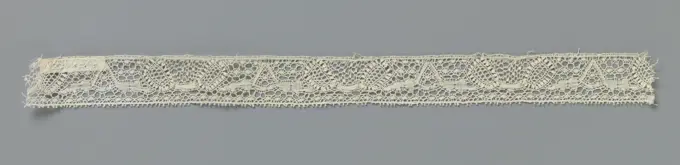
Strip bobbin with triangle and two bragged ovals, anonymous, c. 1900 - c. 1909  Strip of natural-colored bobbin, binche side. The pattern consists of two symmetrical compositions. One composition consists of a triangular motif with a ringed snowflake in the center. The other composition consists of two of each other alternated and schuinge -placed ovals, which are connected to each other on the underside by a slightly bent strap. The triangular motif is connected on the underside to the sluinga -plateed ovals due to a slightly wider strap of three connected round shapes. The straps and contours of the triangle are made in linen battle. The contours of the ovals are made in form. The motifs are connected by a decorative land, a ringed snowflake land. As a decorative land, a Paris soil has been used in the oval and a lace-hole-grid foundation is decorated between the ovals with staging motifs. Top and bottom of the strip are straight finished, with the bottom with picots. Normandy linen
Strip bobbin with triangle and two bragged ovals, anonymous, c. 1900 - c. 1909 Strip of natural-colored bobbin, binche side. The pattern consists of two symmetrical compositions. One composition consists of a triangular motif with a ringed snowflake in the center. The other composition consists of two of each other alternated and schuinge -placed ovals, which are connected to each other on the underside by a slightly bent strap. The triangular motif is connected on the underside to the sluinga -plateed ovals due to a slightly wider strap of three connected round shapes. The straps and contours of the triangle are made in linen battle. The contours of the ovals are made in form. The motifs are connected by a decorative land, a ringed snowflake land. As a decorative land, a Paris soil has been used in the oval and a lace-hole-grid foundation is decorated between the ovals with staging motifs. Top and bottom of the strip are straight finished, with the bottom with picots. Normandy linen
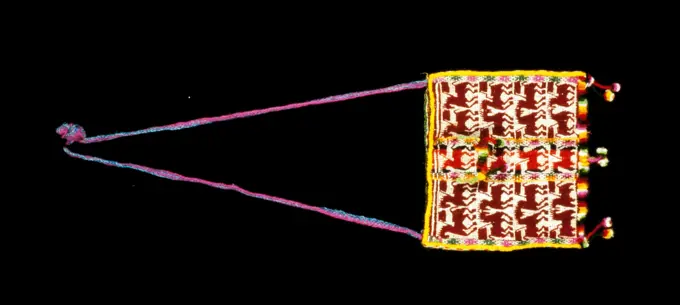
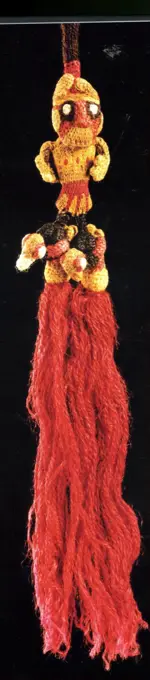
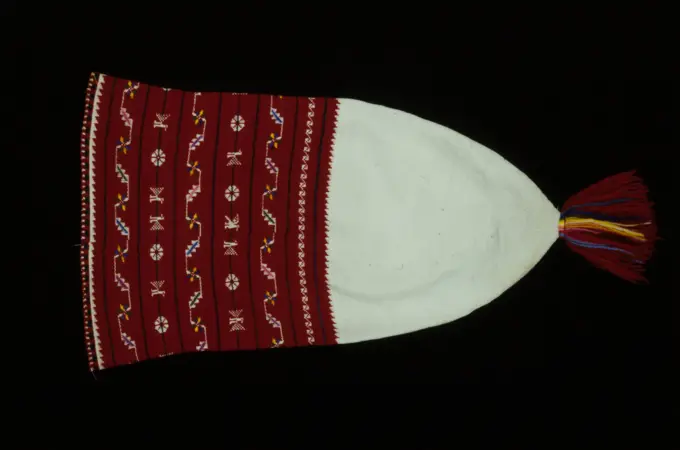
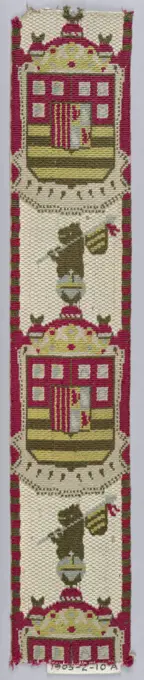
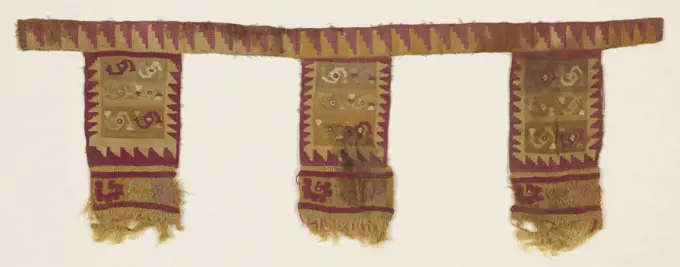
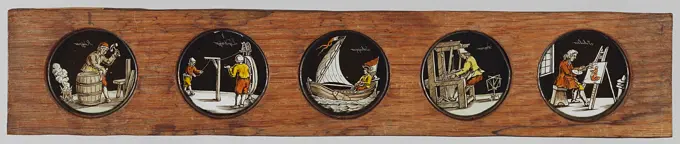
Piece 18th century Japan. Piece 72096Border (England); block-printed and flocked; 50 x 9.5 cm (19 11/16 x 3 3/4 in.)Drawing, Design for a Book Binding; Designed by Alice Cordelia Morse (American, 1863-1961); USA; brush and gouache on paper; Sheet: 18.6 x 3.5 cm (7 5/16 x 1 3/8 in.) Mount: 20 x 4.2 x 0.1 cm (7 7/8 x 1 5/8 x 1/16 in.); 1943-33-1-16Coca leaf bag (ch'uspa), 1965-1975, 7 1/4 x 6 1/2 in. (18.4 x 16.5 cm), Wood, Bolivia, 20th centuryBorder, Block-printed and flocked on paper, Passementerie border with two dark blue flock stripes composed of twisted cables, with overlaid alternating grisaille paterae and bosses., England, ca. 1860, Wallcoverings, BorderBorder (France); block-printed paper; 20 x 5.5 cm (7 7/8 x 2 3/16 in.)BarPin.  Artist: Tiffany and Company, American, founded 1837Fringe (Spain); silkCeremonialSling.  Artist: UnknownOrnament, one of a pair, 11/16 x 7 7/16 x 3/16 in. (1.75 x 18.89 x 0.48 cm), Silver, ChinaSuspenders mid-18th century European. Suspenders 122383Chullo (hat), 20th century, 20 x 10 in. (50.8 x 25.4 cm) (including fringe), Wool, synthetic, Peru, 20th century, Taquile Island is located on the Peruvian side of Lake Titicaca. Taquiles textile arts are well regarded and were declared Masterpieces of the Oral and Intangible Heritage of Humanity by UNESCO in 2005. Male Taquileños knit hats, belts, and other items, while women spin and weave. These hats are customarily worn by men and communicate marital status; single men wear white and married men red.Banknote motif: the word ONE set against a rectangular band of lathe work. Artist: Associated with Cyrus Durand (American, 1787-1868). Dimensions: sheet: 1 x 3 5/16 in. (2.6 x 8.4 cm). Printer: Printed by A. B. & C. Durand & Company (American, active 1824-27); Printed by Durand, Perkins, and Company (New York). Date: ca. 1824-42. Museum: Metropolitan Museum of Art, New York, USA.Border, Block-printed, Grisaille rococo scrollwork with leaf forms, enclosing medallions. The latter are embellished with black strapwork scrolls and leaf forms on blue ground. (Probably clipped on one side or both. Were probably two or more lengths to a width originally). Printed on blue ground., possibly France, ca. 1845, Wallcoverings, BorderLivery trimming, Medium: silk Technique: uncut voided velvet, Heraldic shield surmounted by a standing bear in profile holding a staff or a flag that is held over the shoulder., Italy, 18th century, woven textiles, Livery trimmingEye with copper wire from the wreck of the East Indians Hollandia, Anonymous, 1700 - in Or Before 1743  Varied parts or fragments, end or finials; eroded; circular loop of wire, one end of wire wrapped serriedly round the other, forming a straight shaft, ends broken off. Netherlands copper (metal)   SecondSotck exchange. Around 1850. GAL1994.210.XGimp mid-18th century French. Gimp. French. mid-18th century. Silk. Textiles-TrimmingsFragment, Medium: wool, cotton Technique: embroidery on plain weave foundation; Weft-faced plain weave: slit tapestry. Warp-faced plain weave embroidered in chain stitch., Tapestry woven strip patterned by stepped triangles in red and yellow to which three large tabs are attached (there might have been others). Each tab is made up of two sections sewn together: 1) rectangle patterned by three bands, with two bird heads () with tassels, bordered by stepped triangles in red and yellow 2) Natural orange plain weave wool embroidered with scroll bird-like motifs, Ica, Peru, ca. 1300, embroidery & stitching, FragmentTrimming, Medium: silk Technique: woven, Trimming fragment in a design of diagonal rose bands on a yellow ground; picot edges., France, 19th century, trimmings, TrimmingTrimming (France); 1909-2-182Trimming (France); 1909-2-219Jewelry from Indian Arts and Crafts Board displayImpressions of Grape and LeafOrnamentVijf beroepen.Five glasses with images of professions in a wooden mount. The appeal depicted is also always mentioned on the glass. Extreme left: 'Painter', a man paints a woman's portrait. To the right: 'Wever', a man sitting behind a loom. In the middle: 'skipper', a man at the helm of a small sailing boat. To the right: 'Lijndrakerer', a rope worker at work on a line web. Extreme right: 'Kuijper', a Kuiper cow to a tub with a tuber hammer. Images seem to go back in part to the prints of Jan and Caspar Luyken, but are not directly copied or transposed. The published professions and the composition of the images deviate too much from the original prints.