Lace Fabric Strips

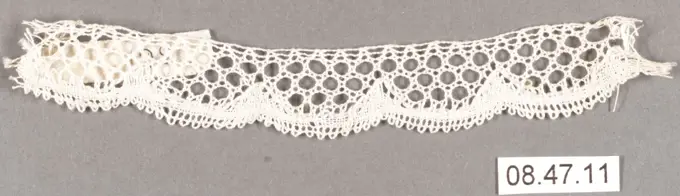
Intricate strips of lace showcasing floral and ornamental designs. Each lace piece features delicate craftsmanship, perfect for sewing and decoration.
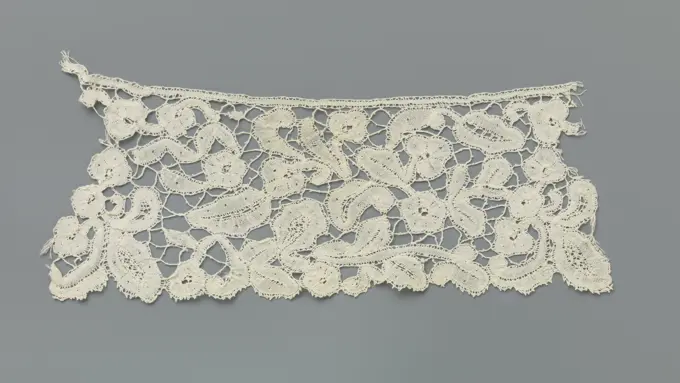
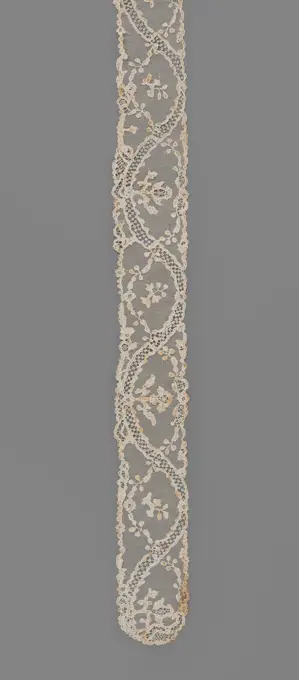
Strip bobbin with simple flowers and leaves, anonymous, c. 1900 - c. 1924 Strip of natural-colored bobbin: Duchesse side. Easily designed flower and leaf motifs and volutes are connected by a braid ground. Along the edge, among other things, a rush -in with two curly leaves. Belgium linen (material) bobbin lace Strip of natural-colored bobbin: Duchesse side. Easily designed flower and leaf motifs and volutes are connected by a braid ground. Along the edge, among other things, a rush -in with two curly leaves. Belgium linen (material) bobbin lace
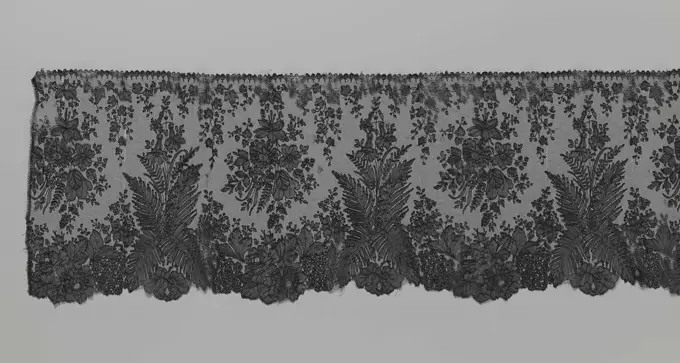
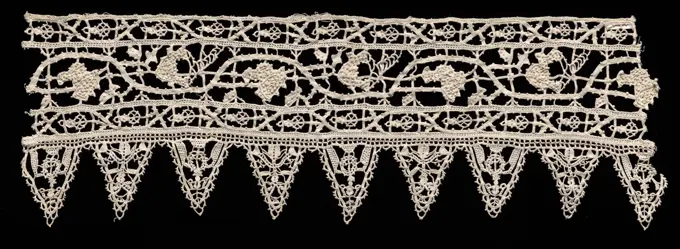
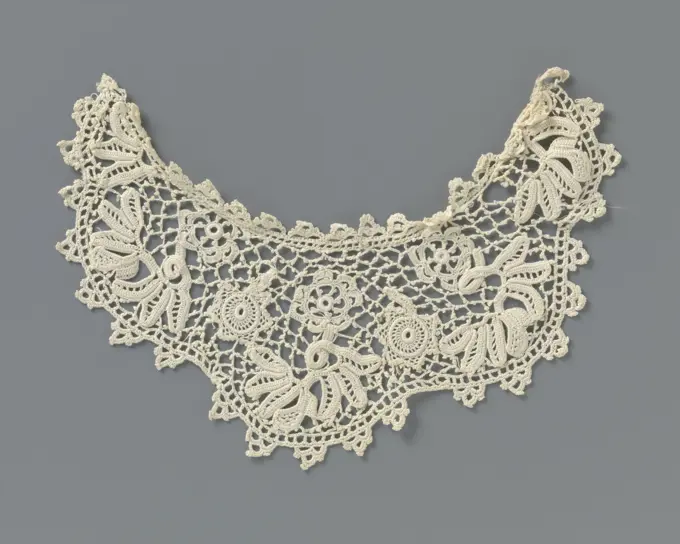
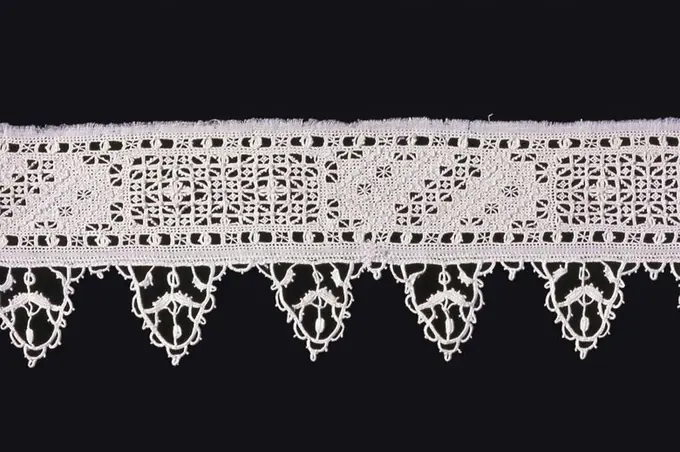
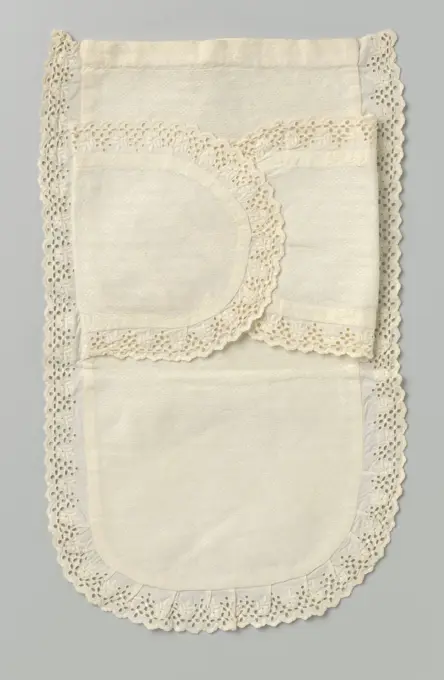
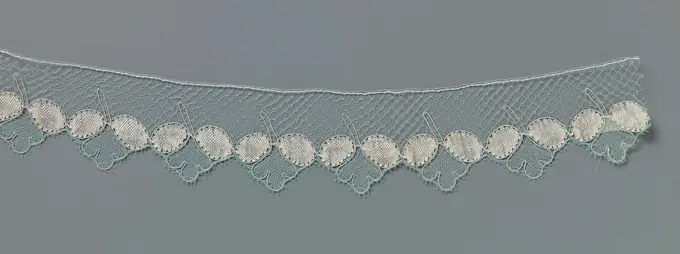
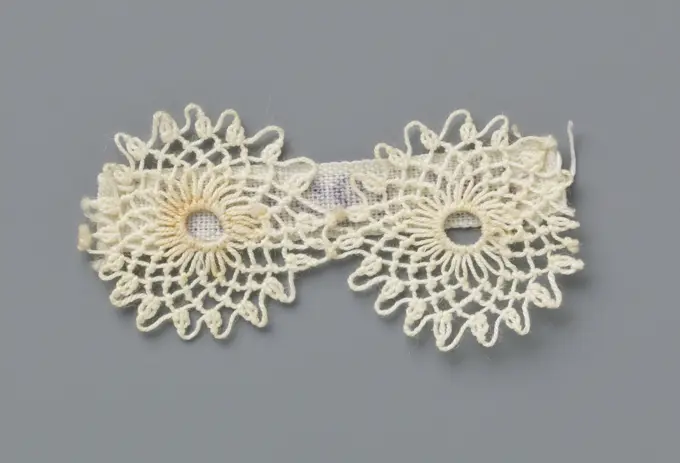
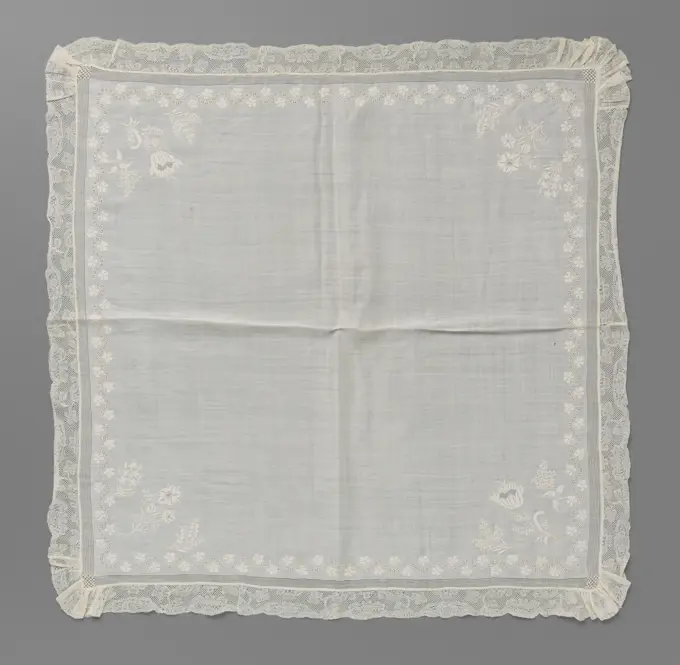
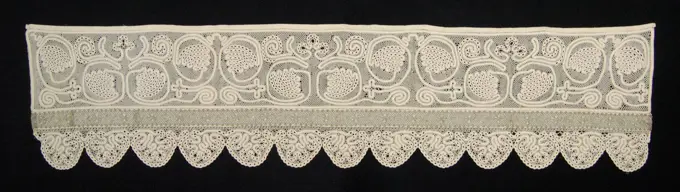
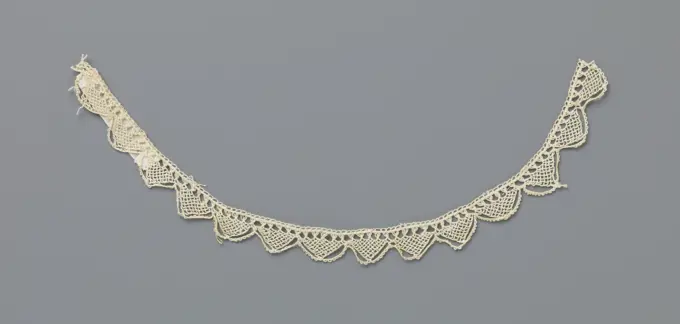
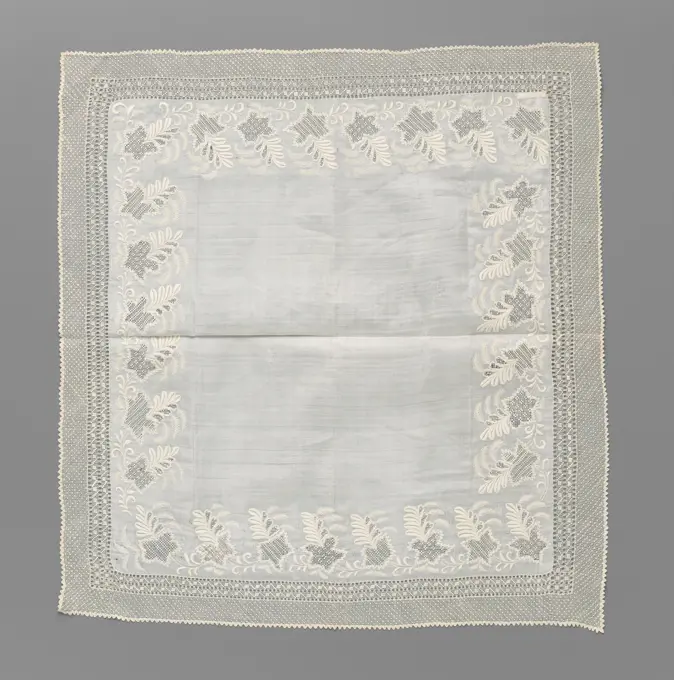
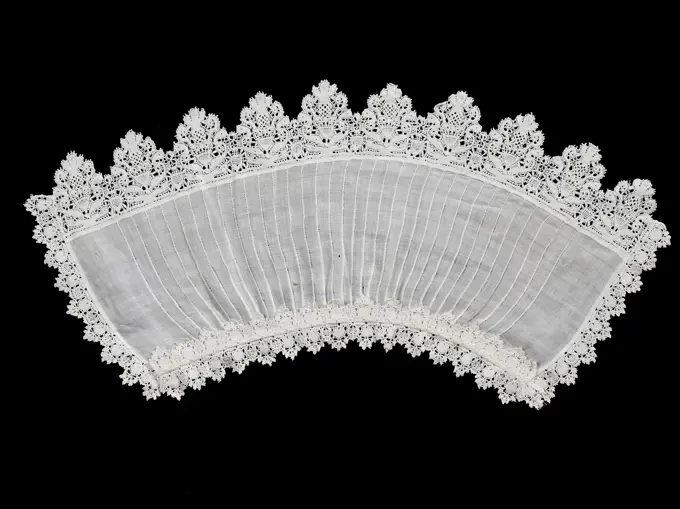
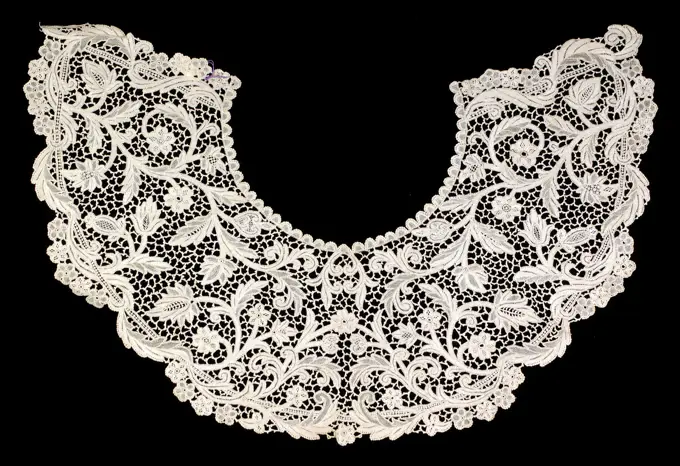
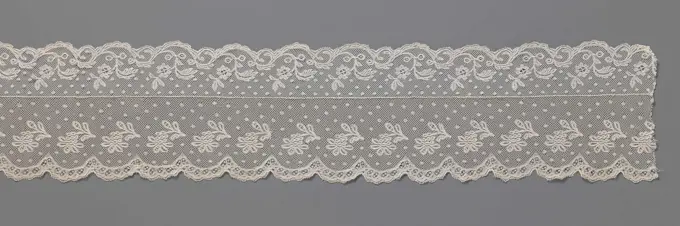
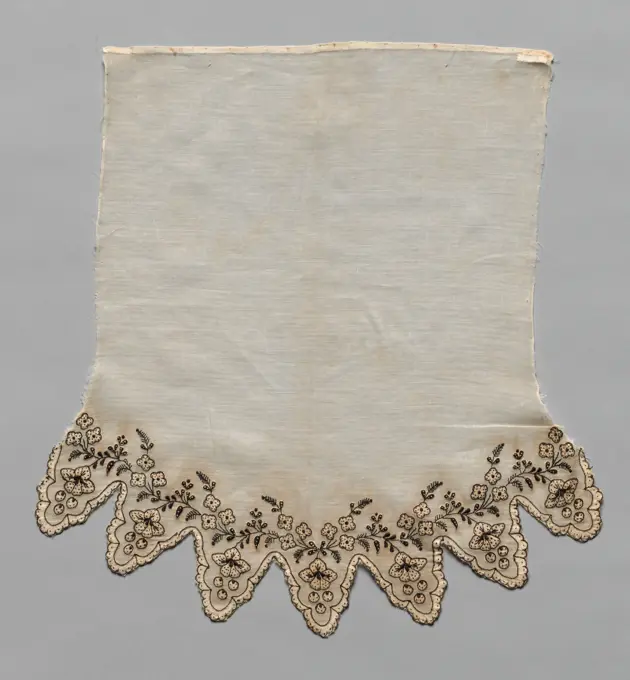
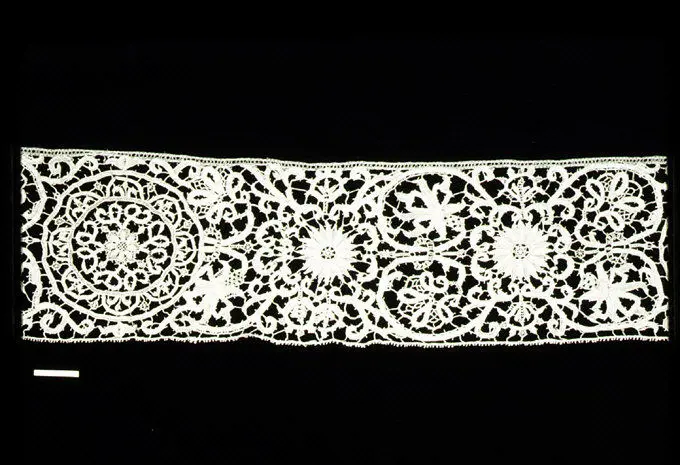
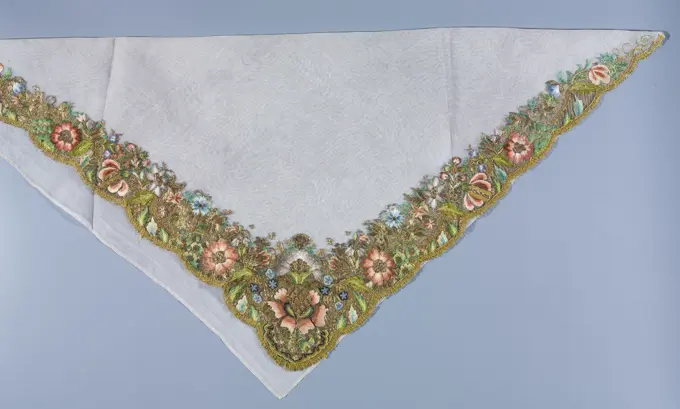
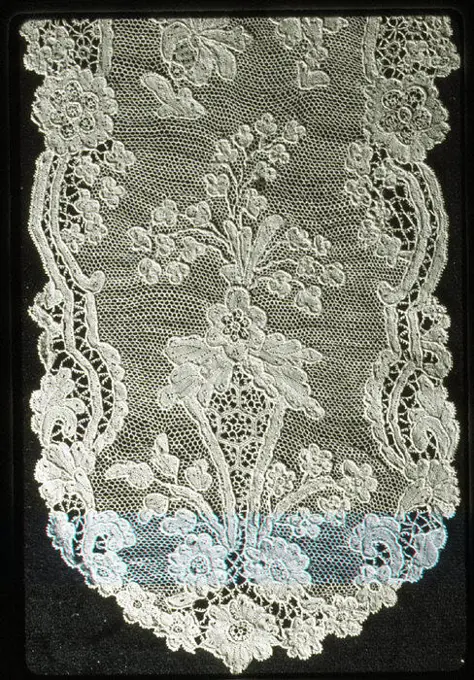
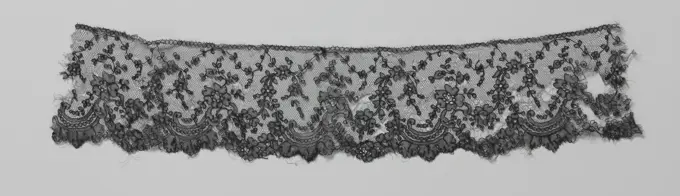
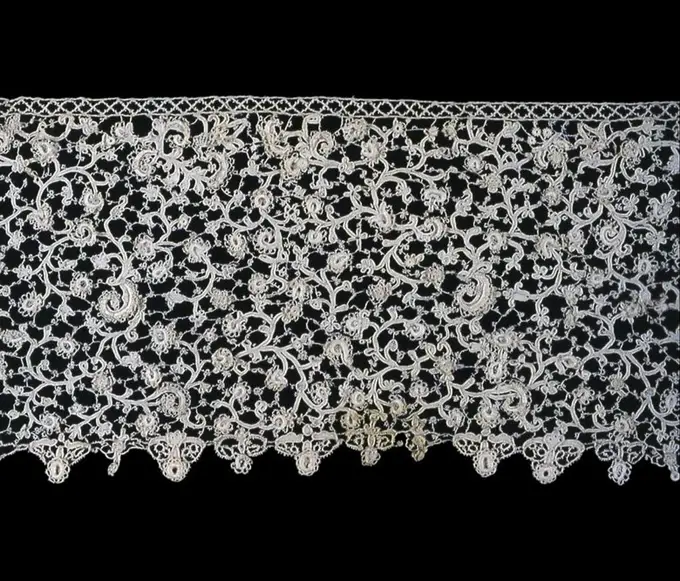
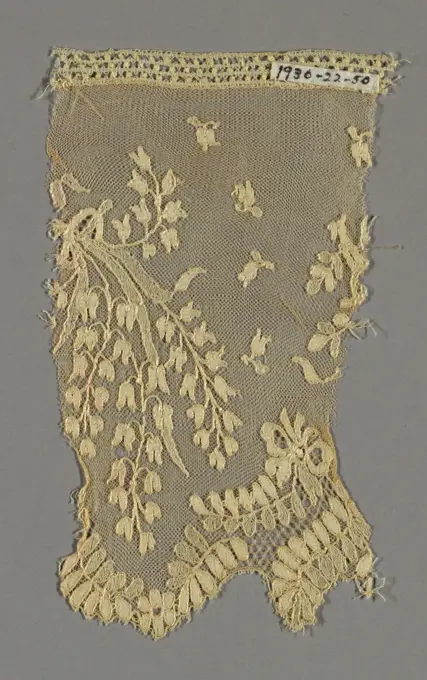
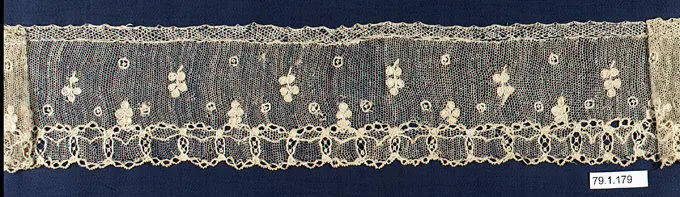
Fragment of the lace;  around 1700 (1690-00-00-1710-00-00);Border French 19th centuryGalloon 17th-18th century Italian or French. Galloon 214081Bobbin Lace Insertion, late 16th century. Italy, Venice, late 16th century. Lace, bobbin; average: 3.9 x 43.6 cm (1 9/16 x 17 3/16 in.).Japon strip of black climbing side with waves of c-volutes and flower tips. Japon strip from black climbing side: Chantilly side. Pattern with waves of c-voluten and flower tips. The motifs are connected by a grille, a toel. The motifs are made in cut-off with contour wires to the motifs. The slip edge along the underside is finished with picots. The top of the strip is finished with a separate splitting strap with a narrow edge tulle with a double row of cables above it. One short side is finished with a soil.Application with Machinal side, anonymous, c. 1850 - c. 1899  Application of natural -colored machine side. Heart -shaped model. The symmetrical pattern consists of a decorative edge along the underside of the heart of openwork squares with a cross in each square with a dot in the center. Halfovaal -shaped scumples hang down along this band with the same crosses. The squares and shells increase towards the tip at the bottom in size. At the top the heart is limited by a slender with small leaves. In the heart are three chalice flowers with two rosette flowers in between, both with small leaves. Europe cotton (textile)Fichu van Kloskant with lightning bolts, anonymous, c. 1875 - c. 1899 Fichu of natural -colored bobbin, Russian or Eastern European side. Triangular model with a narrow straight intermediate piece. The coarse pattern stands on a fine braid ground and shows long, curved edges and spirals, which, one or two-sided, accompanied by a lightning bolt edge. Eastern Europe linen (material) bobbin lace / Russian lace / East European lace Fichu of natural -colored bobbin, Russian or Eastern European side. Triangular model with a narrow straight intermediate piece. The coarse pattern stands on a fine braid ground and shows long, curved edges and spirals, which, one or two-sided, accompanied by a lightning bolt edge. Eastern Europe linen (material) bobbin lace / Russian lace / East European laceFragment 18th century German, Nuremberg. Fragment 214680Strip of bobbin with candle -wing motif, anonymous, anonymous, c. 1880 - c. 1899  Strip of natural -colored bobbin: Eastern European side. The pattern consists of a symmetrical composition in which the contours of the motifs are made with a continuous narrow ribbon that is strongly wriggling. The composition consists of a Kandelaber motif with a flower with nine narrow petals on either side in the middle. Leaves hanging under the flowers. The ribbons are made in linen battle with openwork edges and with seven pairs of bobbins. The motives are connected because the running pair of the ribbon is always hooked up after a bend. The side has been worked with all the bobbins at the same time. The top of the strip is straight finished. The winding ribbon provides a sculpy edge along the underside of the strip and is finished with picots. Eastern Europe (Possible) linen (material) bobbin lace / tape lace (bobbin lace) / East European laceFragment, Medium: linen Technique: Brussels-style bobbin lace, Edging with small piece of insertion attached. Pattern of conventionalized flowers and leaves., Belgium, late 19th century, lace, FragmentFragment 17th century Spanish. Fragment 215123Border 1850s French. Border. French. 1850s. Needle lace, point dAlençon. Textiles-LacesStrip 17th or early 19th century Irish, Youghal or Italian Punto in arialiterally, "stitches in the air"is one of the earliest styles of needle lace, which is itself developed from cutwork of primarily geometric design. When lacemakers transitioned to using a foundation of threads laid out according to a pattern drawn on parchment, they were able to incorporate more fluid lines and curves into their designs.. Strip 229603Lace, 1800s , Italy, maker unknown. Gift of Mrs G. Acland Allen, 1955.Fragment, Medium: silk Technique:, Open flowers form scalloped edge above which rise leaf sprays., England, mid-19th century, lace, FragmentStrip Valenciennes de Brabant. Strip of a climbing side with a bottom edge with large shelters. The edge of the schulls is also scalloped. The big slots show a large rose on the intersections. The rose is growing at the top of a wavy branched rank, to which roses, rose buds and tulips. This decor is repeated in every major scallop.Detail from a cap early 19th century Hungarian. Detail from a cap 213429Strip of a climbing side with rising sun. Strip natural colosside, cluny side. The repeating pattern consists of a circle containing an emerging or setting sun. The sun is made in linen stroke and the rays are made in shape stroke. The top of the circle is made with a band in linen stroke. The bottom of the circle, which also forms a semicircular scallop, is finished with a zigzag braid with a picot at any corner point. The successive circles are connected to each other at the top by a mesh soil, a nozzle ground. The top of the strip is straight finished.Fragment 18th century Flemish. Fragment 218912Needlepoint (Punto in aria) Lace Band, 16th-17th century. Italy, 16th-17th century. Lace, needlepoint; average: 8.3 x 24.8 cm (3 1/4 x 9 3/4 in.).Fragment Swedish, Dalarna 19th centuryLace, 1900s, maker unknown. Acquisition history unknown.Strip 16th-17th century Italian Punto in arialiterally, "stitches in the air"is one of the earliest styles of needle lace, which is itself developed from cutwork of primarily geometric design. When lacemakers transitioned to using a foundation of threads laid out according to a pattern drawn on parchment, they were able to incorporate more fluid lines and curves into their designs.. Strip 218821Edging 17th century Italian, Genoa. Edging 220986Bobbin Lace Fragment, 19th century. Spain, 19th century. Lace, bobbin; average: 16.2 x 11.2 cm (6 3/8 x 4 7/16 in.).DRUE VAN KLA CLAKT MET TUIINHECTHE, MEISON SACRIE, 1894 Fichu of natural-colored bobbin: Valenciennes side. Model: A triangular back piece is quite suddenly in narrow ends. On a fine grid, a square Valenciennes ground, there is a continuous and with the wavy contour-accommodating 'garden gate' with crossed bars and regularly interrupted by a leaf palm with. Outside of a row of large, single and contiguous roses. In the middle one -growing branch with a hanging rose. A winding branch with fine sprouts and a few roses and leaves runs from one end to the other. Brussels linen (material) Bobbi Lace / Valenciennes Lace Fichu of natural-colored bobbin: Valenciennes side. Model: A triangular back piece is quite suddenly in narrow ends. On a fine grid, a square Valenciennes ground, there is a continuous and with the wavy contour-accommodating 'garden gate' with crossed bars and regularly interrupted by a leaf palm with. Outside of a row of large, single and contiguous roses. In the middle one Flounce Belgian 19th centuryBand, Medium: linen Technique: bobbin lace with needle ground, Band in a design of floral scrolling branches alternating with blossoms., Belgium, 19th century, lace, BandJaponstrook van kloskant met varens.Japon strip from black climbing side: Chantilly side. On a blank mesh stock is a closed edge with slot, filled with a garland of flowers and leaves. On the intersections there is a small shell with a hanging rose, above which a striker bouquet rises from four large fern leaves and a flower branch, which reaches the top edge. Here a horizontal ivy drink with hanging twigs runs, while a large bouquet depends on the large scallop of this ivy drink, among other things with a tulip.Insertion 16th century Italian. Insertion 220881Collar, Medium: linen Technique: needle lace with ground of loop & twist with loop & twist return, Round collar with six circular medallions, each enclosing a flower. Border of highly conventionalized flower and leaf design., Belgium, late 19th century, lace, CollarStrip bobbin with ribbon that forms hearts and drop -shaped sculptes, anonymous, c. 1900 - c. 1909  Strip of natural -colored bobbin, Russian side. The repeating and continuous pattern is formed by a ribbon that alternately forms a heart and drop -shaped shell. Along the top the pattern is connected to a mesh ground. The ribbon is made in linen stroke and a diamond -shaped motif is made in netslag in the drop -shaped scoop. The top is straight. The scalloped underside is finished with picots. Russia cotton (textile) bobbin lace / Russian laceSewed hat -strip and hat slips from the needle side with oval fields, anonymous, c. 1755 Sewed hat strip and hat slips of natural-colored needle side: Alençon side. The pattern has formed oval fields by a pendulum of small leaves and an open strap with mulets and stylized leaves along the edges. In the ovals alternately a large flower branch and a small flower and leaf motif. Along the edges the pattern has flowers and leaves. West-Europa linen (material). Alençon Lace Sewed hat strip and hat slips of natural-colored needle side: Alençon side. The pattern has formed oval fields by a pendulum of small leaves and an open strap with mulets and stylized leaves along the edges. In the ovals alternately a large flower branch and a small flower and leaf motif. Along the edges the pattern has flowers and leaves. West-Europa linen (material). Alençon LaceFragment Swedish 19th centuryNeedlepoint (Punto in Aria) Lace Cuff, 16th-17th century. Italy, 16th-17th century. Lace, needlepoint: linen; average: 18.5 x 26.8 cm (7 5/16 x 10 9/16 in.).Crocheted side with tormented stems and rosettes, anonymous, c. 1890 - c. 1909 Curved semicircular support piece of natural -colored crocheted Irish side. Pattern with three rosette flowers with large compound leaves with torped stems. A circle on either side of the middle rosette flower. Crocheted soil with irregular diamond -shaped meshes and picots. Along the entire, faint wavy circumference of the support piece a border with three -part arches. Ierland (possibly) cotton (textile) Curved semicircular support piece of natural -colored crocheted Irish side. Pattern with three rosette flowers with large compound leaves with torped stems. A circle on either side of the middle rosette flower. Crocheted soil with irregular diamond -shaped meshes and picots. Along the entire, faint wavy circumference of the support piece a border with three -part arches. Ierland (possibly) cotton (textile)Border (From a Cover). Italy. Date: 1525-1600. Dimensions: 9.2 x 79.1 cm (3 5/8 x 31 1/8 in.)Weft repeat: 15.6 cm (6 1/8 in.). Linen, plain weave; cut and drawn work embroidered in double faggot, double hem, overcast and padded overcast stitches; needle lace inserts (of buttonhole, darned and overcast bars decorated with buttonhole collar and bullion picots); edged with needle lace points (of six-element plait, buttonhole, double buttonhole, and overcast bars). Origin: Italy. Museum: The Chicago Art Institute, Chicago, USA.Collar ca. 1835 French. Collar 102664Cover of a support cushion for a doll, of twill cotton with machine embroidery, anonymous, c. 1880 Cover of a support cushion for a doll, of twill cotton with machine embroidery. Netherlands cotton (textile) embroidering / twill Cover of a support cushion for a doll, of twill cotton with machine embroidery. Netherlands cotton (textile) embroidering / twillCooper Union Museum Lace Study Card, Medium: linen Technique: needle lace, Border fragment with an elaborate conventionalized serpentine floral design. Many minute rosettes in relief. Many openwork stitches in the design. Small scallops on the the border., France, ca. 1750, lace, Fragment, FragmentStrook kloskant met hangende drielobbige bloem tussen twee ovale bladeren.Strip blue with natural colosside, blonde of Caen. The repetitive and connected pattern exists along the underside of the strip from a hanging triple blue flower between two oval natural colored leaves. The successive flowers form the sloping edge. Along the top of the strip, the motifs are connected by a blue mesh soil, a closed game stroke ground. The flowers are made in a scroll and the leaves in linse stroke and around the fuller runs a silver thread as a contour wire. The top of the strip is straight finished. The slip edge along the underside is finished with picots.Fragment knotted side with two circles, anonymous, c. 1900 - in Or Before 1922 Fragment natural knotted side: Chebka side. Two circles connected to each other. Palestine linen (material) Fragment natural knotted side: Chebka side. Two circles connected to each other. Palestine linen (material)Zakdoek van batist met drie bloemtakken in elke hoek gemaakt in schaduwwerk en rondom een rand Vlaanderse kant.Natural-colored batist handkerchief with embroidery and around a border in the chart: Flanders side. The embroidery is located in the corners and along the edges. There are three flower branches in every corner, flanked by two smaller ones. In two corners a large chalis flour between branches with forget-me-staples. In the other corners a large rosette flower between finer branches with carnations. The sloping opposite angles are the same. Along the entire side, a regular wavy garland of openwork forget-me-staples and wingerd leaves. The edge clamping side is smooth along the sides and wrinkled into the handkerchief in the corners. It has a repeating pattern with two broad symmetrical compositions. One composition exists along the underside from a rosette flower under an arc. The other composition exists along the underside from a cloud from which a heart-shaped flower rises bBed curtain border 1800-1850 Russian. Bed curtain border 175595Strip of mechanical side with sluinga -plateed and deeply incised seven -lobe flowers, anonymous, c. 1800 - c. 1949 Strip of natural -colored machine side. The repeating pattern consists, slightly below the center line, from the contours of a sluing -plateed flower with seven deep -cut lobes like petals. The flour is on a crooked stalk with two small leaves, and originates from the straight decorative edge along the underside of the strip. This edge consists of six narrow lines with a different pattern. The contours of the flowers and the flowers are interconnected by a machine "braid ground". Above the center line, the machine tuler is decorated with four rows of groups of four oval recesses placed in diamond shape. Above these four rows are two rows with single oval recesses. The top of the strip has the pattern of a decorative edge with a row of snowflakes. The short sides of the strip are finished with a zoompje. West-Europa linen (material) Strip of natural -colored machine side. Strip Machine side with fuchsia flower in C-shaped branch, anonymous, c. 1875 - c. 1899 Strip of natural-colored machine side: machine valenciennes side. The repeating pattern consists of a C-shaped branch, in which a fuchsia-like flower hangs. A smaller, mirrored C-Volute directly against the branch from the underside. The scallops along the bottom always consist of three small shells, which are created by C-Voluutjes hanging on the bottom of the pattern. The motifs are connected by a diamond -shaped grid. In the motives, recesses were made and ROM the motifs openwork edges. A fine mechanical snowflake soil has been used between the C voluits at the bottom of the pattern. West-Europa (possibly) Strip of natural-colored machine side: machine valenciennes side. The repeating pattern consists of a C-shaped branch, in which a fuchsia-like flower hangs. A smaller, mirrored C-Volute directly against the branch from the underside. The scallops along the bottom always consist of three small sStrip knotted side with triangular shells around which arcs sit around, anonymous, c. 1900 - c. 1909  Strip of natural knotted side: chebka. Triangles hang on a decorated thread like a scrap edge. A semi -circular bow made with a wire with connected loops around each triangle. Palestine linen (material)Borders Made 1760-1769 Burano. Linen, needle lace .Fragment early 18th century Italian, Venice. Fragment 212951Cooper Union Museum Lace Study Card, Medium: linen Technique: bobbin lace, Lace fragment in a scrolling tape pattern with details in Genoese seed stitch. Fragment is mounted on a fabric-covered board and framed behind glass. Frame is natural wood., Italy, 17th-18th century, lace, Fragment, FragmentNeedlepoint (Drawnwork) Lace Insertion, 16th century. Italy, 16th century. Lace, needlepoint: linen; average: 3.9 x 20.4 cm (1 9/16 x 8 1/16 in.).Cuff from crocheted side with fan -shaped flowers, anonymous, c. 1890 - c. 1909 Cuff made of natural Irish crocheted side, imitation coarse Venetian side. Pattern with fan -shaped flowers with stems and a crocheted irregular mesh soil with picots. The top is finished with a straight edge. The semi -circular sculpts on the lower edge are trimmed with picoted arches. Ireland cotton (textile) Cuff made of natural Irish crocheted side, imitation coarse Venetian side. Pattern with fan -shaped flowers with stems and a crocheted irregular mesh soil with picots. The top is finished with a straight edge. The semi -circular sculpts on the lower edge are trimmed with picoted arches. Ireland cotton (textile)Lace motif, 1900s, England, maker unknown. Acquisition details unknown.Cap Streamer Fragment; linen; 1938-23-44Woman's Collar. United States, circa 1837. Costumes; Accessories. Cotton machine net, applied cotton embroidery motifsBorder (From a Flounce) Made 1725-1775 Flanders. Linen, bobbin straight lace of a type known as Mechlin with a Mechlin mesh ground .Barbe early 19th century French. Barbe. French. early 19th century. Bobbin lace. Textiles-LacesBorder; linenSampler (Austria); Embroidered by Karoline Berger (Austrian); Student at Kunstgewerbeschule; cotton embroidery on cotton foundationBatist pago rope with a peripheral lace plunge and a border bobbin, anonymous, c. 1860 Pago rope of natural batist finished with a strip of lace bobbin work - English embroidery - and a strip of bobbin: Lillese side. The strip of English embroidery falls partly over the bobbin edge. West-Europa Batist and English Embroidery: Cotton (Textile). Sleeve: Batiste. bobbin: Linen (Material) bobbin lace / Lille lace Pago rope of natural batist finished with a strip of lace bobbin work - English embroidery - and a strip of bobbin: Lillese side. The strip of English embroidery falls partly over the bobbin edge. West-Europa Batist and English Embroidery: Cotton (Textile). Sleeve: Batiste. bobbin: Linen (Material) bobbin lace / Lille laceLamp Shade (USA); Made by Sybil Carter Indian Mission and Lace Industry Association (United States); linenStrip mixed side with whimsical flowers, anonymous, c. 1650 - c. 1699 Strip of natural mixed side: Venetian ribbon side. Pattern of volute vines, with whimsically shaped flowers and acanthus leaves on an irregular, open bar of land (needle side) with picots. The contours of the pattern are formed by a messing ribbon with holes. Different decorative lands within the contours. The top is trimmed with a border bobbin. The underside is finished with a straight picot edge with arcs. Italy linen (material) mixed lace / tape lace (mixed lace) Strip of natural mixed side: Venetian ribbon side. Pattern of volute vines, with whimsically shaped flowers and acanthus leaves on an irregular, open bar of land (needle side) with picots. The contours of the pattern are formed by a messing ribbon with holes. Different decorative lands within the contours. The top is trimmed with a border bobbin. The underside is finished with a straight picot edge with arcs. Italy linen (material) mixed lace / tape laceBobbin Lace (Needlepoint Design) Insertion, second half of 16th century. Italy, Genoa, second half of 16th century. Lace, bobbin; average: 7.3 x 19.1 cm (2 7/8 x 7 1/2 in.).Fragment (Italy); linenBand, Medium: linen Technique: bobbin made continuous tape with bars added, Open ribbon like design of tulips, facing alternately up and down. Background of narrower ribbons forming loops and twists., 17th-18th century, lace, BandEnvironmental leaf of black bobbin with the horn of abundance, anonymous, c. 1850 - c. 1860 Black bobbin fan: Chantilly side. There is an asymmetrical design on an empty grid. The outer edge shows C-Voluten and Rocailles, filled with palisades and gridwork. On the right -hand side at the decorated right outspide and starting with a volute, lies a horn of abundance with a large coming bouquet with anemoon (), Tulips, daffodil, lily and so on. France (possibly) whole: Silk bobbin lace Black bobbin fan: Chantilly side. There is an asymmetrical design on an empty grid. The outer edge shows C-Voluten and Rocailles, filled with palisades and gridwork. On the right -hand side at the decorated right outspide and starting with a volute, lies a horn of abundance with a large coming bouquet with anemoon (), Tulips, daffodil, lily and so on. France (possibly) whole: Silk bobbin laceVierkante zakdoek van batist met plumetis en een rand kantborduurwerk.Batist handkerchief with embroidery - Plugers and open embroidery - and an edge edge embroidery: work with pulled out wires. Square model with a sloping edge of fine scallops by a wavy edge.Lace, 19th century. Italy, Abruzzi, Pescocostanzo, l'Aquila, 19th century. Bobbin lace with embroidery; overall: 33.3 x 33.3 cm (13 1/8 x 13 1/8 in.).Cuff of linen batist and trimmed all around with scraps from bobbin, anonymous, c. 1635 - c. 1640 Cuff of natural -colored linen batist, finished all around with natural -colored bobbin: Old Flemish side. Model: rectangular linen, with fine pleats laid in a curved shape. One long side is finished with a wide strip of lace, with a deep scrap edge. The other three sides are finished with narrower strips, with finer sculptures. Along the long side with the narrower strip side is also a mirrored narrow strip of lace, which falls over the linen. The wide strip has a pattern with ten symmetrical scales in which a flowerpot inside volute bands, with heart motifs in between. The flower pot motif was common in the Flemish bobbins around 1630 and originally came from the pattern books of Bartolomeo Danieli. The side is 'compiled': the small motifs were made piece by piece and then sewn together. This technique emerged at the end of the 16th century and is associated exclusively with Brussels sidCollar ca. 1890 possibly Italian. Collar 170434Volant Van Kloskant with diamond -shaped medallions, anonymous, c. 1870 - c. 1920 Volant of natural -colored bobbin: Parisian side. The soil is divided in two in a Paris soil with clovers at the top and a tuler ground underneath. In the latter is a symmetrical pattern of diamond -shaped openwork medallions with side vines crowned by a flower between two leaves. The leaves, the side ranks and a series of flowers and sling in the scallops are loose on the other in three closed garlands. The motifs are made in linen stroke and provided with contour threads. A rose soil has been applied as a decorative land. The top of the strip is finished with a separate strap. Belgium linen (material) bobbin lace / Paris lace Volant of natural -colored bobbin: Parisian side. The soil is divided in two in a Paris soil with clovers at the top and a tuler ground underneath. In the latter is a symmetrical pattern of diamond -shaped openwork medallions with side vines crowned by a flower between two leaves. Glass curtain with decoration of handle basket with flowers and medallions., Anonymous, c. 1905 White cotton glass curtain with machine tulle with an application and chain stitch embroidery in white and yellow. Decoration of handle basket with flowers in a medallion caught in reed stems.  cotton (textile). White cotton glass curtain with machine tulle with an application and chain stitch embroidery in white and yellow. Decoration of handle basket with flowers in a medallion caught in reed stems.  cotton (textile).Edging Italian, Genoa 16th centuryPiece 18th century Italian. Piece 214956Collar of Batist trimmed with a sculpin that is decorated with English embroidery, c. 1875 - c. 1925 Cotton batist's collar with upright collar and stitched strips. The collar is trimmed with a wrinkled strip, which is decorated with English embroidery in the form of flowers, and is trimmed with a founded scalley. The collar closes with three knots in a row. West-Europa whole: Cotton (textile). Knoop: Mother of Pearl Cotton batist's collar with upright collar and stitched strips. The collar is trimmed with a wrinkled strip, which is decorated with English embroidery in the form of flowers, and is trimmed with a founded scalley. The collar closes with three knots in a row. West-Europa whole: Cotton (textile). Knoop: Mother of PearlBand (Italy); linen; Bequest of Marian Hague; 1971-50-484Lace, 1800s , Lille, maker unknown. Gift of Mrs G. Acland Allen, 1955.Length of Lace. Belgium, 1825-1850. Textiles; textile lengths. Silk Chantilly bobbin laceScarf collar of cream -colored silk needle, tenerife, anonymous, c. 1912 Scarf collar made of cream -colored side in so -called Tenerife needle side. Pattern of large and small circles between which tires with alternating butterflies or circles. Nine sculptures along the edge. Paraguay whole: Silk. Tenerife lace  Paraguay Scarf collar made of cream -colored side in so -called Tenerife needle side. Pattern of large and small circles between which tires with alternating butterflies or circles. Nine sculptures along the edge. Paraguay whole: Silk. Tenerife lace  ParaguayInsertion 16th century Italian, Venice. Insertion 221024Band 16th century Italian. Band 212294Strook kloskant met kromme takjes.On a coarse and meadows meshing (square mesh), above a semi-circular shell, is an open pattern of an overhanging twig with a flower. Valenciennes side. Originally this strip was one of the parts of a strip that consisted of four separate parts. Of these, three are sewn together: BK-BR-J-259-A, -B, -C. In 1966 on this top of the long strip that has arisen, then a slightly narrower strip, BK-BR-J-321-A, with a somewhat similar pattern.Embroidered Sleeve, 19th century. America, 19th century. overall: 41.6 x 39.6 cm (16 3/8 x 15 9/16 in.).Border early 17th century Italian Punto in arialiterally, "stitches in the air"is one of the earliest styles of needle lace, which is itself developed from cutwork of primarily geometric design. When lacemakers transitioned to using a foundation of threads laid out according to a pattern drawn on parchment, they were able to incorporate more fluid lines and curves into their designs.. Border 222720Shawl;  1. PO. 18th century (1700-00-00-1750-00-00);Fashion accessories, scarves, embroideryJoined lappets third quarter 18th century French or Italian, Venice (Burano) The Metropolitan Museum's great lace collection was started when the Museum became the first among American museums to organize a permanent collection of lace with the acceptance of the McCallum Collection in 1879 and the bequests of Mrs. John Jacob Astor, Mrs. Robert L. Stuart, Mrs. Augustus Cleveland, and Mrs. A. W. Winters shortly thereafter. In 1893 a loan collection of antique laces shown at the World's Columbian Exposition in Chicago was assembled by a committee of New York women headed by Catharine Augusta Newbold. About 1900 Miss Newbold arranged and labeled an exhibition of laces and linenworks lent to the Metropolitan Museum by Mrs. James Boorman Johnstone and the Misses Johnstone. "Her scholarly knowledge of lace technique enabled the Museum for the first time to offer a comprehensive display of lace illustrating its historical development," wrote Miss Frances Morris, then curator of the textile depZakdoek van batist met een drievoudige rand van kloskant en borduurwerk.Handkerchief from Batist with a triple edge of dick edge and embroidery. The inner edge is a climbing side intermediate site, followed by an embroidery intermediate site - white work - and then finished around with a wide edge of clamping: Malinois. The embroidery has rosettes and stripes. The climbing side has flowers and tendrils.Headdress. Culture: Russian. Date: 1830-70.This object is from the collection of Natalia de Shabelsky (1841-1905), a Russian noblewoman compelled to preserve what she perceived as the vanishing folk art traditions of her native country. Traveling extensively throughout Great Russia, she collected many fine examples of textile art of the wealthy peasant class. From the 1870s until moving to France in 1902, Shabelsky amassed a large collection of intricately embroidered hand-woven household textiles and opulent festival garments with rich decoration and elaborate motifs. The Brooklyn Museum holdings include many fine examples including the majority of the garments. Portions of Shabelsky's collection are also housed at the Museum of Fine Arts, Boston, the Cleveland Art Museum, and the Russian Museum of Ethnography in St. Petersburg.Married women in Russia were required to cover their hair entirely lest they be considered immodest; they wore a fata, usually a white muslin veil woven withCover of a tag in front of a doll, made of cherine cotton with machined embroidery. Cover of a tag in front of a doll, made of cherine cotton with machined embroidery.Shawl collar of needle side with switch chain. A pointed barred backpiece connects two long, narrow slips with widened ends. A pendulum tape from jerked wheels has been placed five times in a loop, in which there is always a rose branch. The roses show imposed relief from crescent-shaped petals. The bouquet in the back consists of three hanging rosary branches. The three or fifty leaves are all divided into a closed half and an open half with speckles. Point the Gaze de Bruxelles.Sleeve of applicationant with the pear-shaped medallions. Wood of natural colored application edge, dick edge and needle side applied to machine tulle. Against a background, which is widowed with mates, closed worked slopes are filled with a pear-shaped medallion with violets and a circle arc with a flower branch. The pear shape is surrounded by a flower wreath with a flower branch in the top. The branch above the circle arc is c-shaped and has two large dependent sodes, a dune rose and an anemone (both of needle lace) and hanging bells.Collar of needle side and an outer edge of bastard with very deep sculptures, anonymous, c. 1650 - c. 1699 Collar of natural -colored needle side: Venetian needle side "Gros Point" with an outer edge of Kloskant. On the collar is a cord with decorative brushes, Akers. The pattern of the needle side consists of wide curly leaves and palm flowers. The pattern of the bobbin side consists of geometric motifs and very deep sculptures and is inspired by Punto in Aria (needle side). Italy linen (material) Venetian gros point (heavy raised Venetian lace) / bobbin lace Collar of natural -colored needle side: Venetian needle side "Gros Point" with an outer edge of Kloskant. On the collar is a cord with decorative brushes, Akers. The pattern of the needle side consists of wide curly leaves and palm flowers. The pattern of the bobbin side consists of geometric motifs and very deep sculptures and is inspired by Punto in Aria (needle side). Italy linen (material) Venetian gros point (heavy raised VeStrip of black bobbin with broken C-voluten, anonymous, c. 1850 Strip of black bobbin: chantilly side. A running pattern shows alternately broken C-volutes with a leaf sculpt and a hanging flower branch, of which a side branch with four roses forms the other shell. Belgium silk bobbin lace Strip of black bobbin: chantilly side. A running pattern shows alternately broken C-volutes with a leaf sculpt and a hanging flower branch, of which a side branch with four roses forms the other shell. Belgium silk bobbin laceExcerpt with bobbin loss applied on tulle, c. 1850 - c. 1920 Fragment (lap) With bobbin lacquered on tulle, irregularly sculpted and provided with picots. The pattern consists of flower branches and C-shaped volutes. West-Europa . bobbin lace Fragment (lap) With bobbin lacquered on tulle, irregularly sculpted and provided with picots. The pattern consists of flower branches and C-shaped volutes. West-Europa . bobbin laceEdging 16th century Italian, Venice. Edging 221079Batist handkerchief with bouquet in scalloped corners in embroidery and an edge of machine side, anonymous, c. 1850 Natural linen handkerchief with embroidery - Whitework with plumetis - and finished all with a border machine side: machine Valenciennes side. Square model with rounded corners where the strip of side is wrinkled. The embroidery is located in the corners and is the same in every corner. It consists of five lying C-Voluten along the edge, connected by palms. In the C-Volut in the corner there is a small rosette flower with a large bouquet above it. The bouquet is symmetrical and has wingerd leaves, forget-me-not, shiver grass and in the top three cone-shaped flowers with high-radiating stamens. The lace pattern consists of a continuous bow edge along the underside that forms a scrap edge. An oval flower hangs in each shell between two oval leaves. The scrap edge is finished with picots. Netherlands (possibly) whole: Linen (Material). Embroidery: Cotton (textile) embroideriFlounce. Italy, Venice. Date: 1675-1700. Dimensions: 16.6 × 196 cm (6 1/2 × 77 1/8 in.)Width repeat: 24.3 cm (9 1/2 in.)Heading: .8 cm (1/4 in.). Linen, needle lace with raised details; added cotton edging. Origin: Italy. Museum: The Chicago Art Institute, Chicago, USA.Fragment (USA); Manufactured by A .G. Jennings & Sons; silkStrip late 18th century Italian, Burano. Strip 212386Needlepoint (Punto Avorio or Ivory Stitch) Lace Insertion, 17th century. Italy, 17th century. Lace, needlepoint; average: 3.5 x 15.3 cm (1 3/8 x 6 in.).