Lace Fragments and Samples

Historical lace fragments showcasing intricate patterns, created with techniques like bobbin lace, reflecting 18th to 19th century craftsmanship.

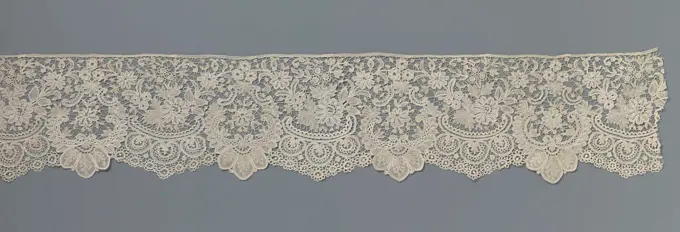
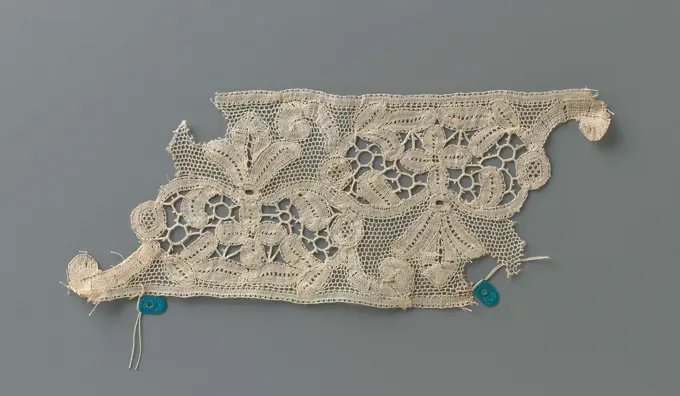
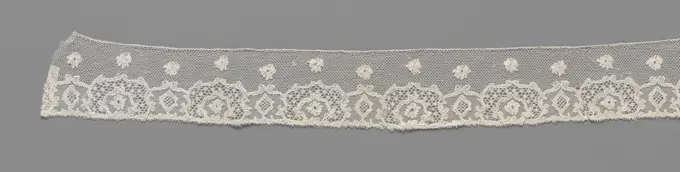
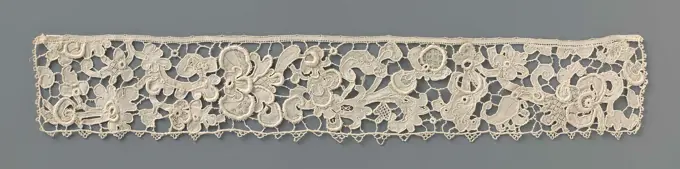
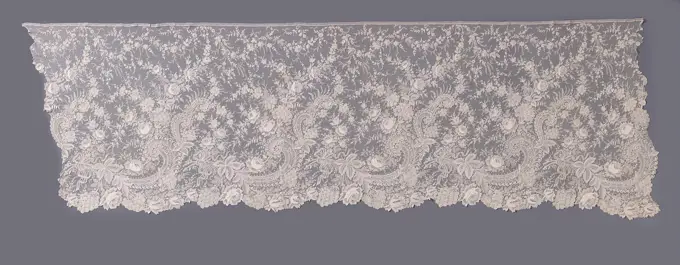
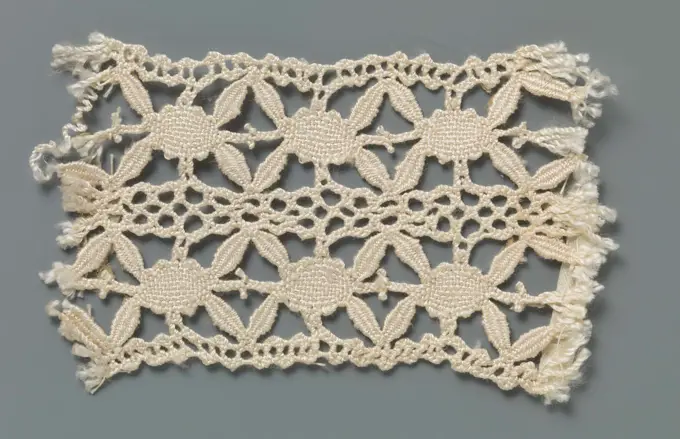
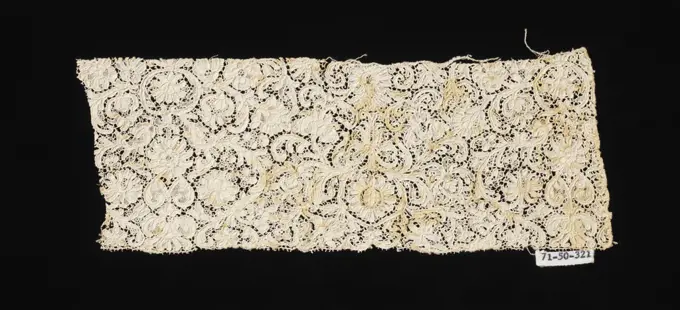
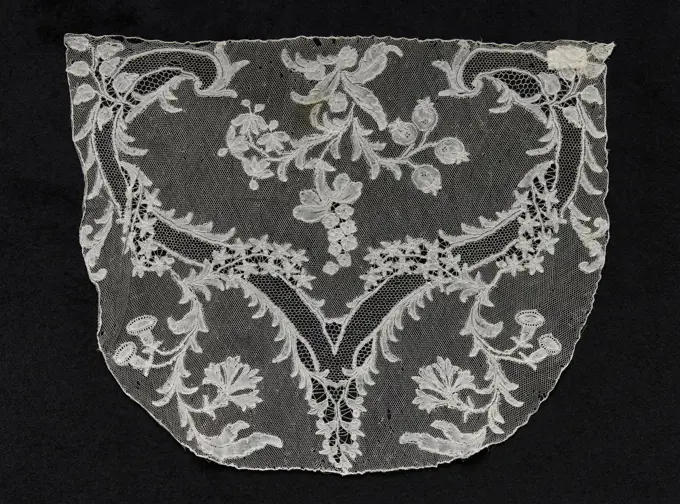
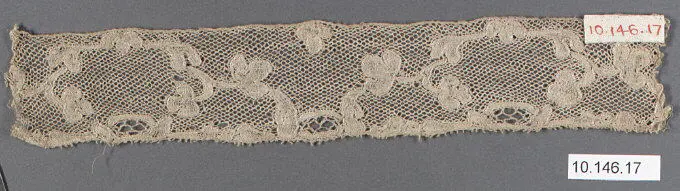
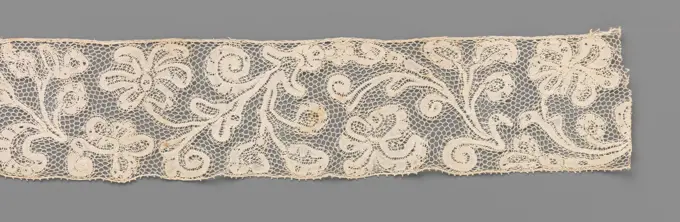
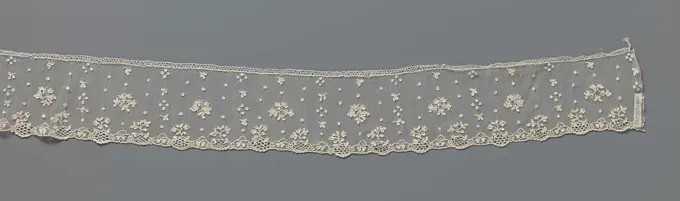
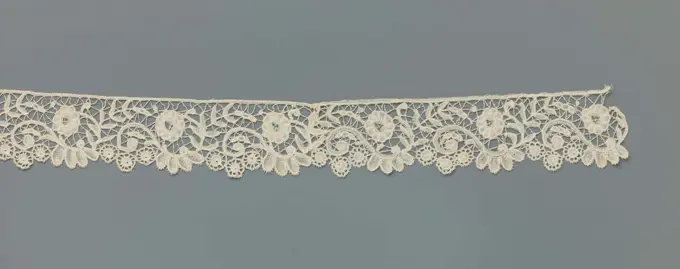
Strip bobbin with two halved cartouches with wide serrated decorative edge, anonymous, c. 1735 Strip of natural -colored Brussels bobbin. The symmetrical pattern consists of two halved cartouches placed next to each other, the half -shaped center of which is on the top of the strip. The wide serrated decorative edge reaches around it up to the underside of the strip and is richly decorated with sloping stripes and a straight down -hanging iris or French lily. The pattern between the cartouches is not symmetrical, but beyond on both sides. This pattern consists of rosette flowers and volute leaves in which elements return from the cartouches in different ways. The motifs are connected by picoted braids. The motifs are made in linen battle with recesses and openwork edges and with mains fillings. Most motives are provided with burst relief contours. Different decorative lands have been applied, including fine snowflake grounds and fine mesh plots with square motifs in shape. The top is f
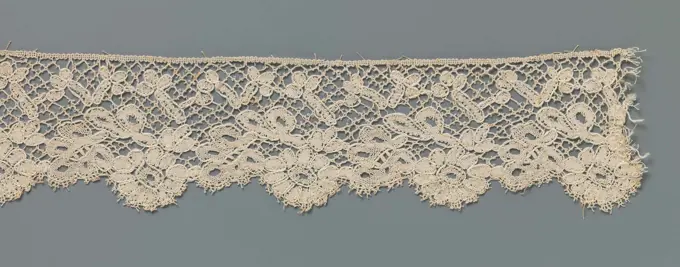
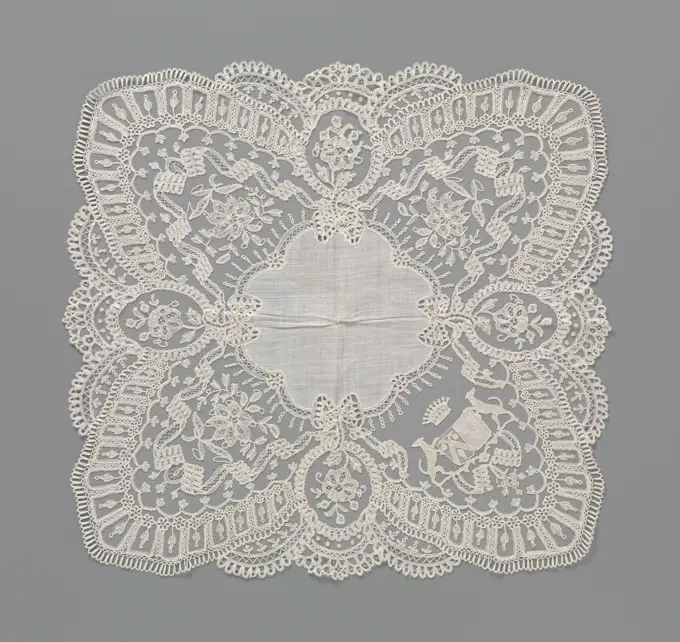
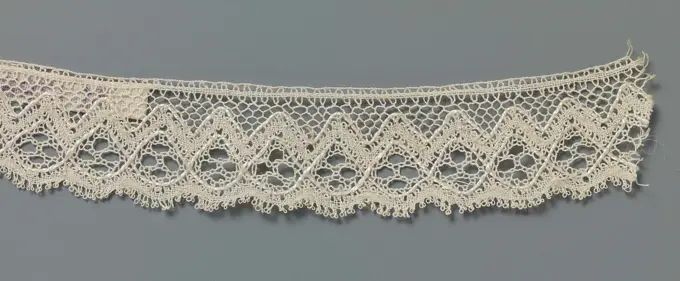
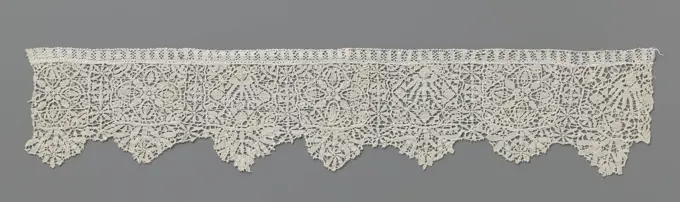
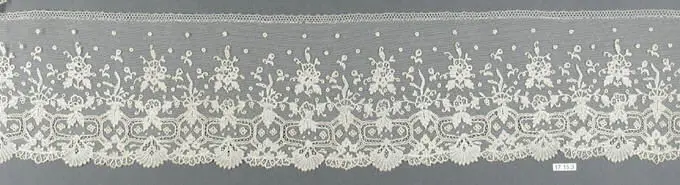
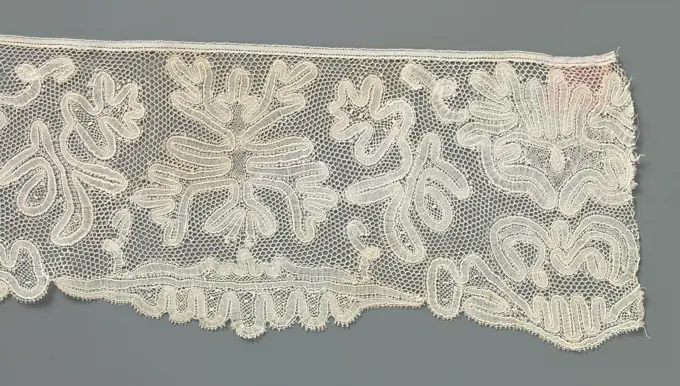
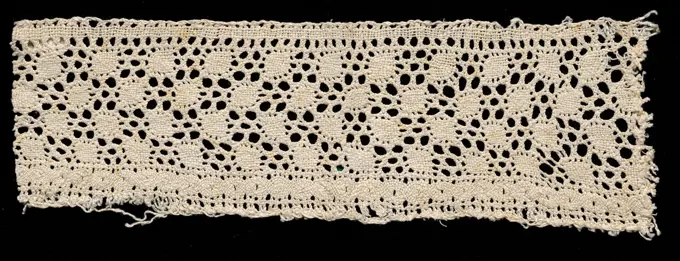
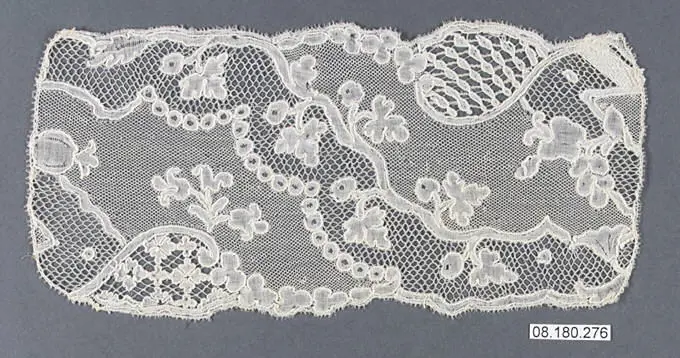
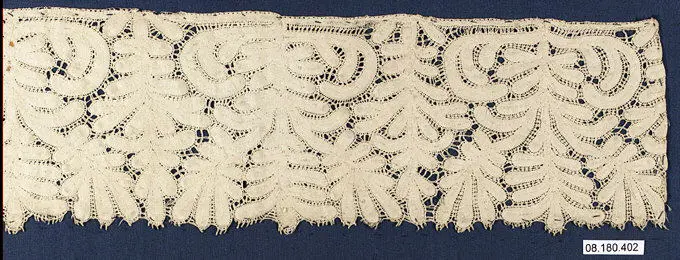
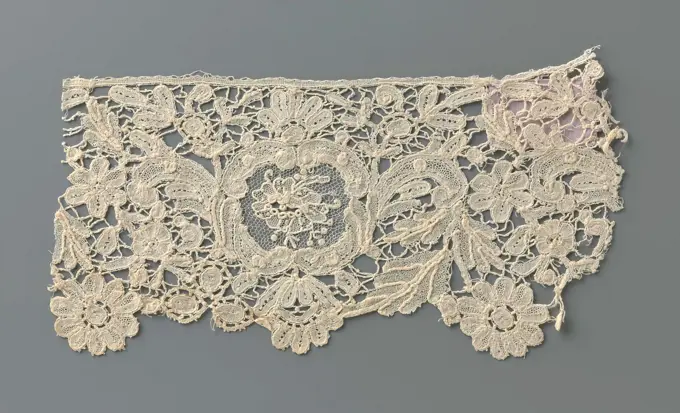
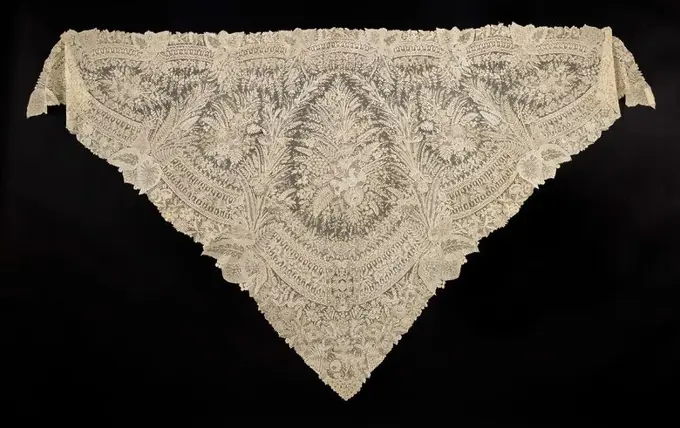
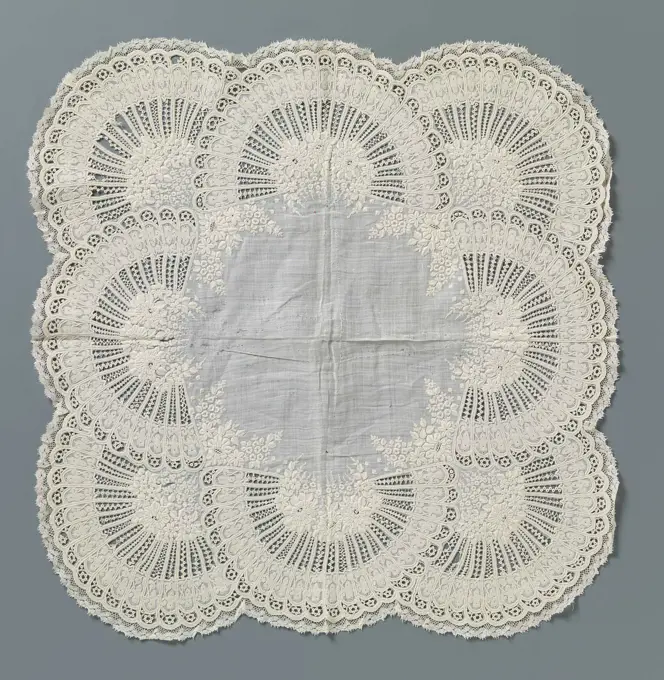
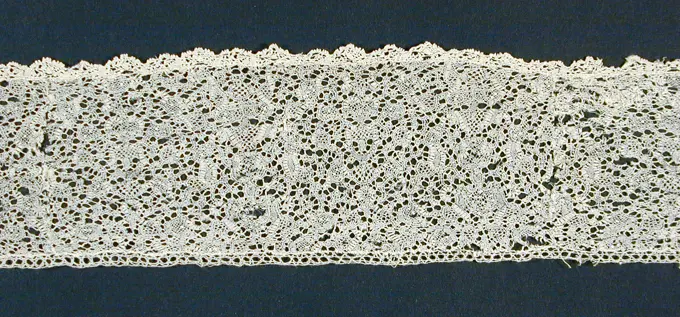
Fragments (England); linenSample end of lappet, Medium: linen Technique: bobbin lace, Mechlin style, N. Europe, 19th century copy of 18th century, lace, Sample end of lappetStrook kloskant met twee composities van c-voluten en madeliefjes.Strip natural colosside: fine bridges flower work. The repeating pattern consists of two, largely symmetrical compositions of C-Volutes and daisies. One composition consists along the underside of the strip of two c-volutes giving each other, placed at the bottom. Along the exterior of the volutes have been made in large increasing lovers, where the three largest forms a lobed shell. Between the C-Volutes are two chali flowers and a daisy, with a hanging palm paper leaf above, awarded three rosette flowers. The other composition consists of three highly bent C-volutes under an elongated lying C-voltage. A row of seven consecutive rosette flowers below forms the other lied glule. Above the lying C-voltage is an A-symmetrical settlement of larger and smaller rosette flowers and madelieves. The motifs are connected by a picoted braid soil. They are largely made in detached linen battle with openwork edges and recesses. The Insertion 18th century Italian, Abruzzi (Gessopalena). Insertion 221130Bobbin Lace (Needlepoint Design) Insertion, second half of 16th century. Italy, Genoa, second half of 16th century. Lace, bobbin; average: 4.5 x 19.7 cm (1 3/4 x 7 3/4 in.).Strook gehaakte kant met waaiervormige bloemen.Strip natural-colored Irish crochet side. Pattern with impeller-shaped flowers with stems and a crocheted irregular maase ground with picots. The top is finished with a straight edge. The semi-circular shelter on the lower edge are deposited with picoted arcs.Lace Border. Belgium, Mechlin, 19th century. Textiles; borders. Cotton and linen bobbin laceFlounce (Belgium); linenStrip bobbin with two halved cartouches with wide serrated decorative edge, anonymous, c. 1735 Strip of natural -colored Brussels bobbin. The symmetrical pattern consists of two halved cartouches placed next to each other, the half -shaped center of which is on the top of the strip. The wide serrated decorative edge reaches around it up to the underside of the strip and is richly decorated with sloping stripes and a straight down -hanging iris or French lily. The pattern between the cartouches is not symmetrical, but beyond on both sides. This pattern consists of rosette flowers and volute leaves in which elements return from the cartouches in different ways. The motifs are connected by picoted braids. The motifs are made in linen battle with recesses and openwork edges and with mains fillings. Most motives are provided with burst relief contours. Different decorative lands have been applied, including fine snowflake grounds and fine mesh plots with square motifs in shape. The top is fBand with Diverse Roses. Lace with small and refined, as well as large and imposing, motifs was made in Venice at the end of the 17th century. These are two variations of the first kind, the so-called Venetian raised and small scale lace. The French call it point de neige, literally snowflake stitch.Strook naaldkant met granaatappel en stralenkrans in eikenblad.Strip natural needle side: Punto in Aria. The repeating pattern consists of the oak leaf contour in which a pomegranate or beam wreath is alternately. There is a French lily between the oak leaves. The motifs are made up of feston stitches, partly equipped with recesses. The motifs are connected by an irregular, open bars soil with picots. The sloping edge forms from the oak leaf motif and is finished with picots. The top of the strip is straight finished with a splitting strap.Fragment of Lace. Belgium, Brussels, 1875-1900. Textiles; fragments. Cotton point de gaze needle laceStrip mixed side with a wreath of rosette flowers, anonymous, c. 1900 - c. 1924  Strip of natural -colored mixed side: Milanese ribbon side. Pattern with a wreath of six rosette flowers from which a slender of C-Voluten originates. The top of the short strip is finished straight. The silly outskirts of scales stems from the pattern and is finished with picots. The VoluTrank forms the finish of one short side. The other short side is frayed. Belgium cotton (textile) mixed lace / tape lace (mixed lace) / Milanese tape lace (mixed lace)Strook kloskant met schulpenrand van afwisselend een rozetbloem en een vijflobbig blad.Strip natural colosside, cluny side. The repeating pattern exists along the underside of strip from a rosette flower and a sloping fibergly leaf. The successive flowers and leaves are placed against each other and together form a slip edge. Above the center line, a kind of zigzag line has been created with an oblonged elongated motifs diagnown to each other, each crowned by three oval motifs. The motifs are made in detached linen stroke with double contour wires. They are interconnected by a diamond-shaped maas of mesh, formed by picoted braids. In the center of the five-spinning leaves are cubes made in shape stroke. The top of the strip is straight finished. The sloping edge along the underside comes from the pattern and is finished with small arcs made with braids, equipped with picots.Strip crocheted side with fan -shaped flowers, anonymous, c. 1890 - c. 1909 Strip of natural -colored Irish crocheted side. Pattern with fan -shaped flowers with stems and a crocheted irregular mesh soil with picots. The top is finished with a straight edge. The semi -circular sculpts on the lower edge are trimmed with picoted arches. Ireland cotton (textile) Strip of natural -colored Irish crocheted side. Pattern with fan -shaped flowers with stems and a crocheted irregular mesh soil with picots. The top is finished with a straight edge. The semi -circular sculpts on the lower edge are trimmed with picoted arches. Ireland cotton (textile)Kloskant cuff with Margrietjes, Anonymous, c. 1900 - c. 1924 A coarse mesh stock (square Maas) with daisies above scoops of pearls. Valenciennes side. Sluis (Possible) linen (material) Bobbi Lace / Valenciennes Lace A coarse mesh stock (square Maas) with daisies above scoops of pearls. Valenciennes side. Sluis (Possible) linen (material) Bobbi Lace / Valenciennes LaceZakdoek van batist met een brede rand applicatiekant met het wapen van de familie Pommeret.Natural batist handkerchief around finished with a wide edge of natural applicationant: dick side applicated on machine tulle. Square model with rounded corners and eighty batist midfield. In one corner there is an application of needle side with a double weapon, between two climbing dogs with thrown heads as shield holders. One of the weapons concerns the coat of arms of the Pommeret family (France). The other weapon has not yet been identified, there are three bovine heads. They stand against each other, with a loose crown above it.Strip bobbin with two loose flower branches between a spray pattern, anonymous, c. 1840 - c. 1860 Strip of natural-colored bobbin, Valenciennes side. The pattern consists halfway through the strip of a row of loose flowers on a handle with two leaves. Below that a row of flower branches is placed, always at the bottom of the flowers in the row above it. Between the flowers and flower branches there is a spray pattern of kidney -shaped moths and between the flower branches in a circular motif. Along the lower edge, a pattern runs from a succession of three rosette flowers and an elongated C-shaped leaf. The motifs are connected by a hexagonal Maas soil. The motifs are made in linen battle with openwork edges. A decorative soil is used sparingly in the flower hearts and the circular spreading motif. The scalloped underside is finished with picots. The top is straight. Valenciennes (Possible) linen (material) Bobbi Lace / Valenciennes Lace Strip of natural-colored bobbin, Valenciennes sidStrip 19th century French. Strip 212394Strook kloskant met druppels tussen een zigzag-lijn en een golvende lijn.Strip natural colosside, Buckingham side. The repetitive and continuous pattern consists of a zigzag line that runs almost at the top of the strip and a wavy line on the bottom of the strip. Between these lines a concatenation of drip-shaped motifs arises. Above the zigzag line, the strip consists of a maas soil, a tulet. Under the zigzag line, in the drops, an ornamental soil has been applied, a rose ground. The motifs are made in linen stroke with thick and shiny contour wires. The top of the strip is straight finished. The slip edge along the underside is finished with picots.Strip of needle side with alternating a rosette and a window in geometrically divided surfaces, anonymous, c. 1630 - c. 1640 Strip of natural -colored needle side: Punto in Aria. The pattern consists alternately of a rosette and a window in a square that is made up of sixteen small squares. Between the large squares there is always a column of three squares with a rosette in each. There is a three -lobe shell under each large square, which is connected to each other at the height of the column by a fourth rosette. The top is finished with a messing strap. The scrap edge is finished with picots. England (possibly) linen (material) Strip of natural -colored needle side: Punto in Aria. The pattern consists alternately of a rosette and a window in a square that is made up of sixteen small squares. Between the large squares there is always a column of three squares with a rosette in each. There is a three -lobe shell under each large square, which is connected to each other at the height ofStrip of needle side with sloping bunched flower above two scallops, anonymous, c. 1900 Strip of natural-colored needle side: Alençon side. The repeating pattern consists of a sloping branch with a cluster flower with fan -shaped flowers along the scrap edge. Under the flour are five spring -shaped leaves on the branch, four of which are upstairs and one leaf hangs down. Above the flower branches is a spray pattern of round flowers with three petals. There are two semicircular scallops under each flower branch. Along the scallops, an edge of connected spring -shaped leaves with a fierce dotted line of Moesjes and underneath a narrow ornamental ground below. The motives are connected by an Alençon ground. The scums are finished with an extremely fine picot edge. The top of the strip is straight finished. BURANO linen (material) Alençon Lace Strip of natural-colored needle side: Alençon side. The repeating pattern consists of a sloping branch with a cluster flower with fan -shaped flowerStrip of a climbing side with quadruped rosettes between four zigzag tires. Strip natural colosside, blonde. The repeating and continuous pattern consists of four zigzag tires placed among assemblies, which divide the strip into diamond-shaped fields. There is a quadruped rosette in the center of each diamond-shaped field. A faint wavy band runs along the top and bottom of the strip. Here are the fields of triangular and the rosettes are missing. The motifs are connected by a coarse mesh soil, strewn with square moes. The zigzag band, rosettes and tires along the top and bottom of the strip are made in linen stroke. Only the rosettes and the lower or upper wavy belt are equipped with a contour wire.Border ca. 1860 Belgian, Brussels. Border 219874Strook kloskant met brede bloemkelk en gestileerde dubbelkoppige adelaar.Strip natural colosside: Oosteuropean side (ribbon side). The pattern consists of two more or less symmetrical compositions where the contours of the motifs are made with winding clost ribbons, which vary at least in width. One composition consists of a large and wide flower celk, with a short stem and simple volty leaves. The other composition consists of a hanging flower with a much smaller and easily designed flower celk, and lobed leaves such as wings of a bird, it may not be a flower but a stylized double-headed eagle. The motifs are connected by a grille, a round valenciennes ground. The ribbons are made in linen stroke with thicker and shiny contour wires on both sides of the ribbon. Within the contours of ribbons, ornamental soils are used, including a power stuff filling and a meshes of soil decorated with moes made in shape stroke. The top is finished with a woven linen strap.Fragment (Russia); linen; 1933-1-163Strook gemengde kant met een mand waaruit een drielobbig palmetblad ontspringt.Strip natural-colored mixed side: Milanese ribbon side. The repetitive and symmetrical pattern consists of a basket with a quadruped rosette flower in the center from which a triple palm-blade releases, which protrudes above the basket. The basket is alternately along the bottom or hangs down from the top of the strip. The rounded corners of the successive baskets touch each other. The motifs are clamped in linen stroke with openwork edges, recesses and contour wires. The motifs are connected by a needle side ground, a Maas soil. In the baskets, a scented bars has been applied. The top and bottom of the strip are straight finished and one side is equipped with two blue colored metal stamps on which 'Dentelle' and 'Véritable' is translated as 'real side'.Strook kloskant met hangende bloempot aan guirlande langs de bovenrand.Strip natural colosside: Mechelen side. The repeating pattern consists of a reverse flowerpot, which depends on a continuous garland along the top edge. Along the lower edge, between the downside flower branches, alternately lies a row of oval cartouches formed by leaves and flowers and a reverse flowerpot with a symmetrical bouquet. The motifs are connected by a fine Maas soil. The motifs are made in linen stroke and with thicker and shiny contour wires. Different ornamental grounds are applied in the flower pots and in the cartouches. The top and bottom are straight finished, with the underside with picots.Strip of a climbing side with foded slot. Strip natural colosside: Valenciennes-side. Pattern with embraced semi-circlical slump, above which a hanging daisy between 'sequins'.Echarpe made of mixed side with symmetrical branches, anonymous, before 1914 Echarpe of natural -colored mixed side: Milanese ribbon side. Symmetrical, hanging rectangles, exhibit a coarse mesh soil (needle side), on which stiff double branches grow, which form different medallions over the length axis. The very stiff flowers are five or three-lobes. The four scalloped sides are formed by part of the indoor pattern. Belgium (possibly) linen (material) mixed lace / tape lace (mixed lace) / Milanese tape lace (mixed lace) Echarpe of natural -colored mixed side: Milanese ribbon side. Symmetrical, hanging rectangles, exhibit a coarse mesh soil (needle side), on which stiff double branches grow, which form different medallions over the length axis. The very stiff flowers are five or three-lobes. The four scalloped sides are formed by part of the indoor pattern. Belgium (possibly) linen (material) mixed lace / tape lace (mixed lace) / Milanese tape lace (mixed lace)Bobbin Lace Insertion, 17th-18th century. Italy, Umbria, 17th-18th century. Lace, bobbin; average: 6.7 x 21.3 cm (2 5/8 x 8 3/8 in.).Border 18th century French or Flemish. Border 215234Fragment, Medium: linen Technique: bobbin lace (Valenciennes ground), Border fragment has a conventionalized design of blossoms and scrolls with round mesh., France, 18th century, lace, FragmentFragment 18th century French. Fragment 214606Lace laceDoubled strip of needle side with heart -shaped slens, anonymous, c. 1690 - c. 1699 Strip of natural -colored needle side: flat Venetian side. On a soil of regular six-sided meshes is a fine pattern of two symmetrical, heart-shaped slens connected by serpentine ranks. Straight finish of large triangles. Venice linen (material) flat Venetian (needle point) Strip of natural -colored needle side: flat Venetian side. On a soil of regular six-sided meshes is a fine pattern of two symmetrical, heart-shaped slens connected by serpentine ranks. Straight finish of large triangles. Venice linen (material) flat Venetian (needle point)Strook kloskant met s-ranken.Natural collate strip: Duchesse-Side. There is an ongoing pattern on a braid soil. S-tanks with three daisies and an edge of Campanes form the slot and end in a simple rose.Strip bobbin with windows and fan shells, anonymous, c. 1800 - c. 1899 Strip of natural -colored bobbin, straw side. The repeating pattern consists of one row of loose windows made in netslag. The windows are connected to each other by a traly land: a litter. A double straight line runs under this pattern, including openwork fan -shaped sculptes. The top of the strip is straight finished. Italy linen (material) Bobbi lace / lace cloth Strip of natural -colored bobbin, straw side. The repeating pattern consists of one row of loose windows made in netslag. The windows are connected to each other by a traly land: a litter. A double straight line runs under this pattern, including openwork fan -shaped sculptes. The top of the strip is straight finished. Italy linen (material) Bobbi lace / lace clothStrip bobbin with careless scales, anonymous, c. 1875 - c. 1899 Strip of natural-colored bobbin: Valenciennes side. Pattern with careless half -circular sculptures, above which a hanging daisy between 'sequins'. In 1966 sewn on a strip of side with pair list and flower branch. Belgium (possibly) linen (material) Bobbi Lace / Valenciennes Lace Strip of natural-colored bobbin: Valenciennes side. Pattern with careless half -circular sculptures, above which a hanging daisy between 'sequins'. In 1966 sewn on a strip of side with pair list and flower branch. Belgium (possibly) linen (material) Bobbi Lace / Valenciennes LaceStrip bobbin with connected shield -shaped cartouches, anonymous, c. 1840 - c. 1849 Strip of natural -colored bobbin: Lille side. Under a row of loose rosette flowers, the lower half of strip is filled by a repeating pattern of connected shield -shaped cartouches. It concerns two different symmetrical cartouches. The motifs are connected by a fine grid, a tuler land. The motifs are made in linen battle, with thicker and shiny contour threads. Different decorative lands have been applied, alternately in the list and in the center of the cartouches. At the top and bottom are straight finished, with the bottom with picots. Lille linen (material) bobbin lace / Lille lace Strip of natural -colored bobbin: Lille side. Under a row of loose rosette flowers, the lower half of strip is filled by a repeating pattern of connected shield -shaped cartouches. It concerns two different symmetrical cartouches. The motifs are connected by a fine grid, a tuler land. The motifs are made in linen battle, wFragment 18th century Danish. Fragment 218805Strook naaldkant met symmetrisch versierde ovalen.Strip natural needle side: Argentan side. The repeating pattern consists of, among other things, symmetrically decorated ovals. The motifs are connected by or filled with many different types of ornamental soils, including a diamond floor with the patch eyes typing in the argella side in the ovals. The motifs are made up of feston stitches with decorative cutouts. The top is trimmed with a border clamping side. Slip edge on the underside, arising from the pattern.Strook naaldkant met korenbloemen.Two-thirds of the width is filled with a scattering pattern of falling cornflowers on a coarse ground (of abusive bars). A third of the width forms a right-ended outer edge (with a single Alençon-distance), lined with two parel lists, and decorated with a horizontal rank of coordinated stems, each with three cornflowers, which are always in the same direction. Alençon side.Strip application side with rightly hanging flowers, anonymous, c. 1900 Strip of natural -colored application side, bobbin lacquered on mechanical tulle. Stiff symmetrical design on a fond littered with Moesejs. Between debts with campanes, the final pieces are formed by hanging twigs, which are decorated in size increasing leaves and a rosette flower. Loosely above the scallops is a straight twig, including three flowers. Brussels (possibly) linen (material) Strip of natural -colored application side, bobbin lacquered on mechanical tulle. Stiff symmetrical design on a fond littered with Moesejs. Between debts with campanes, the final pieces are formed by hanging twigs, which are decorated in size increasing leaves and a rosette flower. Loosely above the scallops is a straight twig, including three flowers. Brussels (possibly) linen (material)Strook kloskant met gestileerde hangende korenaren.Strip natural colosside: straw side. The repeating pattern consists of stylized hanging corners. The corners are straight down, they are placed against each other and form a slip ridge along the bottom of the strip. At the top of the strip, the ears of corn starts from an inverted V-shaped motif made in slot base, with a diamond in the top in linen stroke. These motifs are connected to each other at the top of the strip by a table ground, a nozzle ground, in which one block is always processed between the ears of corn. The top of the strip is straight finished.Kloskant intermediate mate with tilted U-shaped motifs, anonymous, c. 1925 - c. 1936  Interestset of natural -colored Italian bobbin side. Made after Italian example from the 17th century. The repeating pattern consists of a succession of tilted U-shaped motifs. They form one row between two narrow straight tracks, also the top and bottom of the strip. The opening of the U-shapes is always on the same side, but alternately tilted up or diagonally. One half of each u is wider and more open than the other half, but unadorned. The closed narrower halves are decorated with bows with picots and potented dots. Sansepolcro linen (material) bobbin laceKraag van naaldkant met niet gebonden ranken.Collar of natural needle side: Venetian relief side. Narrow, rectangular model. Randomly scattered large and small palmet flowers and only a few stems with leaf volutes off against an open bars soil. A row of triangular arcs is applied along the outside, a pearl table on the two ends.Bobbin Lace Edging, 18th century. Belgium, Binche, 18th century. Lace, bobbin: linen; average: 5.1 x 14.6 cm (2 x 5 3/4 in.).Strook naaldkant met gestrikt boeket en sneeuwballen.Strip natural-colored coniferous lace: Brussels gauze side. Spreading pattern of mates on a maas land. Here, a repeating pattern decides that consists at the bottom of a landscape and strict bouquet. The bouquet consists of large branches with substantial roses and snowballs, which bend up and down. As an extension of the lying bouquet, a very large and richly processed C-volute has been placed, from which the top also spring flower branches. The pattern is to the top of ijler, with smaller motifs and consists of wavy flower garlands. Full work with recesses, relief contours with partly strongly thickened cordons and a variety of ornamental grounds and decorative stitches. The scalloped edge stems from the pattern. The top is trimmed with a border clamping side. The sides are finished with a soil, in which partially the shape of the motives is followed.Border (Italy); linenStrip 16th-17th century Italian, Tuscany. Strip 220908Edging 18th century Danish. Edging. Danish. 18th century. Drawnwork. Textiles-LacesEmbroidered Square, 19th century. Philippines, 19th century. Embroidery in ecru thread on pina cloth; overall: 44 x 89 cm (17 5/16 x 35 1/16 in.).Fragment, Medium: linen Technique: bobbin lace, continuous braid like, Pattern of lattice and floral like forms, 16th century, lace, FragmentKleed van drie stroken kloskant met symmetrische kandelabermotieven die elkaar afwisselen.Dress of natural colosside: ribbon side. The rug consists of three strips sewn among each other. The repetitive and symmetrical pattern exists per strip of two candlestick records that alternate each other. The motifs are shaped by long narrow ribbons split into linen battle with openwork edges. The ribbons form the contours of the motifs and many loops. Within the contours, various ornamental grounds have been used, compared to the ground ground, worked close to, among other things, snowflakes and linen stroke with very fine recesses. Plump edge around.Bobbin Lace (Needlepoint Design) Insertion, 17th century. Italy, Genoa, 17th century. Lace, bobbin; average: 9.6 x 21 cm (3 3/4 x 8 1/4 in.).Bobbin Lace (Needlepoint Design) Edging of Star Points, second half of 16th century. Italy, Genoa, second half of 16th century. Lace, bobbin; average: 5.5 x 20.4 cm (2 3/16 x 8 1/16 in.).Border Made 1650-1700 France. Gold-gilted-silver strip-wrapped silk and gold-gilted-silver strips, bobbin straight lace .Strip of dumplings with double row of ovals flanked by four leaves. Strip natural colosside: Cluny side. The repeating and symmetrical pattern consists of a double row of ovals. Each oval is made in linen stroke and is flanked by four leaves made in shape stroke. The ovals are connected to each other by a braid with a picot on either side. And between the rows of ovals a band runs over the center of the strip with an oval grille. Upper and bottom of the strip are straight finished with comparable but narrower tires with a single row of oval meshes.Cuff Made 1875-1900 Belgium. Cotton, mixed lace bobbin and needle laces .Fragment, Medium: linen Technique: punto in aria needle lace, Band fragment with densely worked plants and flowers in a symmetrical arrangement., France, late 17th-early 18th century, lace, FragmentBobbin Lace (Point d'Angleterre) Cap Crown, 18th century. Flanders, 18th century. Lace, bobbin: linen; average: 21 x 26.7 cm (8 1/4 x 10 1/2 in.).Fragment 18th century Flemish. Fragment 218906Piece 18th century Flemish, Mechlin. Piece 214498Fragment 18th century possibly French. Fragment 214630Piece late 18th century Dutch. Piece 214754Strip bobbin with wavy tiflets and palm flowers, anonymous (school of), c. 1650 - c. 1674 Strip of natural -colored bobbin, Old Flemish side. The repeating pattern consists of a continuous, wavy slender with various flowers and leaves including palm flowers and volute leaves. The motifs are connected by a hexagonal Maas soil. The motifs are made in linen battle with openwork edges and some recesses. Almost all flowers and leaves are filled with a decorative land within their circumference. Top and bottom of the strip are straight finished, with picots along the bottom. Southern Netherlands linen (material) bobbin lace / old Flemish lace Strip of natural -colored bobbin, Old Flemish side. The repeating pattern consists of a continuous, wavy slender with various flowers and leaves including palm flowers and volute leaves. The motifs are connected by a hexagonal Maas soil. The motifs are made in linen battle with openwork edges and some recesses. Almost all flowers and leaves are filled wFragment of white satin with a machining side with a pattern of connected flowers and a strip of sculpted and potente mechanical side with flower pattern, c. 1925 Fragment of white satin with a machine -sided intermediate springs with pattern of connected flowers and a strip of scalloped and potented machine side with flower pattern. Nijmegen cardboard Fragment of white satin with a machine -sided intermediate springs with pattern of connected flowers and a strip of scalloped and potented machine side with flower pattern. Nijmegen cardboardPiece 18th century German, Nuremberg. Piece 214682Fragment ca. 1775 French. Fragment 212987Strook gemengde kant met roosje in medaillon.Strip natural-colored mixed side: Brussels Duchesse. Partly symmetrical pattern with different sizes of rosette flowers, leaves and a few feathered leaves. In the center there is a more or less medallion of C-Volutes, within the frame a rose. With the exception of the filling of the medallion, all motifs are clamped in linen stroke with fine recesses, openwork edges, contour wires and partly clost relief contours. The closted motifs are connected by braids. The filling in the medallion is made of needle side, with a rose on a gauze side. The top of the strip is straight finished. The sloping edge stems from the pattern with the rosette flowers and leaves and is finished with picots.Strook gehaakte kant met reticella motieven.Strip natural colored Irish crochet side, imitation reticella. The top and bottom are finished with a straight edge. The sides are finished with a picoted impeller-shaped slot.Fragment of Embroidery. Western or Southern Europe, 18th century. Textiles; fragments. Linen embroidery (drawn work and featherstitch) on linenBobbin Lace Edging, 18th century. Flanders, 18th century. Lace, bobbin: linen; average: 17.8 x 58.5 cm (7 x 23 1/16 in.).Fragment 17th century Italian, Genoa. Fragment. Italian, Genoa. 17th century. Bobbin lace. Textiles-LacesCrinoline frill. unknown, authorStrook naaldkant met moesjes rond bloemtakken met ovale blaadjes.Strip natural-colored coniferous lace: Alençon side. Spreading motif on a fine hexagonal maas soil, with two different flower branches over the middle line, to which many oval leaves. The flower branches are surrounded with a clear pattern of mates and twigs with three leaves. The pattern at the bottom of the strip consists of a concatenation of ovals, a five-leaf flower and cross-crossing arcs that end with heart-shaped leaves. Flower branches of the ovals filled with ornamental grounds. The underside is finished with a slightly wavy border with ragfine picots. The top is trimmed with a border clamping side.Strip bobbin with five -leaf, anonymous, c. 1890 Strip of natural -colored bobbin, fine bridge flower arrangements. On an open bars stock there are concentric U-shapes with a running pattern of branches, on which an anemone, a five-leaf and a bunch of three almond-shaped fruits or leaves. Bruges (possibly) linen (material) bobbin lace Strip of natural -colored bobbin, fine bridge flower arrangements. On an open bars stock there are concentric U-shapes with a running pattern of branches, on which an anemone, a five-leaf and a bunch of three almond-shaped fruits or leaves. Bruges (possibly) linen (material) bobbin laceShawl. Culture: Belgian. Date: 1860-70. Museum: Metropolitan Museum of Art, New York, USA.Strip of a climbing side with winding ribbon in large turns and narrow lobes. Strip natural colosside, Russian side. The pattern is formed a swinging ribbon, which forms large bends and deep narrow lobes. The ribbon is made in poetry linen, with open edges. Relief contours are formed by a braid that runs over the center of the ribbon. The pattern is held in shape by an ornamental ground and consists of four-pointing stars and windows, made with picoted braids. The top is straight finished and equipped with picots. The slot along the underside are also finished with picots.Band, Medium: linen Technique: bobbin lace, Binche style with Binche ground, Belgium, 19th century, lace, BandHandkerchief of embroidery with eight fans. Natural-colored embroidery handkerchief on natural batist: Plugers. Very fine and closed satin stitches, placed over filling stitches, exhibit 'feathered' ('Plugermetis') leaves. Sand stitch and open needle ladder stitches enliven the indoor drawing. Four fan-shaped slots in the corners are crossed by four others on the sides. In the event of a start, a flower bouquet is in every range. The openwork legs of the impellers are grumbling light S-shaped. The fan leaf is narrow and high placed ('Cabriolet' impeller) and has music key motifs. Around a edge of natural colosside: Valenciennes-side.Fragment early 18th century Italian, Venice. Fragment 218866Fragment; linenCuffs. Culture: probably Belgian. Date: ca. 1890. Museum: Metropolitan Museum of Art, New York, USA.Chalice cover. Date/Period: Late 17th century. Chalice cover. Medium: linen. Technique: needle lace. Author: UNKNOWN.Length of Lace. France, Lille, early 19th century. Textiles; textile lengths. Silk Lille bobbin laceEdging 17th century Italian, Liguria. Edging 221008Fragment, Medium: linen Technique: bobbin lace (Binche style with no ground), Pattern of a scrolling branch with flowers and leaves and snowballs., Belgium, 17th century, lace, FragmentLength of Lace. Italy, early 17th century. Textiles; textile lengths. Linen needle laceEdging 17th century Italian. Edging 221027Strook naaldkant met barokke bloem- en bladranken.Strip natural colored Venetian needle side "Gros Point". Pattern of baroque flower and leaf. Irregular bars soil with picots. The top is trimmed with a border clamping side. The underside is finished with a straight edge with riderpicots.Strook naaldkant met ruit en rozet in vierkanten.Strip natural needle side, reticella. A repeating pattern of a square, alternating with a diamond or rosette, made up of 4x4 small squares. Along the bottom edge under each large square a semicircular shell with varying filling between two bell-shaped, hanging flowers. The top is trimmed with a woven edge, this is probably later date than the side.Fragments of Lace. Belgium, circa 1700. Textiles; fragments. Linen Binche bobbin laceStrip 17th century Italian, Genoa. Strip 220947Fragment (Italy); linen; Bequest of Marian Hague; 1971-50-332Fragment; linen; 1946-48-1-aFragment of the lace;  End of the 18th century (1791-00-00-1800-00-00);Insertion 16th century Italian, Venice. Insertion 221040Bobbin Lace (Bride Ground) Point, 17th century. Italy, Milan , 17th century. Lace, bobbin; average: 5.8 x 7.7 cm (2 5/16 x 3 1/16 in.).