Lace Fragments and Samples

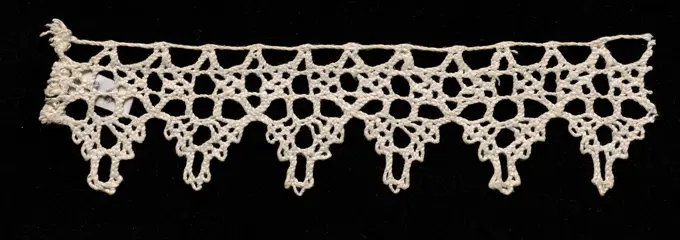
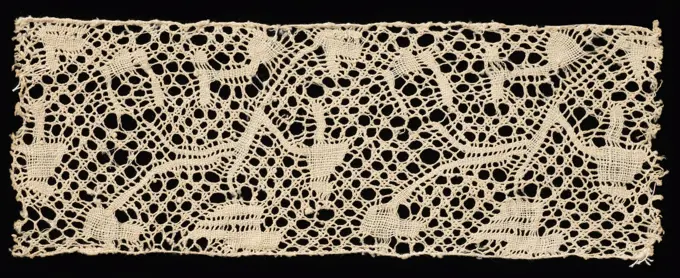
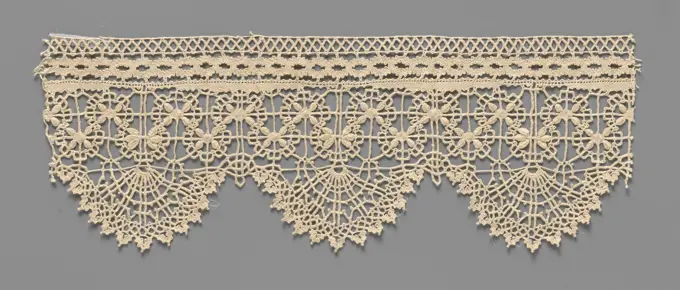
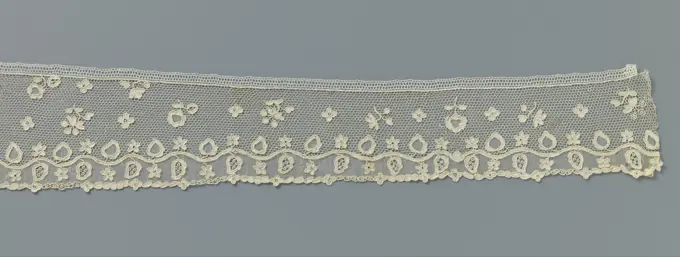
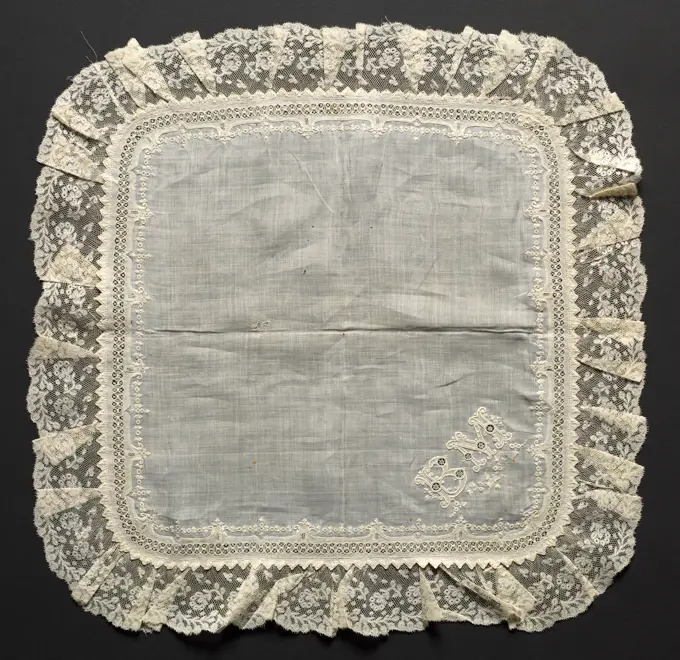
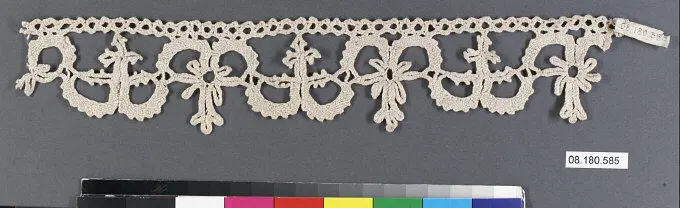
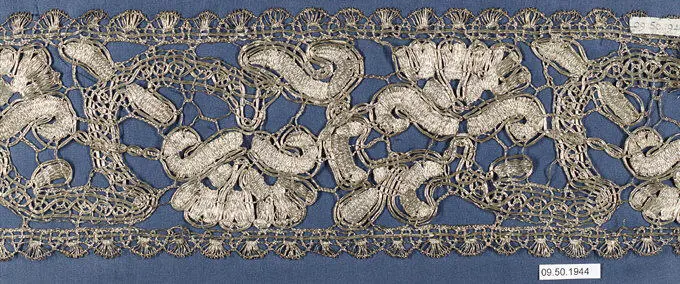
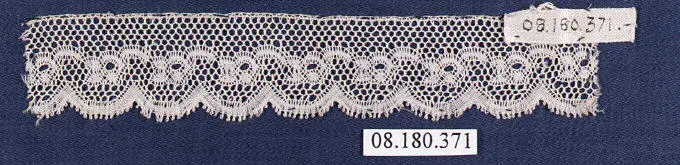
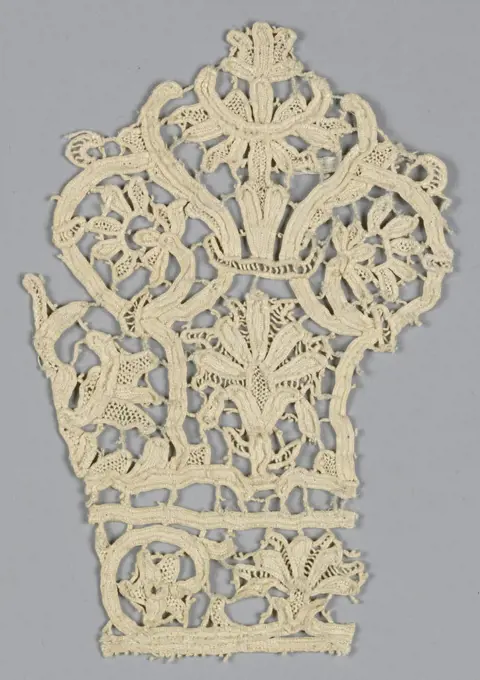
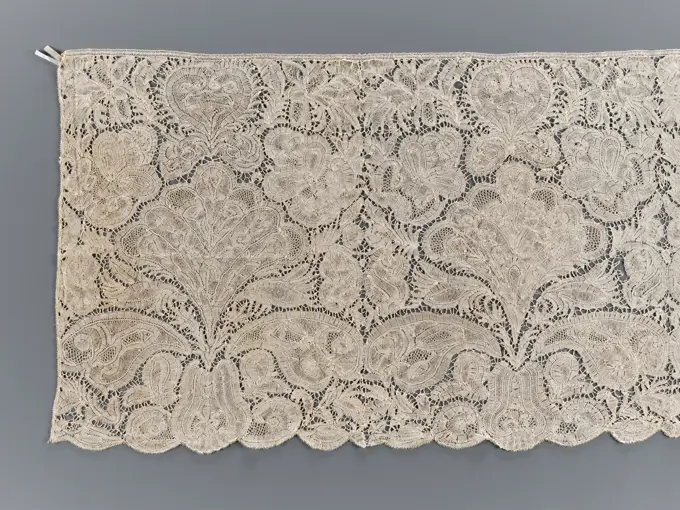
Historical lace fragments showcasing intricate patterns, created with techniques like bobbin lace, reflecting 18th to 19th century craftsmanship.

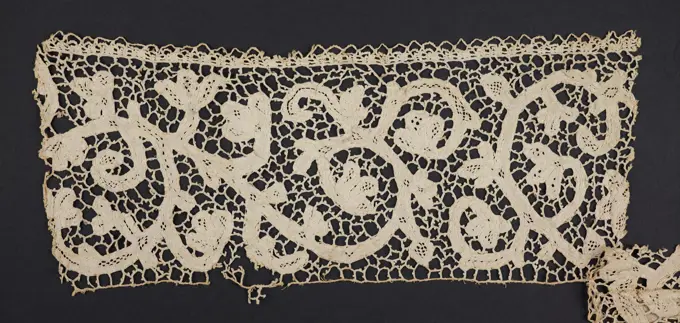
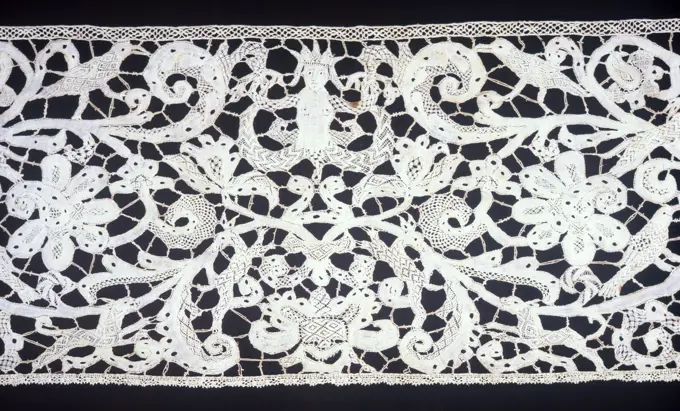
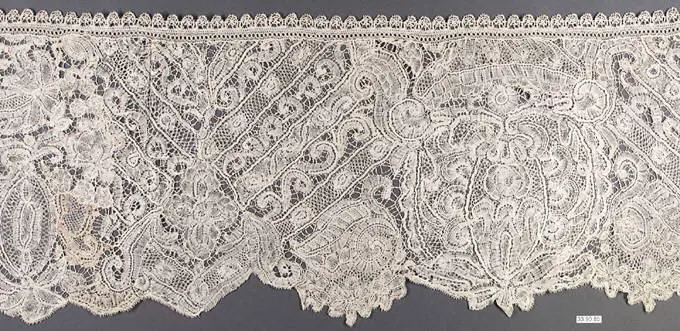
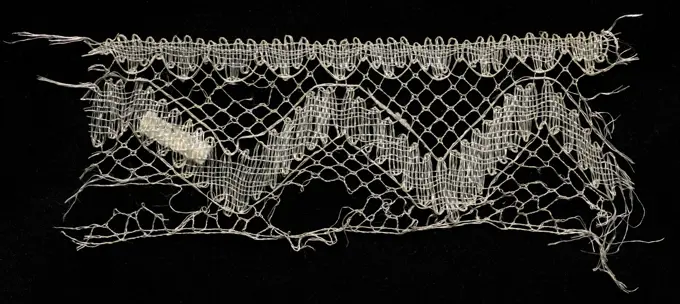
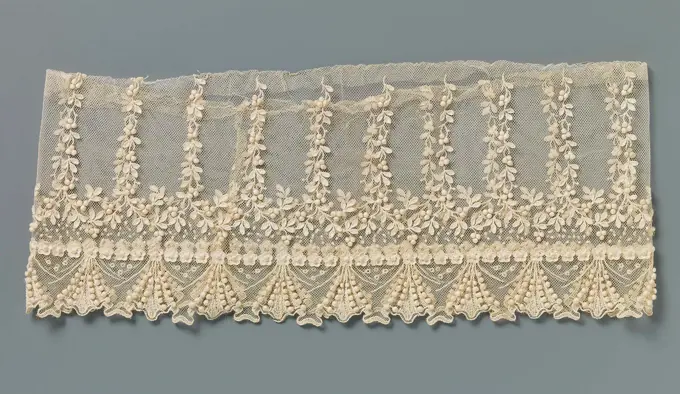
Strip bobbin with two halved cartouches with wide serrated decorative edge, anonymous, c. 1735 Strip of natural -colored Brussels bobbin. The symmetrical pattern consists of two halved cartouches placed next to each other, the half -shaped center of which is on the top of the strip. The wide serrated decorative edge reaches around it up to the underside of the strip and is richly decorated with sloping stripes and a straight down -hanging iris or French lily. The pattern between the cartouches is not symmetrical, but beyond on both sides. This pattern consists of rosette flowers and volute leaves in which elements return from the cartouches in different ways. The motifs are connected by picoted braids. The motifs are made in linen battle with recesses and openwork edges and with mains fillings. Most motives are provided with burst relief contours. Different decorative lands have been applied, including fine snowflake grounds and fine mesh plots with square motifs in shape. The top is f
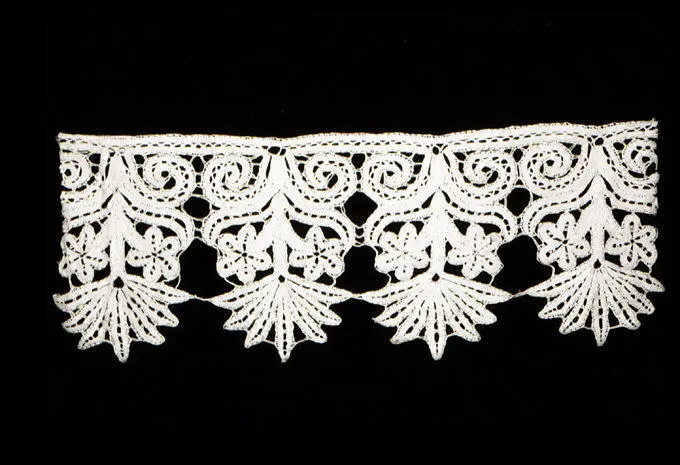
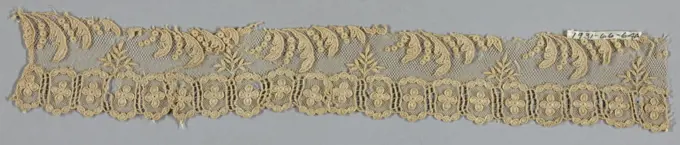
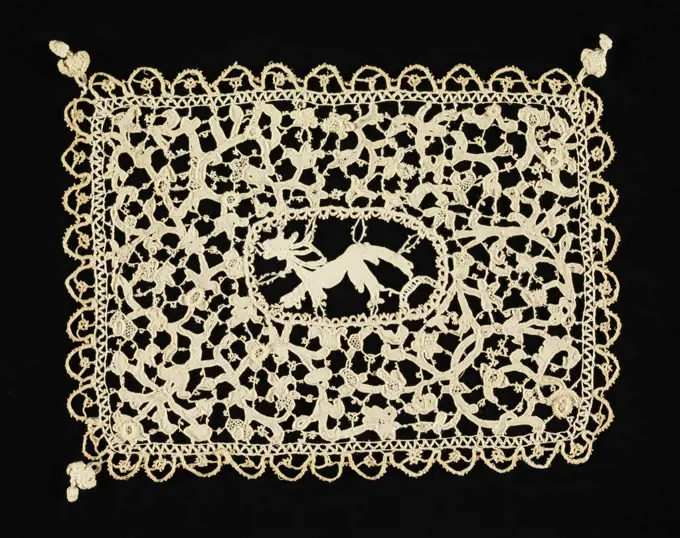
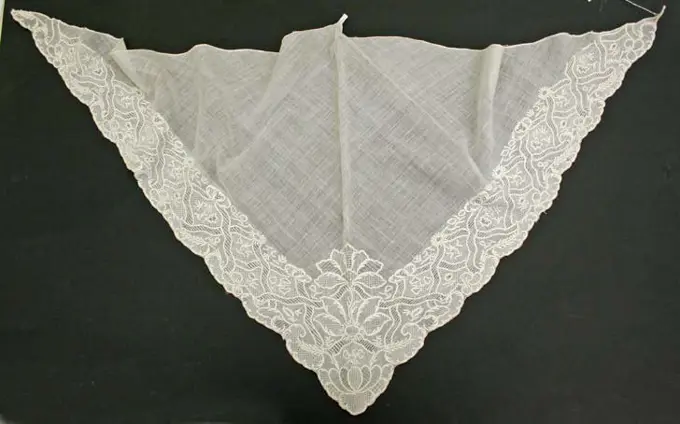
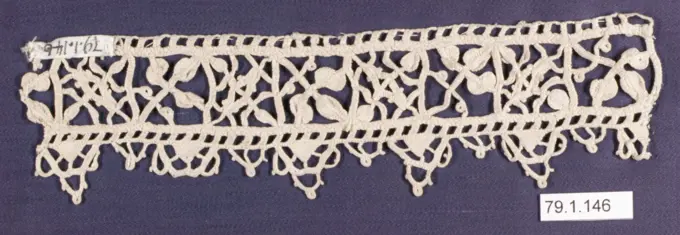
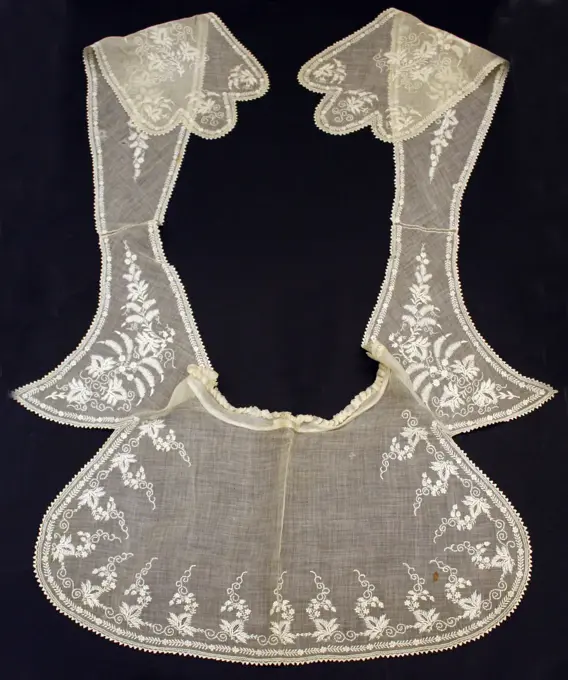
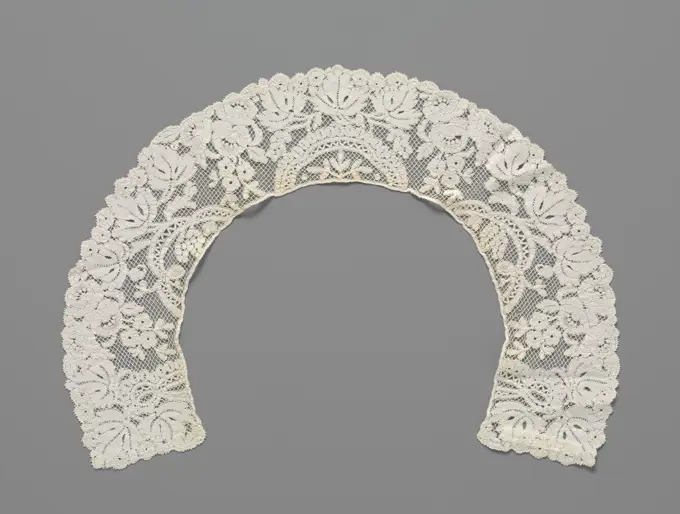
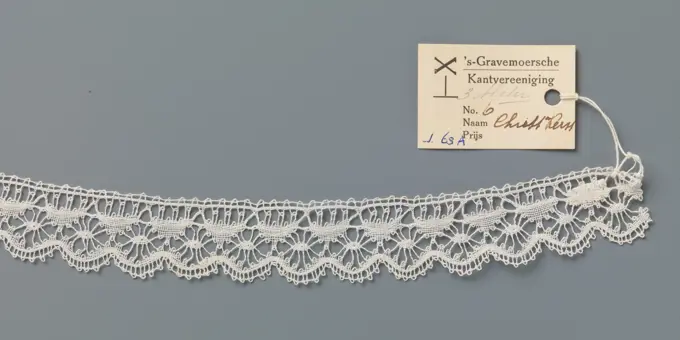
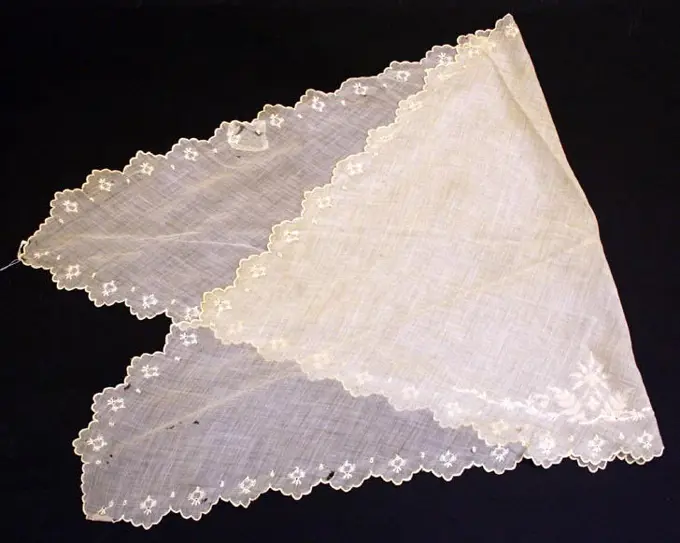
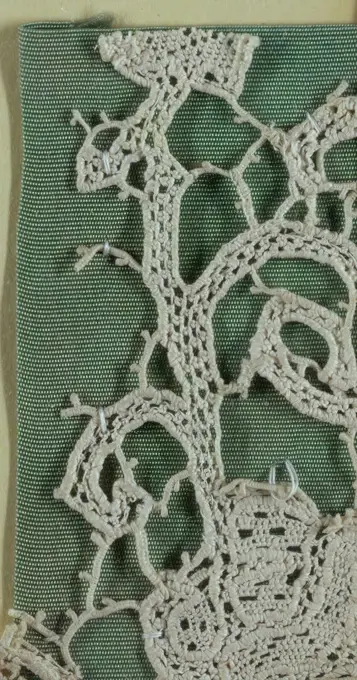
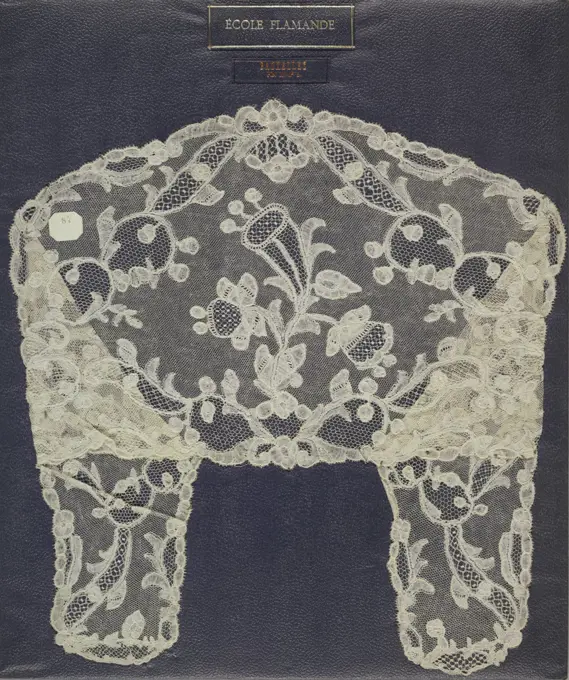
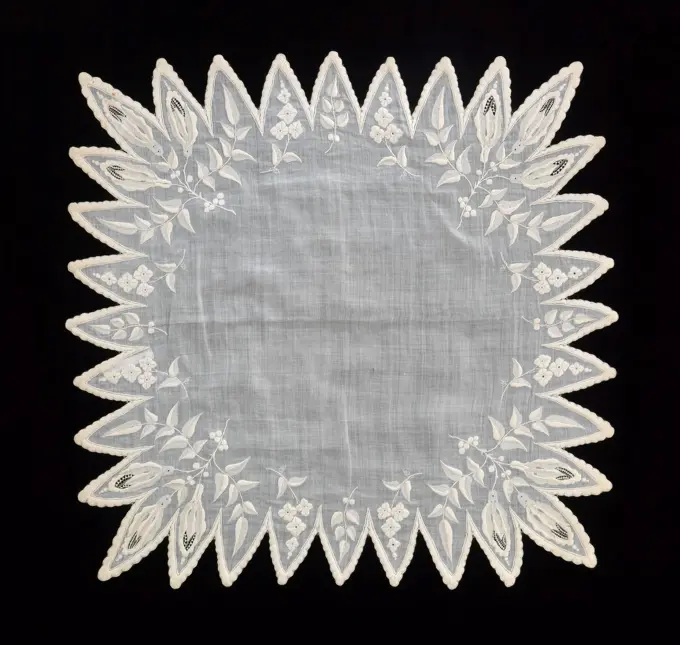
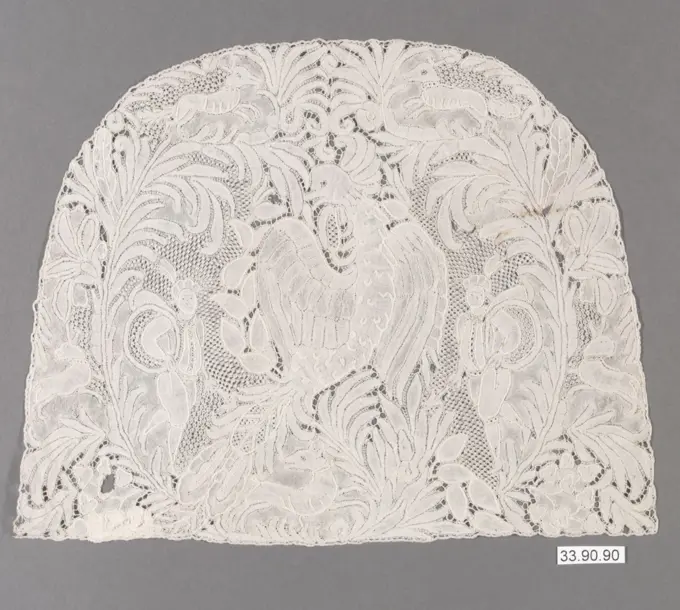
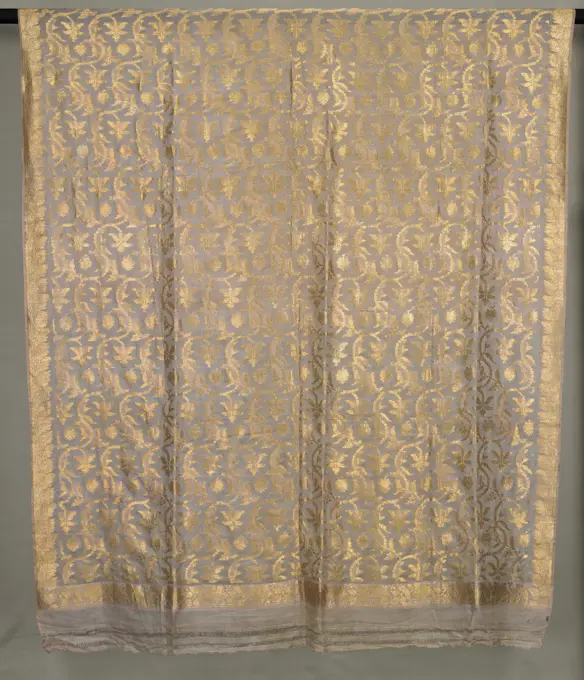
Two Fragments of a Border. Belgium, Bruges. Date: 1880-1900. Dimensions: a: 9.7 × 16.9 cm (3 7/8 × 6 5/8 in.)b: 9.5 × 17.5 cm (3 3/4 × 6 7/8 in.)Width repeat: 9.9 cm (3 7/8 in.). Cotton, bobbin part lace of a type known as "Duchesse de Bruges". Origin: Bruges. Museum: The Chicago Art Institute, Chicago, USA.Sleeve of applicationant with the pear-shaped medallions. Sleeve of natural-colored application side, dick edge and needle side applicated on machine tulle. Against a background, which is widowed with mates, closed worked slopes are filled with a pear-shaped medallion with violets and a circle arc with a flower branch. The pear shape is surrounded by a flower wreath with a flower branch in the top. The branch above the circle arc is c-shaped and has two large dependent sodes, a dune rose and an anemone (both of needle lace) and hanging bells.Strip of needle side with fan -shaped leaves, anonymous, c. 1800 - c. 1815 Strip of natural-colored needle side: Alençon side. Spread motif with leaves and round flower on a fine hexagonal mesh ground. The pattern at the bottom of the strip consists of three rows with different leaves, filled with different decorative land. The leaves in the bottom row are relatively large and fan -shaped. They also form the finish of the strip, which results in a scalloped edge on the bottom. The top is trimmed with a border bobbin. France linen (material) Alençon Lace Strip of natural-colored needle side: Alençon side. Spread motif with leaves and round flower on a fine hexagonal mesh ground. The pattern at the bottom of the strip consists of three rows with different leaves, filled with different decorative land. The leaves in the bottom row are relatively large and fan -shaped. They also form the finish of the strip, which results in a scalloped edge on the bottom. The top is trimmed with a border Border 17th century Italian Punto in arialiterally, "stitches in the air"is one of the earliest styles of needle lace, which is itself developed from cutwork of primarily geometric design. When lacemakers transitioned to using a foundation of threads laid out according to a pattern drawn on parchment, they were able to incorporate more fluid lines and curves into their designs.. Border 226815Length of Lace. Italy, late 17th century. Textiles; textile lengths. Linen Venetian needle laceBobbin Lace Edging with Points, mid 16th century. Italy, Venice, mid 16th century. Lace, bobbin; average: 3.6 x 14 cm (1 7/16 x 5 1/2 in.).Border ca. 1600 Italian. Border 218004Cravat end. Date/Period: Early 18th century. Cravat end. Medium: linen. Technique: bobbin lace. Author: UNKNOWN.Tablemat, 1800s, Devon, maker unknown. Gift of Mrs G. Acland Allen, 1955.Fragment, Medium: cotton Technique: machine made, Beige imitation Alençon. Ornamental strip made up of small pieces of lace, for the center a stem with leaves with a border on either side in design of four-petaled flower in compartments., possibly France, ca. 1890, lace, FragmentCollar 18th century French. Collar. French. 18th century. Linen, needle lace. Textiles-LacesChalice cover, Medium: linen Technique: needle lace Label: Linen needle lace, Rectangle of linen needle lace with a lion-like animal in an oval central medallion. The surrounding field is filled with small-scale flowers and foliage. Scalloped edging of attached braid on four sides. Knotted tassels on three corners., Italy, late 17th-early 18th century, lace, Chalice coverFragment (Belgium); linenTwo fragments of needle laceTwo pussy slips from needle side or Buranokant, Anonymous, c. 1750 Two pussy slips of needle side. The flower and leaf motif of the side is interrupted by cartouches. The scalloped edge is trimmed with picots. France (possibly) linen (material). Alençon Lace Two pussy slips of needle side. The flower and leaf motif of the side is interrupted by cartouches. The scalloped edge is trimmed with picots. France (possibly) linen (material). Alençon LacePortion of Dress for a Madonna Statue Made 1701-1800 Spain. Silk, plain weave; embroidered with silvered-metal strips and gilt-metal-strip-wrapped silk in stem stitches; laid work and couching; square glass pieces .Strip bobbin with spiral and mirrored volutes, anonymous, c. 1625 - c. 1649 Strip of natural -colored bobbin: Old Flemish bobbin. The repeating and largely symmetrical pattern consists of a double volute that is mirrored over the width axis and below that a semi-round shell, which is formed by a spiral. The motifs are formed by burst ribbons, made in linen battle with openwork edges. The spiral is surrounded by a regularly swinging narrower ribbon. Crosses are made with form strokes between the mirrored volutes. The motifs are connected by braids. The top edge is finished with a separate strap. Tonderen (Possibly) linen (material) bobbin lace / tape lace (bobbin lace) / old Flemish lace Strip of natural -colored bobbin: Old Flemish bobbin. The repeating and largely symmetrical pattern consists of a double volute that is mirrored over the width axis and below that a semi-round shell, which is formed by a spiral. The motifs are formed by burst ribbons, made in linen battle with openwork Fragment, Medium: linen Technique: bobbin lace (Binche style with Binche ground), Binche-style fragment with conventionalized, diagonal floral groups. Cinq trous ground and straight edges., Belgium, 17th century, lace, FragmentBorder, Medium: Technique: needle lace, Needle lace, floral pattern; early 18th century Alencon edge sample, early 18th century, lace, BorderRug of doily van Kloskant with clover three and rosette flower, anonymous, c. 1875 - c. 1899  Red or doily of natural -colored bobbin: Bruges flower arrangements. Round model with scalloped square middle part of Batist. The repeating pattern consists alternately of a clover three and a rosette flower. On the outer edge there is always a circle between the leaves and the flour. The motifs have been held in netslag and linen battle, with openwork edges and cut -outs such as leaf rods. The motives are accentuated by contour threads. In the flowers, cubes are made in shape. A few connections were made between the motifs with potented braids. The scrap edge comes from the pattern and is finished with picots. Used linen (material) bobbin lace / Bruges flower laceStrip of a climbing side with whimsical round flower. Strip natural colosside, Lille side. The pattern is not complete, can be seen is a whimsical flower showing whimsical leaves to all sides. Below are two comparable but smaller flowers with horizontal leaves placed. The motifs are connected by a maas land, a tulet, strewn with square moes. The motifs are made in linseed with large recesses and with thicker and shiny contour wires. The edges of the recesses are decorated and a trim with crossing couples has been realized with two openwork ovals. The Moeses are made in shape stroke. The top and bottom of the strip are straight finished, the underside with picots.Kloskant collar with Maltese crosses, anonymous, c. 1900 Collar of natural -colored bobbin: Maltese Kant. Round, lying collar from Kloskant, sculpted in seven points. The pattern has a Maltese cross in all points. A closed intermediate circle of C-Voluten and palmettes separates an inner arch with radiating sheets from an outer edge with large daisies and rosette flowers. The motifs were cost in linen and the many leaves in and around the motifs and along the edges are made in form. Malta silk bobbin lace / Maltese lace Collar of natural -colored bobbin: Maltese Kant. Round, lying collar from Kloskant, sculpted in seven points. The pattern has a Maltese cross in all points. A closed intermediate circle of C-Voluten and palmettes separates an inner arch with radiating sheets from an outer edge with large daisies and rosette flowers. The motifs were cost in linen and the many leaves in and around the motifs and along the edges are made in form. Malta silk bobbin lace / Maltese laceHandkerchief Made 1892-1900 Switzerland. .Border, Medium: silk Technique: bobbin lace, blonde style, Lace showing a pattern of sprays of flowers and leaves that form a border on one edge and conventionalized flowers and leaves on the other., Spain, 19th century, lace, BorderValance of an altar frontal 17th century Spanish. Valance of an altar frontal. Spanish. 17th century. Embroidered net, punto avorio, punto à tela. Textiles-LacesPiece 18th century German, Saxony. Piece 214721Bobbin Lace (Rose Lace) Edging of Bell Points, 17th-18th century. Italy, Genoa, 17th-18th century. Lace, bobbin; average: 4.2 x 19.1 cm (1 5/8 x 7 1/2 in.).Manchet van applicatiekant met keten van miniatuurrozetten.Cuff of natural-colored application side, dock edge - duchesse-lace - applicated on machinery. Narrow, rectangular. Symmetrical design of a stiff edge of connected miniature rosettes and bowets with palms. A speckled distance is only decorated in the pointed collar tips with a loose flour branch.Collar. Culture: probably American. Date: 1840s. Museum: Metropolitan Museum of Art, New York, USA.Strip bobbin with open profile frame, anonymous, c. 1870 - c. 1890 Strip of natural -colored bobbin: Mechelen side. On a grid -lined traly land (a Mechelen ground or ice ground) is a symmetrical pattern of a hanging flower branch, which cuts both a pendulum hanging in the air and an open profile list; The list follows the pendulum, but is angular. The shells are alternately of a wingerd leaf and three daisies. Turnwood linen (material) bobbin lace / Mechlin (lace) Strip of natural -colored bobbin: Mechelen side. On a grid -lined traly land (a Mechelen ground or ice ground) is a symmetrical pattern of a hanging flower branch, which cuts both a pendulum hanging in the air and an open profile list; The list follows the pendulum, but is angular. The shells are alternately of a wingerd leaf and three daisies. Turnwood linen (material) bobbin lace / Mechlin (lace)Strip bobbin with lotus flower, anonymous, c. 1750 Strip of natural -colored bobbin: Mechelse side. The repeating pattern consists of a lotus flower with lush volute leaf, which originates at the top of the strip from a more or less diamond -shaped motif. The volute leaf hangs down to the underside, while the flower is aiming up with a bend. The motifs are made in linen battle and mains with thicker and shiny contour threads. The motifs are connected by a grid, a five -part ground. A snowflake soil has been used as a decorative soil. The faintly scalloped underside stems from the pattern and is finished with picots. The top is straight. Mechelen linen (material) bobbin lace / Mechlin (lace) Strip of natural -colored bobbin: Mechelse side. The repeating pattern consists of a lotus flower with lush volute leaf, which originates at the top of the strip from a more or less diamond -shaped motif. The volute leaf hangs down to the underside, while the flower is aiming up with a bend. The motBorder (Italy); linenFragment early 19th century Flemish, Brabant. Fragment 214502Fragment; linen; Bequest of Marian Hague; 1971-50-370Fragment; linen; 1933-1-93Fragment 17th century Italian. Fragment 214892Fragment, Medium: linen Technique: bobbin lace with needle ground, wavy ribbon like floral design, on needlepoint ground., 17th century, lace, FragmentKloskant handkerchief with rocailles, anonymous, c. 1900 - c. 1949 Linen Batist handkerchief with a edge of natural tornel side: Lille side. Square model with rounded linen batist cloth in the center. The lace has a symmetrical pattern of coral -shaped twigs that form rocailles or cartouches with different grounds including tulumpy land, rose soil and in the middle of the sides a grid filling of small motifs in linen stroke into a rose soil. Tondon linen (material) bobbin lace / Lille lace Linen Batist handkerchief with a edge of natural tornel side: Lille side. Square model with rounded linen batist cloth in the center. The lace has a symmetrical pattern of coral -shaped twigs that form rocailles or cartouches with different grounds including tulumpy land, rose soil and in the middle of the sides a grid filling of small motifs in linen stroke into a rose soil. Tondon linen (material) bobbin lace / Lille laceBand. Date/Period: Late 17th century. Band. Medium: linen. Technique: needle lace. Author: UNKNOWN.Bobbin Lace Insertion with Edging, late 16th century. Italy, Venice, late 16th century. Lace, bobbin; average: 6.4 x 16.9 cm (2 1/2 x 6 5/8 in.).Fichu mid-18th century British. Fichu 119420Strip early 18th century Italian. Strip 212459Fragment ca. 1600 Italian Punto in arialiterally, "stitches in the air"is one of the earliest styles of needle lace, which is itself developed from cutwork of primarily geometric design. When lacemakers transitioned to using a foundation of threads laid out according to a pattern drawn on parchment, they were able to incorporate more fluid lines and curves into their designs.. Fragment 212452Handkerchief with a border of needle side with four large and four small ovals. Handkerchief with an edge of natural needle lace, Brussels mesh edge. Around a cross-shaped batters, a wide edge of lace with hollow shelters, which are overcured by four large corner rises, interspersed by four smaller ones. De Schulpen are composed of 'railways', a wheels edge and a leaf branch. The spiers are awarded by a leaf palm. The ovals filled with asterisks and wheels are closed by a sculpture, which consists of daisies, including leaves depend. Holle and Bolle C-Volutes form the inner edge.Fragment, Medium: linen Technique: bobbin lace, Fragment of Lille-type lace with a border design of small floral sprays. Small oval leaves scattered over the ground., France, late 18th century, lace, FragmentFragment of Point de Milan lace 17th-18th century Italian or Flemish. Fragment of Point de Milan lace. Italian or Flemish. 17th-18th century. Bobbin lace, Milanese lace. Textiles-LacesFlounce early 18th century Flemish, Brussels. Flounce. Flemish, Brussels. early 18th century. Bobbin lace. Textiles-LacesBatist handkerchief with embroidery and finished all around with a border bobbin, anonymous, c. 1875 - c. 1899 Batist handkerchief with embroidery and finished all around with a border of natural torway side: Valenciennes side. Square model with rounded corners. Embroidery: A continuous pattern of small leaves runs along the edge and there is a flower bouquet in each corner, with needle lace pier stitches in open sewing between palm leaves. Side: The repeating pattern consists of a hanging fuchsia flower on a crooked stalk that rises along the outer edge between two oval leaves. Valenciennes linen (material). batiste Embroidering / Bobbi Lace / Valenciennes Lace Batist handkerchief with embroidery and finished all around with a border of natural torway side: Valenciennes side. Square model with rounded corners. Embroidery: A continuous pattern of small leaves runs along the edge and there is a flower bouquet in each corner, with needle lace pier stitches in open sewing between palm leaEdging early 18th century Flemish. Edging 222811Handkerchief 19th century French. Handkerchief 212533Strip bobbin with millet grain leaves in square grid and fan -shaped sculptures, anonymous, c. 1925 - c. 1936  Strip of natural -colored Genoese bobbin. The repeating and symmetrical pattern consists of a braided grid of three rows of squares with a succession of fan -shaped motifs. These fan, or half rosettes, are positioned alternately and standing standing and have an oval center with four or six leaves around it. The leaves are made in shape. The scrap edge along the underside of the strip consists of larger fan -shaped sculptures. These are largely made up of braids, the small pointed lobes at the ends are made in linen battle. The top of the strip is straight finished with a decorative edge that consists of a row of connected openwork ovals in linen battle and above it a straight edge with a braided diamond -shaped grid. The pattern is made to seventeenth-century example. Italy linen (material) bobbin lace / Genoese pillow laceFragment; linen; Bequest of Marian Hague; 1971-50-369Strip of needle side with heart -shaped leaves, anonymous, c. 1790 - c. 1799 The Maliën Fond of the field is strewn with flowers and small rosettes; A nice mesh stock fills the edge. A wavy branch with heart -shaped leaves and flowers serves as a separation. The outer edge is almost straight and composed of rosettes, leaves and a chain of circles. Argent tank. France linen (material) Argentan Lace The Maliën Fond of the field is strewn with flowers and small rosettes; A nice mesh stock fills the edge. A wavy branch with heart -shaped leaves and flowers serves as a separation. The outer edge is almost straight and composed of rosettes, leaves and a chain of circles. Argent tank. France linen (material) Argentan LaceAccessory set. Culture: Belgian. Date: 1895.The complexity and lyrical quality of the design, the variety of intricate fillings, and the superb execution establish this set of point de gaze lace as a prime example of its kind made in the late 19th century. When it was purchased it was, according to the donor, "the finest that could be found in Brussels in 1895.". Museum: Metropolitan Museum of Art, New York, USA.Embroidered Handkerchief, second half of 19th century. Switzerland, second half of 19th century. Embroidery: linen; average: 41.9 x 41.9 cm (16 1/2 x 16 1/2 in.).Fragment 16th century Italian. Fragment 214935Strip 17th century Spanish. Strip 216791Sleep of bobbin side semicircular model with three-lobe leaves formed by a ribbon, Sophia Gerardine Cenijn-Smit, c. 1914 Insert of natural -colored bobbin: fine brugs flower arrangements. Half -circle -shaped model. The motifs are formed by a ribbon closted in linen stroke with a shiny contour thread and openwork edges. The narrow straight ribbon is the circumference of the insert. The continuous ribbon forms three -lobe inputs on the round side of the semi -circular insert. In this way it forms three leaves, each with three lobes in the insert. A V-shaped line with an equally wide ribbon forms a dividing line between the part with the leaves and the field above where a row of loose circles or cubes hang between fine braids with picots. The motifs are interconnected with fine braids with picots. The braids form stars in the field between the leaves. Amsterdam cotton (textile) bobbin lace / tape lace (bobbin lace) Insert of natural -colored bobbin: fine brugs flower arrangements. Half -Piece 18th century German, Saxony. Piece 214724Capslip from Application side with tie, anonymous, c. 1906 - c. 1918 Application side barbe, bobbin and some details in the needle side applied on mechanical tulle. Gridding of small and larger leaf branches stands in rows in a rectangular foundation, the ends of which run slightly wider. In the straight ends, above a 'hill' of C-Voluten there is a dash of flower branches, bound together by an openwork bow. In the faintly scalloped edge there are some medallions with grid works (needle side). The Hague (possibly) linen (material) Application side barbe, bobbin and some details in the needle side applied on mechanical tulle. Gridding of small and larger leaf branches stands in rows in a rectangular foundation, the ends of which run slightly wider. In the straight ends, above a 'hill' of C-Voluten there is a dash of flower branches, bound together by an openwork bow. In the faintly scalloped edge there are some medallions with grid works (needle side). The Hague (possibly) linen (materiaEdging 17th century Italian, Genoa. Edging 220974Two Fragments (From a Chasuble) Made 1715-1738 France. Silk and gilt-metal-strip-wrapped silk, warp-float faced 4 1 satin weave with supplementary brocading and patterning wefts tied by supplementary binding warps in weft-float faced 4 1 and 2 3 twill interlacings .Towel End (USA); 1944-43-5-bScarf 1700-1941 American. Scarf. American. 1700-1941. no medium availableStrip bobbin with ovals that form deep pointed sculptes, anonymous, c. 1825 - c. 1849 Strip of natural -colored bobbin: blonde. The color tends vague to blue. The repeating pattern consists of an oval with one pointed point that hangs down and forms a deep shell. The successive scallops are connected by an openwork circle, in which an X-shaped motif is made in form. The ovals are formed by a decorative soil, a rose ground, around which a wide open work runs from contour threads between which are blocks made in shape. An extra decorative band runs around the lower part of the ovals, which is formed by a succession of openwork and fine picots finished. The contour threads consist of a combination of a bundle of floss threads and a twisted wire. At the top, the motifs are connected by a traly land, a tuler floor. The top is straight. Belgium (possibly) silk bobbin lace / blonde (lace) Strip of natural -colored bobbin: blonde. The color tends vague to blue. The repeating pattern consists oCap crown 18th century French. Cap crown 218849Cuff with Floral Vines, 19th century. Unassigned, 19th century. Needle lace, filet/lacis (knotted ground and darned in one direction); bleached linen (est.); overall: 17.9 x 22.2 cm (7 1/16 x 8 3/4 in.). In this lace cuff (one of a set, see 1936.226), scrolling vines with budding flowers emerge from a tied bow, creating a stylized bouquet. A scrolling vine with budding vegetation or a tendril motif is a recurring pattern in needle lace. The frequent use of the motif, adapted in lace from different centuries and regions, suggests that it was found in a pattern book.Border (Italy); silk on linen; Bequest of Marian Hague; 1971-50-104Fragment late 17th century Flemish. Fragment 212509Piece 18th century German, Nuremberg. Piece. German, Nuremberg. 18th century. Bobbin lace. Textiles-LacesFragment, Medium: linen Technique: lace of premade tape with needlework fillings, Bobbin-made tape, buttonholed along edges, forms outlines for scrolling symmetrical floral design. Details filled in with needle lace stitches and connecting picoted bars. Sometimes referred to as mezzo punto., Italy, late 17th century, lace, FragmentFragment of lace. unknown, authorFragment, Medium: natural linen Technique: -Narrow loom-woven tape bent and folded to define pattern -Buttonhole stitch over a cord for raised linear details -Buttonhole stitch over a cord for connecting bars -Needle-made fillings -Padded, shaped and tapered forms in high relief covered by buttonhole stitch, Band fragment with rounded tabs has scrolls and floral forms., 1650-1700, lace, FragmentSub -sleek for children's clothing from machine side, anonymous, c. 1860 Underemen for children's clothing made of natural-colored machine side: Machinal Valenciennes side. Tapered Model with turned cuff with glass knot. Along the cuff a wrinkled strip of lace. A tunnel with a cord along the bottom. Pattern of leaf vines and flowers. West-Europa cotton (textile). knoop: glass Underemen for children's clothing made of natural-colored machine side: Machinal Valenciennes side. Tapered Model with turned cuff with glass knot. Along the cuff a wrinkled strip of lace. A tunnel with a cord along the bottom. Pattern of leaf vines and flowers. West-Europa cotton (textile). knoop: glassStrip side, white, sculpted on one side with floral pattern, on cardboard, c. 1925 Strip lace, white, sculpted on one side with floral pattern, on cardboard Nijmegen cardboard Strip lace, white, sculpted on one side with floral pattern, on cardboard Nijmegen cardboardBobbin Lace Edging, 18th-19th century. Spain, Huelva, 18th-19th century. Lace, bobbin; average: 3.9 x 11.5 cm (1 9/16 x 4 1/2 in.).Collar 1828-37 American or European. Collar 118961Kloskant collar with wind leaves and roses, anonymous, c. 1860 Collar of natural-colored bobbin: Brabantse Valenciennes side. Half -shaped model. The pattern has a border of alternating three vine leaves and three roses on the outside and the ends. On the inside, there are five arched ornaments with zigzags and godrons under the vine leaves. The motifs have been hit in very closed linen battle and are connected by a square Valenciennes ground. Belgium linen (material) Bobbi Lace / Brabant Valenciennes Lace Collar of natural-colored bobbin: Brabantse Valenciennes side. Half -shaped model. The pattern has a border of alternating three vine leaves and three roses on the outside and the ends. On the inside, there are five arched ornaments with zigzags and godrons under the vine leaves. The motifs have been hit in very closed linen battle and are connected by a square Valenciennes ground. Belgium linen (material) Bobbi Lace / Brabant Valenciennes LaceFragment, Medium: linen Technique: needle knotting, Two squares with surrounding geometric border. Each square contains a geometric design built on the border., Italy, 17th century, lace, FragmentCollar late 1890s Irish. Collar 118936Cap crown 18th century Flemish, Brussels. Cap crown 227697Collar van Duchesse with large flower vines and Point de Flandre with small flower branches, Maggy Rouff, c. 1936 Collar van Duchesse with large flower vines and Point the Flandre with small flower branches. Paris (possibly) linen (material) Flanders lace Collar van Duchesse with large flower vines and Point the Flandre with small flower branches. Paris (possibly) linen (material) Flanders laceStrip 17th century Spanish. Strip 213222Kloskant handkerchief strip with triangles and spiders, 's-Gravenmoersche Kantvereniging, c. 1930 Handkerchief strip made of natural -colored bobbin, straw side. A pendulum forms small shells along an open middle edge of large spiders and a closed edge of triangles. 's Gravenmoer linen (material) Bobbi lace / lace cloth Handkerchief strip made of natural -colored bobbin, straw side. A pendulum forms small shells along an open middle edge of large spiders and a closed edge of triangles. 's Gravenmoer linen (material) Bobbi lace / lace clothFichu 1876 American. Fichu. American. 1876. no medium availableStrook machinale kant met dikke ronde besjes.Strip natural-colored machining: machine embroidery on machining ground. The repeating pattern consists of straight down hanging thin tanks with oval leaves and bunches of always three thick round berries together. Something below the middle of the strip the rank splits into two short branches, both with one bunch of berries. Between the successive split branches, a loose sprig with three leaves hangs, including a trump with three berries down in a narrow job with mates. Below is a row of loose rosette flowers, with a thick around flower heart. Under every fourth rosette flower, a triangle of sliers with thick berries is hanging on the underside of the strip. The motifs are equipped with contour wires. A sloping edge is formed along the underside of the strip with a kind of bell-shaped and flat-printed heart-shaped slot. The top of the strip is not finished. The short sides of the strip are sewn together.Cooper Union Museum Lace Study Card, Medium: linen Technique: needle lace, Corner fragment of flat lace in a floral design. Fragment is mounted on a fabric-covered board and framed behind glass. Frame is natural wood., Italy, 17th century, lace, Fragment, FragmentBatist tip cloth with white embroidery, anonymous, c. 1850 - c. 1860 Tip towel made of batist with white embroidery. Corner bouquet between edges of Schulpen, each with a small flower filled, above which three rows of a three -leaf. Triangular model, decorated along the short sides. Netherlands batiste Tip towel made of batist with white embroidery. Corner bouquet between edges of Schulpen, each with a small flower filled, above which three rows of a three -leaf. Triangular model, decorated along the short sides. Netherlands batisteCollar, Technique: bobbin lace, Bobbin lace collar, growing flowering plant, early 18th century Brussels, early 18th century, lace, CollarCollar of mixed side with a faint V-shaped model, anonymous, c. 1890 - c. 1910 Collar of natural ribbon side (mixed side): luxurious lace, with a woven ribbon and needle side fillings. Faint V-shaped model, with rectangular ends and a widened triangular center. The symmetrical pattern consists of motifs whose contours are formed by a narrow woven ribbon. In the middle is the largest flower with a four -lobe center, flanked by volutes under which a triangular point hangs. In addition to this central palmet flour on each side, an openwork oval flower, made with two against each other on placed sickles, oval leaves and three times a three -lobe flower. The three -lobby flowers and the central flower have an elevated (relief) and feasted circular flower heart. Within the contours with which the motifs are formed, decorative lands (needle side) with coarser yarn are used for making the ribbon. The motifs are connected by a bar of land (needle side). The uneven scrap edge stems from the pattCollar 1890s American. Collar 116021Handkerchief second quarter 19th century probably American Striking forms with exaggerated points enclosing the border motifs contribute to this handkerchief's distinctive look. The pod forms are unusual and beautifully detailed. The alternating use of different embroidery stitches creates shading and depth within the graphic images.. Handkerchief 157724Strip 16th century Italian. Strip 220818Edging 17th century Italian. Edging 220913Handkerchief 1840-80 French or Swiss. Handkerchief 236953Edge, Medium: linen Technique: bobbin lace, continuous braid-like, Band fragment with an oval tab edge in a geometric floral pattern. Design is taken from needle lace., Italy, 16th-17th century, lace, EdgeFragment 16th century Italian. Fragment. Italian. 16th century. Filet, embroidered net. Textiles-LacesCap crown early 18th century Flemish, Brussels. Cap crown 222779Shawl, c. 1920s, 98 x 56 in. (248.92 x 142.24 cm), Silk and metal threads; woven, India, 20th centuryApplication side scarf with large bows. Scallop of natural application side, dick side with some details in needle side applicated on machine tulle. Rectangular model with something widened straight ends. Symmetrical pattern relative to the short axis. At the ends, a large bow of a cut-away ribbon is overwhels, the slips of which depend on the corners. Above it rises a branch that carries a chalis flour and a carnation on fine, curved stems. From the middle is a deep pendulum with the same flowers to two sides. Different, sprinkled flower twigs fill the remaining field. Around free flat slippers from openwork medallions, which as golf juices rise high into the midfield.