Lace Patterns and Textiles

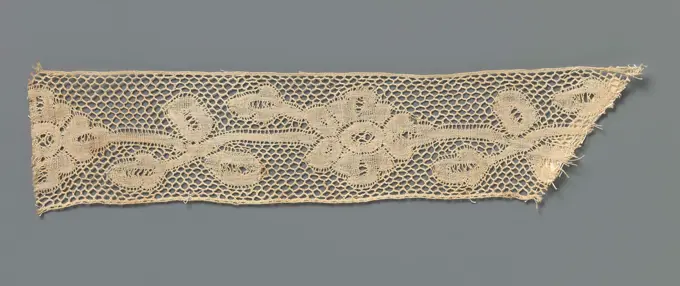
Elegant lace strips showcasing intricate designs and historical details, suitable for fashion and interior decoration inspirations.

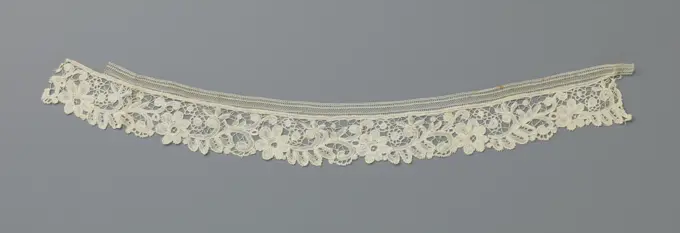
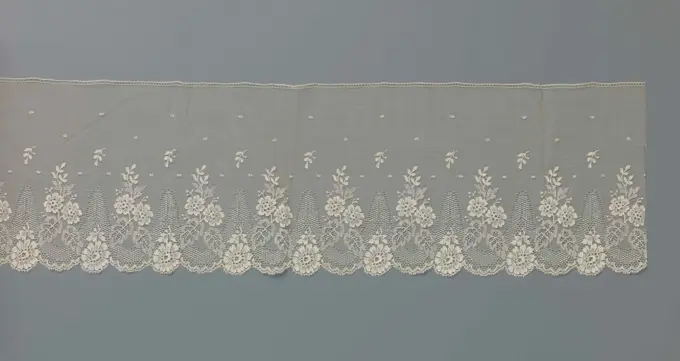
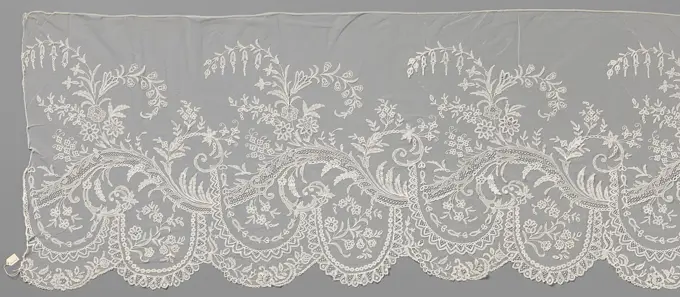
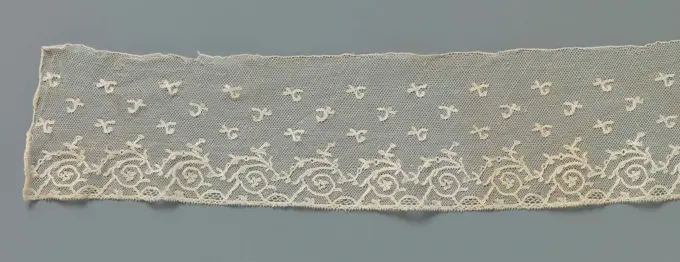
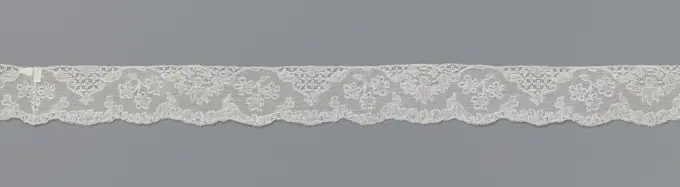
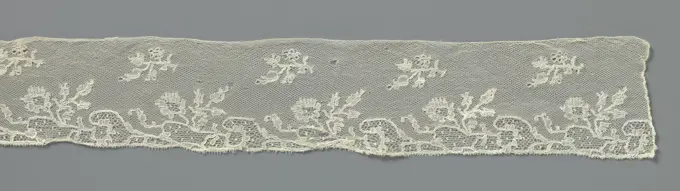
Strip of needle side with cornflowers, anonymous, c. 1800 - c. 1820 Two -thirds of the width is filled with a spreading pattern of falling cornflowers on a coarse soil (of flooded bars). A third of the width forms a right-winged outer edge (with a single alençon soil), lined with two pearl lists, and decorated with a horizontal flank of stretched stalks, each with three cornflowers, which are always in the same direction. Alençon side. France linen (material) Alençon Lace Two -thirds of the width is filled with a spreading pattern of falling cornflowers on a coarse soil (of flooded bars). A third of the width forms a right-winged outer edge (with a single alençon soil), lined with two pearl lists, and decorated with a horizontal flank of stretched stalks, each with three cornflowers, which are always in the same direction. Alençon side. France linen (material) Alençon Lace
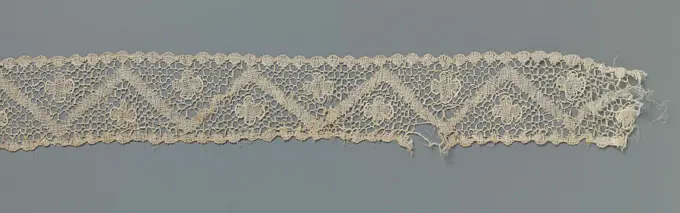
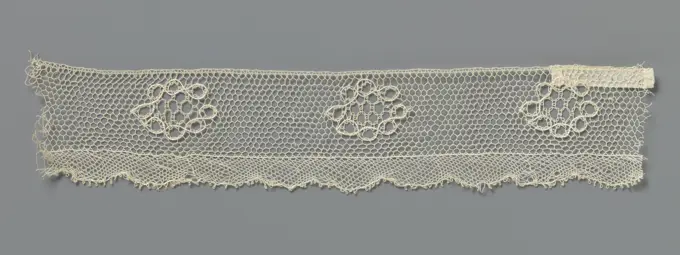
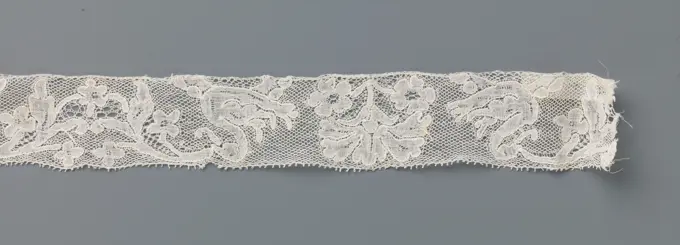
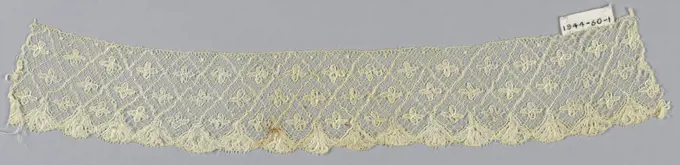
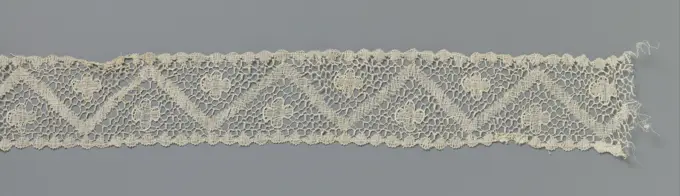
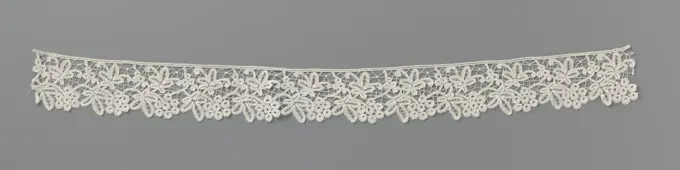
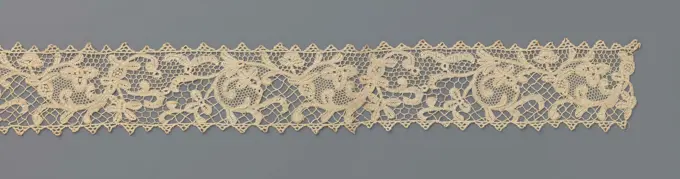
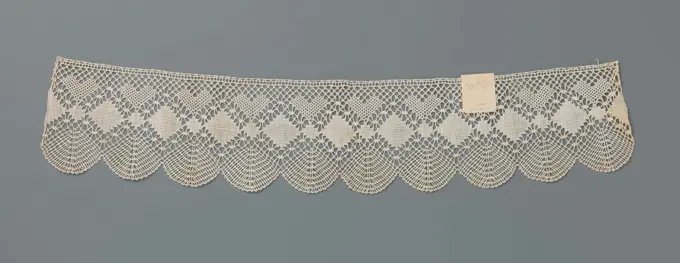
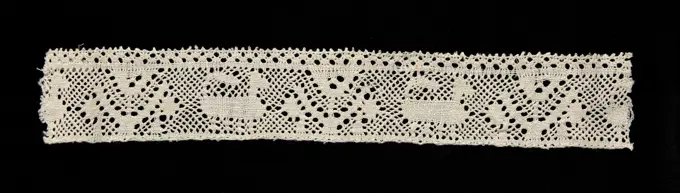
Strip bobbin with a central lane of connected windows, anonymous, c. 1850 - c. 1899 Strip of natural -colored bobbin. The repeating and geometric pattern consists of a succession of diamond -shaped motifs, which form a wide track over the center line of the strip. The windows have an openwork edge or an open worked center. The motifs are connected by a mesh soil, a lace-hole strike-grid. A concatenation of pointed -oriented recesses in the Maas soil forms a decorative edge along the underside of the strip. The motifs are made in linen battle with openwork edges. Both the fullwork and the recesses are largely equipped with thick contour threads. A decorative land has been used in the windows with an open -up center. The top and bottom of the strip are straight finished, with the bottom with picots. Germany (possibly) linen (material) bobbin lace Strip of natural -colored bobbin. The repeating and geometric pattern consists of a succession of diamond -shaped motifs, which form a wide traBorder 18th century Spanish. Border 215126Strook kloskant met ruiten tussen waaiervormige schulpen.Strip natural colosside, sling. The repeating pattern exists along the underside of the strip of fan-shaped slots placed against each other. One window is always placed above the slip edge in the space between the fans. The windows are made in linen stroke and are connected to each other at the top of the strip by a grille: a nozzle ground. The ground is decorated with square moes, made in shape stroke. There are always four meadows in diamond-shaped configuration between the windows. The top of the strip is straight finished.Fragment late 18th century French, Chantilly. Fragment 214670Border (France); linenStrip bobbin with pineapple -shaped reserve, anonymous, c. 1725 - c. 1745 Strip of natural -colored bobbin: Mechelse side. The repeating and symmetrical pattern consists of two types of reserves with different fillings. One of the two reserves is reminiscent of a halved pineapple and is flanked to the left and right by branches that are bothered. The motifs are connected by a fine Maas soil. In the reserves, decorative lands have been used with coarser meshes and with small motifs including in the pineapple rosette flowers. The motifs are made in linen battle with very few recesses and with thicker and shiny contour threads. The faintly scalloped underside is finished with picots. The top is straight. Southern Netherlands linen (material) bobbin lace / Mechlin (lace) Strip of natural -colored bobbin: Mechelse side. The repeating and symmetrical pattern consists of two types of reserves with different fillings. One of the two reserves is reminiscent of a halved pineapple and is flanked Strip bobbin with swinging ribbon under a row of mosjes, anonymous, c. 1850 - c. 1874  Strip of natural -colored bobbin, Parisian side. A swinging ribbon runs between a row of open -worked mosjes just above the center line and the scums along the bottom. The motifs are connected by a Maas soil, a Parisian soil. The motifs are made with thick threads. The top of the strip is straight finished. The scums are finished with picots.  silk bobbin lace / Paris laceStrip of needle side with cornflowers, anonymous, c. 1800 - c. 1820 Two -thirds of the width is filled with a spreading pattern of falling cornflowers on a coarse soil (of flooded bars). A third of the width forms a right-winged outer edge (with a single alençon soil), lined with two pearl lists, and decorated with a horizontal flank of stretched stalks, each with three cornflowers, which are always in the same direction. Alençon side. France linen (material) Alençon Lace Two -thirds of the width is filled with a spreading pattern of falling cornflowers on a coarse soil (of flooded bars). A third of the width forms a right-winged outer edge (with a single alençon soil), lined with two pearl lists, and decorated with a horizontal flank of stretched stalks, each with three cornflowers, which are always in the same direction. Alençon side. France linen (material) Alençon LaceStrook kloskant met gestileerde ronde bloem tussen twee dikke c-voluten.Natural collate strip: Beverse Kant. The strip is finished on one long and two short sides with a narrower strip of Lille side. The repeating and symmetrical pattern of the wide strip consists of a stylized round flower between two thick C-volutes, such as a candelabar with three arms. The repeating pattern of the narrow strip consists of a unilateral curved stem with a fan-shaped flower. The motifs are connected by a nice ground ground, a tulet, which is strewn with square mates. The motifs are made in linselag with mostly large recesses and thicker and shiny contour wires. Different ornamental grounds have been applied, including so-called curriculums or 'ladderjes' made in shape stroke, in the round flower and in the volutes. The mates are also made in shape stroke. The outer sides of both strips are straight finished. The scales along the underside of the narrow strip are finished with picots.Strook kloskant met zigzag-baan.Strip natural colosside: Parisian side. A double symmetrical zigzag orbit of sloped S-SEN is located on a closed pins stroke ground. There are loose cloud bands between the courses. The underside of the strip is formed by hooking accolade motifs with more or less impeller-shaped motifs below. Most motifs are made in linen stroke. The circles in the upper zigzag web and motifs along the underside of the strip are made in slurbase. All motifs are surrounded by a thicker and shiny contour wire. A rose soil has been applied as ornamental ground. The top of the strip is straight finished. The accolade motifs with impeller-shaped motifs underneath form the slip edge along the underside of the strip, which is finished with picots.Pieces (2) 18th century Flemish. Pieces (2) 218898Fragment early 19th century Belgian. Fragment. Belgian. early 19th century. Bobbin lace. Textiles-LacesBed curtain border 1790-1825 Russian. Bed curtain border 175597Needle strip with medallions and leaves, anonymous, c. 1850 - c. 1874  Strip of natural needle side, Brussels mesh side. Repetitive symmetrical motif with a medallion of flower garlands in the bowl of an arc including large leaves. The pattern stands on a fine soil with single twisted meshes, which is littered with mosjes. An asymmetrical bouquet in the medallion. The arches are filled with circles, with a large circle with rosette flower in the middle and ends. Different decorative grounds in the floral motifs and the circles. The scallops along the underside are formed by the large leaves. The top is finished with a straight edge. Brussels linen (material) Brussels Gaze PointStrook kloskant met vierlobbig rozet boven en onder een zigzag-band.Strip natural colosside, blonde. The repetitive and continuous pattern consists of a zigzag band, which divided the strip into triangular fields. There is a quadruped rosette in the center of each field. Along the top and bottom of the strip a sculpture runs, which consists of a concatenation of circles. The crafts are finished with picots. The motifs are connected by a coarse mesh soil, strewn with square moes. The zigzag band, rosettes and circles edges are made in linen stroke, whereby the rosettes are equipped with a contour wire.Strip bobbin with rosettes made of circles, anonymous, c. 1900 - c. 1924  Strip of natural -colored bobbin, Lille side. The repeating pattern consists of a rosette made of a circles forming decorative soil, a rose soil. The motifs are connected by a Maas soil, a tuler land. Along the bottom of the strip, the tuler land turns into a base of mains. The contours of the round petals are accentuated with a thicker and shiny wire. Such the same wire has also been used to accentuate the transition from the tulip to the mains and the sculptures along the underside of the strip. The top of the strip is straight finished. The scums along the bottom are finished with picots. Belgium cotton (textile) bobbin lace / Lille laceStrip bobbin with swans and carnations, anonymous, c. 1725 - c. 1749 Strip of natural -colored bobbin: Mechelse side. The repeating pattern consists of a symmetrical composition with two swans, left and right flanked by a separate carnation between two rosette flowers. The motifs are connected by a fine Maas soil, the Mechelen soil. The motifs are made in linen battle with recesses, and equipped with thicker and shiny contour threads. A few decorative land has been used sparingly, between the branches that hold the swans with their beak and in the rosette flowers. At the top and bottom are straight finished, with picots along one side. Mechelen linen (material) bobbin lace / Mechlin (lace) Strip of natural -colored bobbin: Mechelse side. The repeating pattern consists of a symmetrical composition with two swans, left and right flanked by a separate carnation between two rosette flowers. The motifs are connected by a fine Maas soil, the Mechelen soil. The motifs are made in linen battleBorder (Netherlands); linenBorder, Medium: linen Technique: bobbin lace made in Lille style with heavy outlining thread and honeycomb ground, 19th century, lace, BorderStrook naaldkant met klaverblaadjes en waaiervormige bloemen.Natural coniferous strip: Men-Alençon. Spreading dot with clover leaves on a fine hexagonal maas soil. Along the top edge a row of mashes. The pattern on the underside of the strip consists of a concatenation of leaf branches with plumes. Including fan-shaped flowers that spring from the lower edge filled with an ornamental ground. The underside is finished with scalloped edge of picoted circles containing a rider poic. The top is finished with a straight edge.Strip bobbin with volute vines and rosettes, anonymous, c. 1875 - c. 1899 Strip of natural-colored bobbin: Duchesse side. On a braid ground is an ongoing pattern of branched volute vines with incised leaves and rosettes, which form the sculpes. Netherlands (possibly) linen (material) bobbin lace Strip of natural-colored bobbin: Duchesse side. On a braid ground is an ongoing pattern of branched volute vines with incised leaves and rosettes, which form the sculpes. Netherlands (possibly) linen (material) bobbin laceCuff of needle side with a straight decorative band with vertical stripes and three simple flower garlands of leaves and at the lowest point one rosette flower, anonymous, c. 1880 Cuff of natural -colored needle side: Brussels mesh side. Rectangular model with a scalloped edge of leaves and a straight tape with a square grid along the top. Symmetrical pattern with a straight decorative band with vertical stripes above which three simple flower garlands next to each other, with leaves and at the lowest point one rosette flower. The decorative band with stripes is cut over on the corners and in the middle by a total of four rosette flowers, the bottom of which forms part of the scrap edge. These rosette flowers are crowned at the top by three rosette flowers and a few leaf branches that pierce between the successive flower garlands to the top edge. The motifs are made with feston stitches and equipped with relief contours made of wide -racing thread bundles. The flowers are connected to Strip bobbin with four-lobbish rosette above and below a zigzag band, anonymous, c. 1840 - c. 1860 Strip of natural -colored bobbin, blonde. The repeating and continuous pattern consists of a zigzag band, which divided the strip into triangular fields. There is a four -lobe rosette in the center of each field. Along the top and bottom of the strip runs a scallop, which consists of a succession of circles. The scallops are finished with picots. The motifs are connected by a coarse mesh soil, strewn with square moes. The zigzag band, rosettes and circling edges are made in linen stroke, with the rosettes equipped with a contour wire. unknown silk blonde (lace) / bobbin lace Strip of natural -colored bobbin, blonde. The repeating and continuous pattern consists of a zigzag band, which divided the strip into triangular fields. There is a four -lobe rosette in the center of each field. Along the top and bottom of the strip runs a scallop, which consists of a succession of circles. The scallFragment of the lace;  2. PO. 19th century (1851-00-00-1900-00-00);Strip bobbin with the grapes bunches, anonymous, c. 1875 - c. 1899 Strip of natural-colored bobbin: Duchesse side. On an open braid soil is a running pattern of a short branch with two vine leaves and a grapes. In turns, a leaf and the bunch form the uneven scums. Netherlands linen (material) bobbin lace Strip of natural-colored bobbin: Duchesse side. On an open braid soil is a running pattern of a short branch with two vine leaves and a grapes. In turns, a leaf and the bunch form the uneven scums. Netherlands linen (material) bobbin laceLace, 1800s , maker unknown.Strook kloskant met voluten.Insignment of natural colosside, possibly Flemish guipure. A repeating pattern with volutes to which three, four and five-leaf flowers spring. Around the motifs a braided barrier ground with picots. Within the motifs a honeycomb ground. Upper and bottom finished with triangles built from arcs.Strip bobbin with a rose and an oval flower with nine lobes such as petals, anonymous, c. 1900 - c. 1915  Strip of natural-colored bobbin: Honiton side. The repeating pattern consists alternately from a rose and a flower with nine open work as petal leaves around an oval flower heart along the underside of the strip. A few different leaves above this flower row. The contours of the motifs are made in linen battle with openwork edges and partly in netslag, with shiny contour threads. Ornamental fillings have been applied in forms within the contours in linen and mains. The motifs are connected by a potented braid ground. The scrap edge is formed by the flowers and is finished with picots. The top is straight finished with a separate strap. Assert linen (material) bobbin lace / Honiton laceStrook kloskant met waaiers en ruiten en harten.Strip natural colosside: sloping. The repeating pattern consists of a sloping edge of fans above which a row of large windows is interspersed with smaller ones and a row of hearts above it. Sigzag jobs with spiders walk around the windows. The windows are made in linen stroke, the hearts in a cut-off. At the top of the strip the hearts are connected by a nozzle ground. A label is sewn on the strip on which the handwritten text: 'Lace course Fort De Kock 15 / 2-15 / 6-1917 Lian Fort v / d Capellen Kant no. 4'.Bed curtain border 1800-1850 Russian. Bed curtain border 173364Strook machinale kant met aaneengeschakelde u-vormige velden met een bloemtakje erin en een hangende rozetbloem eronder.Strip natural-colored machining. The repeating pattern along the lower half of the strip consists of a concatenation of U-shaped motifs made with ornamental grounds. Under every 'leg' of one you depend a rosette flower. This flower together with the U-shaped fields for a slip ridge along the bottom of the strip. In the U-shaped field is a flower branch with two smaller rosette flowers. A branch with leaves raises up between these flowers. Two larger leaves hang under the flowers. The upper half of the strip has a wide spreading pattern from Moesjes between which one row hanging leaf packs. The motifs are partly equipped with contour wires and are connected to each other by a fine machining. A narrow edge along the top is made in machining roses. The sloping edge along the bottom of the strip is finished with picots.Piece 18th century Flemish, Mechlin. Piece 214508Strip Application side with grape bunches and halved leaves, anonymous, c. 1850 - c. 1890 Strip of natural -colored application side, bobbin lacquered on mechanical tulle. A narrow part, along the inside, shows a running pattern of halved, lobed leaves, which also accompanies a halved medallion with grid filling. On a wide part with a tulle surface are symmetrical, deep sculptures, which are alternately filled with a grape vice and a fan plant. Belgium (possibly) linen (material) Strip of natural -colored application side, bobbin lacquered on mechanical tulle. A narrow part, along the inside, shows a running pattern of halved, lobed leaves, which also accompanies a halved medallion with grid filling. On a wide part with a tulle surface are symmetrical, deep sculptures, which are alternately filled with a grape vice and a fan plant. Belgium (possibly) linen (material)Strook naaldkant met een schuin geplaatst motief van c-voluten met eikenbladeren en rozetbloempjes.Strip natural needle side: point de france. The repeating pattern consists of a sloping motif that is composed of C-Volutes and decorated with, among other things, oak leaves and rosette flowers. From the cartouche around the oak leaf, with which the obliquely placed motif has been awarded, from the left side a curly-curling sheet, a drop-shaped leaf and a more or less triangular field that indicates sloping down and is crowned by a rosette flower. The motifs are connected by a picoted bars soil. The motifs are made with closely contiguous festons, often decorated with recesses and provided with festived relief contour lines. Ornamental grounds are applied in the center of various sub-motives. The top of the strip is finished with a straight edge of two scented wires between which a row of picoted ovals. The sloping edge on the underside comes from the pattern and is finished with picots.Bobbin Lace Insertion, 17th-18th century. Italy, Abruzzi, Pescocostanzo , 17th-18th century. Lace, bobbin; average: 5.1 x 31.8 cm (2 x 12 1/2 in.).Japon strip of application side with wavy rank and bluebells. The strip is made as a lower strip of three strips for a crinolin juke. On the strip is a continuous pattern with a wavy and opened leaf drink to the left. Three rosette flowers and a large to the right reveal branch with bells flowers. Under one wave there are two richly decorated garlands, which form the deep slots. The motifs are made in linen stroke and the motifs are largely equipped with relief contours made with a thicker thread and here and provided with clost relief contours (ribs). One type of ornamental ground (needle side), with thickened knots decorated meshes, fills part of the motifs. The top edge is finished with a soil.Strook kloskant met omkrullende steel en vijflobbig bloempje.Strip natural colosside, Lille side. Under a scattering pattern of three rows split twigs, it consists of a repeating pattern along the underside of the strip from a curved branch, with an offset and strong curling branch underneath. At the end of the curling branch, a five-spinning flower is located in the center of the curl and right under the curved branch. The successive curved branches are connected. The motifs are connected by a fine Maas soil, a tulet. The motifs are made in linen stroke with thicker and shiny contour wires. In small semi-shaped cartouches, which lie between the curls against the underside of the strip, an ornamental soil has been applied with coarser meshes. Upper and bottom of the strip are straight finished, the underside with picots. The short sides are finished with a soil.Band. Date/Period: Mid- 18th century. Band. Medium: linen. Technique: needle lace with ground of loop and twist with twist return. Author: UNKNOWN.Strip crocheted side with reticella motifs, anonymous, c. 1890 - c. 1909 Strip of natural Irish crocheted side, imitation reticella. The top and bottom are finished with a straight edge. The sides are finished with potente fan -shaped sculptures. Ireland cotton (textile) Strip of natural Irish crocheted side, imitation reticella. The top and bottom are finished with a straight edge. The sides are finished with potente fan -shaped sculptures. Ireland cotton (textile)Manchet van een strook kloskant met een rozetbloem aan een c-vormige stengel waaronder drie lobben hangen.Strip natural colosside: fine bridges flower work. The strip is probably used as a cuff, the short sides are not finished but cut. The repeating pattern consists of a rosette flower with a C-shaped stem, including three loss. The rosette flower is flanked by two lying stems with a smaller rosette flower and underneath by a twice down stalk with a three-piece sheet. The three-part leaves and the three lobes under the C-shaped stems form the slip edge, which is finished with picots. The motifs are largely made in linen stroke with openwork edges, recesses and contour wires. The smaller rosette flowers and a few other parts are made in a cut-off. In the flowers and some leaves are cubes to decoration, made in shape stroke. The other long side is straight finished, with a straight smooth strap.Kloskant intermediate mate with zigzag line, anonymous, c. 1875 - c. 1949 Piles of Natural -colored bobbin side: Mechelse side. In the middle of the fine grid, a Mechelen soil (also known as ice soil), an openwork band runs in Zigzaglijn, cut over by two types of rosettes. Belgium linen (material) bobbin lace / Mechlin (lace) Piles of Natural -colored bobbin side: Mechelse side. In the middle of the fine grid, a Mechelen soil (also known as ice soil), an openwork band runs in Zigzaglijn, cut over by two types of rosettes. Belgium linen (material) bobbin lace / Mechlin (lace)Rabat late 17th-early 18th century Italian, Milan. Rabat. Italian, Milan. late 17th-early 18th century. Bobbin lace, Milanese lace. Textiles-LacesVolant Van Kloskant with sunflowers, anonymous, c. 1875 - c. 1899 Volant of natural -colored bobbin, Russian or Eastern European side. Ground of short, irregular braids. Symmetrical pattern. A row of sunflowers, set between V-shaped branches, stands above a sculpin of folded 'ribbons', in which fan-shaped and straight ranking alternate. Eastern Europe linen (material) bobbin lace / Russian lace / East European lace Volant of natural -colored bobbin, Russian or Eastern European side. Ground of short, irregular braids. Symmetrical pattern. A row of sunflowers, set between V-shaped branches, stands above a sculpin of folded 'ribbons', in which fan-shaped and straight ranking alternate. Eastern Europe linen (material) bobbin lace / Russian lace / East European laceBand, Medium: linen Technique: bobbin made continuous tape with bars added, Scrolls and leaves held in place by bars with picots., Burano, Italy, early 18th century, lace, BandStrook kloskant met ruit in zigzag-schulpen.Strip natural colosside, sling. The repeating pattern consists of a separate window in Zigzag-Schulpen. The window is made in linen stroke, in a maas soil, a closed game stroke ground. Along the zigzagging underside a band runs into linen stroke, with a thick contour wire at the top and equipped with picots at the bottom. The top of the strip is straight finished.Strip of needle side with spreading pattern of hanging corn sheaves, anonymous, c. 1800 - c. 1815 Strip of natural-colored needle side: Alençon side. Under a spreading pattern of hanging corn sheaves, a decorative edge with a row of alternately a standing and a hanging corn sheaves runs along the underside of the strip. The hanging corn sheaves in the decorative edge are surrounded by a circle of granules and under the standing sheaves hangs a stylized corner. The decorative edge is framed by a concatenation of ovals with a Raderpicot each. The top of the strip is straight finished with a tie. The very flat scrap edge is formed by the bottom row with ovals and rader picots and is finished with picots. Alençon linen (material) Alençon Lace Strip of natural-colored needle side: Alençon side. Under a spreading pattern of hanging corn sheaves, a decorative edge with a row of alternately a standing and a hanging corn sheaves runs along the underside of the strip. The hanging corn sheaves inStrip bobbin with mountain and valley line, anonymous, c. 1740 On a fine grid, a Mechelen soil (also known as ice soil), is a symmetrical pattern. Within a stretched scallop of lobed leaves and florets, triple flower branches are on weather sofa from a leaf rosette under a 'mountain and valley' line. This limits two halved diamond -shaped medallions with a grid filling of crucifixes. Part of a strip that consists of two parts sewn together. Mechelen side. Southern Netherlands linen (material) bobbin lace / Mechlin (lace) On a fine grid, a Mechelen soil (also known as ice soil), is a symmetrical pattern. Within a stretched scallop of lobed leaves and florets, triple flower branches are on weather sofa from a leaf rosette under a 'mountain and valley' line. This limits two halved diamond -shaped medallions with a grid filling of crucifixes. Part of a strip that consists of two parts sewn together. Mechelen side. Southern Netherlands linen (material) bobbin lace / Mechlin (lace)Linen 18th century possibly French. Linen. possibly French. 18th century. Drawnwork. Textiles-LacesFragment 17th-18th century German. Fragment 217732Strip bobbin with rosette flower and dot, anonymous, c. 1880 - c. 1910 Strip of natural-colored bobbin: Valenciennes side. Repetitive motive with rosette flower and dot on a square Valenciennes ground. Under the flowers a regular scrap edge. The top is finished with a straight edge. Belgium linen (material) Bobbi Lace / Valenciennes Lace Strip of natural-colored bobbin: Valenciennes side. Repetitive motive with rosette flower and dot on a square Valenciennes ground. Under the flowers a regular scrap edge. The top is finished with a straight edge. Belgium linen (material) Bobbi Lace / Valenciennes LaceStrip of cream-colored machine side with a pattern of flower and leaf vines, anonymous, c. 1900 - c. 1925 Strip crème-colored machine side with a pattern of flower and leaf vines. The strip was intended as neck filling and was spelled on a pair of purple side: BK-1978-282-D. West-Europa whole: Linen (Material). whole: Cotton (textile) Strip crème-colored machine side with a pattern of flower and leaf vines. The strip was intended as neck filling and was spelled on a pair of purple side: BK-1978-282-D. West-Europa whole: Linen (Material). whole: Cotton (textile)Strook kloskant zogenaamde pottekant.On a coarse grille (a Malinois or ice soil) there is a symmetrical pattern of two distant, hanging towers, which, in purpose, now above a low flower pot, then touch the straight outer edge and emboss a grid work medallion. There are two types of halved cross flowers on the inside. Both the tendrils and the cross flowers surround some parties filled with grid work. Mechelen side.Strook kloskant met drieblad.On a fine mesh network there is a stiff row of three-part leaves in the outer half, which are unilaterally directed. A straight edge shows smaller, oppositely directed flower branches. Valenciennes side.Strip bobbin with Drieblad on Golf, Anonymous, c. 1875 Strip of natural-colored bobbin: Valenciennes side. On a traly land, a square Valenciennes-Ground, a square pattern of a Drieblad, emerging from the top of a wave. A smooth list fills the stretched scallops. Netherlands (possibly) linen (material) Bobbi Lace / Valenciennes Lace Strip of natural-colored bobbin: Valenciennes side. On a traly land, a square Valenciennes-Ground, a square pattern of a Drieblad, emerging from the top of a wave. A smooth list fills the stretched scallops. Netherlands (possibly) linen (material) Bobbi Lace / Valenciennes LaceEdging 17th century Italian, Genoa. Edging 220983Bobbin Lace Insertion and Points, early 17th century. Italy, Venice, early 17th century. Lace, bobbin; average: 15 x 39.4 cm (5 7/8 x 15 1/2 in.).Kloskant collar with three butterflies, Alida Maria van Schaik, c. 1914 Collar of natural -colored bobbin. Trapezoidal model. Symmetrical pattern with a butterfly in midfield, which is flanked on two sides a larger butterfly. The contours of the motifs are narrow ribbons cloated in linen battle with a thick relief wire in the middle, as one also sees with Russian ribbon side. The motifs are connected by braids that form four -pointed stars. Decorations in the butterfly wings are made with leaves in shape and with a kind of coarse snowflakes or spiders. The collar was made by Alida Maria van Schaik, student of a bobbin course at the Rijksschool voor Kustijverheid in Amsterdam. NetherlandsAmsterdam cotton (textile) bobbin lace / Russian tape lace Collar of natural -colored bobbin. Trapezoidal model. Symmetrical pattern with a butterfly in midfield, which is flanked on two sides a larger butterfly. The contours of the motifs are narrow ribbons cloated in linen battle with a thick relief wStrip 17th century Italian. Strip 220922Lace, 1800s, maker unknown.Border 18th century Flemish, Brussels. Border 227684Strook kloskant met aaneengeschakelde ovaaltjes langs de onderzijde.Strip natural colosside, Buckingham side. The repeating and continuous pattern consists of jointed ovals along the bottom of the strip. The motifs are made in linen stroke and are connected to each other by a grille at the top, a toel. The top of the strip is straight finished. The ovals form the semicircular scallops along the bottom.Needlepoint (Venetian Rose Point) Lace Cuff (One of a Pair), 17th-18th century. Italy, Venice, 17th-18th century. Lace, needlepoint; overall: 15.3 x 29.5 cm (6 x 11 5/8 in.).Border. Northern Europe. Date: 1701-1725. Dimensions: 13.1 x 55.2 cm (5 1/4 x 21 3/4 in.)Width repeat: 26.8 cm 26.7 cm (10 1/2 in.). Linen, needle lace on woven tapes. Origin: Northern Europe. Museum: The Chicago Art Institute, Chicago, USA.Border; 1974-52-37Lappet early 18th century Flemish, Brussels. Lappet 213009Band. Date/Period: Early 18th century. Band. Medium: linen. Technique: needle lace with ground of loop and twist with twist return. Author: UNKNOWN.Needlepoint (Drawnwork) Lace Insertion, 16th century. Italy, 16th century. Lace, needlepoint: linen; average: 3.9 x 18.5 cm (1 9/16 x 7 5/16 in.).Fragment; linenBorder (England); cotton thread, linen foundation cloth; 13.5 x 140 cmPiece 18th century Flemish, Mechlin. Piece 214497Strip bobbin with hanging leaf branch, anonymous, c. 1820 - c. 1830 Strip of natural -colored bobbin: Mechelen side. Under a spreading pattern of one -sided targeted twigs with one round flower, the repeating pattern of the scrap edge consists of a curved branch. A large composite flower hangs down between two leaf fillets on this twig. The flower consists of a drop -shaped flower heart with half a wreath of five rosette flowers around it. Every successive flower forms a semicircular shell in this way. The motifs are made in linen stroke and equipped with thicker and shiny contour threads. The motifs are connected by a fine grid, a Mechelen soil. In the drop -shaped flower hearts, a coarser ornamental soil has been used with cubes made in shape. The scrap edge is finished with picots. The top of the strip is straight finished. Southern Netherlands linen (material) bobbin lace / Mechlin (lace) Strip of natural -colored bobbin: Mechelen side. Under a spreading pattern of one -sided targeFragment of the lace;  beginning of the 18th century (1701-00-00-1710-00-00);Bobbin Lace (Needlepoint Design) Insertion, second half of 16th century. Italy, Genoa, second half of 16th century. Lace, bobbin; average: 2.3 x 23.8 cm (7/8 x 9 3/8 in.).Fragment 18th century French. Fragment 214615Strook kloskant met hangende kelkbloempjes.Strip natural colosside: Lille side. Under a scattering pattern of square moes, it consists of a repeating pattern from a hanging chelish flower, to a curved stalk with three round leaves. The chali flowers are placed against each other and form the scallops along the bottom of the strip. The motifs are connected by a fine grille, a tulet. The FOOL in the Kelkbloem is made in linen stroke, with a cut-away center web and equipped with thicker and shiny contour wires. The stem and the leaves are made with contour wires where a decorative soil is used in the leaves. The Moeses are made in shape stroke. The top of the strip is straight finished. The scivels along the underside are finished with picots.Border, Medium: Technique: needle lace, Needle lace; mid-17th century Point Plat de Venise, mid-17th century, lace, BorderTarascan laceweave.   Maker: UnknownStrip of mechanical side with sluinga -plateed and deeply incised seven -lobe flowers, c. 1800 - c. 1949 Strip of natural -colored machine side. The repeating pattern consists, slightly below the center line, from the contours of a sluing -plateed flower with seven deep -cut lobes as petals. The flour is on a crooked stalk with two small leaves, and originates from the straight decorative edge along the underside of the strip. This edge consists of six narrow lines with a different pattern. The contours of the flowers and the flowers are interconnected by a machine "braid ground". Above the center line, the machine tuler is decorated with four rows of groups of four oval recesses placed in diamond shape. Above these four rows are two rows with single oval recesses. The top of the strip has the pattern of a decorative edge with a row of snowflakes. The short sides of the strip are finished with a zoompje. West-Europa linen (material) Strip of natural -colored machine side. The repeatingFragment of a rochet strip from Kloskant with two triangular compositions, anonymous, c. 1700 - c. 1724 Fragment of a strip of natural -colored bobbin: old Brabant side. The original pattern has two varied and more or less triangular compositions with large motifs, which are partly connected by a braid of soil with picots and partly by a grid. One of the compositions can be seen here and concerns the symmetrical composition with a large flower, or fruit in a bowl, surrounded by rosette flowers and four rush -hourly. The motifs are made in loosely worked linen battle with openwork edges and with very sparingly occurring relief contour lines. A five -part ground has been used as a decorative soil. The top is finished with a cracked edge. The scrap edge on the underside stems from the pattern. Southern Netherlands linen (material) bobbin lace / old Brabant lace Fragment of a strip of natural -colored bobbin: old Brabant side. The original pattern has two varied and more or less triangularCap Streamers (Belgium); linenJapon strip of mixed side with lobed medallions, anonymous, c. 1875 - c. 1899 Japonstrook made of mixed side - bobbin in combination with needle side - Brussels Duchesse. Standing lobed oval medallions with fine Maas soil and, among other things, weeping willow leaves (needle side) are connected by lying C-Voluten, a Margriet of which depends. The remaining land is an irregular braid land and is filled with five and three-lobe leaves and 'daisies' (bobbin). Belgium (possibly) linen (material) mixed lace / mixed Brussels Japonstrook made of mixed side - bobbin in combination with needle side - Brussels Duchesse. Standing lobed oval medallions with fine Maas soil and, among other things, weeping willow leaves (needle side) are connected by lying C-Voluten, a Margriet of which depends. The remaining land is an irregular braid land and is filled with five and three-lobe leaves and 'daisies' (bobbin). Belgium (possibly) linen (material) mixed lace / mixed BrusselsCapslip (fragment) of needle side with rader picots in triangular fields and a lily of valleys in the wavy midfield, anonymous, c. 1725 - c. 1749 Heat slip (fragment) of natural -colored needle side: Brussels mesh side. It is about the bottom of the straight hat -slip with completed end. Between triangular fields along the edges, with a decorative filling of Raderpicots in a hexagonal or diamond -shaped grid runs a wide wavy midfield with a fine mesh ground, a mesh side. In this midfield there is a flower branch, a lily of valleys (bunch flower with clocks), two loose bastards and in the rounded end a flower branch with a flower that forms part of the fine sculpting edge. The motifs are made up of feston stitches with fine recesses and founded relief contours. Ornamental fillings are mainly used in the triangular fields. The flat scrap edge consists of connected flowers and elongated leaves and is finished with picots. Brussels linen (material) Brussels Gaze Point Heat slip (fragment) Strip bobbin with a row of loose lying flower branches and along the underside connected fields formed by a thin rank, anonymous, c. 1850 - c. 1899 Strip of natural -colored bobbin: Mechelse side. The repeating pattern consists of a row of loose and lying flower branches with a rosette flower a chalice flower and a few whimsically shaped leaves. Along the bottom are connected fields formed by a thin rank with narrow whimsical leaves. The motifs are connected by a fine Maas soil, the Mechelen soil. The sparing fullwork is made in linen battle, with thicker and shiny contour threads. One type of decorative soil has been applied, strewn with moes made in form. This decorative land has been used in the connected fields along the underside of the strip and in the flower hearts of the flowers that result from it. The top and bottom are straight, with the bottom with picots. Tonderen (Possibly) linen (material) bobbin lace / Mechlin (lace) Strip of natural -colored bobbin: Mechelse side. The Cravat End (Belgium); linenStrip of needle side with spring motif, anonymous, c. 1875 - c. 1909 Strip of natural -colored needle side: Venetian relief side. On an open bar of land there are tumbles with multifaceted flowers, including flowers with a spring motif. It is a continuous pattern with a report. The top edge is straight finished with equal triangles. The lower edge is finished with arcs and picots. BURANO linen (material) Venetian raised work Strip of natural -colored needle side: Venetian relief side. On an open bar of land there are tumbles with multifaceted flowers, including flowers with a spring motif. It is a continuous pattern with a report. The top edge is straight finished with equal triangles. The lower edge is finished with arcs and picots. BURANO linen (material) Venetian raised workCollar early 18th century French. Collar. French. early 18th century. no medium availableStrip bobbin with hanging florets, anonymous, c. 1815 - c. 1825 Strip of natural -colored bobbin: Mechelse side. Under a spray pattern hang close together roses that form the scrap edge. Each branch sits at the top one small rosette flower on a side branch and one oval rose hangs under five leaves on the hanging branch. The motifs are made in linen battle with some recesses and equipped with thicker and shiny contour threads. The motifs are connected by a grid, a Mechelen soil. In the oval roses there is a decorative soil with a few cubes in shape. The top of the strip is straight finished. The scrap edge is finished with a picot edge, which forms shells around the hanging florets. Mechelen linen (material) bobbin lace / Mechlin (lace) Strip of natural -colored bobbin: Mechelse side. Under a spray pattern hang close together roses that form the scrap edge. Each branch sits at the top one small rosette flower on a side branch and one oval rose hangs under five leaves on the hanging branBorder Made 1860-1869 France. Linen and horsehair, needle lace of a type known as Point d'AlenÁon ; heading of cotton, bobbin lace .Piece 17th century Spanish. Piece 215121Three Flounces Made 1701-1725 Flanders. Linen, bobbin part lace; (cloth work tapes joined with the aid of a hook) .Fragment late 17th century Flemish, Antwerp. Fragment 214474Tie slip from bobbin, triangular in shape, anonymous, c. 1925 - c. 1950  Tie slip from bobbin, triangular in shape. Six clover leaves have been incorporated in the pattern, four of which together form a flower in the middle. Venice . bobbin laceStrip clamp side with triangles. Strip natural colosside. Work has been done with thick wires. The very open pattern consists of three rows of joint triangles. The sloping lines of the triangles are made from ribbons in poetry linen. The horizontal lines are made with three braided lines. At each corner point, the triangles are connected by Maas soil that forms a more or less star-shaped field. Along the top and bottom of the strip a border with square meshes runs.Fragment (Italy); linen; 1933-1-242Strook naaldkant met granaatappel en stralenkrans in eikenblad.Strip natural needle side: Punto in Aria. The repeating pattern consists of the oak leaf contour in which a pomegranate or beam wreath is alternately. There is a French lily between the oak leaves. The motifs are made up of feston stitches, partly equipped with recesses. The motifs are connected by an irregular, open bars soil with picots. The sloping edge forms from the oak leaf motif and is finished with picots. The top of the strip is straight finished with a splitting strap.Dass slip with symmetrical pattern of many tendrils with small leaves and flowers, anonymous, c. 1675 - c. 1699 Dassle slip of natural -colored needle side: flat Venetian side. Apparently confused but symmetrical pattern with a vertical axis in the middle from which many curling flower and leaf vines move. The motifs are made with feston stitches, where simple patterns in different flowers and leaves have been realized with recesses. The motifs are connected by a potente soil. The top of the strip is finished with a tie. The underside and two short sides are finished with a bow edge. Venice linen (material) flat Venetian (needle point) Dassle slip of natural -colored needle side: flat Venetian side. Apparently confused but symmetrical pattern with a vertical axis in the middle from which many curling flower and leaf vines move. The motifs are made with feston stitches, where simple patterns in different flowers and leaves have been realized with recesses. The motifs are connected by a Lace, bobbin bobbin lace, Limerick lace, laceBobbin Lace Insertion with Fringe, mid 16th century. Italy, Venice, mid 16th century. Lace, bobbin; average: 6.4 x 16.5 cm (2 1/2 x 6 1/2 in.).Japon strip of application side with pendulum and oval, anonymous, c. 1840 - c. 1849 Japon strip of natural -colored application side, bobbin and needle side Applicated on mechanical tulle. A thin, oval flower and leaf garland, asymmetrically structured, but with symmetrical medallions in the top and at the foot, alternates with a deeply bending sling with grider filling. Within the oval there is a strict bouquet, a single flower branch above the pendulum. Only the stock above the oval is filled with flower branches. Deep, three -sided scallops with a symmetrical reserve with grid filling are flanked under the pendulum by reserves with crested leaf. The strip consists of two parts that have been put together. Brussels linen (material) Japon strip of natural -colored application side, bobbin and needle side Applicated on mechanical tulle. A thin, oval flower and leaf garland, asymmetrically structured, but with symmetrical medallions in the top and at the foot, alternates with a deeply Tussenzetsel van kloskant met doorlopend patroon van gebogen rozentakken.Natural collate strip, Valenciennes side. The repeating pattern consists on the center line of the strip from a slightly curved branch with one rose in the middle and some thick leaves. The ends of the consecutive branches cut each other and form a continuous whole. The motifs are connected by a Maas soil, a round valenciennes ground. The motifs are made in linen stroke with openwork edges and a recesses in the flower hearts and the center of the (flower) leaves. The recesses are decorated with crossing couples, the decoration in the flower hearts is made with a fat mat. The top and bottom of the strip are directly finished. One short side is sloped off.