Lace Patterns and Textiles

Elegant lace strips showcasing intricate designs and historical details, suitable for fashion and interior decoration inspirations.

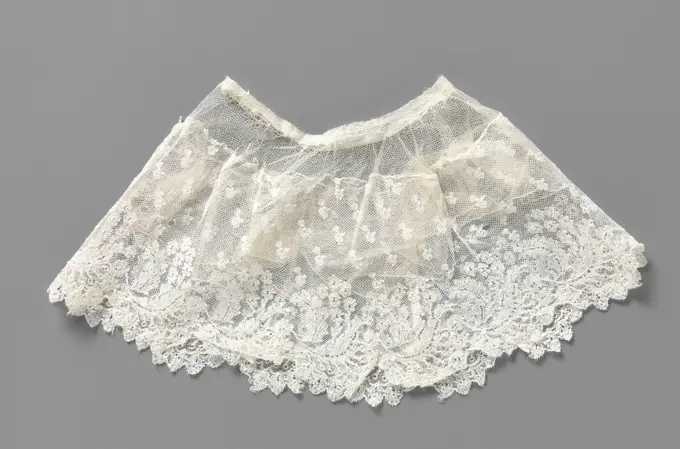
Strip of needle side with cornflowers, anonymous, c. 1800 - c. 1820 Two -thirds of the width is filled with a spreading pattern of falling cornflowers on a coarse soil (of flooded bars). A third of the width forms a right-winged outer edge (with a single alençon soil), lined with two pearl lists, and decorated with a horizontal flank of stretched stalks, each with three cornflowers, which are always in the same direction. Alençon side. France linen (material) Alençon Lace Two -thirds of the width is filled with a spreading pattern of falling cornflowers on a coarse soil (of flooded bars). A third of the width forms a right-winged outer edge (with a single alençon soil), lined with two pearl lists, and decorated with a horizontal flank of stretched stalks, each with three cornflowers, which are always in the same direction. Alençon side. France linen (material) Alençon Lace
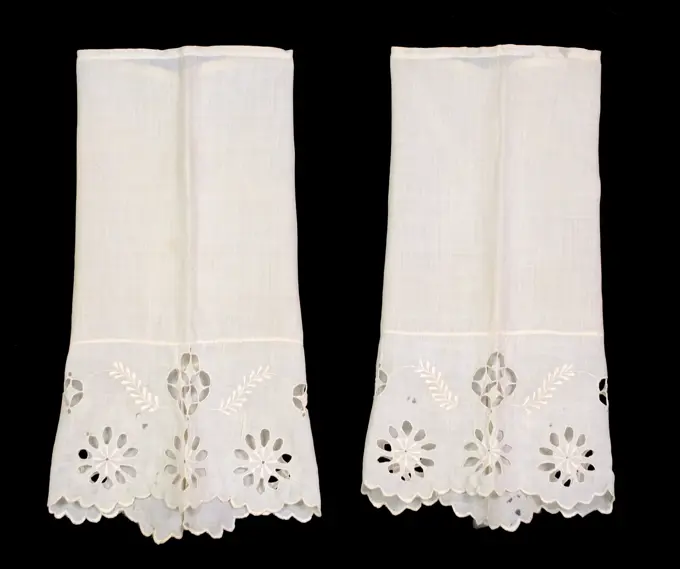
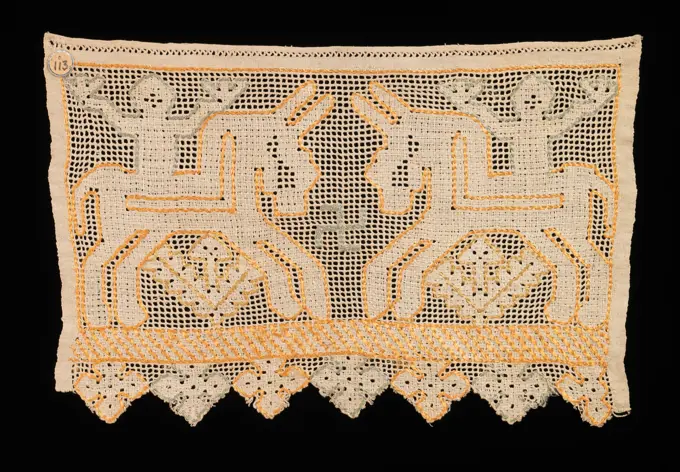
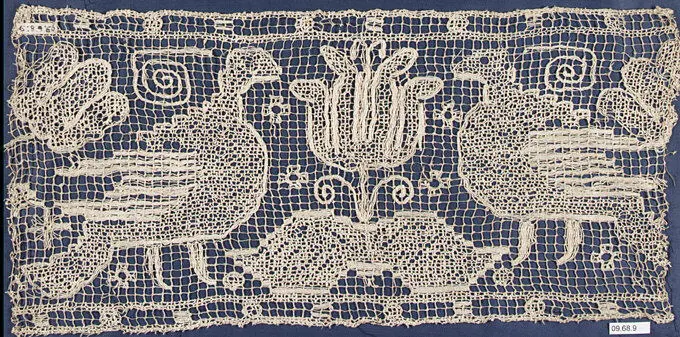
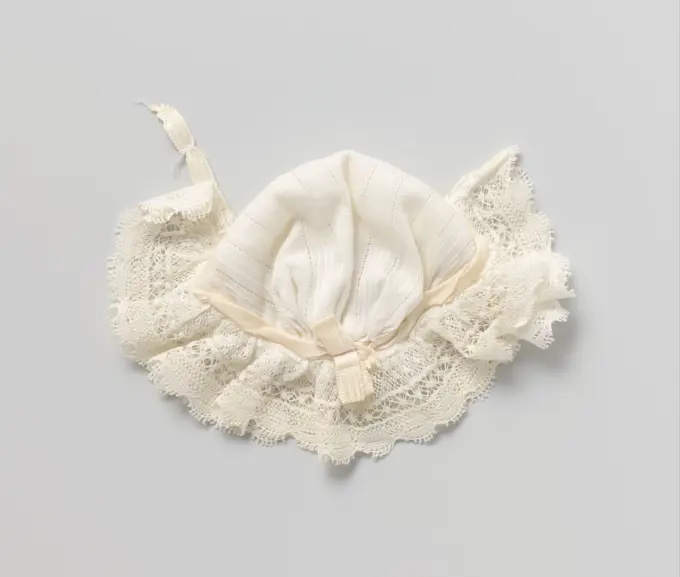
Plastron early 19th century Southern German. Plastron 214727Fragment (USA); Manufactured by A .G. Jennings & Sons; cottonFontaneldoek van Linen with lace, anonymous, c. 1750 - c. 1900 Brain pan - fontan cloth () - of linen with lace strips. Europe linen (material). Brain pan - fontan cloth () - of linen with lace strips. Europe linen (material).Undersleeves ca. 1855 American. Undersleeves 168873Towel border early 19th century Russian This object is from the collection of Natalia de Shabelsky (1841-1905), a Russian noblewoman compelled to preserve what she perceived as the vanishing folk art traditions of her native country. Traveling extensively throughout Great Russia, she collected many fine examples of textile art of the wealthy peasant class. From the 1870s until moving to France in 1902, Shabelsky amassed a large collection of intricately embroidered hand-woven household textiles and opulent festival garments with rich decoration and elaborate motifs. The Brooklyn Museum holdings include many fine examples including the majority of the garments. Portions of Shabelsky's collection are also housed at the Museum of Fine Arts, Boston, the Cleveland Art Museum, and the Russian Museum of Ethnography in St. Petersburg.In 19th-century Russia the swastika was a heraldic symbol along with the imperial eagle. In Slavic cultures the shape is a manifestation of the sun, worshipped foA gold ornamental plateTriangular scarf of application side with rose branch and tulip, anonymous, c. 1850 Scarf of natural application side, needle side applied on mechanical tulle. Triangular model. The pattern consists of a rose branch and a tulip in the middle, above a garland of tulips, carnations and other flowers. The scarf has a scalloped edge of hanging tulips and leaves. Brussels linen (material) Scarf of natural application side, needle side applied on mechanical tulle. Triangular model. The pattern consists of a rose branch and a tulip in the middle, above a garland of tulips, carnations and other flowers. The scarf has a scalloped edge of hanging tulips and leaves. Brussels linen (material)Double Jabot of Application side on Machine Tulle, Anonymous, c. 1925 - c. 1950 Double jabot of application side on machine tulle, with sculpted and potented edge. The pattern of the Kloskant application has leaves, curled branches and moesjes. Belgium . bobbin lace Double jabot of application side on machine tulle, with sculpted and potented edge. The pattern of the Kloskant application has leaves, curled branches and moesjes. Belgium . bobbin laceBorder fragment 16th-17th century Southern German. Border fragment 217941Fragment 16th century Italian. Fragment 214858Doll hat of nettle cloth, with lace strips and pink ribbon, anonymous, c. 1900 Doll hat from Neteldoek., With lace strips and pink ribbon. Gräfenheim b. Ohr buckram Doll hat from Neteldoek., With lace strips and pink ribbon. Gräfenheim b. Ohr buckramFragment (France); linenBobbin Lace (Point d'Angleterre) Lappet, 18th century. Belgium, Brussels, 18th century. Lace, bobbin: linen; average: 123.2 x 12.7 cm (48 1/2 x 5 in.).Strook kant gemaakt als meubelbekleding met lelie.Natural collate strip: ribbon side. The repetitive and symmetrical pattern consists of a stylized hanging lily. The successive lilies touch each other at the height of the curly outer flower leaves. The leaves of two adjacent flowers form a U-shaped field. In these fields a drop-shaped leaf hangs from the top of the strip. The motifs are formed by ribbons that are clamped in linen battle with openwork edges and contour wires. The motifs are connected to each other by a braiding ground of double braids that form stars. The lilies form the slip edge. The top of the strip is straight finished. It concerns monastic work from Naples.Slab of white cotton (), With flannel bottom layer and top layer with piqué, decorated with a wide recommended scalloped edge of English embroidery, anonymous  Slab made of white cotton (), With flannel bottom layer and top layer with piqué, decorated with a wide advanced scalloped edge of English embroidery.  cotton (textile). flannel embroideringFragment; linen; Bequest of Marian Hague; 1971-50-348Collar ca. 1878 American. Collar 119186Mantle 1870s American or European. Mantle 122975Manchet van kloskant met sikkelvormige blad- en bloemtakken.Cuff from natural tulle with a border underneath: Mechelen side. The tulle is unfinished and slightly darker from shade than the Malinois side that is sewn from the tulle. Trapezoidal clocking model. The repeating pattern of the Mechelen side consists of semicircular slot, formed by fine leaves that are on the outside of a curved rocaille motif. Long leaves and a group of six rosette flowers or forget-me-staples on the inside. Blossoms scattered on the field above that. The motifs are made in linen stroke and are accentuated by thicker shiny contour wires. The motifs are connected by a Mechelen soil. In the leaves a dot decoration is made in shape stroke. The side is made in Belgium, the cuffs are made in the Netherlands.Shawl ca. 1860 French. Shawl 123037Bobbin Lace (Point d'Angleterre) Lappet, 1720s-1730s. Flanders, 18th century. Lace, bobbin: linen; average: 59.7 x 12.1 cm (23 1/2 x 4 3/4 in.).Cap 1810-15 French. Cap. French. 1810-15. cottonBorder. Northern Italy. Date: 1701-1750. Dimensions: 13.1 x 292.8 cm (5 1/8 x 115 1/4 in.)Width repeat: 27.8 cm (11 in.). Linen, bobbin part lace. Origin: Italy. Museum: The Chicago Art Institute, Chicago, USA.Strip of a climbing side with pearl and rosette list. On the ground soil, a mechelen soil (also known as ice soil), with some sprinkled four-pastor moes is a running pattern. Along the inside are small hanging rosette branches, a dune rose in the middle of a dune rose to larger voluntaries, which shown at the same flour that forms the closing piece of pure circle arc shut. The tubes consist of a pearl and rosette list, which enclose a center barrier with grid work. Mechelen side.Neckcloth 1864-67 American. Neckcloth. American. 1864-67. cottonPair of Engageantes. France, circa 1765-1775. Costumes; Accessories. Linen point d'Argentan needle laceFragment of the lace;  XVII century (1601-00-00-1700-00-00);