Lace Textile Fragment

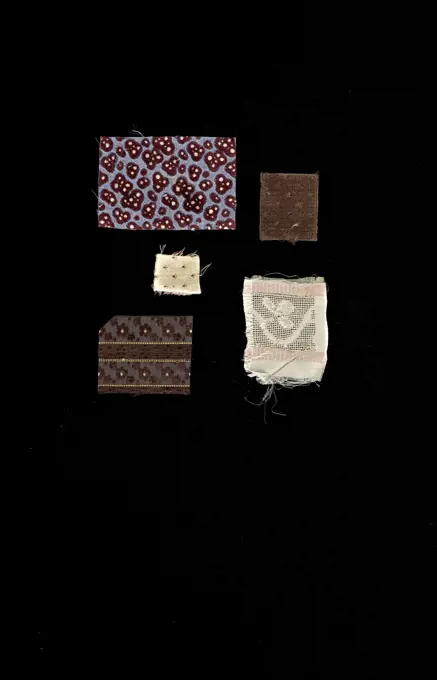
Historical lace strips showcasing intricate patterns in various styles, emphasizing craftsmanship and decorative textile design.


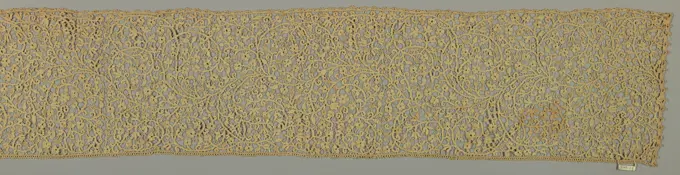
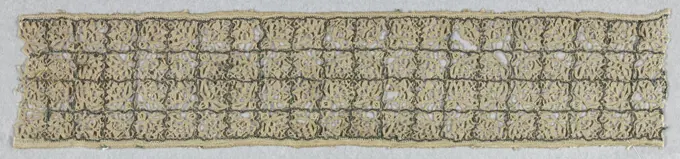
Strip bobbin with curly flower branch on continuous slender, anonymous, c. 1700 Strip of natural -colored bobbin: Old Flemish bobbin with braid soil. The repeating pattern consists of a continuous wavy slender with a curly side branch with a flower in each golf valley and a curly branch with a flower under each golf top under each golf top. The motifs are connected by a braid ground. The motifs are made in linen battle with openwork edges. Top and bottom of the strip are straight finished, the bottom is equipped with picots. The upper edge is somewhat ragged due to damage. Flanders linen (material) bobbin lace / Flemish lace with plaited ground Strip of natural -colored bobbin: Old Flemish bobbin with braid soil. The repeating pattern consists of a continuous wavy slender with a curly side branch with a flower in each golf valley and a curly branch with a flower under each golf top under each golf top. The motifs are connected by a braid ground. The motifs are made in linen battle with
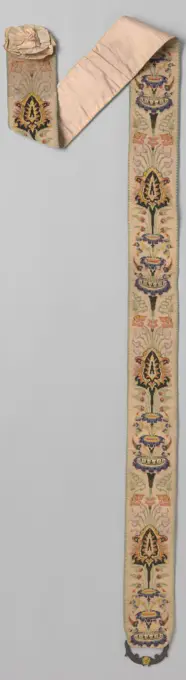
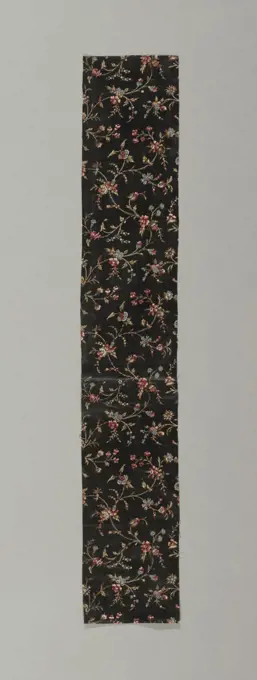
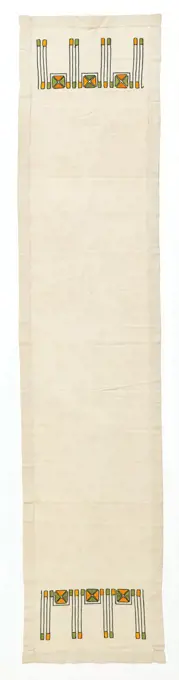
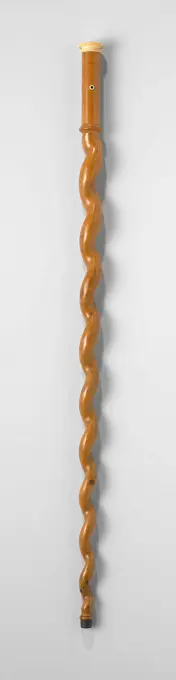
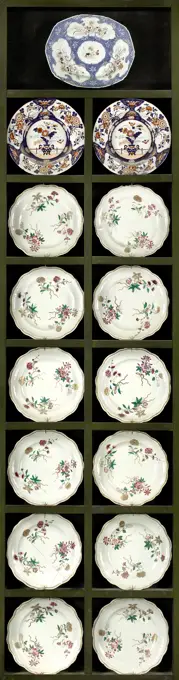
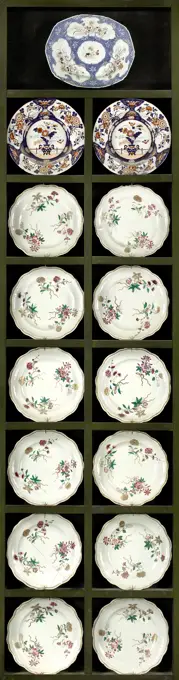
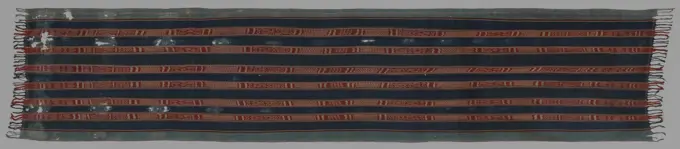
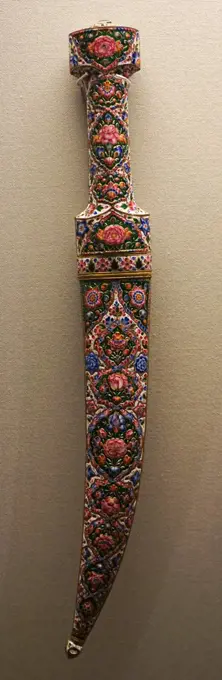
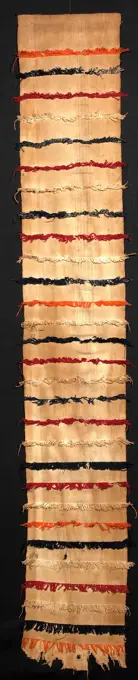
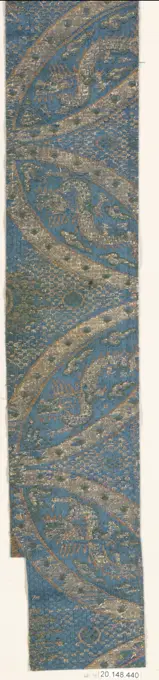
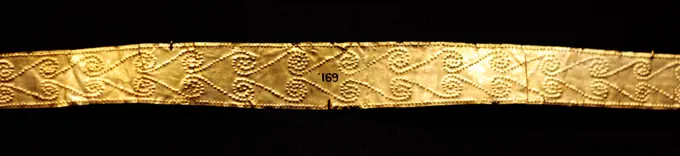
Fringe, Medium: silk Technique: woven, Red fringe with an ornamental heading and picots on the top edge. Skirt threads are looped to form scallops., Italy, 16th century, trimmings, FringeFragment Made 1701-1725 Japan. Brocaded fancy satin, silk .Design for a sheath with the head of a man with a helmet at the top, Heinrich Aldgrever, 1535 print Design for a dagger, decorated with leaf vines. At the top is a wreath with the head of a man with a helmet. Germany paper engraving foliage, tendrils, branches ~ ornamentWampum belt -Fragment lining fabric, brown checked., C. 1800 - c. 1950 Fragment lining fabric, brown checked.  cotton (textile) Fragment lining fabric, brown checked.  cotton (textile)Band (Italy); linen; 1945-9-3Fringe, Medium: silk Technique: woven, Fringe in pink, yellow and tan with a plain-woven heading. Skirt threads, looped in pink, yellow and tan stripes, are scalloped, France, 18th century, trimmings, FringeFragment early 19th century British, Buckinghamshire. Fragment 219448Fringe (Spain); silkTrimming (Italy); silkFragment 17th century Italian, Venice. Fragment. Italian, Venice. 17th century. Bobbin lace, gros point lace. Textiles-LacesEdging 16th century Italian. Edging 220853Blanket, 1800s. India, 19th century. Twill weave: cotton, metal thread; overall: 302.3 x 87.6 cm (119 x 34 1/2 in.).Spatula with fist finial 2nd-6th century Moche. Spatula with fist finial 318523Hanging China Qing dynasty (1644-1911), Qianlong period (1736-95)Section of Border from Thanka (Religious Picture) Made 1701-1800 China. Silk, warp-float faced 2 1 's' twill weave with plain interlacings of secondary binding warps and supplementary patterning wefts . ManchuTrimming, Medium: silk, paper or linen backing Technique: embroidered, Fragment of an embroidered and scalloped trimming. Yellow satin cut into scallops is edged with green and gold cord and embroidered in the center with a four petal flower head pattern in orange and blue silk thread., Spain, 18th century, trimmings, TrimmingSchelkoord with wool embroidery ,, c. 1800 - c. 1850 Schelkoord with woolen embroidery. On a yellowed pattern is a repeated candelabre motif. The cord is lined with a pink taft side and is finished with a rose of rose and white taf side. The handle consists of a dark patinated, partly gilded bronze half arch of two acanthus vines, which spring from the neck of a lion's head and are closed by a gilded rosette. Netherlands silk. taffeta. bronze (metal). gilding (material) embroidering / gilding Schelkoord with woolen embroidery. On a yellowed pattern is a repeated candelabre motif. The cord is lined with a pink taft side and is finished with a rose of rose and white taf side. The handle consists of a dark patinated, partly gilded bronze half arch of two acanthus vines, which spring from the neck of a lion's head and are closed by a gilded rosette. Netherlands silk. taffeta. bronze (metal). gilding (material) embroidering / gildingFragment, Medium: cotton Technique: plain weave foundation. block-printed; two reds, deep purple, light purple. Yellow and blue applied by brush (no green)., Fine flowering vine on a dark purple background., possibly Netherlands, late 18th century, printed, dyed & painted textiles, FragmentTable runner, Medium: cotton Technique: embroidered on plain weave, Long rectangular white table runner with an embroidered geometrical pattern of green and orange squares and triangles outlined in black stem stitch., USA, ca. 1912, embroidery & stitching, Table runnerFragment (Japan)Trimming (France); silk, silver metallic thread, silver stripsEmbroidered Border Fragment 5th-4th century B.C. Paracas. Embroidered Border Fragment 308044Lace, 1800s, maker unknown. Acquisition history unknown.Ribbon early 19th century French. Ribbon 215683Fragment 16th century Italian. Fragment. Italian. 16th century. Bobbin lace. Textiles-LacesFragment, Sleeve Ornament from a Tunic, 500s - early 600s. Egypt, Byzantine period, 6th-early 7th century. Tapestry (probably originally inwoven in tabby ground); wool; overall: 2.5 x 11 cm (1 x 4 5/16 in.).Border, Block-printed and flocked on machine-made paper, Narrow border, with very ornate strung bead and honeycomb lace design. Printed in grisaille and red flock on white ground. Passementerie or fancy gimp, printed three across., H#43, France, 1835-1860, Wallcoverings, BorderBelt hook 4th-3rd century B.C. China. Belt hook 44785Border, Block printed and flocked on paper, Border strip, with serpentine streamer of flowers and foliage between rocaille strips. Printed in blue, gray, green, brown and yellow with brown flock., France, ca. 1860, Wallcoverings, BorderFringe (France); silkTrimming, Medium: silk Technique: woven, Blue satin ground with ivory leaves turning alternately left and right; wave design in border., France, early 19th century, trimmings, TrimmingPiece 18th century Japan. Piece 71593Trimming, Medium: linen, silk, wire, Woven openwork linen band wound with pink and white silk. Green silk floss foliage band down the center, dotted with buds of ribbon in shades of pink, white, dark purple and red., France, 18th century, trimmings, TrimmingTrimming (Spain); white and colored silks in uncut velvet weave.; Overall: 31 x 4.5 cm (12 3/16 x 1 3/4 in.)Bell Pull ca. 1870 French, probably. Bell Pull 13568Bamboo, Chiang Ting, 1832 Painting proposing bamboo. Note: see AK-MAK-97-A. In wooden box. China ink. paper Painting proposing bamboo. Note: see AK-MAK-97-A. In wooden box. China ink. paperFragment (France); silk, metallic thread; Warp x Weft: 97 x 11.5 cm (38 3/16 x 4 1/2 in.); Bequest of Richard Cranch Greenleaf in memory of his mother, Adeline Emma Greenleaf; 1962-58-30Warped wooden walking sticks were introduced by wealthy and fashionable young Frenchmen, who were called the Incroyables (Incredibles) because of their highly eccentric attire. They were rebelling against the Reign of Terror during the Directoire period (1795-1799). To express their refusal to be subject to this rule, they nicknamed their walking sticks pouvoir executive (executive power).Hand-painted lamppost with four portraits of celebrities and or noble persons, slide plate slideshope images glass paper textiles, Hand-painted rectangular magic lantern plate with the illustrations from top to bottom. The edges are finished with white paper. Black background with four portraits of celebrities and or noble people. The record is part of series of fifteen and is accompanied by list of contents Handwritten on paper around: J. van Oldenbarnevelt; Hugo de Groot; Maria van Reigersbergen; Vlugt by H. de Groot; under the loop: N = 5 Oldenbarnevelt optics magic lantern magic lantern plate toy history education Hugo de Groot RotterdamBorder (possibly France); block-printed and flocked; 47 x 4 cm (18 1/2 x 1 9/16 in.)Border, Medium: linen Technique: bobbin lace, continuous braid-like, 17th-18th century, lace, BorderHeadband(partial).  Artist: UnknownPassementerie mid-18th century French. Passementerie. French. mid-18th century. Silk. Textiles-TrimmingsAltar Back Made 1801-1900 France. Embroidered in silver and gold metal wrapped fiber cord, silver frisÈ, silk floss, silk plain weave fabric for appliquÈ, twisted silk (2-ply), lining silver purl silver plate , cord; couching in pattern over cord, couching; satin, long and short, stem, and couched filling stitches; French knot .Ribbon early 19th century possibly French. Ribbon 220666Strip with Rond Medallon, Anonymous, After Jacques Vauquer, After 1631 - Before 1676 print Leaves and ribbons are depicted in the background. France (possibly) paper engravingBand, Medium: linen, silk, metal Technique: grid of withdrawn element with needle lace, reticella style, Band with a design of circles within squares. Embroidered square grid., England, 16th-17th century, lace, BandTrimming (France); 1909-2-211Khamar, 20th century, 123 x 36 in. (312.42 x 91.4 cm), Silk, Bhutan, 20th centuryField of three rand tiles, anonymous, c. 1660 - c. 1700 Field of 3 edge tiles (1 x 3) each with a blue painted animal. Netherlands earthenware. tin glaze majolica Field of 3 edge tiles (1 x 3) each with a blue painted animal. Netherlands earthenware. tin glaze majolicaVictor Hugo (1802-1885). Chinese decor from Juliette Drouet's house in Guernsey, West Wall. Green wooden record containing plates and dishes, composed of fourteen compartments (left side of the fireplace). Painted wood. 1857-1864. Paris, house of Victor Hugo. 78171-21 Asian art, decorative arts, green wood, Chinese cabinet, chinoiserie, compartment, decor, earthenware, painted, storage, Chinese living room, dishes, 19th XIX 19th 19th 19th 19th century, plate, dishVictor Hugo (1802-1885). Chinese decor from Juliette Drouet's house in Guernsey, West Wall. Green wooden record containing plates and dishes, composed of fourteen compartments (left side of the fireplace). Painted wood. 1857-1864. Paris, house of Victor Hugo. 78171-21 Asian art, decorative arts, green wood, Chinese cabinet, chinoiserie, compartment, decor, earthenware, painted, storage, Chinese living room, dishes, 19th XIX 19th 19th 19th 19th century, plate, dishBarbed Point 3rd century B.C.-A.D. 2nd century Vicús. Barbed Point 315500Border, Medium: linen Technique: bobbin lace, Mechlin style, Border of Mechlin lace has the upper part ornamented with buds in diagonal rows. At the border, a row of scrolls with flowers and leaves. Edge is straight., Belgium, early 19th century, lace, BorderShroud(Rindulolo)Currency bar from Fiji, with cowrie shells threaded on a stick. circa 1900Fish Pendant 1300 BCE-900 BCE China. Jade .Collection Dutch Heidematschappij. Insects, damage, moorspaint beetle. undatedStole mid-17th century Italian, probably Venice. Stole 229690Day one by Barnett Newman, oil on canvas, 1951-52, 1905-1970, USA, New York State, New York City, Whitney Museum of American ArtFrench textile manuscript, ca. 1820, ca. 1820, instruction manual for a school associated with a manufactory begins with a history of silk manufacture and continues with discussion of contemporary silk makers in Spain, Italy and France. The text is illustrated with 136 intricate drawings of looms, many in watercolor, showing set-ups for various patterns and materials, and includes 102 tipped-in examples of fabric. The chapters contain detailed information on silkworms and their breeding, the pulling of silk, and the composition of fashion materials, including gauze and damask.Hanging scroll with bamboo and orchids on a rock, Ma Shouzhen, c. 1548 - c. 1604 Hang roll with bamboo and orchids on a rock. In wooden box. Nanking paper. ink Hang roll with bamboo and orchids on a rock. In wooden box. Nanking paper. inkBorder (England); block-printed and flocked paper; 84 x 13 cm (33 1/16 x 5 1/8 in.)Large dagger with a Damascus steel blade from Qajar, Iran. Dated 19th CenturyTrimming, Medium: silk Technique: woven, Red trimming fragment in a chevron pattern; picot edges., France, 19th century, trimmings, TrimmingMantle, early 20th century, 79 x 12 in. (200.66 x 30.48 cm), Cotton; cut weft pile, Guatemala, 20th centuryPiece 18th century China. Piece 71433Mirror 6th century B.C. Greek, Cypriot. Mirror. Greek, Cypriot. 6th century B.C.. Bronze. BronzesFragment (France); Manufactured by Petitpierre Freres; Made by Petitpierre et Cie; cottonA sash from the funeral of Adam Mickiewicz in Krakow on July 4, 1890Ancient Greek 'Palace Age' Minoan Gold Diadems. Circa 1850-1550 BC. From the Aegina treasures held at the British Museum, London. Originally from Aegina, off the south coast of Greece.Fringe, Medium: silk, metallic thread (gold strips on silk core) Technique: plain weave, Fringe of red and gold threads with a heading and skirt threads cut into points; tufts hanging on red loops between points and at center of each., Italy, 17th century, trimmings, FringeSpine. Brantôme, Pierre de Bourdeille, seigneur de (d. 1614). bindings (gathered matter components), Book covers. 1882. Spencer Collection. BookbindingBookmark, Technique: jacquard woven, Bookmark with writing at top, eagle and flags in the center and a view of Machinery Hall at the bottom. Paper wrapper accompanies bookmark. Woven for the Columbian Exposition of 1893., USA, 1893, woven textiles, Bookmark