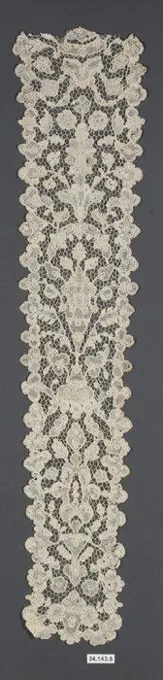
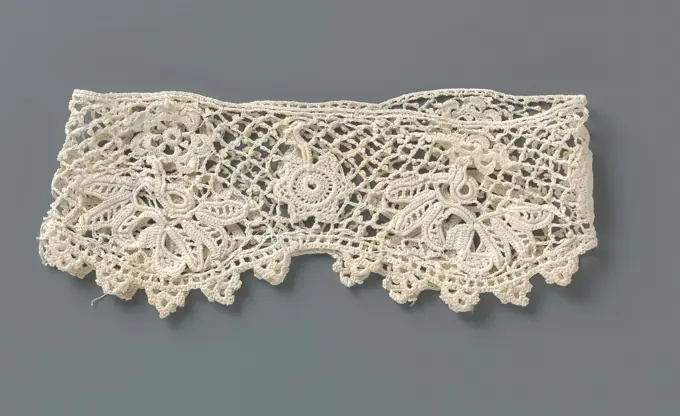
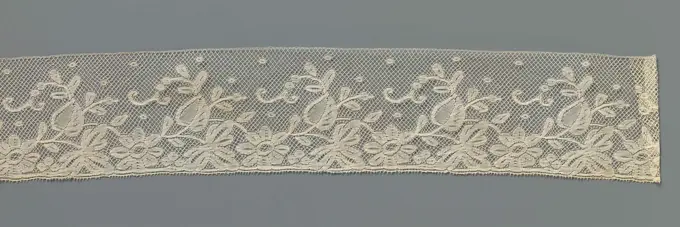
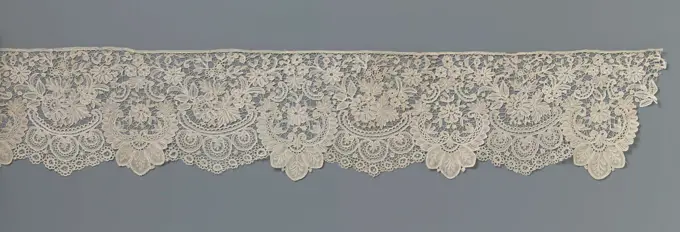
Lace Textile Fragments

Delicate lace strips featuring intricate patterns and techniques, highlighting traditional craftsmanship from different historical periods.

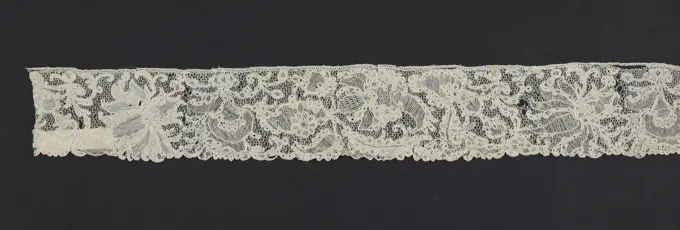
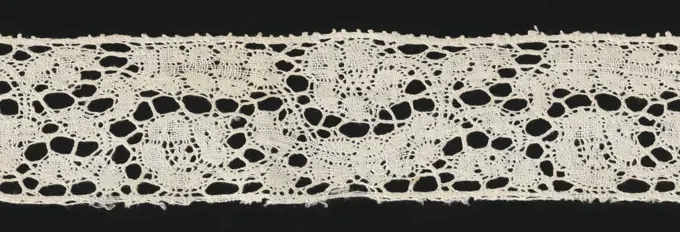
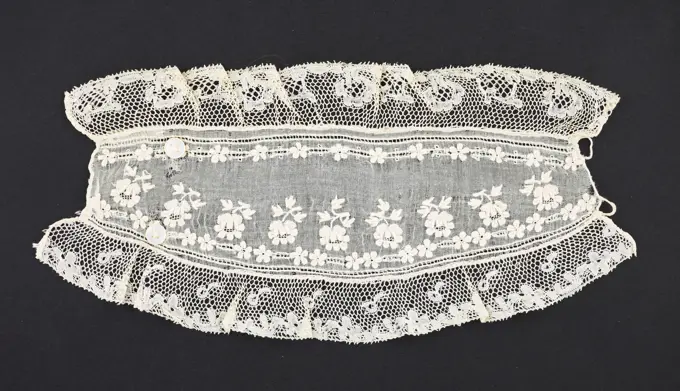
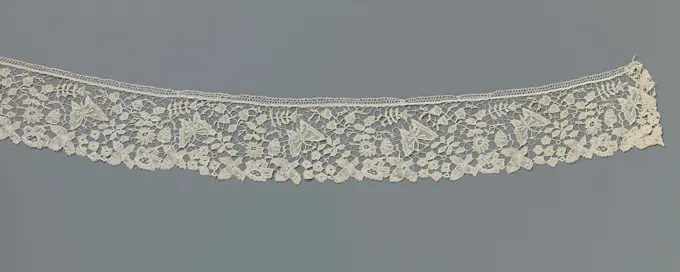
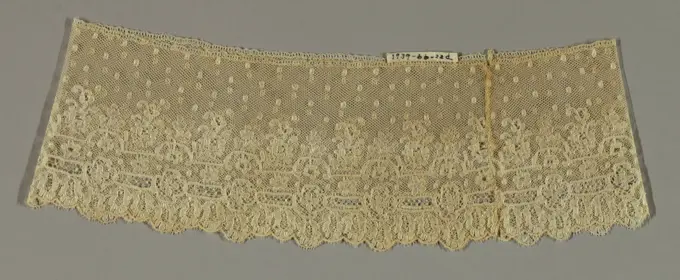
Border; linen
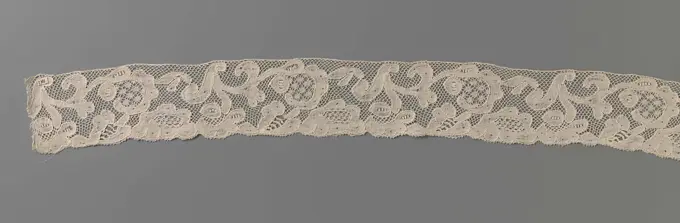
Border; linen
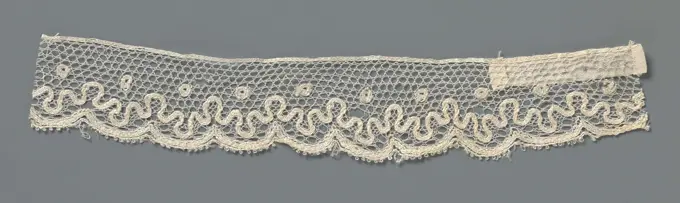
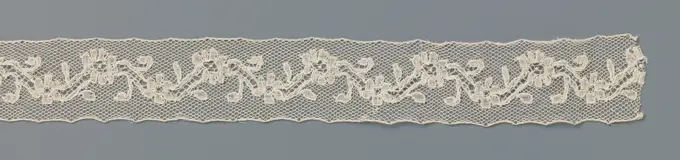
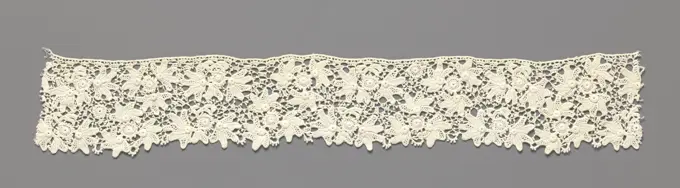
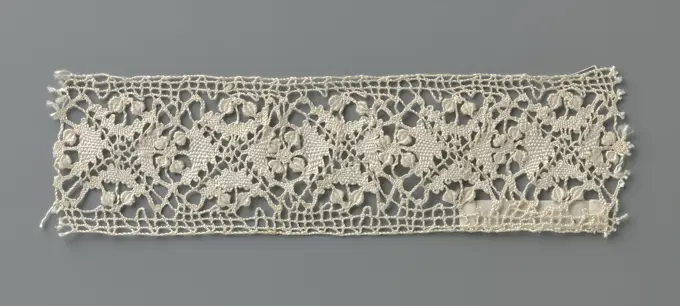
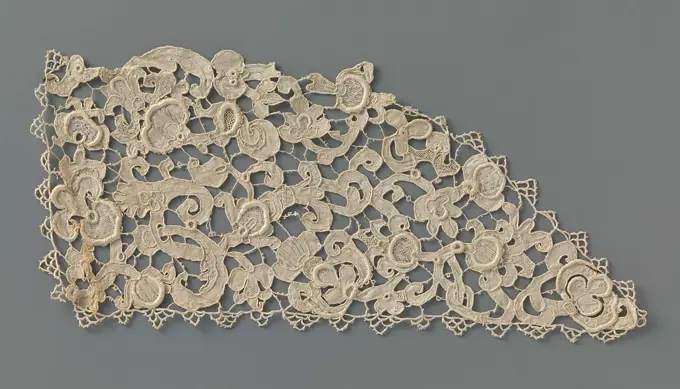
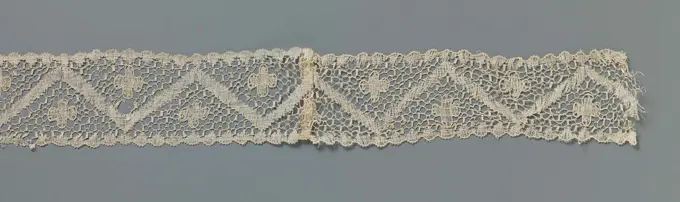
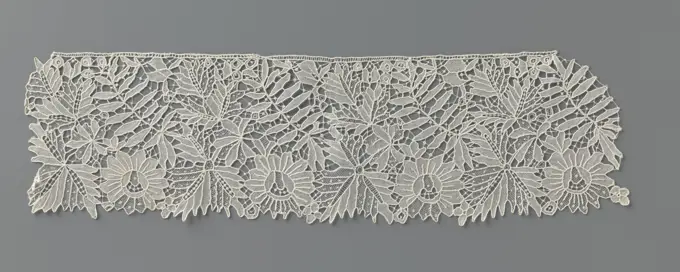
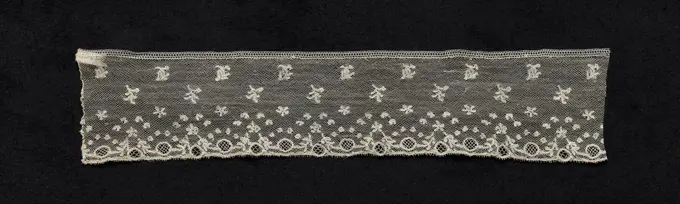
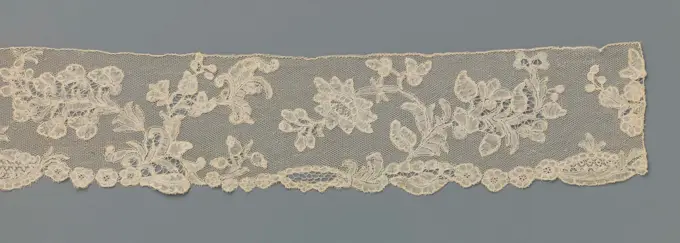
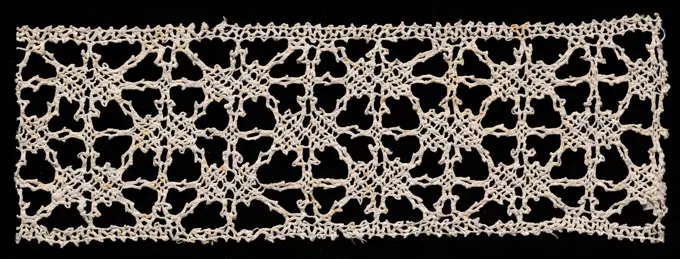
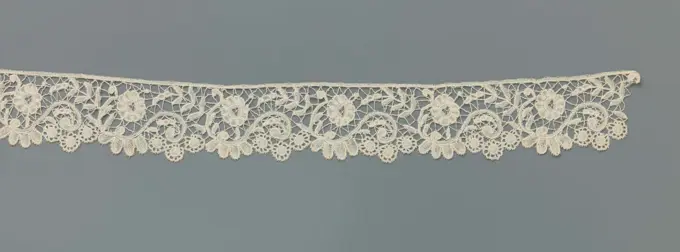
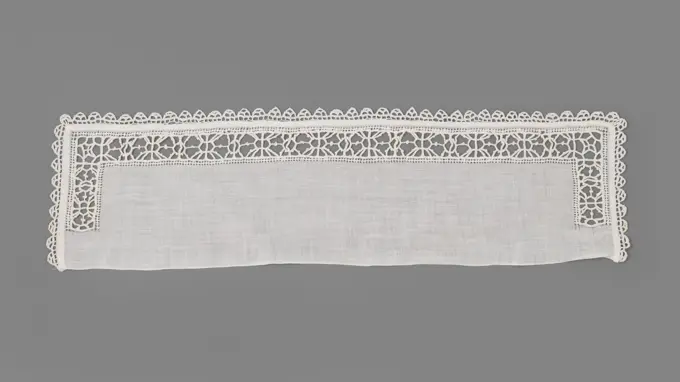
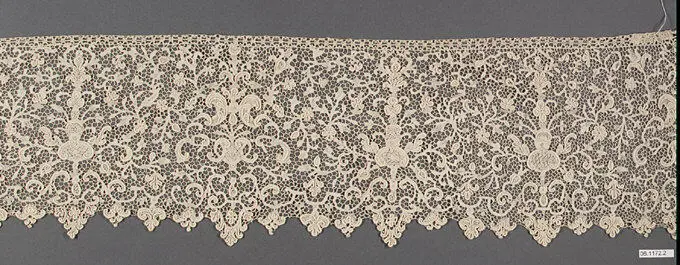
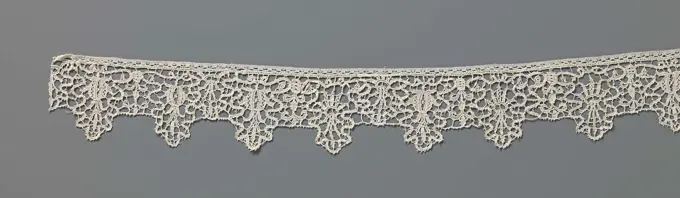
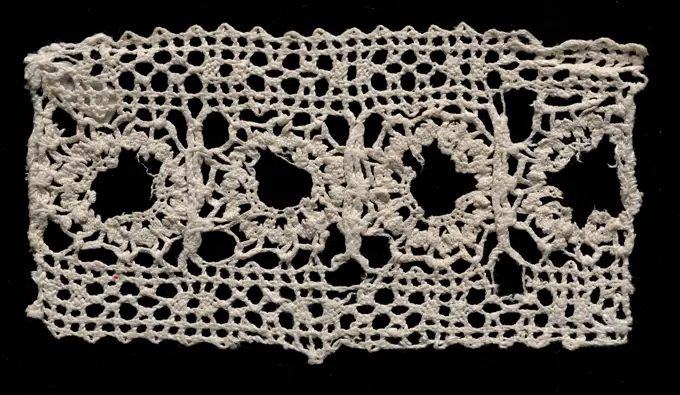
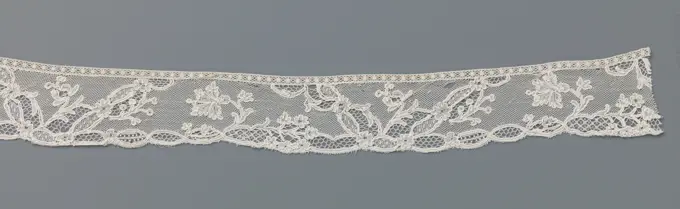
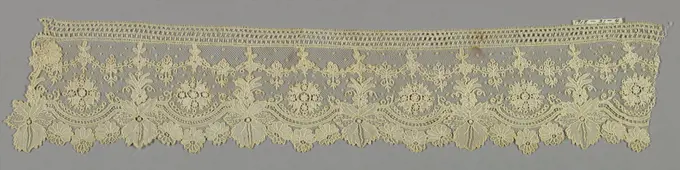
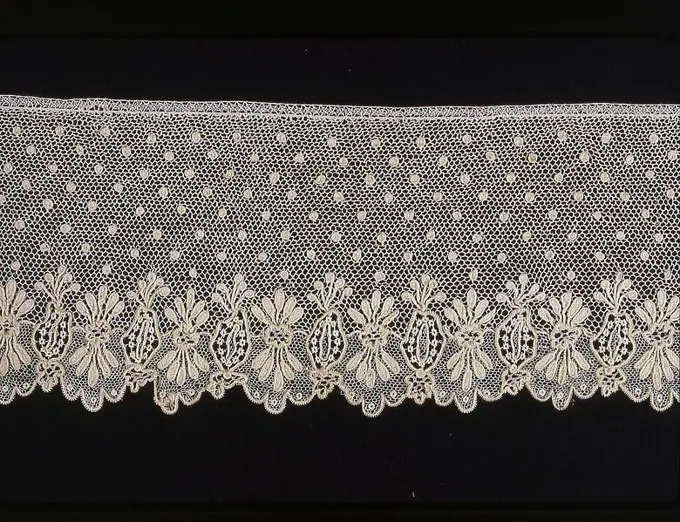
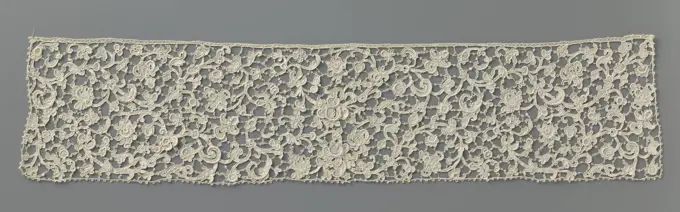
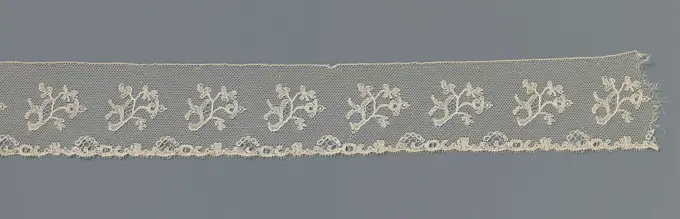
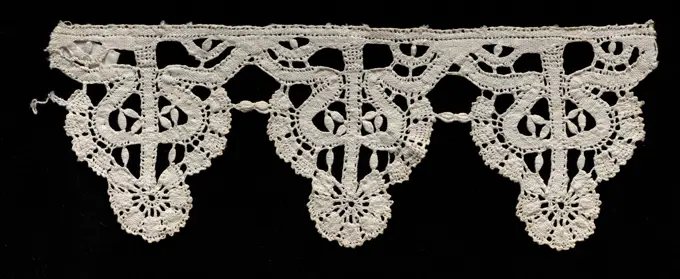
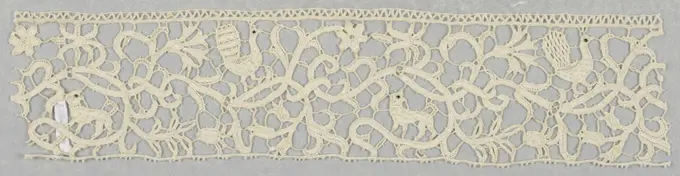
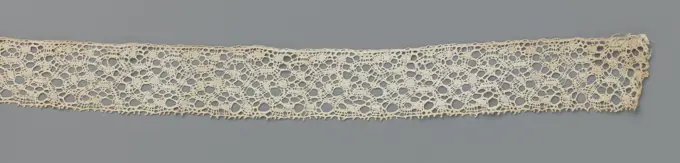
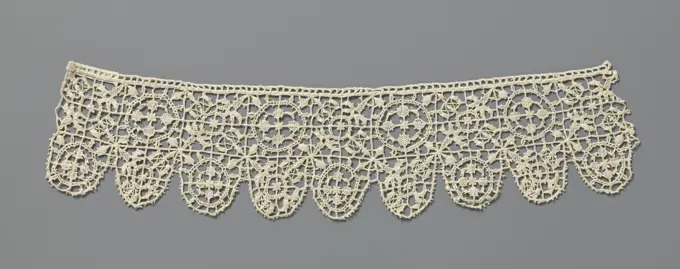
Strip of needle side with two types of rosettes in squares, anonymous, c. 1600 - c. 1609 Strip of natural needle side: reticella. The top of the pattern consists of squares, which are made up of four small squares. In the squares alternately a small and a large circle. Flowers around the small circle in the corners. Around the large circle in the corners leaves. This pattern jumps and repeats itself in the bottom of the strip, but the squares are rounded on the side and bottom to half -circular deep sculptes. The scrap edge is finished with picots. The top of the strip is finished with a crocheted narrow border with squares. Italy linen (material) Strip of natural needle side: reticella. The top of the pattern consists of squares, which are made up of four small squares. In the squares alternately a small and a large circle. Flowers around the small circle in the corners. Around the large circle in the corners leaves. This pattern jumps and repeats itself in the bottom of the strip, buStrip of needle side with stretched S-rank, anonymous, c. 1875 - c. 1909 Strip of natural -colored needle side: Venetian relief side. A loose pattern of interrupted volute vines and palm flowers stands on a very open bar of bar. Straight finish with triangles, alternately large and small. BURANO linen (material) Venetian raised work Strip of natural -colored needle side: Venetian relief side. A loose pattern of interrupted volute vines and palm flowers stands on a very open bar of bar. Straight finish with triangles, alternately large and small. BURANO linen (material) Venetian raised workFragment, Medium: linen Technique: bobbin lace, Mechlin style with five hole ground, Belgium, 18th century, lace, FragmentStrook kloskant met slingerend lint onder een rij moesjes.Strip natural colosside, Paris side. A swinging ribbon runs between a row of opened meadows just above the center line of the strip and the shelters along the bottom. The motifs are connected by a Maas soil, a Paris soil. The motifs are made with thick threads. The top of the strip is straight finished. The shelters are finished with picots.Belegstuk van kloskant met voluten.Insignment of natural colosside, possibly Flemish guipure. Symmetrical pattern with volutes to which three, four and five-leaf flowers spring. Around the motifs a braided barrier ground with picots. Within the motifs a honeycomb ground. Finish on all sides with triangles built from arcs.Fragment of the lace;  after. 18th century (1740-00-00-1760-00-00);Border; linenKloskant intermediate base with Zigzaglijn, Anonymous, 1875 - 1949 Piles of Natural -colored bobbin side: Mechelse side. In the middle of the fine grid, a Mechelen soil (also known as ice soil), an openwork band runs in Zigzaglijn, cut over by two types of rosettes. Belgium linen (material) bobbin lace / Mechlin (lace) Piles of Natural -colored bobbin side: Mechelse side. In the middle of the fine grid, a Mechelen soil (also known as ice soil), an openwork band runs in Zigzaglijn, cut over by two types of rosettes. Belgium linen (material) bobbin lace / Mechlin (lace)Strip of needle side with incised leaves, anonymous, c. 1900 Walking pattern of incised leaves above a rose and a three -leaf, which together form the sharply toothed outside line. Cross-shaped bars with button (soil of long X-shaped bars with a spider). The Remplis consists of buttonholes and a long distance gazé. German side: 'Carlsbader Points'. Karlsbad (Germany) (possibly) linen (material) Walking pattern of incised leaves above a rose and a three -leaf, which together form the sharply toothed outside line. Cross-shaped bars with button (soil of long X-shaped bars with a spider). The Remplis consists of buttonholes and a long distance gazé. German side: 'Carlsbader Points'. Karlsbad (Germany) (possibly) linen (material)Strip crocheted side with hand -shaped blades around circular medallion, anonymous, c. 1850 - c. 1899 Strip of natural -colored crocheted side: Irish crocheted side. Pattern with a double row with two or three large hand -shaped leaves that jump out of a circular medallion. West-Europa cotton (textile) Strip of natural -colored crocheted side: Irish crocheted side. Pattern with a double row with two or three large hand -shaped leaves that jump out of a circular medallion. West-Europa cotton (textile)Kloskant intermediate springs with diamond -shaped fields formed by thin braids, anonymous, c. 1900 - c. 1915  Piles of natural -colored bobbin: Maltese Kant. The repeating and symmetrical pattern consists of a row of connected diamond -shaped fields, formed by thin braids. In each field there is a flower with four petals made in form, between two triangular motifs in linen battle. The triangular fields above and below this row of windows show a halved version of this pattern. Top and bottom of the strip are straight. Malta silk bobbin lace / Maltese laceStrip bobbin with rushed and flour in a circle under a line with leaves, anonymous, c. 1890 - c. 1899  Strip of natural -colored bobbin, Maltese side. The repeating pattern exists under a wide decorative border along the top, from a more or less straight line with Spuntovale leaves on either side. Every so many leaves the line is interrupted by a circle. The lower half of the pattern consists alternately of a rush -hour and a circle, with openwork decorative edges. In the circle there is a flower with eight rush -hour petals. The motifs are connected by braids. The motives are made in linen battle. The (flour) leaves are made in form. Such a magazine is known in Maltese Kant as Maltese leaf. The top is straight. The rush -hour and circles form scallops along the underside. Malta silk bobbin lace / Maltese laceLace, 1600-1700, Belgium, maker unknown. Gift of Mrs G. Acland Allen, 1955.Needle's antipendium edge with star -shaped flowers, anonymous, c. 1675 - c. 1699 Antependium edge of white needle side with a pattern of spiral vines with flowers including some star -shaped flowers. Very open soil with some potented bars. The top is trimmed with a straight border bobbin. The underside is finished with a straight picotrand with arches. Venice linen (material) flat Venetian (needle point) Antependium edge of white needle side with a pattern of spiral vines with flowers including some star -shaped flowers. Very open soil with some potented bars. The top is trimmed with a straight border bobbin. The underside is finished with a straight picotrand with arches. Venice linen (material) flat Venetian (needle point)Piece 19th century French. Piece 212532Strip bobbin with rosette flowers, anonymous, c. 1900 - c. 1924  Strip of natural-colored bobbin, Valenciennes side. The repeating pattern consists of a rosette flower that hangs down on a curved branch. Between the successive flowers there is a loose dot, with the right there, a rushed leaf slightly below the top of the strip. Along the underside of the strip, a wavy track is formed by such diagonally against each other at lying leaves. The motifs are connected by a Maas soil, a diamond-shaped Valenciennes ground. The motifs are made in linen battle with recesses and openwork edges. The top of the strip is straight finished. The scums along the bottom are finished with picots.  cotton (textile) Bobbi Lace / Valenciennes LaceBand; linen; 1933-1-50Lappet (one of a pair) 18th century French. Lappet (one of a pair) 223017Strip bobbin with hanging tulip, anonymous, c. 1900 - c. 1909 Strip of natural-colored bobbin: Valenciennes side. There is a running pattern on a gross traly soil (square grater), which is littered with 'sequins'. Unilaterally targeted hanging tulips are loose above stretched scales of a garland with hanging berries. The strip has doubled, along the straight top is a narrower strip with a similar pattern (BK-BR-J-321-C). Netherlands (possibly) linen (material) Bobbi Lace / Valenciennes Lace Strip of natural-colored bobbin: Valenciennes side. There is a running pattern on a gross traly soil (square grater), which is littered with 'sequins'. Unilaterally targeted hanging tulips are loose above stretched scales of a garland with hanging berries. The strip has doubled, along the straight top is a narrower strip with a similar pattern (BK-BR-J-321-C). Netherlands (possibly) linen (material) Bobbi Lace / Valenciennes LaceStriping closy side with sepals under Over -defeated Golf, Anonymous, c. 1840 - c. 1860 Strip of natural-colored bobbin, Honiton side. The repeating and continuous pattern consists of a band that forms skipping waves, with a hanging narrow chalice flower under each foam head. Between the successive chalices, a rosette flower hangs from the wavy band on a handle with two leaves. Stir upwards from the golf three stems, each with a smaller chalice flower. The motifs are connected by a braid ground, with potented braids. They are made in linen and mains with openwork edges. Three relief contour lines have been installed in each wave top. In the chalice, a decorative land with square motifs in shape has been used. The top of the strip is straight finished with a strap in linen. The scallops along the underside stems from the petals of the chalice and rosette flowers and is finished with picots. Assert cotton (textile) bobbin lace / Honiton lace Strip of natural-colored bobbin, Honiton side.Manchet van gehaakte kant met getorst takje en stervormige bloem.Cuff of natural colored Irish crochet side. Pattern where a source of flour with a rosette flower and several elongated leaves are interspersed by a hanging star-shaped flower on a short stem without leaf. Crochet diamond-shaped Maas soil with picots. The top is finished with a straight edge. The wavy lower edge is deposited with picoted three-part arcs.Strook machinale kant met regelmatig golvende rank met kleine blaadjes.Strip natural-colored mechanical side: machining argentan side. The pattern consists of a regularly wavy rank with small leaves. There is a separate twig above each golf valley. Along the bottom, the pattern consists of two wavy tendrils with small leaves that together form a succession of circular cartouches and at the same time the sloping edge. Every third cartouche is the regular wave line above, where the tune point is overcured by a rosette flower. The motifs are equipped with contour wires and decorative grounds are used in the cartouches. The motifs are connected by a machining argentan ground, with meshes that seem to be festonated by the machine as done with the handmade Argentan side. The top of the strip is straight finished. The sloping edge seems to be finished by the looseed threads from the machine ornamental grounds with picots.Strook kloskant met rozetbloem tussen hartvormige bladeren en wijnbladeren.Natural collate strip, Valenciennes side. The repetitive and continuous pattern consists of a rosette flower between heart-shaped leaves and vine leaves. The motifs are connected by a maas soil, a diamond-shaped valenciennes ground, strewn with moes. The motifs are made in linen battle with recesses and open editors. One half of the heart-shaped leaf is made in a cut-off. The flower heart is decorated with a ring between four braids. The recesses in the petals are decorated with crossing couples. Upper and bottom of the strip are straight finished, the underside with picots.Strook kloskant met twee composities van c-voluten en madeliefjes.Strip natural colosside: fine bridges flower work. The repeating pattern consists of two, largely symmetrical compositions of C-Volutes and daisies. One composition consists along the underside of the strip of two c-volutes giving each other, placed at the bottom. Along the exterior of the volutes have been made in large increasing lovers, where the three largest forms a lobed shell. Between the C-Volutes are two chali flowers and a daisy, with a hanging palm paper leaf above, awarded three rosette flowers. The other composition consists of three highly bent C-volutes under an elongated lying C-voltage. A row of seven consecutive rosette flowers below forms the other lied glule. Above the lying C-voltage is an A-symmetrical settlement of larger and smaller rosette flowers and madelieves. The motifs are connected by a picoted braid soil. They are largely made in detached linen battle with openwork edges and recesses. The Bobbin Lace (Needlepoint Design) Insertion with Edging of Points, second half of 16th century. Italy, Genoa, second half of 16th century. Lace, bobbin; average: 3.9 x 19.8 cm (1 9/16 x 7 13/16 in.).Fragments of needle laceStrook van kloskant met dikke ranken.Strip natural colosside: Parisian side. On a square Valenciennes ground is an ongoing pattern of voluntaries. In the volutes a grid work filling with coarse spiders. Three fleshy and lobed leaves or flowers, which spring from the rank form the flattening. The motifs are made in linen stroke with a single recess and with thick contour wires. If ornamental grounds are coarse snowflakes, with ringed and non-ringed snowflakes. Some motifs have been realized with shape strokes. The top of the strip is straight finished. The slight sloping edge along the underside stems from the pattern with the voluntaries and is finished with picots.Bef van naaldkant met arabeskenbladeren.BEF of natural needle side: Venetian relief side. There are very large spiral raft on an open bars, among other things and there with a ring. Fleid arabesque leaves and various flowers show a moderate relief. On three sides a (new) bow edge runs.Band; medium:; Bequest of Marian Hague; 1971-50-294Strook kloskant met vierlobbig rozet boven en onder een zigzag-band.Strip natural colosside, blonde. The repetitive and continuous pattern consists of a zigzag band, which divided the strip into triangular fields. There is a quadruped rosette in the center of each field. Along the top and bottom of the strip a sculpture runs, which consists of a concatenation of circles. The crafts are finished with picots. The motifs are connected by a coarse mesh soil, strewn with square moes. The zigzag band, rosettes and circles edges are made in linen stroke, whereby the rosettes are equipped with a contour wire.Strip of needle side with incised leaves, anonymous, c. 1900 Walking pattern of incised leaves above a rose and a three -leaf, which together form the sharply toothed outside line. Cross-shaped bars with button (soil of long X-shaped bars with a spider). The Remplis consists of buttonholes and a long distance gazé. German side: 'Carlsbader Points'. Karlsbad (Germany) (possibly) linen (material) Walking pattern of incised leaves above a rose and a three -leaf, which together form the sharply toothed outside line. Cross-shaped bars with button (soil of long X-shaped bars with a spider). The Remplis consists of buttonholes and a long distance gazé. German side: 'Carlsbader Points'. Karlsbad (Germany) (possibly) linen (material)Bobbin Lace Edging, 1780-1800. Belgium, Mechelen, 18th century. Lace, bobbin; average: 7 x 33 cm (2 3/4 x 13 in.).Strook kloskant met aaneengeschakelde schuingeplaatste rechthoeken.Strip natural colosside: Mechelen side. Under a scattering pattern of hanging round flowers with one leaf lies a decorative belt along the underside of the strip, which is built up with jointed and slightly shaking rectangles. The edges of the rounded rectangles are thin branches with whimsical leaves. The lower edge forms a curl inwards, from which a sprig of round leaves fires and fills the center of the rectangle. Between the consecutive rectangles, a narrow cutter edge is filled with ovals in linen stroke, without contour wires. The motifs are connected by a fine Maas soil, a Mechelen soil. The sparse fullwork is made in linen stroke with thicker and shiny contour wires. The top of the strip is finished with a separate splitting strap. The underside is probably finished and provided with picots, but this is no longer clearly clear due to limited damage.Strook kloskant met vergeet-mij-nietjes en twee samengestelde takken.Strip natural colored Brussels climbing side. The repeating pattern consists of a hanging branch with a bunch of rosette flowers followed by two different composite branches, with lots of leaves, a single flower and berries. The branches from the bottom, both with a branch left and right. The motifs are connected by a fine Maas soil, a slighten ground. The full work is largely made in linen battle with openwork edges and recesses. Some berries have a power stuff. Most motifs are equipped with closted relief contours. Different ornamental grounds have been applied, including picoted braids (grounds). The top and short sides are immediately finished. The irregular scalloped underside is finished with picots.Strip of mechanical side with C-shaped leaves and fan-shaped flour, anonymous, c. 1875 - c. 1899 Strip of machine side. Under two rows of moesjes, the repeating pattern consists of a curved stalk with a bending fan-shaped flower bending down, with a C-shaped leaf. A rising chalice flower rises from the curved stem. The motives seem to have been made in netslag and linen battle with a few round cut -outs and are provided with contour threads. They are connected by a mechanical Parisian land. As a decorative land, a machine snowflake soil is used in the room that is enclosed by the C-shaped leaf. The top of the strip is straight finished. The scrap edge along the bottom stems from the pattern with the flowers and leaves and is finished with picots. Europe cotton (textile) Strip of machine side. Under two rows of moesjes, the repeating pattern consists of a curved stalk with a bending fan-shaped flower bending down, with a C-shaped leaf. A rising chalice flower rises from the curved stem.Verdubbelde strook naaldkant met hartvormige rankjes.Strip natural needle side: Flat Venetian side. On a ground of regular six-sided mesh is a fine pattern of two symmetrical, heart-shaped ranks connected by serpentine ranks. Straight finish of large triangles.Bobbin Lace Insertion, mid 16th century. Italy, Venice, mid 16th century. Lace, bobbin; average: 8.6 x 26.1 cm (3 3/8 x 10 1/4 in.).Fragment 17th century Danish, possibly Tønder. Fragment 214378Strip bobbin with torped straps, anonymous, c. 1920 - c. 1929 Strip of natural-colored bobbin, Valenciennes side. Two torped straps are running along the scalloped side against a background. 's Gravenmoer linen (material) Bobbi Lace / Valenciennes Lace Strip of natural-colored bobbin, Valenciennes side. Two torped straps are running along the scalloped side against a background. 's Gravenmoer linen (material) Bobbi Lace / Valenciennes LaceVeil van Machinale tulle with tambourer work, anonymous, c. 1850 Veil of natural -colored machine side: Machine tambooering on mechanical tulle. Small bouquets have been worked between the scalloped edge and a regular pendulum with stylized leaves. In midfield is a symmetrical pattern consisting of hanging bouquets on the short sides, flanked by flower vines, above which symmetrically worked leaves and flower branches have been worked in the same technology. The sculpting edge around the veil Europe cotton (textile) Veil of natural -colored machine side: Machine tambooering on mechanical tulle. Small bouquets have been worked between the scalloped edge and a regular pendulum with stylized leaves. In midfield is a symmetrical pattern consisting of hanging bouquets on the short sides, flanked by flower vines, above which symmetrically worked leaves and flower branches have been worked in the same technology. The sculpting edge around the veil Europe cotton (textile)Strook kloskant met s-ranken.Natural collate strip: Duchesse-Side. There is an ongoing pattern on a braid soil. S-tanks with three daisies and an edge of Campanes form the slot and end in a simple rose.Fragment, Medium: linen Technique: bobbin lace (Mechlin-style), Design of ovals surrounded by conventionalized blossoms. Tiny quatrefoils scattered over upper ground. Mechlin ground and snowball ground., Belgium, 18th century, lace, FragmentBand (Italy); linen; Bequest of Marian Hague; 1971-50-288Strip bobbin with hearts made with circles, anonymous, c. 1900 - c. 1924  Strip of natural -colored bobbin, Lille side. The repeating pattern consists of a heart made of a circles forming decorative soil, a rose soil. The hearts are on the straight strap that runs along the bottom. The motifs are connected by a Maas soil, a tuler land. The contours of the hearts are made with thicker and shiny threads. Also along the strap, made in linen battle, run contour threads, where the upper runs into the hearts. The top and bottom of the strip are straight finished, with the bottom with picots. Belgium linen (material) bobbin lace / Lille laceRight collar of linen with reticella for a girl dress, C.I. Bosch Reitz-Teding van Berkhout (Possible), c. 1870 - c. 1880 Straight collar of linen with reticella for a girl dress. Rectangular model. Along three sides, the linen was removed and filled with lying rectangles with a wide flower. The lines are from Feston stitches and here and there with picots decorated. Outside, an arc of crocheting runs. Amsterdam linen (material). crocheting Straight collar of linen with reticella for a girl dress. Rectangular model. Along three sides, the linen was removed and filled with lying rectangles with a wide flower. The lines are from Feston stitches and here and there with picots decorated. Outside, an arc of crocheting runs. Amsterdam linen (material). crochetingEdging 17th century Italian, Genoa. Edging 220945Bobbin Lace 3, Medium: linen Technique: bobbin lace, Cut fragment with scrolling vine motif. Previously mounted on a fabric-covered board for study., Italy, 17th century, lace, Fragment, FragmentStrip bobbin with rosette flowers and spirals, anonymous, c. 1925 - c. 1932  Strip of natural -colored bobbin: Rosaline. Pattern with rosette flowers and spirals. The motifs have been hit in linen battle with open picotrand and with fine recesses in a few motifs. The shocked relief contours, which are actually characteristic of Rosaline, are lacking in this design. The contours are accentuated here and there by thicker threads or clarified parts. The motifs are connected by braids with picots. In the Bloemharten a decoration has been applied in the shape of a block of shape or with a decorative soil, a closed pin stroke ground. The top of the strip is straight finished. The silly outskirts of scales stems from the pattern and is finished with picots. Belgium linen (material) bobbin lace / rosaline lace (bobbin lace)Flounce early 18th century French. Flounce 213004Strook naaldkant met granaatappel en stralenkrans in eikenblad.Strip natural needle side: Punto in Aria. The repeating pattern consists of the oak leaf contour in which a pomegranate or beam wreath is alternately. There is a French lily between the oak leaves. The motifs are made up of feston stitches, partly equipped with recesses. The motifs are connected by an irregular, open bars soil with picots. The sloping edge forms from the oak leaf motif and is finished with picots. The top of the strip is straight finished with a splitting strap.Passementerie 17th century Spanish. Passementerie. Spanish. 17th century. Silk and beads. Textiles-TrimmingsStrook kloskant met reticella-patroon van ruiten en sterren.Strip natural colosside. The pattern is based on reticella and consists of two webs with braids that form windows and interspersed by two stars, also made with braids. A narrower path with braids in the shape of an x run along the lower and top of the strip and over the center line of the strip, between the two courses with windows. The top and bottom of the strip are directly finished and both provided with picots. One short side has been cut and the other is finished with edge with a zigzag pattern and long pointed slot.Band, Medium: linen Technique: bobbin lace, Binche style with Binche ground, Scrolling vine with pomegranate motif., 18th century, lace, BandBorder late 17th-early 18th century Italian, Venice. Border 226253Cooked side side with four passes and square godronschulpen, anonymous, c. 1890 - c. 1899 Collar of natural Irish crocheted side. Rectangular model with rounded corners. The midfield consists of a network with three rows of moesjes. The collar is finished on three sides with a succession of open four passes (rosettes with four petals). There is a circle in the center of every four pass. And under every four pass a square shell, filled with Godrons. The top of the collar is straight. Ierland (possibly) cotton (textile) Collar of natural Irish crocheted side. Rectangular model with rounded corners. The midfield consists of a network with three rows of moesjes. The collar is finished on three sides with a succession of open four passes (rosettes with four petals). There is a circle in the center of every four pass. And under every four pass a square shell, filled with Godrons. The top of the collar is straight. Ierland (possibly) cotton (textile)Bobbin Lace (Plaited Lace) Edging of Points, second half of 16th century. Italy, Genoa, second half of 16th century. Lace, bobbin; average: 3.2 x 15.9 cm (1 1/4 x 6 1/4 in.).Lace laceInsertion 16th century Italian, Venice. Insertion 221065Bobbin Lace (Needlepoint Design) Edging of Round Points, second half of 16th century. Italy, Genoa, second half of 16th century. Lace, bobbin; average: 2.6 x 15 cm (1 x 5 7/8 in.).Border late 16th century Italian. Border 223076Strip bobbin with anjer between V-shaped fields, anonymous, c. 1780 Strip of natural -colored bobbin: Mechelse side. The pattern consists of a double narrow pendulum, which forms and forms a concatenation of pointed-shaped cartouches along the underside at a regular distance with sloping lines to the top of the strip of V-shaped fields. A large carnation of a curved stem originates from the pendulum along the bottom edge and is always in the room between two consecutive V-shaped fields. The motifs are connected by a fine Maas soil. The motifs are made in linen battle with very thick contour threads. Different decorative lands have been used in the cartouches and in residual spaces. The faintly scalloped underside stems from the pattern with the double pendulum and is finished with picots. The top is finished with a separate stretch of strap. Southern Netherlands linen (material) bobbin lace / Mechlin (lace) Strip of natural -colored bobbin: Mechelse side. The pattern consists of a doubBorder, Medium: linen Technique: needle lace with ground of loop & twist with loop & twist return, Lace, commonly called Point de Gaza, with a border of flowers and floral ornament., Belgium, 19th century, lace, BorderInsertion 17th century Italian. Insertion. Italian. 17th century. Bobbin lace. Textiles-LacesBorder 1860-70 French. Border 226031Border (Fragment) Made 1725-1800 Flanders. Cotton and linen, bobbin straight lace .Border. France. Date: 1801-1825. Dimensions: 8.8 × 87.5 cm (3 1/2 × 34 1/2 in.). Linen and horsehair, needle lace of a type known as "Point d'Argentan" with a whipped mesh ground. Origin: France. Museum: The Chicago Art Institute, Chicago, USA.Border early 17th century Italian Punto in arialiterally, "stitches in the air"is one of the earliest styles of needle lace, which is itself developed from cutwork of primarily geometric design. When lacemakers transitioned to using a foundation of threads laid out according to a pattern drawn on parchment, they were able to incorporate more fluid lines and curves into their designs.. Border 227761Needle's jabot with thin spiral vines, anonymous, c. 1675 Jabot of natural -colored needle side: Venetian relief side. The side is composed of two double strips sewn one above the other. On a very open bar with picots, in the form of cogs, there are running spiral vines with small flowers and volutes. Finished three -sided with a single eye list. Venice linen (material) Venetian raised work Jabot of natural -colored needle side: Venetian relief side. The side is composed of two double strips sewn one above the other. On a very open bar with picots, in the form of cogs, there are running spiral vines with small flowers and volutes. Finished three -sided with a single eye list. Venice linen (material) Venetian raised workBand, Medium: linen Technique: bobbin lace, Binche style with Binche ground, Belgium, 19th century, lace, BandStrook applicatiekant met rijen klaverblaadjes.Strip natural colored application side, climbing side applicated on machine tulle. Screw pin with four flavored rows of clovers. Along the straight-panned lower edge, a fine, continuous leaf garland. Motifs in linen stroke with clusted relief contours. The top is deposited with a separate splitting strap.Border of Lace. France, late 18th century. Textiles; borders. Linen Point d'Alençon needle laceBorder; linenStrook kloskant met twee margrieten en een trosbloem naast hangende bloem met negen lobben.Strip natural colosside: fine bridges flower work. The repeating pattern consists of a flower with nine elongated lobes and a small oval flower heart, which depends on a curved stem from top to bottom of the strip. Between the consecutive hanging flowers there are two daisies diagonally among each other and a bunch of bunch with circular flowers. The motifs are connected by a picoted braid soil. They are made in detached linbroof with recesses and are largely equipped with thin and thicker contour wires. In a part of the opened petals or flower hearts, cubes are made in shape stroke. The top of the strip is finished with a separate splitting strap. The tube edge comes from the pattern and is finished with picots.Insertion 16th century Italian, Genoa. Insertion. Italian, Genoa. 16th century. Bobbin lace. Textiles-LacesFragment 18th century Flemish. Fragment 218913Band, Medium: linen Technique: bobbin lace, Binche style with no ground, Band of northern Italian guipure with an open scrolling pattern with brides., Italy, 17th-18th century, lace, BandStrip crocheted side with reticella motifs, anonymous, c. 1890 - c. 1909 Strip of natural Irish crocheted side, imitation reticella. The top is finished with a straight edge. The underside is finished with a picoted bow edge. Ireland cotton (textile) Strip of natural Irish crocheted side, imitation reticella. The top is finished with a straight edge. The underside is finished with a picoted bow edge. Ireland cotton (textile)Strip bobbin with the horns of abundance, anonymous, c. 1850 - c. 1860 Strip of black bobbin: chantilly side. On an empty mesh stock, along the heavy and wide scalloped bottom hollow horns of abundance, where smaller horns are moving, which are interrupted by Bolle C-Voluten. Forced branches rise from the horns with anemones, tulips, daffodils and lily of valleys. The sculptures in turn show a range of leaves and a thick garland of anemones and other flowers. Fine swingers with flowers hang off the inside with connected rosters. Caen (possibly) silk bobbin lace Strip of black bobbin: chantilly side. On an empty mesh stock, along the heavy and wide scalloped bottom hollow horns of abundance, where smaller horns are moving, which are interrupted by Bolle C-Voluten. Forced branches rise from the horns with anemones, tulips, daffodils and lily of valleys. The sculptures in turn show a range of leaves and a thick garland of anemones and other flowers. Fine swingers with flowers hang off theFragment, Medium: linen Technique: bobbin lace (Valenciennes ground), Band of Point d'Angleterre in a formal arrangment of leaves and scrolls in an open field of mesh. (quotation from 1933 catalogue card), Belgium, early 19th century, lace, FragmentCuff unknownStrook kloskant met vlinders.Natural collate strip, Honiton side. The repeating pattern consists of flowers and leaves in different shapes and sizes between which a butterfly flutters down. The motifs are connected by picoted braids. The motifs are made in closed linen stroke and in a cut-off, with fine openwork edges and recesses. The motifs are accented with contour wires and clost relief contours. In some open-worked flower hearts are made in shape stroke one or more squares. The top of the strip is finished with a separate splitting strap. The slot edge along the underside follows the forms of the lower row of flowers and leaves and is finished with picots. The short sides are finished with a soil on which some press buttons are sewn.Bobbin Lace Insertion and Edging, 17th-18th century. Italy, Abruzzi, Pescocostanzo , 17th-18th century. Lace, bobbin; average: 6.1 x 19.7 cm (2 3/8 x 7 3/4 in.).Sleeve Ruffle; linenBorder; linenStrook kloskant met losse s-vormige takken op de middenlijn.Strip natural colosside: Lille side. The repeating pattern consists on the middle line from loose S-shaped branches, with leaves and one around flower crowned by two leaves and a circle. Along the bottom of the strip, a continuous pattern is formed by a concatenation of leaves, arcs, and openwork ovals, one of which is awarded by a pearl table. The motifs are connected by a fine grille, a tulet. The motifs are made in linen stroke with some large recesses and with thicker, shiny contour wires. Ornamental grounds are used in the ovals along the underside and in a spindle-shaped space between a leaf and the S-shaped branch. The circles on the flowers are decorated with one mouth made in shape stroke, processed in a spary piece of ornamental soil. The top of the strip is straight finished. The very bland scaled underside is finished with picots.Band, Medium: linen Technique: raised needle lace, Band fragment with an elaborate scroll and vine with flowers and three-dimensional details., Italy, mid-late 17th century, lace, BandCooper Union Museum Lace Study Card, Medium: linen Technique: bobbin lace, Lace fragment with a five-hole ground referred to as 'fond à cinq trous.' Fragment is mounted on a fabric-covered board and framed behind glass. Frame is natural wood., Belgium, 18th century, lace, Fragment, FragmentBobbin Lace (Needlepoint Design) Edging of Points, first half of 17th century. Italy, Genoa, first half of 17th century. Lace, bobbin; average: 6.4 x 17.8 cm (2 1/2 x 7 in.).Strip or cuff from Kloskant with sickle -shaped leaves, anonymous, c. 1800 - c. 1849 Strip of natural -colored bobbin: Lille side. The strip is slightly bent, because it has a few folds at the ends and it is cut slanted and finished on both short sides with a narrow edge of tulle. It is possible used as a cuff. Under a narrow edge with three rows of thrown Moesjes, the repeating pattern consists of a sickle -shaped leaf, which bends around a configuration of three open -worked circles with whimsical edges. There is a smaller open worked oval on the circles and there is a small bunch of berries on the leaf. Along the underside of the strip, an edge of openwork motifs runs, where the whimsical edge, which runs like a crown on top, touches the edge of the next one. The motifs are connected by a fine grid, a tuler land. The motifs are made in linen battle with mostly large recesses and thicker and contour threads. In the circles, the berries and the motifs along the underside, decorative lFragment of the lace;  18th century (1701-00-00-1800-00-00);Insertion 17th century Italian, Genoa. Insertion 220871Strip bobbin with rose pattern, anonymous, c. 1795 - c. 1805 Strip of natural -colored bobbin: Mechelse side. Under a straw pattern of double leaves, a repeating pattern of a hanging rose branch is a repeating pattern along the underside of the strip. The flower has five petals on one side of the flower heart. Each flower hangs in a half -round shell. A short twig with a triple leaf is upset. The motifs are connected by a fine Maas soil, a Mechelen soil. The motifs are mainly made by deviating openings in the Maas soil, with thicker and shiny contour threads worked around it. Very sparingly linen battle was used in the motifs, decorated with loops. The top of the strip is straight finished. The scrap edge along the underside of the strip is finished with picots. Southern Netherlands linen (material) bobbin lace / Mechlin (lace) Strip of natural -colored bobbin: Mechelse side. Under a straw pattern of double leaves, a repeating pattern of a hanging rose branch is a repeating pattern aloBorder; medium:Sampler; cotton; Warp x Weft: 143 x 30 cm (56 5/16 x 11 13/16 in.); Bequest of Mrs. Henry E. Coe; 1941-69-197Band, Medium: linen Technique: needle lace (punto in aria), Animals placed in serpentine scroll work. Pattern connected by brides picotées, interspersed by portes and gaze quadrillée., Italy, 17th century, lace, BandStrook gehaakt kant met reticella motieven.Strip natural colored Irish crochet side, imitation reticella. The top is finished with a straight edge. The underside is finished with a picoted bow edge.Strip bobbin with continuous wavy slender with berries and butterfly, anonymous, c. 1770 - c. 1780 Strip of natural -colored bobbin: Mechelse side. The repeating pattern consists of a continuous and wavy slender with small leaves on both sides, a single short branch with a berry on it and a few flowers. At the start of each wave top is a butterfly or butterfly -shaped flour, the slender makes a loop twice within one wave. The faintly scalloped underside is formed by a double narrow pendulum, which forms a succession of pointed -shaped cartouches. Under each wave top there is always a larger cartouche in the pattern along the lower edge, with a browse branch and a star -shaped flower. The motifs are connected by a fine Maas soil, the Mechelen soil. The motifs are made in linen battle with thicker and shiny contour threads. Different decorative lands have been applied in the cartouches along the underside, in the loops, berries and flower hearts. The faintly scalloped underside stems froStrip bobbin with reserves and daddy and flowers, c. 1750 - c. 1770 Strip of natural -colored bobbin: Mechelse side. The repeating pattern consists of a reserve, which is cut by a branch with papaverbollen and poppish flowers. Along the underside are two reserves against each other, with different fillings and framed by connected leaves and spare pals. In the middle between the two reserves, a branch with three flowers, each with six oval petals. The motifs are connected by a fine Maas soil. In the reserves, decorative lands have been used with coarser meshes. The motifs are made in linen battle with few recesses and with thick contour threads. The faintly scalloped underside is finished with picots. A strip of tulle is sewn along the straight top. Southern Netherlands linen (material) bobbin lace / Mechlin (lace) Strip of natural -colored bobbin: Mechelse side. The repeating pattern consists of a reserve, which is cut by a branch with papaverbollen and poppish flowers. Along the underLength of LaceStrip bobbin with a maze of oval buttons, anonymous, c. 1675 - c. 1699 Strip of natural -colored bobbin: Old Flemish side. The pattern consists of a maze of oval buttons with mostly C-shaped appendices. The motifs are connected by a braid ground. The motifs are made in linen battle with openwork edges. Top and bottom of the strip are straight finished, with the bottom with picots. Flanders linen (material) bobbin lace / old Flemish lace Strip of natural -colored bobbin: Old Flemish side. The pattern consists of a maze of oval buttons with mostly C-shaped appendices. The motifs are connected by a braid ground. The motifs are made in linen battle with openwork edges. Top and bottom of the strip are straight finished, with the bottom with picots. Flanders linen (material) bobbin lace / old Flemish lace