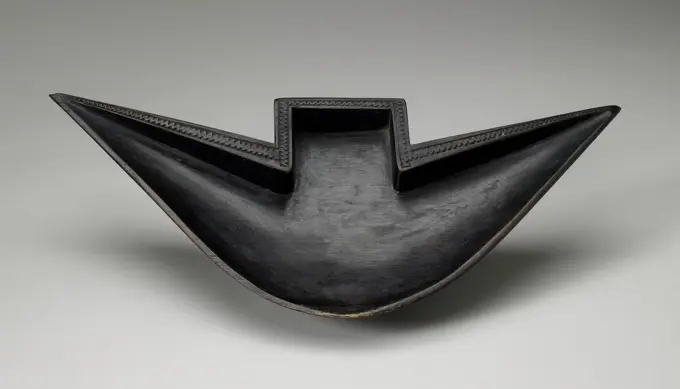
Maritime Model Artifacts

Detailed scale models of ship gun positions and tools, made from wood and brass, reflecting 19th-century naval architecture.

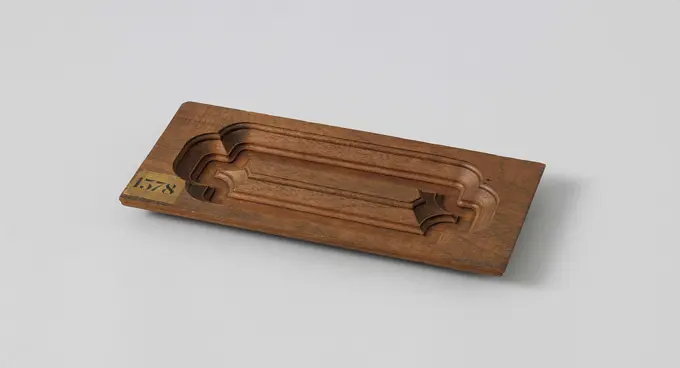
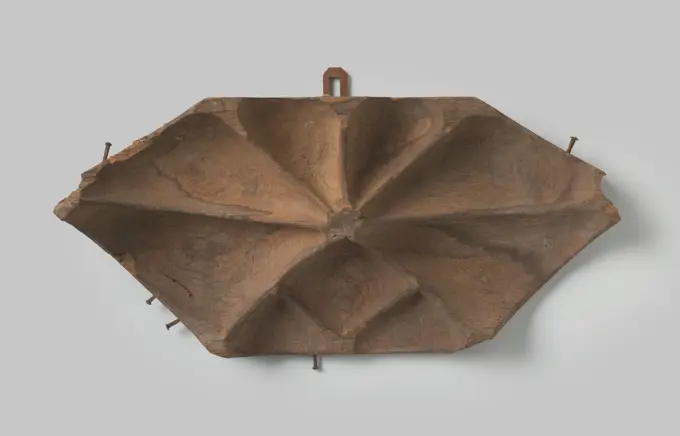
SCHAVE WITH ORDED TOPEN and the year 1755, Anonymous, 1755  Northern Netherlands (possibly)Netherlands (possibly) wood (plant material). beech (wood)  Northern Netherlands (possibly)Netherlands (possibly) wood (plant material). beech (wood)
SCHAVE WITH ORDED TOPEN and the year 1755, Anonymous, 1755 Northern Netherlands (possibly)Netherlands (possibly) wood (plant material). beech (wood) Northern Netherlands (possibly)Netherlands (possibly) wood (plant material). beech (wood)
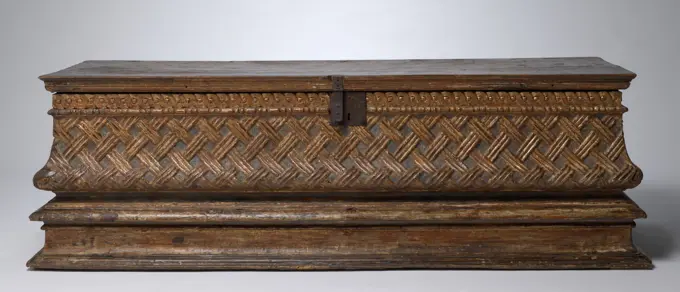
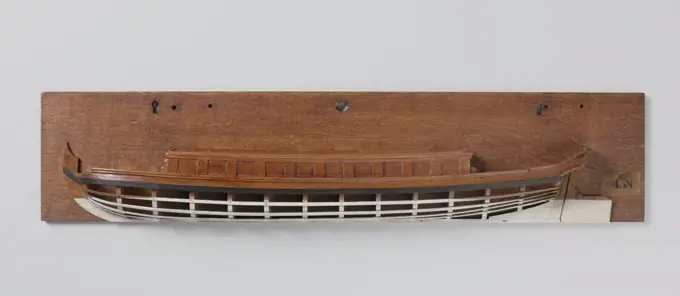
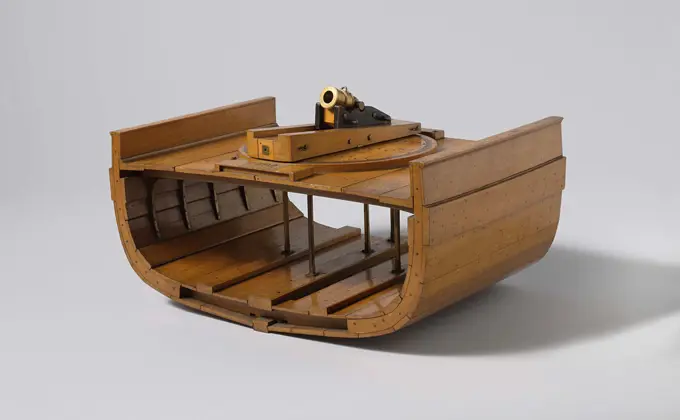
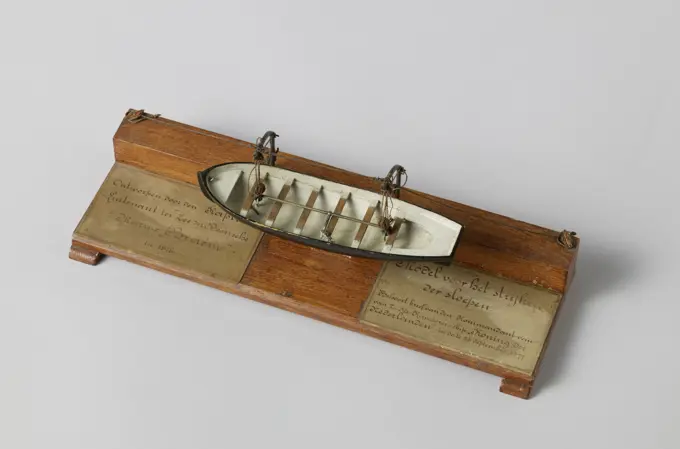
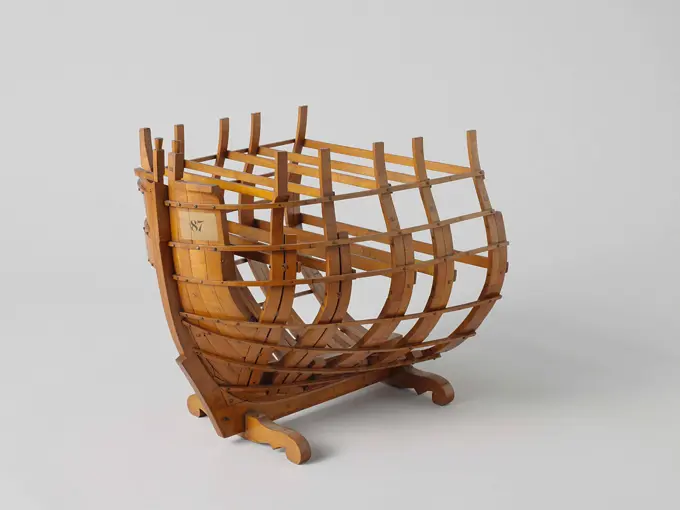
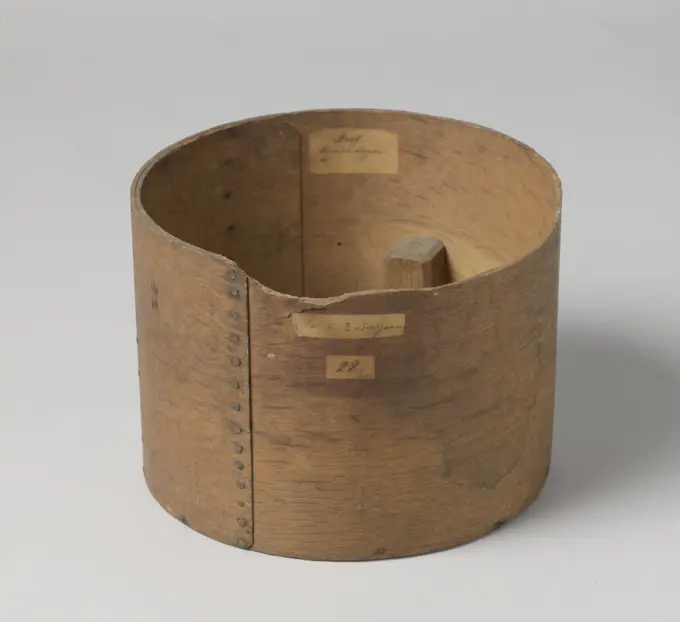
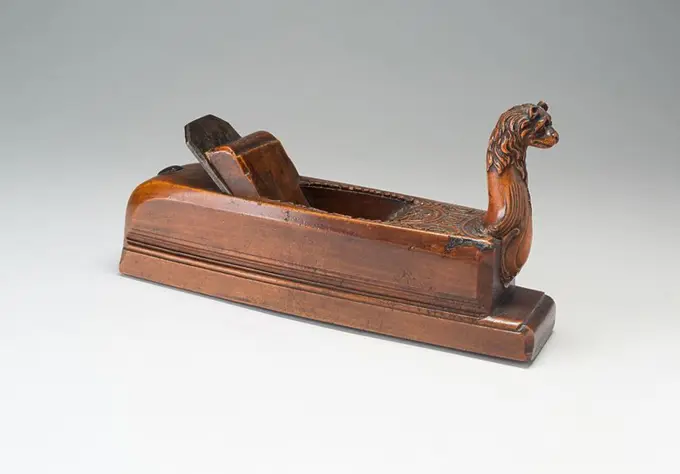
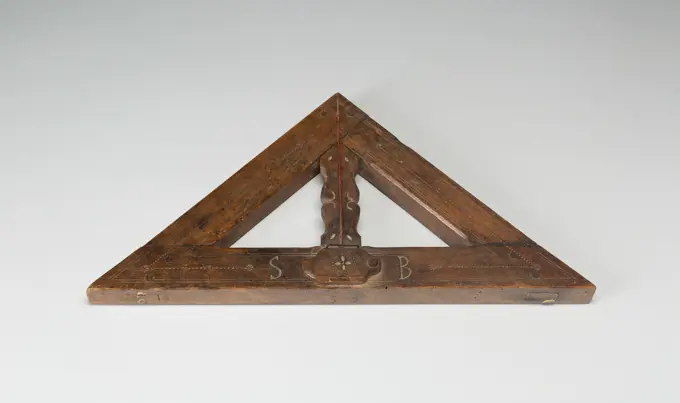
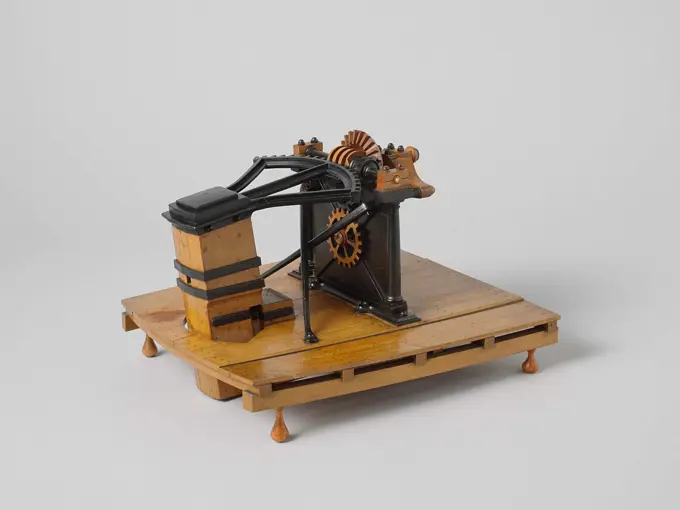
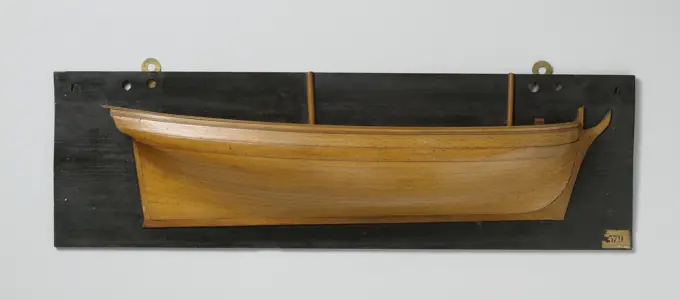
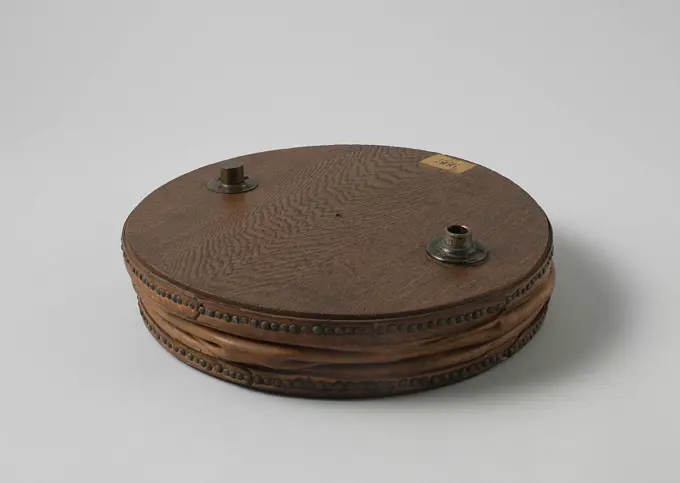
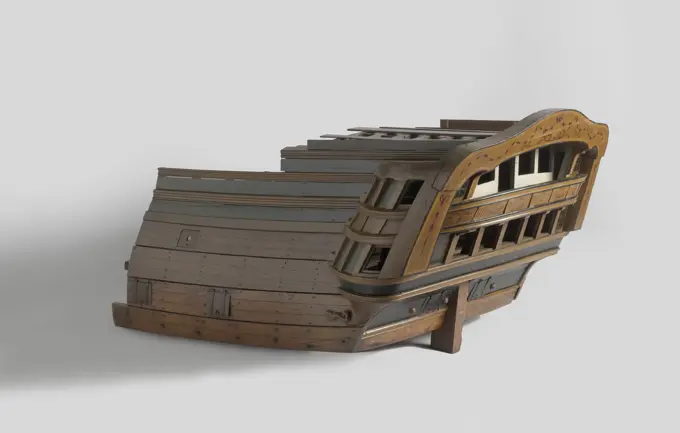
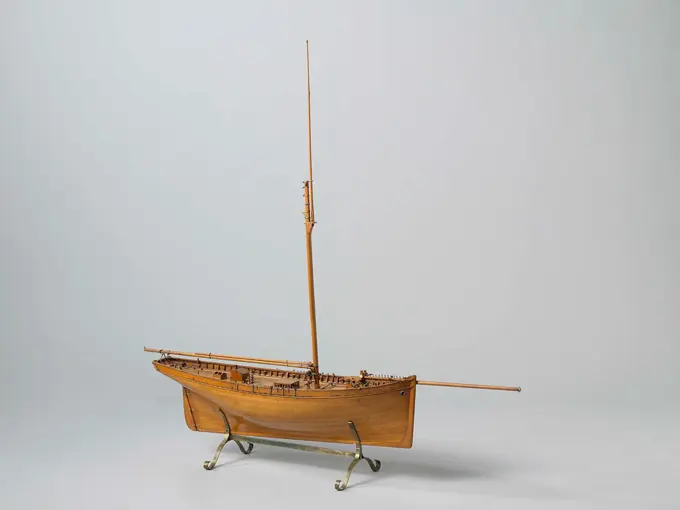
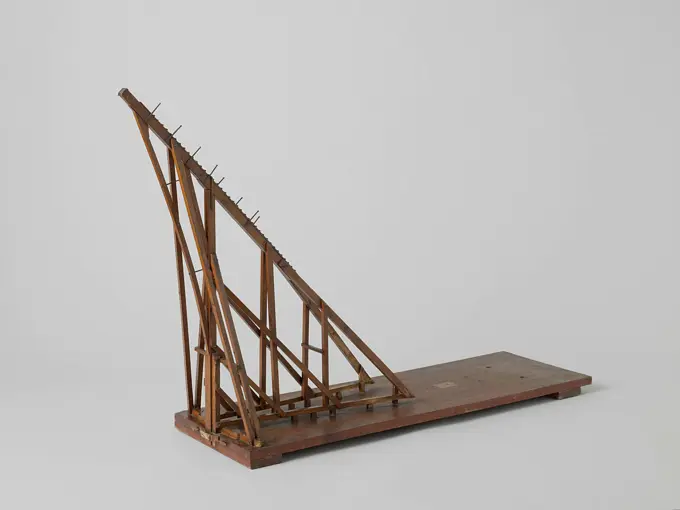
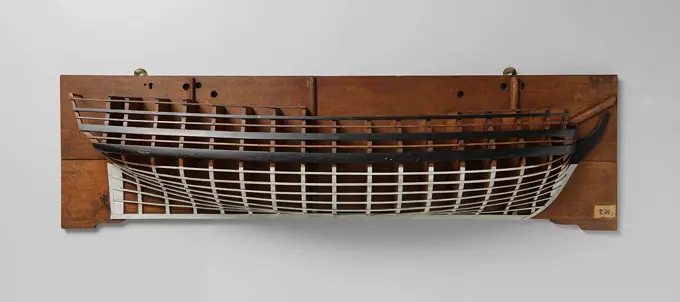
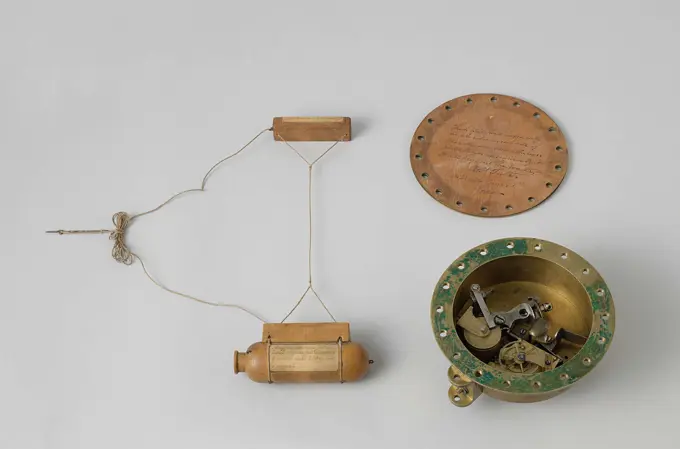
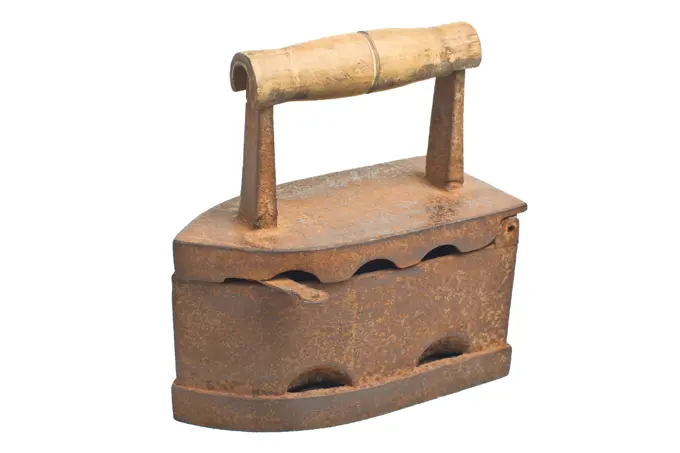
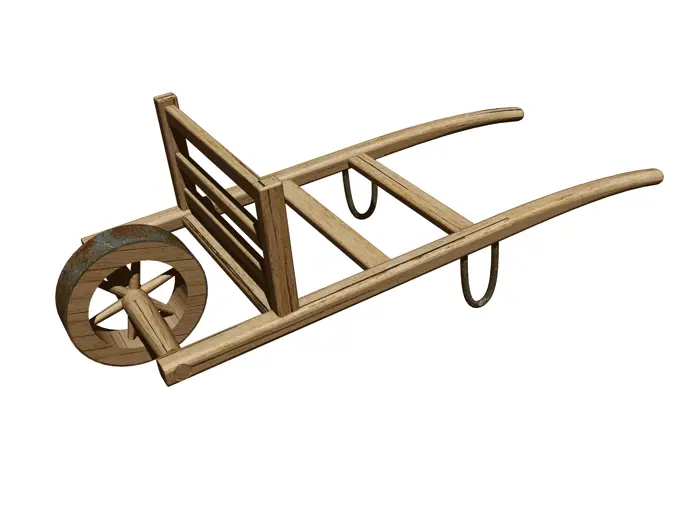
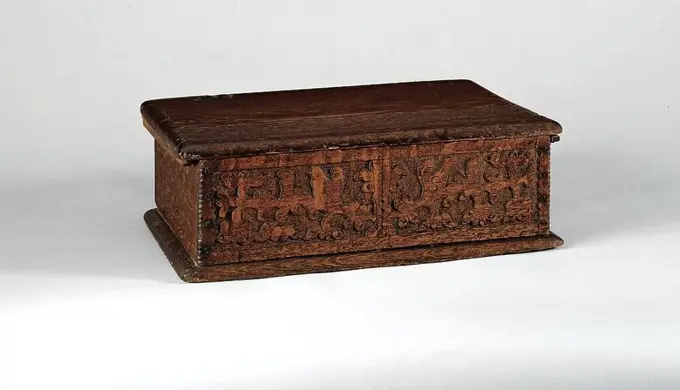
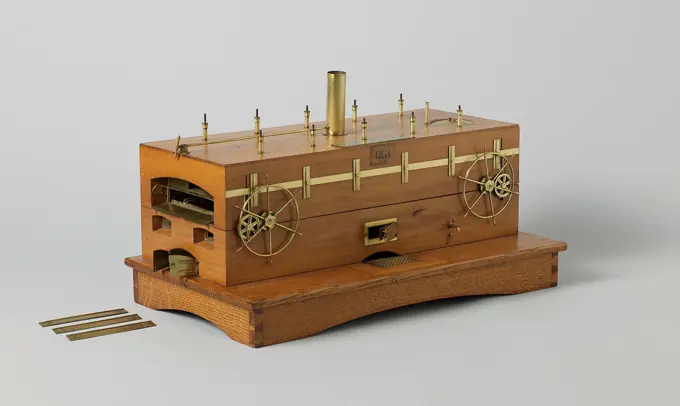
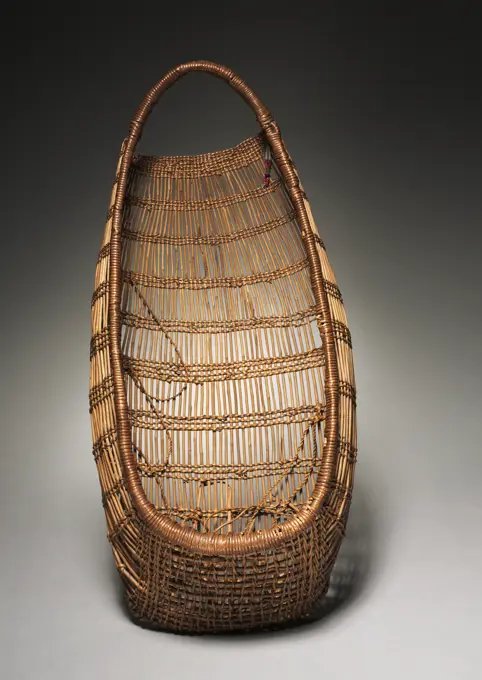
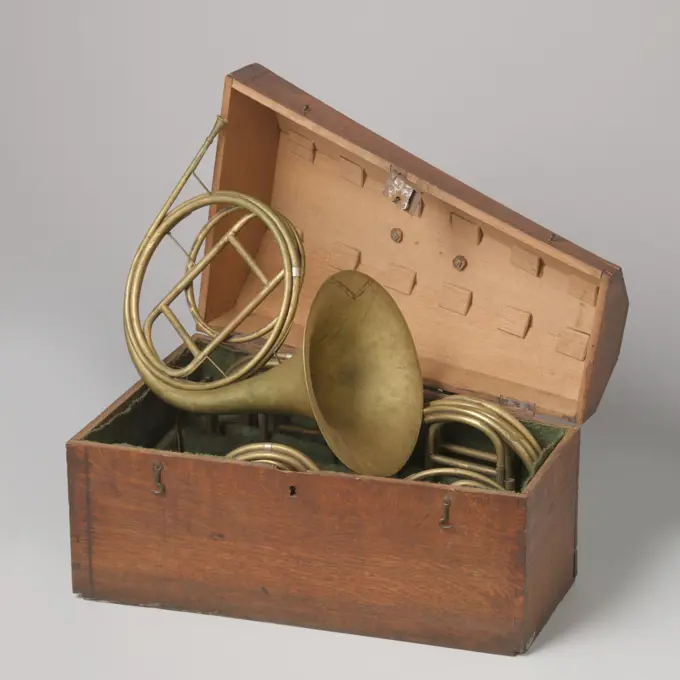
Model of A gun position on the afterdeck. Model of the aft deck of a paddle steam ship with 60 pounds bom gun on a swivel. The loop is 15 cm long and has a 4 mm caliber; An elevation screw goes through the grape. The underlay consists of a wooden frame of two heavy leggers with two light in between, on three cross beams each with two bullets at the bottom of the ends, which run over the turning peaks; On the front and back, the carriage runs up to stop the upper suit. The upper suit consists of two cheeks with four stairs, the upper part with tappan of solid brass; The cross connection consists of a slanting calf, two axles and a crossbar on which the soleplate rests. The axles have no wheels. Two small wheels are applied to the cheeks, which run over the rails of the outer leggers, but only when the wheels are ricked in the middle of the rear asx and walk over the rails of the middle pair of leggers. Brackets to secure the rear asle of the top hit on the sled. The model specifically sModel of Two Different Designs for the Gun Position on the Bow, anonymous, c. 1840 - c. 1850 demonstration model Sketchy block model and waterline model of a front ship with bomb cannon on rotators, incomplete. It has a Scheg, the bows and crane beams are missing, and a roasting spindle has been installed on the back. The cannon with rotary spa turns on in the deck in -the -cover turning pirters: a large circle in the middle, and small turning clouds on either side of the bow. Vague scratches and nails in the deck indicate other possible rail positions. The safe holes are indicated with black paint. They are located below deck and the anchor chains or trusses must be guided by tubes to the roasting spindle on the upper deck; A black rectangle on the upper deck probably indicates the position where the tube is the upper deck. Netherlands wood (plant material). brass (alloy)Cassone, early 1500s. Italy, early 16th century. Walnut, painted and gilded; overall: 54.3 x 168.3 x 51.6 cm (21 3/8 x 66 1/4 x 20 5/16 in.). Chests such as this were made in pairs and presented to young women on the occasion of their marriage. They not only provided storage space in the home for clothing and personal effects, but could also be used as a bench to sit on. It was not uncommon for any one room in a Renaissance palace to have several. This chest was since the 16th century and until 1922 in Savoy Castle, near Verzuolo, in the Piedmont region of northern Italy.Divination Implement, 1890- 1910. Africa, Central Africa, Democratic Republic of the Congo, Kuba, Late 19th- Early 20th century. Wood and plant fiber; overall: 8.9 cm (3 1/2 in.).SCHAVE WITH ORDED TOPEN and the year 1755, Anonymous, 1755  Northern Netherlands (possibly)Netherlands (possibly) wood (plant material). beech (wood)  Northern Netherlands (possibly)Netherlands (possibly) wood (plant material). beech (wood)Model of a Windlass, anonymous, c. 1850 demonstration model Model of a roasting spindle on a floor board. The drum, suspended between two cheeks, has eight continuous holes for wind trees: the roasting spindle can also be operated with a single wind tree on the starboard cheek, which grabs a gear in a gear. In the middle is a strut with two wooden and four metal piles, which grab in the gear part of the drum to prevent the walking. Scale 1:10 (estimate). Netherlands wood (plant material). brass (alloy)Half Model of a yacht or barge within, Anonymous, 1750 - 1850Model of a Marker Waterschip, anonymous, 1800 - 1858 ship model. demonstration model Construction model of the hull of a marker water ship, on standard. Parts of deck and skin have been omitted to study the construction. It is a slippery striker hole with high vertical steven, and straight stern. Wide rudder with wooden helmet wood. There is one deck with a deck structure, which covered the cabin and bun: this structure has been built over and of the curved shape that is so characteristic of ships of this type, and has a small opening for a chimney. There is a roasting spindle against this structure; Furthermore, a roasting spindle in the bow, one in the stern and three more small roasting pills on the aft deck. The Zeeg runs sharp forward. The hull shape is round with a keel, and the skin is perforated for the bun. On the aft deck an overflow for the grandfather, and on the front deck the Mastgat; The model has four putting irons on each side. Netherlands wood (plant material). brass Model of an Anchor release. Semi-model and block model of a front ship above the waterline, on which an anchor fall is demonstrated. Anchor and anchor rope are missing. The anchor must be hung in two chains, which are reflected on a valmery against the side of the ship; If this is detached, the chains are open and let it go anchor.Copper pedometer in rectangular cupboard, c. 1700 - c. 1800 Copper pedometer in rectangular cupboard. On the inside a dial with four digit rings. unknown copper (metal) Copper pedometer in rectangular cupboard. On the inside a dial with four digit rings. unknown copper (metal)Model of a 20-inch mortar on a turntable.This model represents a twenty-inch calibre mortar of the kind fitted on gunboats. The weight of the mortar and its recoil when fired required considerable strengthening of the deck both below and around the weapon. The mortar stands on a sliding mount placed on a turntable. This allowed the weapon to be fired in any direction.Half Model of a Launch, anonymous, c. 1780 - c. 1820 ship model. half model. builder's model Mallen model (starboard) of a sloop. Flat mirror. De Zeeg rises to both ends. Peaked around. Scale approx. 1:20 (scale on model). According to the scale, this Jol 36 Amsterdam feet is long. This model is identical to NG-MC-442. Netherlands wood (plant material)Jack Plane 1786 Central Europe. Boxwood and plumwood .Half Model of a Fireship, anonymous, c. 1795 ship model. half model. builder's model Partly mold and partially fringed model (starboard) of a one-mast ship. The skin above the waterline is closed and has eight rowing types. Four levels: very low lower deck with molds underneath; slightly higher a running corridor along the collar with flammable material (branch forests); half -deck and baking deck, a chimney and a roasting spindle on the baking deck; Upper Campanje. There are removable deck beams over the pit. Two square bins hang on chains in the hold. Round a stave. The Zeeg runs forward and back, two barkhouts and one reehout. Run with flat bottom. One Mast Midscheeps. Netherlands wood (plant material). brass (alloy). paint (coating)Half Model of an 8-Gun Brig, anonymous, c. 1780 - c. 1820 ship model. half model. builder's model Polychromed mold model (starboard) of a two -mast. The skin above the barkwood is closed and the ship has a railing. Low round fore ship, the prestige rise to vertical. Wandered mirror, cave wulf, closed gate, no side gallery, no rudder; Strongly falling stern. Seide to both ends ascending, very high stern, one barkwood and one reehout. Peaked around; Bent keel with emerging ends. The big mast leans back, the breeding mast is almost vertical; The middle hekstut protrudes above the fence and has a claw for the boom. Netherlands wood (plant material)Half Model of a boat, Anonymous, 1780 - 1820Bowl - BearModel of a Lifeboat Release, anonymous, 1876 demonstration model Model of a sloop on two nail dravits, on a ground board. The model demonstrates the sloop trap of the sloop, with two hooks releasing the hoist of the Davits by releasing a right in the middle. The sloop is slippery with a flat mirror, the seam to both ends ascending; He has an open cabin and six dids. Denmark (possibly) wood (plant material). brass (alloy). rope. textile materialsModel of a Marker water ship. Construction model of the hull of a marker water ship, on standard. Parts of deck and skin are omitted to be able to study the structure. It is a simpliced pointed gatter with high vertical steven, and straight falling stern. Wide stir with wooden helmet wood. There is one deck with a decomposition, which caught the cabin and bun: this superstructure is superimposed and of the curved form that is so characteristic of ships of this type, and has a small opening for a chimney. For this structure is a roasting spindle; Furthermore, a roasting pill in the bow, one in the stern and three small roasting pills on the aft deck. The Zeeg opens sharply. The hull shape is round with a keel, and the skin is perforated for the bun. A landing for the large shot on the aft deck, and the mast hole on the front deck; The model has four putting irons on each side.Model of a Ship's Bow in frames. Technical model of a fore ship over the length of five trusses of creation. Two apostles. Three clamp plates on either side, thickened at the height of the lower deck; The clamp plates are compiled to starboard; It consists of a piece of port. Curved Steven. Two decks with deck beams indicated. Nin-part trusses.Double aggele from Delft, Anonymous, c. 1800  Spans content measure for dry wares of a double aggele, marked and v.z.v. Labels. Delft wood (plant material)   DelftJack Plane. Central Europe. Date: 1786. Dimensions: 26 × 8.3 × 15.2 cm (10 1/4 × 3 1/4 × 6 in.). Boxwood and plumwood. Origin: Central Europe. Museum: The Chicago Art Institute, Chicago, USA.Model of a Ventilator, anonymous, 1800 - 1850 demonstration model Model of a fan, working as a double bladder ball. In the large rectangular compartment, a shelf, which is mounted with hinges at half height against the short front, is moved with a lever up and down; The two halves in which the compartment are distributed through the shelf are thereby reduced and enlarged in turns. Air is let in by two square valves on the front, consisting of simple flaps with chamois leather, one upstairs and one below the hinges of the plank. By similar valves, the air is drained to a small compartment, where the air flow is led to a single output. Netherlands wood (plant material). brass (alloy). chamois (animal material)1/4 Boisseau from Deventer, Anonymous, 1800  Spans contents measure with iron fittings for dry wares of 1/4 boisseau with bridge and style, v.z.v. Brand and labels. Deventer wood (plant material)   DeventerHalf model of A 12-Gun Brig, Rijkswerf Rotterdam, c. 1847 ship model. half model. builder's model Polychromed planks Mallen model (starboard) of a two -master. Eight gun ports plus two in the fence, all on one deck; The deck is closed. For ship elaborated with galle and sculpture of a gilded curl. The elliptical fence, decorated with frames and gilded praise, has two gun gates, no side gallery; Stir with round stirring king (American rudder) and rounded Roerblad. Zeeg flat, the barkwood is sunk in the skin, one reehout. Peaked around. Scale 1:40 (scale on model). Rotterdam wood (plant material)Half Model of a 60-Gun Frigate, anonymous, c. 1828 ship model. half model. builder's model Polychromed mold model (starboard) of a three -mast. Thirty -four guns on two decks. The Schegbeeld is a man in walking position. A lion's head on the crane bar. Safe with elliptical fence of one floor without a side gallery, above that an open gun deck; Straight with square stirring king. The Zeeg rises slightly on both ends, one barkhout and two reehouts. The model is equipped with juffer blocks. Peaked around. Scale 1:50 (scale on model). Netherlands wood (plant material). brass (alloy)Model of A Spoon Dredger. Model of a spoonbagger on a base board, in very poor condition and incomplete. The midship has six winches on a raised deck, which are all manually operated and the cables are attached to a spoon with each end, so that one spoon drops when the other is retrieved.Square and Level 1600-1699 Germany. Wood .Miniature canoe -Salt Box ca. 1850 American. Salt Box. American. ca. 1850. Yellow pine. Made in Pennsylvania, United StatesChest withdrawerModel or steering gear. Table model that shows part of a deck with control device, incomplete. The square stirrer head has a steering gradrant, the teeth whose teeth in a cross-aligning screw without end; With gear wheels, the movement of the steering wheel on this screw is transferred without end. A dial of an axiometer is applied under the screw without end, the disadvantage of which is missing.Half Model of a 14-Gun Brig, anonymous, c. 1783 ship model. half model. builder's model Plants Mallen model (starboard) of a two -grade. The deck is closed and the location of the shutters is indicated. Round for ship with almost vertical praise. Get mirror, hollow wulf, the fence is missing, no side gallery, no rudder. Seeping backwards, one barkhout and two reehouten. Peaked around. Netherlands wood (plant material)Egyptian Box, used to contain jewels or cosmetics. Wood and faience. New Kingdom (1550-1070 BC)Half Model of a Jolly Boat, anonymous, c. 1780 - c. 1820 ship model. half model. builder's model Mallen model (starboard) of a rowing boat. Flat mirror. De Zeeg rises to both ends. Stretch around. Scale approx. 1:22 (scale on model). According to the scale, this Jol 24 Amsterdam feet is long. Netherlands wood (plant material)Pair or Bellows. Simple bellows consisting of round wooden top and bottom and leather wind bag, reinforced with an internal hoop. Two openings are applied to the top, one of which is closed with a screw cap. Scale 1: 1.Headrest, 19th-20th century, 7 1/4 x 10 7/8 x 3 5/8 in. (18.42 x 27.62 x 9.21 cm), Wood, South Africa, 19th-20th centuryHeadrest, 1800s-1900s. Africa, Southern Africa, South Africa, Zulu-style carver. Wood; overall: 10.2 cm (4 in.).KEPI French officer, model 1935 Factory productSample of millwork.piece panel work from the Centennial exhibition in Philadelphia in 1876. It is made of one piece and shows one long milled geometric motif.Sundial -Heaven of a canopy, anonymous, c. 1400 - c. 1950 Oak heaven from a canopy. Possible church furniture. Northern Netherlands (possibly)Netherlands (possibly) wood (plant material). oak (wood) Oak heaven from a canopy. Possible church furniture. Northern Netherlands (possibly)Netherlands (possibly) wood (plant material). oak (wood)Gunlock (Flintlock), anonymous, 1830 flintlock On the right canons lock (flint lock) with brass house and iron lock mechanism, rooster and pandel. For mount on the cannon, the lock has a pin in the front and a hole in the middle for a bolt. The tractor has a deductible rope. Netherlands brass (alloy). iron (metal). ropeScherf of a Martavaan from V.O.C. ship De 'Witte Leeuw', Anonymous, Before 1613  Scherf of a Martavaan from V.O.C. ship the 'Witte Leeuw'. Chinezizid-China stoneware. porcelain   Sint-HelenaTobacco box without lid from the wreck of the East Indians Hollandia, Anonymous, 1700 - in or before 1743  Tobacco box; fragm, box, oval, flat underside, plain, five-lugged hinge. Netherlands copper (metal)   SecondCigarette caseCasketModel of Part of the Stern of a Ship of the Line, anonymous, c. 1750 - c. 1800 demonstration model Waterline model of a stern. Hol Wulf with two gates. The fenceboard, decorated with brief paintings of plant and bow motifs, has two floors with a western walk on the upper; Two floors and fish tails side galleries. Under deck, intermediate deck, half -deck and upper camping; Cabin layout. Two mountain wood and a reehout. Netherlands (possibly) wood (plant material)Model of a Pilot Cutter. Very detailed block model with roundwood from a pilot cutter, on brass standard. The vessel has one flat deck. It has a straight, sharp baffle, and an overhanged fence decorated with leafwork, a shell and the inscription. Stir with Round Roerk King (American Stir) and Brass Helm stick to deck. On the deck a rise and a roef; All ironwork executed in detail, winches, pumps etc. The seam rice slightly forward and back, one Reehout. The hull shape is a sharp S-SPAN. The round timber consists of a mast with steng, very long yelf and boom, and a bowsprit that can be pushed into and extended through a rack on a winch.Ceremonial Bowl, 19th century, 1 3/4 x 17 5/8 x 8 in. (4.45 x 44.77 x 20.32 cm), Wood, Fiji Islands, 19th centuryCorner piece of a paneling, part of a paneling, furniture house Legrand, 1900 - 1905 Corner piece of a paneling, part of a paneling, executed in nuts, plywood, various types of wood. Netherlands walnut (hardwood). plywood Corner piece of a paneling, part of a paneling, executed in nuts, plywood, various types of wood. Netherlands walnut (hardwood). plywoodModel or a Mastery Sheer. Model of a mast crane, a mast lifting, on base plank. The legs lean forward and are retained by two crowds and four stains of bolders confirmed. The foot in which the crowd is adjustable in two positions. Behind the bollards are two capstan and two beting. There is a major predict between the paws of the mast crane. Two hoists, one for the top and one for the lower part of the mast: the rope is attached at the top of the mast valve and is hence through the double block that is attached to the mast and a three-disc block at the top of the mast crane, then To a block to the pay, back to the three-disc block at the top and down. At the top of the mast are two more blocks with rope, which is attached to the beting with both ends.Wallbox. Wallbox of mahogany, with eye in back plate to hang. Intended for candles, knives or sulfur sticks.Skarabeusz uskrzydlony. unknown, authorModel or part of a Composite Ship Camel. Polychromed model of a portion of a composite ship's camel, painted in the colors black, white and red. It is a part with longitudinally waterproof shot, standing over two pumps, two roasting pills, two spuien for full and two shutters. The back can be opened and shows the tolls through which the hoists of the roasting pills are led to the bottom of the camel, the pump and the spui.. Polychromed model of a Kielkade with a caught frigate, in the form of a coffin. The foundation of the quay can be viewed by removing loose parts. Five of the six capstanes are used to shift the ship, and a keelmast is prevented from turning the ship from turning. The ship model balances with two small wheels, one against the presence and one behind the helm, on two brass support beams under the shelves that represent the water: with two strings attached to the keel and that fall under the coffin, the model can be straightened . For this, the shelves to be eliminated by the water must be laid down and resigned to the changed position of the ship model. The ship model is a block model of the Frigate Ijssel of 44 pieces with reduced rig, the large mast and breeding is strengthened for the shells. It has eight and forty guns divided into two decks. Three cover a total of: Cow bridge with glass portholes, head deck, continuous upper deck with pit. The galleon has four conveniences, the shHalf Model of an 18-Gun Sloop of War, anonymous, c. 1802 ship model. half model. builder's model Polychromed mold model (starboard) of a three -mast. Striking is the large number of clamps. No guns or decks indicated. Get mirror, no details of the Wulf or Het fence, no side gallery; Straight with square stirring king. Seeping a little rising and behind, one mountain wood and one reehout. Peaked around. Scale 1:55 (scale on model). Amsterdam (possibly) wood (plant material)   Amsterdam. East-IndiaLesser, Anonymous, c. 1600 - c. 1699 Eikhout desk. Note: Identical to BK-KOG-672.  oak (wood) Eikhout desk. Note: Identical to BK-KOG-672.  oak (wood)Wooden wheelbarrow Empty wooden wheelbarrow for the garden isolated over white Copyright: xZoonar.com/IvonnexWierinkx 7182815Heaven of a canopy, anonymous, c. 1400 - c. 1950 Oak heaven from a canopy, executed in late Gothic style. Possible church furniture. Northern Netherlands (possibly)Netherlands (possibly) wood (plant material). oak (wood) Oak heaven from a canopy, executed in late Gothic style. Possible church furniture. Northern Netherlands (possibly)Netherlands (possibly) wood (plant material). oak (wood)Ivory Frame Ajour, with relief three cartouches with Rococo ornaments in which a fruit bowl and garden tools. The ivory frame is Ajour and relieved and has 22 consecutive legs. The three cartouches with Rococo ornaments, in which a fruit bowl and garden tools, are surrounded by smaller cartouches with birds, and small putti. The back is smooth. The inside of the outbounds is topped with metal. Close pin and with sharpened glass.Drum, c. 1800 - before 1865 musical instrument. percussion instrument. drum Trom of the militia. The brass kettle is equipped with a veal sheet on both sides, held by a hoop and tense by means of a tension with tractors and screws. Both hoops are decorated with a motif of triangles in the colors red, white and blue. With engraved numbers: A-64. Netherlands Kettle: Brass (Alloy). Hoop: Wood (Plant Material). Team resorts: Rope. leatherModel or a crane for stepping masts. Model of a mast crane on base plank. It is a wooden structure with tilting back, the cup of excellent over the quay. The head is equipped with discs for the hoist, which is missing. On the back to climb the crane and a double railing. The two capstan and servants on the base board are missing.BoxHalf Model of a 70-Gun Ship of the Line.Polychromed mold model (starboard) of a three-master. No gunpaints and no decks indicated; Half-deck and baking deck are distinguished by the gillings. Wrecked mirror, hollow wulf, no fence, side gallery or stir. Almost flat seam, two mountain wooden and one Reehout. Pretty sharp underwater ship compared to the previous models.Time Fuse in a Box and a Model of A Torpedo. Time inflammatory mechanism in a round brass house, ended on one side with a blind flange with leather gasket on which a inscription. The time inflammatory mechanism itself consists of a flint lock with timepiece. The rooster, which is constantly kept under tension by the battle spring on the tumbler, is retained by a lever (the rod) that has been forged in a hook at the head of the rooster; Tumbler and rod are separated. The rod is held in place with an extension that rests on a disc with a notch. This disk is mounted on a fourteon and runs under the influence of the timepiece: if the notch reaches the extension of the rod, it tilts and the rooster is released. In the side of the house, a blocking mechanism is applied: a pin protruding through the side prints a spring against a gear at the foot of the fourteen and thus blocks the timepiece. The pin is pushed outwards by the spring, but can be held in place by a rod through two eyes outside Old vintage Russian Soviet rusty iron isolated on a white background. Old vintage Russian Soviet rusty iron isolated on a white background. ,model released, Symbolfoto ,property released Copyright: xZoonar.com/SergeyxxKozoderovx 2138626 ,model released, Symbolfoto ,property releasedModel of a Granary with Scribes ca. 1981-1975 B.C. Middle Kingdom This model of a granary was discovered in a hidden chamber at the side of the passage leading into the rock cut tomb of the royal chief steward Meketre, who began his career under King Nebhepetre Mentuhotep II of Dynasty 11 and continued to serve successive kings into the early years of Dynasty 12.The four corners of this model granary are peaked in a manner that is sometimes still found in southern Egypt today presumably to offer additional protection against thieves and rodents. The interior is divided into two main sections: the granary proper, where grain was stored, and an accounting area. Keeping track of grain supplies was crucial in an agricultural society, and it is noteworthy that the six men carrying sacks of grain here are outnumbered by nine men taking care of measuring and accounting. Of the four scribes two are using papyrus scrolls, two write on wooden writing boards.All the accessible rooms in the tomb ohölzerne einrädrige Sackkarre hölzerne einrädrige Sackkarre Copyright: xZoonar.com/Dr.xNorbertxLangex 14306534Box. Culture: American. Dimensions: 7 x 21 x 13 1/4 in. (17.8 x 53.3 x 33.7 cm). Date: 1675-1700. Museum: Metropolitan Museum of Art, New York, USA.A broken wing belonging to a coat of arms, 1665 - 1725  A broken wing belonging to a coat of arms. Netherlands wood (plant material)Flute with a foof.part or flute with caseBrace, 1600s. Europe, 17th century. overall: 15.3 x 43.2 cm (6 x 17 in.).Model of a Bread oven. Model of a machining oven on a base board. It is a box-shaped construction that can be exploited in two halves to show the inside. In the middle of the long front is a fireplace with underground ash pit. Inside, the hot gases are led by flat channels to the four corners, hence upwards to a metal double inhibit over the oven and finally through an irrigation stone; The chimney has a valve that can be served from outside. The channels have valves in the corners that can be operated with a key from outside. The actual bread oven is a large space in the middle through which allows necklaces without end from one side to the other; These chains are set with the loaves with the loaves and transported on the front from one side by a rollerwork on either side. With ten screws protruding above the roof, the height of the chains can be determined. Four long bars have been installed; By shrinking or turning off under the influence of the heat, they each move a pointer to a dContent measure of 1 deciliter, anonymous, c. 1825  Spans contents of 1 deciliter. Netherlands wood (plant material)   NetherlandsAlte hölzerne Straße Wegweiser mit isoliert auf weißem Hintergrund mit Clipping-Pfad. Old wooden road direction sign with isolated on white background with clipping path. LicenseRF Copyright: xZoonar.com/KatsiarynaxHuravax 23238676Kistfragment with bars silver from the wreck of the East Indians Slot ter Hooghe, Anonymous, c. 1650 - Before 1724 chest Eighteen silver bars in a wooden box from the wreck of the East Indians Slot ter Hooghe. Netherlands silver (metal) casting  MadeiraBasket, 19th-20th century, Morita Chikuami, Japanese, 1877 - 1947, 19 1/2 × 8 1/4 × 7 1/2 in. (49.53 × 20.96 × 19.05 cm), Bamboo, Japan, 19th-20th centuryHalf Model of a Sloop of War, anonymous, c. 1780 - c. 1820 ship model. half model. builder's model Polychromed mold model (starboard) of a three -mast. No guns and no decks indicated. Get mirror, Hol Wulf, no details of fence or side gallery; Straight with square stirring king. Seeping forwards and backwards, one bark wood and one reehout. Peaked around. Netherlands (possibly) wood (plant material)Iron mortar on wooden base, anonymous, c. 1700 - c. 1800 cannon. mortar Iron mortar on elm undercarriage. Netherlands iron (metal). elm (wood)Drum. With inscription: Honi is Who Thinks Badly.CUNA DE LOS INDIOS DE LAS COSTAS DEL NOROESTE AMERICANO. Location: MUSEO. Rome. ITALIA.Weaving Basket. Culture: Chancay. Dimensions: H. 22 1/2 x W. 7 1/2 x D. 4 5/8 in. (57.2 x 19.1 x 11.8 cm). Date: 12th-14th century. Museum: Metropolitan Museum of Art, New York, USA.Eventail in its case. Flowers painted on both sides. Broken, openwork blonde horn and gouache. Paris, Carnavalet museum. Eventail: flowers painted on both sides; in its case Fashion accessory, EventailShoe buckles 1784-85 British. Shoe buckles 121214Model of a Gaff-Rigged Gunboat, Rijkswerf Rotterdam (attributed to), c. 1835 ship model. fully rigged model. demonstration model Spant model with round wood of a one -mast flat -bottom gunboat; Cover parts can be removed to show the shelling inside. Round bow and stern, a gate in the bow, two in the stern and two in the sides behind; A cannon on rotators in the bow, two carronades at the rear, four swivel basses. The deck is detailed with a capstan, a chimney in front of the galley, shutters, a roef, a compass house, loading utensils for the guns, a swab and bucket, four rowing stirs, cannonballs and two anchors. A schans rug in the sides and four posts on either side for a higher rug. Below deck full shooting and brass galley. Wide stir with wooden telly stick over the deck. Zeeh virtually flat, a barkwood, swords. The model has the round wood for a one -mast gaffel rig with sails: mast with steng, gaffel and boom, removable bowsprit; The RAs are missing. Scale 1:30 (derived). RotterdCasket. Culture: Catalan. Dimensions: Overall: 5 3/8 x 6 1/2 x 13 3/8 in. (13.7 x 16.5 x 34 cm). Date: 14th century. Museum: Metropolitan Museum of Art, New York, USA.Model or a lifeboat. Witnessed a single liem rescue boat of six belts, the guns and the DREG are missing. It is an over-sided peak hole, with curved presence and straight, slightly falling stern. The skin is painted white. It has a double skin, with float cabinets in the inner skin; Five dulls, an open cabin, a small priority and behind it. The wide stir has no helmet rug but a steering gradrant, the numbers of which are missing. The model is equipped with six belts, two boat hooks, two round buoys. It has been tidable with sailing, the large mast with a logger sail and a breeding, the view with a small triangular sail with boom. Scale 1:10.Cradle Basket, c 1875- 1910. California, Yurok or Hupa, Late 19th century. Twined; overall: 17.8 x 73.7 cm (7 x 29 in.).Drum, 1853 musical instrument. percussion instrument. drum Trom of the militia. The brass kettle is equipped with a veal sheet on both sides, held by a hoop and tense by means of a tension with tractors and screws. Both hoops are decorated with a motif of triangles in the colors red, white and blue. With engraved numbers: 1853-5. Netherlands Kettle: Brass (Alloy). Hoop: Wood (Plant Material). Team resorts: RopeOld Leather Wallet An old leather wallet on white background Copyright: xZoonar.com/AlainxdexMaximyx 8185284old compass plane old compass plane Copyright: xZoonar.com/BorisxZerwannx 7002329Invention Horn, Carl Gottlob Schüster, 1850 - 1950 Copper Invention horn. Marked: C.G. Schüster.  copper (metal) Copper Invention horn. Marked: C.G. Schüster.  copper (metal)Hoedendoos, round, from black lacquered tarpaulin with zipper, fashion salon Hoogland, after 1902 - Before 1978 Hat box, round, from black lacquered tarpaulin with zip closure. The box is lined with black artificial side printed with flowers. Originally a handle on the side of the box; This is broken. Utrecht sailcloth. voering: rayon printing / lacquering Hat box, round, from black lacquered tarpaulin with zip closure. The box is lined with black artificial side printed with flowers. Originally a handle on the side of the box; This is broken. Utrecht sailcloth. voering: rayon printing / lacqueringFashion, 20th century. Arch-shaped crocodile handbag with handle, 1930s.Half Model of a 6-Gun Schooner, anonymous, 1799 ship model. half model. builder's model Polychromed mold model (starboard) of a two -mast. The skin above the barwood is closed, the deck is closed, the ship has a railing. Low round fore ship, with hole and safe holes and the front stem rising to vertical. Get mirror, Hol Wulf, no details of the fence, no side gallery, strong stern; Straight with square Roer King, Kiel with Hieling. Seide to both ends ascending, very high stern, one barkwood and one reehout. Peaked around; Bent keel with emerging ends. The big mast leans back, the breeding mast is almost vertical. The model has two rest with three lady blocks each, with putting; The rest consists of a solid block of wood instead of a shelf. Scale approx. 1:30 (derived). Amsterdam (possibly) wood (plant material)Personal effects. Each crewman had his own sea chest for his personal belongings. These wooden chests have since perished, only the locks and little keys remain. To kill time, the men made music and played sports. A drumstick and a flute were found on Nova Zembla. The ball is made of whalebone and was used to play kolven’, a kind of hockey. The little comb was used to remove headlice.Game Box Inscribed for Taia and His Family ca. 1550-1295 B.C. New Kingdom This wooden game box has two playing surfaces and a drawer for storing gaming pieces and throw sticks that were used as counters for determining moves in the games. The top surface is laid out with twenty squares for the game tjau (robbers). The bottom has thirty squares for the game senet (passing). In the New Kingdom, senet became associated with the underworld; the obstacles of the game corresponding to hazards met on the journey to the afterlife. In the tomb of Nefertari, principal wife of Ramesses II, a scene depicts the queen playing senet in the afterlife against an invisible adversary.The box is inscribed on the top and sides with funerary offering texts for the overseer of works Taia, his father, also named Taia, and his mother, Yuwi. On one end is a scene showing Taia and his wife, Tekhyt, seated on the right facing an offering table. Facing the table on the left is Takhyt's mother, Ahmose.. Game Box InAncient Egypt. Predinastic period. Alabastron. Container carved from alabaster. Perfum Museum. Barcelona. Catalonia. Spain.