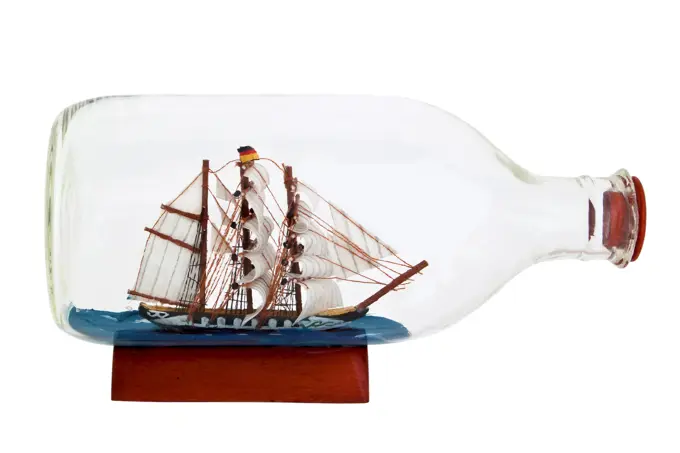
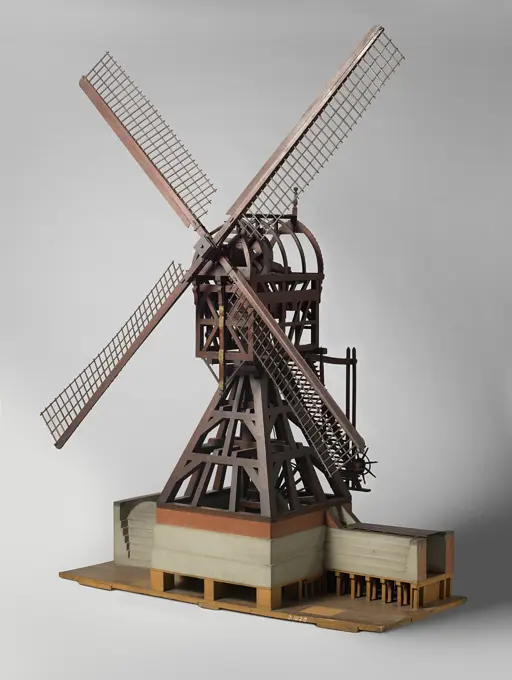
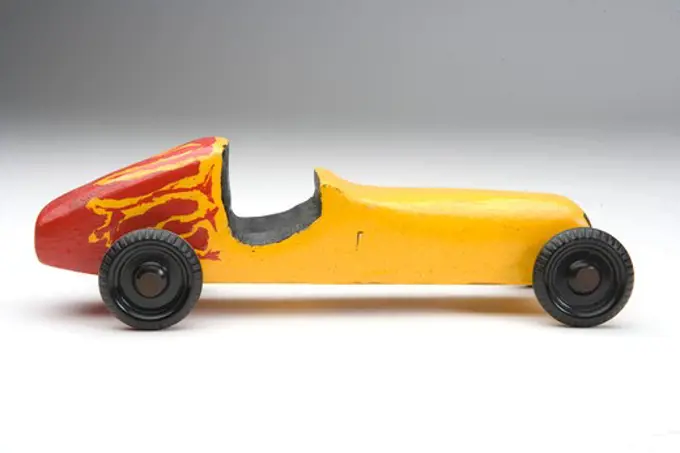
Maritime Model Artifacts

Detailed scale models of ship gun positions and tools, made from wood and brass, reflecting 19th-century naval architecture.

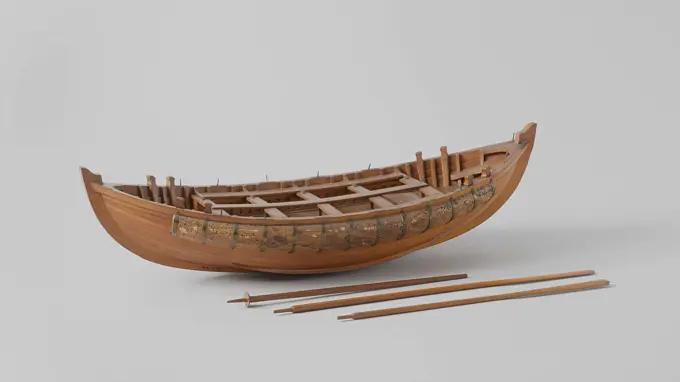
SCHAVE WITH ORDED TOPEN and the year 1755, Anonymous, 1755  Northern Netherlands (possibly)Netherlands (possibly) wood (plant material). beech (wood)  Northern Netherlands (possibly)Netherlands (possibly) wood (plant material). beech (wood)
SCHAVE WITH ORDED TOPEN and the year 1755, Anonymous, 1755 Northern Netherlands (possibly)Netherlands (possibly) wood (plant material). beech (wood) Northern Netherlands (possibly)Netherlands (possibly) wood (plant material). beech (wood)
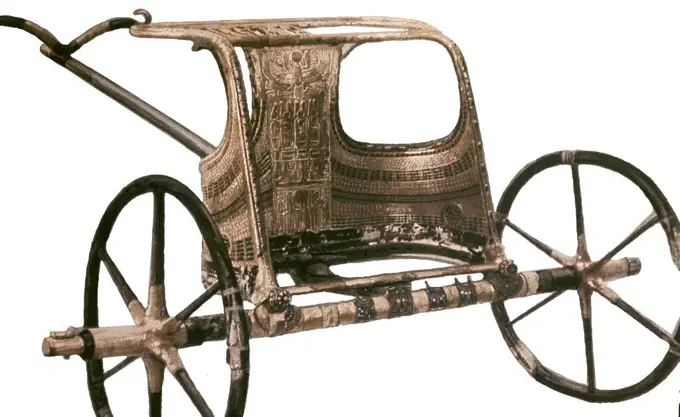
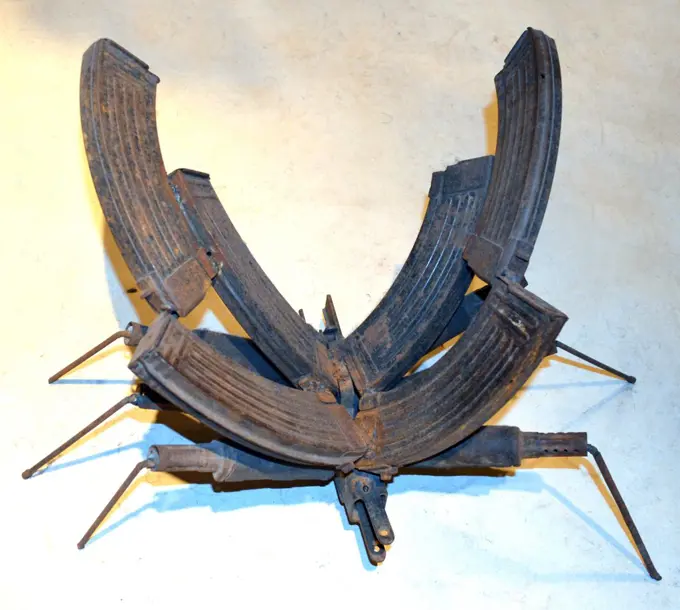
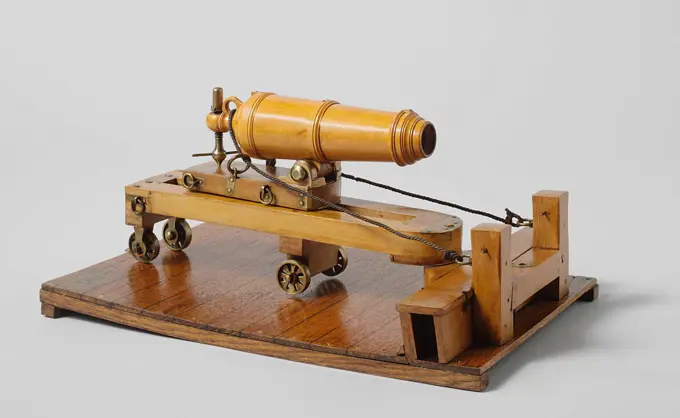
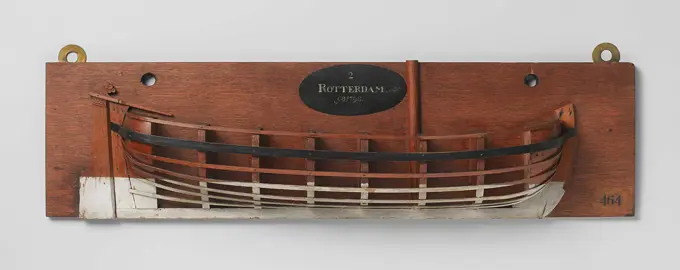
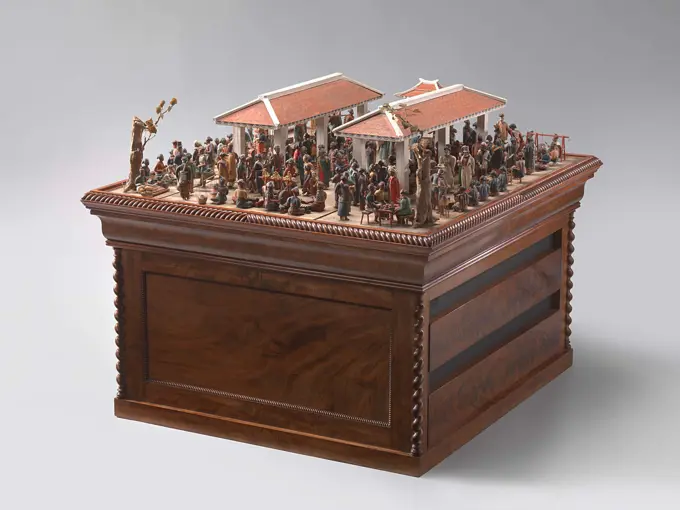
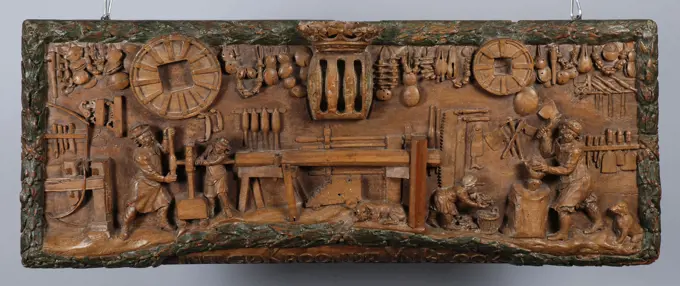
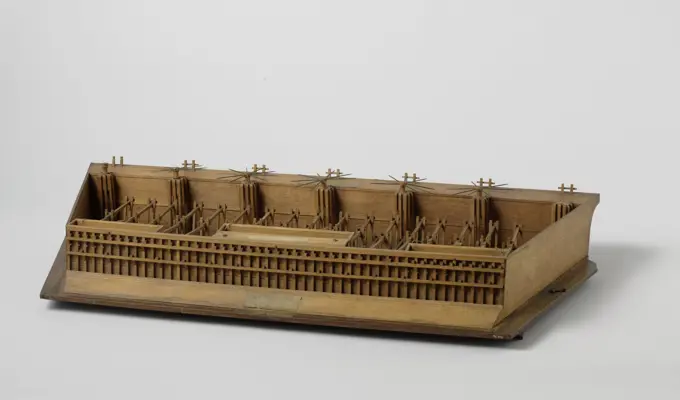
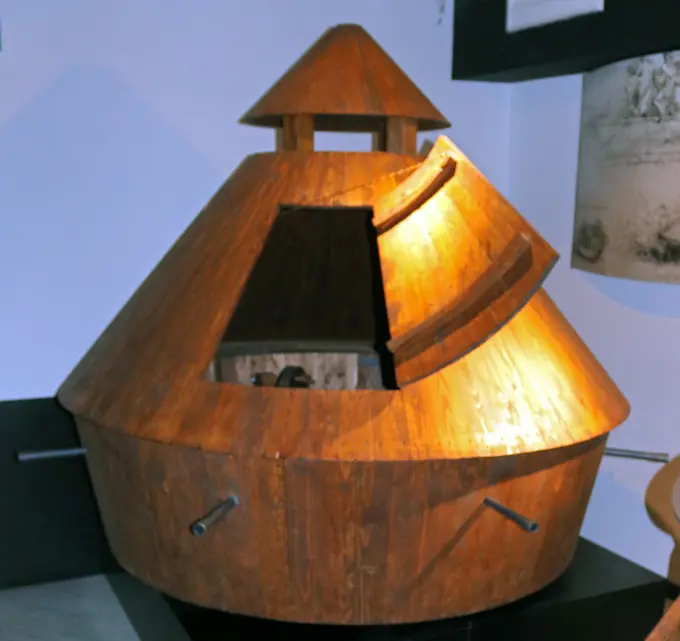
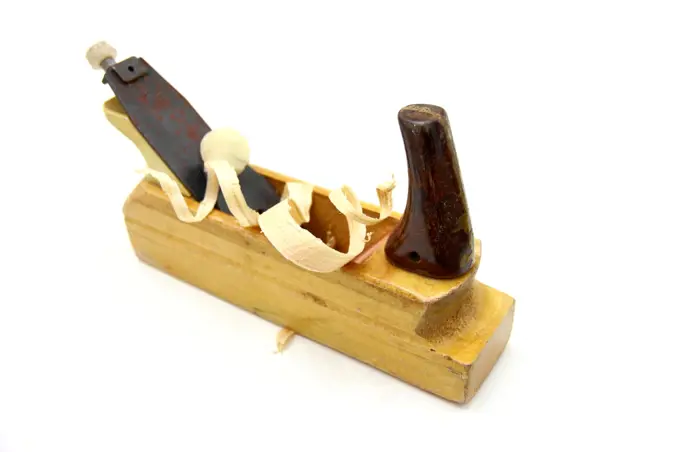
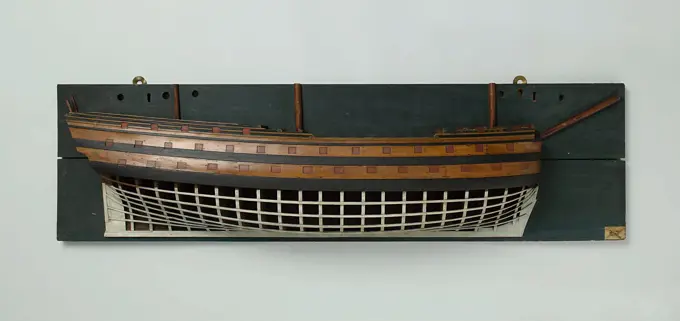
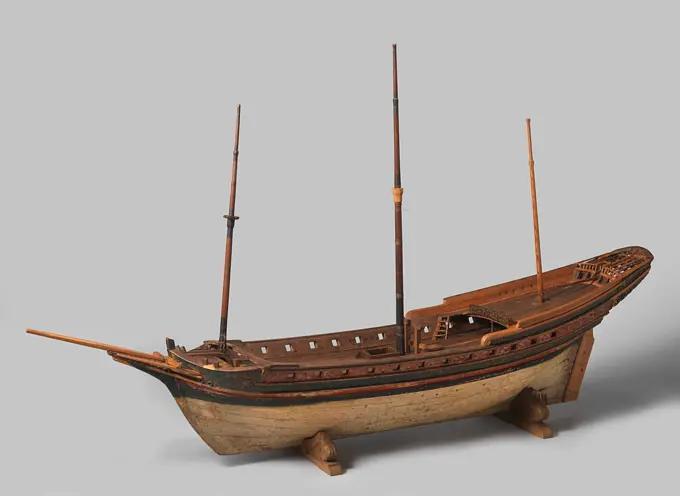
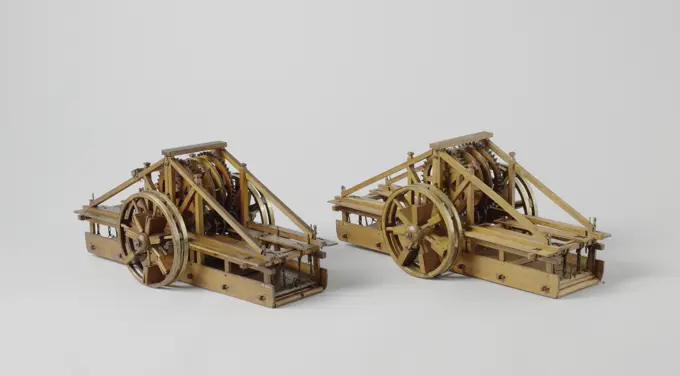
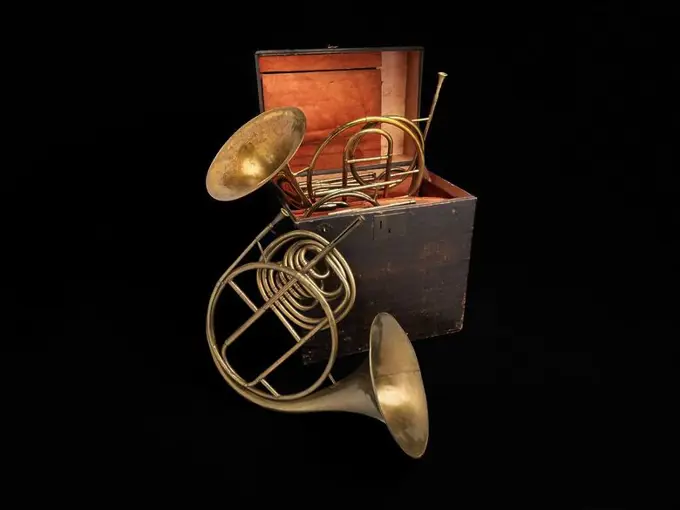
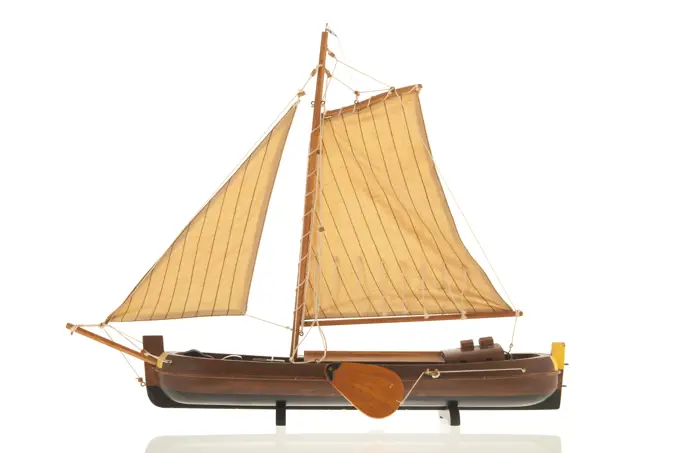
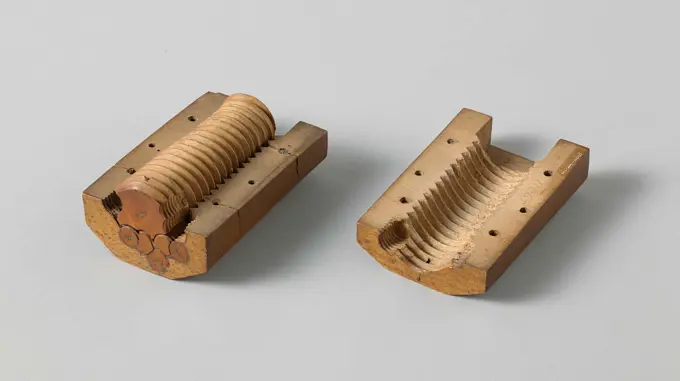
Model of a Lifeboat.Technical model. Overny peak hole sloop, ride with kimkeys, the seam at both ends considerably ascending. Double brakes: Twelve row windows for five dulls, which are connected by a longitudinal shelf; Front and rear. Silk ears, filled in with cork, against the Doftweger. Against the outside of the dolboord, a thick layer of cork is applied in brass tires as a propellant, while four bollards are applied to the dolly. A steering belt, a normal roeir belt and a long stick with a point and a round disc like a ski bowl, probably an anchor stick. Scale 1:12.CARRO DE TUTANKAMON. Location: EGYPTIAN MUSEUM. KAIRO. EGYPT.Model of a Lifeboat Release, C.A. van Haeften, 1876 demonstration model Polychromed model of a part of a ship's wall with a sloop on two nail dravits, on a ground board on which water is simulated. The model demonstrates the sloop drop of the sloop, whereby two hooks on the hoist of the davits are released by removing a locking ring in the middle. The mechanism at the same time closes a prophole in the bottom of the sloop with a lever in the cabin. The sloop is slippery with a flat mirror, the seam to both ends ascending; He has an open cabin, four dids plus two small dows that support the mechanism, and six fools in the sides. Netherlands wood (plant material). brass (alloy). rope. gypsumRecycled weapons used to create sculptures by a group of artists in Maputo 2000. Model or a carronade on a slide. Model of a carronade on sliding slide on a bound board a portion of a ship deck representing. The carronade has a caliber of 21 (16.6) mm and is 29 cm long. The loop has a locking hardener with a visor, a visor on the tap band and a pierce ring and an elevation screw through the grape; The elevation screw is covered with a rainy cap. The top piece has a slightly trapez-shaped body with brass attachment and rings, the front and back are rounded. Against the back the baking koker in brass fittings, on top of a brass plate to support the elevation screw and on the front the ears through which the tapas runs; The swirl bolt runs between the layers of the underled. The underlay consists of a wooden frame with brass fittings that allowed something to the front and finished in front. Cemeted in the middle and behind, including wheels are attached; The rear wheels can swing. A baking sleeve is applied in the back of the frame. The base board represents a part oDIJSTUK, 1599 - 1699  Left, iron, blank, with two chattered hooks that can be hooked at the stump of the breastplate. The thigh piece consists of five horizontal ribs, each with three iron rivets. An over -flinging edge runs from the left -hand side via the bottom to the right side. At the top on the left, IG 27 is noted. Inside, black is reversed. Netherlands (possibly) iron (metal)Half Model of a Poon.Polychromed mold model (starboard) of a single master. Round stern, wide stir with decorated stirring head and helm stick over deck. The seam runs to both ends, bark wood continuously on front and stern. Running.Left Pauldron with Guard Brace, 1801-1900. Germany, 19th century. Steel with black paint; overall: 27.3 x 33 cm (10 3/4 x 13 in.).Seven-piece bronze mold for the head of spreader, cast molding tool tools base metal bronze wood iron, cast twisted Seven-piece bronze mold for the head of spreader with screw thread Rotterdam tin foundry tin pewter Meeuws Druy craft Shapes are from the from origin 18th century Rotterdam tinnegieter J Druy. The large molds that were not signed or dated were the property of the tinker guild and were rented to the small tin caster.Model of a Javanese marketplace. No fewer than 154 miniature figures made of bread dough populate this marketplace on Java. Such models were made as souvenirs for Europeans. It includes all of the ingredients that appealed to Western travellers: a tropical market, various population groups, exotic dancers and even a gamelan orchestra. Note the dignitary and his entourage. They are almost identical to the larger-scale painted court officials on view elsewhere in this gallery.Henryk Siemierradki StampWooden plane, boards and a shaving on a white backgroundWooden facade plate of block factory at the Leuvehaven with Int GeKroonde Ynblock, gable wood carving sculpture sculpture beech wood paint, carved painted Very detailed carved gable board with workshop of block- and pumping shop Scene is dominated by large crowned three-disc block (gypsum block) middle- above. march hangs to the left and to the right In the middle bilge pump is drilled by the master and his pupil (on the left). The tube for the pump is clamped on drilling rig and is hollowed out with spoon drill; this is kept at height with cart with fork. On the right servant is busy chopping in rough form of violin block with the aid of pole while dog is watching. second student makes curls in basket. You can also distinguish them as tools and products: above from left to right: small wooden pump two-disc block rakklootjes parts of the mastroot one-disc block march of the large mast damsel blocks (or skull blocks) wandklootjes violin block gags for running because bram- and marsh-saiModel of a Careening Wharf, anonymous, c. 1800 - c. 1870 instruction model Model of a Kielkade, which shows the pile driving. It is built in a trape -shaped box, the short front of which represents the harbor wall. In three ditches just behind the shore, the blocks for the keels can be attached. Fully behind his seven Cape Standers with Bettings founded. Scale 1: 53.4 (scale on model). Netherlands wood (plant material). brass (alloy). ropeEmpty rectangular wooden cutlery box on textured concrete background. Kitchen utensil itemModel of a Boyer from North Holland, anonymous, c. 1757 ship model. fully rigged model. show model Witnessed model of a Noordhollandse Boeier. On the Roef: "It can't be otherwise". Netherlands wood (plant material). ropeLeonardo da Vinci's fighting vehicle re-construction from a drawing in the Codex Arundel, (British Library, Arundel, 263), a bound collection of pages of notes, written by Leonardo da Vinci and dating mostly from between 1480 and 1518. Sometimes described as a prototype of modern Tanks, Leonardo's armoured vehicle represented a conical cover inspired by a turtle's shell. The covering was to be made of wood and reinforced with metal plates that add to the thickness. Slanting angles would deflect enemy fire. The machine was powered by two large inside cranks operated by four strong men. The vehicle was equipped with an array of light cannons, placed around the perimeter.Ceremonial Bowl, c. 1890, 14 1/4 x 13 9/16 x 27 1/2 in. (36.2 x 34.45 x 69.85 cm), Tapa'a wood, shell, Solomon Islands, 19th century, Elaborate bowls such as this were important ritual objects used during the initiation ceremonies of the bonito fish society, a high-ranking group of men and boys in the community. The bowls were filled with food and offered up to the spirits as part of the initiation. Many vessels like this one are carved in the form of a frigate bird. Native to the Solomon Islands, it can be found twice on this particular object, underscoring its importance in island culture. The frigate bird not only embodied many valued characteristics such as agility and speed, it was also admired for its fierce and aggressive hunting skills as well as its ability to find schools of sacred bonito fish. This beautiful piece exemplifies the important bonds that existed between the visual traditions and the spiritual beliefs of the Solomon Islanders.Tabona (drum) late 19th century Cuban. Tabona (drum) 501248Forge of travel watch with rehearsal blow work with Apollo and Amphissa encounter. Flourish travel watchRibbon ribbon, striped, gray with magenta, black, green and orange, in or before 1926 Ribbon on roll, striped, gray with magenta, black, green and orange. NijmegenFrance (possibly) textile materials. cardboard. paper Ribbon on roll, striped, gray with magenta, black, green and orange. NijmegenFrance (possibly) textile materials. cardboard. paperA pair of double pouches for 7.5 mm rifles Smidt Rubin ALFR. BALMER MÜHLEMBERG, Zoss Salavaux, B.Tiled clock; Wasilewicz, Szymon (Fl. CA 1650-1700); 2. PO. XVII century (1651-00-00-1700-00-00);Bylewski, Tadeusz (1866-1939) - collection, the Risen Christ (iconogr.), Fishermen, Purchase (provenance)Mummy label of Tatetriphe, the daughter of Pasy and Takleopa Roman Period A.D. 2nd-3rd century  View more. Mummy label of Tatetriphe, the daughter of Pasy and Takleopa. A.D. 2nd-3rd century . Wood, ink. Roman Period. From Egypt; Possibly from Northern Upper Egypt, Akhmim (Khemmis, Panopolis)Half Model of a 44-Gun Frigate, anonymous, c. 1780 - c. 1825 ship model. half model. builder's model Polychromed mold model (starboard) of a three -mast. The skin above the waterline is closed, fourteen gun gates indicated on the upper deck, thirteen rowing gates on the lower deck; half cover and baking deck not indicated. Gewlen mirror, Hol Wulf, closed gate, side gallery not indicated; Straight with square stirring king. Zeeg at both ends ascending, two mountain wood and one reehout. Sharp underwater ship. Netherlands wood (plant material). copper (metal)Bracelet 18th-19th century Yoruba peoples, Ijebu group. Bracelet. Yoruba peoples, Ijebu group. 18th-19th century. Brass. Nigeria. Metal-OrnamentsMount (France), early 19th century; bronze (gilt)Pivot, J.M. Kleman & Son, 1825 compass Compass with ruby point on a wooden pedestal, with rose. The rose has a brass cap in the middle with hole in front of the pen at the bottom: the rotation of the rose was improved by the materials used, while fluctuating by increasing the ruby's friction surface was reduced. The rose, which is badly damaged, can be turned within an outer edge, on which a bowl is applied in degrees per quadrant; This was to compensate for the magnetic variation (the angle between the actual north and the magnetic north). The second rose is of the same type, but the cap is equipped with a gem, presumably agate. instrument maker: Amsterdamafter design by: Portsmouth wood (plant material). brass (alloy). iron (metal). ruby (mineral). agate (chalcedony). paperKist, c. 1700 Forged iron box, with two torped stallions on the sides and two forged closing stalls with rectangular opening on the front.  iron (metal) forging Forged iron box, with two torped stallions on the sides and two forged closing stalls with rectangular opening on the front.  iron (metal) forgingTambourine mid 19th century United States This instrument is crudely made and probably constructed by a musician for their own use. The inuse of a metal counterhoop to hold the skin in place and of hooks and wingnuts that allow the skin to be tensioned, is similar to those found on mid-nineteenth century banjos and drums. These details suggest the instrument may have been made to be used in performances of American minstrel music. Technical description: The shell is constructed from a single piece of wood bent around into a cylinder and held in place by several hand-forged nails. The skin is held in place by a metal counterhoop and five hand-forged hooks and five wingnuts allow for the tension to be adjusted on the head. Five slots have been cut into the shell where jingles are mounted on small rods. Each of the five slots has a pair of flat, hand-forged jingles, of unequal and asymetrically cut tin. (Jayson Kerr Dobney, 2004). Tambourine 501170Early wireless communication morse code telegraphWooden plane, boards and a shaving on a white backgroundMouth Organ. Culture: Austrian. Dimensions: H.: 19 cm (7-1/2 in.); Diam.: 10.8 cm (4-1/4 in.). Maker: P. Peckmann. Date: ca. 1835.This instrument, known only by this specimen, has the shape of a baroque-period racket and was seemingly meant as a historicist "new racket." It speaks with pressure and suction, has two-by-five finger buttons, and is tuned like a harmonica in D. The arrangement of the buttons, however, allows one to play chords, making the instrument well suited for accompaniment. Another concept was to provide a large resonance chamber, in the form of the hollow wooden cylinder underneath the reeds at the upper end of the instrument. The sound of the instrument has a special tenderness. Peckmann is also known as a maker of music boxes. The mouth pipe is a reproduction. Museum: Metropolitan Museum of Art, New York, USA.Ink, one of a set of 16, c. 1757, 3 13/16 x 1 3/8 x 7/16 in. (9.68 x 3.49 x 1.11 cm), Pine soot and animal adhesive, China, 18th centuryHalf Model of a 70-Gun Ship of the Line.Polychromed mold model (starboard) of a three-master with the sole embellishment curled gillings, in poor condition. Six and thirty gunposes spread over three decks. The skin of the two gun decks is closed; Half-deck and baking deck are indicated by Gillingen. Wrecked mirror, hollow wulf, no fence, side gallery or stir. Rearly ascending Sea two mountain wooden and reehout. Round underwater ship. Interrupting mountain wood and Reehout indicates the gates on a somewhat older design.Book with clasp 1816 Alexandria. Brown leather, with silver . Artist unknownWimbledon Bank', c. 1885, John Harper & Company, Ltd., English, Willenhall, Staffordshire, England, 1790-1980s, 5 3/8 x 12 3/16 x 2 15/16 in. (13.65 x 30.96 x 7.46 cm), Iron, brass, pigment, 19th centuryAnonymous, reduced housing model (common name), between 0 and 400. Terracotta. Cernuschi Museum, Asia Museum of Asia in the city of Paris.Toy canoe -Wildkroon with twelve hooks and three arches. Wild crown of iron, with twelve hooks and three arches.Scaffolding model or a 60 to 68-gun ship. Towling trunk of a ship on a slope surrounded by wooden scaffolding, on a sloping base plank. The skin of the model has been omitted so that the nin-part trusses are visible. To the extent may be distinguished, the model has divided six and sixty guns over three decks, which are indicated by the gates alone, except the shelter, for which deck beams are also applied. Wrecked mirror with two gates, hollow wulf, no details of fence or side galleries. The seam runs something to both ends, a barque. Skip around. Striking is the replacement of the seed wood by two tops.Model or a chebeq. Polychromed and witnessed a mediterranean chebec, incomplete. Pointed bow and falling, curved venture, galleon with sheas in the shape of a curl. Backwardly rising seam, above the falling stern a mirror with round buttocks. The helm runs up to the semi-deck, which the Roerpen Vaart. Above the fence with windows is a rear cross-crossed campaign cover with cutting board with carving. The sides are decorated above the mountain wood with painted prainmesh. There is one continuous deck with twenty-six gates; Behind is the cabin, half-deck and campaign deck. For a priority and a defense. Of the rig, only the large mast and the keeper attack are stored: the Fokkemast and the bow pits are 20th century additions.Model of a koff. The Department of the Navy not only had scale models made as part of the design process of new ships, it also collected models of existing ship types. This model was bought together with five others at an auction in 1865. The koff was a small cargo vessel that plied the coastalwaters of Europe.Sailboat Miniature sailboat with sails on wooden standard Copyright: xZoonar.com/IvonnexWierinkx 7465636Ribbon on roll, striped, brown with lilac, black, light green and orange, in or before 1926 Ribbon on roll, striped, brown with lilac, black, light green and orange. NijmegenFrance (possibly) textile materials. cardboard. paper Ribbon on roll, striped, brown with lilac, black, light green and orange. NijmegenFrance (possibly) textile materials. cardboard. paperModel of a Life-Saving Cart for Shipwrecks, Rijkswerf Rotterdam (possibly), 1832 demonstration model Rescue device for rescue operations at shipwreck on a beach. It is a two -wheeled car with the wheels in the middle; The wheels have seven double spokes, around which blades are mounted, which can move up and down: this device is likely to promote the rotation of the wheels with the help of the weight of the wheels that falls. The wheels are powered by a needle in a wooden framework in the middle, which has a transfer of 8/45 in the opposite direction. Rotterdam wood (plant material). brass (alloy). ropeCaja, siglo XV. Museu Diocesà i Comarcal de Solsona.Cor d'orchestre. Culture: French. Maker: Pierre Piatet (French, ca. 1796-1868). Date: 1845-50.This type of natural horn was used in Classical and early Romantic orchestras. It is often referred to as the "hand horn" because by placing their hand in the horn's bell and closing it off to varying degrees, players could alter the notes of the harmonic series to produce a chromatic scale. The 10 detachable crooks (from B-flat basso to B-flat alto) typically supplied with cors d'orchestre allowed the horn to cover the wide range of keys encountered in orchestral repertoire. Changing the sounding length through the use of crooks gave each key its own tonal characteristics. The longer crooks produce a darker, "stuffier" tone, while short crooks sounded bright and trumpet-like. The horn responds best when played with crooks in the middle of its range, thus E-flat, E and F became the most frequently used keys for horn compositions. These subtle timbral differences are lost on the modern horn, wModel of a Figurehead, P. Luypen (possibly), c. 1800 - c. 1849 scale model Model of a sheg image on Scheg, on a ground board. The figure is a standing man in seventeenth century clothing, his right arm lifted, the left on his sword; The object that he holds in his right hand is missing, just like his sword. The Scheg is decorated with weapon trophies in relief, the floor board with leaf work. The figure presents Kortenaer. Netherlands wood (plant material)  historical personsOld Dutch sail boat Old wooden Dutch sail boat isolated over white background Copyright: xZoonar.com/IvonnexWierinkx 10212811White City Barrel, No. 1, on Cart' still bank, 1894, Nicol and Co., Chicago, est. 1893, 5 x 3 7/8 x 3 1/4 in. (12.7 x 9.84 x 8.26 cm), Iron, pigment, United States, 19th centuryCDK unknownStone Oil Lamp 9th century This stone lamps design accommodated several wicks, and its curved handle made it easier to carry.. Stone Oil Lamp. 9th century. Steatite; carved. Excavated in Iran, Nishapur. StoneDrum. Iron drom.Model that shows how galls can be stopped in guns. Probably associated with modest in the National Archives, relating to stopping galls in cannons, which were poured by the Bulgarian Jan Verbruggen in 's Gravenhage.Shoe buckle, decorated buckle with leather transverse belt, buckle fastener component soil find iron copper leather metal ) buckle, archeology shoe Rotterdam Soil discovery Rotterdam.Model of a pottery stove Słowicki, Jan, National Potter School in KołomyjaHalf Model of a 1-Gun Schooner.Polychromed blanket mold model (starboard) of a tweemaster. The deck is closed. Sharp defer, safe hole decorated with gold-plated prainmesh. Elliptical fence, surrounded by continuous railing with half government arms, no side gallery; Stir with round roaring (American rudder) and rounded stir sheet. Sollect almost flat, one recessed bark wood. Peaked round trip, sharp underwater ship, hollow stacked keel. Both masts slope back. Scale 1:40.Half Model of a 74-Gun Ship of the Line.Polychromed mold model (port) of a three-master. No gunpaints, semi-deck and baking deck by distinguishing guillings. Wrecked mirror, hollow wulf, no details of fence, side gallery or stir. Rearly ascending Sea, two mountain wooden and one Reehout. Almost flat underwater ship. Scale 1:44 (Scale by model).Coffret 13th century Italian. Coffret 466625Man with wheelbarrow, Gijsbert Barbiers (attributed to), c. 1822 - c. 1827 On an elongated plate is a man with a raised right arm behind a wheelbarrow. The man is wearing a knee pants and a southwester. The plate has a zig-zag line along the edge. The image is marked with a dolphin and a master sign. Utrecht silver (metal) On an elongated plate is a man with a raised right arm behind a wheelbarrow. The man is wearing a knee pants and a southwester. The plate has a zig-zag line along the edge. The image is marked with a dolphin and a master sign. Utrecht silver (metal)Half Model of a 3-Gun Schooner.Polychromed mold model (starboard) of a tweemaster. The skin above the bark wood is closed, the ship has a railing. Wrecked mirror, hollow wulf, no details of the fence, no side gallery, falling stern; Stir straight with square roofing. Side to both ends ascending, one bark wood and one Reehout. Peaked round trip. The large mast lets back, the breeding is almost vertical.Half Model of a 36-Gun Frigate.Polychromed mold model (starboard) of a three-master. Fifteen gunshots on the gun cover and nine gun positions on the upper deck. Wrecked mirror, hollow wulf, no details of fence or side gallery. Stir straight with square roofing. Scroll a little ascending on both ends, two bark woods and one Reehout. Peaked round trip.ARQUILLA GOTICA. Location: CATEDRAL-MUSEO DIOCESANO. GERONA. SPANIEN.Drum, anonymous, anonymous, c. 1700 Iron drum. The metal rings that support the membrane are confirmed with six screws. Europe iron (metal). Iron drum. The metal rings that support the membrane are confirmed with six screws. Europe iron (metal).Loop. Flat and wide strip, vegetable garland on a guilloche background.Music role for a salon cylinder organ. On the role a handwritten text: Menuetto Par Mozart and Variations Par Muller.Old empty zinc bathtub Empty old metal bathtub material galvanized steel sheet. Copyright: xZoonar.com/JFsPic Thielemannx 8723285Ritual Pellet Drum. Tibet, circa 18th century. Tools and Equipment; musical instruments. Opaque watercolor on wood with skin and cowry shells; cotton and silk fittingsMetate ormortar, Stone, 30.48 × 34.29 × 81.28 cm (12 × 13 1/2 × 32in.), Made in Costa Rica, Costa Rica, Nicoya, AtlanticWatershed, 4th-5thperiod, Toys andGames3d rendering of a historic viking ship isolated on white background 3d rendering of a historic viking ship isolated on a white background Copyright: xZoonar.com/HugoxKurkx 14519473Hanging Box with Lid 1891 Michigan. Wood .Cylinder Dial by Claude Picquet, Paris, 1621.Casket with personal subjects of Olga Boznańskaancient Asian stringed musical instrument on black background with backlight. national musical instrument of AsiaModel of a Three-Masted Ship, anonymous, c. 1780 - c. 1820 ship model. waterline model. instruction model Witnessed waterline and construction model of a three-mast. The hull has no skin and only consists of the main wooding. The model has four levels: lower deck, head deck, upper deck (half -deck and container), and upper campain, none of all closed. Safe with woning mirror, cave wulf, no details of fence except the construction, no side galleries. De Zeeg runs a little to both ends, two barkhouts and one reehout. The model mainly demonstrates the three -mastery without sails, with standing and walking because; It is worth mentioning the continuous large and resistance rest, and the possession rod. Netherlands wood (plant material). brass (alloy). rope13th Dynasty egyptian tomb model of boat. 1991 -1783 BCArtillery Bank, Round Trap', 19th-20th century, Peter Adams; Designer: Charles G. Shepard; Manufacturer: J. & E. Stevens Company, Cromwell, Connecticut, 1843-1950s, American, 6 7/8 x 7 7/8 x 3 3/4 in. (17.46 x 20 x 9.53 cm), Iron, pigment, 19th-20th centuryTraveling set with glass beaker in case. Culture: German, Augsburg. Dimensions: Length (Fork a): 7 7/8 in. (20 cm);Length (Knife b): 9 9/16 in. (24.3 cm);Length (Spoon c): 8 1/4 in. (21 cm);Length (Marrow spoon d): 6 3/16 in. (15.7 cm);Length (Two-prong fork e): 9 1/8 in. (23.2 cm);Overall (Spice box f): 1 1/4 × 2 15/16 × 2 3/16 in. (3.2 × 7.5 × 5.6 cm);Overall (Egg cup g): 1 1/2 × 2 3/8 × 1 3/8 in. (3.8 × 6 × 3.5 cm);Height (Beaker with lid h, i): 4 1/2 in. (11.4 cm);Overall (Box j): 2 3/4 × 10 1/8 × 7 7/8 in. (7 × 25.7 × 20 cm). Maker: Samuel Bardet (German, ca. 1719 -1800, master in 1759). Date: 1777-79.Some members of Central and Southeastern European sovereign dynasties never traveled without their cutlery set. This seemed a strange habit to French courtiers, who, during the late seventeenth and eighteenth centuries, shared their knives at table. However, in a time when a little deadly arsenic would go a long way if mixed with one's salt or spices, the HCoin Balance, 1790-1810. Maker: Thomas Beach (Birmingham).  Scales for weighing coinsShoe buckles ca. 1800 French. Shoe buckles 121910Buddling ship Model of a sailing ship in a bottle - free of chargeModel of outdoor mill from fires. Model of a jump water mill with openwork hood and hull. Densely subplement that is gray painted with a border in brick motif. On the cap 4 copper plates on which the date and the inscription. Inscription: Mr. N. Bom. / Carpenter is. Exalto / Buitenmolen van Vuren. Dated: Anno 1832.CONTENTS SAME OF 2 NED SAME.Twisted Wooden Content or 2 deciliters.Studio shot of toy hotrod against white backgroundVauxhall Albert embankment benches made from wood in the shape of boats, England London