My Boards
View Pictures
  • My Boards

Medieval Warfare and Knights

Historical depictions of knights on horseback, showcasing armor, weaponry, and military formations from the 15th to 16th century.

Knights on Horseback An Illuminated Page from the Crusades of Godfrey of Bouillon 14th Century French School Bibliotheque Nationale, Paris, France
145 assets in this story
1848-73078682
The Battle of Wagram, July 5 - 6, 1809, was the decisive battle of the War of the Fifth Coalition, in which Napoleon's French troops defeated the Austrian army under Archduke Karl on the Marchfeld near Vienna, French soldiers, school painting, authentic reproduction of a school mural, around 1911, exact date unknown, historical
6145-52322336
Germany. Saxony. Knights 1910. Vinkhuijzen, Hendrik Jacobus. still image. Illustrations. General Research Division. Military uniforms , History, Germany
1746-19689537
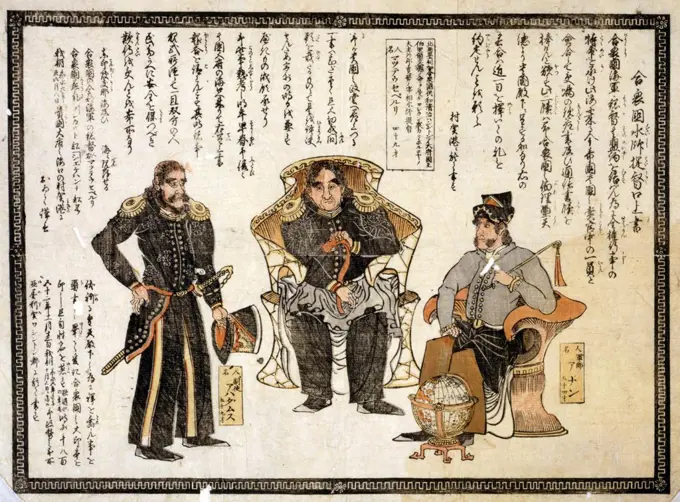
Gasshukoku suishi teitoku kojogaki (Oral statement by the American Navy admiral). circa 1870. Japanese print shows three men, two seated and one standing, possibly Commander Anan, age 54;Perry, age 49;Captain Henry Adams, age 59.
6145-50510491
Battle scene, episode from the First Sino-Japanese War (1894-1895); Nisshin kosen sugoroku (album). Toshiaki, Yusai (1864-1921), graphic artist
1899-29973817
History by Polybius. Volume IV. French edition translated from Greek by Dom Vincent Thuillier. Comments of Military Science enriched with critical and historical notes by M. De Folard. Paris, chez Pierre Gandouin, Julien-Michel Gandouin, Pierre-Francois Giffart and Nicolas-Pierre Armand, 1728. Rider from Fez or Morocco. Engraving. Later colouration.
6176-67039998
'A Group of Samurai', c1890. Artist: Unknown
6145-45916632
The fall of Jinzhou - Our second army conquers Nanshan after a fierce battle; Kinshûjô Kanraku Waga Daini Gun No Caliting Nanzan Senryô No Kôkei. Japanese soldiers beat Russian soldiers on the shore of a river. Jinzhou, on the Liaodong Peninsula was conquered by Japan during the Russian-Japanese War (1904-1905), after which the area was leased to the Japanese.
4409-17396168
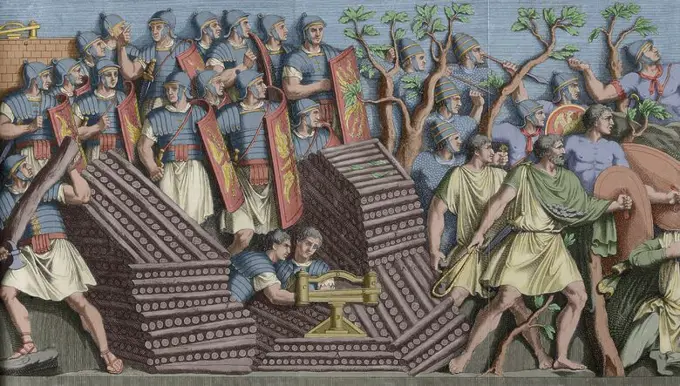
History by Polybius. Volume II. French edition translated from Greek by Dom Vincent Thuillier. Comments of Military Science enriched with critical and historical notes by M. De Folard. Paris, chez Pierre Gandouin, Julien-Michel Gandouin, Pierre-Francois Giffart and Nicolas-Pierre Armand, 1727. Printing by Jean-Baptiste Lamesle. Trajan's Dacian Wars. 2nd century AD. Engraving depicting reliefs from the Trajan Column. Scene of Roman army. Later colouration.
1899-18718886
The Mongol invasions of Japan of 1274 and 1281 were major military invasions undertaken by Kublai Khan to conquer the Japanese islands after the submission of Korea. Despite their ultimate failure, the invasion attempts are of historical importance, because they set a limit on Mongol expansion, and rank as nation-defining events in Japanese history. The Japanese were successful, in part because the Mongols lost up to 75% of their troops and supplies as a result of major storms at sea. These were named 'kamikaze' or divine winds by the Japanese.
1899-18852102
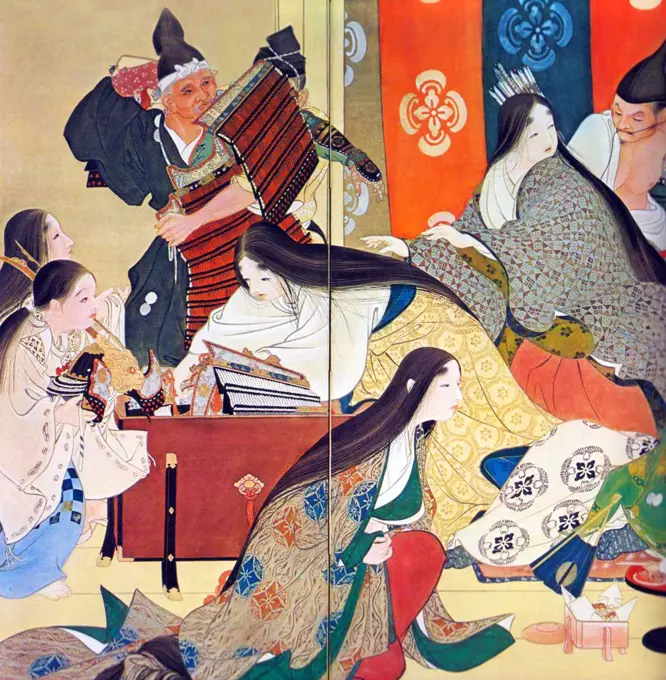
One of a pair of original unsigned gouache drawings; wife of general seated outside tent near staff with shield and banner of rank, kneeling attendant at right.
1746-174
Chinese depiction of the engagement between the British and Chinese at Fatsham Creek on Canton river, Second Opium War - 1856-1858, British wood engraving
6176-59911762
'Esquimaux Attacking an English Boat from their Cayaks', 1941. Indigenous people of Canada defending their land against invaders. Attributed to John White, explorer and colonial governor. From "Canada', by Lady Tweedsmuir, 'The British Commonwealth in Pictures' series. Collins, London, 1941
4435-8398
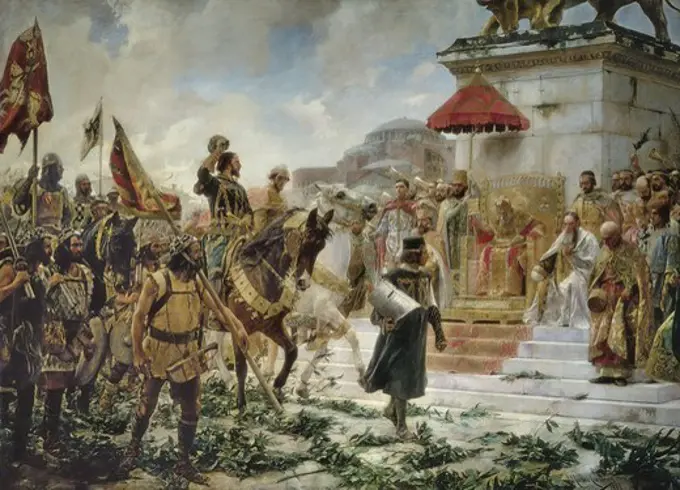
MORENO CARBONERO, Jos_ (1860-1942). The arrival of Roger de Flor in Constantinople. 1888. SPAIN. Madrid. Senate Palace. Scene depicting Roger de Flor and his Almogavars troops marching before the Byzantin Emperor Andronicus II Palaeologus (1303). Oil on canvas.
1899-18789762
The Genpei War (Genpei kassen, Genpei gassen) (1180-1185) was a conflict between the Taira and Minamoto clans during the late-Heian period of Japan. It resulted in the fall of the Taira clan and the establishment of the Kamakura shogunate under Minamoto Yoritomo in 1192. The Battle of Fujikawa (Fujikawa no tatakai) was a battle of the Genpei War of the Heian period of Japanese history. It took place in 1180, in what is now Shizuoka Prefecture. Attempting to recover quickly from his exile, and to rebuild his army, Minamoto no Yoritomo sent out messengers to recruit other families. As he continued through the region below Mount Fuji and into Suruga Province, he planned a rendezvous with the Takeda clan and other families of the provinces of Kai and Kozuke to the north. These allies arrived just in time to fight off the pursuing Taira army. Supposedly, in the night, the Taira mistook the sound of a flock of birds for that of a Minamoto surprise attack, and fled, with no actual battle taki
4220-21869727
 Mongol and Persian warriors in single combat        Date: early 15th century
1746-590
Carthaginian general Hannibal's army crossing the Alps 218 BC to do battle with the Romans. Second Punic War. Early 20th century illustration
1746-19691060
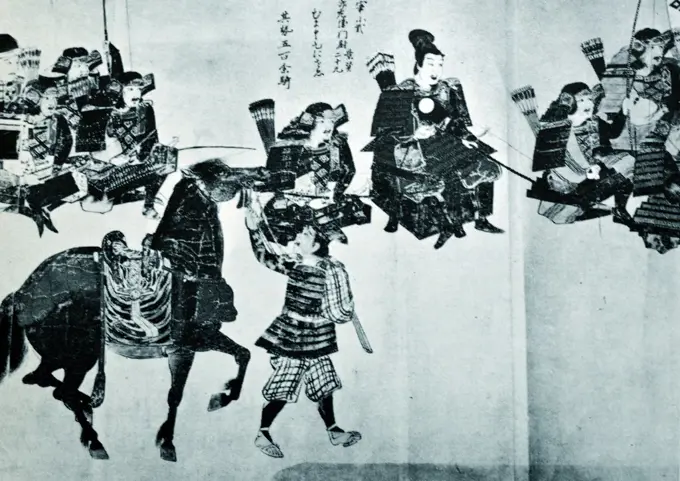
Japanese warlord Muto Kagesuke prepares for the Battle of Kan during the Mongol invasions of Japan. 1274 AD
6145-45916210
In the Chinchon region, five military engineers expel more than a hundred Chinese soldiers; Chihô Ni Gomei No Nihon Kôhei Shinhei Hyakuyonin Kritai. Five Japanese engineers expel more than a hundred Chinese soldiers in the Chinchon region. This helf phantomed incident took place during the first Chinese-Japanese war (1894-1895).
1788-33193
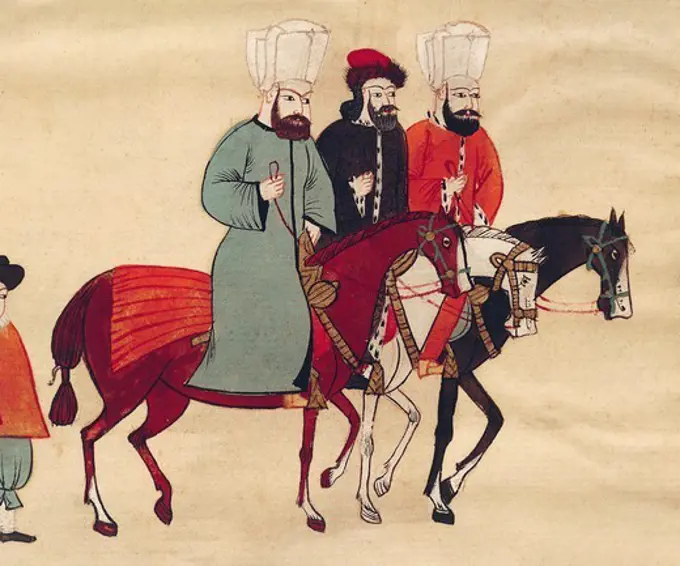
Jacopo Soranzo, the Venetian ambassador to Constantinople being captured by the Sultan's troops, miniature from Turkish Memories, Arabic manuscript, Cicogna Codex, Turkey 17th Century.
4220-21834862
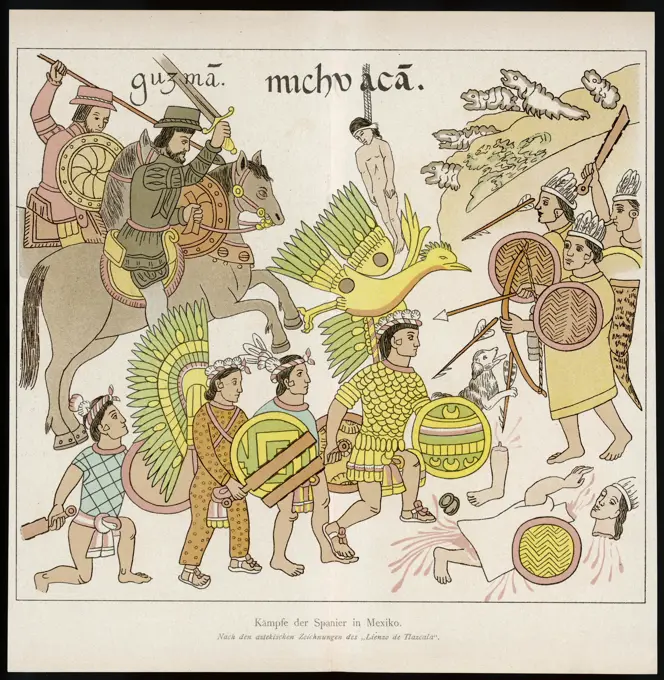
The Spaniards and their allies  fight the Mexicans         Date: 1519
1746-19660190
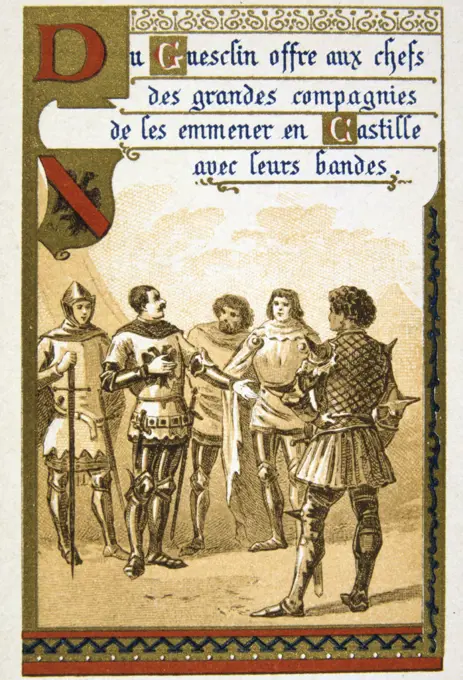
Bertrand du Guesclin or Gueselin (c1320-1380) Eagle of Brittany, Constable of France from 1370. French military commander during the Hundred Years War. Guesclin put at at head of free companies 1366-1369. Trade Card
7155-70377240
Suleyman's campaign. Ottoman victory in Hungary in 1543-4. Battle of Mohacs. Manuscript.
4220-20423626
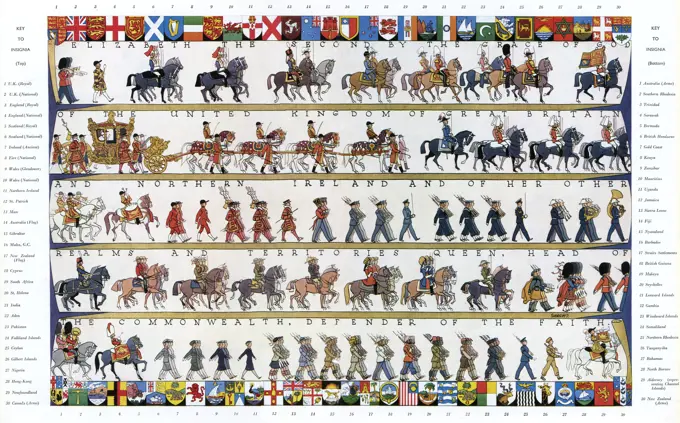
Double page spread artist's impression of the Coronation procession of Queen Elizabeth II showing the various military and ceremonial representatives of the UK and Commonwealth.  The border is edged with flags and insignia.     Date: 1953
1746-111328434
Battle scene showing Japanese soldiers storming a Chinese fort, engaging troops who are defending the fort. Japanese woodcut dated between 1895 and 1900. Sino-Japanese War, 1894-1895
4443-22009248
Samurai in Armour; Kusakabe Kimbei (Japanese, 1841 - 1934, active 1880s - about 1912); Japan; 1870s - 1890s; Hand-colored Albumen silver print
1899-18855149
A ninja (者) or shinobi (び) was a covert agent or mercenary in feudal Japan who specialized in unorthodox warfare. The functions of the ninja included espionage, sabotage, infiltration, and assassination, and open combat in certain situations. Their covert methods of waging war contrasted the ninja with the samurai, who observed strict rules about honor and combat. The shinobi proper, a specially trained group of spies and mercenaries, appeared in the Sengoku or 'warring states' period, in the 15th century, but antecedents may have existed in the 14th century, and possibly even in the 12th century (Heian or early Kamakura era).
4266-21636131
The Battle of the Neva on July 15, 1240 (From the Illuminated Compiled Chronicle), Anonymous
1788-32754
Sultan Murat invading Bulgaria and conquering Sophia, Ottoman from The Hunername miniature, 16th century.
6176-66915406
The fall of Tripoli to the Mamluks, April 1289. This was a battle towards the end of the Crusades, in what is modern-day Lebanon.
4266-29354
Battle between the Mongol and Jin Jurchen armies in north China in 1211. Miniature from Jami' al-tawarikh (Universal History) by Anonymous   / Bibliotheque Nationale de France / ca 1430 / Afghanistan, Herat school / Gouache on paper / History /
6176-66917366
The seizure of Edessa in Syria (1031) by the Byzantine army led by George Maniakes, and the Arabic counterattack.
7127-70535312
First Division US Army Memorial, Omaha Beach, Normandy, France
1899-19134749
China: Shoulder badge of the New Fourth Army (Xin Si Jun) with peasant soldier and the Chinese phrase 'Di Kang' or 'Oppose the Enemy', c. 1938
1899-17320131
Ottoman wars in Europe. Siege of Rhodes (1480). Military action carried out by the Ottoman army, under Gedik Ahmed Pasha (died, 1482). The aim was to wrest control of the island from the Knights of Rhodes, a military order that emerged during the Crusades. Pierre d'Aubusson (1423-1503), Grand Master of the Order of St. John of Jerusalem, led the defenders. Engraving of "Stabilimenta Rhodiorum", 1496. Colored.
6145-48890386
Gideon Attacking the Midianites at Night.
1899-18855843
The Wujing Zongyao (simplified Chinese: ; traditional Chinese: ; pinyin: Wjng Zngyo; Wade-Giles: Wu Ching Tsung Yao; literally: 'Collection of the Most Important Military Techniques') is a Chinese military compendium written in 1044 CE, during the Northern Song Dynasty. Its authors were the prominent scholars Zeng Gongliang (), Ding Du () and Yang Weide (), whose writing influenced many later Chinese military writers. The book covered a wide range of subjects, everything from naval warships to different types of catapults. Although the English philosopher and friar Roger Bacon was the first Westerner to mention the sole ingredients of gunpowder in 1267 (i.e. strictly saltpetre, sulphur, and charcoal) when referring to firecrackers in 'various parts of the world', the Wujing Zongyao was the first book in history to record the written formulas for gunpowder solutions containing saltpetre, sulphur, and charcoal, along with many added ingredients. It also described an e
6145-44320744
The actor Iwai Shijaku as a Terute No Mae. Donation Gerhard Schack
1899-18789300
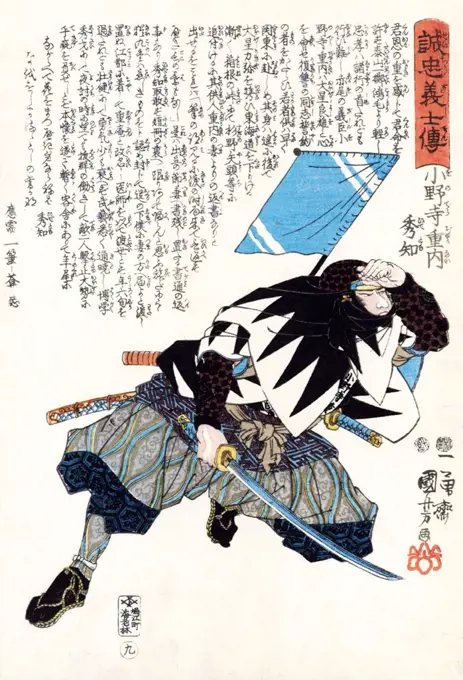
The revenge of the Forty-seven Ronin (Shi-ju-shichi-shi), also known as the Forty-seven Samurai, the Aki vendetta, or the Genroku Aki incident (Genroku aki jiken) took place in Japan at the start of the 18th century. One noted Japanese scholar described the tale as the country's 'national legend'. It recounts the most famous case involving the samurai code of honor, bushidi. The story tells of a group of samurai who were left leaderless (becoming ronin) after their daimyo (feudal lord) Asano Naganori was forced to commit seppuku (ritual suicide) for assaulting a court official named Kira Yoshinaka, whose title was Ki zuke no suke. The ronin avenged their master's honor after patiently waiting and planning for two years to kill Kira. In turn, the ronin were themselves ordered to commit seppuku for committing the crime of murder. With much embellishment, this true story was popularized in Japanese culture as emblematic of the loyalty, sacrifice, persistence, and honor that all good peopl
4408-7203
Britain Needs You at Once, World War I
1899-18712373
The First Sino-Japanese War (1 August 1894 - 17 April 1895) was fought between Qing Dynasty China and Meiji Japan, primarily over control of Korea. After more than six months of continuous successes by Japanese army and naval forces and the loss of the Chinese port of Weihaiwei, the Qing leadership sued for peace in February 1895.
6145-29127467
Siege of a Fortress by the Ottoman Army
6145-59359541
Portrait of a German soldier (cavalry player) on horseback, Philipp Kieffer, 1882, L. Brenner, 1882 photograph Tableau van Gemonteerde Photo's ('In memory of my service') van Philipp Kieffer. Middenboven portrettes van Keizer Wilhelm I, Keizer Franz Joseph I () En. Berlin (possibly) foto: photographic support. paint (coating). blad: paper albumen print
1899-18716702
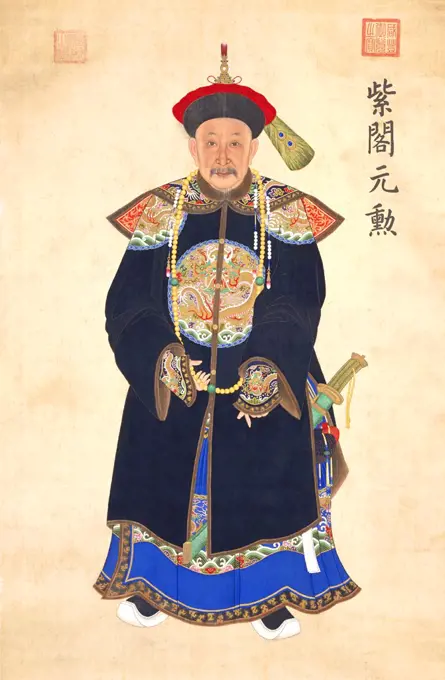
Qing Imperial court portraits of senior Manchu military officers, known as Bannermen, mid-18th century. From the time China was brought under the rule of the Qing dynasty (1644 - 1683), the banner soldiers became more professional and bureaucratised. Once the Manchus took over governing, they could no longer satisfy the material needs of soldiers by garnishing and distributing booty; instead, a salary system was instituted, ranks standardised, and the Bannermen became a sort of hereditary military caste, though with a strong ethnic inflection. Banner soldiers took up permanent positions, either as defenders of the capital, Beijing, where roughly half of them lived with their families, or in the provinces, where 18 garrisons were established. The largest banner garrisons throughout most of the Qing dynasty were at Beijing, followed by Xi'an and Hangzhou. Sizable banner populations were also placed in Manchuria and at strategic points along the Great Wall, the Yangtze River and Grand Can
1746-111523793
Painting depicts the encirclement of the Japanese during the invasion of Korea. Dated 1595
6145-48881906
The Brabants Lay Seige Against the City of Grave. Unknown
PREVIOUS
of 2
NEXT
2401 S. Ervay, Suite 206
Dallas, Texas 75215
United States
Get Started
Free ResearchMy BoardsMy Cart
For Creators
How To License Your ContentContributor PortalFrame of Mind
Resources
API accessPricing
Contact
+1 866 236 0087help@viewpictures.co.uk Contact form
©2026 View Pictures. All Rights Reserved. -A
This site is protected by reCAPTCHA and Google Privacy Policy and Terms of Service apply.