Ornamental Lace Strips

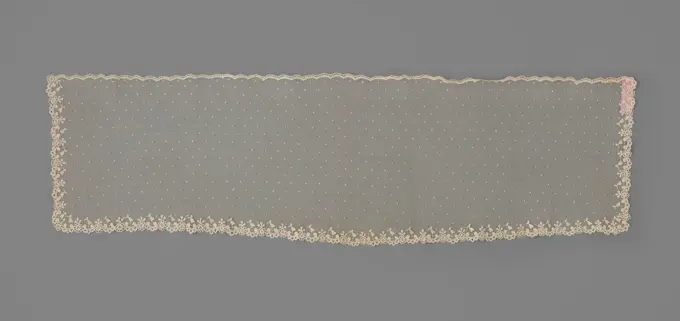
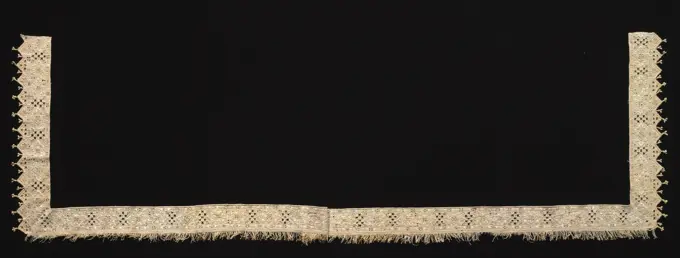
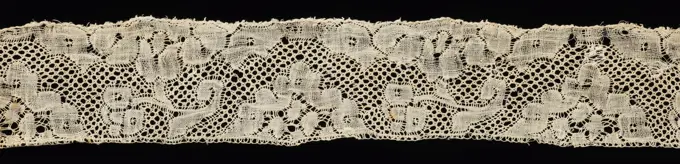
A collection of intricate lace strips featuring floral patterns and natural motifs, showcasing delicate craftsmanship in various materials.

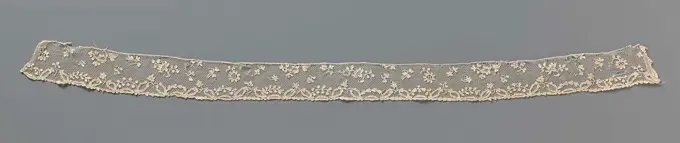
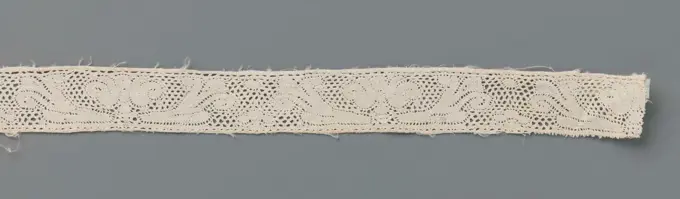
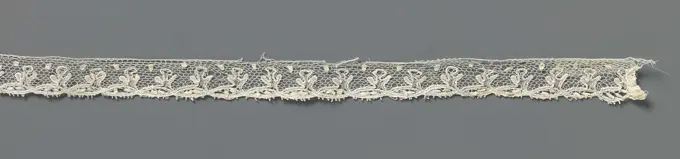
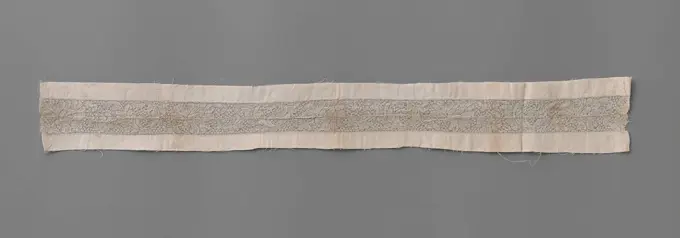
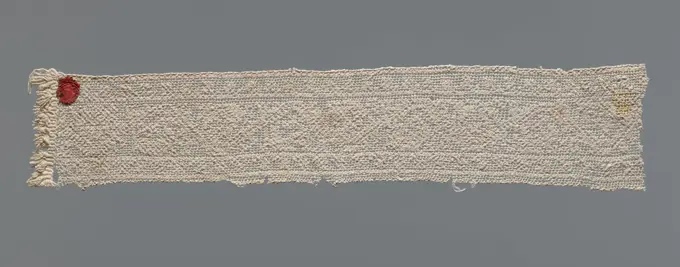
Strip bobbin with V-shapes made of narrow decorative straps with rectangular shape strokes, anonymous, c. 1700  Strip of natural-colored bobbin, binche side. The repeating pattern consists of Wirwar made of small motifs made with different decorative grounds. The outlets of this are partially emphasized with narrow decorative straps with rectangles, made in shape. On the center line, the decorative straps make a V-shape at a regular distance from each other, which is cut over by two hooking C-shapes. The motifs are connected by an irregular decorative land, a snowflake land. The top and bottom of the strip are straight finished, with the bottom with picots. The short sides are finished with a zoompje. Southern Netherlands linen (material) Bobbi Lace / Binche Lace
Strip bobbin with V-shapes made of narrow decorative straps with rectangular shape strokes, anonymous, c. 1700 Strip of natural-colored bobbin, binche side. The repeating pattern consists of Wirwar made of small motifs made with different decorative grounds. The outlets of this are partially emphasized with narrow decorative straps with rectangles, made in shape. On the center line, the decorative straps make a V-shape at a regular distance from each other, which is cut over by two hooking C-shapes. The motifs are connected by an irregular decorative land, a snowflake land. The top and bottom of the strip are straight finished, with the bottom with picots. The short sides are finished with a zoompje. Southern Netherlands linen (material) Bobbi Lace / Binche Lace
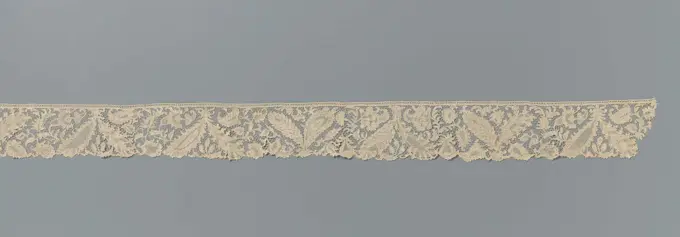
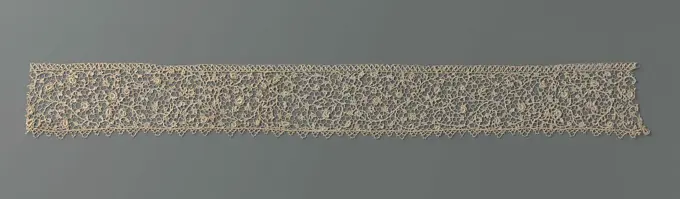
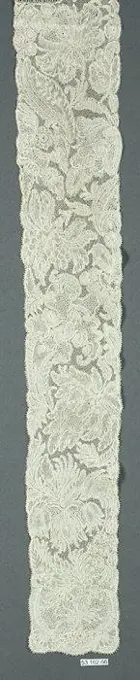
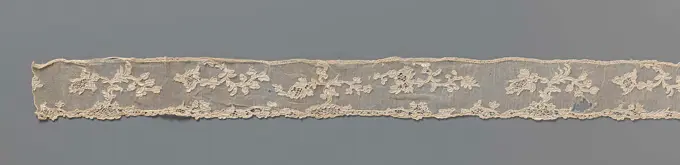
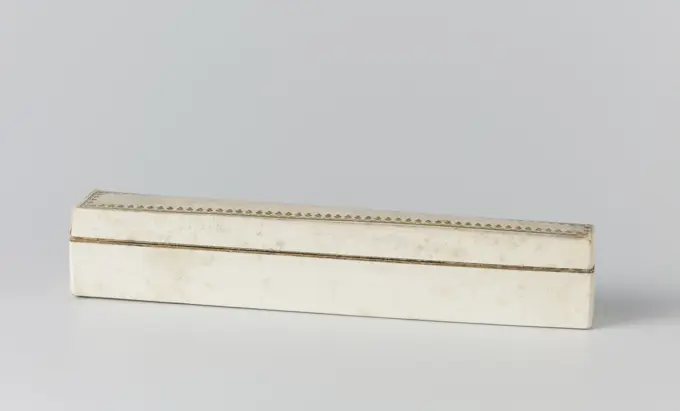
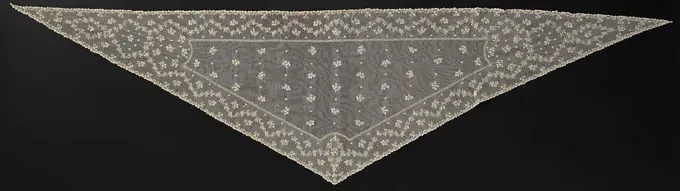
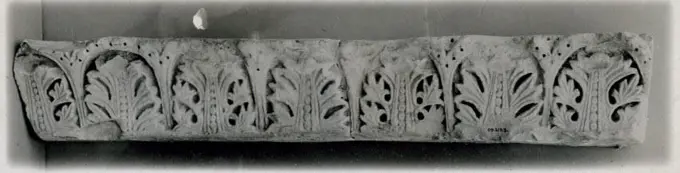
Strook naaldkant met bloemenstrooipatroon en spitsovaaltjes.Strip natural needle side, Argent tank. Spreading pattern from twigs to whom alternately a small or larger flower, leaves and / or berries. Ground with meshes that are close to the buttonhole stitches. The pattern along the lower edge consists of two-way-around spindle releases between which a flower or berry branch exprements. The oval pairs are connected by a bow of leaves and / or berries and hearts. Among these arcs along the bottom edge a flat, oval oval. The oval-shaped figures in the pattern are filled with a fine hexagonal Maas soil (alençong soil). Different ornamental grounds in the flowers. Full work without recesses in flowers, leaves and berries. Sloppy edge on the underside through a concatenation of heart-shaped leaves, regularly interrupted by a rosette flower and the flat oval oval. The top is finished with a straight edge.Band (Italy); linenHeadBandStrook naaldkant met veervormige en pluimvormige bladeren en bloemen.Strip natural needle side: Argentan side. Pattern with spring-shaped and plimged leaves. A recurring motif are always two large leaves that are placed in a V shape, between them are smaller flowers and leaves, the V-shape alternately is upright or hang down. The motifs are connected by a hexagonal soil with scented meshes: an Argentan ground. The sloping edge along the underside comes from the pattern and is finished with picots. The top of the strip is straight finished with a splitting strap.Fragment ca. 1700 Flemish. Fragment 212879Galloon ca. 1830 French. Galloon 213975Galloon late 18th-early 19th century European. Galloon 224981Strook naaldkant met dunne rank met kleine reliëfbloempjes.Strip natural needle side: Venetian rosion side. Pattern with a continuous thin rank with curly branches and equipped with small leaves and different small relief flowers. The motifs are made with feston stitches with recesses and decorative stitches here and there. The tendrils are not provided with relief contours. The only relief that has been applied consists of cordons decorated with raderpicots around the flower hearts. The motifs are connected by a bar soil. The straight top of the strip is finished with a clusted strap with a pattern made of crosses with shape layers. The underside is finished with a bow edge, with arcs that are alternately made up of three and six arcs.Galloon late 18th-early 19th century European. Galloon 225005Strip bobbin with V-shapes made of narrow decorative straps with rectangular shape strokes, anonymous, c. 1700  Strip of natural-colored bobbin, binche side. The repeating pattern consists of Wirwar made of small motifs made with different decorative grounds. The outlets of this are partially emphasized with narrow decorative straps with rectangles, made in shape. On the center line, the decorative straps make a V-shape at a regular distance from each other, which is cut over by two hooking C-shapes. The motifs are connected by an irregular decorative land, a snowflake land. The top and bottom of the strip are straight finished, with the bottom with picots. The short sides are finished with a zoompje. Southern Netherlands linen (material) Bobbi Lace / Binche LaceChef de piece, Medium: cotton Technique: block printed on plain weave, Diagonal lines closely filled with pattern. One set of diagonal lines contains hieroglyphic-like shapes. Two purples and yellow., Seine et Marne, France, 1790-99, printed, dyed & painted textiles, Chef de pieceEdge, Medium: linen Technique: bobbin lace (Valenciennes ground), Scroll, leaf and floral motifs in an open field., France, 18th century, lace, EdgeTrimming (France); 1909-2-200Trimming, Medium: silk Technique: woven, Woven upholstery trimming in design of interlacing circles bordered with semi-circles in gray, pink and ivory., USA, 19th century, trimmings, TrimmingGalloon 17th-18th century probably European. Galloon 213881Fontange of Brussels or Argentan (needle) side, anonymous, c. 1800 - c. 1900 Fontange van Naaldantkant, consisting of two hat slips and an intermediate piece. The pattern consists of leaf and flower vines between which different decorative stitches. The scalloped edge is trimmed with picots. France (possibly) linen (material). Brussels point of gauze / argentan lace Fontange van Naaldantkant, consisting of two hat slips and an intermediate piece. The pattern consists of leaf and flower vines between which different decorative stitches. The scalloped edge is trimmed with picots. France (possibly) linen (material). Brussels point of gauze / argentan laceStrip bobbin with a bump on rectangle and Spitsovaal, Anonymous, c. 1900 - c. 1909  Strip of natural-colored bobbin, binche side. The repeating pattern consists of a horizontal rectangle with a bump on one side and on the short side on the other side lies a sparkle -in Spitsovaal. The contours of the motives are made in linen battle. The center of the Spitsovaal was made in Netslag. And in the center of the rectangle a snowflake land has been used as a decorative land. The motifs are connected by a combination of decorative land, various snowflake grounds and a Paris soil. Top and bottom of the strip are straight finished, with the bottom with picots. Normandy linen (material) bobbin lace / Binche lace / snowflake fillingStrip 18th century Flemish. Strip. Flemish. 18th century. Bobbin lace. Textiles-LacesPair of lappets and joined cap edging early 18th century Flemish, Brussels. Pair of lappets and joined cap edging 227712Wampum belt -Band Made 1801-1900 Austria. Silk, plain weave; embroidered .Needlepoint Lace Lappet, 1715-1774. France, Alençon, 18th century (Louis XV Period, 1715-1774). Lace, needlepoint: linen; average: 95.9 x 7.4 cm (37 3/4 x 2 15/16 in.).Needlepoint Lace Lappet, 1715-1774. France, Argentan, 18th century (Louis XV Period, 1715-1774). Lace, needlepoint: linen; average: 10.8 x 148 cm (4 1/4 x 58 1/4 in.).Border (Belgium); linenPiece 18th century Flemish, possibly Wallonia. Piece 212777Piece 17th century Japan. Piece 71748Tussenzetsel van kloskant met bloem tussen langgerekte voluutbladeren.Inserting natural-colored hollandes. The pattern consists of a repeating symmetrical motif of a flower between elongated voltull leaves. The motifs are made in linen stroke with openwork edges and are connected by a more or less round table ground with braid. The top and bottom are straight finished. The intermediate site is stitched on the same strip of clamping side with a few coarse.Pink Ripszijde wedding ribbon in which alternating with silver wire woven an alliance weapon and 'Francois Noel and/ Maria Rebecka Simons/ in the Echt unites the/ December 14 AO 1756', tried with silver troettes, Aernoud & Francois Noël, Before 1756 Ribbon of pink ripszijde in which alternating with silver wire woven an alliance weapon and 'Francois Noel and/ Maria Rebecka Simons/ in the Echt unites the/ December 14 AO 1756', trimmed with silver tries. Amsterdam lint: silk. lint: silver thread. troetels: silver thread   Westerkerk Ribbon of pink ripszijde in which alternating with silver wire woven an alliance weapon and 'Francois Noel and/ Maria Rebecka Simons/ in the Echt unites the/ December 14 AO 1756', trimmed with silver tries. Amsterdam lint: silk. lint: silver thread. troetels: silver thread   WesterkerkGimp mid-19th century French. Gimp 214221Fragment (Italy); linenTrimming, Medium: silk, silver metallic thread Technique: woven, Design of flowers placed alternately up and down with diagonal bands in between. On one edge, a border in an open weave forming scallops. In yellow and white with silver thread., Italy, 18th century, trimmings, TrimmingBand, Medium: linen Technique: bobbin lace, peasant style, Peasant style lace with scroll motif., 18th century, lace, BandNeedle sheath 17th-18th century Italian. Needle sheath. Italian. 17th-18th century. Horn and metal. Textiles-Methods and MaterialsKloskant's hatcher on tulle (application side), anonymous, c. 1850 - c. 1900 Hat veil from application side, with scalloped edges. Along three edges, the pattern C-Voluten with a leaf branch above it, interspersed with a flower with three leaves. The soil is littered with moesjes. Belgium . bobbin lace Hat veil from application side, with scalloped edges. Along three edges, the pattern C-Voluten with a leaf branch above it, interspersed with a flower with three leaves. The soil is littered with moesjes. Belgium . bobbin laceGalloon 17th-18th century Unknown. Galloon 213799Piece 18th century Flemish. Piece 218160Trimming, Medium: metal-wrapped silk thread Technique: bobbin lace, Design of lozenges with solid blocks at intervals. Scallops on one edge and picots on the other., Italy, 17th century, lace, TrimmingStrook kloskant met spitsovaaltjes en gestileerde mannetjes.Strip natural colosside, Lille side. The repeating and continuous pattern exists along the underside of the strip from concerted spits. From every oval a round flower ranges between two leaves, a stylized male that stands up with two arms. There is always one square mole between the consecutive heads. There are two mares in the openwork ovals. The motifs are connected by a fine Maas soil, a tulet. The energy-saving fireworks is made in detached linen stroke. Dominate the thicker and shiny contour wires. The Moeses are made in shape stroke. The top of the strip is straight finished and attached to a strip of machining tulle. The bland scalloped underside is finished with picots.Cap Streamers (Belgium); linenStrip of bobbin with a one-sided or-shaped flower stem with a chalice, anonymous, c. 1740 - c. 1760 Strip of natural-colored bobbin, binche side. The repeating pattern consists of a unilaterally oriented S-shaped flower stem with a chalice flower. The motifs are connected by a grid, a five -part ground. The motifs are made in linen battle with openwork edges. Top and bottom of the strip are straight finished, with the bottom with picots. Binche (Possible) linen (material) Bobbi Lace / Binche Lace Strip of natural-colored bobbin, binche side. The repeating pattern consists of a unilaterally oriented S-shaped flower stem with a chalice flower. The motifs are connected by a grid, a five -part ground. The motifs are made in linen battle with openwork edges. Top and bottom of the strip are straight finished, with the bottom with picots. Binche (Possible) linen (material) Bobbi Lace / Binche LaceBand, Medium: linen Technique: needlework on gauze weave, Buratto lace worked with a design showing a hunter attacked by a boar, a crowned griffin, and a shield form containing an urn, all combined with foliate scrolls., Italy, 16th-17th century, lace, BandBobbin Lace Edging, 20th century. Belgium, Binche, 20th century. Lace, bobbin: linen; average: 3.9 x 108.6 cm (1 9/16 x 42 3/4 in.).Band, Medium: undyed linen, silk Technique: bobbin lace, Eastern European, peasant, Strip of insertion with undyed linen framework with central band of rosettes in yellow silk; blue and yellow silk guard stripe. Much of the silk is worn away., 19th century, lace, BandBobbin Lace (Punto di Milano) Flounce, 16th-17th century. Italy, Milan, 16th-17th century. Lace, bobbin; average: 17.2 x 165.1 cm (6 3/4 x 65 in.).Band, Medium: linen Technique: needle lace with ground of loop and twist with twist return, Band with a design of a basket filled floral sprays and other motifs., France, 18th century, lace, BandPiece 18th century French or Italian. Piece 214061Fragment of an aurifries, with embroidery of silk and gold board.. fragment of an aurifries, with embroidery. Two fragments with Invnrs are part of the fragment. BK-NM-4165-D-1 and BK-NM-4165-D-2.Strip of needle side with birds, anonymous, c. 1675 - c. 1699 Strip of natural needle side, point the france. Pattern without a report but with recurring motifs, including small birds, on a hexagonal soil with picoted bars. Volwerk decorated with recesses, motifs partly without and partly with Kordons. Small potente arches hang on the straight edge on the underside. The sides are finished with palms. The top is trimmed with a border bobbin. unknown linen (material) Strip of natural needle side, point the france. Pattern without a report but with recurring motifs, including small birds, on a hexagonal soil with picoted bars. Volwerk decorated with recesses, motifs partly without and partly with Kordons. Small potente arches hang on the straight edge on the underside. The sides are finished with palms. The top is trimmed with a border bobbin. unknown linen (material)Miser's Purse; silk, steel beadsFragment 16th century Italian. Fragment. Italian. 16th century. Silk. Textiles-VelvetsNeedlepoint (Cutwork) Lace Edging for Sheet, 17th-18th century. Italy, 17th-18th century. Lace, needlepoint: linen; embroidered in silk, silk fringe; overall: 66.5 x 231.7 cm (26 3/16 x 91 1/4 in.).Copper alloy spearhead ca. 2500-2000 B.C. Cypriot Leaf-shaped blade.. Copper alloy spearhead 244160Strip of needle side with rosettes and oval -shaped flowers, anonymous, c. 1900 - c. 1949 Strip of natural needle side that is made or used as an intermediary, Brussels gauze side. Pattern with a repetitive motif over the full width of the strip, from a rosette flower interspersed by an oval -shaped flour that is flanked by two leaves. The pattern parts are connected by a few bars. Within the contours of the flowers and leaves fine mesh grounds with decorative stitches. The top and bottom edge are finished with a double straight border with vertical spikes. Germany (possibly) linen (material) Brussels Gaze Point Strip of natural needle side that is made or used as an intermediary, Brussels gauze side. Pattern with a repetitive motif over the full width of the strip, from a rosette flower interspersed by an oval -shaped flour that is flanked by two leaves. The pattern parts are connected by a few bars. Within the contours of the flowers and leaves fine mesh grounds with decorative stitcGalloon ca. 1600 Italian. Galloon 213404Barbe early 18th century Flemish. Barbe 218853Heat slip of the needle side with acanthus leaves, anonymous, c. 1720 - c. 1730 Capslip of natural-colored needle side, Régence side. Pattern with acanthus leaves and lush flowers, decorated on a mesh soil with square mushes. Fullwork with recesses and multifaceted decorative stitches. Relief contours with feston stitches. France whole: Linen (Material) Capslip of natural-colored needle side, Régence side. Pattern with acanthus leaves and lush flowers, decorated on a mesh soil with square mushes. Fullwork with recesses and multifaceted decorative stitches. Relief contours with feston stitches. France whole: Linen (Material)Galloon 18th century Italian. Galloon 213380Tussenzetsel van kloskant met anjer en cirkelvormend gevederd blad.Interesting of natural colosside, binche side. The repeating pattern consists of a sloping carnation at a curved stem with feathered leaves. The leaves form a circle. The motifs are connected by an ornamental ground, a snowflakes soil. The motifs are made in linen stroke with openwork edges. The long sides are straight finished. The strip has been cut out of a linen demolition, another edge of linen walks along both long sides.Textile Fragment early 18th century. Textile Fragment 454597Oosters tapijt.Oriental carpet of knotted wool, runner format. There are two medals with grid work, rosettes and heart shapes in midfield. Around three edges.Fichu 1880s probably American. Fichu. probably American. 1880s. cotton, glassStrook naaldkant met vier verschillende gespleten bloemtakken.Strip natural-colored coniferous lace: Alençon side. Repetitive motif with a variety of four different, split flower branches on a fine hexagonal Maas soil with overwached meshes. The flower branches display and from a cartouche along the bottom edge and from the top of the strip. Full work with recesses and limited padding with ornamental grounds in the larger flowers and in the cartouches. Contour lines with relief from feston stitches. The top is trimmed with a border clamping side. Low scalloped bottom edge with a flower garland, finished with ragfine picots.Tapes (USA); linenFringe early 19th century probably European. Fringe 213609Galloon 17th-18th century Unknown. Galloon 213802Trimming, Medium: linen, silk, silver thread Technique: woven, Band with a design of a silver ornament in the center and a scalloped edge formed by the manipulation of the weft., Italy, 16th century, trimmings, TrimmingEdging (Italy); linen; Warp x Weft: 2 x 29 cm (13/16 x 11 7/16 in.); 1946-42-54Piece 18th century Japan. Piece 72173Ribbon, white with silver, fond of gros de Tours with cross stripes of silver lamé, anonymous, c. 1750 - c. 1770 Ribbon, possibly for garter tires, white with silver. Fond of Gros de Tours with transverse stripes of silver ramp. The ornament is partly of browned silverlamé, which is flottant up to the outskirts. Pattern of blending into each other interlocking classic palmets. Self -sides decorated with Hanekammen. France (possibly) silk. Ribbon, possibly for garter tires, white with silver. Fond of Gros de Tours with transverse stripes of silver ramp. The ornament is partly of browned silverlamé, which is flottant up to the outskirts. Pattern of blending into each other interlocking classic palmets. Self -sides decorated with Hanekammen. France (possibly) silk.Gallon;  18th century (1701-00-00-1800-00-00);Strip of needle side for a superplie with iris, anonymous, c. 1600 - c. 1699 Strip of white needle side for a superplie, decorated with a repetitive motif of ranks and multifaceted flowers including irises. Irregular open bar with picots. The top is trimmed with a border bobbin. The underside is finished with a straight picot edge with triangles. Venise flat. Venice linen (material) flat Venetian (needle point) Strip of white needle side for a superplie, decorated with a repetitive motif of ranks and multifaceted flowers including irises. Irregular open bar with picots. The top is trimmed with a border bobbin. The underside is finished with a straight picot edge with triangles. Venise flat. Venice linen (material) flat Venetian (needle point)Insertion 16th century Italian, Genoa. Insertion 220885Needlepoint (Reticella) Lace Fragment, early 17th century. Italy, early 17th century. Lace, needlepoint: linen; average: 2.9 x 66.1 cm (1 1/8 x 26 in.).Galloon 17th-18th century Unknown. Galloon 213865Belt. unknown, craftsmanTussenzetsel van machinale kant met druppelvormige blaadjes aan een golvende rank.Interesting of machining: Machining Mechelen side. The repeating and continuous pattern consists of a wavy rank with alternating at the top and underside a drop-shaped leaf. The rank and leaves are made in loosened linen stroke with thicker and shiny contour wires. The motif has been made in a ground ground, a machining soil. Upper and bottom of the strip are straight finished. The strip is wrapped on a blue card with a price indication.Trimming, Medium: silk Technique: woven, Multi-colored trimming woven in an open design with flowers made of colored ribbons and floss threads that are knotted and fringed., USA, ca. 1902, trimmings, TrimmingEdging, Medium: linen Technique: bobbin lace, peasant style, peasant style, Italy, 19th century, lace, EdgingPassementerie 18th century French. Passementerie 213364Textile Border Fragment. Italy, 19th century. Textiles; borders. Linen plain weave with silk cut pileStrip or intermediate brush from Kloskant with circular motifs and double oval recesses, anonymous, c. 1550 - c. 1599  Strip of natural -colored bobbin. The repeating and symmetrical pattern is formed by an open network of braids, made with a relatively coarse wire. It consists of a chain of circular motifs, filled with an x or finer meshes. The circles are connected to each other by double, placed on top of each other without filling. Top and bottom of the strip are straight. The chain with motifs is connected to this with X-shaped crossed braids, always under the double oval recesses. Italy linen (material) bobbin laceFragment white silk dam mast with pattern of two flowers each time on a curved stem with heraldic lily, anonymous, c. 1600 - c. 1625 Fragments cream-colored Zijddamast with floral motif and Fleurs-de-Lis in flower cores, on panel.  silk damask Fragments cream-colored Zijddamast with floral motif and Fleurs-de-Lis in flower cores, on panel.  silk damaskTextile, Medium: cotton Technique: roller printed on plain weave, Black and purple on a white ground in an allover pattern of tiny black sprigs and black and white dots on a purple ground., USA, 1870-80, printed, dyed & painted textiles, TextileGimp mid-19th century French. Gimp 214223Band; linen; 1933-1-220Strip 18th century Italian. Strip 215518Strip 18th century German. Strip 217135Galloon late 18th-early 19th century European. Galloon 224986Waaaard box made of paper, tapered, exterior covered with finely structured white paper, top lid with rim of clover leaves trimmed, c. 1911 Waaierdug made of paper, tapered, exterior covered with finely structured white paper, top lid with rim of clover leaves trimmed, covered inside with light blue paper. Amsterdam (possibly) whole: Paper. lid:. Cover: Watercolor (Paint) painting Waaierdug made of paper, tapered, exterior covered with finely structured white paper, top lid with rim of clover leaves trimmed, covered inside with light blue paper. Amsterdam (possibly) whole: Paper. lid:. Cover: Watercolor (Paint) paintingFragment of the lace;  16th-18th century (1501-00-00-1700-00-00);Band fragment, Medium: Warp; S-spun linen. Wefts: S-spun wool. S-spun linen Technique: slit tapestry, Curving stem wuth grape leaves, Egypt, 5th-8th century, woven textiles, Band fragmentBobbin Lace Insertion, early 17th century. Italy, Venice, early 17th century. Lace, bobbin; average: 4.8 x 43.9 cm (1 7/8 x 17 5/16 in.).Busk 1675-1725 Italian Old Testament stories are carved along with decorative motives on this busk: Samson slays a Philistine with the jawbone of an ass; decoration features a gaping, laughing grotesque and also swagged drapery.. Busk. Italian. 1675-1725. woodTrimming, Medium: silk Technique: cut and uncut supplementary warp on satin ground (velvet), Red trimming fragment in a design of leaves and flowers., France, 19th century, trimmings, TrimmingHunting cordlasFichu van naaldkant met gestrooide takjes en rozenknopjes.Fichu from natural needle side: Burano side. Triangular model. The triangular midfield has sprinkled twigs with rose jugs and is enclosed by a pearl table. A wide border is running around the midfield with a zigzag pattern of a leaf garland. This pendulum forms from the sharp corners, towards midfield, a diamond shape and two-size-increasing five angles. Twisted festivone stitches form the square mesh soil in midfield, the wide edge has been worked separately with nozzles. The motifs are made with feston stitches and two types of open ornamental stitches. The relief contours are filled and scored. Finished on all sides with a richly decorated edge of arcs and leaves.Heat slip from Brussels bobbin, Anonymous, c. 1730 - c. 1750 Hats slip, sewn, from Brussels bobbin, slightly sculpted with straight ends and equipped with a picotrand. The pattern consists of flowers and leaves. West-Europa linen (material) Brussels bobbin lace Hats slip, sewn, from Brussels bobbin, slightly sculpted with straight ends and equipped with a picotrand. The pattern consists of flowers and leaves. West-Europa linen (material) Brussels bobbin laceBorder, Medium: linen Technique: grid of laid cords with needle lace (reticella style), Border of square compartments filled with stylized floral and foliated forms in an alternating pattern. Connected by brides and interspersed by portes., England, late 16th-early 17th century, lace, BorderFragment from a Molding with Acanthus Clusters under Arcades 5th-6th century The monastic community of Bawit, founded in the 300s by Apa (Father) Apollo at a small village, grew to consist of numerous complexes with residences, chapels, and service structures and two large churches profusely decorated with sculptures and paintings, often reused from other sites, all affiliated with the Coptic church. The more important buildings were decorated with courses of sculpted stone freely combining floral and geometric motifs inspired by classical art - rosettes, acanthus leaves, meander patterns - with more recent Christian themes. These sculptural elements, demonstrating the Byzantine love of complex patterning with lush textures, were originally painted in rich, vibrant colors like those surviving in textiles.. Fragment from a Molding with Acanthus Clusters under Arcades 445965Roll black satin ribbon with white wavy embroidered motif on cardboard, Gustav Schnitzler, c. 1900 - c. 1925 Roll black satin ribbon with white wavy embroidered motif on cardboard. Nijmegenfrance silk. satin. cardboard embroidering Roll black satin ribbon with white wavy embroidered motif on cardboard. Nijmegenfrance silk. satin. cardboard embroidering