Ornamental Lace Strips

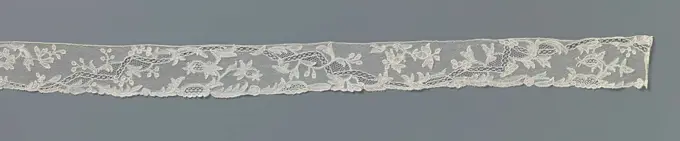
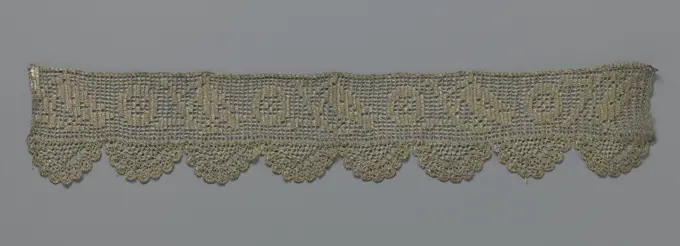
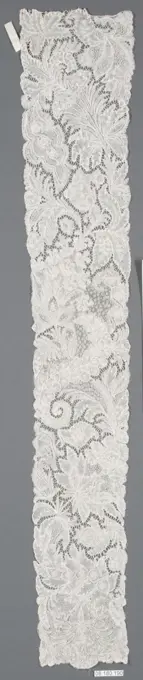
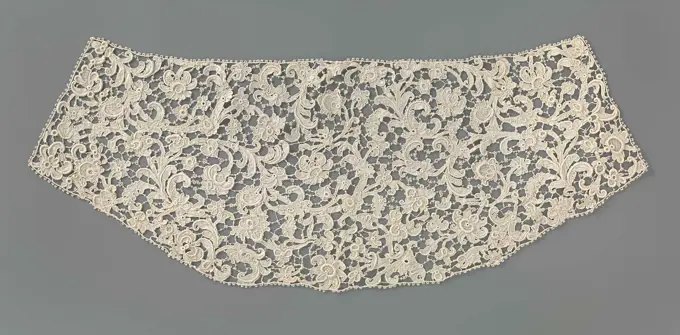
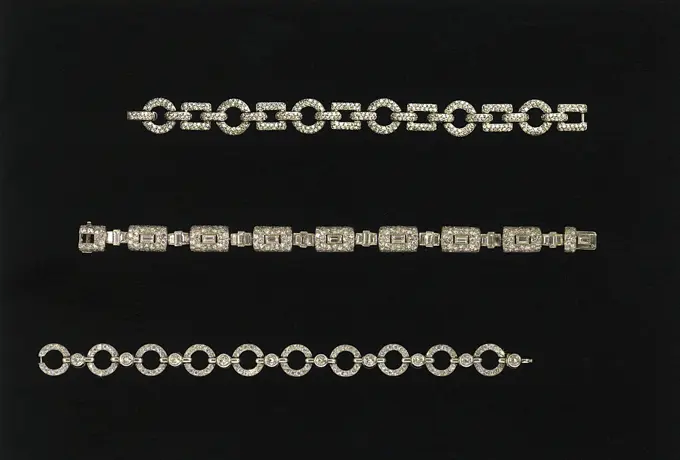
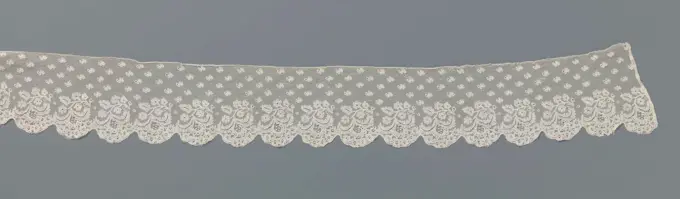
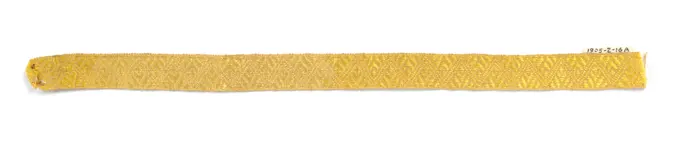
A collection of intricate lace strips showcasing floral motifs, symmetrical designs, and detailed stitching, primarily in natural colors and varying textures.

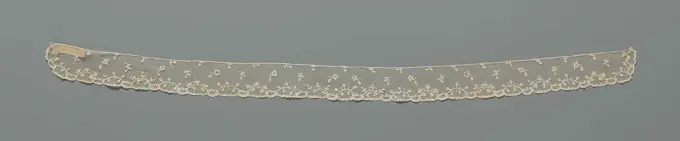
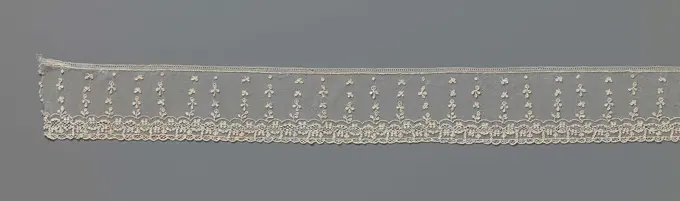
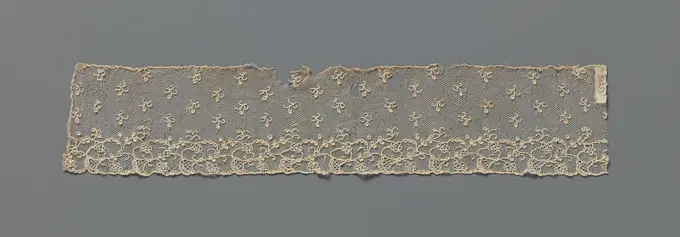
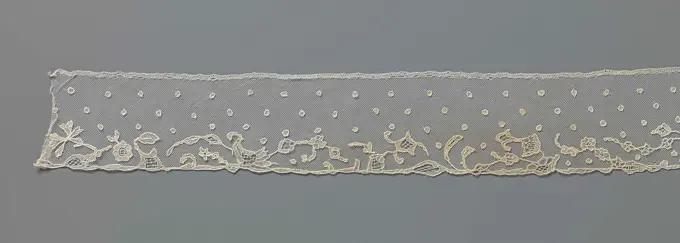
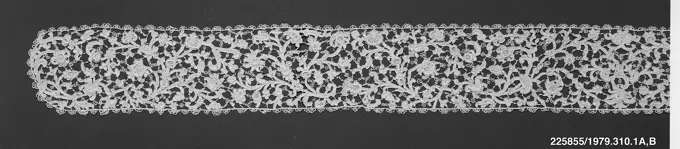
Border, Medium: linen Technique: bobbin lace, Mechlin style, Straight border of Mechlin lace with a design of small square ornaments sprinkled over field has border of detached motifs of flower and leaves above row of flowerheads., Belgium, early 19th century, lace, Border
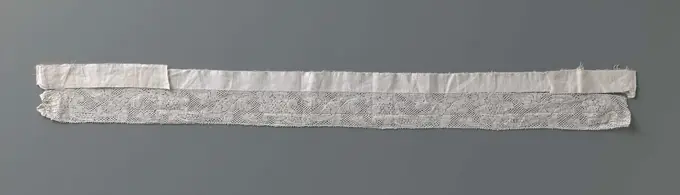
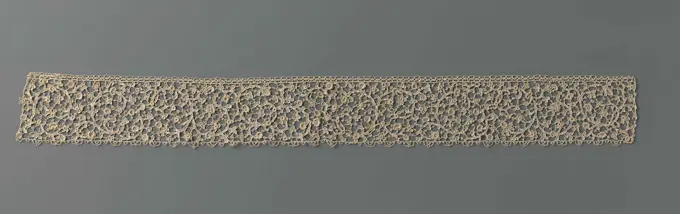
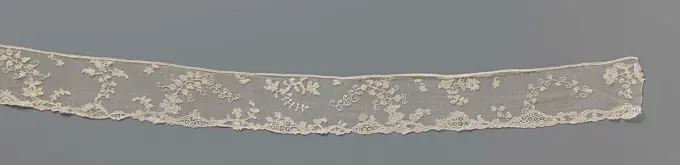
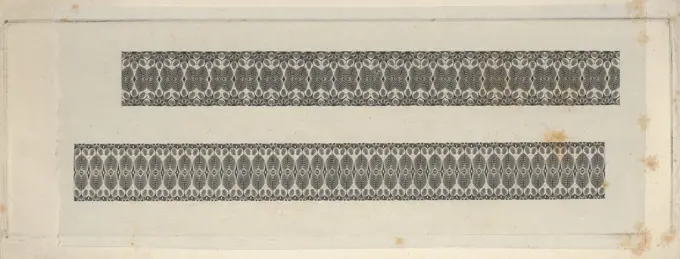
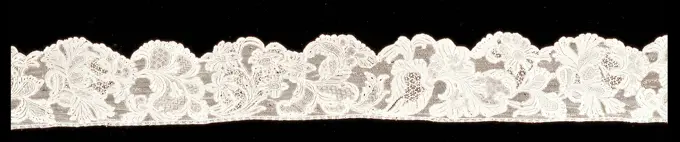
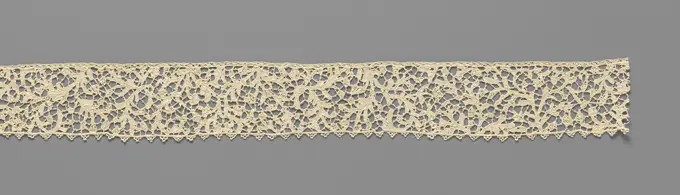
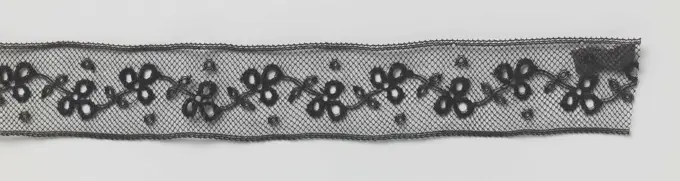
Strook kloskant met pioenroos tussen twee kleinere pioenrozen.Strip natural-colored Dutch clamping side. The pattern consists of a recurring symmetrical motif of a stylized peony with a wavy side branch with left and right. At the end of each side branch, a smaller peony curls and focuses on the large central flower. The motifs are connected by a round table ground with braid. The motifs are made in linen stroke with openwork edges. The top and bottom of the strip are immediately finished, with picots on one side.Strip of needle side with winding flower garland, anonymous, c. 1740 - c. 1760 Strip of natural-colored needle side: Alençon side. Pattern with a winding pendulum with flowers and leaves, on a fine hexagonal mesh ground. The top is trimmed with a border bobbin. The underside is scooped. unknown linen (material) Alençon Lace Strip of natural-colored needle side: Alençon side. Pattern with a winding pendulum with flowers and leaves, on a fine hexagonal mesh ground. The top is trimmed with a border bobbin. The underside is scooped. unknown linen (material) Alençon LaceFlounce with Suns and Flowers, anonymous, c. 1630 - c. 1640 Strip of natural needle side: Punto in Aria. The pattern consists of four rows of sunbathing between multifaceted flowers and spiral vines (narrow ribbons made of feston stitches) that curl and form heart -shaped frames. Around the bottom row of suns there are smaller flowers, caught in heart -shaped lists. Symmetrical compositions occur within the very varied palette. The scrap edge is formed by closed tulips and open palm flowers that alternate. The motifs are made up of feston stitches and many decorative stitches and they are accentuated by relief contours that are here and there decorated with picots. The motifs are connected by picoted braids. The top of the strip is finished with a scrap edge of loops and partial arcs. Italy linen (material) Strip of natural needle side: Punto in Aria. The pattern consists of four rows of sunbathing between multifaceted flowers and spiral vines (narrow ribbons made of feston stitches) tStrip bobbin with Drieblad flanked by rosette flowers, anonymous, c. 1640 - c. 1660 Strip of natural -colored bobbin: Old Flemish side. With small recesses, a repeating symmetrical pattern can be distinguished by a three -leaf along one long side, which is flanked on both sides by a rosette flower, and along the other long side a stylized French lily, which is flanked on both sides by a butterfly -shaped leaf. There is hardly any soil. The motifs are made in linen battle with openwork edges. At the top and bottom are straight finished, with picots along one side. Antwerp linen (material) bobbin lace / old Flemish lace Strip of natural -colored bobbin: Old Flemish side. With small recesses, a repeating symmetrical pattern can be distinguished by a three -leaf along one long side, which is flanked on both sides by a rosette flower, and along the other long side a stylized French lily, which is flanked on both sides by a butterfly -shaped leaf. There is hardly any soil. The motifs are madBorders, Medium: linen Technique: needle lace with ground of loop and twist with twist return, Flowers and leaves in a variety of ornamental stitches on a serpentine band., Burano, Italy, 18th century, lace, BordersKraag van kloskant met strooibloemen en medaillons in bloemenrand de kleinste motieven zijn applicaties.Collar of climbing side with drachelland, Brabant dick. The collar has a pattern of spreader flowers and along the scalloped lower edge a pattern of consecutive medallions, turns enclosed by small and large C forms. Full work in linseed with scrolled embossed and thick contour wires. The smallest motifs are applicable. The shelters along the underside are deposited with picots.Border (Italy); linenStrip 18th century French. Strip. French. 18th century. Bobbin lace, Point de Paris. Textiles-LacesBand, Medium: linen Technique: needle lace with ground of loop and twist with twist return, Border with striped serpentine band interspersed by floral and foliated forms at intervals., Italy, mid-18th century, lace, BandBorder, Medium: linen Technique: bobbin lace, Mechlin style, Straight border of Mechlin lace with a design of small square ornaments sprinkled over field has border of detached motifs of flower and leaves above row of flowerheads., Belgium, early 19th century, lace, BorderBand, Medium: cotton Technique: bobbin lace (late Valenciennes ground), Curving stem with leaves and flowers., 19th century, lace, BandEdging, 18th century, 26 x 3 1/2 in. (66.04 x 8.89 cm), Linen; needle lace, France (), 18th centuryStrook kloskant met golvende bloem- en bladrank.Natural college intersection: Flanders side. The repeating and continuous pattern consists of wavy flower and leaf rank. A wide leaf with pointed ends forms a half wave, from which a drop-shaped flower rises. The other half of each wave consists of a more or less oval-shaped narrower leaf showing curling leaves and a bouquet of three rosette flowers. The motifs are largely made in linen stroke with openwork edges and here and there fine recesses. The motifs are connected by a five-grown soil. If ornamental soil its snowflakes are used and in the wide leaf with pointed ends, a power-bowl fill has been applied with five circles in linen stroke. Upper and bottom of the strip are straight finished and provided with picots. A strip of linen is attached along one of the long sides, a fragment of bedding. One third of seam between the strip linen and the intermediate site is released. The side is probably manufactured in the Southern NetherlandsBand. Date/Period: Early 16th century. Band. Medium: linen. Technique: supplementary warp floats in a plain weave foundation. Author: UNKNOWN.Trimming, Medium: silk, metallic thread Technique: woven, Design of half leaves and open flowers., Italy, 17th century, trimmings, TrimmingEdging, Medium: linen Technique: bobbin lace (Valenciennes ground), Design of scalloped border with bow knots and flowers on diamond mesh., France, 19th century, lace, EdgingEdge, Medium: linen Technique: bobbin lace (late Valenciennes ground), Border of floral motifs along side edge., Belgium, late 18th century, lace, EdgeStrip French 19th centuryBorder (France); linenStrook naaldkant met rijen takjes en boogjeslijnen.Strip natural-colored coniferous lace: Alençon side. Spreading pattern with three rows of twigs on a fine hexagonal Maas soil, an alençon ground. A fourth row of twigs is stuck to a cornice line. Below that a pattern from each other crossing arc lines created ovals, accented by leaves and filled with two different ornamental grounds: an ornamental ground in fine diaman stitch and an ornamental ground with radar picots. The underside is finished with a bow edge with raggy picots, arising from the pattern with ovals. The top is trimmed with a border clamping side.Border 17th-18th century Italian, Venice. Border 226050Strook of kraag van naaldkant met fijne ranken en bloempjes.Strip or collar of natural needle side: Venetian rosary. The pattern consists of fine curling and splitting tendrils with many small leaves and multi-part flowers. The motifs are made with feston stitches. Through turning in the feston stitches, fine recesses are created that patterns form in different petals and leaves. Source stitches have been applied in a few motifs. Along all motives are relief contours and around the flower hearts are thickened with cordons, which are decorated with (Rader) picots. The motifs are connected by picoted bars. The top of the strip is straight finished with a splitting strap. The underside is finished with a bow edge. The short sides are more or less straight finished.Galloon 17th century French. Galloon 213918Strip ca. 1700 Flemish, Antwerp. Strip 212856Strook naaldkant met krulletjes aan bloemtak.Strip natural-colored coniferous lace: Alençon side. Pattern with different curved flower branches, including flower branches with curls, which are scattered on a fine hexagonal Maas soil. The flower branches display either from the pattern along the bottom of the strip or hang down from the top edge. The bland scaled bottom edge stems from various larger and smaller rocaille cartouches that are connected to each other by part of the flower branches and a succession of leaves and flowers. Full work without recesses in the flowers and leaves and various ornamental grounds, especially the cartouches and in the heart of a single larger flower. The top is trimmed with a border clamping side.Strook kloskant met hoorn van overvloed afgesloten door een acanthusblad.Strip natural colosside: Binche-Side. The repeating pattern consists of a horn of abundance, which is closed by an acanthus sheet. Apparently from below this Acanthus leaf, a leaf stalk releases from the edge of the horn, to which a three-dyed flower hangs. These flowers, possibly carnations, shapes shot along the bottom of the strip. The tubing edge along the underside of the strip is formed between the 'flower shuts' by a sheet that lies under the handset of abundance. The motifs are made in linen battle with openwork edges and recesses. The motifs are connected by a grille, a five-gag soil. Some different ornamental grounds have been applied, including a snowflaking ground in the horn of abundance and in the field above the hanging flower. The top of the strip is straight finished. The sloping edge is finished with picots.Fragment, Medium: cotton Technique: printed on plain weave, Brown and black on a white ground in alternate vertical stripes of black and brown with tiny conventionalized flower designs in each stripe., USA, 1870-80, printed, dyed & painted textiles, FragmentTrimming, Medium: gold metallic foil and gold metallic foil wound onto yellow silk Technique: bobbin lace, Wide ribbons densely placed in a serpentine pattern., Spain, 18th century, lace, TrimmingBorder, Medium: linen Technique: bobbin lace, Mechlin style, Straight border of Mechlin lace with a design of buds sprinkled over the field, and a border of detached leaf and flower motifs above a row of flowers., Belgium, early 19th century, lace, BorderBorder 16th century Italian. Border 212280Piece 1760-70 French. Piece 223304Needlepoint Lace Edging, 19th century. France, Alençon, 19th century. Lace, needlepoint: linen; average: 10.8 x 198.1 cm (4 1/4 x 78 in.).Piece 19th century Japan. Piece 72115Strook naaldkant met kelkbloemen.Strip natural-colored coniferous lace: Alençon side. Spreading dotty with an oval flower on a twig on a fine hexagonal maas soil. The pattern at the bottom of the strip consists of a winding branch, which filled outwardly oriented chali flowers, filled with ornamental grounds including a fine diamond stitch. Furthermore, branches with rosette flowers and small round leaves. The top is finished with a straight edge. The underside is finished with a virtually straight edge with ragfine picots. Restorations were carried out in the 19th century.Strip bobbin with curved branches and pomegranates, anonymous, c. 1760 - c. 1770 Strip of natural -colored Brussels bobbin. The pattern consists of curved branches with leaves, flowers and/or berries. The branches randomly bend one or the other and are interspersed with branches with granteds and other larger flowers. The lower edge consists of a succession of small motifs that form different cartouches. The motifs are connected by a fine grid, a drachel soil. The motifs are made in linen battle with openwork edges and largely equipped with burst relief contours. As a decorative soil, picoted braids and a snowflake soil have been used, among other things. The top is finished with a separate strap. The very bland and irregularly scalloped underside stems from the edge pattern and is finished with picots. Brussels linen (material) bobbin lace / Brussels bobbin lace Strip of natural -colored Brussels bobbin. The pattern consists of curved branches with leaves, flowers and/or berries. The Trimming, Medium: silver in flat strips wound on a silk core Technique: bobbin lace, metallic, Band of silver lace made up of three pieces. Insertion is in the design of a serpentine stem with a scalloped border stitched to either side., Italy, 18th century, lace, TrimmingBanknote motifs: two bands of lathe work ornament ca. 1824-42 Associated with Cyrus Durand American. Banknote motifs: two bands of lathe work ornament 393956Hebrew ritual lace (one of four) early 18th century Italian, Burano. Hebrew ritual lace (one of four) 226254Fragment, Medium: cotton Technique: printed on plain weave, White pin dots on a dark brown ground., USA, 1870-80, printed, dyed & painted textiles, FragmentGalloon 18th century French. Galloon 214007Edging, 18th century, 72 3/4 x 2 1/2 in. (184.79 x 6.35 cm), Linen; needlelace, Belgium, 18th centuryTrimming, Medium: metal-wrapped silk and flat metal strips Technique: bobbin lace, Trimming with one straight edge and one scalloped edged formed by fan-shaped pieces, alternately silver and gold., Italy, 17th century, lace, TrimmingStrook applicatiekant met moesjes en verschillende bloemen.Strip natural-colored application side: needle side applicated on machine tulle. Spreading pattern with coarse meadows on a fine hexagonal Maas soil. The bland scalloped bottom edge stems from leaf branches with flowers in different types and formats. Motifs with relief contours of widely scented thread bundles. Decorative stitches in the flowers. The top is finished with a separate clust strap.Edging, 18th century, 45 x 3 1/4 in. (114.3 x 8.26 cm), Linen; needle lace, France, 18th centuryStrook kloskant met grote en kleine pioenrozen aan s-voluutranken.Strip natural-colored Dutch clamping side. The repetitive and symmetrical pattern consists of a large peony between s-voluntaries with smaller peonies to curly side gels. The motifs are made in linen stroke with openwork edges that also provide the drawing in the flowers. The motifs are connected to each other by a table ground with braid. Upper and bottom of the strip are directly finished in which the underside is equipped with picots.Molding; wood, carvedPanel, 16th-17th century, 3/4 x 4 3/4in. (1.9 x 12.1cm), Linen; English needlelace, England, 16th-17th centuryBobbin Lace Lappet, 18th century. Belgium, Binche, 18th century. Lace, bobbin: linen; average: 49.9 x 9.3 cm (19 5/8 x 3 11/16 in.).Strook kloskant met wielen en vijflobbige schulpen.Strip natural colosside: Old cravings. In the semicircular shelter, a repetitive and symmetrical motif of two wheels placed above each other, surrounded by five lobes. The pattern is made up of a winding ribbon made in linen stroke, mainly in shape by braids.Fringe (Italy); silkStrook gehaakte kant met waaiervormige reticella schulpen.Strip natural-colored Irish crochet side, inspired by Reticella. Crocheted wire or line with impeller-shaped picoted slot, made up of loops and arcs.Border, Medium: linen Technique: needle lace, Borders show floral and foliated spray running in serpentine arrangement, interspersed by bow-knots., France, late 18th-early 19th century, lace, BorderBorder, Medium: Technique: bobbin lace (late Valenciennes ground), Border with scalloped edge and pattern of leaves and circles., 19th century, lace, BorderBorder, Medium: linen Technique: bobbin lace, discontinuous tape, Band with tab edge and curving floral vines below., Italy, 17th century, lace, BorderLappet 18th century French. Lappet 222433Section of Border from Thanka (Religious Picture) Made 1701-1800 China. Silk, warp-float faced 2 1 's' twill weave with plain interlacings of secondary binding warps and supplementary patterning wefts . ManchuStrook machinale kant met hangende kelkbloem tussen losse s-voluten.Stretch natural-colored side: machining fir heater. The repeating pattern exists along the lower half of the strip from a hanging chalis flour, flanked and crowned by loose S volutes. There are openworked edges around the closed motifs. The motifs are connected by a machining soil that suggests a braid soil. Upper and bottom of the strip are straight finished, the underside with picots.Strip of needle side with three different flower vessels, anonymous, c. 1875 - c. 1899 Strip of natural needle side: Venetian rose side. Pattern with a repetitive motif of four different volutes, which waves over the full width of the strip. The tantranks do not touch each other, but they are connected by the irregular soil with potented bars. Flowers and leaves with all kinds of different shapes and filled with a variety of decorative land on the tifles through recesses in the fullwork. The top is trimmed with a straight edge with rader picots. The underside is finished with a straight picot edge with arcs. Burano (possibly) linen (material) Venetian rose point Strip of natural needle side: Venetian rose side. Pattern with a repetitive motif of four different volutes, which waves over the full width of the strip. The tantranks do not touch each other, but they are connected by the irregular soil with potented bars. Flowers and leaves with all kinds of different shapes and filled with Textile Fragment 19th century. Textile Fragment 445881Pillow border, 19th century, 2 x 23 7/8in. (5.1 x 60.6cm), Embroidered silk on cotton, Morocco, 19th centuryBand; linen, black beads; Bequest of Marian Hague; 1971-50-339Galloon early 18th century Italian. Galloon 213394White silk stocking in jersey stitch, at the top with two pink narrow stripes and at the bottom with two embroidered decorative lines, ending in a window in cross stitch, anonymous, c. 1815 - c. 1830 Knitted stocking of white silk in jersey stitch, at the top with two pink narrow stripes and at the bottom with two embroidered decorative lines, ending in a window in the cross stitch. Discolored/weathered. Possible court clothing. Netherlands (possibly) whole: Silk knitting / embroidering Knitted stocking of white silk in jersey stitch, at the top with two pink narrow stripes and at the bottom with two embroidered decorative lines, ending in a window in the cross stitch. Discolored/weathered. Possible court clothing. Netherlands (possibly) whole: Silk knitting / embroideringInsertion 16th century Italian, Venice. Insertion. Italian, Venice. 16th century. Bobbin lace. Textiles-LacesGalloon 16th century French or Italian. Galloon. French or Italian. 16th century. Cotton and metal thread. Textiles-TrimmingsTrimming, Medium: linen, silk, silver thread Technique: woven, Band with a design of a silver ornament in the center and a scalloped edge formed by the manipulation of the weft., Italy, 16th century, trimmings, TrimmingGalloon late 18th-early 19th century European. Galloon 224974Border Made 1675-1700 Flanders. Linen, bobbin part lace .Pair of Bobbin Lace (Valenciennes) Lappets (joined), 1740s-1750s. France, 18th century. Lace, bobbin: linen; overall: 111 x 11 cm (43 11/16 x 4 5/16 in.).Border, Medium: linen Technique: bobbin lace, Mechlin style, Band of Mechlin lace with a scalloped border and pattern of foliage, peacocks, dolphins and conventional vases with flowers separated by a scrolling border., Belgium, mid-18th century, lace, BorderGalloon 18th century French or Italian. Galloon 214056Insertion late 18th century Flemish. Insertion 212789Belt, 20th century, 29 1/2 x 2 3/4 in. (74.93 x 6.99 cm) (including braids, without ties), Wool, Bolivia, 20th centuryGimp 18th century Italian. Gimp 213730Band, Medium: linen Technique: needle lace, Pieced-together elements from a needle-lace floral vine border, with a delicate picot along the top edge., Italy, mid-late 17th century, lace, BandPair of Lappets (Joined) Made 1720-1729 Flanders. Linen, bobbin part lace of a type known as Brussels with a plaited bar ground .Mutsenstrook van kloskant met zigzag-rivière.Strip natural colored Brussels climbing side. A river in zigzag line is crossed by spiral raft, enclosing impeller-shaped medallions. The motifs are connected by a draft ground. A coarse hexagonal soil has been applied in the Rivieres. On the fields that are bounded by the Rivier are twigs, to which flowers in the form of pomegranates, pears or winged insects. The strip is probably used or made for a hat.Strip crocheted side of gold thread with a bird on a branch, anonymous, c. 1800 - c. 1899 Strip crocheted side of gold -colored metal wire, filet hook work. Repetitive motive of alternating a circle and a bird on a branch. Eight semicircular scallops on the underside. unknown metal thread Strip crocheted side of gold -colored metal wire, filet hook work. Repetitive motive of alternating a circle and a bird on a branch. Eight semicircular scallops on the underside. unknown metal threadFringe early 19th century Italian. Fringe 224882Barbe 18th century Flemish. Barbe 214544Border Made 1655-1665 Spain. Gilt-and silvered-metal-strip-wrapped silk, silk-wrapped-animal-substrate strips, and gilt-metal-wire-wrapped animal substrate, bobbin straight lace .Jabot van naaldkant met lopende ranken met kleine bloemen.Jabot of natural needle side: Venetian relief side. Cut in a fan-shaped model. Composed of three narrow strips, the lower arcs of which has been completed. Widely spreaded branched acanthus drinks with volutes and small flowers are on an open bar soil.Three Cartier platinum and diamond bracelets     Date: circa 1930sCeremonial Textile (mbesa tali tau batu or pewo) Made 1701-1900 Indonesia. Cotton, plain weave with discontinuous wefts; openwork; resist dyed . RongkongScarf Made 1810 India. Wool, center of pieced 2 2 'S' twill tapestry weave; borders of double interlocking 2 2 'S' twill tapestry weave; ends of 2 2 'S' twill weave; embroidered in running stitches; main warp fringe .Strook kloskant met hangende bladtak.Natural collate strip: Mechelen side. Under a scattering pattern of one-sided sprigs with a one-way flower-looking branch, it consists of a trickling pattern from a curved twig. A large composite flower depends on this twig between two leaf volutes. The flower consists of a drip-shaped flower heart that lies half a wreath of five rosette flowers. Every consecutive flower forms a semicircular shell in this way. The motifs are made in linen stroke and with thicker and shiny contour wires. The motifs are connected by a nice ground ground, a Mechelen soil. In the drop-shaped flower hearts, a coarse ornamental soil has been applied with cubes made in shape stroke. The sloping edge is finished with picots. The top of the strip is straight finished.Stole, Medium: silk ribbons, glass beads, metal thread, and paillettes. Technique: embroidered, Lavender silk ribbon decorated at either end with a vase ornament, a cross border and fringe worked in red, blue, and yellow glass beads and in metal threads, foil, and paillettes; two rosettes of metal between borders., France, 19th century, costume & accessories, StoleFringe (Italy); silkTrimming (Spain); silkStrip of needle side with vertical tifles, anonymous, c. 1650 - c. 1699 Strip of natural needle side, venise flat. Ranks in various non -repetitive patterns. Different leaf vines stand out in a vertical direction. In a few places a symmetrical tiberated pattern can be distinguished, formed from a vertical axis with a flower pattern. Soil with irregularly potented bars. The top is trimmed with a border bobbin. The bottom is finished with a picot edge with triangles. unknown linen (material) flat Venetian (needle point) Strip of natural needle side, venise flat. Ranks in various non -repetitive patterns. Different leaf vines stand out in a vertical direction. In a few places a symmetrical tiberated pattern can be distinguished, formed from a vertical axis with a flower pattern. Soil with irregularly potented bars. The top is trimmed with a border bobbin. The bottom is finished with a picot edge with triangles. unknown linen (material) flat Venetian (needle point)Joined lappets late 17th century Italian The Metropolitan Museum's great lace collection was started when the Museum became the first among American museums to organize a permanent collection of lace with the acceptance of the McCallum Collection in 1879 and the bequests of Mrs. John Jacob Astor, Mrs. Robert L. Stuart, Mrs. Augustus Cleveland, and Mrs. A. W. Winters shortly thereafter. In 1893 a loan collection of antique laces shown at the World's Columbian Exposition in Chicago was assembled by a committee of New York women headed by Catharine Augusta Newbold. About 1900 Miss Newbold arranged and labeled an exhibition of laces and linenworks lent to the Metropolitan Museum by Mrs. James Boorman Johnstone and the Misses Johnstone. "Her scholarly knowledge of lace technique enabled the Museum for the first time to offer a comprehensive display of lace illustrating its historical development," wrote Miss Frances Morris, then curator of the textile department. Miss Newbold's name occurs Stockings ca. 1890 American. Stockings. American. ca. 1890. silkMustenslip from Valenciennes side, anonymous, c. 1775 - c. 1800 Cutslip from Valenciennes side with a round end. The barbe has a picotrand. The pattern consists of floral motifs along the edge and sprinkling flowers in the middle. France linen (material) Valenciennes lace Cutslip from Valenciennes side with a round end. The barbe has a picotrand. The pattern consists of floral motifs along the edge and sprinkling flowers in the middle. France linen (material) Valenciennes lacePattern ca. 1840 British. Pattern. British. ca. 1840. Parchment. Textiles-Methods and MaterialsFragment; linenSari, 1800s. India, Benares, 19th century. Silk and gold brocade; overall: 466.5 x 109.8 cm (183 11/16 x 43 1/4 in.).Tussenzetsel van machinale kant met golfrank.Strip or intersection of black machining. There is a corrugated rank with clips on a mesh fence.Trimming (Russia); silk, linen, metallic threadWampum belt - "The Two Dog Wampum"Fringe (Italy); silk