Ornate Lace Edgings

Historical lace trims with intricate patterns and floral designs, showcasing delicate craftsmanship from different centuries.


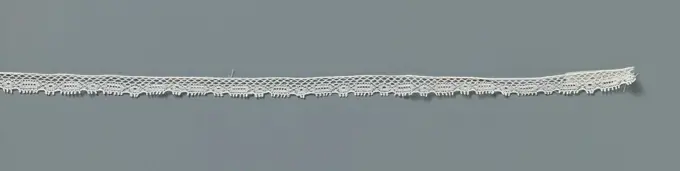
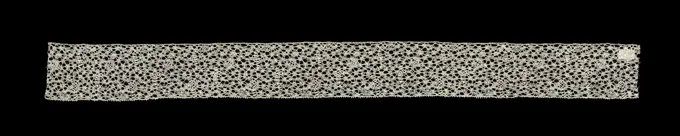
Strip bobbin with V-shaped motifs above fan edge, anonymous, c. 1850 - c. 1899 Strip of natural -colored bobbin. The repeating and geometric pattern consists of a symmetrical V-shaped motif, which reaches from the bottom to the top of the strip. The broad line that forms the motif is divided into rectangles that are made in alternately in linen and mains stroke and are surrounded by thicker contour threads. The triangular space in the V-shaped motif is closed. The motifs are connected by a mesh soil, a lace-hole strike-grid. Between the successive V-shaped motifs, a diamond-shaped motif has been realized in the Maas soil without contour threads, with a network of larger meshes and nine small motifs in linen battle. The top of the strip is straight finished. The silly scrap edge along the underside stems from a succession of fan patterns, which are finished with picots. Germany (possibly) linen (material) bobbin lace Strip of natural -colored bobbin. The repeating and geometric pattern
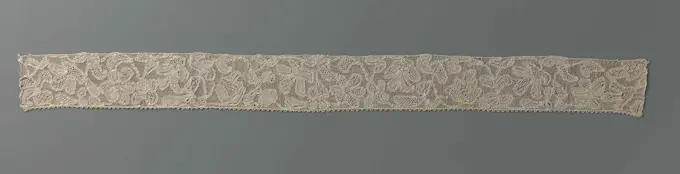
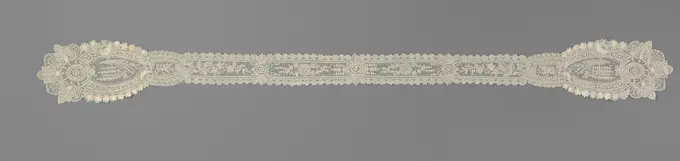
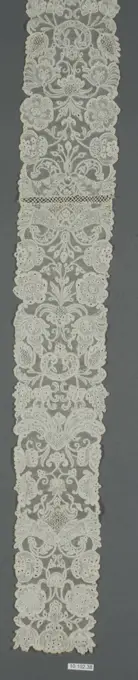
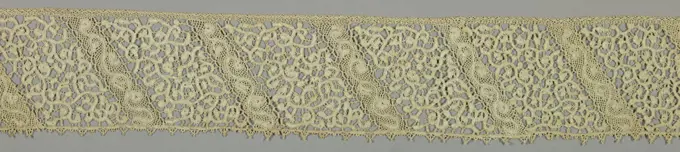
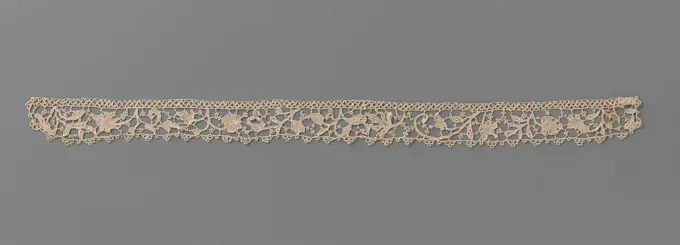
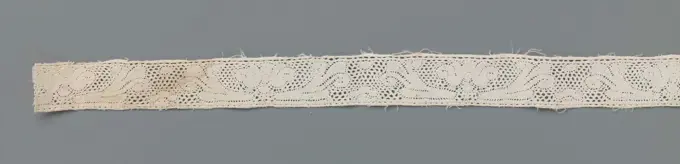
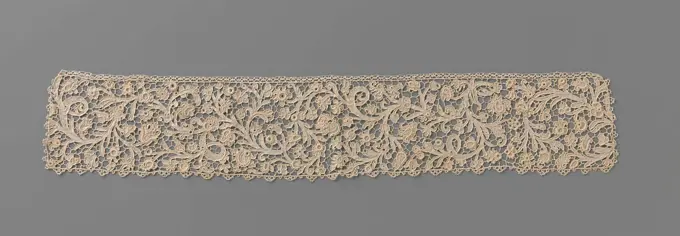
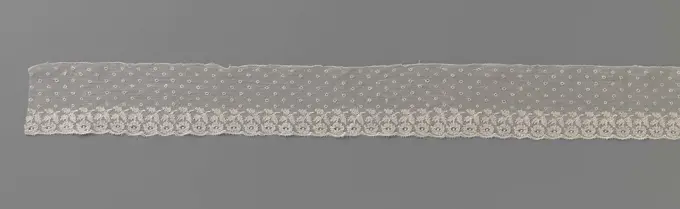
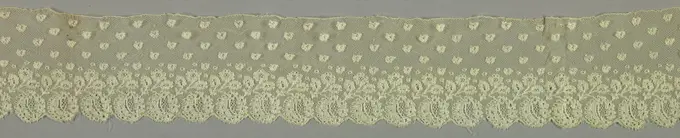
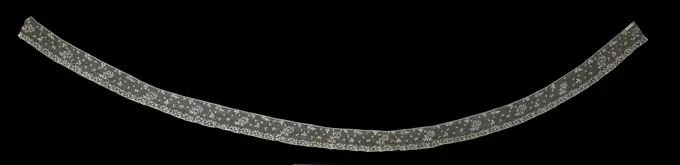
Edging, Technique: bobbin lace, Bobbin lace double edge, symmetrical floral; mid-18th century Valenciennes Fond, mid-18th century, lace, EdgingStrook gemengde kant met golvend lint waaraan verschillende bloemen en bladeren.Strip natural-colored mixed side: Venetian ribbon side. Long-leaked pattern with a full wavy wavy to which palm tree flowers, costholic leaves, rosette flower and four different palmet flowers. The rank and contours of the motifs are formed by a woven ribbon. Different (ornamental) grounds are made with feston stitches within the contours. The motifs are connected by a square mesh soil (needle side). The top is just finished. The underside is finished with a straight picro edge with arcs.Band, Medium: linen Technique: punto in aria needle lace, Border of small scale floral and foliated forms in intricate repeat designs. Patterns connected by brides picotées and outlined by cordonnet., Netherlands, 17th century, lace, BandStrip bobbin with triangular fields and stylized chalice, anonymous, c. 1600 - in or before 1879 Strip of natural -colored bobbin. The repeating pattern consists of two varied triangular fields. One field is formed by a straight down, stylized chalice of chalice between two leaves. The other triangular field is formed by the space between two consecutive fields with chalices. There is a more or less Christmas tree -shaped motif in this field. The motifs are connected to each other by a coarse diamond-shaped Maas soil, a lace-hole stroke-grid, strewn with square mosies. The motifs are made with thick contour threads and regularly winding braided straps. The Mosjes are made in form. Top and bottom of the strip are straight finished, with the bottom with picots. According to tradition, the strip would have put a canvas together with the accompanying strip. Karlberg Palace (possibly) linen (material) bobbin lace Strip of natural -colored bobbin. The repeating pattern consists of two variedTrimming (Spain); 1909-12-14Tie from needle side with golden rain. A very narrow stretched shift band from pearl table and bells runs into stretched, widened, knut-shaped ends, with an edge of doubled rosettes. The button releases a long rosette branch and a hanging gold regentros. A wreath of wingerd leaves at the tops. Point the Gaze de Bruxelles.Strip bobbin with V-shaped motifs above fan edge, anonymous, c. 1850 - c. 1899 Strip of natural -colored bobbin. The repeating and geometric pattern consists of a symmetrical V-shaped motif, which reaches from the bottom to the top of the strip. The broad line that forms the motif is divided into rectangles that are made in alternately in linen and mains stroke and are surrounded by thicker contour threads. The triangular space in the V-shaped motif is closed. The motifs are connected by a mesh soil, a lace-hole strike-grid. Between the successive V-shaped motifs, a diamond-shaped motif has been realized in the Maas soil without contour threads, with a network of larger meshes and nine small motifs in linen battle. The top of the strip is straight finished. The silly scrap edge along the underside stems from a succession of fan patterns, which are finished with picots. Germany (possibly) linen (material) bobbin lace Strip of natural -colored bobbin. The repeating and geometric pattern Galloon late 18th-early 19th century French. Galloon. French. late 18th-early 19th century. Metal thread. Textiles-TrimmingsBorder, Medium: linen Technique: bobbin lace, Mechlin style, Design of serpentine band of open work and two sprays, in alternate directions, growing out from the serpentine band., Belgium, 18th century, lace, BorderBorder, Medium: linen Technique: needle lace, 6-sided reworked ground, Border with elaborate floral arrangements balanced by cartouche forms and volutes., France, ca. 1690, lace, BorderStrip of needle side with split spirals, anonymous, c. 1800 - c. 1899 Strip of natural -colored needle side: Venetian relief side. There are running, wide spiral ranks on an open bar, which are split in many places. There are also large openwork centers in the petals, which typifies the 19th century. Finishing with a straight list of alternately large and small triangles. Bayeux (possibly) linen (material) Venetian raised work Strip of natural -colored needle side: Venetian relief side. There are running, wide spiral ranks on an open bar, which are split in many places. There are also large openwork centers in the petals, which typifies the 19th century. Finishing with a straight list of alternately large and small triangles. Bayeux (possibly) linen (material) Venetian raised workKloskant intermediate mate with elongated oval peony between two curved leaves, anonymous, c. 1650 - c. 1674 Intermediate springs of natural -colored Dutch bobbin side. The repeating and symmetrical pattern consists of an elongated oval peony between two horizontally lying, curved leaves. The motifs are connected by a more or less round grid with braid strokes. The motifs are made in linen battle with openwork edges. Top and bottom of the strip are straight. One short side is sewn and hemmed together. This hem has been released on the other short side. Southern Netherlands linen (material) bobbin lace Intermediate springs of natural -colored Dutch bobbin side. The repeating and symmetrical pattern consists of an elongated oval peony between two horizontally lying, curved leaves. The motifs are connected by a more or less round grid with braid strokes. The motifs are made in linen battle with openwork edges. Top and bottom of the strip are straight. One short side is sewn and hemmed togKloskant intermediate mate with zigzag line, anonymous, c. 1875 - c. 1949 Piles of Natural -colored bobbin side: Mechelse side. In the middle of the fine grid, a Mechelen soil (also known as ice soil), an openwork band runs in Zigzaglijn, cut over by two types of rosettes. Belgium linen (material) bobbin lace / Mechlin (lace) Piles of Natural -colored bobbin side: Mechelse side. In the middle of the fine grid, a Mechelen soil (also known as ice soil), an openwork band runs in Zigzaglijn, cut over by two types of rosettes. Belgium linen (material) bobbin lace / Mechlin (lace)Strook kloskant met viervoudige moesjes.Natural collate strip, Valenciennes side. Repetitive motif from a flower made with a quadruple moot. Santa above the flour is a single mouth. Slight sculpture with decorative tires. The top is finished with a straight edge.Needlepoint Lace Edging, 18th century. France, Alençon, 18th century. Lace, needlepoint: linen; average: 8.3 x 101 cm (3 1/4 x 39 3/4 in.).Border, Medium: linen Technique: bobbin lace, Bobbin lace border, floral vine; early 18th century Binche, early 18th century, lace, BorderFragment ca. 1650 Dutch. Fragment 212861Border, Medium: linen Technique: bobbin lace, Mechlin style, Band with buildings and ships under an archway with vines., Northern Europe, 18th century, lace, BorderInsertion 17th century Italian, Genoa. Insertion 218015Galloon 17th-18th century Unknown. Galloon 213889Bobbin Lace (Point d'Angleterre) Edging, 18th century. Belgium, Brussels, 18th century. Lace, bobbin: linen; average: 8.3 x 126 cm (3 1/4 x 49 5/8 in.).Band, Medium: linen Technique: needle lace, Border of serpentine pattern of large conventionalized flowers and foliage, partly in relief., Venice, Italy, late 17th century, lace, BandIntermediate edge bobbin with openwork oval in trapezoidal waves, anonymous, c. 1900 - c. 1929  Piles of natural-colored bobbin, Valenciennes side. A wavy strap runs over the center line of the strip with flattened wave peaks and valleys, creating trapezoidal spaces, with one loose and open worked oval. The motifs are connected by a Maas soil, a diamond-shaped Valenciennes ground. The motifs are made in linen battle with openwork edges and an open worked and decorated center in the ovals. Top and bottom of the strip are straight. Belgium cotton (textile) Bobbi Lace / Valenciennes LaceStrip bobbin with symmetrical compositions made up of small floral motifs, anonymous, c. 1650 - c. 1699 Strip of natural -colored Dutch bobbin. The repeating pattern consists of two merging symmetrical compositions in which the motifs are close to each other. One composition consists of an inverted chalice or tulip on the top of the strip. Below that, two cloud -shaped leaves that are bothered to each other on the center line with a rosette flower along the underside of the strip below it. The other composition consists of two rosette flowers that are curled to each other on curling stalks, including a fan -shaped flower and below that a button -shaped flour between two volute leaves along the underside. The motifs are made in linen battle with openwork edges. There is little or no soil. The motifs are placed close to each other, sometimes separated by a kind of short thick braids. The top of the strip is straight finished. The underside of the strip has very flat wide scoops that are Barbe 18th century Dutch or Italian. Barbe 218788Border, Medium: linen Technique: needle lace (punto in aria) Label: Linen needle lace (punto in aria), Dense pattern of stylized floral forms contained in vases in a repeating design. Pattern connected by bars, interspersed by decorative filling stitches., Burano, Italy, late 19th-early 20th century, lace, BorderBand, Medium: linen Technique: bobbin made continuous tape with bars added, A narrow band diagonally striped with a small floral serpentine alternating with wider bands of intertwining leaves., Venice, Italy, late 17th-early 18th century, lace, BandBand, Medium: silk Technique: darning stitch on loomed width of gauze weave, Italy or Spain, late 19th century, lace, BandStrook naaldkant met stengels en palmetbloemen.Strip natural needle side: Flat Venetian side. On an open garbage soil, which are decorated with cogs, can be truncated stems to which carefully detailed palmet flowers grow. A straight exterior shows in turn triangles and a few arcs.Edge, Medium: silk Technique: bobbin lace, white silk, Europe, 19th century, lace, EdgeCap streamer, Medium: linen Technique: bobbin lace, Brussels style, Symmetrical arrangement of flowers, one on top of the other., Belgium, late 17th-early 18th century, lace, Cap streamerBorder, Medium: linen Technique: needle lace with 6-sided reworked grounds, Band with a design of floral and foliated sprays balanced by ribbons and elaborate filling stitches., France, mid-late 18th century, lace, BorderStrip 1750-1850 Flemish, Mechlin. Strip 212868Strook machinale kant met een keten van cirkeltjes en spitsovaaltjes langs de onderzijde.Natural-colored Machine Side Strip: Machine Valenciennes. The repeating pattern exists along the underside of the narrow strip from a row of alternating a circle with a cut-away center and a spinner with a list of five small square cut-outs. At the top, the circles and ovals are connected to each other by machining valenciennes ground. The slight sloping edge along the underside of the strip is finished with picots: under every circle of three picots, under each oval six picots. The top of the strip is straight finished.Strip of needle side with flowers and leaves on volutes, anonymous, c. 1675 - c. 1699 Strip of natural -colored Venetian needle side "Gros Point". Pattern with flowers and leaves on volute vines. The motifs are made with feston stitches with fine recesses in mainly the flowers and leaves. The motives are provided with relief contours. In the flower hearts and around the outside of some larger leaves, cordons decorated with picots are used for extra relief. The motifs are connected by a potente soil. The top of the strip is straight finished with a tie. The bottom is finished with an arc edge. Venice linen (material) Venetian gros point (heavy raised Venetian lace) Strip of natural -colored Venetian needle side "Gros Point". Pattern with flowers and leaves on volute vines. The motifs are made with feston stitches with fine recesses in mainly the flowers and leaves. The motives are provided with relief contours. In the flower hearts and around the outside of some larger leaves, cordons dPiece 17th century Japan. Piece. Japan. 17th century. Silk / Compound weave. Textiles-WovenStrip of needle side with double tibs, anonymous, c. 1875 - c. 1909 Strip of natural -colored needle side: Venetian relief side. Spread, small and medium -sized palm flowers grow on thick, doubled stems, which spring abruptly on the straight inside. An open bar of land forms the surface. Edge with triangles. BURANO linen (material) Venetian raised work Strip of natural -colored needle side: Venetian relief side. Spread, small and medium -sized palm flowers grow on thick, doubled stems, which spring abruptly on the straight inside. An open bar of land forms the surface. Edge with triangles. BURANO linen (material) Venetian raised workFragment Swiss 19th centuryTussenzetsel van kloskant met bloem tussen langgerekte voluutbladeren.Interesting of natural Dutch clamping side. The pattern consists of a repeating symmetrical motif of a flower between elongated voltull leaves. The motifs are made in linen stroke with openwork edges and are connected by a more or less round table ground with braid. The top and bottom are straight finished. The intermediate site is stitched on the same strip of clamping side with a few coarse.Fragment, Medium: linen Technique: machine made, Fragment showing a sprig pattern., France or Belgium, 19th century, lace, FragmentGimp mid-19th century French. Gimp 214219Bracelet of gold from Wilhelminaschakels.bracelet or Gold from Wilhelminaschakels with a Spring ring.Strip 1550-1600 Italian. Strip 212338Edging Italian, probably Burano late 19th centuryEdging, Medium: metal-wrapped silk and flat metal strips Technique: bobbin lace, Edging of metallic lace with one scalloped edge formed by fan-shaped and semi-circular sections., Italy, 17th century, lace, EdgingBand 16th century Italian. Band. Italian. 16th century. Silk and linen. Textiles-WovenStrook naaldkant met gepluimde ranken.Strip natural needle side: Venetian rosion side. On a bars soil with six-sided meshes there are rich branched, left and right swiveling tendrils, sometimes drew, sometimes walking. Veeloertige, carefully detailed knob-shaped flowers grow. Here and there the top of a rank has grown through an opening in the branch. Straight finish of alternation an eye and a triangle.Trimming (France); silkGalloon 17th-18th century Italian or Spanish. Galloon. Italian or Spanish. 17th-18th century. Silk and metal thread. Textiles-TrimmingsLace, 1800s, maker unknown.Strook kloskant met gestrooide moesjes en een rand met madeliefjes.Strip natural colosside: Mechelen side. Under a wide job with a spreading pattern of open messes, the pattern along the bottom edge is formed by hanging daisies close side by side, stealing something bent with three feather-shaped leaves. The regularly wavy sculpture follows the pattern, with one flower in every shell. The motifs are connected by a fine Maas soil, the Malinois. The motifs are made in linen flag and are fitted with thicker and shiny contour wires. A sparingly used ornamental land with Grovere Maas is used in the flower hearts, with a rectangle in the center.Galloon 18th century French. Galloon. French. 18th century. Silk and cotton. Textiles-TrimmingsTrimming (France); silkTrimming, Medium: silk Technique: woven, Pink trimming fragment in a design of small open flowers and triangles., France, 19th century, trimmings, TrimmingBorder, Technique: bobbin lace, Bobbin lace border, blossom repeat; early 19th century Maline., early 19th century, lace, BorderBobbin Lace (Tape Design) Edging, 17th century. Italy, Genoa, 17th century. Lace, bobbin: linen; average: 7 x 125.8 cm (2 3/4 x 49 1/2 in.).Handle 9th-11th century A stylized carved animal figure is seen on the top of this object, which may have functioned as a handle for a vessel. The figure is ambiguous and has anthropomorphic or zoomorphic qualities. During the medieval Islamic period, people believed in the magical powers of animals, plants and stonesall creations emanating from the same primal cause. The handle is made of bone and was found in Nishapur, Iran. The space between the legs of the animal, and that created by its tail are punctured with holes, likely used to hold a blade. A dot-in-circle motif is incised on the body of the animal three times, and in one instance it acts as the eye of the animal figure. Beneath the animal there is a band of vertical lines framed on the top and the bottom by two parallel horizontal lines.. Handle 449538Edging (Northern Italy); linen; 1933-1-143Dodenoek, Anonymous, 1900 - 1949 Dodlings with geometric motifs. Laos cotton (textile) Dodlings with geometric motifs. Laos cotton (textile)Band, Medium: cotton, silk Technique: chain stitch embroidery on twill weave, Mughal-style embroidery for the export market. Section of a guard border with two continuous shaded lines forming lobed medallions that alternate with small diamond shapes. Medallions have blue and orange flowers inside, and the small diamonds have red flowers that radiate out on two points. One edge has a straight border in shades of orange, yellow and blue while the opposite edge has a scalloped border in dark purple., India, ca. 1700, embroidery & stitching, BandSampler, Medium: cotton, paper Technique: knotted netting, Continuous web of knotted netting in about sixteen designs mounted on a long strip of stiff green paper., possibly Germany, 1800-1850, knotted, knitted and crocheted textiles, SamplerFringe early 19th century British. Fringe 225106Trimming (Italy); silk, gilt foil on a silk coreBobbin Lace Edging, early 18th century. Belgium, Binche, early 18th century. Lace, bobbin: linen; average: 5.8 x 61 cm (2 5/16 x 24 in.).Edge, Medium: linen Technique: bobbin made continuous tape with net added, Netherlands, 1601-50, lace, EdgeCut and painted cartouche of oak with the weapon of Zeeland., Anonymous, 1653 Cartouche van Oakhout with the weapon of Zeeland, with a banderol on the right and on the left on which the curls at the ends form Griffioenkoppen. Yellow.  wood (plant material). oak (wood). paint (coating) cutting / painting Cartouche van Oakhout with the weapon of Zeeland, with a banderol on the right and on the left on which the curls at the ends form Griffioenkoppen. Yellow.  wood (plant material). oak (wood). paint (coating) cutting / paintingBorder (France); block-printed on continuous paper; Overall: 67 x 6 cm (26 3/8 x 2 3/8 in.); 1974-28-8Bobbin (Appliqué) Lace Edging, late 18th century. Belgium, Brussels, late 18th century. Lace, bobbin; average: 7.7 x 215.9 cm (3 1/16 x 85 in.).Trimming, Medium: linen Technique: deflected element work, Cream-colored linen trimming for a dress in a scrolling vine and flower design in a variety of stitches., Netherlands, 18th century, lace, TrimmingArmlet 19th century. Armlet 444667Strip bobbin with a succession of curved flower stems, anonymous, c. 1750 - c. 1760 Strip of natural-colored bobbin: binche side. Two curved flower stems with wide leaves and different flowers form a wavy pattern together. The motifs are connected by a decorative land, a snowflake ground. The motifs are made in linen battle with openwork edges and in netslag. At the top and bottom are straight finished, with the bottom with picots. Binche linen (material) bobbin lace / Binche lace / snowflake filling Strip of natural-colored bobbin: binche side. Two curved flower stems with wide leaves and different flowers form a wavy pattern together. The motifs are connected by a decorative land, a snowflake ground. The motifs are made in linen battle with openwork edges and in netslag. At the top and bottom are straight finished, with the bottom with picots. Binche linen (material) bobbin lace / Binche lace / snowflake fillingFringe, Medium: silk Technique: woven, Pink fringe with a plain-woven heading and thread skirt., Spain, 16th century, trimmings, FringeEdging (England); medium:Fragment of bobbin lace unknownGalloon 17th century () European. Galloon. European. 17th century (). Silk. Textiles-TrimmingsNeck or Armhole Panel Made 1000-1532 Peru. . IcaEdging French, Mirecourt 19th centuryUpholstery Trimming (France); silkPiece 19th century Japan. Piece 72142Bracelet 17th-19th century. Bracelet 453482Ribbon early 19th century possibly French. Ribbon 220663Fragment, Medium: linen Technique: bobbin lace, Narrow scalloped border with confused geometric design., 17th century, lace, FragmentHalf of a Tweezer. UnknownBrown velvet attachment. Plug from brown velvet to capping the ligament of the so-called Rosendaelbed. Front foot. For the corresponding attachments, see BK-1958-20-A-6 and -7.Straight edge 18th century French. Straight edge. French. 18th century. Iron, partly gilded and silvered. Metalwork-SteelFringe, Medium: silk Technique: woven, White fringe with a plain-woven heading and white skirt threads., France, 17th century, trimmings, FringeGalloon 18th century French. Galloon 213999Lace, 1800s , maker unknown. Gift of Mrs M. Black, date unknown.Lace, 1800s, maker unknown. Gift of Watt, 1989.Ribbon early 19th century French. Ribbon 216401Band (Italy); linenRibbon, 1800s. France, 19th century. Silk; overall: 182.2 x 14.9 cm (71 3/4 x 5 7/8 in.).Trimming, Medium: silk Technique: woven, Yellow and pink trimming fragment in a design of an ornamented zigzag band., France, 19th century, trimmings, TrimmingSampler; cotton, paperPalm-leaf manuscripts in the pothi format are recognizable by their long and horizontal shapes. In contrast to Western-style books that require one to turn the pages left-to-right or right-to-left, pothi are read by flipping the pages with a vertical motion. The palm-leaf pages would have been bound together by a cord attached to a peg that was run through the two binding holes on the top and bottom covers. The spot for the peg is still visible on the left side of this cover. When not in use, the manuscript would have been wrapped in ribbons and textiles that protected it from dust, moisture, and pests. Bottom cover, from a Manuscript of the Perfection of Wisdom in Eight Thousand Lines (Ashtasahasrika Prajnaparamita-sutra), Sunday, September 14, 1119 (year 239 of the Newar Samvat in the month of Ashvina). Eastern India, Bihar, Vikramashila Monastery. Painting: Nepal, Kathmandu. Gum tempera, paper, and colors on wood; overall: 6.5 x 57 x 1.5 cm (2 9/16 x 22 7/16 x 9/16 in.).Palepai (Ceremonial Hanging) Made 1801-1900 Indonesia. Cotton, silk, and gilt-paper-strip-wrapped cotton, plain weave with supplementary patterning and brocading wefts .Border, Medium: cotton Technique: block printed on plain weave, Border with curving and shell-like shapes in brown on a dark yellow ground., France, early 19th century, printed, dyed & painted textiles, BorderBorder (Italy); linenBorder (France); silkTrimming (France); silk