Ornate Lace Edgings

Historical lace trims with intricate patterns and floral designs, showcasing delicate craftsmanship from different centuries.

Strip bobbin with V-shaped motifs above fan edge, anonymous, c. 1850 - c. 1899 Strip of natural -colored bobbin. The repeating and geometric pattern consists of a symmetrical V-shaped motif, which reaches from the bottom to the top of the strip. The broad line that forms the motif is divided into rectangles that are made in alternately in linen and mains stroke and are surrounded by thicker contour threads. The triangular space in the V-shaped motif is closed. The motifs are connected by a mesh soil, a lace-hole strike-grid. Between the successive V-shaped motifs, a diamond-shaped motif has been realized in the Maas soil without contour threads, with a network of larger meshes and nine small motifs in linen battle. The top of the strip is straight finished. The silly scrap edge along the underside stems from a succession of fan patterns, which are finished with picots. Germany (possibly) linen (material) bobbin lace Strip of natural -colored bobbin. The repeating and geometric pattern
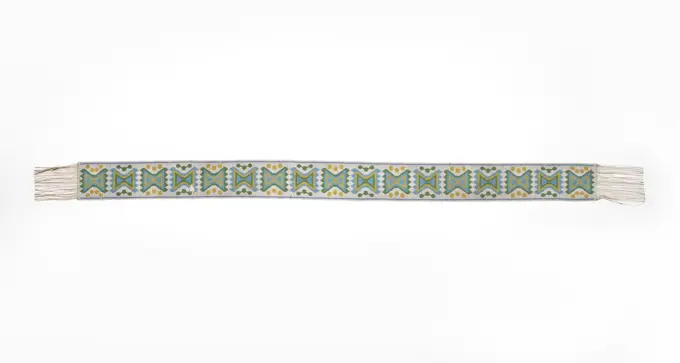
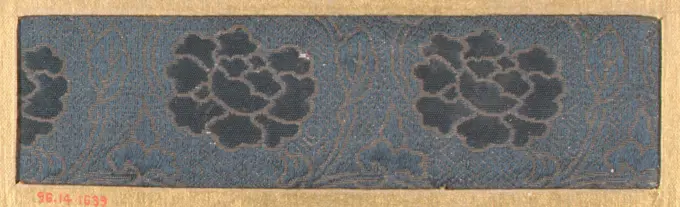
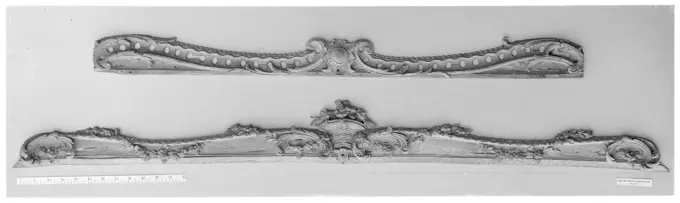
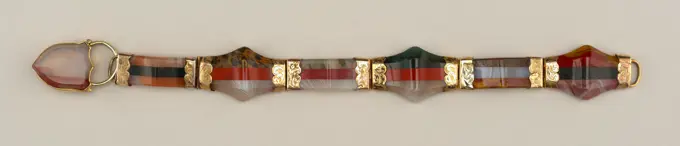
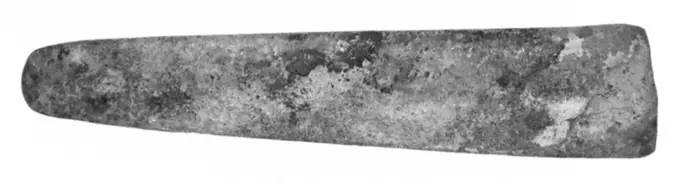
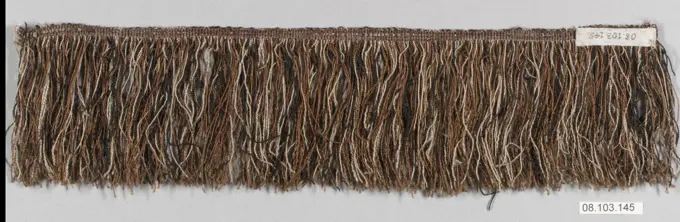
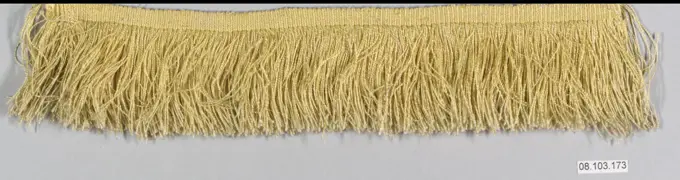
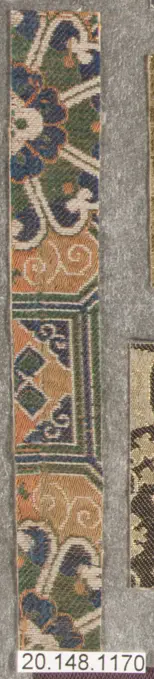
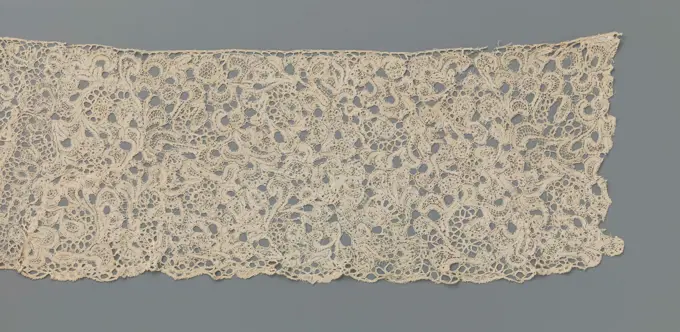
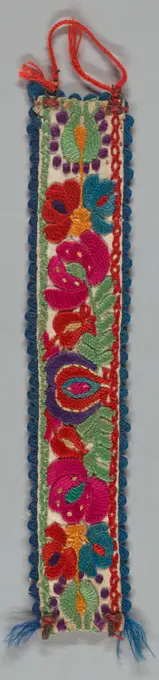
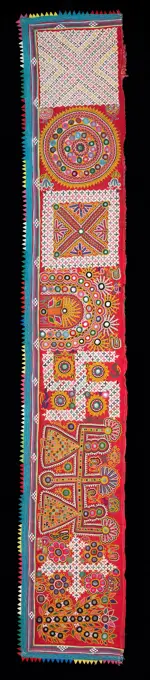
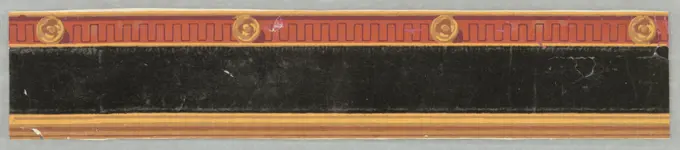
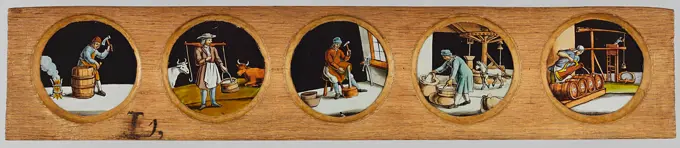
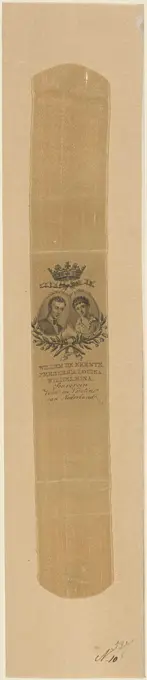
Cover of a Pen Box 17th century. Cover of a Pen Box 446992Trimming (France); 1909-2-180Sewing Sampler (USA); cottonSash -Border, Medium: linen Technique: needle lace with 6-sided reworked ground, Band of Point d'Argentan in an open design of floral sprays and birds., France, mid-18th century, lace, BorderGalloon 18th century French. Galloon 214103Border (Italy); linenPiece 18th-19th century Japan. Piece 67352Border (France); block-printed; 65.5 x 6.5 cm (25 13/16 x 2 9/16 in.); Purchase, Pauline Riggs Noyes Fund; 1953-202-4Trimming, Medium: silk Technique: woven, Brown trimming fragment in a design of a curving stem with three-lobed leaves; borders with zigzag line., France, 19th century, trimmings, TrimmingSilk ribbon with white stock on which wine red windows, anonymous, c. 1700 - c. 1800 Silk ribbon with white stock on which wine red windows. According to earlier description, possibly a long -edge or longcro, used as the Omboard of the Hindeloper Wentke. Netherlands (possibly) whole: Silk Silk ribbon with white stock on which wine red windows. According to earlier description, possibly a long -edge or longcro, used as the Omboard of the Hindeloper Wentke. Netherlands (possibly) whole: SilkTrimming (France); silkOranjelint ,, 1725 - 1750 ribbon (material) Ribbon with serrated ends and centrally two medallions with portraits of Wilhelmina (left) and Willem V. between them in an Oranjeboom in a round container. Oranjezon is shown left and right. At the ends of the ribbon, three crowned coats of arms (Oranje-Nassau, Prussian eagle, Nederlandse Leeuw), connected to each other by a ribbon together. Inscription: Now. Sgijnt. Hy. Finished. Godt increases Oranjes Stam and Gesach that our Vreyheyd Eewyg Duyren Mag Vivat Oranje. Now. Sgijnt. Hy. Finished. Netherlands silk. paper printingBorder (Belgium); linenSleeve Bands (China); silkFrame fragment (cross-bar) first half 18th century French. Frame fragment (cross-bar). French. first half 18th century. Oak (). WoodworkTkanina koptyjska. unknown, authorBracelet (Scotland); agate, gold; A: 19.6 x 2.1 x 0.8 cm (7 11/16 x 13/16 x 5/16 in.) B: 2.2 x 2 x 0.8 cm (7/8 x 13/16 x 5/16 in.)Strigil Fragment. UnknownTrimming (France); silkFragment of a Band with Geometric Pattern and Floral Motif, 19th century. Italy, 19th century. Needle lace, burato (twined ground and darned in one direction); cotton (est.); overall: 5.9 x 48 cm (2 5/16 x 18 7/8 in.). A scrolling vine with budding vegetation or a tendril is a recurring pattern in needle lace. The frequent use of the motif, adapted in lace from different centuries and regions, suggests that it was found in a pattern book.Bobbin Lace Edging with Loops, 17th century. Italy, Venice, 17th century. Lace, bobbin; average: 2 x 21 cm (13/16 x 8 1/4 in.).Tile tableau of 26 tiles, tile bakery on the Schiedamsedijk, c. 1755 - c. 1788 Tile tableau of 26 tiles (13 x 2) with a purple painted festoon of flowers, decorated at the top with a bow and an oval with landscape in the middle. Rotterdam earthenware. tin glaze majolica Tile tableau of 26 tiles (13 x 2) with a purple painted festoon of flowers, decorated at the top with a bow and an oval with landscape in the middle. Rotterdam earthenware. tin glaze majolicaNeck piece for a chyrpy, c. 1875, 55 3/4 x 6 1/16 in. (141.61 x 15.4 cm), Cotton, silk; embroidery, 19th centuryPiece 19th century Japan. Piece. Japan. 19th century. Silk / Compound weave. Textiles-WovenTrimming (France); 1909-2-218Medieval ornamentFringe probabaly European 19th centuryBorder (England); block-printed; 80 x 12 cm (31 1/2 x 4 3/4 in.)Belt -Textile (France); silk; Anonymous bequest in memory of Albert and Rebecca Elsberg; 1938-82-67-cPiece 18th century China. Piece 72000Side panel of fencing and hazard, decorated with heart -shaped composite volutes. Housing in the form of point with S-Voluten. OFF. Mannheimer., 1600 - 1699 A four -part fence consisting of two doors and two side panels; The frame is composed of vertical and horizontally placed rules, the latter allocation over the entire width in two wide between three narrow jobs. In the large lanes there are vertically placed eight-sided bars with above and below one row and in the middle a double row of composite S-volutes that form heart-shaped motifs. Each part of the fence is crowned by a pointed motif of S-Voluten. Italy iron (metal) A four -part fence consisting of two doors and two side panels; The frame is composed of vertical and horizontally placed rules, the latter allocation over the entire width in two wide between three narrow jobs. In the large lanes there are vertically placed eight-sided bars with above and below one row and in the middle a double row of composite S-volutes that forFringe, Medium: silk Technique: woven, Fringe in green, red and white with a patterned heading and skirt threads arranged to form colored stripes., Italy, 17th century, trimmings, FringeTrimming (France); silkFringe European 19th centuryPiece 19th century China or Japan. Piece 72156Trimming (France); silkStrook kloskant met bladranken.Strip natural colosside, old-Flemish or Italian side. The pattern consists of unclear defined leaf refines. The contours of the motifs are made with clusted ribbons in linse and are connected to each other with short crossing connections. Rings are formed in different places by intersection of narrower closted ribbons, such as at Occhiolini. The bland scalloped underside follows the pattern and is finished with picots. The top is just finished.Trimming, Medium: silk Technique: woven, Trimming fragment in a design of alternating ornaments comprised of leaves, scrolls and dots in yellow on a green ground., France, 19th century, trimmings, TrimmingTool 5th-3rd millennium B.C. Iran This bronze tool, possibly an awl, was excavated in 1937 at a prehistoric site in the vicinity of Nishapur in northeastern Iran. While Nishapur itself was founded by the Sasanian king Shapur I (reigned ca. A.D. 241-272), this tool shows that human habitation there goes back to the prehistoric period. Furthermore, the prehistoric pottery from Nishapur has close affinities with ceramic materials from Central Asia rather than with contemporary sites in Iran, meaning that in this period its inhabitants were likely culturally linked to their neighbors to the east. At the same time, Nishapurs location on what later became known as the Great Khorasan Road suggests that it was part of the trade network that facilitated the import of precious stones such as lapis lazuli, carnelian and turquoise from Central Asia to Mesopotamia.. Tool 323706Patriottenlint, , 1795 ribbon (material) Ribbon with three lanes, blue, white and red. In the Witte Baan between the words of the inscription v.l.n.r.: Sealed half column set as an altar on which fire, two hands reaching towards each other above it; Apples; Freedom tree with hat and apples; Apples; Freedom tree with hat and lion; Apples; Freedom tree with hat, scales and apples. Inscription: Alliance - Freedom - Equality - Den 19. January - Anno 1795 - First year - of Freedom - and Fatherland. Object consists of two parts. Netherlands silk printingBand; linen, silk, wool, steelTrimming, Medium: silk Technique: uncut voided velvet, Design of a serpentine flowering stem entwined with colored ribbon. In blue, dark yellow, dark red and olive green on a white ground. Narrow striped borders in blue and dark yellow., Spain, 18th century, trimmings, TrimmingBorder for head covering, mid 20th century, 45 1/2 x 12 1/2 in. (115.57 x 31.75 cm), Cotton, mirrors; needlework, India, 20th centuryCap streamers, Medium: linen Technique: bobbin lace, Mechlin style, Pair of Mechlin-style cap streamers patterned by a heavy scrolled curving band with bold flowers attached. Two cap streamers are attached to a lace band of the same style., 1725-35, lace, Cap streamersBorder, Block-printed and flocked on machine made paper, Border consists of a flocked band with a narrow crenallated fret with rosettes on the top edging. The bottom is edged with stripes. Printed in black flocking, yellow, terra cotta, ochre, brown on fucia ground., H# 183, France, 1860-80, Wallcoverings, BorderSpine. 1898 - 1892. Curtis, George William (1824-1892). bindings (gathered matter components), Book covers. Spencer Collection. BookbindingDelance, Paul Louis (n.1848-03-14-D.1924-10-16), Decorative band, sketch: leaves (holly and laurel) (main title). Oil on canvas. Petit Palais, Museum of Fine Arts of the City of Paris.Piece German 19th centuryStrip of an antispendium, with embroidery, c. 1500 - c. 1600 Strip of a red velvet antpendium, with majuskels, around which a richly embroidered edge of gold and silver thread, silk and pearls with the text: Jubilate deo Omnis Terra. The strip is sewn into a long strip with BK-NM-8708 and BK-NM-8709.  velvet (fabric weave). silk. silver thread. pearl embroidering Strip of a red velvet antpendium, with majuskels, around which a richly embroidered edge of gold and silver thread, silk and pearls with the text: Jubilate deo Omnis Terra. The strip is sewn into a long strip with BK-NM-8708 and BK-NM-8709.  velvet (fabric weave). silk. silver thread. pearl embroideringStrip 17th century Swiss. Strip 213411Vijf beroepen naar Het menselyk bedryf.Five glasses with images of professions in a wooden mount. Extremely left: A Kuiper coughs with a Kuipershamer. To the right of this: the Landman (farmer), in the middle of cows, over his shoulders a yoke with a bucket on one hook. In the middle: the buyer's bearing, with a hammer at work by the window. To the right: the groatsmaker at two stuffed bags, in the background a horse iss. Extreme right: a brewer drops barrels, a tap in the background to load it into boats.Portretten van Willem I Frederik, koning der Nederlanden, en Wilhelmina van Pruisen.Portraits of Willem I Frederik and Wilhelmina, each in an ornamented oval. In the middle of a crown and a ribbon with a bow. Among two orange branches and a ribbon with a bow. In the undermaster their names and titles.Border (France); block-printed on handmade paper; 84.5 x 13 cm (33 1/4 x 5 1/8 in.)Border (France); flocked; Overall: 143.5 x 19 cm (56 1/2 x 7 1/2 in.)