Ornate Textile Bands

Woven textile bands and borders featuring intricate patterns, created from silk and linen, showcasing historical craftsmanship from different centuries.

Border; medium:
Border; medium:
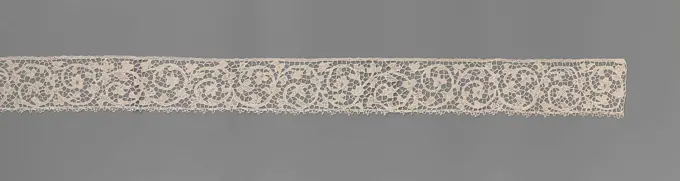
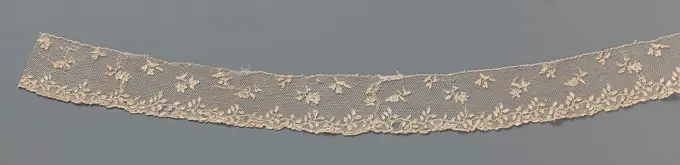
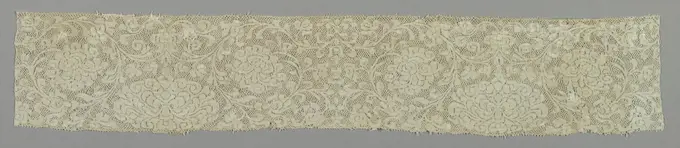
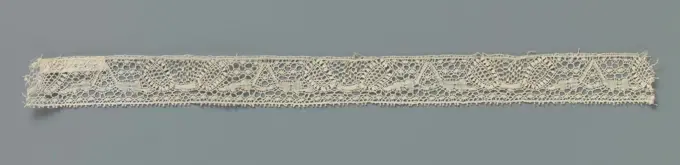
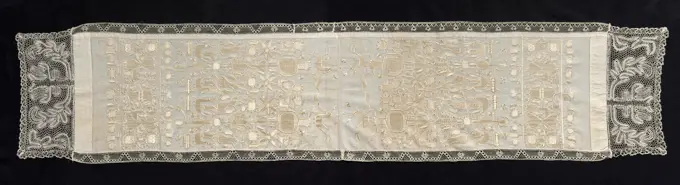
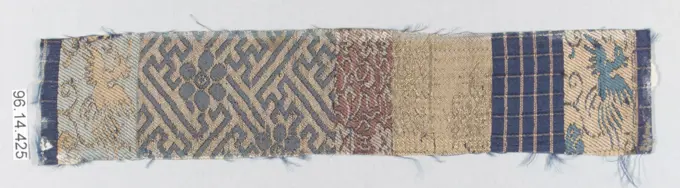
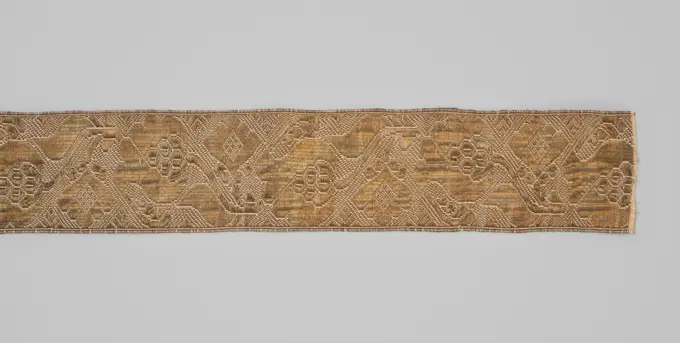
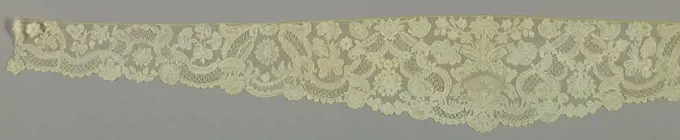
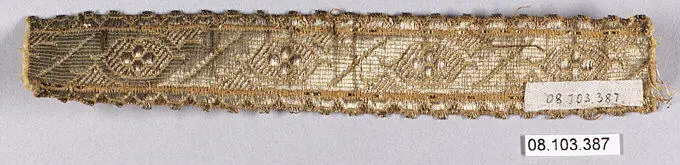
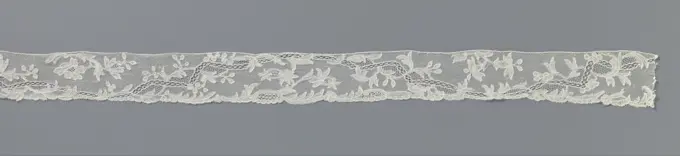
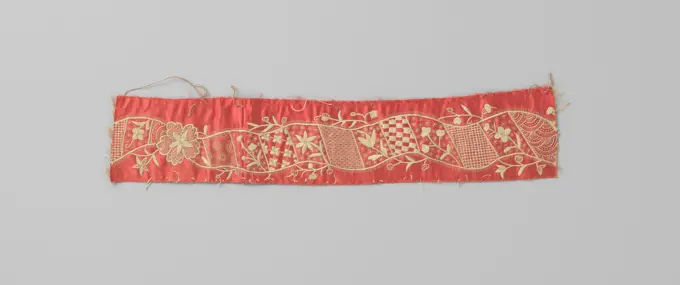
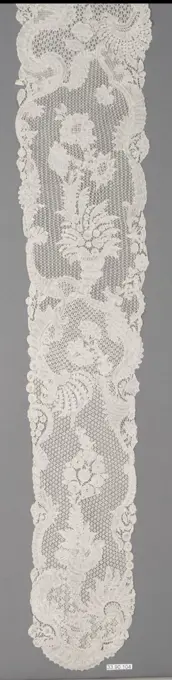
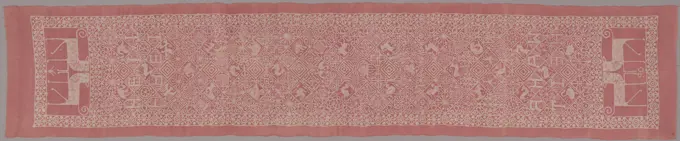
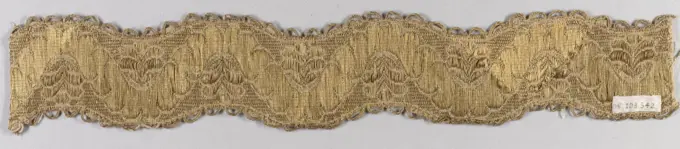
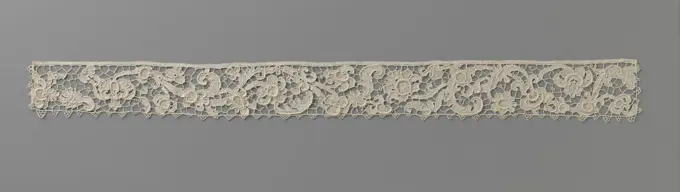
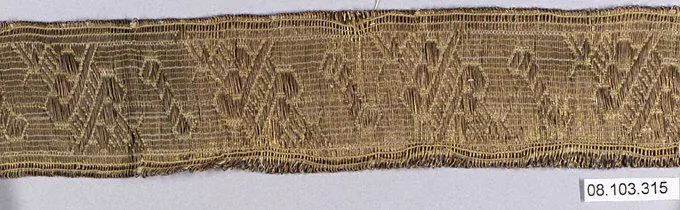
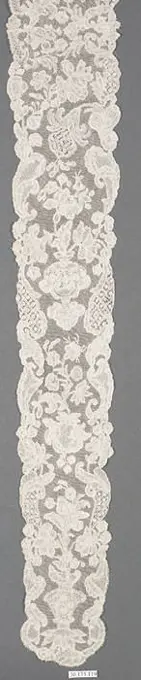
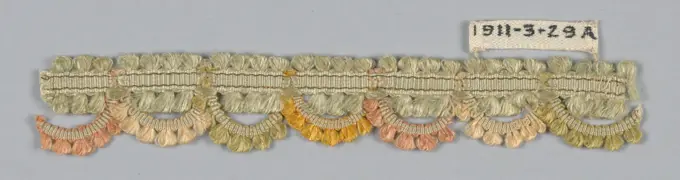
Band, Medium: silk, linen, metallic Technique: complementary weft 3/1 twill; warp twined band sewn to this piece, Rosettes in different colors., Germany or Spain, 14th century, woven textiles, BandBorder (Belgium); linenStrook naaldkant met lopende spiralen.Strip natural-colored mixed side: Venetian ribbon side. Ship soil with picots. Wide spirals, on a running rank with ivy leaves, finish in several small flowers. A closted bow ridge runs along the right outside.Edge, Medium: linen Technique: bobbin lace (Valenciennes ground), Valenciennes type cap lace. Leaf scrolls and rococo ornament with small quatrefoil motifs., 18th century, lace, EdgeBand with Scroll Pattern, 16th century. Italy, Sicily, 16th century. Needle lace, burato (twined ground and darned in one direction); bleached linen (est.); overall: 14.7 x 388.3 cm (5 13/16 x 152 7/8 in.). A scrolling vine with budding vegetation or a tendril is a recurring pattern in needle lace. The frequent use of the motif, adapted in lace from different centuries and regions, suggests that it was found in a pattern book. Here, the pattern is excessively ornate with additional swirling motifs and flourishing vases.Border; medium:Strook naaldkant met golvende bladerrank.Strip natural needle side: Argent tank. Pattern with a wavy leaf right along the bottom edge and above a spreamotherapy with six different flower branches. Ground with hexagonal meshes that are close naid with buttonhole stitches. Blearrank with up and down bending branches with leaves. Under the rank a finer Maas soil, an Alençon ground. Low scalloped picro strand at the bottom due to a variety of leaves, whether or not from the leaves, and small open ovals with rider poic in the center. The top is finished with a straight edge.Sleeve ruffle, Medium: linen Technique: needle lace, Needle lace with a design of twisting vines and grapes. Commonly called 'Point d'Argentan.', France, 18th century, lace, Sleeve ruffleBorder with Cloud and Peony Motifs, anonymous, c. 1650 - c. 1660 Strip of natural -colored Dutch bobbin. The pattern consists of a symmetrical composition of an oval cartouche between two peonies. In the cartouche there is a symmetrical drawing of a tree that is flanked on either side by a flying angel and bird. The angels hold a crown together. You can also see this bird in the peonies and in the leaves hanging from the cartouche. The motifs are made in linen battle and are connected by a round grid. Southern Netherlands linen (material) bobbin lace Strip of natural -colored Dutch bobbin. The pattern consists of a symmetrical composition of an oval cartouche between two peonies. In the cartouche there is a symmetrical drawing of a tree that is flanked on either side by a flying angel and bird. The angels hold a crown together. You can also see this bird in the peonies and in the leaves hanging from the cartouche. The motifs are made in linen battle and are connected by a round grid. SDasslip from needle side with diamond-shaped tendrils. Natural-colored needle side: Flat Venetian side or point de france. On a coarse hexagonal maasing soil there is a symmetrical setting axes relative to two intersecting axes. In the heart there is a large diamond shape that comes back to the left and right outside. They are connected by a smaller window in which a rectified cross. The large windows show four of C-voltages shaped, unreadable monograms (). The intermediate field is filled with spiral drinks with small flowers and buttons. On three sides a straight line with dots, around and large and small.Border, Medium: linen Technique: bobbin lace (early Valenciennes ground), Oval floral clusters flanked by densely foliated scrolls that terminate in stylized floral forms., Netherlands, early 18th century, lace, BorderGalloon French 18th centuryNeck side tie with a symmetrical pattern of many tendrils with small leaves and flowers, anonymous, c. 1675 - c. 1699 Dassle slip of natural -colored needle side: flat Venetian side. Apparently confused but symmetrical pattern with a vertical axis in the middle from which many curling flower and leaf vines move. The motifs are made with feston stitches, where simple patterns in different flowers and leaves have been realized with recesses. The motifs are connected by a potente soil. The top of the strip is finished with a tie. The underside and two short sides are finished with a bow edge. Venice linen (material) flat Venetian (needle point) Dassle slip of natural -colored needle side: flat Venetian side. Apparently confused but symmetrical pattern with a vertical axis in the middle from which many curling flower and leaf vines move. The motifs are made with feston stitches, where simple patterns in different flowers and leaves have been realized with recesses. The motifs are connectedEdging mid-18th century Flemish, Brussels. Edging 222802Bobbin Lace Lappet, 18th century. Belgium, Binche, 18th century. Lace, bobbin: linen; average: 107.3 x 9.9 cm (42 1/4 x 3 7/8 in.).Strook kloskant met driehoek en twee schuingeplaatste ovalen.Strip natural colosside, binche side. The pattern consists of two symmetrical compositions. One composition consists of a triangular motif with a ringed snowflake in the center. The other composition consists of two deviated and shaking ovals, which are connected to each other by a slightly curved strap on the underside. The triangular motif is attached to the underside with the shaking ovals by a slightly wider strap of three co-switched round shapes. The straps and contours of the triangle are made in linen stroke. The contours of the ovals are made in shape stroke. The motifs are connected by an ornamental ground, a ringed snowflakes soil. As ornamental ground, a Paris soil has been applied in the ovals and a fat-mounted ground floor between the ovals decorated with motifs in shape stroke. Upper and bottom of the strip are straight finished, the underside with picots.Strip bobbin with Drieblad, Anonymous, c. 1820 On a fine mesh network there is a stiff row of three-part leaves in the outer half, which are one-sided. A straight edge shows smaller, opposite oriented flower branches. Valenciennes side. Ieper (possibly) linen (material) Bobbi Lace / Valenciennes Lace On a fine mesh network there is a stiff row of three-part leaves in the outer half, which are one-sided. A straight edge shows smaller, opposite oriented flower branches. Valenciennes side. Ieper (possibly) linen (material) Bobbi Lace / Valenciennes LaceBand, Medium: silver thread Technique: embroidery, Shaped band, taken from a cap, heavily embroidered in silver thread with flowers and leaves., Germany, 19th century, embroidery & stitching, BandBobbin Lace Edging, 18th century. Belgium, Binche, 18th century. Lace, bobbin: linen; average: 148.6 x 7.7 cm (58 1/2 x 3 1/16 in.).Insertion 1675-1724 Flemish. Insertion 212523Bobbin Lace Lappet, 18th century. Belgium, Mechelen, 18th century. Lace, bobbin: linen; average: 55.9 x 10.2 cm (22 x 4 in.).Strook kloskant met drieblad geflankeerd door rozetbloemen.Strip natural colosside: Old cravings. With small recesses, a repeating symmetrical pattern can be distinguished with a three-leaf on one long side, which is flanked on both sides by a rosette flower, and along the other long side a stylized French lily, which is flanked on both sides by a butterfly-shaped sheet. There is hardly any floor. The motifs are made in linen stroke with openwork edges. Upper and bottom are straight finished, with picots along one side.Bobbin Lace (Point d'Angleterre) Edging, 18th century. Belgium, Brussels, 18th century. Lace, bobbin: linen; average: 7 x 177.9 cm (2 3/4 x 70 1/16 in.).Table Runner, c 1800s. Czechoslovakia, 19th century. Silk embroidery on linen tabby ground; overall: 185.4 x 39.7 cm (73 x 15 5/8 in.).Strip bobbin with three peonies in a symmetrical composition, anonymous, c. 1650 - c. 1660 Strip of natural -colored Dutch bobbin. The repeating pattern consists of a symmetrical composition with three peonies. The middle peony hangs down on a straight handle and is more or less trapezoidal. From the right stem, a curled stem with elongated narrow leaves on the left and right of this flower rises. A more or less round flower hangs at the ends. The motifs are made in linen battle with openwork edges. The motifs are connected by a grid with braid strokes. Top and bottom of the strip are straight finished, with a separate clost strap on the top and the bottom has picots. The short sides are finished with a zoompje. Antwerp (possibly) linen (material) bobbin lace Strip of natural -colored Dutch bobbin. The repeating pattern consists of a symmetrical composition with three peonies. The middle peony hangs down on a straight handle and is more or less trapezoidal. From the right stem, a curlePiece 18th-19th century Japan. Piece 66150Bobbin Lace (Needlepoint Design) Insertion, second half of 16th century. Italy, Genoa, second half of 16th century. Lace, bobbin; average: 5.5 x 37.2 cm (2 3/16 x 14 5/8 in.).Border 18th century Flemish, Mechlin. Border. Flemish, Mechlin. 18th century. Bobbin lace. Textiles-LacesFragment of the lace;  XVI/XVII century (1590-00-00-1610-00-00);Galloon 17th-18th century Unknown. Galloon 213856Trimming, Medium: metallic strips wrapped around linen core Technique: bobbin lace, Gold and silver metallic lace in a straight band of interlocking diamond shapes, with an elaborate picot on both long edges., Italy or Spain, late 16th-early 17th century, lace, TrimmingEdging (possibly France); cottonGold galon from yellow side, woven with gold in a pattern of stylized tulips of branches with leaves, anonymous, c. 1600 - c. 1699 Gold galon from yellow side, woven with gold in a pattern of stylized tulips of branches with leaves. West-Europa whole: Silk. Decoration: Gold galon from yellow side, woven with gold in a pattern of stylized tulips of branches with leaves. West-Europa whole: Silk. Decoration:Strip of needle side with S-shape in spreading motif, anonymous, c. 1790 - c. 1799 Strip of natural-colored needle side with a regular scatter motif hanging flower branches, circles and s-shapes, on a fine hexagonal mesh ground. The pattern on the underside consists of two double rows with arches, which are filled with different decorative grounds. A repetitive motif of: an oval stuffed with ornamental soil can be seen between these two double rows; An S-shape and a flower branch hanging down. The top is trimmed with a border bobbin. A very finely potented outskirts of scales is the finish on the underside. Alençon side. France linen (material) Alençon Lace Strip of natural-colored needle side with a regular scatter motif hanging flower branches, circles and s-shapes, on a fine hexagonal mesh ground. The pattern on the underside consists of two double rows with arches, which are filled with different decorative grounds. A repetitive motif of: an oval stuffed with ornamental soil can beGalloon 17th-18th century Unknown. Galloon 213768Slendang (Shawl) Made 1801-1900 Java. Cotton, batik dyed .Galloon 17th-18th century Unknown. Galloon 213777Bobbin lace 18th century Flemish. Bobbin lace 218897Molding; wood, carved; 1917-12-21Band, Medium: linen Technique: bobbin lace (Brussels style), Band of insertion lace with a pattern of open flowers and leaves., Belgium, 19th century, lace, BandEdging late 18th century French. Edging 218302Textile Fragment 5th century. Textile Fragment 444125Trimming, Medium: silk, metallic thread Technique: woven, Design of open flowers and diagonal lines set between saw tooth borders. Gilt picots at either edge. In yellow and metallic thread., France, 18th century, trimmings, TrimmingStrip early 18th century Flemish. Strip. Flemish. early 18th century. Bobbin lace. Textiles-LacesLeaf vines, sprouting from the middle, 1500 - 1600 print There is a child at both ends of the Frisian. Shaded background. One of 11 magazines. Germany (possibly) paper engravingBorder, Medium: linen Technique: needle lace, Border of Point d'Alençon with a pattern of dots and leaves., France, early 19th century, lace, BorderDas from Application side with four Spitsovalen and a branch with three flowers at the ends, Anonymous, c. 1880 - c. 1899 Das of natural -colored application side: bobbin lacquered on tulle. Symmetrical pattern with concatenated and partly overlapping pointed soils and ovals. In the Spitsovalen there is always the same elongated flower and leaf motif with two rosette flowers and an oval flower. Between the Spitsovalen, in every rounder oval, there is always one flower with three leaves above and below. The ends are drip -shaped and scalloped and have a branch with three flowers. The entire tie is sculpted and all parts have an outline of leaf branches. Belgium linen (material). Das of natural -colored application side: bobbin lacquered on tulle. Symmetrical pattern with concatenated and partly overlapping pointed soils and ovals. In the Spitsovalen there is always the same elongated flower and leaf motif with two rosette flowers and an oval flower. Between the Spitsovalen, in every rouBand, Medium: linen Technique: needlework on gauze weave, Narrow band with a pattern of white roosters and symmetrical plants on white gauze weave., Italy, 17th century, embroidery & stitching, BandGalloon Swiss 18th century View more. Galloon. Swiss. 18th century. Metal thread. Textiles-TrimmingsBorder, Technique: bobbin lace, Bobbin lace sample edge, floral borders; late 18th century Point de Lille, late 18th century, lace, BorderBorder, Medium: linen Technique: bobbin lace, Mechlin style, Scalloped border of carnation like flower with buds in diagonal rows above., Belgium, 18th-19th century, lace, BorderTextile Japan 19th century View more. Textile. Japan. 19th century. Textiles-WovenPiece early 19th century British, Northamptonshire. Piece 214398Sleeve ruffle, Medium: linen Technique: bobbin lace, Brussels style, Belgium, 1740-55, lace, Sleeve ruffleGalloon 17th-18th century Unknown. Galloon 213884Hats strip Van Kloskant with Zigzag Rivière, Anonymous, c. 1750 - c. 1760 Strip of natural -colored Brussels bobbin. A rivière in Zigzaglijn is crossed by spiral ranks, which enclose fan -shaped medallions. The motives are connected by a drachel soil. A coarser hexagonal soil has been used in the Rivières. On the fields that are bordered by the Rivière, there are twigs on which flowers in the form of pomegranates, pears or winged insects. The strip was probably used or made for a hat. Brussels linen (material) bobbin lace / Brussels bobbin lace Strip of natural -colored Brussels bobbin. A rivière in Zigzaglijn is crossed by spiral ranks, which enclose fan -shaped medallions. The motives are connected by a drachel soil. A coarser hexagonal soil has been used in the Rivières. On the fields that are bordered by the Rivière, there are twigs on which flowers in the form of pomegranates, pears or winged insects. The strip was probably used or made for a hat. Brussels linen (material) bobbin Fringe ca. 1700 Italian. Fringe 213374Ceintuur ribbon of side brokaat; On a silver surface, a repeating pattern in dark red, pink and brown is in the shape of a snail house () From which fruits and leaves come, anonymous, c. 1735 Ceintuur ribbon of side brokaat; On a silver surface, a repeating pattern in dark red, pink and brown is in the shape of a snail house () From which fruits and leaves come. The edges are trimmed with silver -colored decorative tape. West-Europa geheel: silk. brocade (textile). silver thread Ceintuur ribbon of side brokaat; On a silver surface, a repeating pattern in dark red, pink and brown is in the shape of a snail house () From which fruits and leaves come. The edges are trimmed with silver -colored decorative tape. West-Europa geheel: silk. brocade (textile). silver threadPanel, Medium: cotton, silk, metallic threads Technique: plain compound weave, Rectangular panel with a border design of conventionalized blossoms and leaves in green, red and blue with silver threads. Two ends are striped red, green and red and gold., India, 19th century, woven textiles, PanelStrip of bobbin with stylized flour between two vertical lines and ovals on a rectangular batist, anonymous, c. 1600 - c. 1624 Strip of natural -colored bobbin, Old Flemish side or Dutch bobbin side. The strip is attached to a narrow rectangular fragment linen batist, possibly a remnant of a sheet. The side has a pattern that consists of vertical straight lines, between which a stylized flower stands. On the center line, the flower is flanked on the left and right by a lying rush -hour, which always cuts the vertical line. The motives are made in linen battle with recesses, there is hardly any soil, the motives are connected by very short braids. Up and bottom of the strip are finished with a straight edge. Netherlands (possibly) linen (material) bobbin lace / old Flemish lace Strip of natural -colored bobbin, Old Flemish side or Dutch bobbin side. The strip is attached to a narrow rectangular fragment linen batist, possibly a remnant of a sheet. The side has a pattern that consists ofMizuhiki (Temple Banner) Made 1668-1703 Japan. Silk, warp-float face 4 1 satin weave; appliquÈd with silk, warp-float face 4 1 satin weave and warp-float face 4 1 satin weave; stenciled (suri hita); embroidered with silk, gold-leaf-over-lacquered paper strip wrapped cotton and silver-over lacquered paper strip wrapped cotton, in satin and single satin stitches; laidwork and couching; lining silk, plain weave .Heat slip of the needle side with acanthus leaves, anonymous, c. 1720 - c. 1730 Capslip of natural-colored needle side, Régence side. Pattern with acanthus leaves and lush flowers, decorated on a mesh soil with square mushes. Fullwork with recesses and multifaceted decorative stitches. Relief contours with feston stitches. France whole: Linen (Material) Capslip of natural-colored needle side, Régence side. Pattern with acanthus leaves and lush flowers, decorated on a mesh soil with square mushes. Fullwork with recesses and multifaceted decorative stitches. Relief contours with feston stitches. France whole: Linen (Material)Band; silk on cottonDistrict of Jan Stanis Stanis Awski, Jan (1860-1907); End of the 19th century (1890-00-00-1900-00-00);Galloon early 19th century French. Galloon 213957Embroidered Interior Textile, anonymous, c. 1750 - c. 1760  France (possibly) silk embroidering  France (possibly) silk embroideringFringe (Italy); gold foil in a silk coreGalloon late 18th-early 19th century European. Galloon 224973Galloon 17th-18th century probably European. Galloon 213873Bobbin Lace Edging, mid 18th century. Belgium, Binche, mid 18th century. Lace, bobbin; average: 4.2 x 81.3 cm (1 5/8 x 32 in.).Fragment, Medium: natural linen Technique: needle lace, 6 sided reworked ground, Fragment of a shaped band, probably a sleeve ruffle, with fantastic floral forms., early 18th century, lace, FragmentBobbin Lace Insertion, 18th century. Malta, 18th century. Lace, bobbin; average: 2.7 x 302.3 cm (1 1/16 x 119 in.).Fringe, Medium: silk Technique: woven, Red fringe with an ornamental heading and red skirt threads., Italy, 16th century, trimmings, FringePiece 18th century Flemish, Mechlin. Piece 214561Bobbin Lace Edging, 18th century. Belgium, Mechelen, 18th century (Louis XV period). Lace, bobbin; average: 8.6 x 106.7 cm (3 3/8 x 42 in.).Band, Medium: silk, metal-wrapped silk, coiled metal strips on linen Technique: split, satin and double running stitches using silk, couched and padded couching for metal-wrapped silk and metal coils on plain weave (metallic yarns are couched in pairs for large dense areas, two plied Z-twist for outline, two plied Z-twist and re-plied S-twist for outer border), A pair of narrow borders of cream-colored linen elaborately embroidered in gold thread and colored silk. Design shows a winged head of cherubim with a symmetrical border pattern of dolphins, lions, and a vase of flowers with delicate symmetrical vines framing and connecting the elements. Faces of cherubs in white silk, long and short stitch, with dark brown for curly hair. Balance of the design in couched gold thread, partly with color. Manes of lions in heavy, looped gold. Flower heads in colored silks in pale tints., Italy, 16th-17th century, embroidery & stitching, BandPiece 16th century Japan. Piece 71080Textile, China, 18th-19th century, woven textiles, TextileFragment of Border 14th century. Fragment of Border 451035Silver side strip with semicircular scallops, anonymous, c. 1600 - c. 1935  Strip bobbin, silver side. On a narrow straight tire, made in linen, hang semi -rounds with a recess in the middle. The sculpts are also made in linen battle. unknown silver thread bobbin laceLappet mid-18th century Flemish, Brussels. Lappet 222793Wallpaper Panel. Dimensions: 121 1/2 x 16 1/2 in. (308.6 x 41.9 cm). Date: 1700-1730.This wallpaper panel is part of a set originally consisting of seventeen pieces (see 14.106.1-.16 for set.). The panels depict mountain landscapes, scenes with houses, birds, and flowering shrubs. They were hand-painted in China during the early eighteenth century for export to England. There, as in America, such exotic wallpaper enjoyed a vogue among the fashionable gentry. Considered a great luxury, it added richness and colors to walls. This wallpaper hung in an English home for two hundred years. The panels are installed, in whole or in part, in the Powel Room in The American Wing. Museum: Metropolitan Museum of Art, New York, USA.Silver side strip with zigzag line and fans, anonymous, c. 1700 - c. 1799 Strip bobbin, silver side. The pattern consists of a zigzag line between which alternately hanging and standing fans. A small range hangs under the standing fans. The zigzag lines are formed by a double row of leaves made in form. The fans are largely made with long -up and down silver threads, with ribbed filé threads in between. The scoops along the underside stem from the pattern with the fans. The top is straight. Spain silver thread bobbin lace Strip bobbin, silver side. The pattern consists of a zigzag line between which alternately hanging and standing fans. A small range hangs under the standing fans. The zigzag lines are formed by a double row of leaves made in form. The fans are largely made with long -up and down silver threads, with ribbed filé threads in between. The scoops along the underside stem from the pattern with the fans. The top is straight. Spain silver thread bobbin laceLappet early 18th century Flemish. Lappet. Flemish. early 18th century. Bobbin lace. Textiles-LacesTrimming, Medium: silk Technique: woven, Yellow trimming fragment in a design of eight-petal flowers separated by conventional ornaments., France, 19th century, trimmings, TrimmingBliej Kultury unknownGalloon 17th-18th century Unknown. Galloon 213839Galloon 17th-18th century Unknown. Galloon 213770Lace laceTie (Belgium); linenPiece 18th century Japan. Piece 71369Strip of needle side with stretched S-rank, anonymous, c. 1875 - c. 1909 Strip of natural -colored needle side: Venetian relief side. A loose pattern of interrupted volute vines and palm flowers stands on a very open bar of bar. Straight finish with triangles, alternately large and small. BURANO linen (material) Venetian raised work Strip of natural -colored needle side: Venetian relief side. A loose pattern of interrupted volute vines and palm flowers stands on a very open bar of bar. Straight finish with triangles, alternately large and small. BURANO linen (material) Venetian raised workFragment, Medium: silk Technique: machine made, Black lace with narrow border of open flowers, ribbon and dots., France, 1850-99, lace, FragmentGalloon 17th-18th century Unknown. Galloon 213812Band (Italy); linen; Bequest of Marian Hague; 1971-50-279Lappet 18th century Flemish. Lappet 222436Fragment, Medium: silk, metallic Technique: woven, Small scale all-over repeat in white and silver, 17th century, woven textiles, FragmentBorder Fragment, 16 x 1 1/2 in. (40.64 x 3.81 cm) (approximate)3 1/4 x 18 1/8 in. (8.26 x 46.04 cm) (outer frame), Cotton (), PeruTrimming (USA); silk