My Boards
View Pictures
  • My Boards

Saturn and Celestial Bodies

Stunning visuals of Saturn showcasing its rings and atmospheric colors. Also includes artistic impressions of distant planets.

Saturn, artwork
Saturn, artwork
244 assets in this story
6145-45262766
Artist's concept of what binary asteroid 2017 YE5 might look like. The two objects showed striking differences in radar reflectivity, which could indicate that they have different surface properties. A movie is available at
6145-44628271
Hazy Days on Titan
6145-44564608
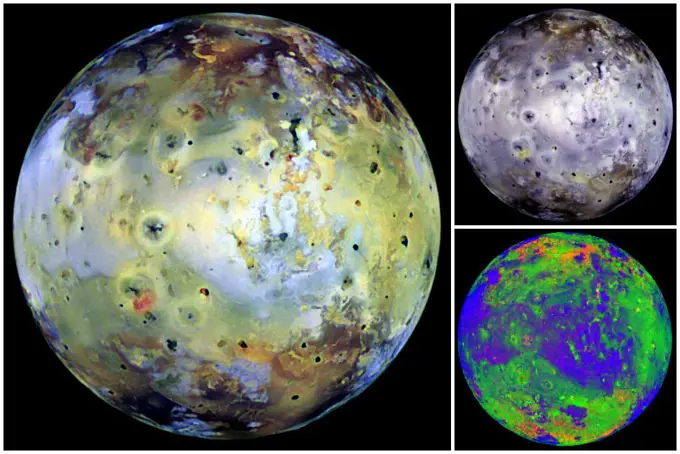
Io Shown in Lambertian Equal Area Projection and in Approximately Natural Color
6145-45115765
As NASA's New Horizons approached Pluto in late 2014 and then flew by the planet during the summer of 2015, NASA's Chandra obtained data during four separate observations. During each observation, Chandra detected low-energy X-rays from the small planet.
6145-44618357
Titan in Natural Color
6145-44734549
Photograph by Pioneer Venus Venus image 0694
4239R-20483149
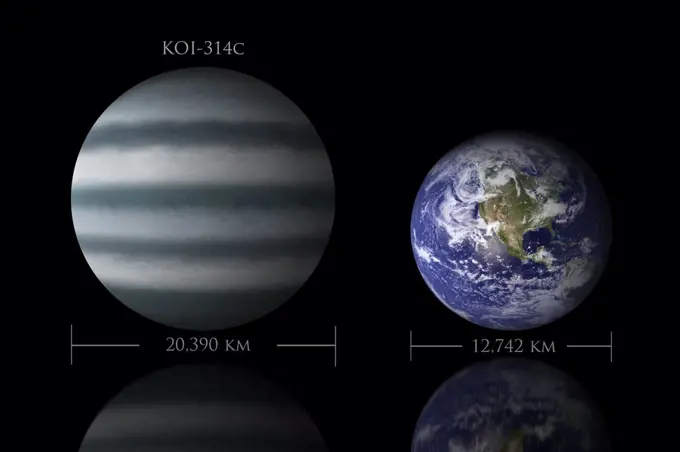
Artist's depiction of the size relationship between Earth and KOI-314c. Orbiting around a red dwarf star, this relatively small gas planet reaches temperatures of 104°C. It is approximately 200 light years from Earth. Some elements of this illustration are courtesy of NASA.
6145-45110576
NASA's New Horizons scientists have spotted an expanse of terrain they describe as 'fretted' (bright plains divided into polygon-shaped blocks by a network of dark, connected valleys) in Pluto's informally named Venera Terra region.
6188-65608174
yellow planet in space with stars yellow planet in space with stars illustration Copyright: xZoonar.com/magannx 14204216
6145-44561482
This photographic mosaic of images covering an area of 34,000 kilometers by 22,000 kilometers (about 21,100 by 13,600 miles) in Jupiter's equatorial region was taken by NASA's Galileo orbiter on December 17, 1996.
6145-45106281
The red outline in this global view of Pluto from NASA's New Horizons marks the large area of mysterious, bladed terrain extending from the eastern section of the large feature informally named Tombaugh Regio.
6145-44562536
Jupiter's Southern Hemisphere in the Near-Infrared (Time Set 2)
6145-44737225
Range 106,250,000 km. ( 66 million miles) P-22830C This, Voyager 1 image shows Saturn and three of its satellites. A series of dark and light cloud bands appears through high altitude haze in the northern hemisphere. Cosiderable structure can be seen in the rings. The Cassini division, between the A-ring and B-ring, is readily visible. The shadow of rings on the planet's disk can also be seeen. The three satellites visible are, left to right, Enceladus (off the left edge of rings), Dione (just below the planet), and Tethys (at right edge of frame). The spacecraft will make its closest approach, 124,200 km. (77,174 miles) abovr the cloud tops, at 3 45 pm PST on Nov. 12, 1980. Nine months later, in August 1981, Voyager 2 will encounter Saturn and then continue on to Uranus.
4128R-14846312
Earth compared to Venus, illustration
6145-44566171
Hubble Views Saturn Ring-Plane Crossing
4128-24796274
Neptune with clouds and atmosphere, illustration
6145-44736443
Photo by Voyager 1 Jupiter's satellite Io poses before the giant planet in this photo returned Jan 17, 1979 from a distance of 29 million miles (47 million kilometers). The satellite's shadow can be seen falling on the face of Jupiter at left. Io is traveling from left to right in its one-and-three-quarter-day orbit around Jupiter. Even from this great distance the image of Io shows dark poles and bright equatorial region. Voyager 1 will make its closest approach to Jupiter 174, 000 miles (280,000 kilometer) on March 5. It will then continue to Saturn in November 1980. This color photo was assembled at Jet Propulsion Laboratory's Image Processing Lab from three black and white images taken through filters. The Voyagers are managed for NASA's Office of Space Science by Jet Propulsion Laboratory. (JPL Ref P-20946C)
6145-45256913
Topography of Earth's moon generated from data collected by the Lunar Orbiter Laser Altimeter, aboard NASA's Lunar Reconnaissance Orbiter, with the gravity anomalies bordering the Procellarum region superimposed in blue. The border structures are shown using gravity gradients calculated with data from NASA's Gravity Recovery and Interior Laboratory (GRAIL) mission. These gravity anomalies are interpreted as ancient lava-flooded rift zones buried beneath the volcanic plains (or maria) on the nearside of the Moon. Launched as GRAIL A and GRAIL B in September 2011, the probes, renamed Ebb and Flow, operated in a nearly circular orbit near the poles of the moon at an altitude of about 34 miles (55 kilometers) until their mission ended in December 2012. The distance between the twin probes changed slightly as they flew over areas of greater and lesser gravity caused by visible features, such as mountains and craters, and by masses hidden beneath the lunar surface. The twin spacecraft flew i
6145-44512976
These two images, taken by NASA's Cassini spacecraft, show Jupiter in a near-infrared wavelength, and catch Europa, one of Jupiter's largest moons, at different phases.
6145-44671745
A Look from LEISA
6145-45292690
All spinning objects, from carousels to planets, generate centripetal force. If a planet rotates too fast, that force can pull it apart. Before that happens, the planet will experience flattening, or bulging around its midsection, as seen in this animated illustration of a brown dwarf, Jupiter, and Saturn. Animation available at
6145-44569378
This computer enhancement of a NASA Voyager 2 image, emphasizes the high-level haze in Uranus' upper atmosphere. Clouds are obscured by the overlying atmosphere.
6145-45135953
This view of Jupiter, from NASA's Juno spacecraft, highlights Oval BA -- a massive storm known as the Little Red Spot. Despite its unofficial name, the Little Red Spot is about as wide as Earth.
6145-45232120
In this comparison image the photo at the top was taken by Hubble's Wide Field Planetary Camera 2 in 1995 and shows the spot at a diameter of just under 21 000km; the second down shows a 2009 WFC3 photo of the spot at a diameter of just under 18 000km; and the lowest shows the newest image from WFC3 taken in 2014 with the spot at its smallest yet, with diameter of just 16 000km. -- Jupiter's trademark Great Red Spot -- a swirling anti-cyclonic storm larger than Earth -- has shrunk to its smallest size ever measured. According to Amy Simon of NASA's Goddard Space Flight Center in Greenbelt, Maryland, recent NASA Hubble Space Telescope observations confirm the Great Red Spot now is approximately 10,250 miles across. Astronomers have followed this downsizing since the 1930s. Historic observations as far back as the late 1800s gauged the storm to be as large as 25,500 miles on its long axis. NASA Voyager 1 and Voyager 2 flybys of Jupiter in 1979 measured it to be 14,500 miles across. In 19
4128R-15536564
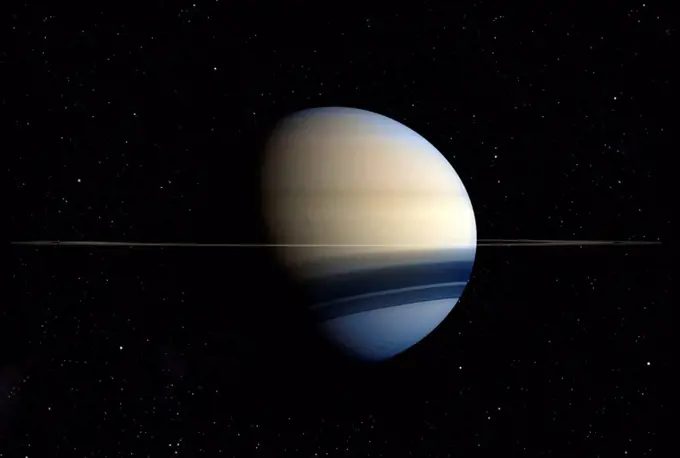
Illustration of Saturn
6145-44786769
This artist's conception shows a nearly invisible ring around Saturn -- the largest of the giant planet's many rings. It was discovered by NASA's Spitzer Space Telescope.
6145-45258129
This enhanced color image of Ceres' surface was made from data obtained on April 29, 2017, when NASA's Dawn spacecraft was exactly between the sun and Ceres. Dawn's framing cameras took images of Ceres with a clear filter as well as five different color filters. Images combining these different color filter perspectives reveal fine details of Ceres' surface. For example, they emphasize the distinct compositions and textures of the material ejected from craters. The brightest region on Ceres, called Cerealia Facula, is highlighted in Occator Crater in the center of this image. Vinalia Faculae, the set of secondary bright spots in the same crater, are located to the right of Cerealia Facula. One of the darkest regions on Ceres is next to Occator, and represents ejected material from the impact that formed the crater. The ejected material forms a large arc that extends over several hundred kilometers, below the center of Ceres in this image. That material's distribution is partly determin
4128R-15545581
Illustration of Venus
6145-44736429
Pioneer-Venus Image 00078
6145-44734546
Photograph by Pioneer Venus Venus image 589
6145-45266149
During its routine yearly monitoring of the weather on our solar system's outer planets, NASA's Hubble Space Telescope has uncovered a new mysterious dark storm on Neptune (right) and provided a fresh look at a long-lived storm circling around the north polar region on Uranus (left).
5514-30460146
Macro shot of a soap bubble simulating a planet
6145-44953978
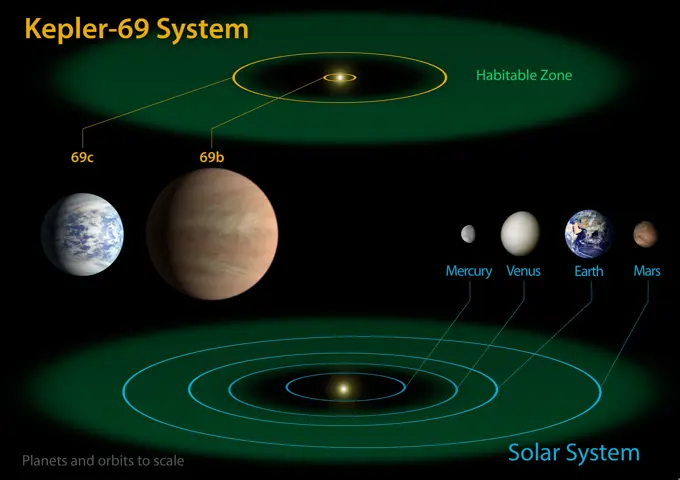
This diagram compares the planets of the inner solar system to Kepler-69, a two-planet system about 2,700 light-years from Earth in the constellation Cygnus.
6145-44596172
Astronomers are studying the unusual appearance of Saturn's rings. The top portion of this Hubble Space Telescope snapshot shows Saturn with its rings barely visible. Normally, astronomers see Saturn with its rings tilted, but because the Earth was almost in the plane of Saturn's rings, they appear edge-on. Positioned above the ring plane, the Sun is causing the rings to cast a shadow on Saturn. The bottom photograph shows Saturn with its rings slightly tilted, and displays a faint narrow ring, the F-ring, just outside the main ring, which is normally invisible from Earth. The moon called Dion, on the lower right, is casting a long, thin shadow across the whole ring system due to the setting of the sun on the ring plane.
6145-45118705
This composite image depicts Jupiter's cloud formations as seen through the eyes of NASA's Juno's Microwave Radiometer (MWR) instrument as compared to the top layer, a Cassini Imaging Science Subsystem image of the planet.
6145-44738600
P-29502C Range 1.04 million kilometers (650,000 miles) This color photo of Umbriel, the darkest of Uranus' five large moons was synthesized from frames exposed with the Voyager narrow-angle camera's violet and clear filters and has a resolution of 19 km (12 mi.). Umbriel is characterized by the darkest surface and smallest brightness variations of any of the large satellites of Uranus. As seen here, the surface is also generally gray and colorless. Nevertheless, at this resolution, considerable topographic detail is revealed, showing that Umbriel's surface is covered by impact craters. The brightest spot (shown at top near the equator at approxiamately 270 ° longitude) appears as a bright ring. Its geological significance is not yet understood. Umbriel has a diameter of about 1,200 km (750 miles) and orbits 267,000 km (166,000 mi) from Uranus' center. The satellite's name, from Alexander Pope's 'Rape of the Lock,' means 'dark angel'.
6145-44647973
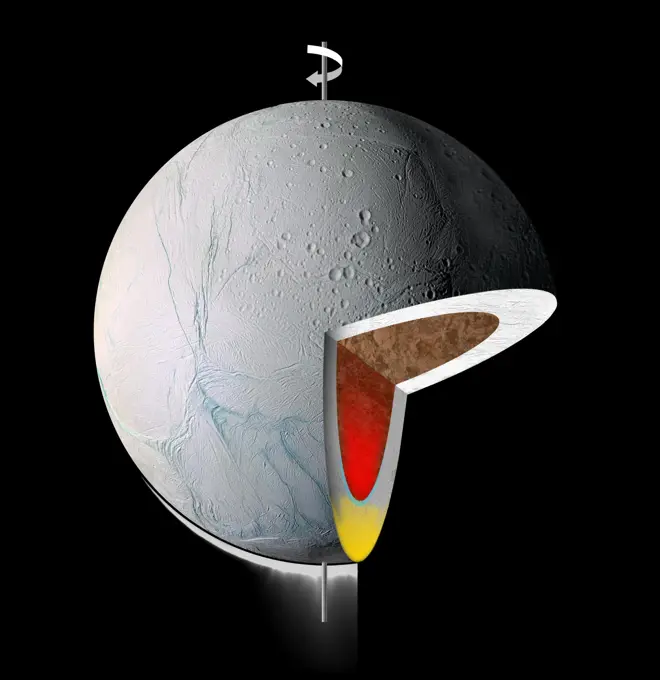
This graphic illustrates the interior of Saturn's moon Enceladus. It shows warm, low-density material rising to the surface from within, in its icy shell (yellow) and/or its rocky core (red)
6145-44671230
A bizarre six-sided feature encircling the north pole of Saturn has been spied by the VIMS on NASA's Cassini spacecraft. This image is one of the first clear images ever taken of the north polar region as seen from a unique polar perspective
1848-49507952
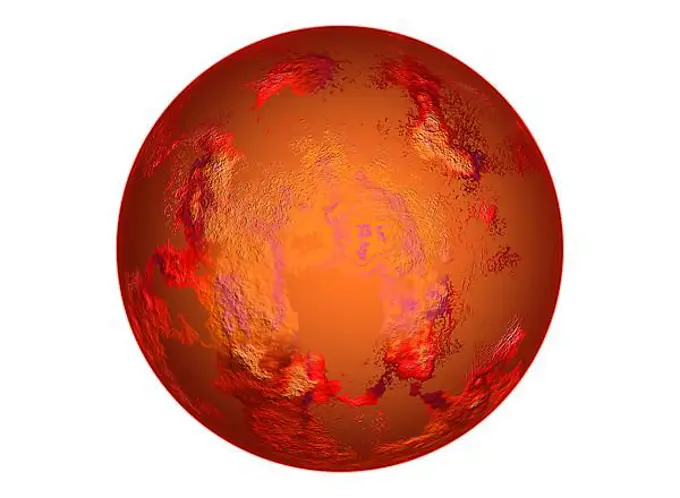
Digitally rendered planet Mars isolated on white background
6176-66094109
"The Planet Jupiter" - Observed November 1, 1880. Colour lithograph by Etienne Trouvelot, 1882.
6145-45265905
During super-close flybys of Saturn's rings, NASA's Cassini spacecraft inspected the mini-moons Pan and Daphnis in the A ring; Atlas at the edge of the A ring; Pandora at the edge of the F ring; and Epimetheus, which is bathed in material that fans out from the moon Enceladus. The mini-moons' diameter ranges from 5 miles (8 kilometers) for Daphnis to 72 miles (116 kilometers) for Epimetheus. The rings and the moons depicted in this illustration are not to scale.
1848-49598523
Digitally rendered image of planet mars isolated on white background
6145-44561454
Global View of Io in various colors
6145-44610982
The artist's rendition shows the newly discovered planet-like object, dubbed 'Sedna,' in relation to other bodies in the solar system, including Earth and its Moon; Pluto; and Quaoar, a planetoid beyond Pluto.
PREVIOUS
of 3
NEXT
2401 S. Ervay, Suite 206
Dallas, Texas 75215
United States
Get Started
Free ResearchMy BoardsMy Cart
For Creators
How To License Your ContentContributor PortalFrame of Mind
Resources
API accessPricing
Contact
+1 866 236 0087help@viewpictures.co.uk Contact form
©2026 View Pictures. All Rights Reserved. -A
This site is protected by reCAPTCHA and Google Privacy Policy and Terms of Service apply.