My Boards
View Pictures
  • My Boards

Science and Research Activities

A variety of scientists and technicians at work, focusing on experimentation, analysis, and teamwork in laboratory environments. The images capture a mix of modern and historical settings.

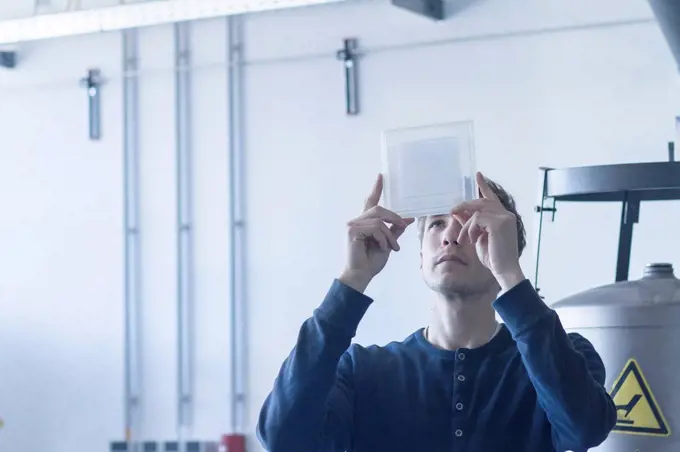
Technician in workshop examining sample
138 assets in this story
6145-45184794
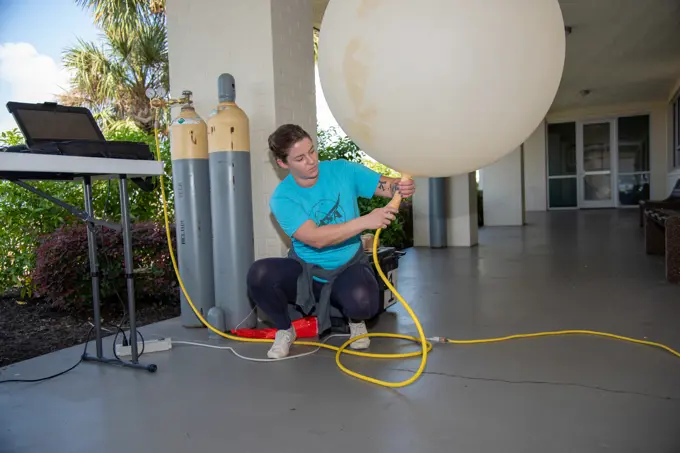
In order to make sure weather conditions are acceptable at multiple altitudes, NASA meteorologists on the ground conduct constant monitoring operations, and launch weather balloons to get accurate data for aircraft and pilot.
6145-52108585
A technician examines a specimen in the polymer branch of the materials laboratory. Base: Wright-Patterson Air Force Base State: Ohio (OH) Country: United States Of America (USA)
6145-55885036
WHITE SANDS MISSILE RANGE, N.M. -- (left to right) Justin Angel, Aaron Pino and Aron Jaquez, 15th Space Surveillance Squadron, Detachment 1 operators, look at a map of common start trajectories at White Sands Missile Range, N.M., Aug. 25, 2022. The operations team at Det. 1 uses mechanically driven optical telescopes known as ground-based, electro-optical deep space surveillance sensors to track and catalog these objects.
1815R-100837
Young man doing experiment and using laptop
6145-45060962
Members of team Survey follow their robot as it conducts a demonstration of the level two challenge during the 2014 NASA Centennial Challenges Sample Return Robot Challenge, Thursday, June 12, 2014, at the Worcester Polytechnic Institute (WPI) in Worcester, Mass.   Eighteen teams are competing for a $1.5 million NASA prize purse. Teams will be required to demonstrate autonomous robots that can locate and collect samples from a wide and varied terrain, operating without human control. The objective of this NASA-WPI Centennial Challenge is to encourage innovations in autonomous navigation and robotics technologies. Innovations stemming from the challenge may improve NASA's capability to explore a variety of destinations in space, as well as enhance the nation's robotic technology for use in industries and applications on Earth.
6145-45288648
Members of NASAs Perseverance Mars rover team study data on monitors in mission control, Thursday, Feb. 18, 2021, at NASA's Jet Propulsion Laboratory in Pasadena, California. A key objective for Perseverances mission on Mars is astrobiology, including the search for signs of ancient microbial life. The rover will characterize the planets geology and past climate, pave the way for human exploration of the Red Planet, and be the first mission to collect and cache Martian rock and regolith.
1815-18041556
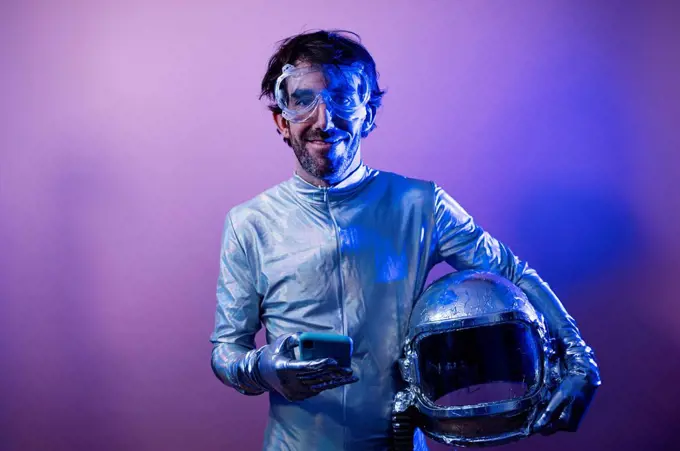
Smiling male astronaut holding smart phone and space helmet colored background
7176-70562586
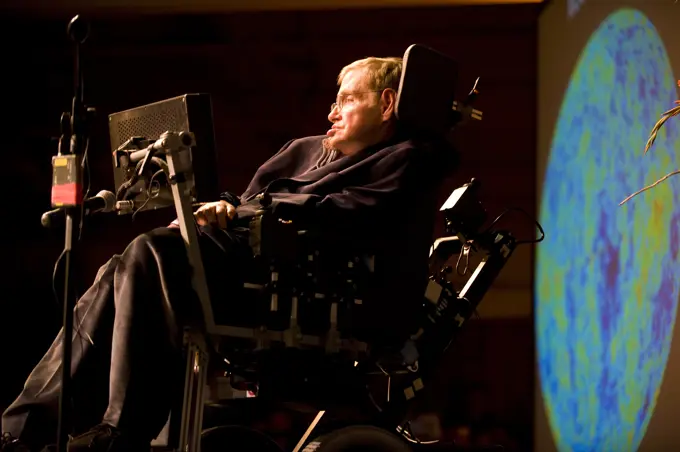
Stephen Hawking at TED conference.Stephen William Hawking PhD, CH, CBE, FRS, FRSA is a British theoretical physicist. Hawking is the Lucasian Professor of Mathematics at the University of Cambridge.
1815-20165553
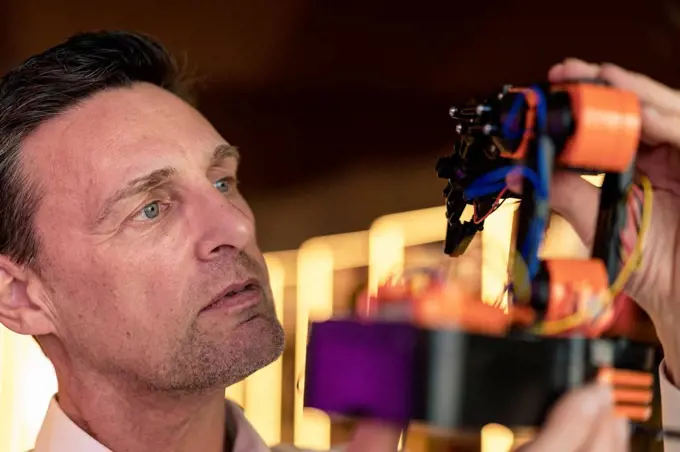
Concentrated engineer examining robotic arm at workshop
6145-44643295
CEV model with pressure sensitive paint (PSP) test 11-0148 in the 11ft Ames wind tunnel. Shown here with Paul Espinosa (l) and Tuan Truong (r) wwith blue LEDS
6145-45140435
Audience members, seated under the wing of the space shuttle Enterprise, listen as NASA Acting Chief Technologist Douglas Terrier, moderates a panel discussion titled "The Big Picture" with NASA James Webb Space Telescope systems engineer Mike Menzel,  SpaceX Director of space operations and former NASA astronaut Garret Reisman, Honeybee Robotics co-founder and chairman Stephen Gorevan, and former NASA astronaut Mike Massimino, Saturday, Aug. 5, 2017 at the Intrepid Sea, Air & Space Museum in New York City.
1815-16021624
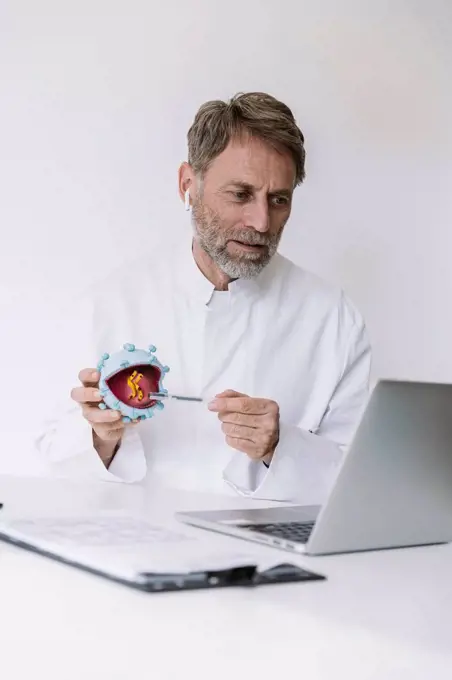
Scientist explaining corona virus model in video conference at desk
6145-45187584
An image of Mars made by one of the Mars Cube One CubeSats is shown during a Mars InSight post-landing press conference, Monday, Nov. 26, 2018 at NASA's Jet Propulsion Laboratory in Pasadena, California. InSight, short for Interior Exploration using Seismic Investigations, Geodesy and Heat Transport, is a Mars lander designed to study the "inner space" of Mars: its crust, mantle, and core.
1439-63067618
Man examining a water sample through a magnifying glass against a scenic lake backdrop.
1033-117
Chronobiology Research
6145-44640384
KENNEDY SPACE CENTER, FLA. -  In the Vertical Integration Facility on Launch Complex 41, Cape Canaveral Air Force Station, Hal Weaver, New Horizons project scientist with the Johns Hopkins University Applied Physics Laboratory, signs the fairing enclosing the New Horizons spacecraft. The fairing protects the spacecraft during launch and flight through the atmosphere. Once out of the atmosphere, the fairing is jettisoned.  The compact 1,060-pound New Horizons probe carries seven scientific instruments that will characterize the global geology and geomorphology of Pluto and its moon Charon, map their surface compositions and temperatures, and examine Pluto's complex atmosphere.  New Horizons is the first mission in NASA's New Frontiers program of medium-class planetary missions. The spacecraft, designed for NASA by the Johns Hopkins University Applied Physics Laboratory in Laurel, Md., will fly by Pluto and Charon as early as summer 2015.
6145-44740460
Sikorsky UH-60 (USA 82-23748 NASA-748) Airloads research aircraft - Blackhawk helicopter with MUX-Bucket in flight over Livermore, CA. Note Used in publication in Flight Research at Ames; 57 Years of Development and Validation of Aeronautical Technology NASA SP-1998-3300 fig. 135
5514-53895347
Paul Debevec stands in Light Stage 5 at the USC ICT Graphics Laboratory in Marina Del Rey, Calif., on Friday, Jan. 29, 2010.
1525-25483297
sport, bodybuilding, fitness and people concept - young man or bodybuilder with protein shake bottle and bare torso over gray background with diagram chart hologram. young man or bodybuilder with protein shake bottle
4201-17946
Passion Flower (Barteria sp) scientist Doyle Mckey cautiously approaches vine occupied by Ant (Tetraponera sp) colony, Cameroon
6145-45288389
The Empire State Building is illuminated in red to celebrate this Thursday's scheduled landing on Mars of NASA's Perseverance rover, Tuesday, Feb. 16, 2021 in New York City. A key objective for Perseverances mission on Mars is astrobiology, including the search for signs of ancient microbial life. The rover will characterize the planets geology and past climate, pave the way for human exploration of the Red Planet, and be the first mission to collect and cache Martian rock and regolith.
6145-45274581
Sarah Manning, an aerospace engineer at NASAs Johnson Space Center, is part of a team that operates “Sasquatch,” an important software tool created specifically for the agencys Orion spacecraft. Sasquatch will be used to predict large footprints of the various debris that will be released from Orion before splashdown into the Pacific Ocean. The Landing and Recovery team, based out of Exploration Ground Systems at Kennedy Space Center in Florida, will be aboard a Navy ship, ready to retrieve Orion and some of the intentionally released debris.
6145-45288880
Members of NASAs Perseverance Mars rover team watch in mission control as the first images arrive moments after the spacecraft successfully touched down on Mars, Thursday, Feb. 18, 2021, at NASA's Jet Propulsion Laboratory in Pasadena, California. A key objective for Perseverances mission on Mars is astrobiology, including the search for signs of ancient microbial life. The rover will characterize the planets geology and past climate, pave the way for human exploration of the Red Planet, and be the first mission to collect and cache Martian rock and regolith.
6145-44819937
ISS023-E-041815 (16 May 2010) --- Russian cosmonaut Oleg Kotov, Expedition 23 commander; and NASA astronaut Tracy Caldwell Dyson, flight engineer, are pictured near fresh fruit and vegetables floating freely in the Unity node of the International Space Station while space shuttle Atlantis (STS-132) remains docked with the station.
6145-45060731
A team KuuKulgur robot approaches the sample as it attempts the level one challenge during the 2014 NASA Centennial Challenges Sample Return Robot Challenge, Wednesday, June 11, 2014, at the Worcester Polytechnic Institute (WPI) in Worcester, Mass.   Eighteen teams are competing for a $1.5 million NASA prize purse. Teams will be required to demonstrate autonomous robots that can locate and collect samples from a wide and varied terrain, operating without human control. The objective of this NASA-WPI Centennial Challenge is to encourage innovations in autonomous navigation and robotics technologies. Innovations stemming from the challenge may improve NASA's capability to explore a variety of destinations in space, as well as enhance the nation's robotic technology for use in industries and applications on Earth.
6145-45187090
NASA social media participant Bryan Branly takes a photograph of the Mars Cube One (MarCO) model ahead of the Mars InSight pre-landing briefing, Sunday, Nov. 25, 2018 at NASA's Jet Propulsion Laboratory in Pasadena, California.  InSight, short for Interior Exploration using Seismic Investigations, Geodesy and Heat Transport, is a Mars lander designed to study the "inner space" of Mars: its crust, mantle, and core. InSight is scheduled to touch down on the Red Planet at approximately noon PST (3 p.m. EST) on Nov. 26.
1889-60420576
Naturalist uses an experienced nose to identify a foam grasshopper in Gorongosa National Park, Mozambique; Mozambique
4197-66734673
Beaker, science and solution with man in laboratory at night for breakthrough, development or experiment. Chemical reaction, investigation and liquid with scientist at work for innovation or research
6145-58970847
Artemis I Launch Director Charlie Blackwell-Thompson stands at her console inside the Launch Control Centers Firing Room 1 at NASAs Kennedy Space Center in Florida during a simulation rehearsing propellant loading on Aug. 18, 2020. The simulation involved members of the launch team practicing the procedures for loading the Space Launch System (SLS) rocket with cryogenics, or super cold propellants. During the exercise, potential problem scenarios were introduced to test the tools, processes, and procedures necessary for fueling the rocket. Artemis I will be the first integrated test flight of SLS and the Orion spacecraft - the system that will ultimately land the first woman and the next man on the Moon by 2024.
1773-88678
Scientists examining liquid in beaker
6145-55971697
Memorial Ceremony for Walter Cunningham. Lisa Schott, vice chairman of the Astronaut Scholarship Foundation, speaks during a memorial ceremony honoring former Apollo astronaut Walter Cunningham at NASAs Kennedy Space Center in Florida. The ceremony was held Jan. 9, 2023, at the Heroes and Legends exhibit within the Astronaut Hall of Fame at the spaceports visitor complex. Cunningham was the lunar module pilot for Apollo 7 - the first crewed flight test of the Apollo spacecraft - where he tested maneuvers necessary for docking and lunar orbit rendezvous. He passed away Jan. 3 at the age of 90.
1848-61944395
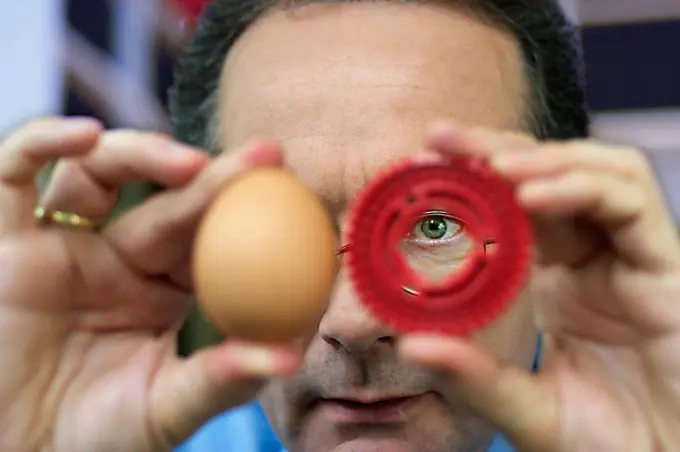
Nature and technology biological engineering Man holding egg nest to cog wheel
6145-45190613
New Horizons co-investigator Kelsi Singer of the Southwest Research Institute (SwRI), Boulder, CO, and New Horizons science team affiliate Kirby Runyon of John Hopkins discuss the various instruments on the New Horizons spacecraft, Monday, Dec. 31, 2018 at Johns Hopkins University Applied Physics Laboratory (APL) in Laurel, Maryland.
6145-45187311
Jet Propulsion Laboratory Chief Engineer Rob Manning is seen in a video shown during a Mars InSight social media briefing, Sunday, Nov. 25, 2018 at NASA's Jet Propulsion Laboratory in Pasadena, California.  InSight, short for Interior Exploration using Seismic Investigations, Geodesy and Heat Transport, is a Mars lander designed to study the "inner space" of Mars: its crust, mantle, and core. InSight is scheduled to touch down on the Red Planet at approximately noon PST (3 p.m. EST) on Nov. 26.
1848-V61826371
6145-44714696
S69-25198 (25 Feb. 1969) --- Astronaut Neil A. Armstrong, commander of the Apollo 11 prime crew, studies rock sample during a geological field trip to the Quitman Mountains area near the Fort Quitman ruins in far west Texas.
6145-58971411
jsc2023e065198 (10/19/2023) --- iForward Public Online Charter School student researchers work on their experiment on Germination of Pleurotus ostreatus Spores, which will be included in the Nanoracks-National Center for Earth and Space Science Education-Orbiter-Student Spaceflight Experiments Program Mission 17 to ISS (Nanoracks-NCESSE-Orbiter-SSEP).
6145-44703060
Dr. Stephen Hawking, a professor of mathematics at the University of Cambridge, delivers a speech entitled "Why we should go into space" during a lecture that is part of a series honoring NASA's 50th Anniversary, Monday, April 21, 2008, at George Washington University's Morton Auditorium in Washington.
PREVIOUS
of 2
NEXT
2401 S. Ervay, Suite 206
Dallas, Texas 75215
United States
Get Started
Free ResearchMy BoardsMy Cart
For Creators
How To License Your ContentContributor PortalFrame of Mind
Resources
API accessPricing
Contact
+1 866 236 0087help@viewpictures.co.uk Contact form
©2026 View Pictures. All Rights Reserved. -A
This site is protected by reCAPTCHA and Google Privacy Policy and Terms of Service apply.