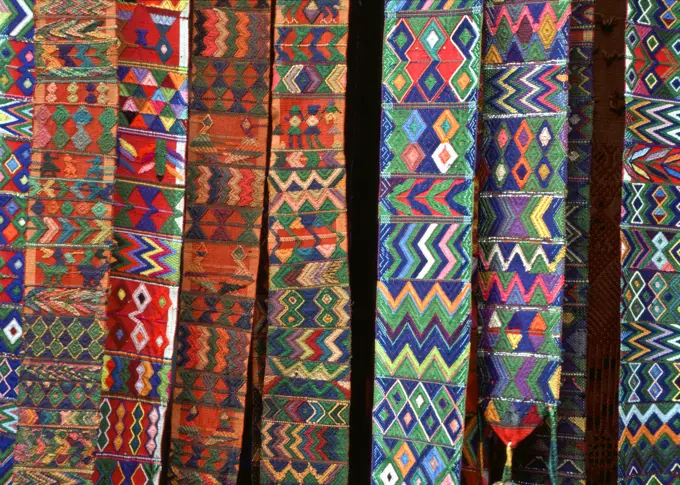
Textile Designs and Patterns

Richly embroidered textiles and intricate fabric patterns, representing 19th and 20th-century craftsmanship from various cultures.
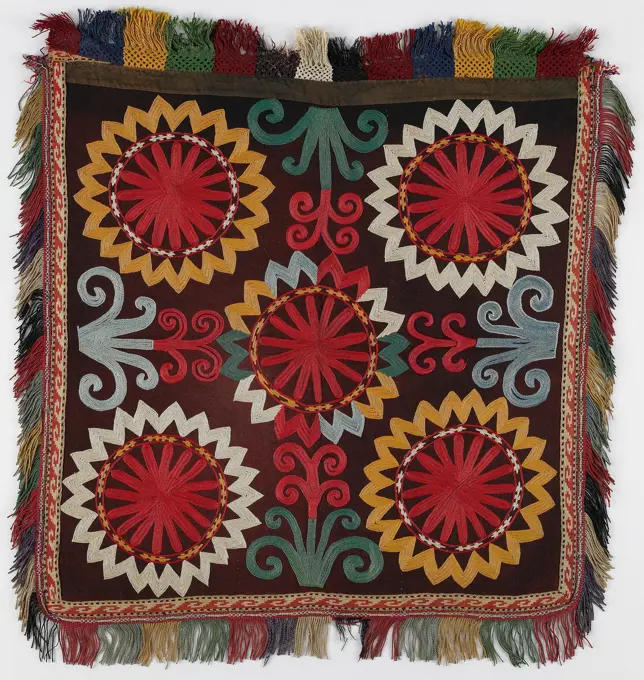
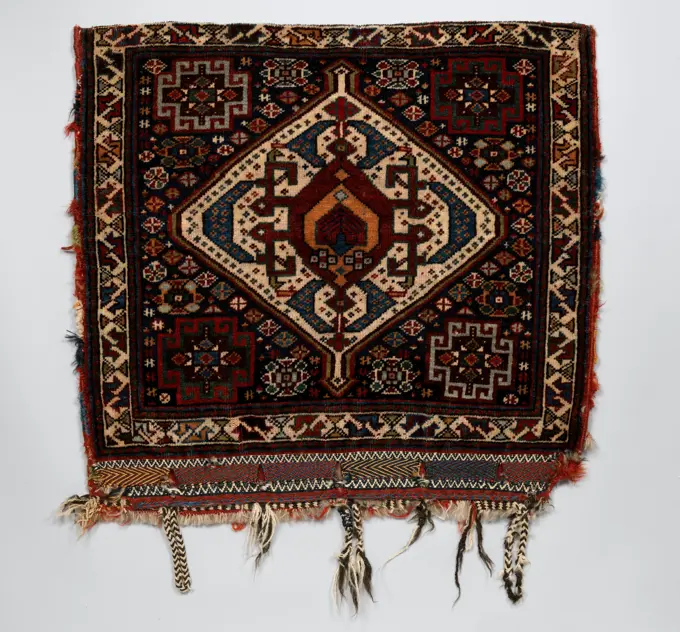
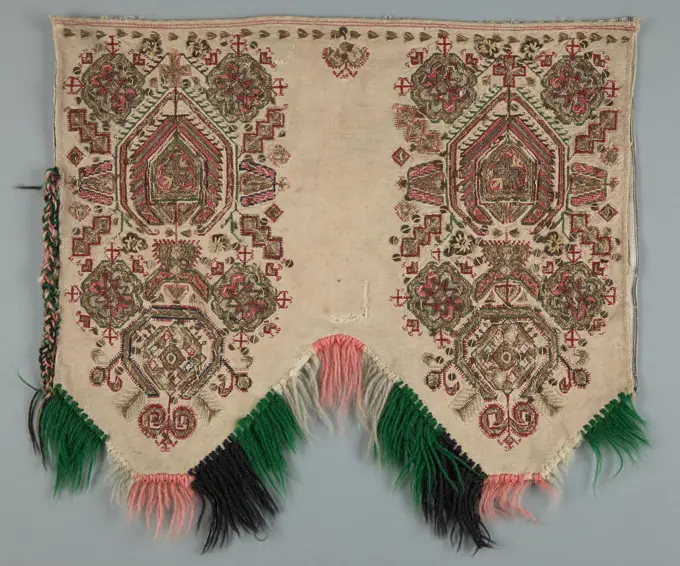
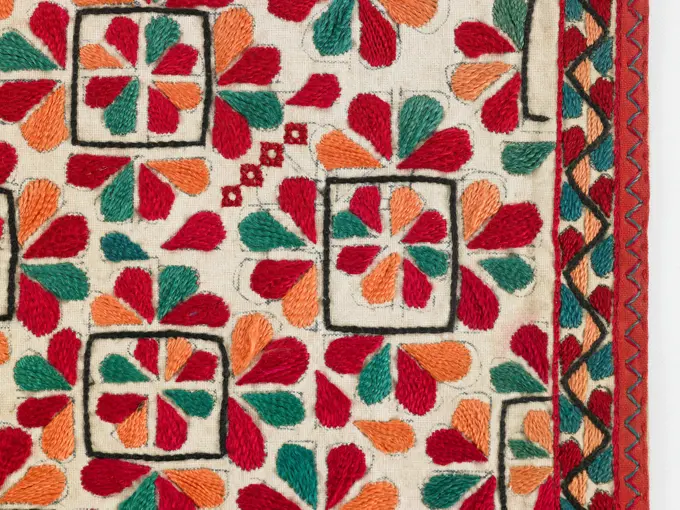
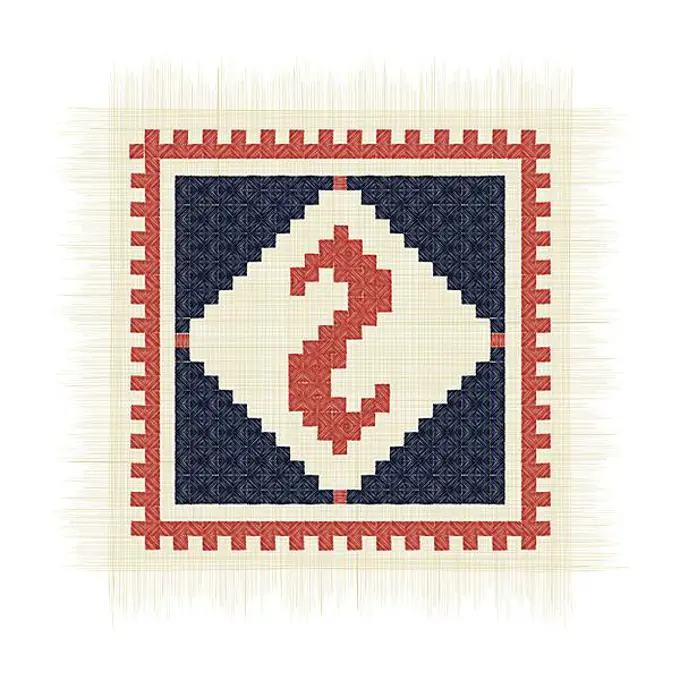
Ilgich, 19th century, 14 x 13 1/4 in. (35.56 x 33.66 cm) (without fringe), Wool, silk, cotton; embroidery, 19th century
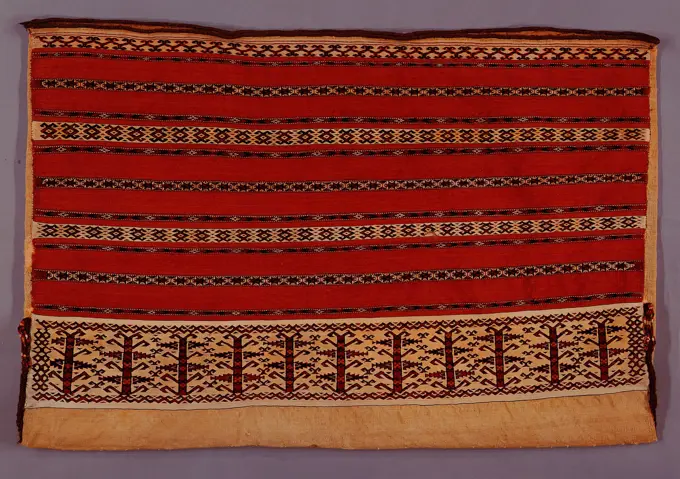
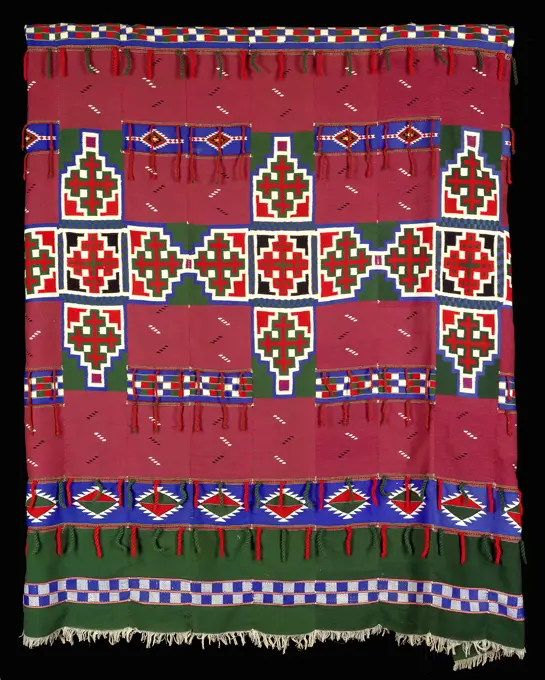
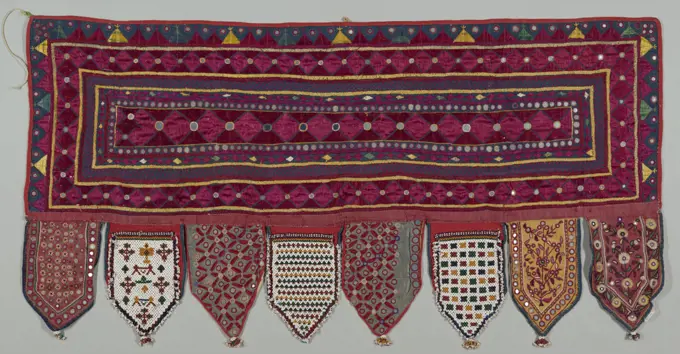
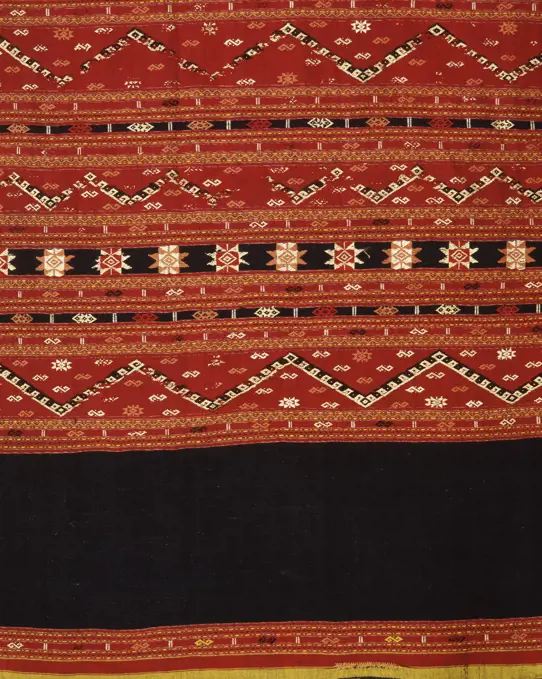
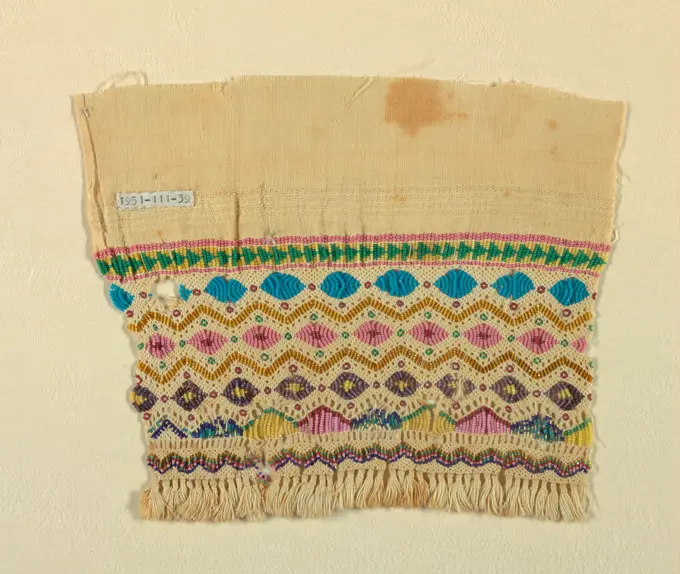
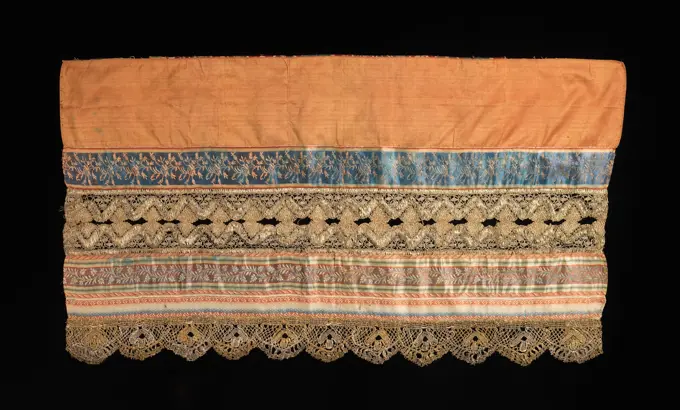
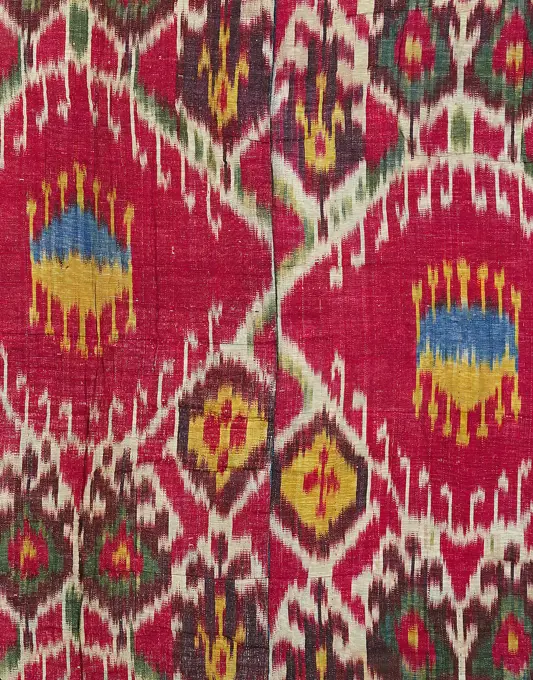
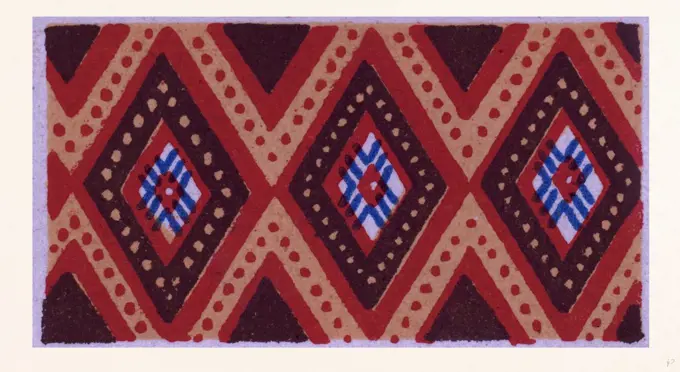
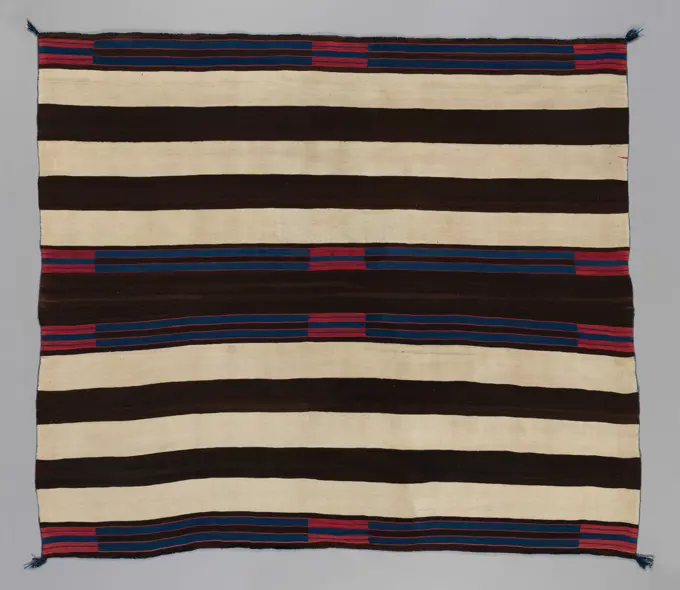
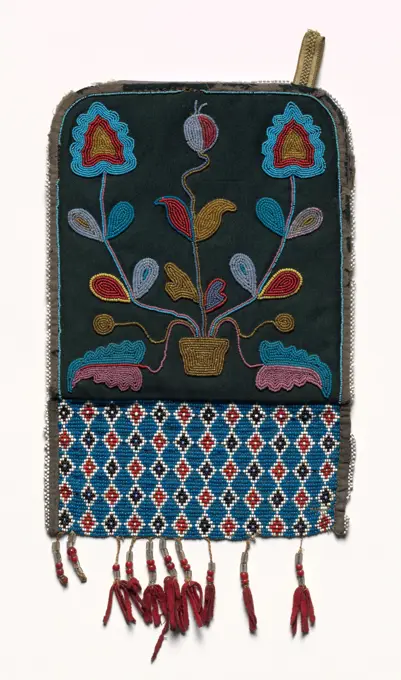
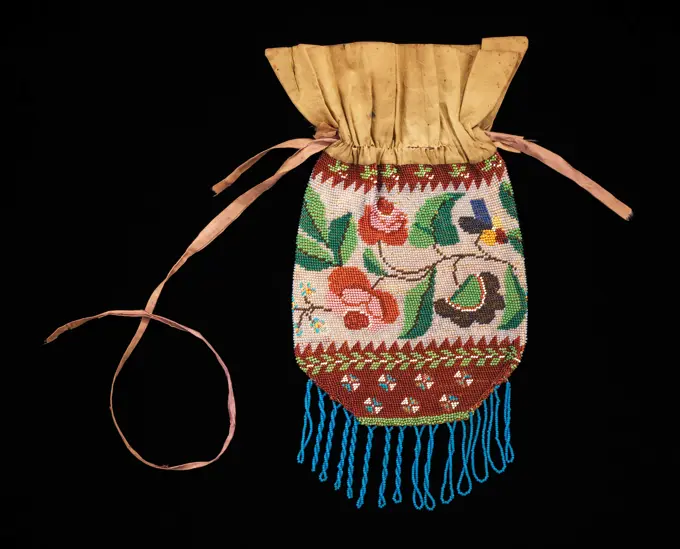
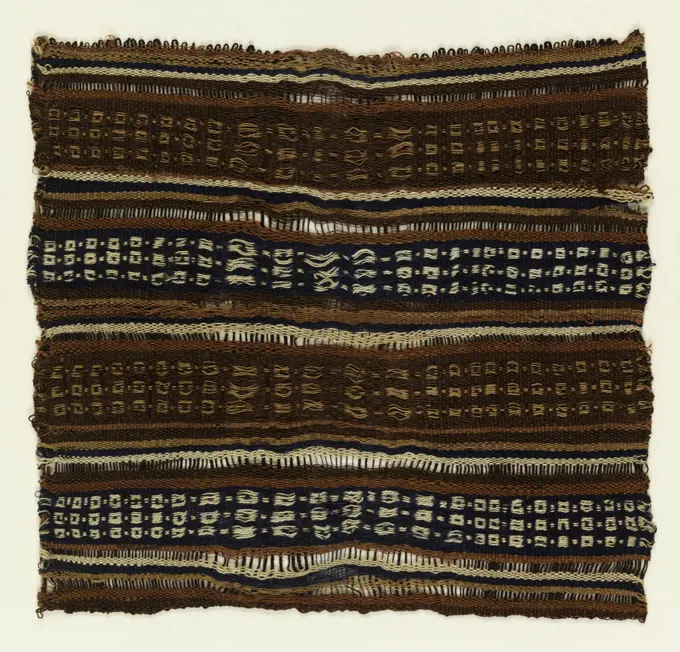
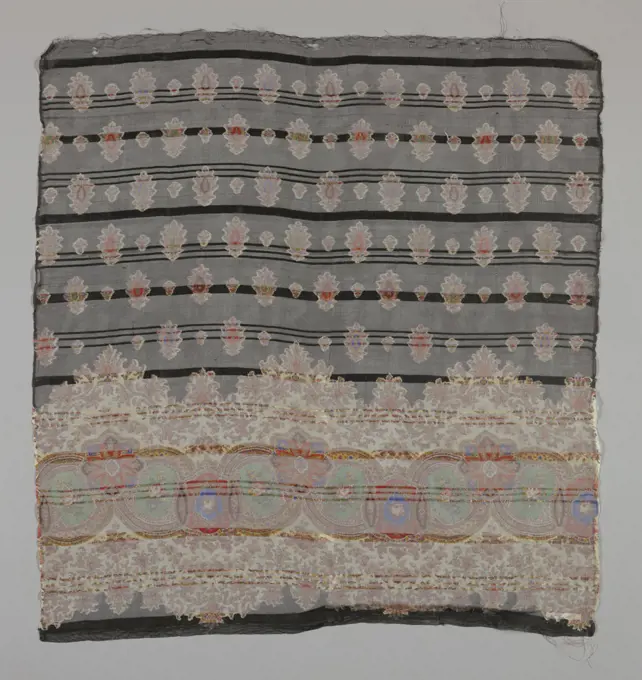
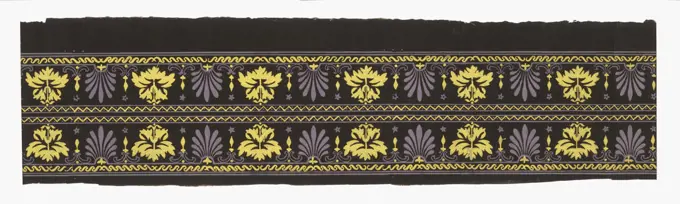
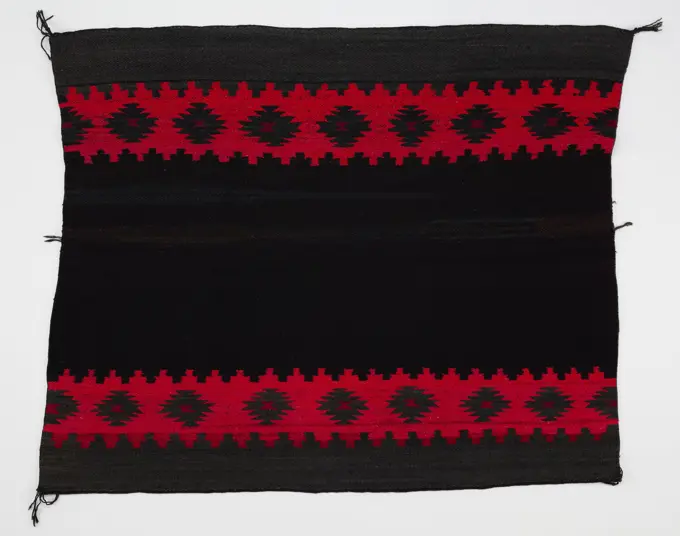
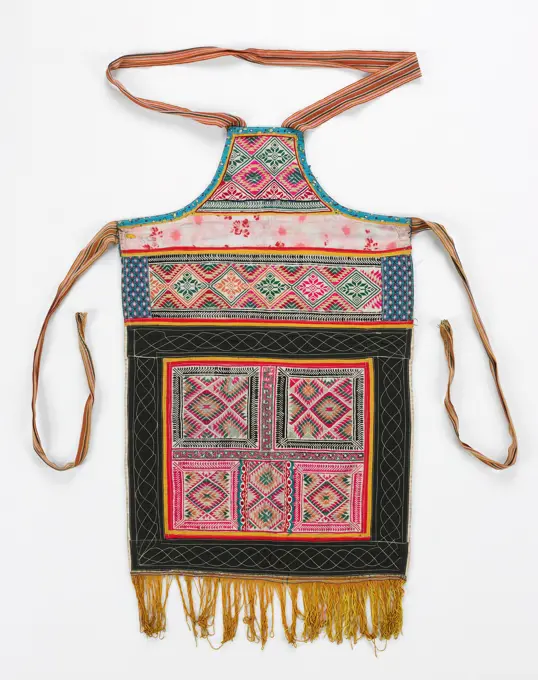
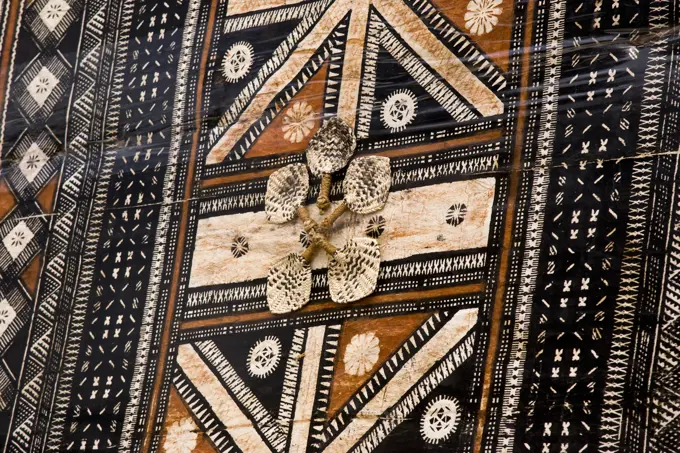
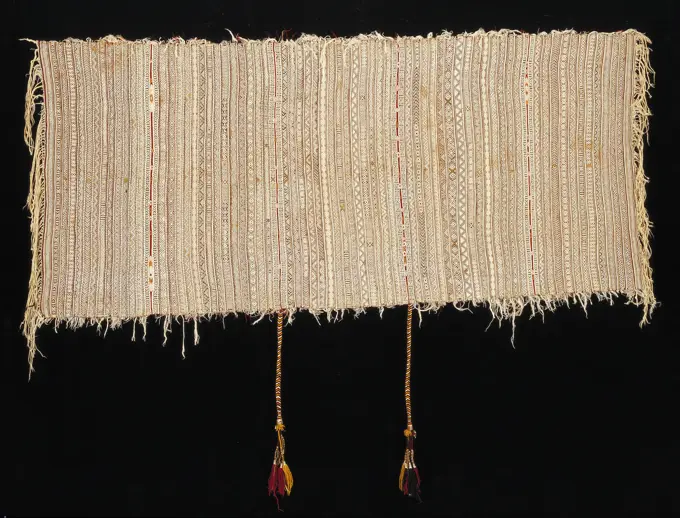
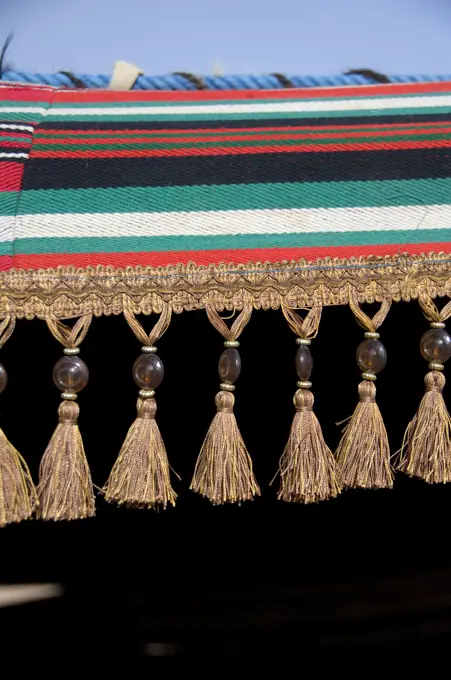
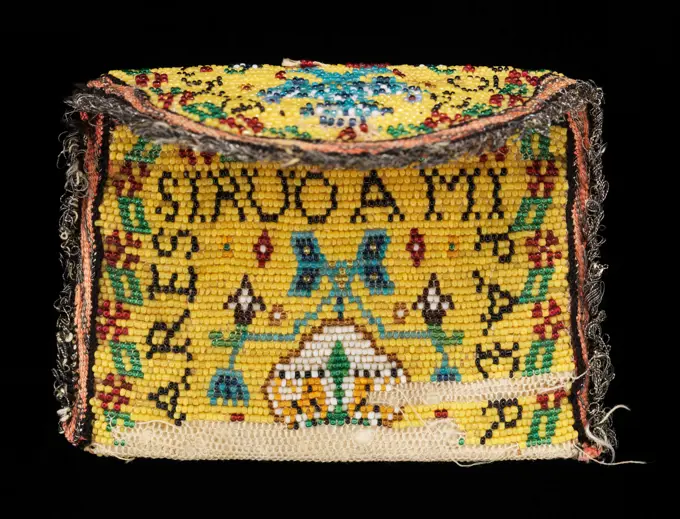
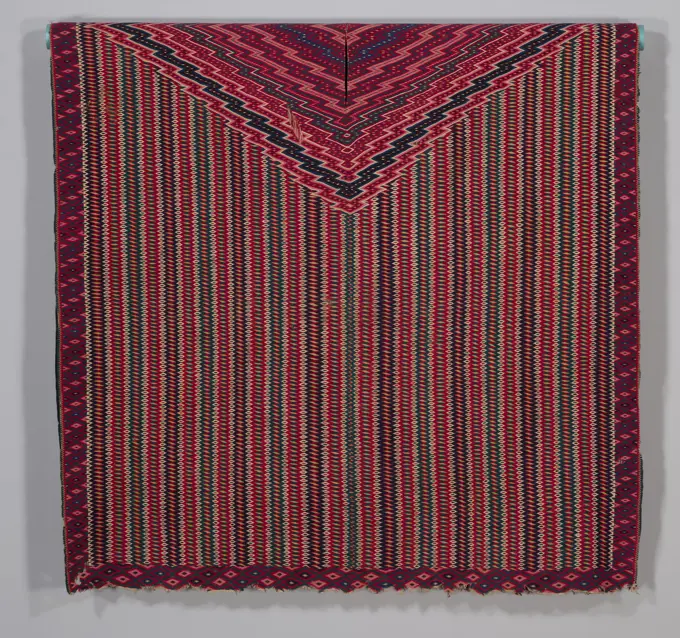
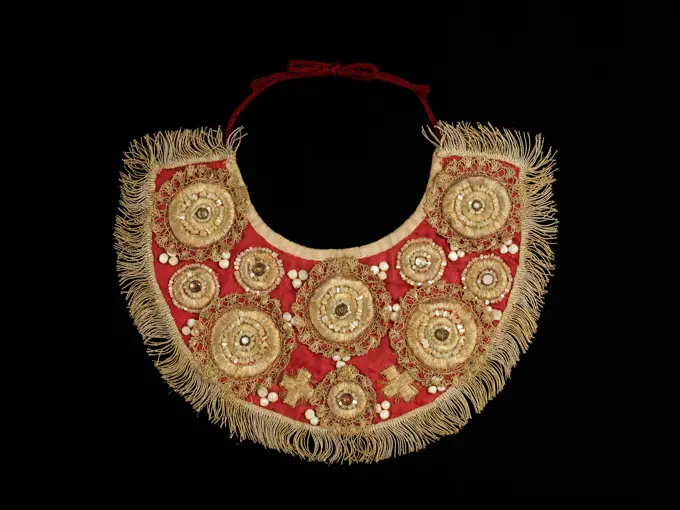
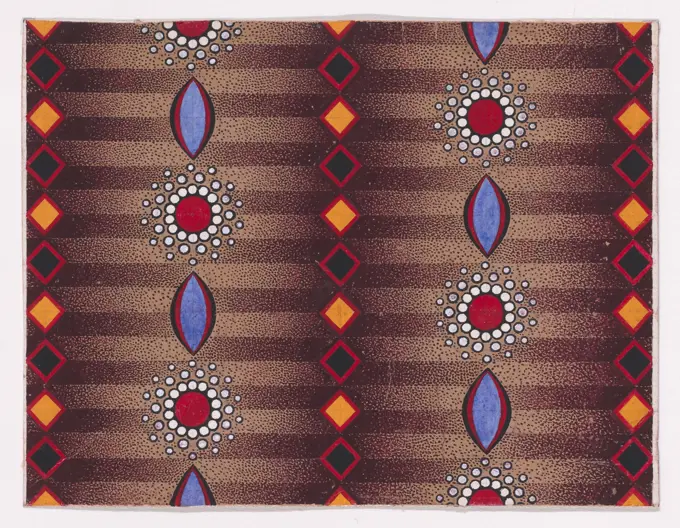
Ilgich, 19th century, 14 x 13 1/4 in. (35.56 x 33.66 cm) (without fringe), Wool, silk, cotton; embroidery, 19th centuryTextile Design with Vertical Strips of Alternating Lens-Shapes and Circles Framed by Pearls Separated by Vertical Strips of Lozenges over a Striped Background 1840 Anonymous, Alsatian, 19th century Rectangular sheet of paper with a textile design from a group, dated 1840, made in Mulhouse, Alsace, which was an important nineteenth-century center for textile production in the Haut-Rhin region of France. The design is made up of vertical strips of alternating lens-shapes and circles framed by pearls, separated by vertical strips of lozenges over a striped background of light tan color and dark reddish-brown stipples. The lens-shapes are colored with purple and have red and black outlines; the circles are colored with red and the pearls around them are colored with white. The lozenges are all outlined with red color, and are colored alternatingly with yellow and black.. Textile Design with Vertical Strips of Alternating Lens-Shapes and Circles Framed by Pearls Separated by Vertical StripsFragment of a Storage Bag first half 19th century. Fragment of a Storage Bag 447502Room divider, 20th century, Beniki Master, African, Democratic Republic of Congo, Songye, , 169 x 97 1/2 in. (429.26 x 247.65 cm), Cotton; weft patterning, Democratic Republic of Congo, 20th centuryHanging, Medium: silk, cotton, mirrored glass, glass beads Technique: surface, ladder, buttonhole and chain stitch embroidery on plain weave Label: surface, ladder, buttonhole and chain stitch silk embroidery on cotton ground with mirrored glass, glass beads, Hanging in the shape of a horizontal rectangle with eight tabs at the bottom. The rectangle is of blue cotton plain weave with embroidery in red and yellow silk in borders ornamented with discs of mirrored glass. Five tabs are of this type of embroidery and three are beadwork., India, 19th century, embroidery & stitching, HangingSleeve cloth; Sarung. Sleeve cloth with geometric motifs.Chief Blanket (Third Phase) 1870-1890 New Mexico. Wool, plain weave with lazy lines and dovetail tapestry weave; warp and weft twining; corner tassles . Navajo (Diné)Poncho, 19th-20th century, 57 1/2 x 53 1/2 in. (146.1 x 135.9 cm), Wool; ikat (jaspe), Chile, 19th-20th centuryTextile,ThailandFragment Made 900 CE-1470 Peru. Cotton and wool (camelid), slit tapestry with eccentric and wrapped outlining wefts . ChancayTowel End (Mexico); cotton, glass beadsTowel border early 19th century Russian This object is from the collection of Natalia de Shabelsky (1841-1905), a Russian noblewoman compelled to preserve what she perceived as the vanishing folk art traditions of her native country. Traveling extensively throughout Great Russia, she collected many fine examples of textile art of the wealthy peasant class. From the 1870s until moving to France in 1902, Shabelsky amassed a large collection of intricately embroidered hand-woven household textiles and opulent festival garments with rich decoration and elaborate motifs. The Brooklyn Museum holdings include many fine examples including the majority of the garments. Portions of Shabelsky's collection are also housed at the Museum of Fine Arts, Boston, the Cleveland Art Museum, and the Russian Museum of Ethnography in St. Petersburg.Russian bed curtains and towels were not only used for decorative purposes, but also provided an important role in ceremony. Bed curtains often adorned sleighs foComforter cover, 19th century, 49 9/16 x 35 13/16 in. (125.89 x 90.96 cm), Cotton, China, 19th centuryPanel, 19th century, 90 3/4 x 55 1/2 in. (230.51 x 140.97 cm), Silk, cotton; ikat, Uzbekistan, 19th centuryIndian ornamentPoncho (ceremonial, chieftain's), 19th century, 81 1/2 x 69 in. (207 x 175.3 cm) (opened flat, including fringe), Alpaca, Bolivia, 19th centuryFragment, Medium: cotton, wool Technique: slit tapestry with use of non-horizontal weft, Small fragment with highly stylized llamas. Half of fragment has tan background and animals in red and blue, other half has red background, animals in tan and dark blue., Peru, 1100, woven textiles, Fragmentjudaica symbolsPortion of camel's bag, early 19th century, 29 1/4 x 47 3/4in. (74.3 x 121.3cm), Wool, cotton; tapestry weave, pile, ikat (), Kazakhstan, 19th centuryGREECE, CRETE, Lasithi Province, Kritsa: Souvenir FabricsChief's blanket 1855-60 Unidentified The six Navajo weavings from the Ernst Collection represent a range of traditional Indigenous designs, adding depth and range to The Mets holdings of Native North American textiles.Weaving is an ancient form of visual expression, and the Indigenous peoples of the Southwest have been producing complex textiles for centuries. Navajo weavings were widely traded—for their aesthetic quality and use value—among neighboring groups, particularly in the Plains region. By the mid-nineteenth century, non-Natives were seeking out blankets and serapes as works of art and souvenirs. They were called "chiefs blankets" by both Native and Euro-Americans due to their high cost and importance. The term "second phase" is used by cultural historians and collectors to refer to weavings with red rectangles made between 1850 and 1880. "Third-phase" blankets are characterized by artful compositions of diamonds or cross formations, and date to between 1860 and 1880.This dyStrip -CarpetKontusz sash. Manufaktura Skarbu Radziwiłłowskiego (Słuck; wytwórnia pasów; 1790-1846), manufacture, Manufaktura Karola Stanisława Radziwiłła (Słuck ; wytwórnia pasów ; ca 1767-1790), manufacture, Madżarski Leon (ca 1740-1811), manufacturerBag, 1850-1900. Plains or Northeastern Woodlands, Nehiyawak (Cree) or Metis People. Beadwork on cloth; overall: 30.5 x 20.4 cm (12 x 8 1/16 in.). This colorful bag is beaded on both sides. On one side, the flowers resemble the sun, which native peoples of the Woodlands regard as the supreme spirit; the visual parallel is probably intentional. On the other side, a different plant symmetrically spreads its leaves and flowers across a dark, contrasting ground.Pouch 1830-60 American Although in fragile condition, this bag has retained its original silk top and drawstring. The beadwork pattern is color blocked rather than shaded, as are similar bags, which gives it a folkloric character.Margaret S. Bedell (1861-1932) donated, by gift or bequest, over 500 objects to the Brooklyn Museum, including furniture, quilts, samplers, costume and Native American beadwork. Her collection of American and European beaded bags includes examples from Philadelphia and the Catskill Mountain region of New York State, as well as Italy, Austria, Germany, and Holland.. Pouch 156437Hand cloth (servietta), 20th century, 27 1/4 x 19 1/2 in. (69.2 x 49.5 cm), Cotton; discontinuous supplementary weft patterning, Guatemala, 20th centuryPurse 19th century European. Purse 87671Cloth. Three-door cloth with geometric motifs, bridal gift.Knife Sheath, 19th century, 12 1/2 x 3 in. (31.75 x 7.62 cm) (excluding beaded attachments), Cotton, leather, beads, United States, 19th centuryFragment, Medium: cotton, wool Technique: warp-faced plain weave patterned by warp floats and stripes, Horizontal bands wide and narrow. Wide bands are warp-patterned in a light color on either blue or brown background. Other colors are tan and dark red. Fragment probably from a bag., Peru, 1000-1450, woven textiles, FragmentTextile, Medium: silk Technique: gauze weave with narrow bands of printed plain weave, Fragments from a pieced skirt of black gauze striped in black with areas of denser weave printed in an allover design of small stylized floral motifs and at the bottom, a wide border of small flowers and a row of large roundels enclosing roses and more. Fine, high quality printing with many bright colors., France, 1850-1900, printed, dyed & painted textiles, TextileCushion Cover. United States. Date: 1801-1825. Dimensions: 98.2 x 96.5 cm (38 5/8 x 38 in.)Repeat: 3.7 x 11.6 cm (1 1/2 x 4 1/2 in.). Wool, cotton, and jute, stripes of four-color complementary weft warp-faced twill weave self-patterned by weft-float faced twill weave. Origin: United States. Museum: The Chicago Art Institute, Chicago, USA.Rugs and Carpets: Russia - Turkestan - 19th century. Prayer carpet, coming from Ersari tribeFabric piece, 20th century, 44 x 32 in. (111.8 x 81.3 cm), Cotton, Guatemala, 20th centuryWoman's Ceremonial Skirt (Sora Langi') probably 18th century Toraja people. Woman's Ceremonial Skirt (Sora Langi') 318098Old hand made carpet and rugs of  traditional typesNavajo Rugs    Coca bag, Medium: wool Technique: warp-faced plain weave, Small flat bag woven in stripes of red, black, and brown. Hand stitched at sides with red wool to form bag. warp selvage for bag opening, Peru, possibly 1200-1500, woven textiles, Coca bag. Square palm line of printed wool with a white fond and colorful spreading dot. In the middle a round medallion in wine red, lilac, dark moss and goudoo. In the corners, quarter-medallions and a narrow edge. The scattered botas on the field are upright and in staggered rows. Liberty intermediate motifs are smaller than the Bota's. The medallion and corners are symmetrical, even on eight rays. In the middle a eight-pointed star in the White Fond. Sound concentric, circle formed by wine-red carnations, first of sixteen pieces, and the outer of forty pieces. Busy intermediate filling of smaller, lilac flowers with yellow flower leaves here and there. The circular contours are finely plated in wine red and dark moss-green, with from outstanding yellow points. In the cross and side edges, an ongoing pattern of wavy green tendrils, to which turns a fine impeller-shaped flower and a pear-shaped growth. The corners are random, the printing is in miter. The technique consists of a wool necklacCoverlet Detail. Dated: c. 1936. Dimensions: overall: 35.4 x 27.9 cm (13 15/16 x 11 in.) Original IAD Object: 7 3/4" high; 8 1/4" wide. Medium: watercolor, gouache, and graphite on paper. Museum: National Gallery of Art, Washington DC. Author: Ruth M. Barnes.Andujar, Jaen Province, Andalusia, Spain. Traditional colorful decorations on horses at a Spanish festival.Rug, c. 1920, 123 1/2 x 86 3/4in. (313.7 x 220.3cm), Wool, Iran, 20th centuryBorder, Block-printed on handmade paper, Wide central band of anthemia or palmette motif, alternating with a stylized floral motif. Band of chevron or herringbone along top edge. Band of wave scroll along bottom edge. Printed in lavender and yellow on black ground., France, 1800-1825, Wallcoverings, BorderRomania. Traditional textile, woven designs on cloth.Armband -Trimming, Medium: silk Technique: cut supplementary warp pile (velvet), Trimming fragment in a design of flowers sprays and scrolling leaves in red cut velvet on a yellow checkerboard ground., France, early 19th century, trimmings, TrimmingEmbroidery Sample, 100 x 8 in. (254 x 20.32 cm), Cotton; needlework, ChinaColorful woven fabrics, Chaullacocha vilage, Andes Mountains, Peru, South AmericaBourse. Gal1955.32.9Apron, 20th century, 29 x 29in. (73.7 x 73.7cm), Cotton, China, 20th centuryCeremonialBag.  Artist: UnknownHalf of Double Saddle Bag (Khorjin) last quarter 19th century. Half of Double Saddle Bag (Khorjin). last quarter 19th century. Wool (pile, warp, and weft); asymmetrically knotted pile, tapestry weave, brocaded with wool and cotton. From Iran, Fars. Textiles-Woven-BrocadeMantle, c. 1900, 48 1/4 × 38 1/4 in. (122.56 × 97.16 cm), Cotton, pigments, United States, 20th centuryKontusz sash/belt. unknown, authorUnder Apron, 29 x 16 5/8 in. (73.66 x 42.23 cm) (including fringe), Cotton, ChinaSkirt, from a two-piece set, 29 x 26 5/8 in. (73.66 x 67.63 cm), Cotton, seeds, feathers, beads, metal ring, ChinaBand Fragment 5th-6th century. Band Fragment 445807Rug;  1890-1939 (1890-00-00-1939-00-00);Podole (Ukraine), Wołyń (Ukraine), plant ornaments, Poland (culture), decorative fabrics, equipment and home equipmentQuiver -Textile, laceAt torba ilgich, 19th century, 26 x 25 in. (66.04 x 63.5 cm), Silk, wool, cotton; needle chain stitch, Uzbekistan, 19th centuryPolynesia, Kingdom of Tonga. Detail of tapa cloth made of bark.Kilim pattern 13Cape (Tabrdouhte), 19th century, 38 3/4 x 85 1/2 in. (98.4 x 217.2 cm) (without fringe and tassels), Cotton, linen, silk, wool; supplementary weft patterning, Morocco, 19th century, This elaborately patterned cape is a superb example of refined weaving from a people who are known for their textile skills. The individual design components and basic striping arrangement are part of a shared ethnic aesthetic but the specific arrangement is dependent on the artistic sensitivity of the weaver. Even today, many women weave their own fabrics, but it is possible that this piece was commissioned by a wealthy family for the use of silk and the time involved to do such complex weaving would have made it very costly. It would have been worn only on very special occasions and treated as an important family heirloom.Central America, Guatemala, Western Highlands, Lake Atitlan, San Antonio Palopo. Small lake side town famous for its very fine textiles. Colorful textiles.Rooster Hat, 20th century, 8 1/4 x 12 1/4 in. (20.96 x 31.12 cm), Cotton; appliqué and embroidery, Laos, 20th centuryJordan, Wadi Rum. Traditional Bedouin tent cover with beaded tassels.Conciliate belt;  18th century (1701-00-00-1800-00-00);Purse (USA); wool embroidery on linen foundationWeaving mini machine for making belts with patterns. Folk art, handmade. Detail. Weaving mini machine for making belts with patterns. Folk art, handmade. Detail Copyright: xZoonar.com/OvchinnikovaxOlgax 11600344Bag, 1900s. Africa, West Africa, Nigeria, Yorùbá peoples. Leather, glass beads, and natural fiber; overall: 29.3 x 27.2 cm (11 9/16 x 10 11/16 in.).Bag (India); silk on linen, mirrored glassCoin purse 1790-1810 Mexican The stylized double-headed eagle seen here is a conventionalized image; other images appear to be free-form creations of the maker. The text on the border roughly translates as: "I serve my little father the senor? Dn Jose Cone?ares," a humorous self-reference to the coin purse and its owner. The purse is part of the Mexican beadwork collection of over 600 pieces assembled by Elizabeth Morrow (1873-1955), mother of writer Anne Morrow Lindbergh, the wife of renowned aviator Charles Lindbergh. Morrow collected the objects between 1927 and 1930, when her husband, Dwight Morrow, Sr., served as U.S. ambassador to Mexico. She lent the collection to the Brooklyn Museum in 1938 and upon her death, her children donated it. A collection of 155 pieces of Mexican ceramics and other decorative arts were given to Amherst College, her husband's alma mater. Mrs. Morrow collected Mexican beadwork, along with other examples of colonial and native arts, to decorate their Embroidered pennant decorated with eastern embroidery unknownEmbroidery Sample, 18 1/8 x 18 in. (46.04 x 45.72 cm), Cotton (); needlework, ChinaDetail of beadwork. Near Melmoth. KwaZulu-Natal, South Africa.Egyptian OrnamentItaly, Sicily, Erice. Traditional carpets form the region.Saudi Arabia, Abha, Tuesday Market, Close-Up Of BasketTurkish Rugs on display, Cappadoccia TurkeyPair of Leggings, from a three-piece costume, 2000 - 2004, 12 1/4 x 15 11/16 in. (31.12 x 39.85 cm) (unfolded, each), Beads, cotton, animal hide, United States, 21st centurySaltillo Sarape, c. 1820-50. Mexico, Coahuila state, Saltillo Region. Wool, cotton; tapestry weave; overall: 258 x 130.8 cm (101 9/16 x 51 1/2 in.). The sarape (wearing blanket) is a classic Mexican mens garment that became a symbol of national identity and pride after Mexico achieved independence from Spain in 1821. Examples woven between about 1750 and 1875 in Saltillo, a town in northern Mexico, are the sarapes most famous representatives, prized for their design, color, and technical refinement.ARGENTINA, IGUASSU, SOUVENIR SHOP, COLORFUL TABLECLOTHRomanian vector pattern inspired from traditional embroideryCoin purse 1830-60 American. Coin purse 156617close up burnt blank page with party eye mask locker doorFragment (Peru); cotton, woolEmbroidery samples unknown, a professional school in KrakowCoin purse 1800-1820 Mexican The iconography on this coin purse alludes to Christianity and marriage, which suggests that it may have been part of a marriage or betrothal ritual. It is part of the Mexican beadwork collection of over 600 pieces assembled by Elizabeth Morrow (1873-1955), mother of writer Anne Morrow Lindbergh, the wife of renowned aviator Charles Lindbergh. Morrow collected the objects between 1927 and 1930, when her husband, Dwight Morrow, Sr., served as U.S. ambassador to Mexico. She lent the collection to the Brooklyn Museum in 1938 and upon her death, her children donated it. A collection of 155 pieces of Mexican ceramics and other decorative arts were given to Amherst College, her husband's alma mater. Mrs. Morrow collected Mexican beadwork, along with other examples of colonial and native arts, to decorate their country home in Cuernavaca in order to promote a more peaceful image of that country through its works. The Morrows sought to overturn the perception of poSanta Fe, New Mexico, United States. Shiprock Rug Trading, various Native American rugs.Southwest, American Indian art & handicrafts. Classic Navajo bead work necklaces.Moon of Ramallah Palestinian embroidery Tatreez symbol drawing over white backgroundMirror 19th century China. Mirror 69701Selection of Ottoman Turkish traditional tassels in various colorsCollar 1830-80 Russian This object is from the collection of Natalia de Shabelsky (1841-1905), a Russian noblewoman compelled to preserve what she perceived as the vanishing folk art traditions of her native country. Traveling extensively throughout Great Russia, she collected many fine examples of textile art of the wealthy peasant class. From the 1870s until moving to France in 1902, Shabelsky amassed a large collection of intricately embroidered hand-woven household textiles and opulent festival garments with rich decoration and elaborate motifs. The Brooklyn Museum holdings include many fine examples including the majority of the garments. Portions of Shabelsky's collection are also housed at the Museum of Fine Arts, Boston, the Cleveland Art Museum, and the Russian Museum of Ethnography in St. Petersburg.Russian women accessorized their festival ensembles with collars such as this along with cuffs, belts, and jewelry. The use of mother-of pearl and pearl in the embroidery suggestsTop view looking into a decorative basket in fall colors over white background.Rank Badge (China); silk, gilded paper-wrapped silk thread; Warp x Weft (B): 33 x 31.1 cm (13 in. x 12 1/4 in.)Guatemala, Chichicastenago, Mayan textiles at the Public MarketPincushion, 20th century, 11 9/16 x 10 11/16 x 3 1/2 in. (29.37 x 27.15 x 8.89 cm) (without dangles), Beads, cotton, velvet, paper, United States, 20th century