Textile Embellishments

Diverse collection of decorative textile pieces, including lace trims and ribbons, showcasing unique patterns and historical craftsmanship.

Cap crown and border, Medium: linen, straw Technique: satin and running stitches on net, Round cap crown and ties in black net embroidered with straw. Crown never mounted., France, 19th century, embroidery & stitching, Cap crown and border
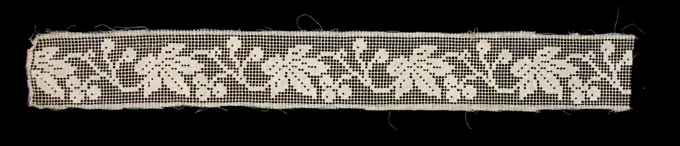
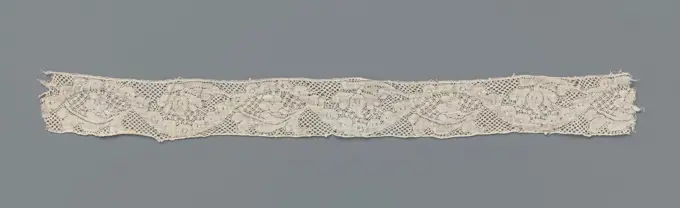
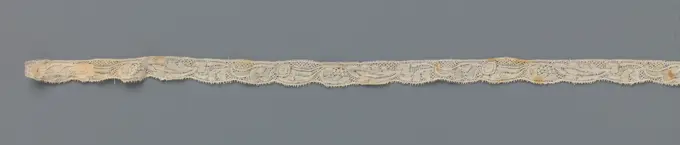
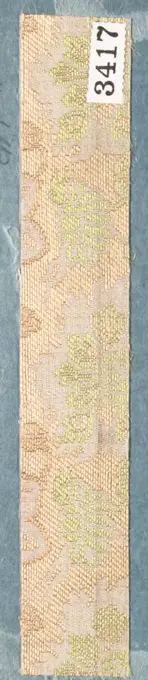
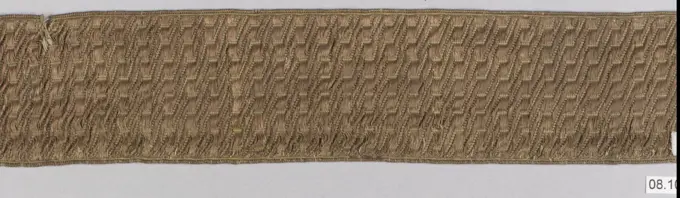
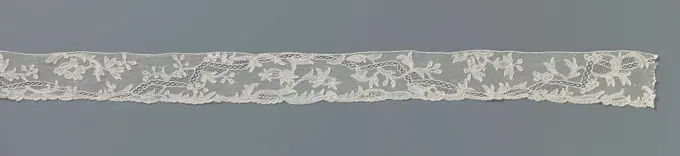
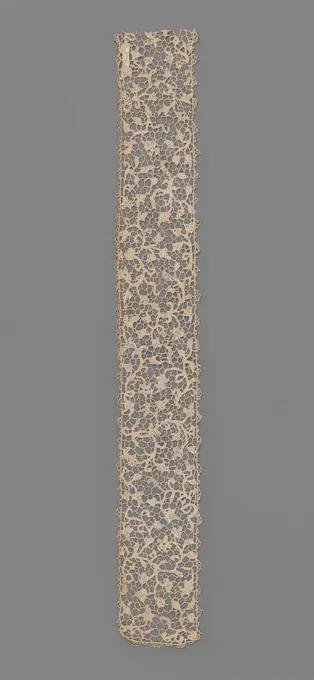
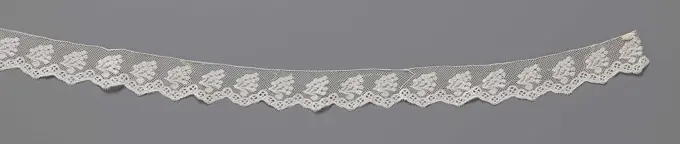
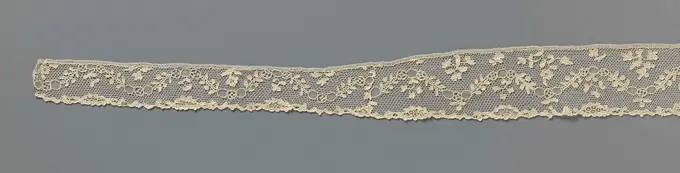
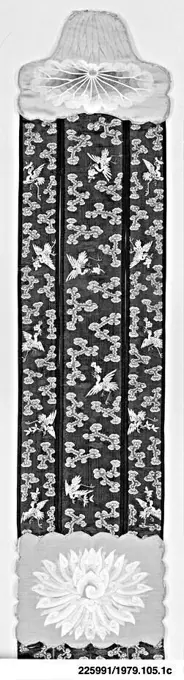
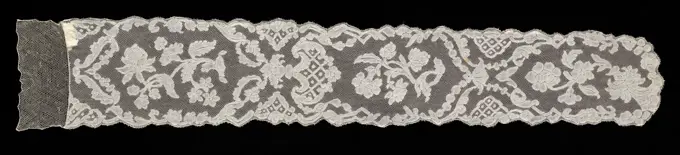
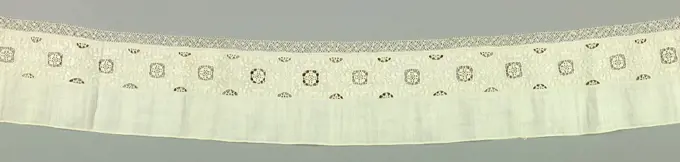
Wampum belt -Lace lace, embroideryBobbin Lace (Punto di Milano) Flounce, 18th century. Italy, Milan, 18th century. Lace, bobbin; average: 22.3 x 170.7 cm (8 3/4 x 67 3/16 in.).Border, Block-printed, Undulating length of lavender moire ribbon with parallel white stripes of two widths. Bows or gathers, bound transversely by twisted cords, occur at intervals. White portions are shaded with gray. Printed on white ground., France, 1845, Wallcoverings, BorderStrip of needle side with wavy brower, anonymous, c. 1770 - c. 1785 Strip of natural needle side: argent tank edge. Pattern with a wavy brower just along the bottom edge and above it a scattering motif with six different flower branches. Ground with hexagonal meshes that are closed with buttonholes. Browse rank with branches bending up and down with leaves. Under the rank a finer Maas soil, an alençon ground. Faintly scalloped picotrand on the bottom due to a change of leaves, whether or not from the browse rank, and small open ovals with Raderpicot in the center. The top is finished with a straight edge. Argentan linen (material) Argentan Lace Strip of natural needle side: argent tank edge. Pattern with a wavy brower just along the bottom edge and above it a scattering motif with six different flower branches. Ground with hexagonal meshes that are closed with buttonholes. Browse rank with branches bending up and down with leaves. Under the rank a finer Maas soil, an alençon ground. FaStrip late 17th century Flemish. Strip. Flemish. late 17th century. Bobbin lace. Textiles-LacesKloskant intermediate mate with zigzag line, anonymous, c. 1875 - c. 1949 Piles of Natural -colored bobbin side: Mechelse side. In the middle of the fine grid, a Mechelen soil (also known as ice soil), an openwork band runs in Zigzaglijn, cut over by two types of rosettes. Belgium linen (material) bobbin lace / Mechlin (lace) Piles of Natural -colored bobbin side: Mechelse side. In the middle of the fine grid, a Mechelen soil (also known as ice soil), an openwork band runs in Zigzaglijn, cut over by two types of rosettes. Belgium linen (material) bobbin lace / Mechlin (lace)Border, Medium: Technique: bobbin lace (late Valenciennes ground), Design of separate leaf motifs with dots above a border of flower motifs arranged to form scallops., 19th century, lace, BorderTussenzetsel van kloskant met een golflijn van rozetbloemen.Interesting of natural colosside, Flanders side. The repeating pattern consists of a regular wave line of close-linked rosette flowers with a flower stalk under and above each wave. At the flower stalk is around and a rosette flower with a large leaf and a stem with two smaller leaves. And a drip-shaped flower heart between two heart-shaped flower leaves at the end. The motifs are connected by a grille, a five-gag soil. The motifs are made in linen stroke. Around the flowers on the stems is an ornamental ground with balls. Upper and top are finished with a straight edge.Cap crown and border, Medium: linen, straw Technique: satin and running stitches on net, Round cap crown and ties in black net embroidered with straw. Crown never mounted., France, 19th century, embroidery & stitching, Cap crown and borderFragment early 19th century Belgian. Fragment 220625Strip bobbin with arcs between which small feathered leaves, anonymous, c. 1850 - c. 1870 Strip of natural -colored bobbin, Lille side. The repeating and continuous pattern consists of arcs, between which always one one -sided feathered leaf. A continuous line of inverted arches runs along the bottom. Along the top, above the arcs, a fine diamond -shaped Maas soil, the tuler land, has been applied. A decorative land is used under the arcs, a rose ground. The arches and leaves are made with thicker and shiny threads. The top is straight. The shells along the bottom are finished with picots. Lille (possibly) linen (material) bobbin lace / Lille lace Strip of natural -colored bobbin, Lille side. The repeating and continuous pattern consists of arcs, between which always one one -sided feathered leaf. A continuous line of inverted arches runs along the bottom. Along the top, above the arcs, a fine diamond -shaped Maas soil, the tuler land, has been applied. A decorative land is used under Strook knoopwerk met kleine en grote ruiten.Strip natural-colored knotary work made with a needle. Pattern of small and large windows. The strip has peak tenders and at the top and bottom it is trimmed with a double folded edge linen.Trimming (France); silk, metallic threadBand, Medium: linen Technique: bobbin lace, Binche style with no ground, Band of open scrolling pattern., Italy, 17th-18th century, lace, BandBobbin Lace Insertion with Selvage, mid 16th century. Italy, Venice, mid 16th century. Lace, bobbin; average: 1.6 x 29.6 cm (5/8 x 11 5/8 in.).Strip bobbin with concatenation of five different leaves, anonymous, c. 1700 - c. 1799 Strip of natural -colored bobbin, Old Flemish side. The repeating pattern consists of a succession of five different leaves. One leaf is cut by an oval. The motifs are connected by a grid, a five -part ground. The motifs are made in linen battle with openwork edges, two of the leaves have a mains filling. One of the five leaves has been bent back, under which a decorative land has been applied, a snowflake ground. The top is straight. The faintly scalloped underside stems from the pattern and is finished with picots. Flanders linen (material) bobbin lace / old Flemish lace Strip of natural -colored bobbin, Old Flemish side. The repeating pattern consists of a succession of five different leaves. One leaf is cut by an oval. The motifs are connected by a grid, a five -part ground. The motifs are made in linen battle with openwork edges, two of the leaves have a mains filling. One of the five leaves hasTextile 19th century Japan. Textile 68051Bands; wool, cottonGalloon 17th-18th century Unknown. Galloon. Unknown. 17th-18th century. Metal thread. Textiles-TrimmingsBorder, Block-printed on handmade paper, A band of rosettes and addorsed anthemion is bordered on the bottom by a beaded molding and on top by a row of dentils., H# 518, France, 1796-1830, Wallcoverings, BorderBorder 18th century Dutch. Border 222868Halve Meter 'Project Aeneas', Hendrik Aeneas, c. 1800  Length of half a meter with handle, divided into decimeters (not calculated). First decimeter divided into centimeters. Not provided with brass shoes. V.z.v. label. Netherlands wood (plant material)   NetherlandsFringe (Italy); silkMutsenstrook van kloskant met zigzag-rivière.Strip natural colored Brussels climbing side. A river in zigzag line is crossed by spiral raft, enclosing impeller-shaped medallions. The motifs are connected by a draft ground. A coarse hexagonal soil has been applied in the Rivieres. On the fields that are bounded by the Rivier are twigs, to which flowers in the form of pomegranates, pears or winged insects. The strip is probably used or made for a hat.BorderRibbon 18th century probably European. Ribbon 213065Piece 17th century Japan. Piece. Japan. 17th century. Silk / Compound weave. Textiles-WovenBobbin Lace Edging, 18th century. Italy, Milan, 18th century. Lace, bobbin design on mesh ground: linen; average: 6.4 x 155 cm (2 1/2 x 61 in.).Strip 17th century Flemish. Strip 218251Trimming (Italy); silk, metal foil, metallic threadFontange Van Point de France, Anonymous, c. 1680 - C. 1690 Fontange from Point de France, with a pattern of tendrils, palmet motifs and rosettes. On one side and around the round ends, picoted festons have been worked on the other long side picoted leaf motifs. France linen (material). Fontange from Point de France, with a pattern of tendrils, palmet motifs and rosettes. On one side and around the round ends, picoted festons have been worked on the other long side picoted leaf motifs. France linen (material).Capslip made of flat Venetian side (Point Plat de Venise), Anonymous, c. 1680 - c. 1690 Heat slip of the needle side. The pattern consists of irregular angular branches connected by irregular hexagonal meshes with picots. The hat -slip is trimmed with picots. Venice linen (material). flat Venetian (needle point) Heat slip of the needle side. The pattern consists of irregular angular branches connected by irregular hexagonal meshes with picots. The hat -slip is trimmed with picots. Venice linen (material). flat Venetian (needle point)Border, Medium: linen Technique: bobbin lace, Mechlin style, Border of floral and foliated garland interspersed by inversed ribbons at repeated intervals and an unusual ground., Belgium, 18th century, lace, BorderPillow border, 19th century, 2 x 17in. (5.1 x 43.2cm), Embroidered linen, silk, Morocco, 19th centuryInsertion Hungarian-Slovak 19th centuryFancchon of application side with Moesjes Fond, Anonymous, c. 1870 - c. 1899 Natural Application Santon Fancon, Kloskant Applicated on Machine Tulle. Around a Mazenfond littered with mosomes, an edge of arches of C-Voluten lined with a loop, which are decorated with campanes along the outside. Brussels (possibly) linen (material) Natural Application Santon Fancon, Kloskant Applicated on Machine Tulle. Around a Mazenfond littered with mosomes, an edge of arches of C-Voluten lined with a loop, which are decorated with campanes along the outside. Brussels (possibly) linen (material)Needle's Engageante, Anonymous, c. 1760 - c. 1780 In a widened middle is a symmetrical three -part branch, from which a wavy branch with sliding scales originates. From the lace triangles are formed by a wavy ribbon, rosters and a fine and varied grid-Rivière, deep into the ground. Alençon side. France linen (material) Alençon Lace In a widened middle is a symmetrical three -part branch, from which a wavy branch with sliding scales originates. From the lace triangles are formed by a wavy ribbon, rosters and a fine and varied grid-Rivière, deep into the ground. Alençon side. France linen (material) Alençon LaceBorder 18th century Flemish. Border 218569Border (Italy); linenGalloon 17th-18th century Unknown. Galloon 213801Ribbon early 19th century Italian, Venice. Ribbon 221771Band, Technique: bobbin lace, Edge of bobbin lace, leaf scallops; late 18th century Buckinghamshire., late 18th century, lace, BandStrook kloskant met bloemtrosjes.On a meshing soften (square mesh), one-sided directed strips of three flowers are above a zigzag sculpture with connected cogs. Valenciennes side.Mount; L x W x D: 32 x 1.5 cm (12 5/8 x 9/16 in.)Sword knife hilt, anonymous, 1500 - 1900 Top with cloisononné decorations: a light blue background against which a floral decoration with green and purple leaves and red-with-white flowers. Japan iron (metal). Top with cloisononné decorations: a light blue background against which a floral decoration with green and purple leaves and red-with-white flowers. Japan iron (metal).Band, Medium: silk embroidery on linen foundation Technique: embroidered with deflected element work on plain weave, Natural linen band embroidered in red silk with a scrolling vine with a flower blossom enclosed in each scroll. Embroidery fills the ground, with the design reserved in natural linen., Italy, 16th century, embroidery & stitching, BandRibbon Samples (France); silkSheath with a woman on the back, c. 1500 - c. 1600 print The woman holds a passer and a globe (Geometria). The lower part is decorated with leaf vines. Germany (possibly) paper engravingRibbon 18th century French. Ribbon 219872Fringe, Medium: cotton, linen Technique: woven, Brown and white fringe with a plain-woven heading and a thread skirt arranged in stripes., Italy, 17th century, trimmings, FringeGallon;  19th century (1801-00-00-1900-00-00);Trimming (France); 1909-2-202Strip bobbin with cartouches with flower pots, anonymous, c. 1700 Strip natural -colored bobbin: Old Flemish bobbin with braid ground. Pattern with symmetrically composite flower pots with an irregular braid with picots. The soil runs through the motifs in different places. Volwerk in linen stroke with recesses and filling of motifs with decorative land. The top is finished with a straight edge. The underside is finished with a silly outskirts of scales that comes from the pattern. Southern Netherlands linen (material) bobbin lace / Flemish lace with plaited ground Strip natural -colored bobbin: Old Flemish bobbin with braid ground. Pattern with symmetrically composite flower pots with an irregular braid with picots. The soil runs through the motifs in different places. Volwerk in linen stroke with recesses and filling of motifs with decorative land. The top is finished with a straight edge. The underside is finished with a silly outskirts of scales that comes from the pattern. SoutherBorder with Floral Motifs, 19th century. Italy, Sardinia, 19th century. Needle lace, filet/lacis (knotted ground and darned in one direction); bleached linen (est.); overall: 27.9 x 316.2 cm (11 x 124 1/2 in.). A tendril motif is a recurring pattern in needle lace. The frequent use of the motif, adapted in lace from different centuries and regions, suggests that it was found in a pattern book. Here, the pattern is unusually ornate with additional swirling and flowering motifs.Velvet Fragment, 1400s. Italy, 15th century. Velvet; silk; overall: 74.9 x 9.3 cm (29 1/2 x 3 11/16 in.).Strap Hinge 15th-16th century European. Strap Hinge. European. 15th-16th century. Iron. Metalwork-IronStick of a narwhal with a gold-plated copper button and eye. With copper point. An edge decoration is engraved above and below the button.Bobbin Lace (Point d'Angleterre) Edging, 18th century. Belgium, Brussels, 18th century. Lace, bobbin: linen; average: 414 x 8.9 cm (163 x 3 1/2 in.).Trimming, Medium: silk Technique: woven, Yellow trimming fragment in a design of a zigzag band ornamented with open flowers and triangular leaf forms., France, 19th century, trimmings, TrimmingRibbon; silkGalloon 18th century French. Galloon. French. 18th century. Metal thread. Textiles-TrimmingsEdging 18th century Flemish. Edging. Flemish. 18th century. Bobbin lace, mechlin. Textiles-LacesTrimming, Medium: silk Technique: woven, Yellow trimming fragment in a design of a central band with flower ornaments separated by lines and between chain borders; picot edges., France, 19th century, trimmings, TrimmingStrook naaldkant met ovalen op toppen en in dalen van golvende bladerentak.Strip natural needle side: Argentan side. The strip was part of an engagic and is narrowes on the left. The largely repeating pattern consists of a regular wavy leaves, with three ovals at the highest and lowest point of each wave. There is always a flower branch under every wave top. From the top of the strip a large flower branch hangs down in each golf valley. The flower branches differ. The motifs are made up of feston stitches with recesses such as decoration and equipped with relief contours. The wavy branch has a ladder pattern. The motifs are interconnected by a hexagonal ground of scented meshes, an Argentan ground. Flat slip edge is formed by a flower garland, which forms point oval cartouches on regular distance in which various ornamental grounds are applied. The top of the strip is straight finished with a splitting strap.Temple Banner 19th century China. Temple Banner 70639Fragment; silk, metallicTrimming (France); 1909-2-216Wheat boats, Fishmonger fresh water, Boatman passer, vintage engraved illustration. Magasin Pittoresque 1846.Bobbin Lace Lappet, mid 18th century. France, Valenciennes, mid 18th century. Lace, bobbin: linen; average: 52.1 x 9.9 cm (20 1/2 x 3 7/8 in.).Machine Lace Barb, 19th century. France, Chantilly, 19th century. Lace, machine: cotton; average: 96.6 x 8.5 cm (38 1/16 x 3 3/8 in.).Gimp 17th century Italian. Gimp 213737Trimming, Medium: silk Technique: supplementary warp pile in a plain weave foundation, Yellow and pink trimming fragment in a design of a central band showing squares alternately in pink velvet and pink plain weave with yellow borders and picot edges., France, 19th century, trimmings, TrimmingTrimming, Medium: silk Technique: woven, Red trimming fragment in a broad chevron design in center with ornamental triangles forming borders., France, 19th century, trimmings, TrimmingScapular (Italy); silk, metallic threadBobbin (Appliqué) Lace Edging, 18th century. Belgium, Brussels, 18th century. Lace, bobbin; average: 2.9 x 180.4 cm (1 1/8 x 71 in.).Trimming (Italy); silkFragment 17th-18th century Italian. Fragment 230406Fragment, Medium: metallic, silk Technique: bobbin lace, metallic, France, mid-18th century, lace, FragmentBorder, Medium: linen Technique: cutwork, needle made fillings, embroidery, Long narrow border with the lower edge embroidered in a small scale flower design in a symmetrical arrangement. Squares of cutwork with needle lace fillings are at two-inch intervals. Edges of border above and below have circles of cutwork. Lower edge trimmed with narrow bobbin lace., Italy, 18th century, lace, BorderFringe, Medium: silk Technique: woven, Pink fringe with a plain-woven heading and thread skirt., Spain, 17th century, trimmings, FringeGalloon early 17th century Italian. Galloon 213393Edging late 16th century Italian or French. Edging. Italian or French. late 16th century. Needle lace. Textiles-LacesBobbin (Appliqué) Lace Edging, late 18th-19th century. Belgium, Brussels, late 18th-19th century. Lace, bobbin: linen; average: 6.4 x 54.6 cm (2 1/2 x 21 1/2 in.).Ôhi (Stole) Made 1801-1825 Japan. make of pieces of nishiki-kinran, silk compound weave, with ground of dark blue flecked pattern and circular motifs woven in colored silks and kinran, cut paper with gold foil. .Ribbon early 19th century possibly French. Ribbon 220669Fragment, Medium: cotton Technique: machine made on Schiffli machine, Imitation Venetian needle lace has a center row of flowers surrounded by scrolling bands and leaves. Narrow side borders have circles and crosses., France or USA, ca. 1890, lace, FragmentMounted Archery Contest at Nikkō Tōshōgū. Itaya Keishū (Hiromasa) (Japan, 1729-1797). Japan, 18th century. Paintings; scrolls. Handscroll; ink and color on silkTrimming, Medium: silk Technique: woven, Yellow and white trimming fragment in a design of an open flower alternating with a scrolling leaf ornament; one picot edge., France, 19th century, trimmings, TrimmingTrimming (France); silk, silver metallic threadEdging (France); cottonVelvet blood band with the weapon of Amsterdam, Anonymous, 1595 on both ends Blood band of red and black velvet, on which the Amsterdam weapon is attached to both ends, enamelled black and red and with gold -plated silver crown and ditto lions. Under these weapons silver, partially gold -plated cartouches in which the year 1595. On the tire, six times and once one cross of silver were applied. Netherlands silver (metal). velvet (fabric weave)   Amsterdam Blood band of red and black velvet, on which the Amsterdam weapon is attached to both ends, enamelled black and red and with gold -plated silver crown and ditto lions. Under these weapons silver, partially gold -plated cartouches in which the year 1595. On the tire, six times and once one cross of silver were applied. Netherlands silver (metal). velvet (fabric weave)   AmsterdamShawl (doshalla), 18th-19th century, 93 1/2 x 29 1/2in. (237.5 x 74.9cm), Wool, India, 18th-19th centuryTextile with Figures 14th century Italian. Textile with Figures 463302Rand decoration with pattern of braided ornaments, Reinier Willem Petrus de Vries (1874-1953), 1884 - 1952 print   paper  interlace ~ ornamentPiece 15th century Japan. Piece 71039Sub -sleek of machine tulle, decorated with tracing in the form of leaves, anonymous, c. 1800 - c. 1900 Sub -sleek of mechanical tulle, decorated with tracing in the form of leaves. West-Europa whole: Sub -sleek of mechanical tulle, decorated with tracing in the form of leaves. West-Europa whole:Fringe (Italy); silkDecoration with plants, including a golden varneck, against a brown underground; A golden edge at the ends.Ribbon (USA); silk