Textile Fragments

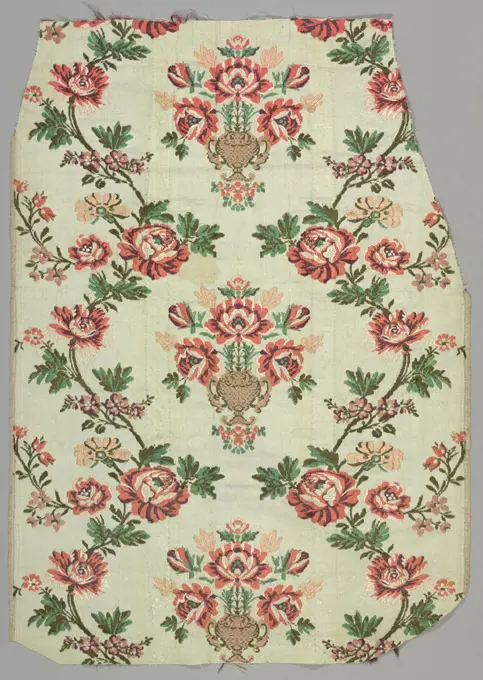
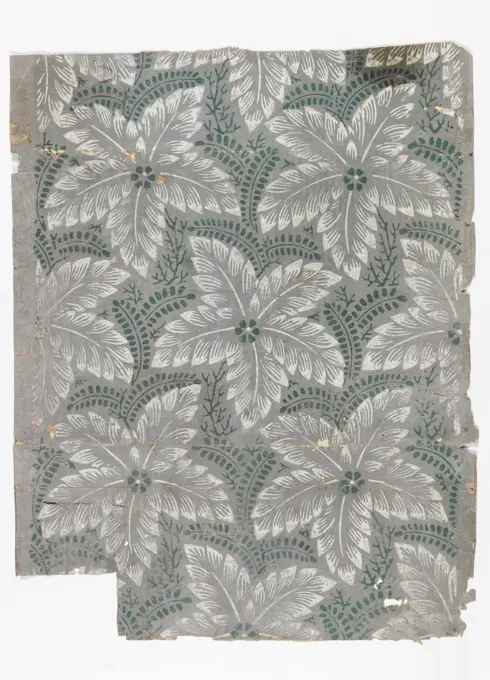
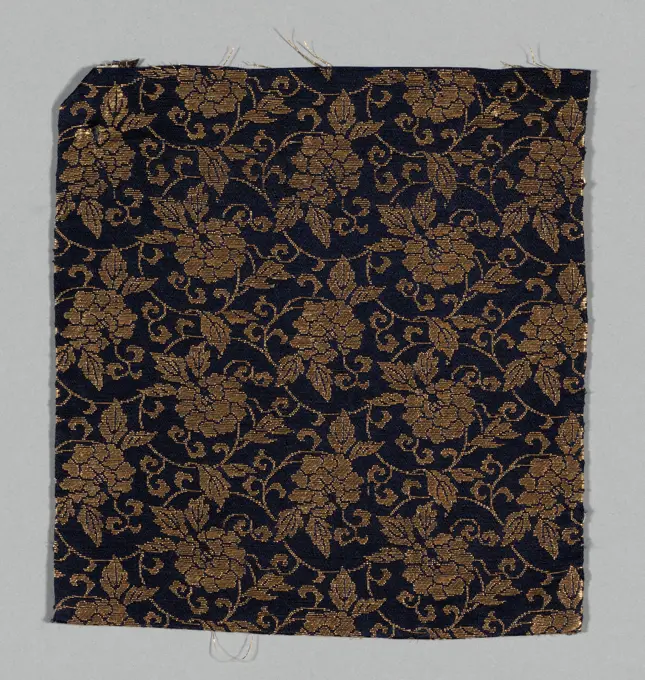
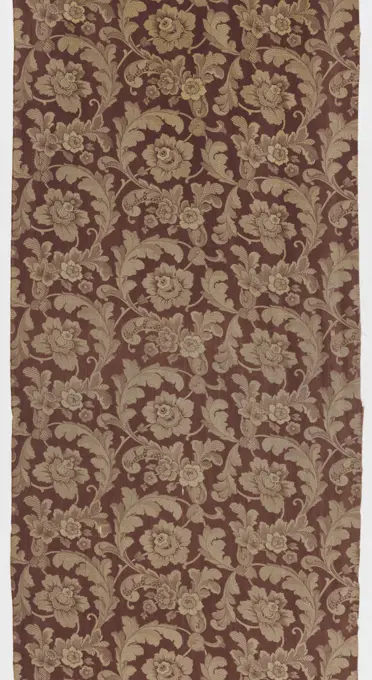
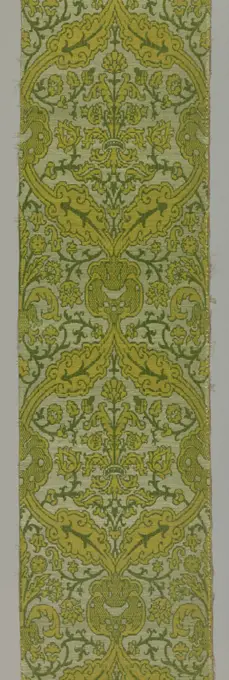
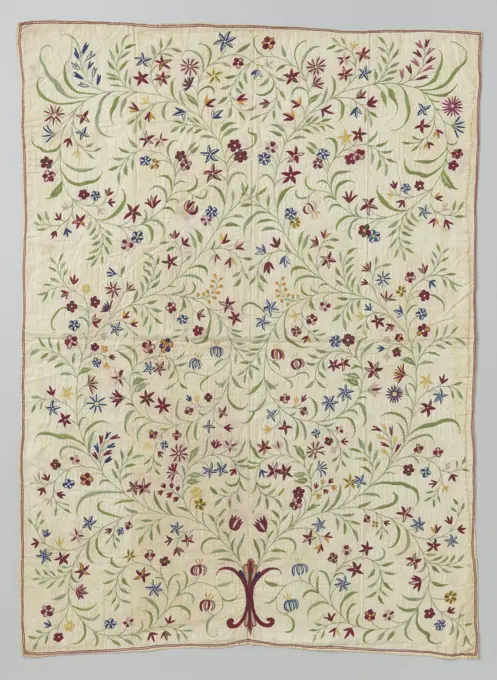
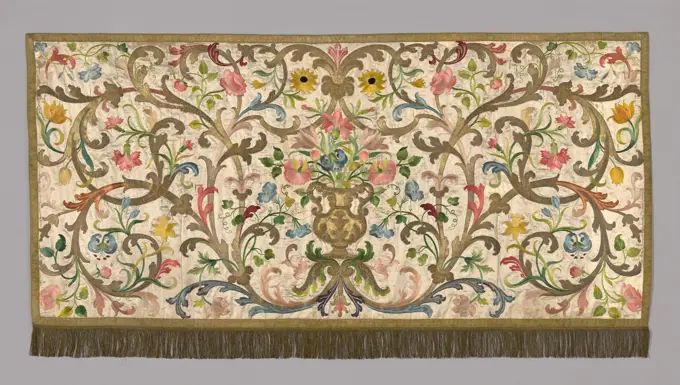
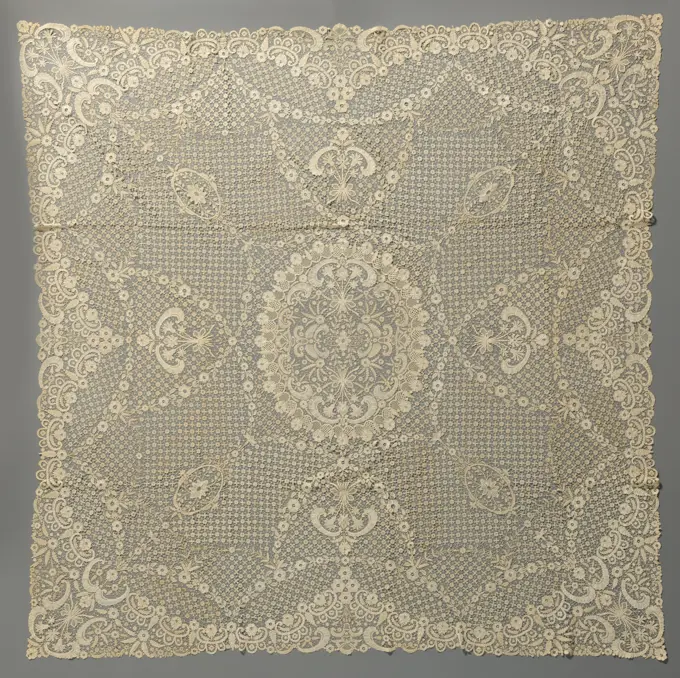
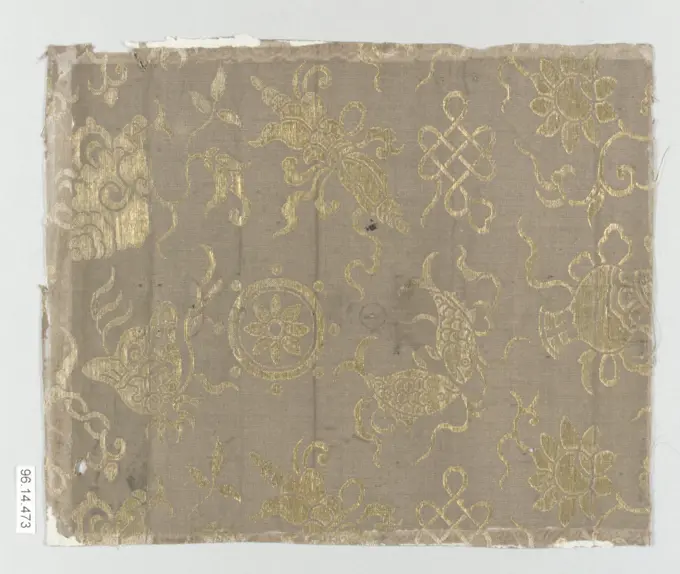
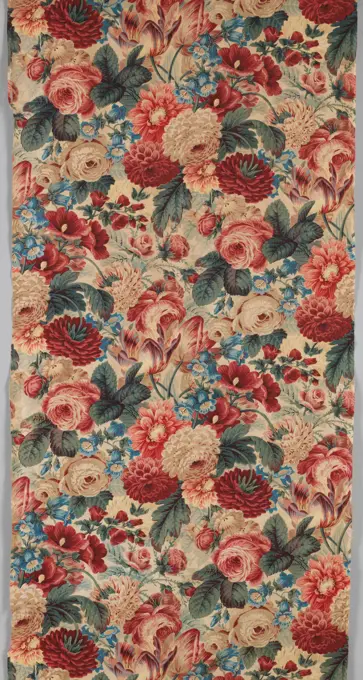
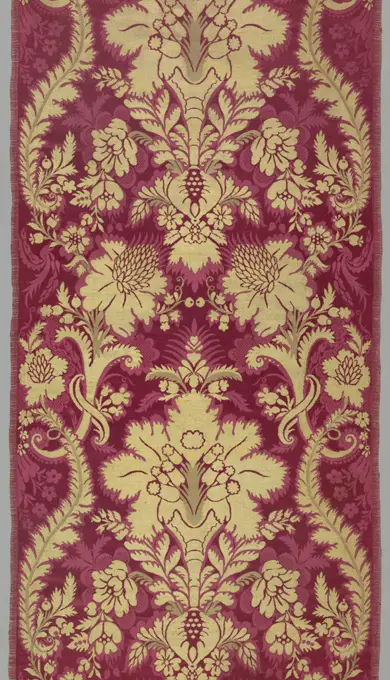
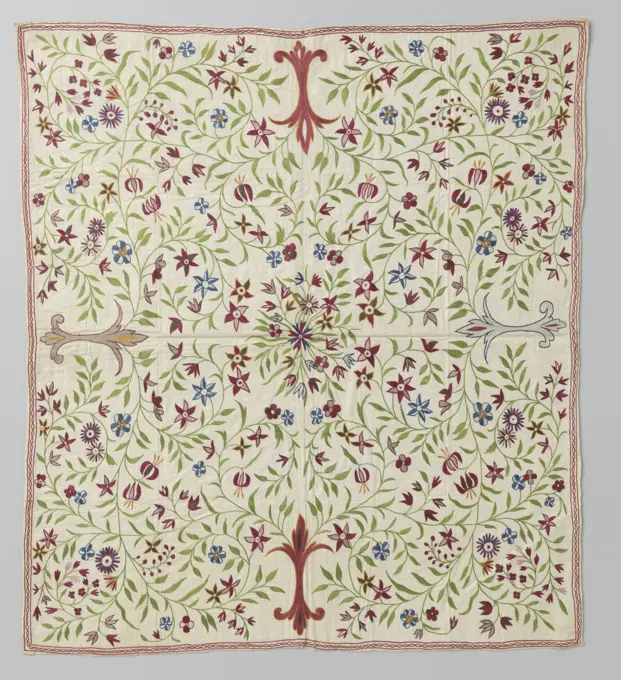
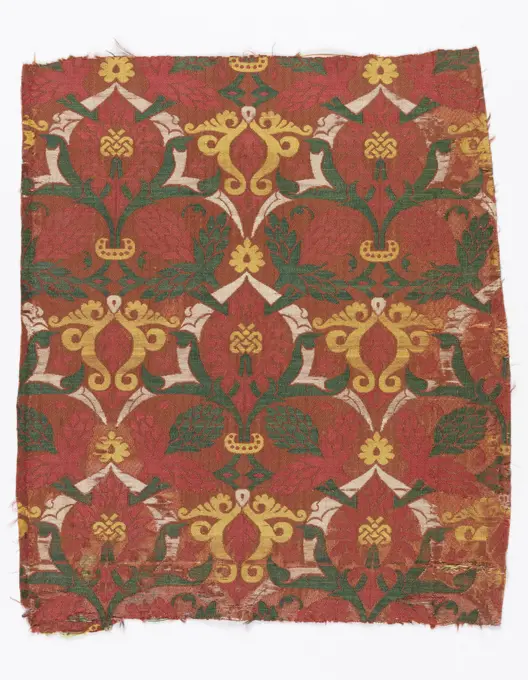
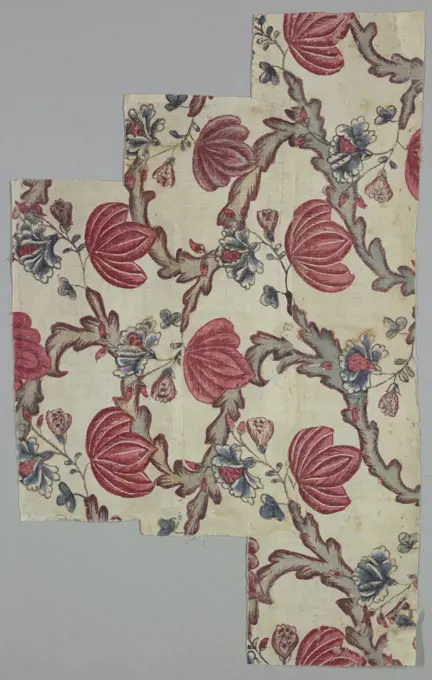
Historical textile fragments showcasing intricate designs in floral and damask patterns. The colors include muted greens, pinks, and golds, portraying a vintage feel.

Textile, Medium: cotton Technique: printed by engraved roller, White cotton, roller printed in shades of brown on greyish ground. Flower clusters around an urn of water on which perch two birds; snake coiled at side. Below urn minute naked figures appear. White cotton scallop fringe attached at bottom., 1850-99, printed, dyed & painted textiles, Textile
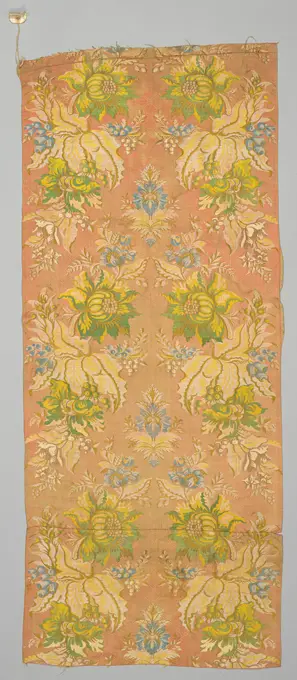
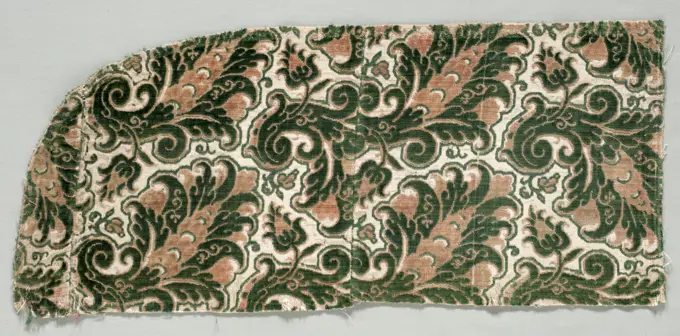
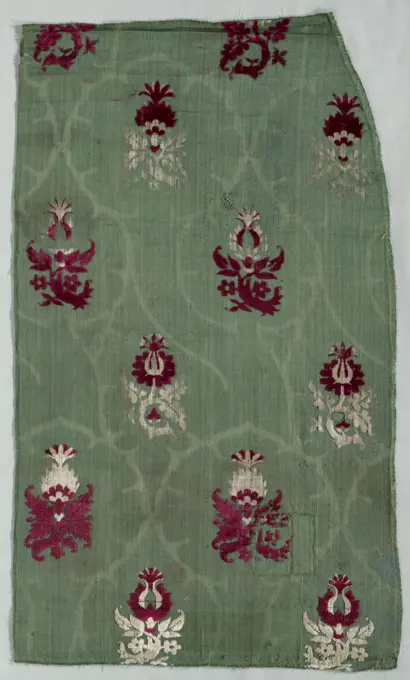
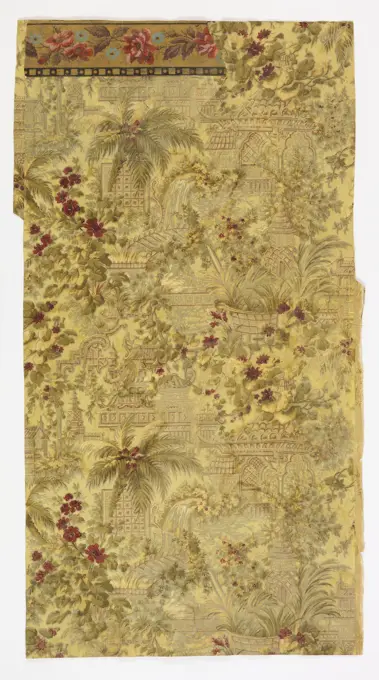
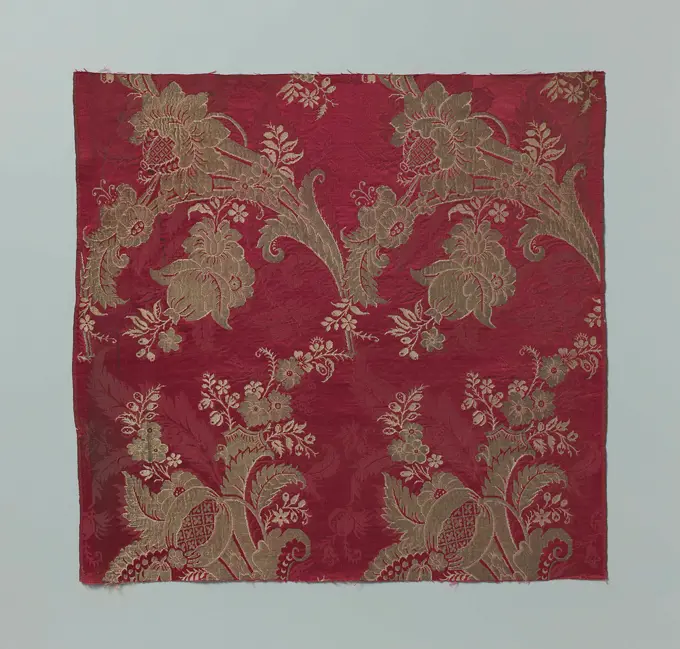
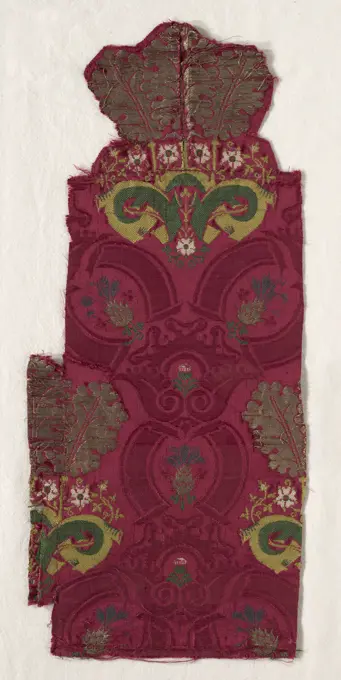
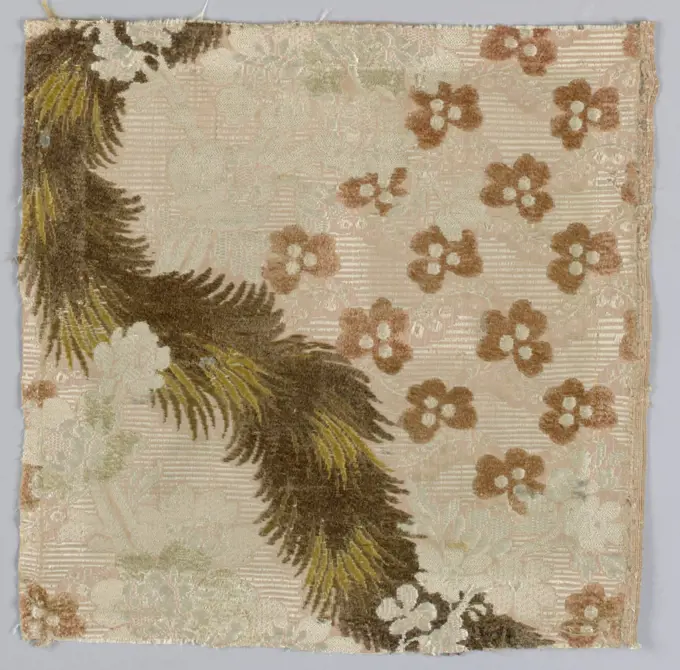
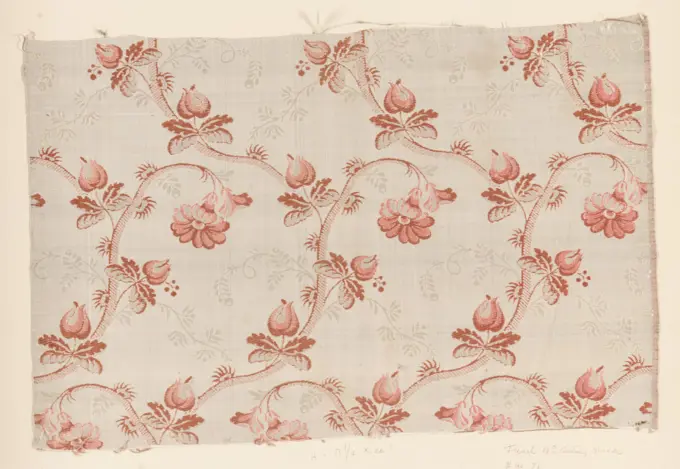
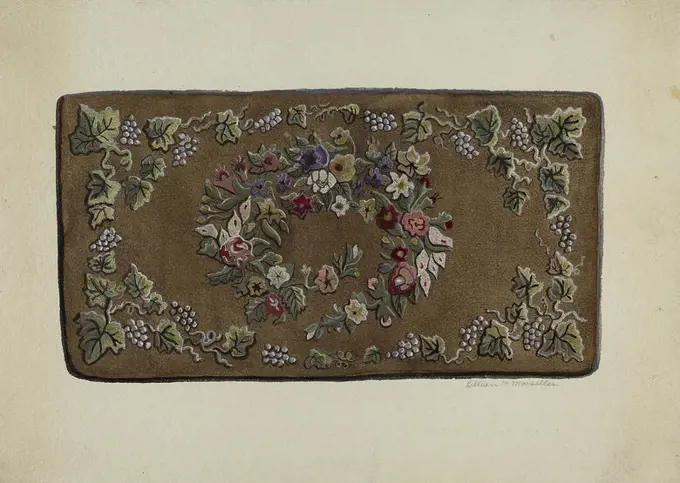
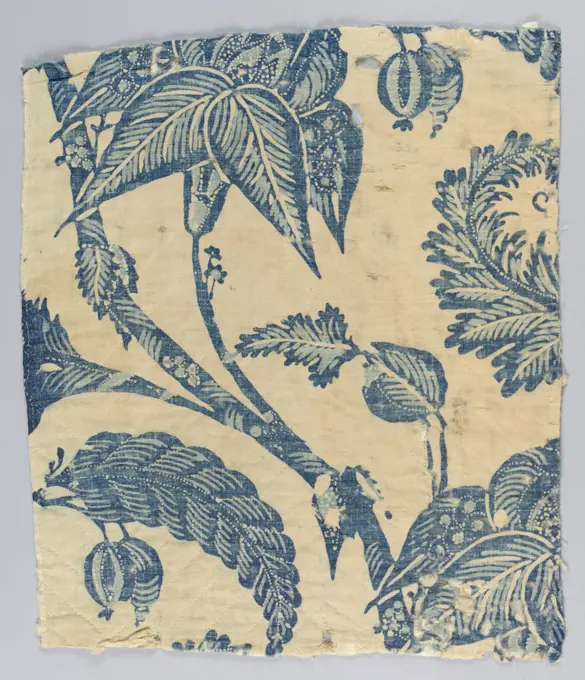
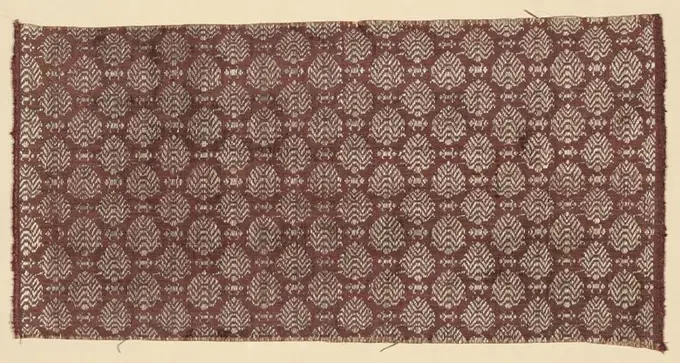
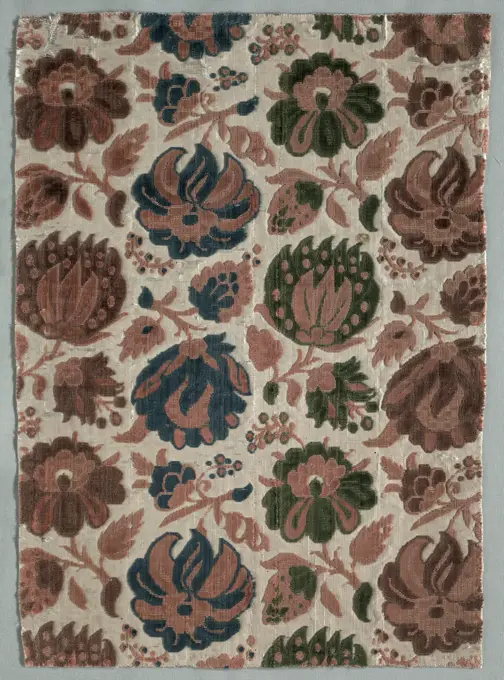
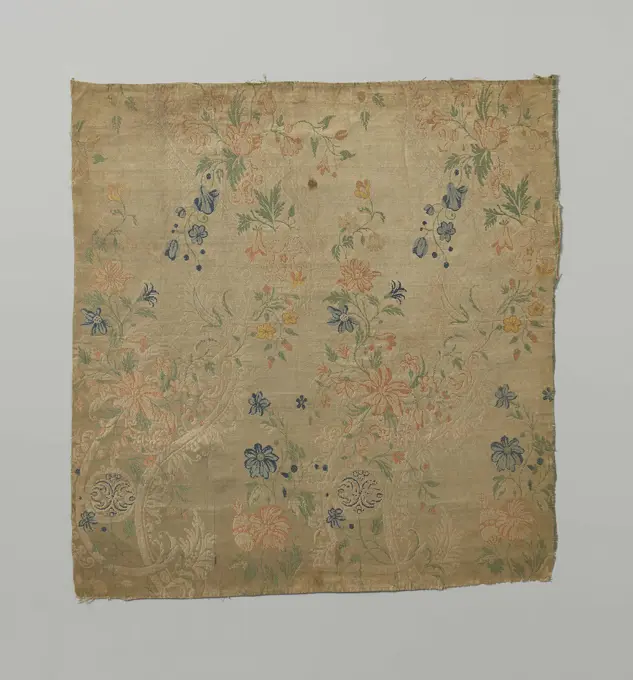
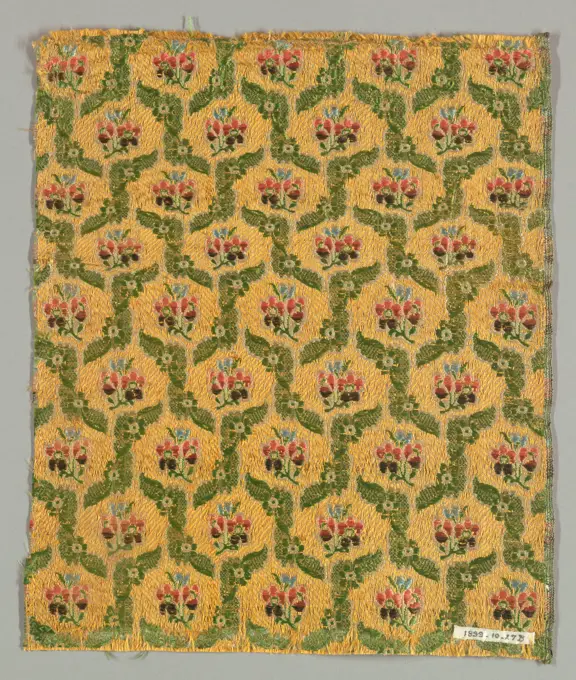
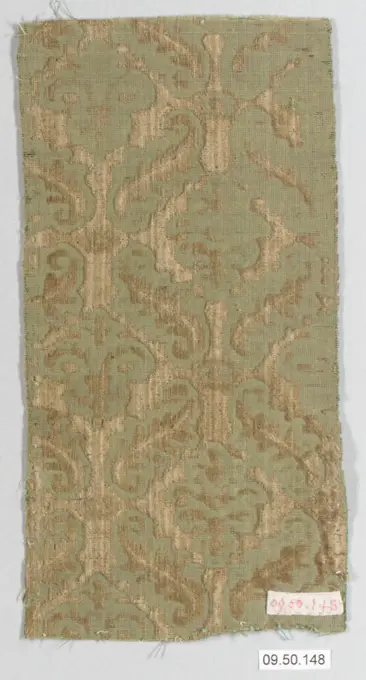
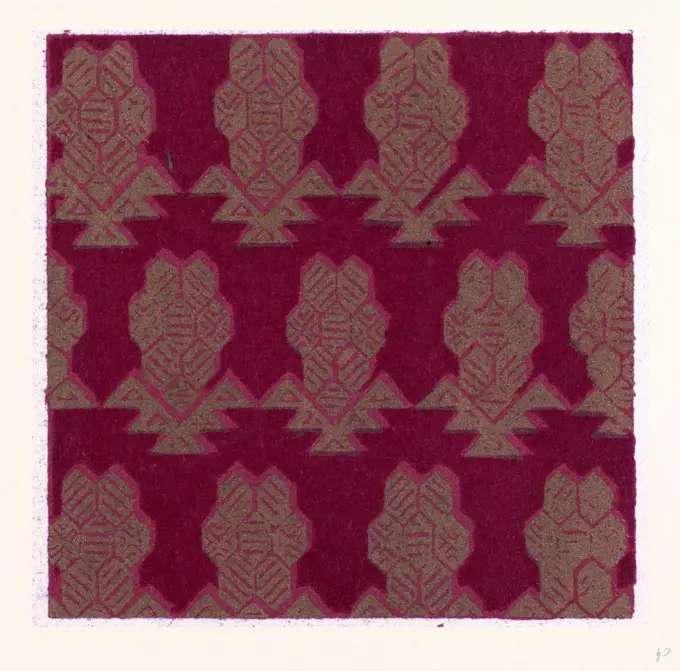
Fragment late 17th-early 18th century Italian. Fragment 230476Baan van twee aan elkaar genaaide zijdeweefsels met bloemdessin.Baan of two launched and bordered silk fabrics, canntillé, Liseré. Dessin: pairs towards each other Wit very large-scale arrangements of flowers and leaves between which a central, smaller, symmetrical constructed flower arrangement in yellow, mustard color, green and two colors blue (brochation) and écru (launch) on pink fond with Liseré effect in Beige. On top Label with 22576 Rose Ground Brocade 1 1/3 YRDS 35.00 yard. Frequent on the back of the fabric: 22576. Pinned paper with letter Z. Condition: good, matte a bit worn.Velvet, c. 1650. Italy, 17th century. Velvet (cut, uncut, and voided); overall: 24.8 x 50.8 cm (9 3/4 x 20 in.).Textile (England); cottonVelvet Fragment, early 1400s. Italy, early 15th century. Velvet (cut and voided); silk; overall: 68.6 x 40 cm (27 x 15 3/4 in.).Fragment multicolored silk pekin, anonymous, 1750 An excerpt of blue and white striped silk, on which colored bouquets, bows and garlands. NOTE: MEERSHIP; 0.4 cm, plain binding. Netherlands silk An excerpt of blue and white striped silk, on which colored bouquets, bows and garlands. NOTE: MEERSHIP; 0.4 cm, plain binding. Netherlands silkTextile Fragment, mid 1700s. Italy, mid 18th century. Silk; overall: 61 x 24.8 cm (24 x 9 3/4 in.).Textile, Medium: cotton Technique: printed by engraved roller, White cotton, roller printed in shades of brown on greyish ground. Flower clusters around an urn of water on which perch two birds; snake coiled at side. Below urn minute naked figures appear. White cotton scallop fringe attached at bottom., 1850-99, printed, dyed & painted textiles, TextilePanel Made 1750-1775 France. silk; plain weave with additional patterned warps .Fragments of silk fabric  a naturalistic floral pattern with architectural elements unknownRibbon French 19th centuryFragment 18th century Italian. Fragment 230352Chintz, Medium: cotton Technique: mordants for 3 reds, 2 purples, and black applied by pen and brush; madder dyed; blue and yellow applied by brush; chintz on plain weave, Diamond lattice of columns and curving ribbons enclosing floral sprays. Indian adaptation of a European design for printed fabric., India, 18th century, printed, dyed & painted textiles, ChintzSidewall (possibly USA); machine-printed; 92 x 49 cm (36 1/4 x 19 5/16 in.); 1973-17-1-b/fTextile, Medium: cotton Technique: cut floats of supplementary weft in plain weve foundation (velveteen), embossed and printed with gilt paint, Sprays of flowers in gold on maroon., 19th century, printed, dyed & painted textiles, TextileFragments (India); silkPiece 18th century Japan. Piece 71368Textile, Medium: silk Technique: 8-harness regular satin weave plus two supplementary wefts with a variety of surface effects, Curving lace-like bands in ivory with entwined floral vines in green, salmon, and ivory superimposed on a patterned yellow-on-yellow background., early 18th century, woven textiles, TextilePiece 18th-19th century Japan. Piece. Japan. 18th-19th century. Silk. Textiles-WovenFragment, Medium: silk, metallic thread Technique: plain compound cloth with supplementary weft, Flower brocaded in thick rust colored chenille thread and silk on a background trellis pattern in metallic threads., France, 18th century, woven textiles, FragmentTextile; cotton; Warp x Weft (a): 113 × 66 cm (44 1/2 in. × 26 in.) Warp x Weft (b): 111 × 66 cm (43 11/16 in. × 26 in.) Repeat H: 87.5 cm (34 7/16 in.); Bequest of Elinor Merrell; 1995-50-108-a,bPiece late 18th century possibly French. Piece 224027Textile, Medium: silk Technique: warp-faced plain weave with supplementary warp floats (background) and supplementary weft, Nineteenth century machine-made copy of Louis XV-style fabric. Cream ribbed silk with wavy S-shaped ribbons and brocaded floral clusters in several color combinations: red, pink and green; yellow, cream and brown; and yellow and white. Scattered buds throughout in yellow and coral., early 19th century, woven textiles, TextileFragment, Medium: silk Technique: woven, Symmetrical pattern of flowering vines around flowering urns on a white ground.Both selvages present., 1700-1750, woven textiles, FragmentSidewall And Label (USA); block-printed on handmade paper; 66 x 51 cm (26 x 20 1/16 in.)Fragment multicolor silk satin. Fragment silk tissue. On a white soil rows of flower branches in green, red and yellow, between which a small geometric triangular shape.Fragment Made 1800-1825 Japan. Silk and gold-leaf-over-lacquered-paper, twill weave with supplementary patterning wefts bound by secondary binding warps in twill interlacings .Textile, Medium: cotton Technique: roller-printed on 2/2 twill, Exotic flowers on curving scrolling leaves with a variety of different patterns on the leaves and petals. Most of the original yellow has faded away leaving the fabric predominantly brown and off-white., England, ca. 1800, printed, dyed & painted textiles, TextileFragment of carmine red damask with gold colored silk tissue with a pattern of stylized leaves and flowers with curved bulbs of flowers, leaves and fruits. A fragment of karmine dry damask with a pattern of stylized leaves and flowers, on which a pattern of rows of rows to the left and to the right bending flour flowers alternately filled with pomegranates and rosette flowers with a pear-shaped heart. Browse silver and white.Length of Velvet, 1600s. Italy, Genoa, 17th century. Velvet (cut and uncut); silk and flat gold wire; overall: 44.8 x 55.6 cm (17 5/8 x 21 7/8 in.).Fragment 16th-17th century Italian. Fragment 230678ChintzTextile (France); Manufactured by Schwartz-Huguenin; cottonEmbroidered shawl unknownFragment of Silk Textile, 18th century. Spain, 18th century. Plain cloth, brocaded; silk; average: 66.7 x 57.8 cm (26 1/4 x 22 3/4 in.).Fragment, Medium: silk Technique: plain compound weave with brocading, Fragment has a pink ground, originally orange, with wide horizontal ribbing formed by extra warp. Heavy serpentine of feathers or fur in brown and tan silk and brown chenille brocading. Trefoil blossoms in pink chenille scattered over the ground. Second serpentine of white branches and flowers in white silk and white frisé silk., France, 18th century, woven textiles, FragmentFragment 18th century possibly French. Fragment 230226Textile (France); cotton; Warp x Weft: 59 x 88 cm (23 1/4 x 34 5/8 in.) Repeat H: 24 cm (9 7/16 in.); Bequest of Elinor Merrell; 1995-50-244Piece 18th century probably Spanish. Piece 229670Ôhi (Stole) Made 1775-1825 Japan. .Textile Fragments, 1800s. Japan, 19th century. Silk, metallic thread; overall: 31 x 15.5 cm (12 3/16 x 6 1/8 in.).strip of brocatelle, Medium: silk, linen Technique: lampas; combination of two structures, satin and plain weave, Bands and leaves forming cartouches in green, yellow and white., 17th century, woven textiles, strip of brocatelleBrocade, 1723-1774. France, 18th century, period of Louis XV (1723-1774). Lampas weave, brocaded; overall: 55.3 x 54.3 cm (21 3/4 x 21 3/8 in.).Fragment of a silk tissue with a pattern of a large bouquet and pomegranate in white on blue, a so -called mosaic decor, anonymous, 1700 - 1725 Fragment of a silk tissue with a running pattern of very large flowers and a fruit. A bouquet is arranged for a hanging pomegranate. Bottom left a pear -shaped leaf with lobed contours and mosaic edges and grain. At the bottom right a loose flower, top left a poppy with a large seed ball as a heart and three extinguishing flowers. Under the leaf a curved flower branch on a sloped widened base. Note: Fragment upholstery () Of a "cheese chair". France (possibly) silk. Fragment of a silk tissue with a running pattern of very large flowers and a fruit. A bouquet is arranged for a hanging pomegranate. Bottom left a pear -shaped leaf with lobed contours and mosaic edges and grain. At the bottom right a loose flower, top left a poppy with a large seed ball as a heart and three extinguishing flowers. Under the leaf a curved flower branch on a sloped wiRug of Eastern textile; With multi -colored embroidery ,, c. 1800 - c. 1899 Dress of multi -colored tambourized cotton, decorated with flower vines and ornament, lined with cotton. India cotton (textile). silk embroidering Dress of multi -colored tambourized cotton, decorated with flower vines and ornament, lined with cotton. India cotton (textile). silk embroideringAltar Frontal Made 1801-1900 Italy. Silk, satin weave over linen, plain weave; lined with silk in plain weave; moirÈ; braid in gilt over silk and yellow silk (gold fringe - twisted threads, gilt over core); embroidered in silk floss, silver and gilt over silk core with satin, (flat), long and short, stem (outline) stitches; couching and some underside couching .Fragment, Medium: silk Technique: 5-harness satin damask, Red damask patterned by two offset rows of flowering plants; a different plant in each row., Italy, 17th century, woven textiles, FragmentSpread from mixed side with wildflower, J.M. van der Roos, c. 1918 - c. 1920 Spread of natural -colored mixed side - bobbin in combination with needle side - Brussels Duchesse. A surface of braids is strewn with butterflower and clovers of four, which contains a large pattern that is symmetrical compared to two axes. The middle wears a large oval medallion with toothed circumference, on which there is a poppy and a corner in turn. The heart shows, among other things, two tufts of cow flowers, corn flowers and an edge of C-Voluten. Outside there are a large reserve of a lobed four-pass, surrounded by C-Voluten, outside of wheats and cornflowers. Large circle arches, formed by popping roses strung on a stem, cut each other in the four pass. In between, four KorenbloemtoTjes and four ovals are placed crosswise. Lock linen (material) mixed lace / mixed Brussels Spread of natural -colored mixed side - bobbin in combination with needle side - Brussels Duchesse. A surface of braids is strewn Ispahan designed ca. 1888 William Morris British. Ispahan 229994Textile Fragment, 1800s. Japan, 19th century. Silk; average: 41.9 x 15.3 cm (16 1/2 x 6 in.).Fragment, Medium: silk; tempera Technique: printed and painted on plain weave, White ground divided in to circles and lozenges by slender vines and blossoms, foliage and buds. Round floral group in center of each circle. Single blossoms with four leaves in each lozenge., China, late 18th-early 19th century, printed, dyed & painted textiles, FragmentTextile (India); cottonFragment; silkFragment Made 1600-1650 Italy. Silk, satin weave self-patterned by complimentary ground weft floats .Hooked Rug. Dated: c. 1936. Dimensions: overall: 23.1 x 30.2 cm (9 1/8 x 11 7/8 in.) Original IAD Object: 33" wide; 63" long. Medium: watercolor, graphite, and gouache on paper. Museum: National Gallery of Art, Washington DC. Author: Lillian M. Mosseller.Textile, Medium: linen warp, cotton weft Technique: block printed on plain weave 'siamoise', Undulating vertical stripes of blue with small white flowers, alternating with wider columns of large pink roses on a white ground., Image shown is of 1986-84-2d, 1760-62, printed, dyed & painted textiles, TextileTextile (France); linen warp, cotton weft; Warp x Weft: 113.5 x 94.5 cm (44 11/16 x 37 3/16 in.) Repeat H: 31 cm (12 3/16 in.); Bequest of Elinor Merrell; 1995-50-229Fragment, Medium: cotton, wool batting Technique: block-printed and resist-dyed plain weave, quilted, Fragment of a quilted textile. Woven cotton textile resist-dyed in two shades of blue on white background showing pattern of leaves and fruit. Interlined with wool and backed with faded pieces of plain cotton, or cotton printed in very small geometric patterns. Quilting is done in diagonal lines., England, late 18th-early 19th century, printed, dyed & painted textiles, FragmentFragment 18th century French. Fragment 230310Fragment of fabric brocaded with gold unknownFragment. Italy. Date: 1650-1700. Dimensions: . Silk, plain compound cloth. Origin: Italy. Museum: The Chicago Art Institute, Chicago, USA.Textile (France); technique: block printed on plain weave with a resist medium; then immersion dyed in blue; Warp x Weft: 61 x 42 cm (24 x 16 9/16 in.) Repeat H: 58.1 cm (22 7/8 in.)Fragment, Medium: silk Technique: 5-harness satin plus 14 twill, Continuous ogival framework of broad checkered bands drawn together by crowns and a leaf pattern. Ogives enclose a palmette in one horizontal row and a fruiting tree in the next. In a coarse yellow satin on a ground of red weft twill., Italy or Spain, late 16th-early 17th century, woven textiles, FragmentIndian ornamentTextile (France); cottonLength of Textile, 1700s. Italy, 18th century. Plain cloth; silk and metal; average: 61.1 x 54.2 cm (24 1/16 x 21 5/16 in.).Cap Crown (Italy); linenPiece 18th century Japan. Piece 66197Velvet, 1600s. Italy, 17th century. Velvet (cut and uncut); silk; overall: 46.4 x 33.7 cm (18 1/4 x 13 1/4 in.).Piece British 19th century View more. Piece. British. 19th century. Cotton. Textiles-PrintedFragment (Spain); silkFragment Italian early 18th centuryFragment, Medium; wool. linen Technique; two partially integrated fabric structures, plain weave plus plain weave, A formal repetition of lions, birds, and floral figures., 17th century, woven textiles, FragmentFragment Multicolored silk with on a white fond (brown discolored) A pattern of curl work and stylized leaf motifs with flowers and flower branches in and on the swirled jobs. Fragment Multicolor silk tissue with on a white fond (brown discolored) A pattern of swinging courses consisting of white curly and stylized leaf motifs. On and between the winding lanes, the pattern has multicolored flowers and flower branches.Textile; cotton; Warp x Weft: 25 x 40.5 cm (9 13/16 x 15 15/16 in.)Textile, Medium: silk Technique: 4&1 satin damask with discontinuous supplementary wefts (brocading), Red silk satin damask brocaded in gold in a vertically symmetrical design of flowering plants., Europe, late 19th century, woven textiles, TextileDress of Eastern textile with multi -colored embroidery ,, c. 1800 - c. 1899 Dress of multi -colored tambourized cotton, decorated with flower vines and ornament, lined with cotton. India cotton (textile). silk embroidering Dress of multi -colored tambourized cotton, decorated with flower vines and ornament, lined with cotton. India cotton (textile). silk embroideringFragment, Medium: silk Technique: 4&1 satin patterned by plain weave (lampas), Curving stems with blossoms and pomegranates and areas of interlaced strapwork in rose, yellow, green and white on a red ground., Spain, 15th century, woven textiles, FragmentFragment Made 1750-1775 France. Silk, cut, uncut, and voided velvet against satin weave foundation .Lampas with foliate medallions in ogival lattice, 1400s. Egypt. Lampas: silk; overall: 21.6 x 22.3 cm (8 1/2 x 8 3/4 in.).Linnamast napkin with a edge pattern, anonymous, c. 1750 - c. 1775 Linnamast napkin, with an ornament with leaves and fruits in the middle, framed by a edge pattern. From the border sprouts to the middle, flour, on which a leaf and fruit motif. A small vase with a flower branch diagonally in the corners. Southern Netherlands (Possible) linen (material) damask Linnamast napkin, with an ornament with leaves and fruits in the middle, framed by a edge pattern. From the border sprouts to the middle, flour, on which a leaf and fruit motif. A small vase with a flower branch diagonally in the corners. Southern Netherlands (Possible) linen (material) damaskChintz fragment, Medium: cotton Technique: mordants for 2 reds, purple and black applied by pen and brush; madder dyed; blue applied by brush chintz on plain weave, Curving stems with umbrella-like blossoms. Three pieces glued together. (chintz), India, 18th century, printed, dyed & painted textiles, Chintz fragmentBorderBordered Fragment; silkFragment, Medium: silk, silver foil on silk thread Technique: woven, Fragment of rectangular doily of compound satin, brocaded: Same material and facing as 1951-112-14. Slightly different metallic galloon., Italy or France, 1700-1750, woven textiles, FragmentMakat with an Eastern motif; according to Playlement; PO .xviiw. (1750-00-00-1750-00-00);Textile (France); cottonFragments (France); silkOrnamental tapiser;  XVIII/19th century (1790-00-00-1820-00-00);Fragment of a Cover 17th century. Fragment of a Cover 446221Chinese ornamentLength 18th century Dutch. Length 229304Velvet Fragment, c. 1600. Italy, early 17th Century. Velvet; overall: 45.5 x 14.5 cm (17 15/16 x 5 11/16 in.).Piece 16th-17th century Italian. Piece 215549Fragment white brochure silk ,, 1750 Fragment silk tissue with a white soil on which multicolored flower branches that are surrounded by a white side pattern and white flower branches. Netherlands silk Fragment silk tissue with a white soil on which multicolored flower branches that are surrounded by a white side pattern and white flower branches. Netherlands silkTextile Fragment (China); silk; temperaFragment multicolored brochure silk, anonymous, 1750 A fragment silk tissue. A white soil has a white checkered pattern with dots in the windows, horizontally striped bands around which a colored flower garland and white outlines around multicolored flower branches. France silk A fragment silk tissue. A white soil has a white checkered pattern with dots in the windows, horizontally striped bands around which a colored flower garland and white outlines around multicolored flower branches. France silkRibbon French 19th centuryIndian ornamentFragment; silk woven; Warp x Weft: 23.4 x 20 cm (9 3/16 x 7 7/8 in.)