Textile Fragments

A variety of antique textile pieces from Japan and beyond, featuring intricate patterns and historical significance, highlighting textile artistry.

Lumbar ,, 1736 Lendloop van Linen with Entre-Deux van Kloskant, brand WG6 and 1736 Northern Netherlands linen (material). bobbin lace Lendloop van Linen with Entre-Deux van Kloskant, brand WG6 and 1736 Northern Netherlands linen (material). bobbin lace
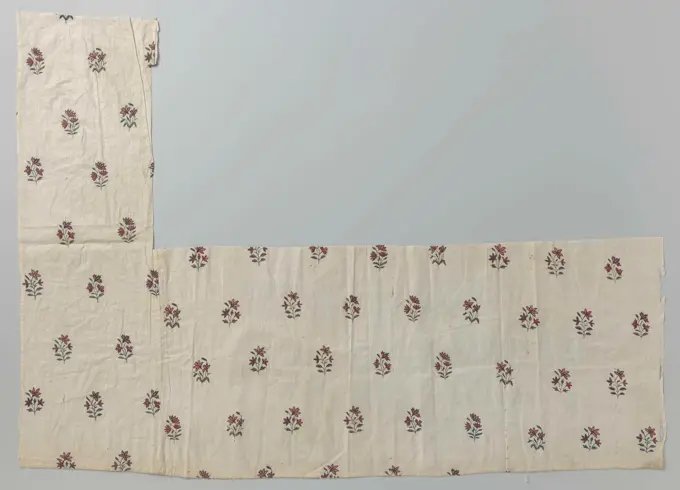
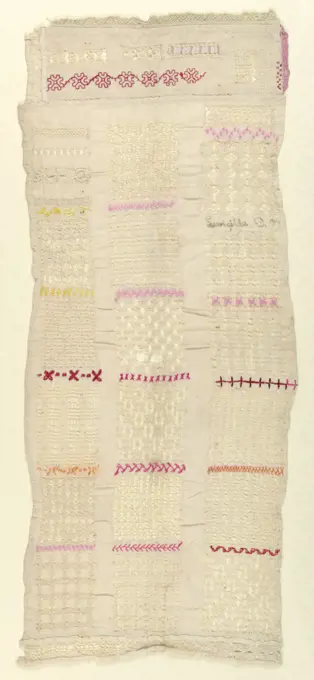
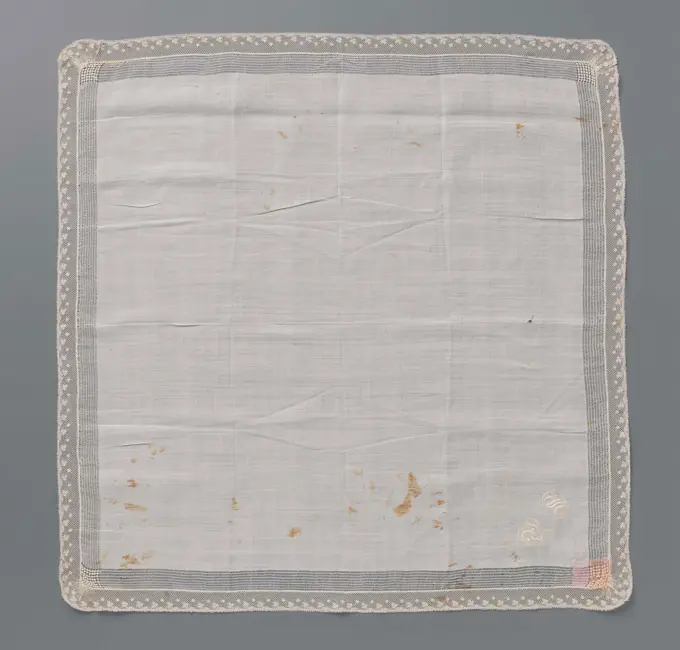
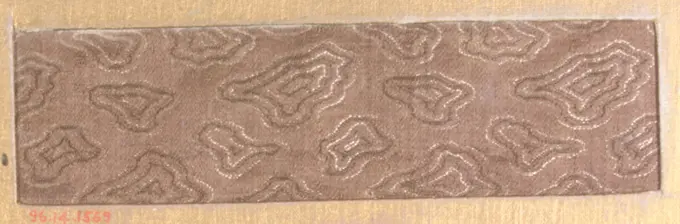
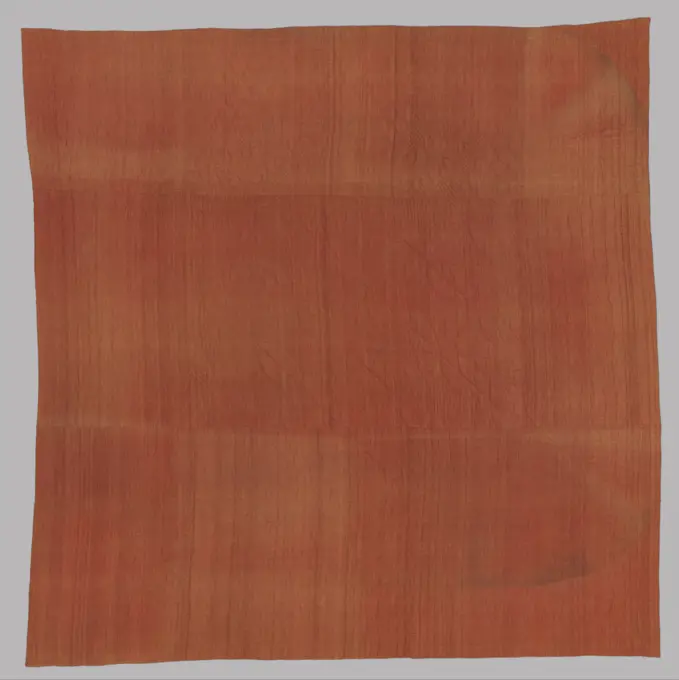
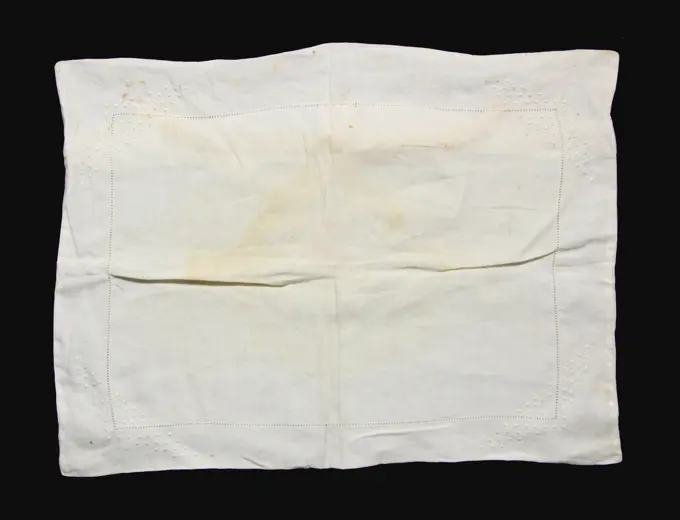
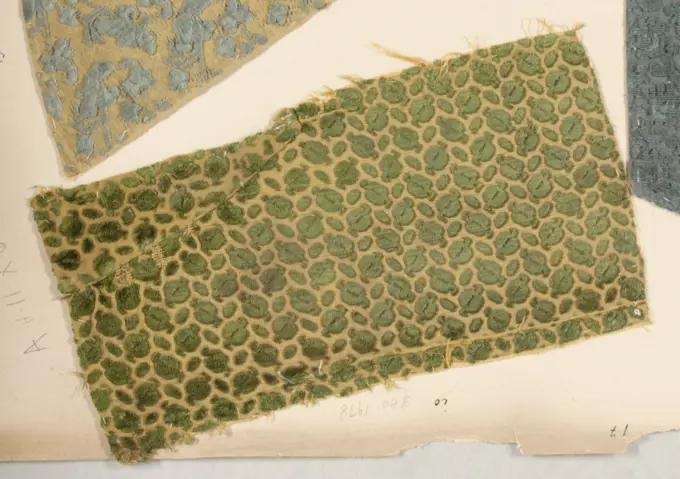
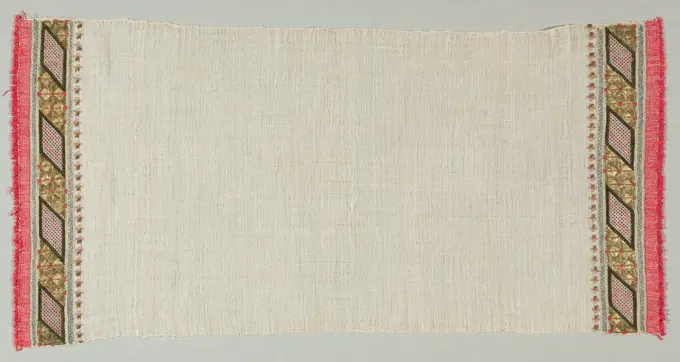
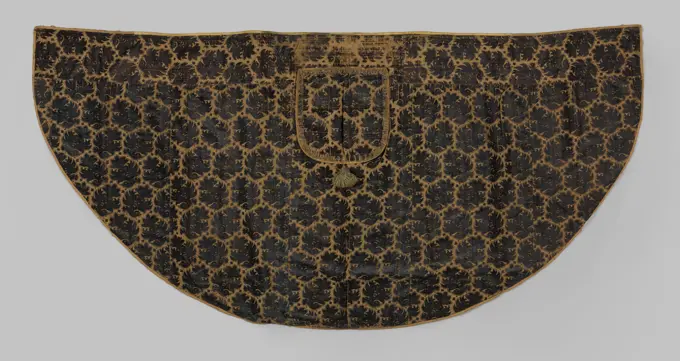
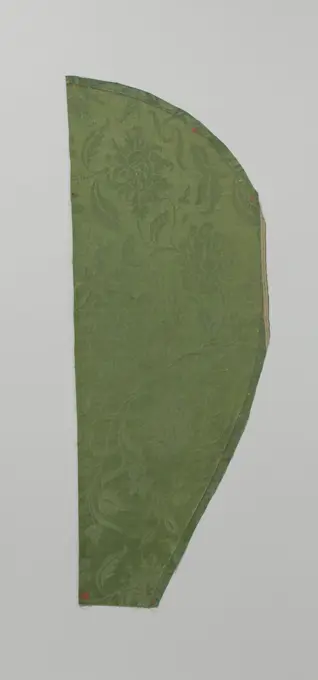
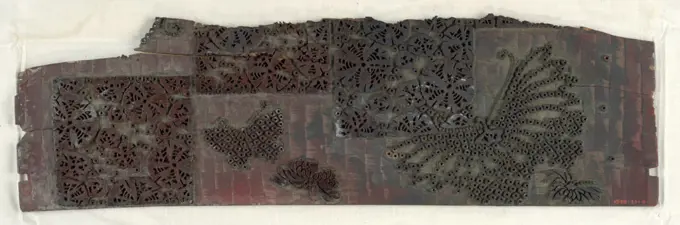
Church tablecover. unknown, authorPiece 18th-19th century Japan. Piece 67305Fragment late 18th century French. Fragment 212892Two consistent fragments oriental textile with embroidery. Two consistent fragments oriental textiles with embroidery; Tamboerderk. Flower branches are embroidered on white cotton in silk.Sampler, Medium: linen, silk Technique: embroidered on plain weave, Sampler with many small rectangles of drawnwork patterning interspaced with lines of silk embroidery., Mexico, 19th century, embroidery & stitching, SamplerPiece 18th century Japan. Piece 71988Textile Swatches Onondaga Silk Company, Inc. (1925-1981). Textile Swatches, 1948-1959. 81 silk; 19 metal, (a) - (c): 9 x 4 in. (22.9 x 10.2 cm).    1948-1959Fragment Made 1476-1532 Peru. Brocaded interlocking tapestry (old card) . ChuquibambaSampler; cottonPiece 12th century Japan. Piece 71041Batist's handkerchief with embroidered initials PS and openwork sized and finished around with a strip of dumplings. Natural batist's handkerchief with embroidered initials PS and openwork hems with edge embroidery: work with pulled out wires. The handkerchief is finished around with a strip of natural colosside: Valenciennes side. The repeating pattern consists of three-part leaves and mates, made in linen stroke with openwork edges. The motifs are connected by a grille, a square valenciennes ground. The straight bottom of the strip around the handkerchief is finished with picots.Textile Sample from Sample Book 19th century Japan. Textile Sample from Sample Book 68173Stripped flowers and edge with garlands, anonymous, 1625 - 1650 Napkin from White Linnamast with a pattern of stripped flowers and edge with garlands, Brand Kroon LP 12. Northern Netherlands (Possible) linen (material) damask Napkin from White Linnamast with a pattern of stripped flowers and edge with garlands, Brand Kroon LP 12. Northern Netherlands (Possible) linen (material) damaskBack wrapper. Photographs, Photograms, Book covers. 1843-10 - 1844-05. Spencer Collection. Plants in artFragment (USA)Piece 18th-19th century Japan. Piece 67282Fragment (Italy); silk; Warp x Weft: 128 x 21 cm (50 3/8 x 8 1/4 in.); 1960-171-3Textile, Medium: silk, metallic Technique: supplementary warp pile (velvet) in plain weave foundation, with continuous supplementary weft patterning Label: silk velvet with metallic supplementary weft patterning, Deep red velvet with offset repeat pattern of gold disks. The foundation is plain weave formed by a red silk warp and tan silk weft; the supplementary warp pile is red silk. The velvet pile is voided in the areas where the coin dots appear, and supplementary gold wefts are floated in pairs to the surface in these areas, bound in twill with the secondary ivory warp., Iran, possibly 13th century, woven textiles, TextileWholecloth calamanco quilt ca. 1750 American The top of this quilt is of a rust-colored glazed wool, and the back is of a coarsely woven gold cotton. The top is made of three panels of fabric, the widest g7G inches. The piece is quilted with a central area of quatrefoils, a feather-vine border, and pyramids of shells.. Wholecloth calamanco quilt 13858Textile Swatches Onondaga Silk Company, Inc. (1925-1981). , 1948-1959. Acetate and Rayon, 40 1/2 x 23 1/2 in. (102.9 x 59.7 cm).    1948-1959Textile (France); silk, metallic thread; Anonymous bequest in memory of Albert and Rebecca Elsberg; 1938-82-44-bPillowcase, 1800s , maker unknown. Gift of G Preston, 1981.Plain blue paper, anonymous, 1800 - 1900 decorated paper   paper. paint (coating). lacquer (coating)Eva Wilson, Cotton Towel  Blue Border and Fringe, c 1937 Cotton Towel - Blue Border and FringeTextile Swatches Onondaga Silk Company, Inc. (1925-1981). , 1948-1959. Silk, metal, a: 40 1/2 x 24 1/2 in. (102.9 x 62.2 cm).    1948-1959Poncho, 18th century, 34 15/16 × 55 5/16 in. (88.74 × 140.49 cm), Wool, Peru, 18th centuryFragment 16th century Italian. Fragment 230549Sleeveless Tunic. Culture: Chimú. Dimensions: H. 40 x W. 22 1/4 in. (101.6 x 56.5 cm). Date: 12th-15th century. Museum: Metropolitan Museum of Art, New York, USA.Ribbon French 19th centuryFragment early 16th century Italian. Fragment 230124Towel, Medium: silk and metal-wrapped silk on cotton (warp) and silk (weft) ground Technique: counted and uncounted stitches; running, stem, satin and double running stitches on plain weave, Towel with a wide border at each end. The border has three repeats of a five inch plant in shades of pink, blue and metallic silver. There is a five inch fringe at each end made from the warp., Turkey, 19th century, embroidery & stitching, TowelFragment. La Capilla, Culebra Valley, north coast, Peru. Date: 1000-1476. Dimensions: 21 × 41.9 cm (8 1/4 × 16 1/2 in.). Origin: Peru. Museum: The Chicago Art Institute, Chicago, USA. Author: Tiwanaku.Square Ceriserode Men's Sucking Finger with Stains, Unknown, 1800 - 1899  Europe textile materials  Europe textile materialsTextile Swatch , 1950s to 1960s. Silk, 20 x 20 1/2 in. (50.8 x 52.1 cm).    1950s to 1960sPiece 18th-19th century Japan. Piece 65985Sampler (England); linen embroidery on linen foundationTextile, Medium: piña (pineapple) fiber, cotton Technique: plain weave, Sheer cream-colored ground with a fine check of blue and red cotton., Philippines, 19th century, woven textiles, TextileKerchief 18th century Spanish. Kerchief 119293Square, Medium: cotton Technique: plain weave, Gingham square in blue, green, brown, yellow and red., USA, 1850-1900, woven textiles, SquareTable runner, Medium: cotton, silk embroidery Technique: embroidered on plain weave, Light brown table runner with a pair orange pinwheel-like flowers on pale green stems set with a geometrical framework. Geometrical pink flower head is in the center. Fringe on both ends., USA, ca. 1910, embroidery & stitching, Table runnerPiece 18th-19th century Japan. Piece. Japan. 18th-19th century. Silk. Textiles-WovenTowel. Italy. Date: 1601-1700. Dimensions: 142.3 x 50.8 cm (56 x 20 in.). White linen with borders of red silk and white linen. Origin: Italy. Museum: The Chicago Art Institute, Chicago, USA.Cover 16th or 17th century Italian or Spanish. Cover 460778Embroidered Towel (Peshkir), 19th century. Turkey, 19th century. Embroidery; silk and silver filé on linen ground; average: 80.7 x 41.9 cm (31 3/4 x 16 1/2 in.).Choir of velvet brocade ,, c. 1575 - c. 1625 Choir of velvet brokaat. The pattern has staggered rows of a three-leaf on an S-shaped bent branch, oriented to the left or right row. The choir hood is decorated with a passion in gold and silver thread and a brush of yellow, white and blue fringes and a silver knot. The choir hood is lined with linen. Italy silk. silver thread. linen (material). brocade (textile) Choir of velvet brokaat. The pattern has staggered rows of a three-leaf on an S-shaped bent branch, oriented to the left or right row. The choir hood is decorated with a passion in gold and silver thread and a brush of yellow, white and blue fringes and a silver knot. The choir hood is lined with linen. Italy silk. silver thread. linen (material). brocade (textile)Piece 16th century Italian. Piece 212466Skirt, 21st century, 19 1/4 x 24 1/8 in. (48.9 x 61.28 cm), Cotton, Myanmar (Burma), 21st centuryShawl (England)Woman's Mantle 18th century () Aymara. Woman's Mantle 318175Roundel with Geometric Decoration Coptic. Roundel with Geometric Decoration, 5th-7th century C.E. Flax, wool, 7 1/16 x 7 1/16 in. (18 x 18 cm).   Egyptian, Classical, Ancient Near Eastern Art 5th-7th century C.E.Fragment green silk damask with pattern of winding tendrils with stylized leaves, anjelieren and roses, anonymous, c. 1700 - c. 1750 Fragment green silk damask of two parts sewn together, with a pattern of winding tendrils with stylized leaves, anjelieren and roses. Italy silk damask Fragment green silk damask of two parts sewn together, with a pattern of winding tendrils with stylized leaves, anjelieren and roses. Italy silk damaskTextile Swatches Onondaga Silk Company, Inc. (1925-1981). , 1948-1959. Silk, 24 x 9 in. (61 x 22.9 cm).    1948-1959Piece 10th century Japan. Piece 71005Fragment Made 1600-1700 China. .Piece 17th century Japan. Piece 71326Sack pattern Close up shot of raw sack pattern Copyright: xZoonar.com/Baloncicix 7641878Blanket, 20th century, 57 x 25 1/8 in. (144.78 x 63.82 cm), Cotton, silk (), Vietnam, 20th centurySample first half 19th century French. Sample 219307Textile Fragment 4th-5th century. Textile Fragment 443926Lucille Chabot, Shaker Rug Strip, c 1936 Shaker Rug StripFragment (USA)Textile Sample from Sample Book 19th century Japan. Textile Sample from Sample Book 68144Printing block, Medium: wood, Design of circular floral motifs, stylized spider mums and butterflies. Mums and butterflies patterned by groups of small ring shapes., 19th century, appliances & tools, Printing blockPrzeszo Przyszoci unknownFragment of a silk tissue, with print. Fragment of a silk tissue, with print. Flower branches are printed on a light green fond and golden lines.Fragments, 1700s. China, 18th century. Brocaded satin, silk; overall: 26 x 21.5 cm (10 1/4 x 8 7/16 in.).Napkin from white Linnamast ,, 1703 - 1704 White Linen Damas napkin with the surprise of Landau by the French in the Spanish Succession War. Brand crowned V and 12. Holland (possibly) linen (material) damask White Linen Damas napkin with the surprise of Landau by the French in the Spanish Succession War. Brand crowned V and 12. Holland (possibly) linen (material) damaskSample early 19th century French. Sample 219333Fragment; linenPiece 18th century Japan. Piece 71577Banknote motif: a circular lathe work design composed out of the repetition of the words "Five thousand dollars" ca. 1824-42 Associated with Cyrus Durand American. Banknote motif: a circular lathe work design composed out of the repetition of the words "Five thousand dollars" 393986Lace 18th century Flemish. Lace 120787Piece 19th century Japan. Piece. Japan. 19th century. Silk / Compound weave. Textiles-Wovenphoto frame on the background matBody of beige checkered wool with 7 black buttons, anonymous, 1870 - 1880 Part of beige checkered wool. Belonging to Pop BK-15444.  wool twill Part of beige checkered wool. Belonging to Pop BK-15444.  wool twillBamboo place mat on wooden deck table.Man's cloth, 20th century, 122 x 73 in. (309.88 x 185.42 cm), Rayon, Ghana, 20th centuryTextile Swatches Onondaga Silk Company, Inc. (1925-1981). , 1948-1959. Silk, a-c: 40 x 3 1/2 in. (101.6 x 8.9 cm).    1948-1959Fragment with Fringe Coptic. Fragment with Fringe, 5th-7th century C.E. Flax, 4 x 5 in. (10.2 x 12.7 cm).   Egyptian, Classical, Ancient Near Eastern Art 5th-7th century C.E.Fragment; wool on linenTextile 19th century Japan. Textile. Japan. 19th century. Textiles-WovenFragment, Medium: silk Technique: cut and uncut supplementary warp pile (velvet), Collar of green cut and uncut velvet on yellow silk ground. Central symmetrical group of large leaves and the base of a flower., Italy, 17th century, woven textiles, FragmentTextile 19th century Japan. Textile. Japan. 19th century. Textiles-WovenObi  a gray green kimonan belt with colorful chrysanthemums unknownFragment, Medium: silk Technique: 5-harness satin damask, Dark red damask with an oblong shaped geometrical design. Green selvage., France, 18th century, woven textiles, FragmentCosmetic scraper pendants ca. 7th-9th century A.D. Alanic. Cosmetic scraper pendants 327568Ceremonial skirt, 34 1/2 x 50 1/2 in. (87.63 x 128.27 cm), Cotton, ceramic beads, seeds, metal, shells, Myanmar (Burma)Square dress of edge embroidery with rosette flower. Square dress of natural-colored edge embroidery: File side. Pattern with a rosette flower of four heart shaped leaves. The motif is embroidered on a knotted network of square meshes - fillet node - with the cross-linking technique (linen stop stitch). The sides are immediately finished.Red -white checkered curtain, anonymous, 1776 - 1800 Curtain of red-white checkered side with a straight top. At the rear at the top a coarse linen border with copper rings. A string is attached to a curtain ring at the end. Northern Netherlands silk. linen (material) Curtain of red-white checkered side with a straight top. At the rear at the top a coarse linen border with copper rings. A string is attached to a curtain ring at the end. Northern Netherlands silk. linen (material)Place mat on wooden deck table.Sidewall, Flocked, Red flock, damask-like pattern, with step-edged outlines., France or USA, 1890-1910, Wallcoverings, SidewallFragment, Medium: cotton Technique: block-printed on plain weave, Printing is in dull red and brighter red on natural ground. Parallel stripes of dull red alternate with natural in which there are twining vines with leaves in the brighter red. Colors are probably quite faded., India, 18th century, printed, dyed & painted textiles, FragmentPiece 18th-19th century Japan. Piece 66664Close up of tassels of a shwal kept on a chairVeil 19th century Belgian. Veil. Belgian. 19th century. no medium availableSouth Africa, Cape Town. Stellenbosch, Dorp Street, Africa Silks. Textiles made of local African silk.Carrying cloth, Medium: cotton Technique: plain weave with warp floats, crêpe spun; four selvedges Label: crepe-spun cotton plain weave with warp floats, Carrying cloth of loosely woven, crepe-spun, indigo-dyed cotton, with stripes of brown and natural off-white cotton., Peru, 1000-1450, woven textiles, Carrying clothCoverlet fragment, 19th century, 92 1/2 x 43 in. (234.95 x 109.22 cm), Linen; woven fabric, United States, 19th centuryMantle Fragment () 10th-15th century Peru; central coast (). Mantle Fragment () 307974Fragment 17th century Italian. Fragment 230570