Textile Fragments

Historical textile fragments showcasing intricate patterns in rich colors, reflecting craftsmanship from various periods and styles.

Hexodring, Daghestan or Shirwan, Anonymous, 1800 - 1900 Hexagon rug, daghestan or shirwan. Midfield: Cobalt blue long distance with four hex corners in natural, blonde and beige with crochet motifs. Singed half triangles with stepped gable. Rand: five times. The middle one is white with so -called wine glass motif (= angular tulip) in beige tones with black contours. Here, outside of a few equal hems in yellow with rosettes. A second pair of hems in natural with rosettes. Caucasus wool Hexagon rug, daghestan or shirwan. Midfield: Cobalt blue long distance with four hex corners in natural, blonde and beige with crochet motifs. Singed half triangles with stepped gable. Rand: five times. The middle one is white with so -called wine glass motif (= angular tulip) in beige tones with black contours. Here, outside of a few equal hems in yellow with rosettes. A second pair of hems in natural with rosettes. Caucasus wool
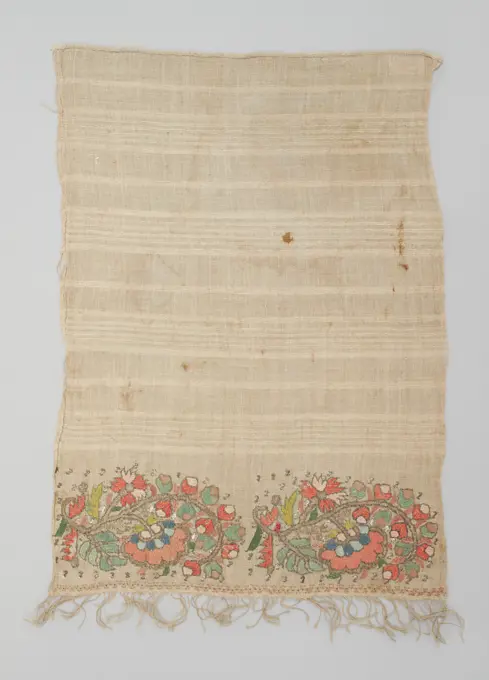
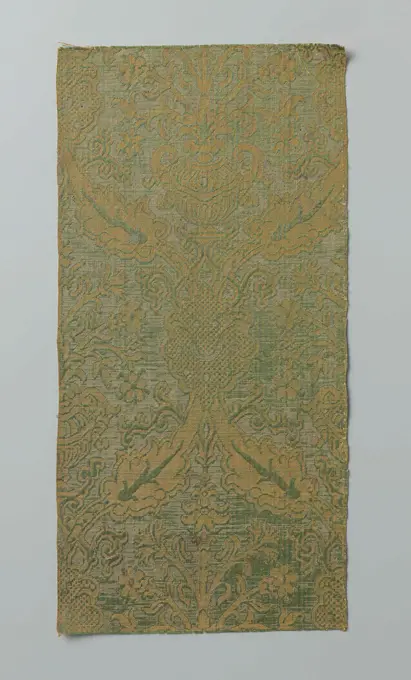
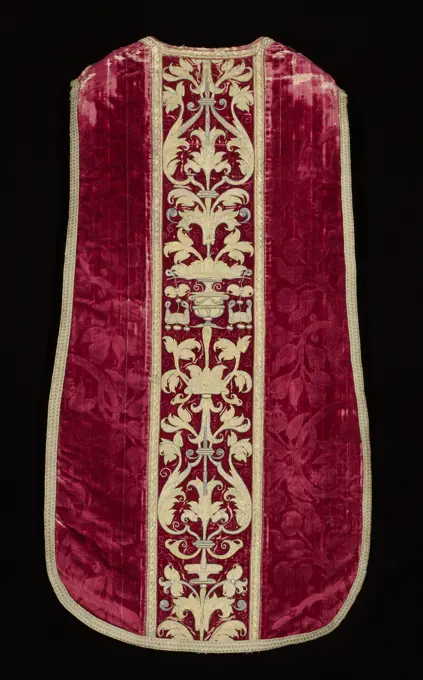
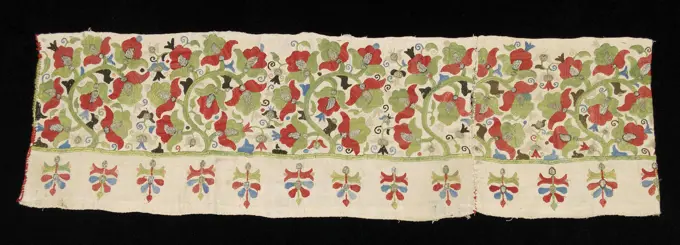
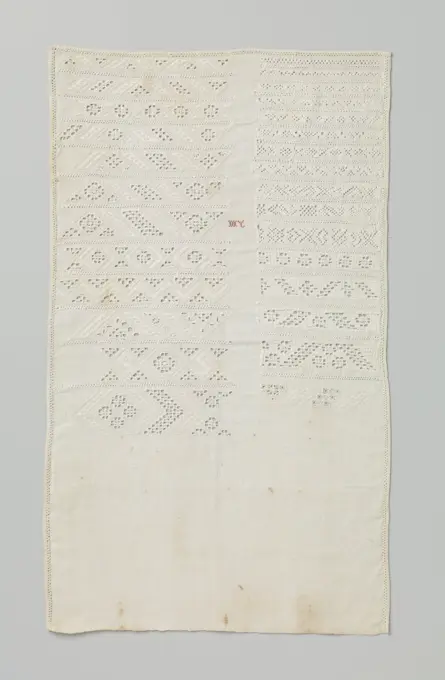
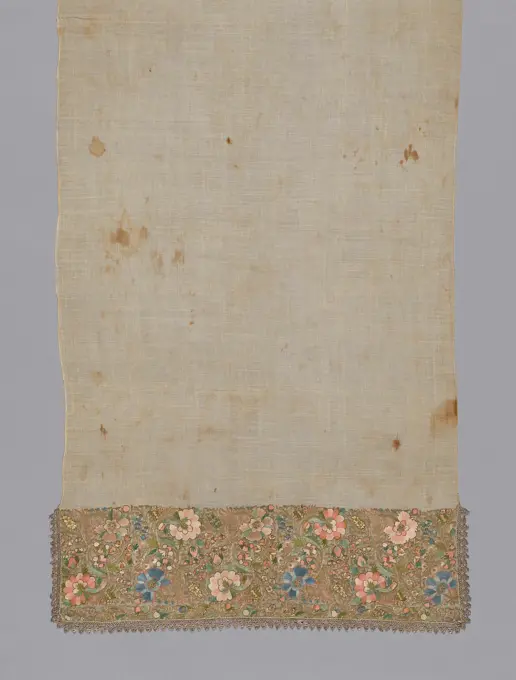
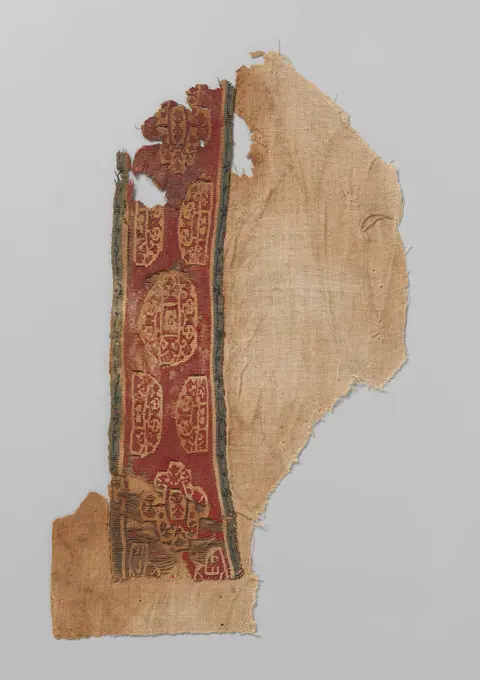
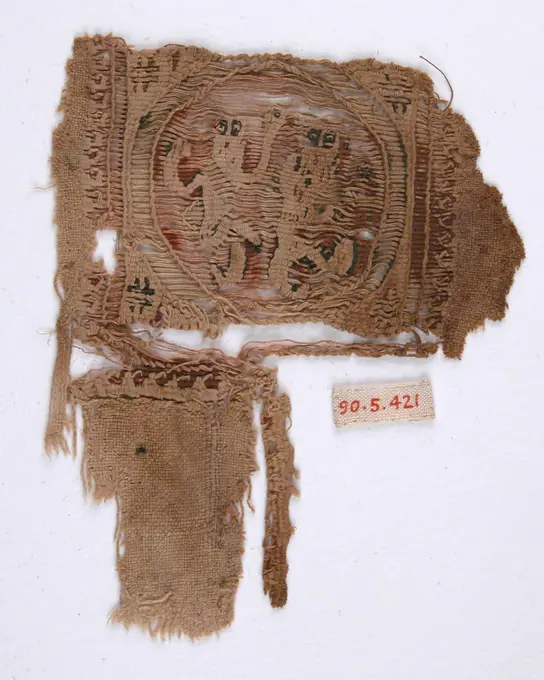
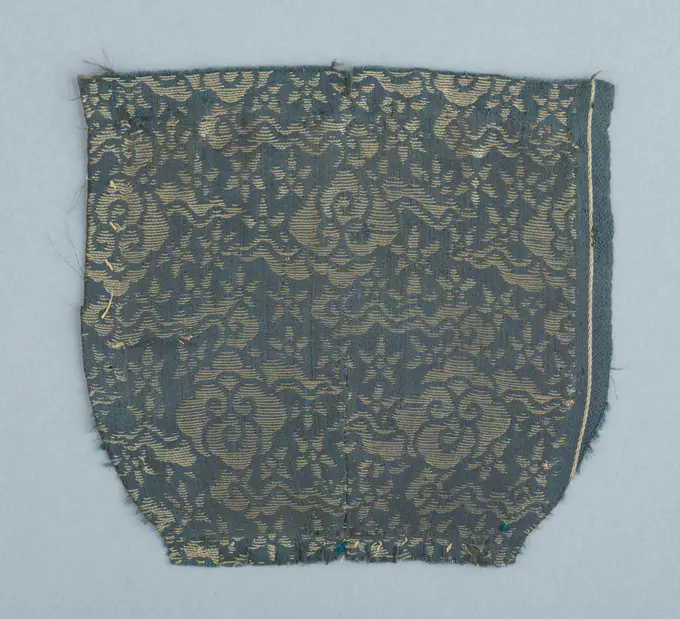
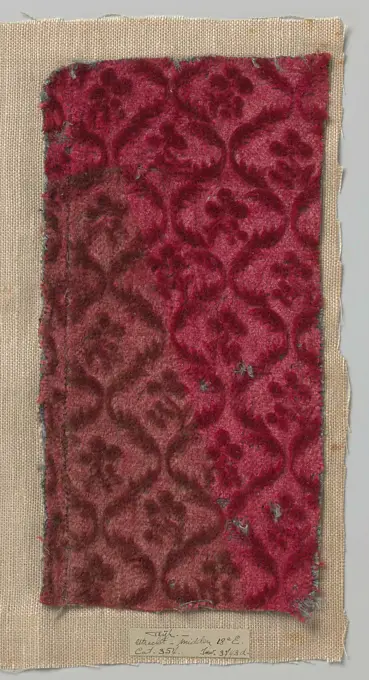
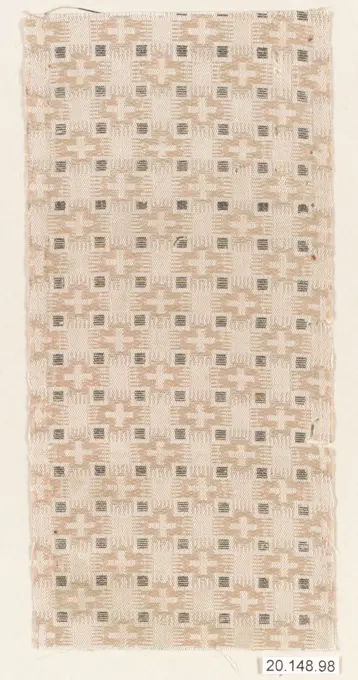
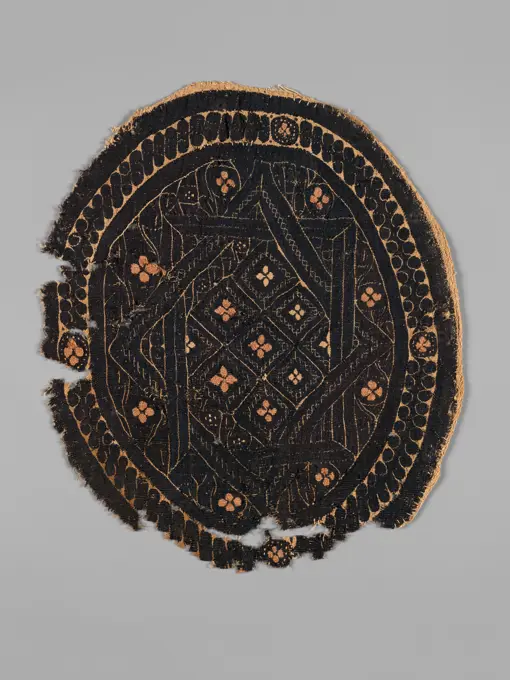
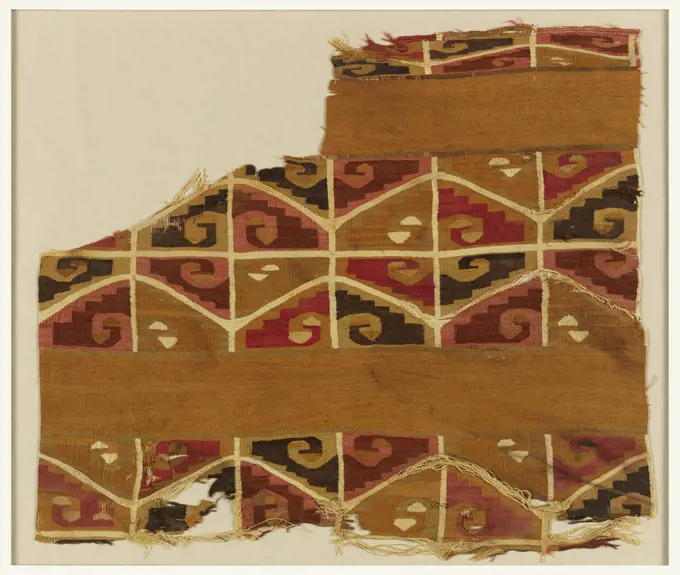
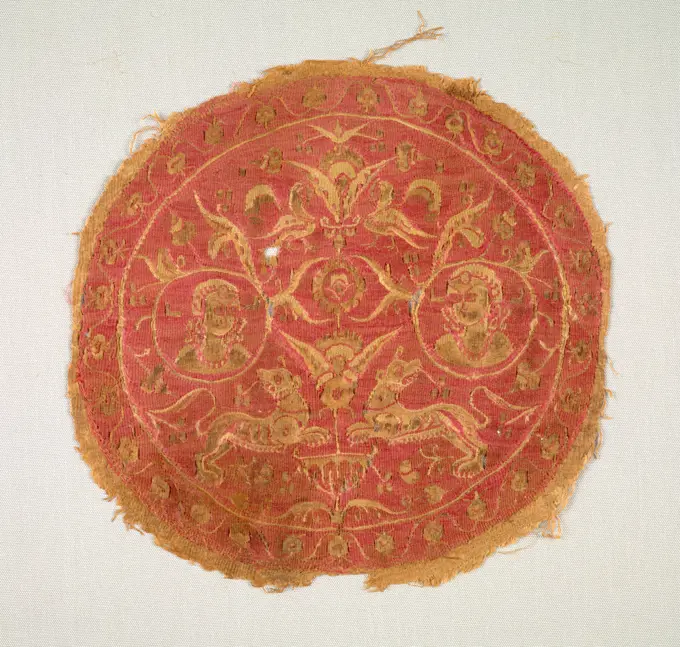
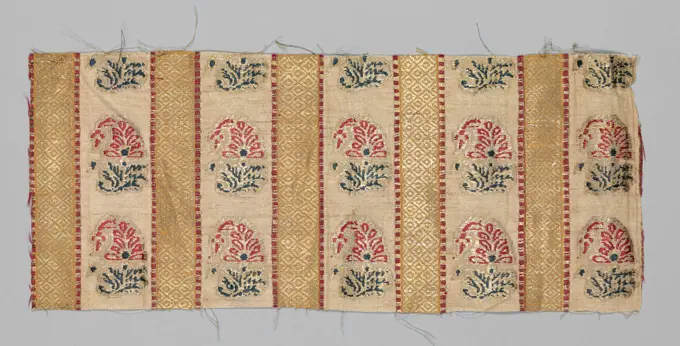
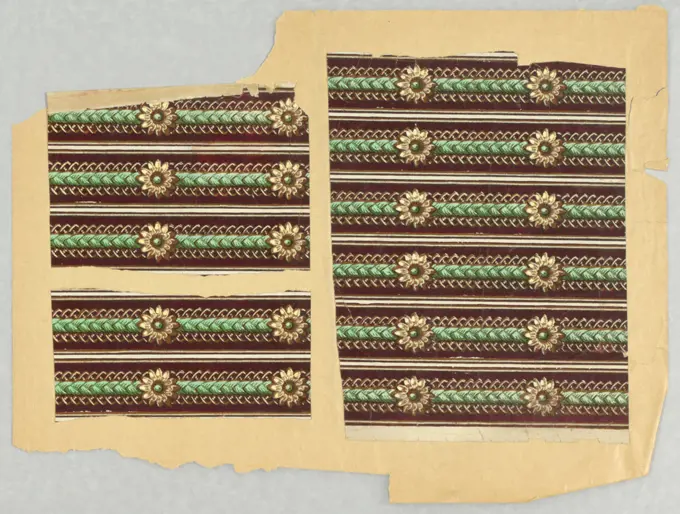
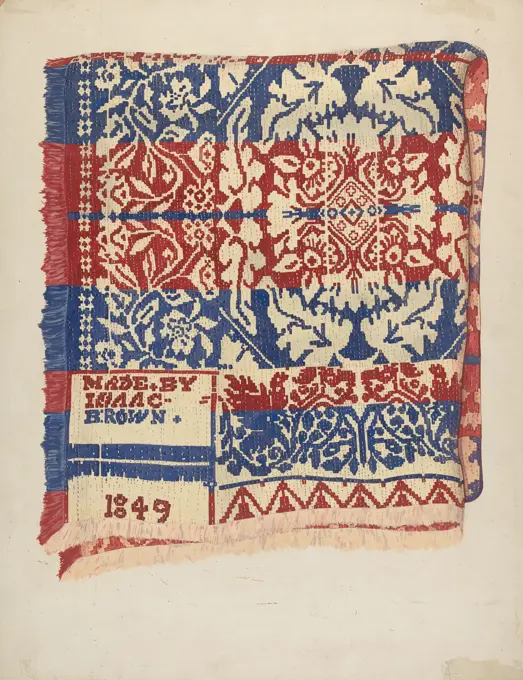
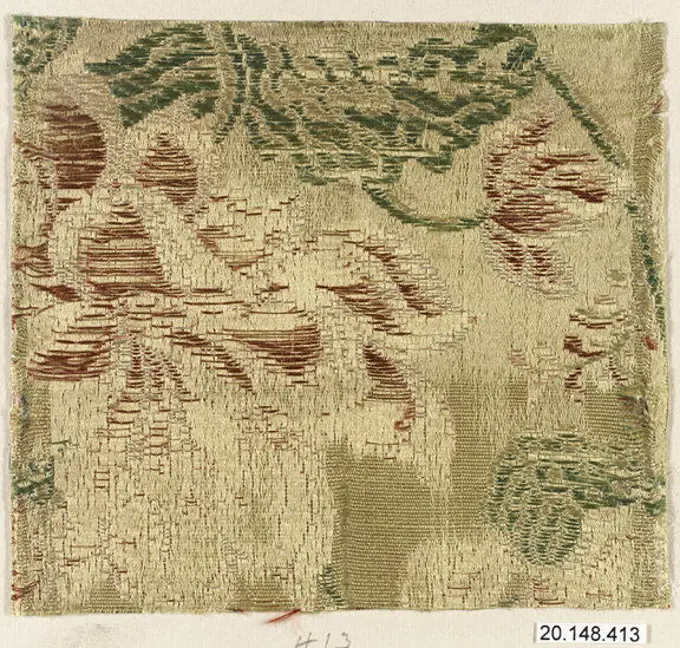
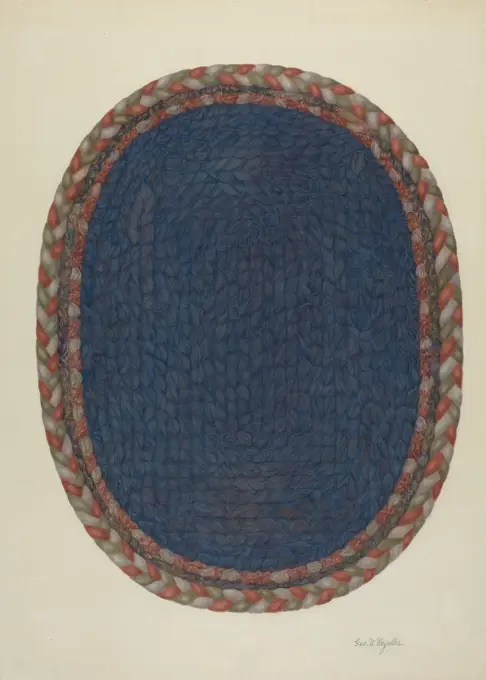
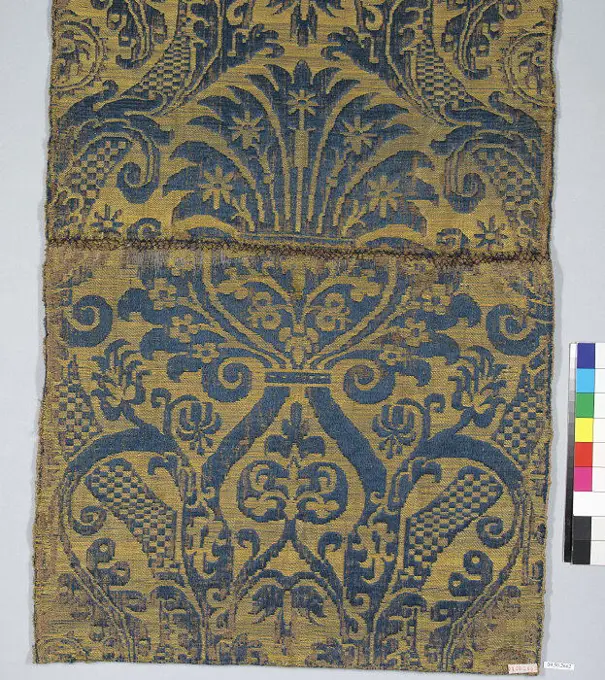
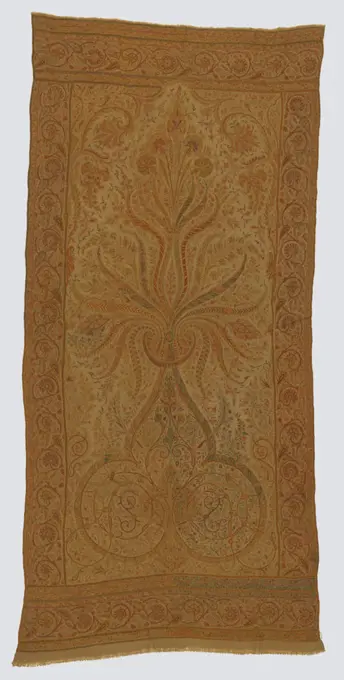
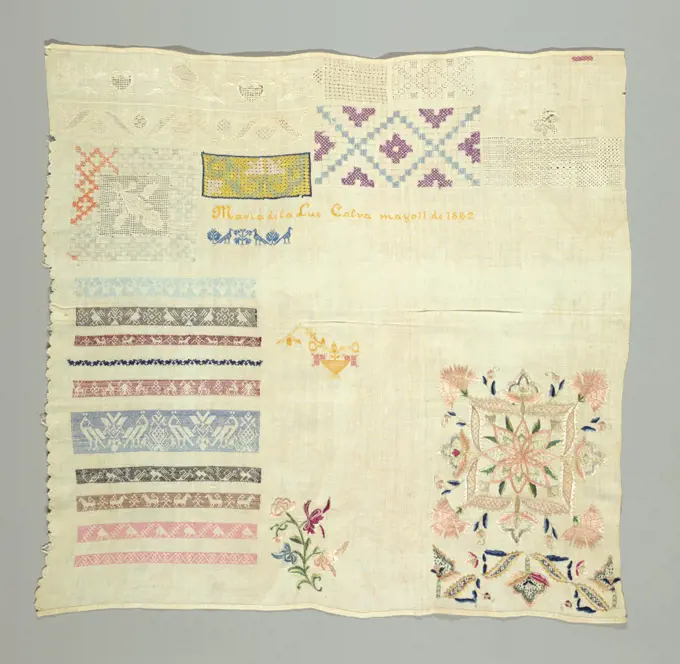
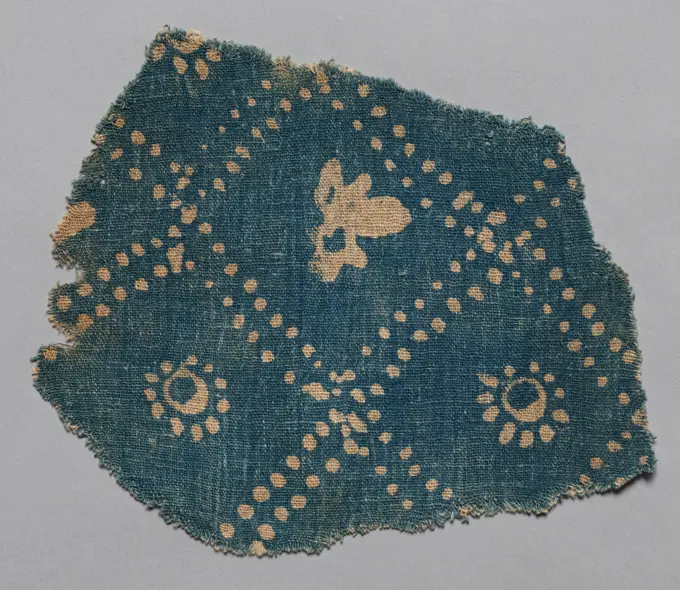
Fragment, 1100s - 1300s. India, 12th-14th century. Plain cloth, resist dyed; cotton; overall: 22.3 x 18.8 cm (8 3/4 x 7 3/8 in.).Piece 19th century Japan. Piece 71399Embroidered Band, 1500s - 1600s. Italy, 16th-17th century. Embroidery; silk on linen; overall: 11.5 x 34.3 cm (4 1/2 x 13 1/2 in.).Fragment veelkleurig zijde brocatel.Fragment silk tissue. A white ground has a symmetrical pattern with tendrils with lancet-shaped leaves that strike vases, which are vases with flowers, while on the nodes checked palmets, derived from the sword lily. The pattern is colored yellow and green.Chasuble, late 1600s. Spain, late 16th century. Silk, velvet, embroidery on orphery metallic thread, or nue; overall: 114.3 x 62.2 cm (45 x 24 1/2 in.).Textile, Medium: linen Technique: plain weave with supplementary weft, Tan linen ground with design of rosettes in red and tan. Design arranged in horizontal stripes with rosettes in diamond frames. No selvage present., Egypt, 10th-14th century, woven textiles, TextileTextile Fragment 3rd-4th century. Textile Fragment 443956Silk Fragment, 10th century. Syria, 10th century. Plain compound cloth; silk; overall: 18.4 x 16.2 cm (7 1/4 x 6 3/8 in.).Stomacher 1725-50 possibly British. Stomacher 168325Fragment of a shirt fourth quarter 18th century Russian. Fragment of a shirt 173433Strip Side Boarding. Strip native-colored side board work, work with knocked wires and snowed work.Fragment 16th century Italian. Fragment 230466Letter Case (Italy); straw, paper, linenGalloon 18th century German. Galloon. German. 18th century. Textiles-TrimmingsEmbroidery patch of linen on linen, c. 1680 - c. 1710 Embroidery patch of white linen on white linen. The embroidery has edges with different stitches and patterns and the initials MB. North Holland linen (material) embroidering Embroidery patch of white linen on white linen. The embroidery has edges with different stitches and patterns and the initials MB. North Holland linen (material) embroideringPiece 18th-19th century Japan. Piece 67513Towel Made 1850-1900 Turkey. Embroidered floral borders . AnonymousSample, Orinoka Mills, (Philadelphia, Pennsylvania, USA), A gold color warp and slightly different gold color weft form a tone on tone floral pattern., USA, ca. 1910, woven textiles, SampleMedallion (Egypt); warp; s-spun, z-twist linen. weft: s-spun woolsTissue fragment with clavus. Natural colored linen tissue fragment with tangled clavus with natural colored geometric motifs (circles, lob forms with small motifs) on red ground. The tire is trimmed with green edges with a black line drawing.Small Tablecloth, 19th century, 54 x 50 in. (137.16 x 127 cm), Linen; needlework, Switzerland, 19th centuryHead or Waist Wrapper (Pewo or Mbesa TaliTobatu)Textile Fragment 5th century. Textile Fragment 443907Fragment of fabric unknownFragment (Netherlands); linenFragment rood reliëffluweel.Fragment red relief veluweel. The pressed pattern has oval cartouches within which a flower branch.Fragments, Medium: silk Technique: supplementary warp forming cut and uncut pile in a plain weave foundation (velvet), Architectural and botanical ogives containg tripartite plant forms in pink, white and green., 16th-17th century, woven textiles, FragmentsTextile Fragment 4th-5th century. Textile Fragment 447334Five gold colored passes with fringes on cardboard. Cardboard on which five passs are secured, made of gold-colored wire with fringes. Red silk is also used in the upper two passes. On the cardboard are written in addition to the strips of the letters A to E.Textile, Medium: silk Technique: satin weave with supplementary weft patterning, A length of fabric woven specifically to be used to upholster a chair. Gold satin ground with neoclassical motifs for the back, seat top, and seat front (or arm) in red., France, 1800-1820, woven textiles, TextilePiece 18th century Japan. Piece 71092Embroidered Cover, 1800s. India, 19th century. Embroidery: silk, metal, and cotton thread on cotton ground; silk edging and velvet appliqué; overall: 125 x 88 cm (49 3/16 x 34 5/8 in.).Fragment (India); silk, metallic thread; Warp x Weft: 13.5 x 9 cm (5 5/16 x 3 9/16 in.); Bequest of Richard Cranch Greenleaf in memory of his mother, Adeline Emma Greenleaf; 1962-58-29Darning Sampler; silk embroidery on linen foundationRoundel 3rd-4th century. Roundel. 3rd-4th century. Linen, wool; tapestry weave. Attributed to Egypt. TextilesWomans Ceremonial Skirt (Tapis)Bed curtain border. Culture: Russian. Dimensions: 22 x 72 in. (55.9 x 182.9 cm). Date: 1790-1825.This object is from the collection of Natalia de Shabelsky (1841-1905), a Russian noblewoman compelled to preserve what she perceived as the vanishing folk art traditions of her native country. Traveling extensively throughout Great Russia, she collected many fine examples of textile art of the wealthy peasant class. From the 1870s until moving to France in 1902, Shabelsky amassed a large collection of intricately embroidered hand-woven household textiles and opulent festival garments with rich decoration and elaborate motifs. The Brooklyn Museum holdings include many fine examples including the majority of the garments. Portions of Shabelsky's collection are also housed at the Museum of Fine Arts, Boston, the Cleveland Art Museum, and the Russian Museum of Ethnography in St. Petersburg.Russian bed curtains and towels were not only used for decorative purposes, but also provided an importEmbroidered kerchief trimming unknownFragmentTrimming fragment, Medium: silk Technique: woven, Floral spray. In yellow and tan on blue., France, ca. 1830, woven textiles, Trimming fragmentPiece 17th century Italian. Piece 225185Excerpt multicolour, anonymous, 1750 Fragment multicolored silk tissue. A green soil has a pattern of white, stylized leaf hangers with bows between which multi -colored flower branches. Spain silk Fragment multicolored silk tissue. A green soil has a pattern of white, stylized leaf hangers with bows between which multi -colored flower branches. Spain silkFragment (Japan)Piece 18th-19th century Japan. Piece. Japan. 18th-19th century. Silk. Textiles-WovenFragment, Medium: silk, metallic Technique: twill with complementary wefts and inner warps (samite), Portion of a horizontal band with a fret pattern motif., Spain or Italy, 13th century, woven textiles, FragmentTextile Fragment 5th-6th century. Textile Fragment 444231Conciliate belt;  18th century (1701-00-00-1800-00-00);Fragment (Spain); linen warp, cotton weftFragment; linenBorder Fragments (Italy); silkPiece 18th-19th century Japan. Piece. Japan. 18th-19th century. Silk. Textiles-WovenTunic fragment, Medium: cotton, wool Technique: single interlock tapestry, 1:1, A fragment with geometrical figures is strongly suggestive of Tiwanaku IV () art. The background is dark tan, the design in light tan, medium and dark brown, light red, red-brown, and purple red., Peru, 800, woven textiles, Tunic fragmentBusts and Animals Under Tree of Life, late 700s - 800s. Egypt, Islamic period, Abbasid, 8th - 9th century. Plain weave and slit-tapestry weave; undyed linen, dyed wool; overall: 20.3 x 20.3 cm (8 x 8 in.); mounted: 28.6 x 28.6 cm (11 1/4 x 11 1/4 in.).Fragment. Chimú; Probably north coast, Peru. Date: 1250-1532. Dimensions: 69.9 x 35.6 cm (27 1/2 x 14 in.). Cotton and wool (camelid), plain weave with brocading wefts. Origin: Peru. Museum: The Chicago Art Institute, USA.Band 16th century Italian Colorful silk embroidery complements the bleached ground of this gauze-weave linen textile. To produce such a fine, yet robust, buratto cloth, the warp and weft threads are highly twisted and plied, which creates a mesh-like surface that is well suited to receive embroidery. The cloth was woven in a narrow band and both selvages are preserved.. Band 213099Textile Fragment 18th century. Textile Fragment. 18th century. Silk and metallic thread; brocaded. Made in India. Textiles-BrocadesFragment (Spain); silk, metallic; Warp x Weft: 18.1 x 16.8 cm (7 1/8 x 6 5/8 in.)Chalice cover, Medium: linen Technique: grid of withdrawn element with needle lace, reticella style, Center of cover is a woven square with an insertion of reticella. Around center piece are evenly spaced geometric motifs of reticella. Outer border has foliated forms and triangular pendants of reticella., Italy, 17th century, lace, Chalice coverBorder, Block-printed, Fancy gimp with braided ribbon and floral (daisy) boss. Printed in green, tan and brown, on a white ground., possibly France, possibly USA, 1840-60, Wallcoverings, BorderCope with Hood Cast 1801-1900 Italy. Silk, wild silk and gilt-metal-strip, plain weave with plain interlacing of secondary binding warps and supplementary patterning wefts; edged with silk and gilt-metal-strip-wrapped linen, plain weave with supplementary patterning wefts forming weft loop fringe; lined with silk, plain weave .Band Fragment with Botanical Decoration Coptic. Band Fragment with Botanical Decoration, 5th-7th century C.E. Linen, wool, 4 1/4 x 4 3/4 in. (10.8 x 12.1 cm).   Egyptian, Classical, Ancient Near Eastern Art 5th-7th century C.E.Katherine Hastings, Coverlet, c 1938 CoverletPiece 18th century China. Piece 71404Piece 18th century Japan. Piece 67195Textile Fragment 7th century Coptic. Textile Fragment 475259George V Vezolles, Shaker Rug, c 1941 Shaker RugFragment silk tissue of a seat cover., C. 1805 Fragment yellow silk tissue, from a seat cover. The pattern has pink palmets and arabesks on a yellow ground. The fragment is part of thirteen fragments with invnr. BK-1992-18-A to BK-1992-18-M. France silk Fragment yellow silk tissue, from a seat cover. The pattern has pink palmets and arabesks on a yellow ground. The fragment is part of thirteen fragments with invnr. BK-1992-18-A to BK-1992-18-M. France silkUnhealthy or corded ball shoe or bridal shoe made of cream-colored satin with golden embroidery. Ball shoe or bridal shoe, not yet sewn or seedless, creamy satin with golden embroidery. Model: Hopeless model with square nose; Only in circumference indicated with driving wire on a rectangular laptop satin that is attached to a lining of mul. On the cover page a palm in pointed arch embroidered from O.A. Insert Cannetille gold thread. In the mode of the restoration. NETHERLANDS, CA. 1820.Piece 16th-17th century Spanish. Piece 217320Piece 18th-19th century Japan. Piece 67836Textile Japan 19th centuryFour jabots, anonymous, c. 1800 - c. 1810 Jabot of linen consisting of a double smooth edge with two strips of which are sewn, the upper of which is very finely pleated and the bottom in wider flat pleats are folded and ironed. A founded buttonhole in the smooth edge. Netherlands Board: Linen (Material). Strip: Linen (Material) Jabot of linen consisting of a double smooth edge with two strips of which are sewn, the upper of which is very finely pleated and the bottom in wider flat pleats are folded and ironed. A founded buttonhole in the smooth edge. Netherlands Board: Linen (Material). Strip: Linen (Material)Piece 18th-19th century China. Piece 67497Textile Fragments ca. 1635Saddle unknownFragment of Shoulder Band 5th-6th century. Fragment of Shoulder Band 444157Stop patch from linen., 1758 Stop patch of linen, on which embroidered is the letters and the year 1758. Netherlands linen (material) embroidering Stop patch of linen, on which embroidered is the letters and the year 1758. Netherlands linen (material) embroideringSampler 1827 British. Sampler. British. 1827. Silk and wool. Textiles-EmbroideredConciliate belt;  18th century (1701-00-00-1800-00-00);Fragment Made 801 CE-1300 Egypt. Plain compound cloth . CopticPrinting Block (USA); wood, metalNapkin with flowers and garlands, anonymous, c. 1800 - c. 1810 Linnamast napkin with flowers and garlands. Midfield: A straight -up fine swinging branch, with cord and brush, is intersected by a wide wavy -leafed branch. Edges: three times a straight list, coordinously wound; The middle one is wide and with leaves wound, the outer narrow and with a fine flower branch overranks. Brabant (possibly) linen (material) damask Linnamast napkin with flowers and garlands. Midfield: A straight -up fine swinging branch, with cord and brush, is intersected by a wide wavy -leafed branch. Edges: three times a straight list, coordinously wound; The middle one is wide and with leaves wound, the outer narrow and with a fine flower branch overranks. Brabant (possibly) linen (material) damaskShawl, Medium: wool Technique: embroidered, Cashmere shawl with embroidery in shades of yellow, orange, green and brown. A tan ground in a design of large floral ornament set in a panel surrounded by borders., India, 18th century, embroidery & stitching, ShawlMiniature Mantle and Poncho Paracas (rectilinear). Miniature Mantle and Poncho, 200-600 C.E. Camelid fiber, Mantle: 4 5/16 x 6 11/16 in. (11 x 17 cm).   Arts of the Americas 200-600 C.E.Handkerchief. China for the European market, circa 1880. Costumes; Accessories. Silk plain weave with silk embroideryShaker Linen. Dated: 1935/1942. Dimensions: overall: 25 x 22 cm (9 13/16 x 8 11/16 in.). Medium: watercolor and graphite on paper. Museum: National Gallery of Art, Washington DC. Author: George Constantine.Fragment zasłony. unknown, authorFragment rękawa tuniki. warsztat egipski, workshopRosette Fragment Coptic. , 5th-7th century C.E. Flax, wool, 3 1/4 x 4 1/4 in. (8.3 x 10.8 cm).   Egyptian, Classical, Ancient Near Eastern Art 5th-7th century C.E.Sampler, Maria de la Luz Garcia, Medium: wool, silk Technique: embroidered in satin, stem, knot, cross, buttonhole, chain, herringbone, feather, and running stitches with withdrawn element work and needle made fillings on plain weave foundation, Unfinished sampler with horizontal bands of animal patterns in running stitch imitating weaving in the lower left corner, a large floral motif in the lower right corner, a various geometric pattern bands, withdrawn element work, and spot motifs scattered over the ground. Embroidered in pale shades of brown, blue, green, yellow, and pink on a natural ground., Mexico, May 11, 1852, embroidery & stitching, SamplerFragments (Spain); silk, metallic threadPiece 17th century Japan. Piece. Japan. 17th century. Silk / Compound weave. Textiles-WovenPiece 18th century China or Japan. Piece 71890Typographic tires, c. 1890 - c. 1922  Among other things with triangles, circles and tulips. Page 15 Recto from a sketchbook with 43 sheets.  paper. pencil. ink pen / brush flowers ~ ornament. ornament ~ geometric motifsFragment of the fabric;  after. 18th century (1740-00-00-1750-00-00);Garthwaithe, Anna Maria (1688-1763), Flowers, fabrics, patterned fabricsBag face. Date/Period: Ca. 1810. Bag face. Medium: linen. Technique: needle lace with ground of loop and twist with twist return. Author: UNKNOWN.Bedcover and Pillow ShamsCope. Italy or Sicily. Date: 1601-1675. Dimensions: 135.4 x 289.7 cm (53 3/8 x 114 1/8 in.). Silk, satin weave; underlaid with linen, plain weave; embroidered with silk, gilt-metal-strip-wrapped silk and gilt-metal-strips in crossed back, running, satin, and split stitches; laid work, couching, and padded couching; beaded with coral beads; edged with woven tapes. Origin: Italy. Museum: The Chicago Art Institute, Chicago, USA.Textile Fragment 10th-11th century. Textile Fragment 451779Medallion (Egypt); warp; 2 ply s-spun z-twist linen. wefts; s-spun linen, s-spun wool