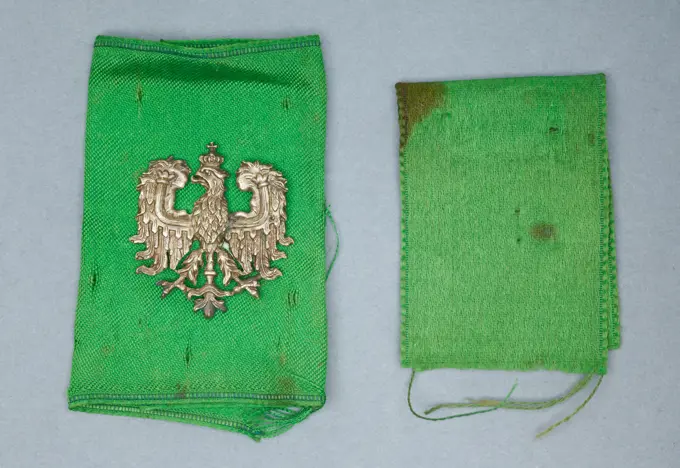
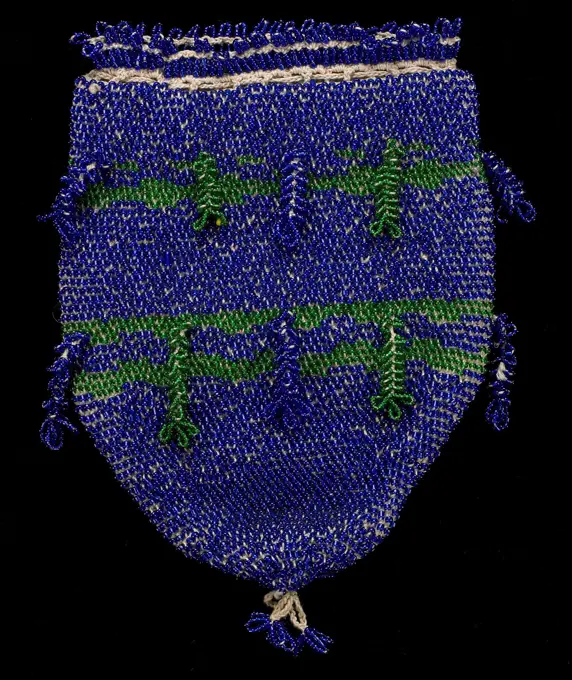
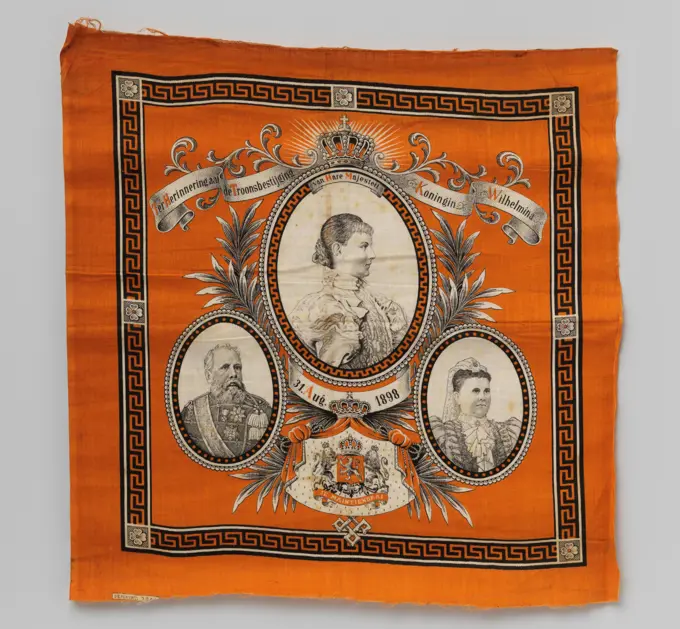
Textile Fragments And Embroidery

Historic textile fragments featuring intricate silk embroidery and colorful patterns, highlighting craftsmanship from various cultures and periods.

Red side fragment with pattern in gold and silver wire, anonymous, c. 1600 - c. 1699 Fragment of red silk with a pattern in a twill of browned gold and silver thread, probably in the form of cartouches, filled with feather plume-shaped figures, and surrounded by wide ornament tires. Netherlands silk.. lampas (textile material) Fragment of red silk with a pattern in a twill of browned gold and silver thread, probably in the form of cartouches, filled with feather plume-shaped figures, and surrounded by wide ornament tires. Netherlands silk.. lampas (textile material)
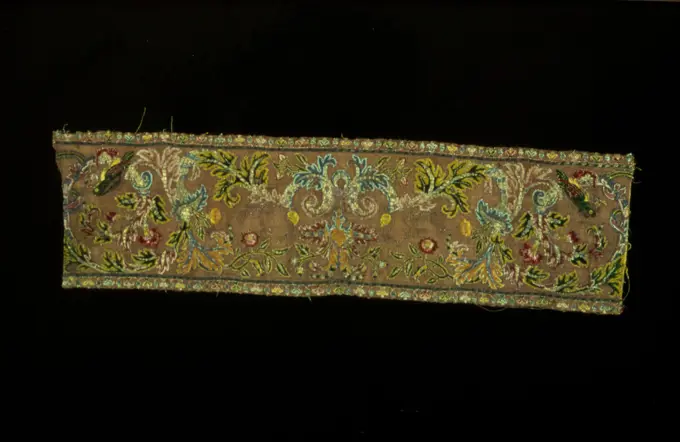
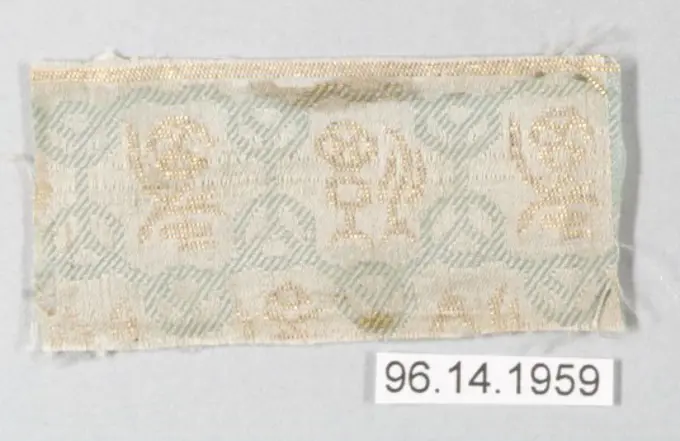
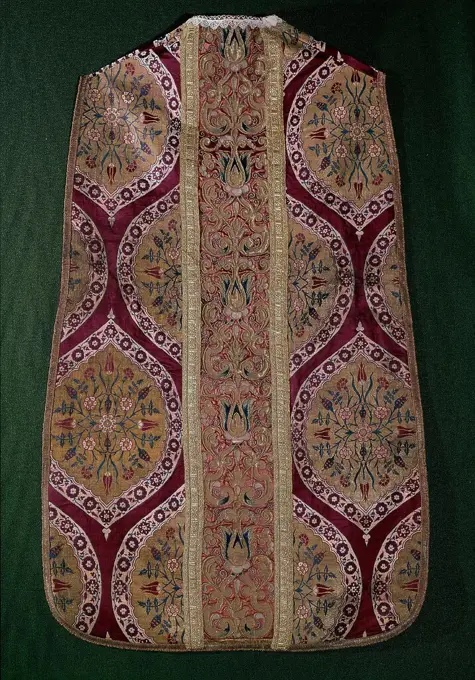
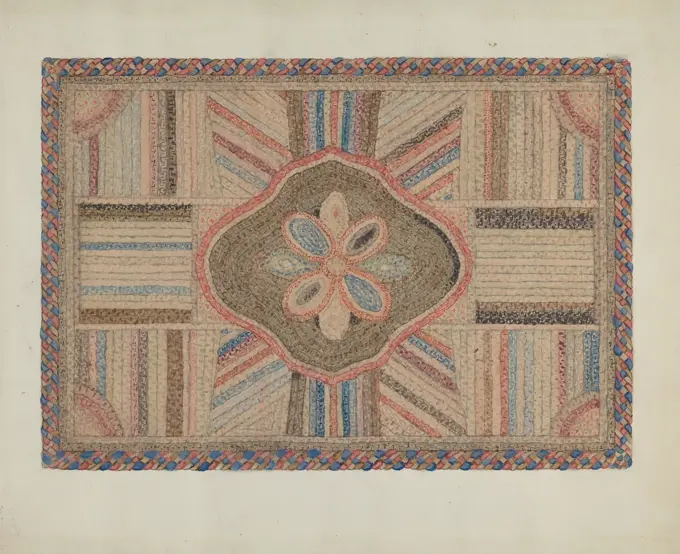
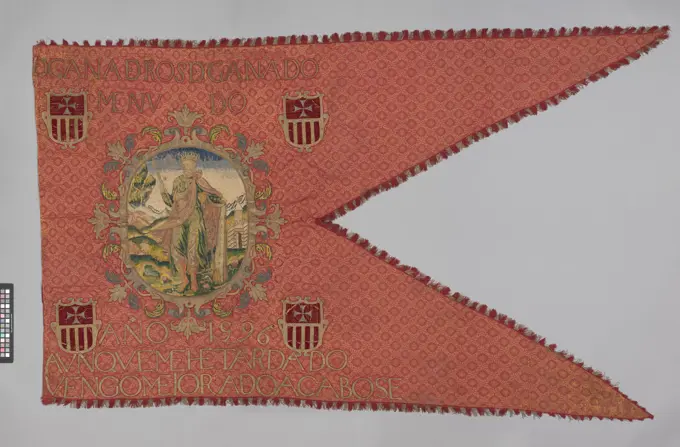
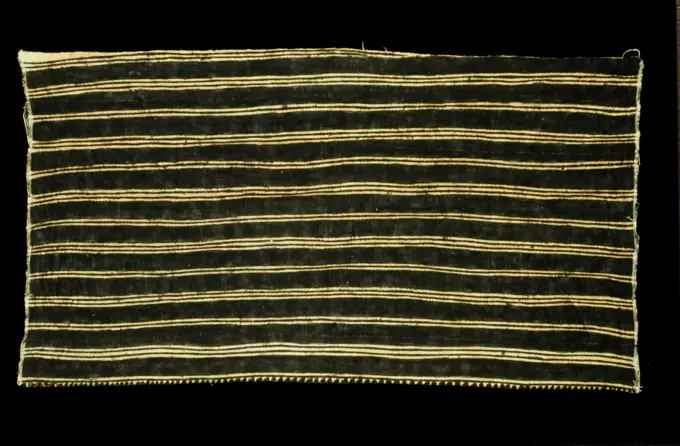
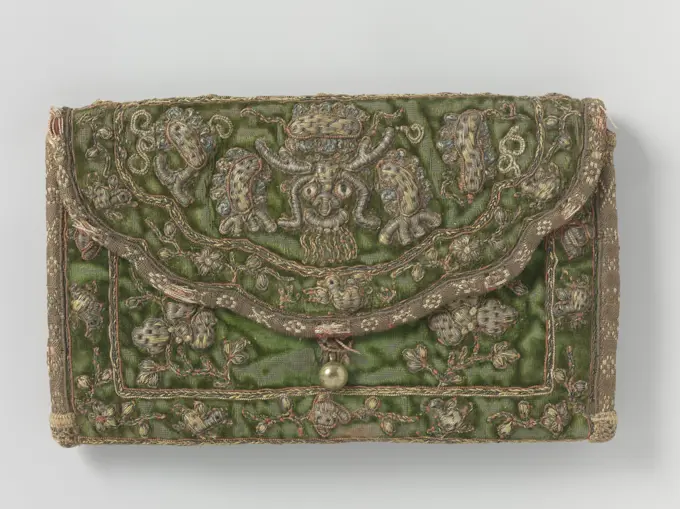
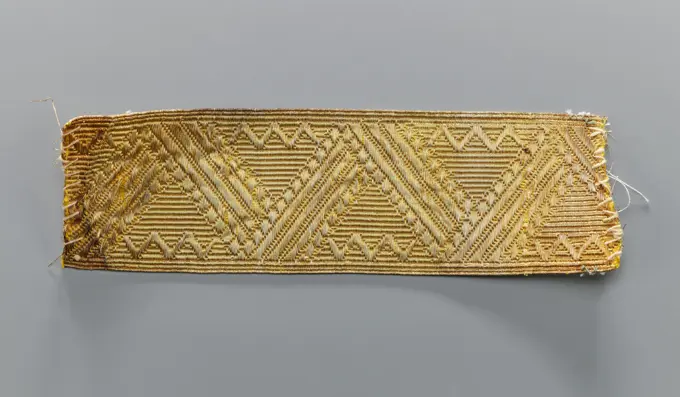
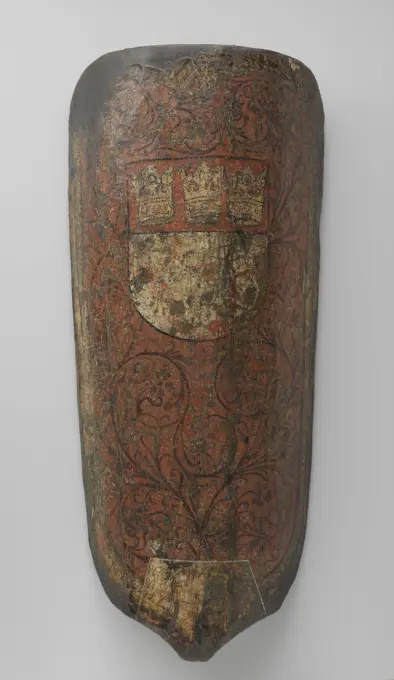
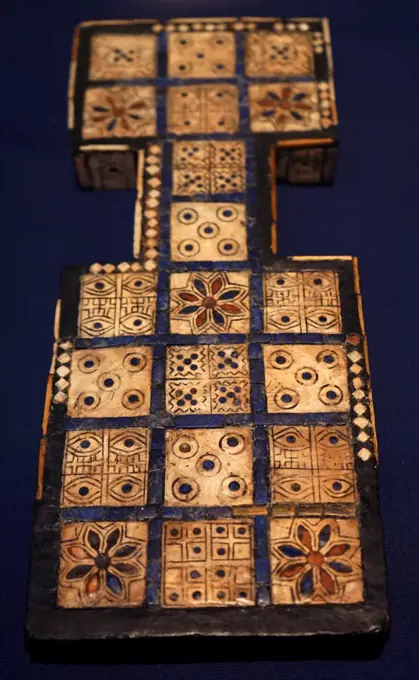
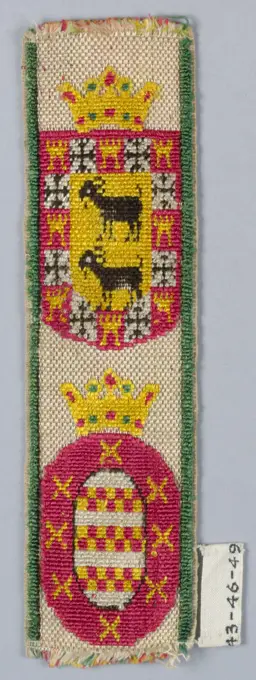
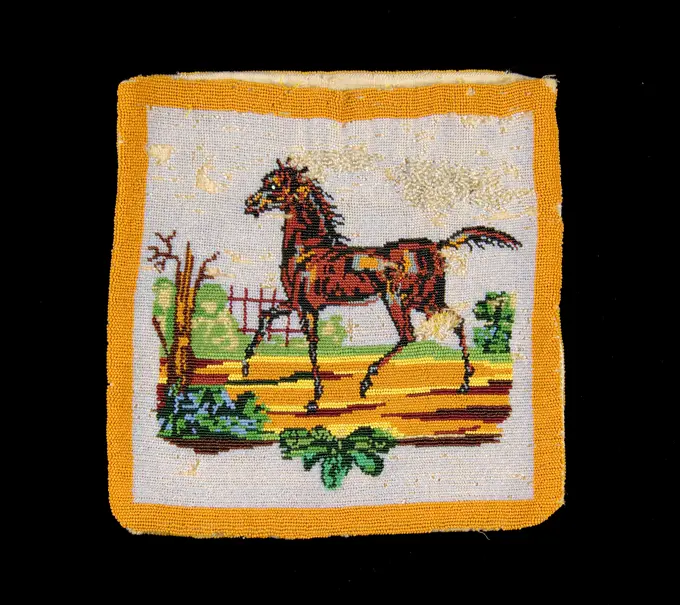
Fragment Light silk with embroidered partially dragged stripes, semic circles, rectangles with scalloped edge, graceful flowers and rays, c. 1790 - c. 1820 Fragment (a) Light silk with embroidered partially flared stripes, whole and semi -circles, rectangles with scalloped edge, graceful flowers and rays. Corresponding small fragment (B) with identical pattern. France Ca. 1820. France (possibly) silk. paillette. embroidering Fragment (a) Light silk with embroidered partially flared stripes, whole and semi -circles, rectangles with scalloped edge, graceful flowers and rays. Corresponding small fragment (B) with identical pattern. France Ca. 1820. France (possibly) silk. paillette. embroideringPiece 18th century Japan. Piece. Japan. 18th century. Silk / Compound weave. Edo period (1615-1868). Textiles-WovenLivery Trimmings; silk; Bequest of Richard Cranch Greenleaf in memory of his mother, Adeline Emma Greenleaf; 1962-56-35-a/hTextile, Date UnknownBand; linen, silk, metallic thread; Bequest of Marian Hague; 1971-50-227Piece 18th-19th century Japan. Piece 67671Trimming (France); silkFragment; silk, metallic threadFragment, 400s - 650. Egypt, Byzantine period, 5th to mid-7th century. Tabby weave with interwoven tapestry ornament, linen and wool; overall: 7 x 17.2 cm (2 3/4 x 6 3/4 in.).Chasuble late 18th century probably Portuguese The extensive appliqué work almost completely covers the substrate of the chasuble. A great deal of attention was paid to creating the lively color combination; the lavish use of primary colors lends a certain naive quality. The gleaming braid, with its serpentine scallop, adds to the overall decorative appearance.. Chasuble 158329Panel Bag ca. 1840 Cree-Métis. Panel Bag 319156Textile Fragment 5th century. Textile Fragment 443917Fragment; linenBand Fragment with Botanical Decoration Coptic. Band Fragment with Botanical Decoration, 5th-7th century C.E. Flax, wool, 2 x 6 3/4 in. (5.1 x 17.1 cm).   Egyptian, Classical, Ancient Near Eastern Art 5th-7th century C.E.CASULLA BORDADA EN ORO S XVI. Location: CONVENTO DE LAS CLARISAS / MUSEO DE ARTE SACRO. MONFORTE DE LEMOS. LUGO. SPAIN.Cushion Cover with Coats of Arms 1600-1650 Northern Germany, probably Hamburg. Cushion Cover with Coats of Arms 461426Elbert S Mowery, Shirred Rug, c 1936 Shirred RugCap 1850-99 Montenegrin. Cap 173291Palla with embroidery where a madonna with child is embroidered within a flower edge, anonymous, c. 1675 - c. 1699 Palla with embroidery. A Madonna with a child is embroidered within a flower edge. The palla is deposited with gold side and has four glans -shaped brushes. The palla is part of six ecclesiastical embroidery with Invs. BK-1966-54-A to BK-1966-54-F. Italy . embroidering Palla with embroidery. A Madonna with a child is embroidered within a flower edge. The palla is deposited with gold side and has four glans -shaped brushes. The palla is part of six ecclesiastical embroidery with Invs. BK-1966-54-A to BK-1966-54-F. Italy . embroideringBanner 1596 Spanish Based on the embroidered inscription, this banner apparently belonged to a confraternity of shepherds who cared for the flocks of a Mercedarian monastery. Both religious and military orders had close associations with the Mesta (livestock organization) at this period.. Banner 228734Mudcloth skirt, 20th century, 76 x 32 in. (193.04 x 81.3 cm) (uneven; with frayed fringe), Cotton; mudcloth (bogolanfini); dyed, Mali, 20th centuryLetter bag in an envelope model of green velvet, embroidered with a mask -like face on the front and a fantasy animal on the back, anonymous, c. 1700 - c. 1715 Letter bag in a flat envelope model of green velvet, on which in relief with silver thread is a mask -like face on front and a fantasy animal embroidered on the back, both surrounded by a list of flowers and small birds. The edge of the bag is trimmed with a brown silk wire with ecrin -tasty ornaments. The two lower corners are reinforced with embroidery. The lining is made of unadorned red cotton. Two equal courses on the inside, reinforced with paper. The valve closes by means of a loop of multiple colors of silk wire and a copper ball. Europe (possibly) whole: velvet (fabric weave). Decoration: Silk. Decoration: Silver thread. Closure: Copper (Metal). Gilding (Material) cutting / gilding / forging / embroidering Letter bag in a flat envelope model of green velvet, on which in relief with silver thread is a mask -like face on Sutra Covers with the Eight Buddhist Treasures China This pair of sutra covers was made for an edition of the Tibetan Buddhist canon produced in Beijing at the order of the emperor in 1410. A triple flaming jewel is flanked by four of the Eight Buddhist Treasures. Unlike Chinese texts, which were either in scroll or accordion-fold-book format, Tibetan texts were formatted as stacks of horizontal, loose-leaf sheets that would have fit between these covers.. Sutra Covers with the Eight Buddhist Treasures. China. Red lacquer with incised decoration inlaid with gold. Ming dynasty (1368-1644), Yongle period (1403-24). LacquerDraperie of a bed garnish of yellow waved wool with green passion and hanging spools, c. 1795 - c. 1815 A drapery for over a curtain stick, belonging to Bedgarnituur of yellow waved wool, Omboard with green passion with a yellow motif and with a green and yellow border with hanging spools that are wound with yellow and green silk. Northern Netherlands wool. passement: silk A drapery for over a curtain stick, belonging to Bedgarnituur of yellow waved wool, Omboard with green passion with a yellow motif and with a green and yellow border with hanging spools that are wound with yellow and green silk. Northern Netherlands wool. passement: silkFragment (Italy); linen, silk; Bequest of Marian Hague; 1971-50-195Gallon;  beginning of the 19th century (1901-00-00-1910-00-00);Panneau dekoracyjne. unknown, craftsmanEight gallons;  19th century (1801-00-00-1900-00-00);Textile Fragment 16th-17th century. Textile Fragment 454447Piece 18th century Japan. Piece 72190Purse late 17th century British or French. Purse 222251Mitaine of white knitted cotton, anonymous, c. 1875 - c. 1895 Mitaine made of white knitted cotton with a broken pattern of wide and narrow zigzigbanden. The part that falls over the palm is subdivided into five scallops. No thumb. West-Europa whole: Cotton (textile) knitting Mitaine made of white knitted cotton with a broken pattern of wide and narrow zigzigbanden. The part that falls over the palm is subdivided into five scallops. No thumb. West-Europa whole: Cotton (textile) knittingSample Card Of Macramé (Germany); Height of card: 23.5cm (9 1/4in.). Width of card:24.5cm (9 5/8in.).Fragments of silk fabric from the sides of the chasuble  a pattern of belts filled with geometric and vegetable ornament unknownRoundel with Botanical and Geometric Decoration Coptic. Roundel with Botanical and Geometric Decoration, 5th-7th century C.E. Flax, wool, 4 5/16 x 4 5/16 in. (11 x 11 cm).   Egyptian, Classical, Ancient Near Eastern Art 5th-7th century C.E.ARQUETA DE CARRION DE LOS CONDES - 42x24x20 cms. Location: MUSEO ARQUEOLOGICO NACIONAL-COLECCION. MADRID. SPAIN.Textile Fragment 16th-17th century. Textile Fragment 452855Pommel Plate of a Saddle (from the Garniture of Rudolf II), c. 1571. Anton Peffenhauser (German, 1525-1603). Blued, etched, and gilded steel; overall: 31.3 x 17 cm (12 5/16 x 6 11/16 in.). This plate, one of two and once part of a saddle, is from tournament armor made for man and horse made for the sons of Emperor Maximilian II, archdukes Rudolf and Ernst. Most of the remaining elements of this armor are still in the collections of the Imperial Armouries in Vienna. The decorative pattern (in the imperial colors of black and gold) forms elegant knots, with distinctive foliage and hop sprigs filling the loops.Textile 19th century Japan. Textile 68010Wampanoag textile designs were made from plant fibers twisted into cording, then dyed using natural dyes made from plants and then woven into bags, sleeping mats and wall coverings.Trimming, Medium: silk Technique: woven, Yellow, white and brown trimming fragment in a design of an open flower alternating with lozenges decorated in scroll pattern., France, 1800-1810, trimmings, TrimmingLegging strip  -Feathered Panel. Culture: Wari. Dimensions: H. 27 1/2 x W. 83 1/2 x D. 3 1/4 in. (69.9 x 212.1 x 8.3 cm). Date: A.D. 600-900.The discovery of an ancient burial or ceremonial site in the upriver region of the Churunga Valley, in far south Peru, received little attention in the turbulent world of 1943. Decades later, it would take two generations of Andean scholars to painstakingly piece together the puzzling story of this discovery, which included the largest and most spectacular find of Precolumbian Peruvian feather work to date.Protected from decay by being rolled, placed into large ceramic jars, and buried in the arid soil, the cache included an estimated ninety-six panels, each densely covered with tens of thousands of small glossy macaw body feathers, primarily from the blue and yellow macaw (Ara ararauna). Although these panels were found in the dry western foothills of the Andes, the birds' home is the Amazonian rainforest, far to the east. The effort required to secureBorder, Machine-printed paper, Small portion of a paper, probably for a border, showing a band of vine with grapes, leaves and flowers. Printed in yellow, orange, brown and black., USA, ca. 1870, Wallcoverings, BorderJewellery from 19th century, Thailand, Southeast Asia, Asia&10,Strip -Collar, 1821-1850, 30 x 13 1/4 in. (76.2 x 33.7 cm), Silk, China, 19th centuryCap. Culture: Bolivia or Peru. Dimensions: H. 31 3/4 x W. 6 3/4 in. (80.6 x 17.1 cm). Date: 17th century. Museum: Metropolitan Museum of Art, New York, USA.Festival Yoke, c. 1940, 32 1/2 x 16 1/4 in. (82.55 x 41.3 cm), Cotton, cross stitch, brocade, applique, and embroidery, China, 20th centuryEmbroidered Rank Badge for Civil Official 19th century China. Embroidered Rank Badge for Civil Official 44243Shawl Made 1801-1850 India. Wool, pieced twill weaves; embroidered in back, buttonhole, fishbone, satin, and stem stitches; laid work and couching; main warp fringe .Fragment, Medium: Warp; S-spun linen, Wefts; s-spun linen, S-spun wool Technique: slit tapestry woven, Purple basket or vase on goblet base containing five rounded fruit-like objects. Fragment from a garment or a textile decoration., 4th century, woven textiles, FragmentShoulder clasp from the ship-burial at Sutton Hoo, Anglo-Saxon, early 7th century.Wool Fragment, 3rd century. Syria, 3rd century. Tapestry weave: wool; average: 7.7 x 2.6 cm (3 1/16 x 1 in.).Fragment, Medium: silk, linen Technique: 4&1 (5-harness) satin, Stripes of rose, black, yellow and ivory., Middle East, 13th century, woven textiles, FragmentFragment, 1100s - 1300s. India, 12th-14th century. Plain cloth, hand painted; cotton; overall: 7.7 x 15 cm (3 1/16 x 5 7/8 in.).Textile Fragment, Unascertainable or possible Border Proto-Nasca (curvilinear). Textile Fragment, Unascertainable or possible Border, 200-600 C.E. Cotton, camelid fiber, 9 1/4 × 10 1/2 in. (23.5 × 26.7 cm).   Arts of the Americas 200-600 C.E.Fragment of a Hanging 5th century. Fragment of a Hanging 447850Band, Medium: silk on linen Technique: embroidered, Band fragment with a tassled border showing a geometric vine in blue and yellow silk on a linen ground., Italy, 16th-17th century, embroidery & stitching, BandShield, anonymous, 1474 - 1475 shield Elongated bulky shield with round top edge, downwards to a truncated point above which two holes. The unpainted inside is equipped with four fixing points for leather belts; In the middle a diamond pattern of head nails, probably to confirm a leather pillow. The front is painted with black leaf vines and flowers on a red stock, framed by a yellow-black border. In the middle a weapon with three crowns (Cologne). Parts of the underlying paint layer have been released at De Punt below and in the Cologne weapon. Low Countries (possibly) wood (plant material). oil paint (paint)  coat of arms (as symbol of the state, etc.) (+ city; municipal) CologneFragment Of Upholstery Trimming (France); silk and woolFragment (Italy); linenThe Royal Game of Ur. also known as the Game of Twenty Squares, refers to an ancient game represented by two game boards found in the Royal Tombs of Ur in Iraq by Sir Leonard Woolley in the 1920s. Dated 2600 BCFrill of gold.frill or gold.Mitre of gold and silk. Made in Catalonia, probably with Valencian fabric. C. 18th century. Rococo style. Diocesan and Comarcal Museum of Solsona, Catalonia, Spain.Chasuble. unknown, authorBanners (Set of Four) Made 1750-1775 China. Silk and gold-leaf-over-lacquered-paper-strip-wrapped silk, slit tapestry weave with eccentric and interlaced outlining wefts; painted details; lined with silk, 4 1 satin damask weave; metal fittings . ManchuRebato (collar) early 17th century possibly French. Rebato (collar) 222480Pair of gloves. Culture: British or Dutch. Dimensions: L. 12 1/2 x W. 5 3/4 inches (31.8 x 14.6 cm). Date: 1620-40.Gloves are replete with associations to love, honor, and loyalty, and these accessories played an important symbolic role in the portraiture of the sixteenth and seventeenth centuries. As a surrogate for their owner, gloves could be indicative of both romantic love or political allegiance, as when a woman's glove was bestowed upon her chosen contestant to be worn in a tournament.The gauntlets on this pair of gloves contain small birds and flaming hearts, surely symbols of romantic devotion. The symbol of the flaming heart in a cartouche also appears in a Dutch collection of embroidery designs for fashionable accessories, dating to the 1620s, in the Museum's collection. Museum: Metropolitan Museum of Art, New York, USA.Bag, Medium: glass beads Technique: knitted, Light brown bag encircled by a white band with a floral vine in blues and greens, with guard bands of white stylized vines., USA, early 19th century, costume & accessories, BagYoung Man's Shirt, 20th century, Djotene Tarawale, 27 x 27 in. (68.6 x 68.6 cm), Cotton; mudcloth (Bogolanfini); dyed, Mali, 20th centuryNoh Robe, compoundtwillENCUADERNACIONES DE CUERO DEL S XV AL XIX. Location: MUSEE D'ARTS DECORATIFS. MADRID. SPANIEN.Trimming (Spain); white, black, and colored silk in uncut, voided velvet weave.; Overall: 19.5 x 5.2 cm (7 11/16 x 2 1/16 in.)Boys unknownBand, Medium: linen Technique: grid of laid cords with needle lace, reticella style Edge of Punto in Aria, Border of square compartments with a narrow serpentine band running through the entire length. Pieced edged by pendants., Italy, early 17th century, lace, BandA questionable badge in the shape of an eagle stylized as an eagle of the JagiellonianBag, 19th century, 6 5/8 x 5 in. (16.83 x 12.7 cm) (without cords, tassels or loops), Cotton, glass beads; crochet, Turkey, 19th centuryStrip -Floral art pattern example of the Ottoman time in viewFringe ca. 1750 Italian. Fringe 225064Carpets (3). Album leaf with five photos of carpets and coated seats. Part of photo album from the Palthe family from Almelo.Oranjeozakfter Throne increase Queen Wilhelmina, Deponirt (Possible), 1898  Square white handkerchief with print in orange and black. Middle Portrait of a young woman in profile to the right (Wilhemina) in crowned pearl list. Below that crowned Dutch weapon with left and right of it portrait busts of a man Willem III and a woman (Emma). At the top of the tire with text: in memory of the throne increase of her Majesty Queen Wilhelmina / 31 Aug. 1898. Signed; r.o.: Deponirt. Netherlands cotton (textile) printing / snipping  NetherlandsGuantes femeninos confeccionados en Barcelona, siglo XIX. Museu Textil i d'Indumentaria de Barcelona.Benjamin Harrison and Whitelaw ReidBandanna.   Subject: Benjamin Harrison, American, 1833-1901  Subject: Whitelaw ReidBag 1830-60 possibly Italian. Bag 168381Bag with mines scenes. The small bag is interpreted as a Minn or Bridal gift. It shows a loving couple in unmistakably erotically colored scene. The clothes are shattered to dance, the young girl holds the man's youth at the suckle of his hood. In the other hand, she keeps holding a wreath, as a sign of her virginity. The back of the bag shows in also fine silk embroidery the arrival of the Cavalier. The special fineness of execution, the magic of presentation and the excellent condition of conservation make this bag to a gem among the embroidery of the minutetime. Property of the Foundation for the Hamburg Art CollectionsFragment (Italy); linenJames A. Garfield and Chester A. ArthurBandanna. Manufacturer: S. H. Greene & Sons, American, 1865-1926 Subject: James A. Garfield, American, 1831-1881 Subject: Chester Alan Arthur, American, 1829-1886