Textile Fragments Collection

A collection of historical textile fragments including silk and cotton, showcasing intricate patterns and embroidery techniques from various cultures and time periods.

Fragments, Medium: silk, metallic Technique: woven, Pattern of red flowers in ogival shaped latticework. Bottom border of flowers., Indo-Persia, 19th century, woven textiles, Fragments
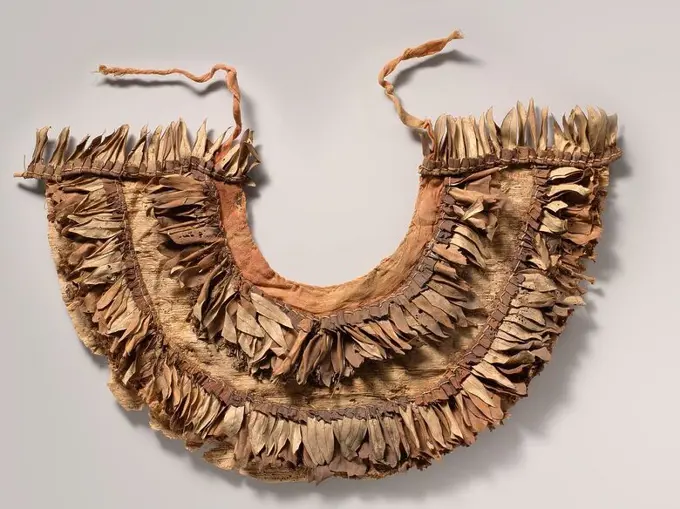
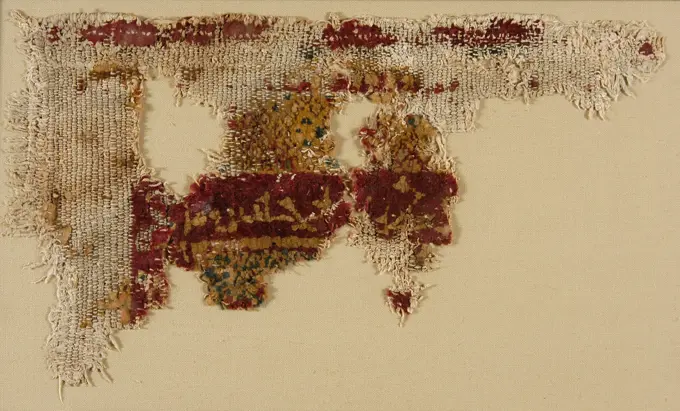
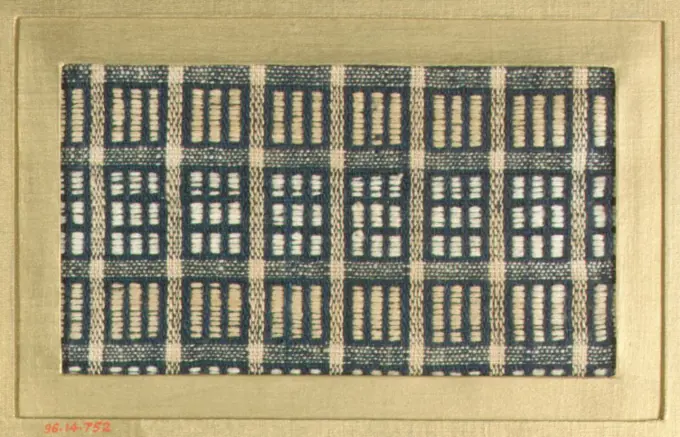
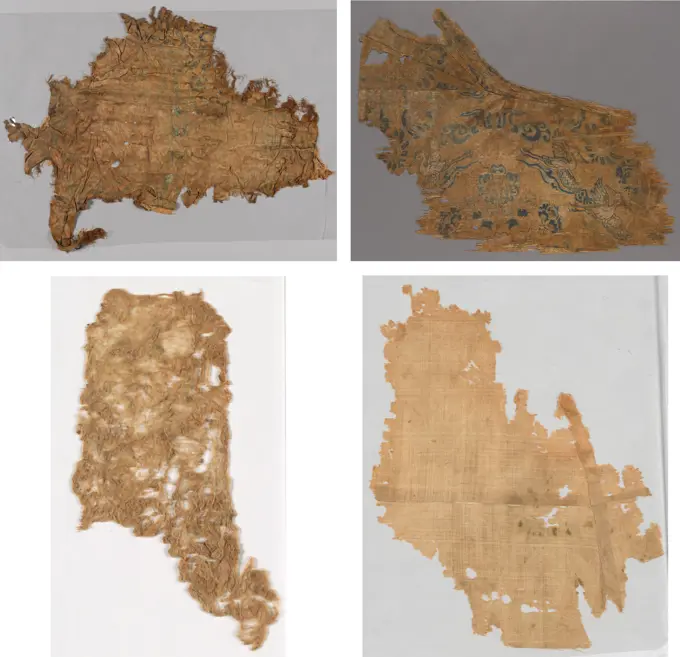
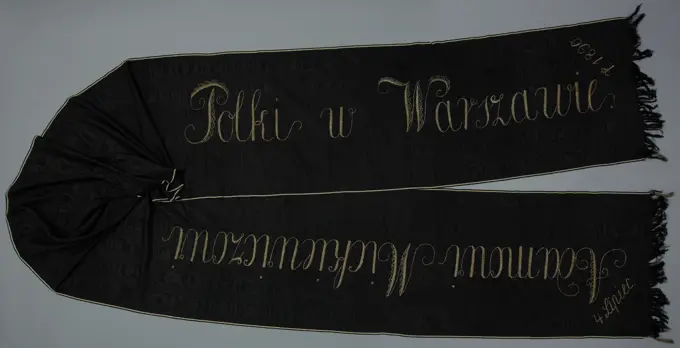
Fragment, Medium: Warp: S-spun linen. Weft: S-spun linen, S-spun wool Technique: slit tapestry with supplementary weft wrapping, Large tapestry-woven leaf. Monochrome type, purple wool and undyed linen. Purple nine-lobed leaf with two down-curving volutes from the stem and purple dots between the lobes on an undyed background. Embroidery defines the veining of the leaf., Egypt, 3rd-4th century, woven textiles, FragmentTextile, undetermined or Net , 1532-1700 or Undetermined. Camelid fiber, 9 1/4 × 46 in. (23.5 × 116.8 cm).   Arts of the Americas 1532-1700 or UndeterminedFloral collar from Tutankhamun's Embalming Cache. Dimensions: Diam. 44 cm (17 5/16 in.); D. 15.5 cm (6 1/8 in.). Dynasty: Dynasty 18. Reign: reign of Tutankhamun. Date: ca. 1336-1327 B.C..This remarkably preserved floral collar, from the funerary cache of Tutankhamun, illustrates how the broad collars so frequently depicted in Egyptian tomb paintings were made. Alternating rows of flower petals and blossoms, leaves, berries, and blue faience beads were sewn to a papyrus backing, and linen ties secured the collar around the wearer's neck. Some of the flora used in the Tutankhamun collars have been identified as olive leaves, cornflowers, and poppies. Several collars in the cache, like this one, were bound around the edge with red cloth, and the resulting combination of red, blue, black, and green must have been very colorful and similar to the polychrome decoration on some of the terracotta vessels in same deposit. Museum: Metropolitan Museum of Art, New York, USA.Tinsel and metal thread 17th-18th century French. Tinsel and metal thread 214199Textile Fragment. Egypt, Fustat, 8th-9th century. Textiles; carpets. Cotton plain weave with wool knotted pileMasi bolabola (Tapa Cloth), Fiji, maker unknown. Gift of Alexander Turnbull, 1913.Piece 18th-19th century Japan. Piece 66476Galloon 18th century French. Galloon. French. 18th century. Textiles-TrimmingsLa générosité et la reconnoissance (Generosity and Gratitude), Engraved and hand-colored paper leaf, turned wood handle, Obverse: hand-colored engraving of a man giving gold coins to three women in front of a bust of Napoleon, surrounded by a scrolling framework, fleur-de-lys, and the coat of arms of Napoleon. Reverse: text on the relative merits of generosity and gratitude., France, early 19th century, costume & accessories, Handscreen, HandscreenMitaine of red and white striped linen, lined, c. 1700 - c. 1800 Mitaine of red white striped linen, at the top a narrow spool side with crochet and eye closure, for baby or child. Zaanstreek whole: Linen (Material). edge:. Closure: Metal bobbin lace Mitaine of red white striped linen, at the top a narrow spool side with crochet and eye closure, for baby or child. Zaanstreek whole: Linen (Material). edge:. Closure: Metal bobbin laceLinen mark of Myt ca. 2060-2010 B.C. Middle Kingdom. Linen mark of Myt 545308Fringe Made 1601-1800 Italy. silk .Fragments from a Garment , 900s. China, Lao dynasty (907-1125), 10th century. Weft-faced compound twill, silk; overall: 138 x 133 cm (54 5/16 x 52 3/8 in.); second section: 37.1 x 46.6 cm (14 5/8 x 18 3/8 in.).A sash from the funeral of Adam Mickiewicz in Krakow on July 4, 1890Fragment of embroidery with the inscription EIIZABETH” unknown