Thangka Paintings in Tibetan Culture

Vibrant thangka paintings illustrating Tibetan Buddhist themes and figures. They showcase intricate designs and rich colors, encapsulating spiritual stories and cultural heritage.
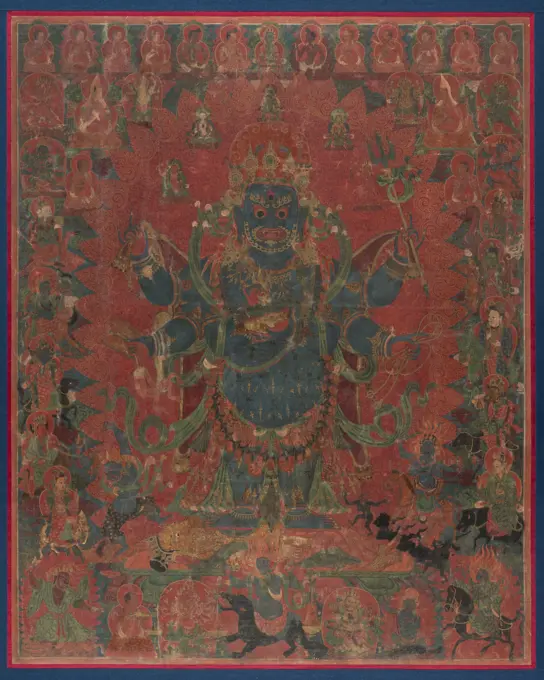
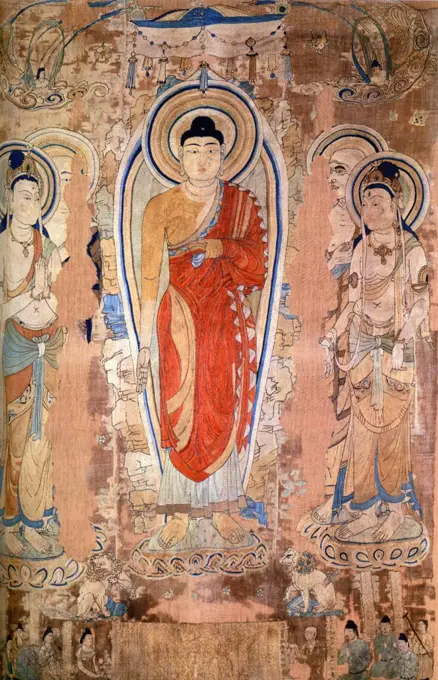
Mahakala and his Entourage. Central Tibet, Gyantse (), circa 1450-1500. Paintings. Mineral pigments, gold, and ink on cotton cloth
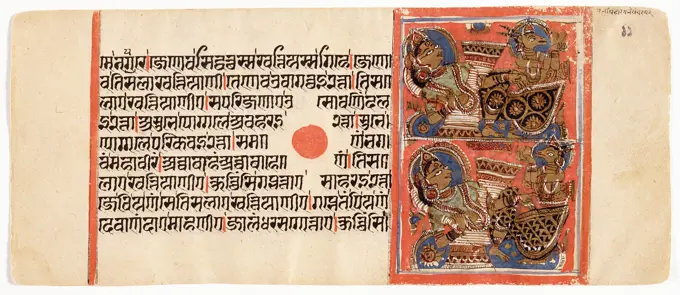
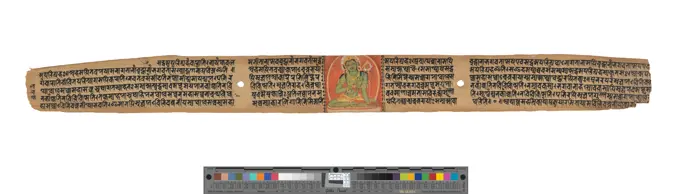
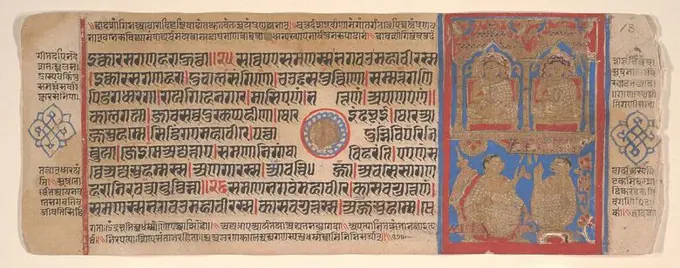
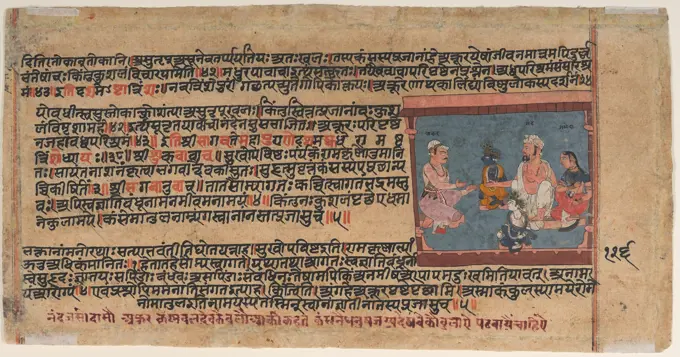
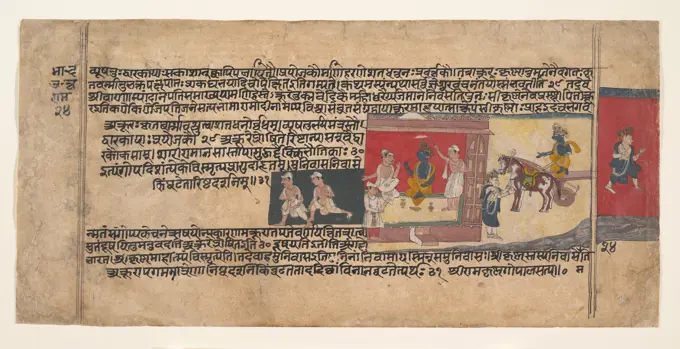
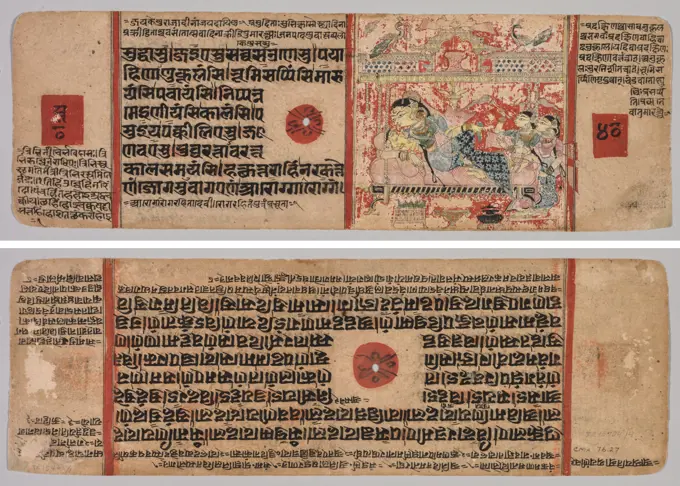
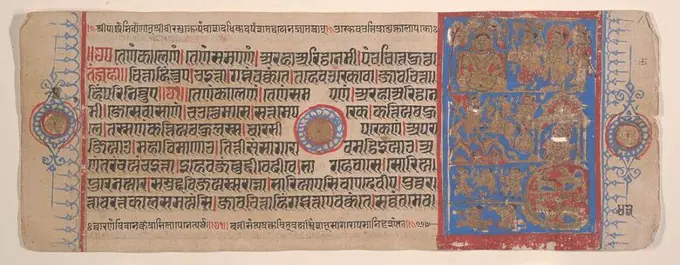
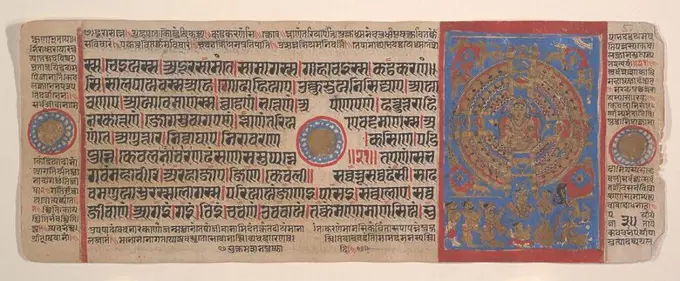
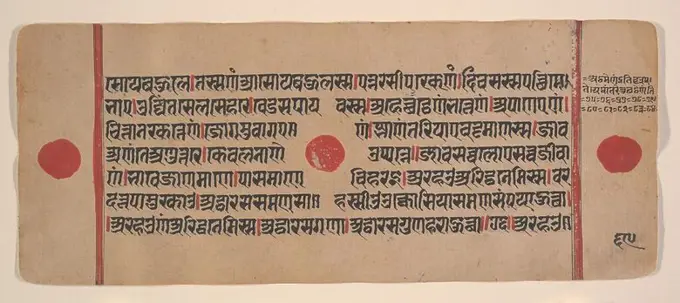
Celestial Performers: Folios from a Kalpasutra Manuscript. Culture: India (Gujarat). Dimensions: Overall: 4 1/2 x 11 1/2 in. (11.4 x 29.2 cm). Date: ca. 1490.In Jain cosmology, Shakra's heaven is a blissful place where the jinas reside for eternity. It is populated by celestial dancers, seen here as beautiful maidens sensuously poised in the text margins. On the lower folio a male dancer accompanies the female dancers. These scenes are echoed in the textual descriptions of the Kalpasutra celebrating the jina Mahavira. The manuscript displays innovative use of red, blue, and green marginal designs that anticipate sixteenth-century styles and a lavish use of gold script on a red ground. Museum: Metropolitan Museum of Art, New York, USA.Ten Jain Tirthankaras, folio 97 from a Dispersed KalpaSutraLeaf from an Illuminated Buddhist Manuscript 14th century Nepal (Kathmandu Valley). Leaf from an Illuminated Buddhist Manuscript 74876Kalaka in Conversation with Sakra. India, Gujarat, circa 1450. Manuscripts. Ink, opaque watercolor, and gold on paperHarinegameshin Takes the Embryo of Jina Mahavira from Devananda and Brings it to Queen Trishala, Folio from a Kalpasutra (Book of Sacred Precepts). India, Gujarat, Khambhat (Cambay) (), circa 1450. Books. Opaque watercolor, gold, and ink on paperVigil on the Sixth Night After Mahavira's Birth, Folio 33 (recto), from a Kalpa-sutra, c. 1475-1500. Western India, Gujarat, last quarter of the 15th century. Gum tempera, ink, and gold on paper; overall: 12.5 x 25.7 cm (4 15/16 x 10 1/8 in.).Page 64 from a manuscript of the Kalpasutra: recto image of Neminatha and Krishna standing in water, verso 2-tiered image of Neminatha's wedding Page 64 from a manuscript of the Kalpasutra: recto image of Neminatha and Krishna standing in water, verso 2-tiered image of Neminatha's wedding, 1472. Opaque watercolor and ink on gold leaf on paper, sheet: height: 4 3/8 in.   Asian Art 1472Wall painting inside old part of Dolma Lagang, Gompa of Charang, Mustang, NepalMahavira as a monk. Draughtsman: anonymous. Dating: 1460 - 1480. Place: Gujarat. Measurements: h 109 mm × w 80 mm; w 254 mm; w 200 mm. Museum: Rijksmuseum, Amsterdam.Bihar Gyalpo, the patron of monasteries and temples. Chromolithograph.Eleven Folios and Two Covers from Various Jain Manuscripts. India, Gujarat or Rajasthan, 15th-18th century, covers late 19th century. Manuscripts. Folios: Ink, opaque watercolor, and gold on paper; Covers: Gold, silver, silk thread, and sequins embroidered on silkMahavira als monnik.On a long, narrow strip the God Mahavira is depicted in a temple on the right; The left side contains a text in old Indian Scripture in red and black, the upper two and lower four rules in a smaller note; Verso more text in the same way; On either side a narrow unwritten column with a large red dot, which is also placed in the middle of the strip and also on the back. Two-thirds text column on recto, one-third show; Verso: text; Broad red brush line along text and show, three red dots in the middle of strip and in narrow margins on the sides.Mahavira Gives Away His Belongings, Folio from a Kalpasutra (Book of Sacred Precepts). India, Gujarat, 1475-1500. Manuscripts. Ink, opaque watercolor, and gold on paperIllustration from a Jain Kalpasutra Manuscript Indian. Illustration from a Jain Kalpasutra Manuscript, late 15th century. Opaque watercolor and gold on paper, sheet: 4 1/4 x 10 1/8 in. (10.8 x 25.7 cm).   Asian Art late 15th centuryPage 11 from a Manuscript of the Kalpasutra: recto text, verso image of Indra with Harinegamesin Page 11 from a Manuscript of the Kalpasutra: recto text, verso image of Indra with Harinegamesin, 1472. Opaque watercolor and ink on gold leaf on paper, sheet: height: 4 3/8 in.   Asian Art 1472Leaf from an Illuminated Buddhist Manuscript 14th century Nepal (Kathmandu Valley). Leaf from an Illuminated Buddhist Manuscript 74878Kalpasutra (Book of Sacred Precepts) Manuscript. India, Gujarat or Rajasthan, circa 1450. Manuscripts. Ink, opaque watercolor, and gold on paper; Cover is silk brocadefine arts, Tibet, painting, Thangka, Hell, silk, 18th century, Ethnological Collection, Zuerich University,Kalaka Arjakatha - a card from the D Initic one;  2. PO. XV-1. after. 16th century (1451-00-00-1550-00-00);The Bodhisattva Manjushri, Folio from a Prajnaparamita (The Perfection of Wisdom). India, Bihar, circa 1050. Books. Ink and opaque watercolor on palm leafLeaf from a Kalpa Sutra (Jain Book of Rituals). Artist: Bhadrabahu (Indian, died ca. 356 B.C.). Culture: India (Gujarat). Dimensions: (Average size .1-.71): 4 1/2 x 11 3/8 in. (11.4 x 28.9 cm). Date: 15th century. Museum: Metropolitan Museum of Art, New York, USA.Bosbewoner met pauwenveren.Painting on paper, a forest dweller with peacock feathers. Nepalese miniature.Man with a woman on shot. Painting on paper, a man with a woman on shot. Nepalese miniature.Kalaka Becomes a Jain Monk; Kalaka Abducts the Nun, Two Leaves from a Dispersed Jain Manuscript of the Kalakacharya-katha Indian. Kalaka Becomes a Jain Monk; Kalaka Abducts the Nun, Two Leaves from a Dispersed Jain Manuscript of the Kalakacharya-katha, ca. 1465. Opaque watercolor and gold on paper, sheet: 4 3/8 x 10 1/2 in. (11.1 x 26.7 cm).   Asian Art ca. 1465Leaf from a Kalpa Sutra (Jain Book of Rituals) 15th century Bhadrabahu Indian. Leaf from a Kalpa Sutra (Jain Book of Rituals) 75090Three Illustrated Palm Leaves from a Pancharaksha Manuscript Three Illustrated Palm Leaves from a Pancharaksha Manuscript, 11th-12th century. Opaque watercolors and ink on palm leaves, Each: 2 1/2 x 12 3/4 in. (6.4 x 32.4 cm).   Asian Art 11th-12th centuryLeaf from a Kalpa Sutra (Jain Book of Rituals) 15th century Bhadrabahu Indian. Leaf from a Kalpa Sutra (Jain Book of Rituals) 75084A King and a Monk (recto); Text (verso); Folio from an Uttaradhyayanasutra. India, Gujarat, circa 1450. Manuscripts. Ink and opaque watercolor with mica on paperPage 27 from a manuscript of the Kalpasutra: recto text, verso image of King Siddhartha's exercises Page 27 from a manuscript of the Kalpasutra: recto text, verso image of King Siddhartha's exercises, 1472. Opaque watercolor and ink on gold leaf on paper, sheet: height: 4 3/8 in.   Asian Art 1472Page from a Dispersed Kalpa Sutra (Jain Book of Rituals) 15th century India (Gujarat). Page from a Dispersed Kalpa Sutra (Jain Book of Rituals) 75010Adoration of a Tirtankara, c. 1500, 4 3/8 x 10 3/8 in. (11.11 x 26.35 cm), Opaque watercolors and gold on paper, India, 15th-16th century, These typical western Indian Jain manuscripts both illustrate scenes from the Kalpasutra. In the top example, the Jina Mahavira, founder of Jainism, is seated on a throne, giving his possessions to an old man. This represents Mahavira's renunciation of title, position, vanity, and wealth in preparation for his life as an ascetic and teacher. The bottom page illustrates the adoration of a tirthankara, one of the twenty-four Jain saints, including Mahavira, whose righteous existence and fine example allowed them to escape the cycle of reincarnation.Leaf from a Kalpa Sutra (Jain Book of Rituals) 15th century Bhadrabahu Indian. Leaf from a Kalpa Sutra (Jain Book of Rituals) 75095Kalaka Becomes a Jain Monk; Kalaka Abducts the Nun, Two Leaves from a Dispersed Jain Manuscript of the Kalakacharya-katha Indian. Kalaka Becomes a Jain Monk; Kalaka Abducts the Nun, Two Leaves from a Dispersed Jain Manuscript of the Kalakacharya-katha, ca. 1465. Opaque watercolor and gold on paper, sheet: 4 3/8 x 10 1/2 in. (11.1 x 26.7 cm).   Asian Art ca. 1465On a long, narrow strip on the right is depicted the god Mahavira in a temple, the left side contains a text in Old Indian script in red and black, the top two and bottom four lines in a smaller script, verso more text in the same way, on both sides a narrow undescribed column with a large red dot, which is also placed in the middle of the strip and also on the back. Two-thirds text column on recto, one-third representation, verso: text, wide red brush line along text and representation, three red dots in the middle of strip and in narrow margins on the sides, Mahavira as monk., draughtsman: anonymous, Gujarat, 1460 - 1480, paper, brush, h 109 mm × w 80 mm, w 254 mm, w 200 mmPage 15 from a Manuscript of the Kalpasutra: recto image of Devananda with Harinegamesin, verso image of Queen Trishala with Harinegamesin Page 15 from a Manuscript of the Kalpasutra: recto image of Devananda with Harinegamesin, verso image of Queen Trishala with Harinegamesin, 1472. Opaque watercolor and ink on gold leaf on paper, sheet: height: 4 3/8 in.   Asian Art 1472Mahavira as a monk, anonymous, 1460 - 1480 Indian miniature. drawing On a long, narrow strip, the god Mahavira is depicted in a temple on the right; The left contains a text in Old Indian script in red and black, the top two and lower four lines in a smaller script; Verso more text in the same way; On both sides a narrow unwritten column with a large red dot, which is also placed in the middle of the strip and also on the back. Two -thirds text column on recto, one -third show; Verso: text; Wide red brush line along text and show, three red dots in the middle of strip and in narrow margins on the sides. Gujarat paper brush monk(s), friar(s)Kalaka Becomes a Jain Monk; Kalaka Abducts the Nun, Two Leaves from a Dispersed Jain Manuscript of the Kalakacharya-katha Indian. Kalaka Becomes a Jain Monk; Kalaka Abducts the Nun, Two Leaves from a Dispersed Jain Manuscript of the Kalakacharya-katha, ca. 1465. Opaque watercolor and gold on paper, sheet: 4 3/8 x 10 1/2 in. (11.1 x 26.7 cm).   Asian Art ca. 1465The Sakyamuni Buddha is shown flanked by two disciples teaching the Lotus Sutra on 'Vulture Peak'. Siddartha Gautama, also known as Śākyamuni ('Sage of the Śākyas'), is the primary figure in Buddhism, and accounts of his life, discourses, and monastic rules are believed by Buddhists to have been summarized after his death and memorized by his followers. Various collections of teachings attributed to him were passed down by oral tradition, and first committed to writing about 400 years later.Buddhist caves of Dazu with rock carvings, World Heritage Site, a buddhist monk started to do carvings in the rocks in the 11th century, Mahayana buddhism, Dazu, Chongqing, People's Republic of ChinaAkrura Informs Nanda and Yashoda: Page From a Dispersed Bhagavata Purana (Ancient Stories of Lord Vishnu) ca. 1630-50 India (Rajasthan, Mewar) The evil king Kamsa, Krishna's nemesis, hatches yet another plan to kill the child-god and his brother. He sends Akrura to invite the boys to a function at his palace and plans to have them killed as they enter the city. Akrura, however, is a devotee of Krishna's. He falls at the god's feet and informs Krishna's adopted parents, Nanda and Yashoda, of Kamsa's plot.. Akrura Informs Nanda and Yashoda: Page From a Dispersed Bhagavata Purana (Ancient Stories of Lord Vishnu). India (Rajasthan, Mewar). ca. 1630-50. Ink and opaque watercolor on paper. PaintingsLeaf from a Kalpa Sutra (Jain Book of Rituals) 15th century Bhadrabahu Indian. Leaf from a Kalpa Sutra (Jain Book of Rituals) 75094Kalpa-sutra Manuscript with 24 Miniatures: Siddhartha Hears the Recitation of Trisala's Dreams, c. 1475-1500. Western India, Gujarat, last quarter of the 15th century. Color and gold on paper; overall: 12.5 x 25.7 cm (4 15/16 x 10 1/8 in.). King Siddhartha is depicted on this page with his wife, Trishala, who had a series of auspicious dreams associated with her pregnancy. Her child Mahavira would grow up to become the historical founder of the Jain religion in the 500s BC.Page from a Dispersed Kalpa Sutra (Jain Book of Rituals) 15th century India (Gujarat). Page from a Dispersed Kalpa Sutra (Jain Book of Rituals). India (Gujarat). 15th century. Ink, opaque watercolor, and gold on paper. PaintingsBirth of Mahavira, Folio 30 (verso), from a Kalpa-sutra, c. 1475-1500. Western India, Gujarat, last quarter of the 15th century. Gum tempera, ink, and gold on paper; overall: 12.5 x 25.7 cm (4 15/16 x 10 1/8 in.).Page from a Dispersed Bhagavata Purana Manuscript ca. 1620-30 India (Rajasthan, Mewar) In the central palace, Krishna (blue skinned) meets Akrura. At right, Balarama (white skinned) helps Krishna with his chariot and then Balarama appears again, at far right, wandering off the page; linking these last two scenes is a river. Two minor characters run to the far left in a frame that has been squeezed into the text itself. Early Mewari paintings are often compartmentalized, with each section framing a different place or moment in time. Often, color changes reinforce the temporal divisions, and text and image are tightly intermingled.. Page from a Dispersed Bhagavata Purana Manuscript. India (Rajasthan, Mewar). ca. 1620-30. Ink and opaque watercolor on paper. PaintingsThe Python Swallows Nanda (Recto), Singeing of the Python (Verso), Folio from a Bhagavata Purana (Ancient Stories of the Lord). India, Rajasthan, Mewar, circa 1600-1650. Books. Opaque watercolor and ink on paperKalpasutra (Book of Sacred Precepts) and Kalakacharyakatha (Story of the Teacher Kalaka) Manuscript. India, Gujarat, Satyapur, 1442, covers late 19th-early 20th century. Manuscripts. Folios: Ink, opaque watercolor, and gold on paper; Covers: silk brocadeKalaka with Shakra Disguised and Revealed, Leaf from a Dispersed Jain Manuscript of the Kalakacharya-katha Indian. Kalaka with Shakra Disguised and Revealed, Leaf from a Dispersed Jain Manuscript of the Kalakacharya-katha, ca. 15th century. Opaque watercolor and gold on paper, sheet: 4 1/4 x 10 1/4 in. (10.8 x 26.0 cm).   Asian Art ca. 15th centuryPage from a Dispersed Kalpa Sutra (Jain Book of Rituals) 15th century India (Gujarat). Page from a Dispersed Kalpa Sutra (Jain Book of Rituals) 75019Leaf from a Jain Manuscript: Kalpa-sutra: Text (recto); Leaf from a Jain Manuscript: Kalpa-sutra: Birth of Mahavira, folio 40 (verso) , c. 1400. Western India, Gujarat, Jain school, early 15th Century. Opaque watercolor and ink on paper; overall: 9.4 x 28.4 cm (3 11/16 x 11 3/16 in.). The tiny golden-hued infant in the palace chamber will grow to be Mahavira, historical founder of the Jain religion who lived during the 500s BC in northern India. He and his mother Queen Trishala gaze intently and lovingly at one another as two handmaidens holding fly whisks to honor them. Many elements of the image are characteristic of painting styles during the 15th century: the flat red background, two-dimensional sense of space, and the eye extended beyond the boundary of the faces, which are a combination of profile and three-quarter view. The text on this page describes her joyous and peaceful pregnancy of 9 months, 7-and-a-half days. It goes on to say that Mahavira was born at midnight on the 13Leaf from a Kalpa Sutra (Jain Book of Rituals). Artist: Bhadrabahu (Indian, died ca. 356 B.C.). Culture: India (Gujarat). Dimensions: (Average size .1-.71): 4 1/2 x 11 3/8 in. (11.4 x 28.9 cm). Date: 15th century. Museum: Metropolitan Museum of Art, New York, USA.Kalpasutra (Book of Sacred Precepts) Manuscript. India, Gujarat, 1510. Manuscripts. Folios: Ink, opaque watercolor, and gold on paper; Covers: silk brocadePage from a Dispersed Bhagavata Purana Manuscript. Culture: India (Rajasthan, Mewar). Dimensions: 7 1/16 x 14 3/4 in. (17.9 x 37.5 cm). Date: ca. 1620-30.In the central palace, Krishna (blue skinned) meets Akrura. At right, Balarama (white skinned) helps Krishna with his chariot and then Balarama appears again, at far right, wandering off the page; linking these last two scenes is a river. Two minor characters run to the far left in a frame that has been squeezed into the text itself. Early Mewari paintings are often compartmentalized, with each section framing a different place or moment in time. Often, color changes reinforce the temporal divisions, and text and image are tightly intermingled. Museum: Metropolitan Museum of Art, New York, USA.Leaf from a Kalpa Sutra (Jain Book of Rituals) 15th century Bhadrabahu Indian. Leaf from a Kalpa Sutra (Jain Book of Rituals) 75085Hebrew Bible. King Siddhartha is depicted on this page with his wife, Trishala, who had a series of auspicious dreams associated with her pregnancy. Her child Mahavira would grow up to become the historical founder of the Jain religion in the 500s BC. The royal couple is resplendently enthroned and bedecked in jewelry. Queen Trishalas bodice was painted with a green pigment made from copper and vinegar; its high acid content caused the paper itself to disintegrate. The lavish use of gold and lapis lazuli indicates that it was a costly production. King Siddhartha and Queen Trishala Sit Alone to Discuss Her Dreams, Folio 24 (recto), from a Kalpa-sutra, c. 1475-1500. Western India, Gujarat, last quarter of the 15th century. Gum tempera, ink, and gold on paper; overall: 12.5 x 25.7 cm (4 15/16 x 10 1/8 in.).Kalpa-sutra, 1279. Western India, Gujaret, Jain school, 13th century. Ink and color on palm leaf; overall: 5.7 x 35.6 cm (2 1/4 x 14 in.).Four sages and magic circles. Gouache.Leaf from a Jain Manuscript: Shalibhadra: Text (verso), 1279. Pradyumnasuri (Indian). Opaque watercolor and ink on palm leaf; text; overall: 6.7 x 32.4 cm (2 5/8 x 12 3/4 in.).Page from a Copy of the Perfection of Wisdom Sutra (Astasahasrika Prajnaparamitasutra). Western Tibet, Guge. Date: 1499-1599. Dimensions: 16 x 58.5 cm (6 5/16 x 23 in.). Colors and gold on paper. Origin: Western Tibet. Museum: The Chicago Art Institute, Chicago, USA.Folio 348, from a Gandavyuha-sutra (Scripture of the Supreme Array), 1000-1100s. Nepal. Gum tempera and ink on palm leaf; average: 4.2 x 52.4 cm (1 5/8 x 20 5/8 in.). This leaf has six paintings, three on the recto and three on the verso, creating part of a visual grand finale. The first 340 leaves of the manuscript mainly have a single painting, but at the end there are more, and they depict varied and sometimes aggressive imagery. Similarly, the text ends with a hymn, the Buddhisattva vow to clear the path to enlightenment of evil obstacles, such as wrong views and bad influences.Page from a Dispersed Kalpa Sutra (Jain Book of Rituals) 15th century India (Gujarat). Page from a Dispersed Kalpa Sutra (Jain Book of Rituals) 75051Folio from a Dispersed Devi Series: Durga Kills Demons , 17th century. Ink and opaque watercolors on paper, 4 1/4 x 8 5/16 in. (10.8 x 21.2 cm).   Asian Art 17th centuryPage from a Dispersed Kalpa Sutra (Jain Book of Rituals). Culture: India (Gujarat). Dimensions: 4 3/8 x 10 5/8 in. (11.1 x 27 cm). Date: 15th century. Museum: Metropolitan Museum of Art, New York, USA.Page from a Dispersed Kalpa Sutra (Jain Book of Rituals) 15th century India (Gujarat). Page from a Dispersed Kalpa Sutra (Jain Book of Rituals) 75014Page 86 from a manuscript of the Kalpasutra: recto text, verso image of monk preaching Page 86 from a manuscript of the Kalpasutra: recto text, verso image of monk preaching, 1472. Opaque watercolor and ink on gold leaf on paper, sheet: height: 4 3/8 in.   Asian Art 1472Illustration from a Jain Kalpasutra Manuscript Indian. Illustration from a Jain Kalpasutra Manuscript, late 15th century. Opaque watercolor and gold on paper, sheet: 4 1/4 x 10 1/8 in. (10.8 x 25.7 cm).   Asian Art late 15th centuryPage from a Dispersed Kalpa Sutra (Jain Book of Rituals) 15th century India (Gujarat). Page from a Dispersed Kalpa Sutra (Jain Book of Rituals) 75068Leaf from a Kalpa Sutra (Jain Book of Rituals) 15th century Bhadrabahu Indian. Leaf from a Kalpa Sutra (Jain Book of Rituals) 37964Wall painting in Trongsa Dzong. Trongsa Dzong, built on a spur overlooking the gorge of the Mangde River, is the largest dzong fortress in Bhutan.Page from a Dispersed Kalpa Sutra (Jain Book of Rituals) 15th century India (Gujarat). Page from a Dispersed Kalpa Sutra (Jain Book of Rituals) 75063Leaf from a Prajnaparamita Manuscript Leaf from a Prajnaparamita Manuscript, 11th-12th century. Palm leaves, ink and color, 2 1/4 x 22 5/8 in. (5.7 x 57.5 cm).   Asian Art 11th-12th centurySeated Jina Rishabha Enshrined, from a Jain Manuscript: Kalpa-Sutra, c. 1500. Western India, Gujarat. Gum tempera, ink, and gold on paper; paper: 11.1 x 25.9 cm (4 3/8 x 10 3/16 in.). By the 1400s, paper had replaced palm leaves as the primary support for Jain manuscripts. Although binding strings were no longer passed through holes in the manuscript, since they would tear the paper, the location of the holes was maintained by means of ornamented gold lozenges. Followers of Jainism commissioned copies of sacred manuscripts in order to accrue spiritual merit for themselves and their families; adorning the manuscript with paintings increased the merit. The main figure, painted in gold, sits in eternal meditative bliss, bejeweled to denote his success in reaching liberation. His long hair and the tiny, white bull beneath his crossed ankles identify him as Rishabha.Buddha's image inside Arracan Arakan Pagoda.. Postcards. 1910. The Miriam and Ira D. Wallach Division of Art, Prints and Photographs: Picture Collection. Buddhas, Sculpture, BurmeseLeaf from a Kalpa Sutra (Jain Book of Rituals). Artist: Bhadrabahu (Indian, died ca. 356 B.C.). Culture: India (Gujarat). Dimensions: (Average size .1-.71): 4 1/2 x 11 3/8 in. (11.4 x 28.9 cm). Date: 15th century. Museum: Metropolitan Museum of Art, New York, USA.Leaf from a Kalpa Sutra (Jain Book of Rituals) 15th century Bhadrabahu Indian. Leaf from a Kalpa Sutra (Jain Book of Rituals) 75128Leaf from a Kalpa Sutra (Jain Book of Rituals) 15th century Bhadrabahu Indian. Leaf from a Kalpa Sutra (Jain Book of Rituals). Bhadrabahu (Indian, died ca. 356 B.C.). India (Gujarat). 15th century. Ink, opaque watercolor, and gold on paper. PaintingsTransfer of the embryo of Mahavira, Anonymous, 1460 - 1480 Indian miniature. drawing On a long, narrow strip, the god Mahavira is depicted as embryo on the right; The left side contains a text in Oud-Indian script in red and black, the upper and lower lines in a smaller script. More text in the same way; A narrow unwritten column on either side; A large red dot is placed in the middle of the strip. Two -thirds text column on recto, one -third show; Verso: text; wide red brush line along text and show, red dots in the middle of strip; Also on Verso text and three dots. Gujarat paper brush / brushTransfer of the Embryo of Mahavira, from a Kalpa-sutra, c. 1475-1500. Western India, Gujarat. Gum tempera, ink, and gold on paper; overall: 12.5 x 25.7 cm (4 15/16 x 10 1/8 in.). The tiny captions written in Sanskrit to the right of the painting identify the subject of this scene: abduction of the embryo” and transfer of the embryo.” The embryo is the unborn founder of the Jain religion. In this miraculous episode, a goat-headed divinity who presides over miscarriage and childbirth gently takes the embryo in his cupped hands away from the reclining Brahmin lady in the scene above. Below, he carries it to a queen, who will be his birth mother.MANUSCRITO HINDU 898-S IX-HISTORIA NATURAL. Author: MOHAMED ALI BEN. Location: MONASTERIO-BIBLIOTECA-COLECCION. SAN LORENZO DEL ESCORIAL. MADRID. SPAIN.Leaf from a Kalpa Sutra (Jain Book of Rituals) 15th century Bhadrabahu Indian. Leaf from a Kalpa Sutra (Jain Book of Rituals) 75091Krishna Embracing Radha, anonymous, c. 1450 - c. 1475 Indian miniature Two of these performances are stuck on a passepartout; On this bottom hug Krishna Radha, next to it a text in Sanskrit, from the Balagopalastuti. The second of two sheets with performances from the Balagopalastuti; Damage on the back covered with white. Gujarat (possibly) paper. gouache (paint) brushPage 1 from a Manuscript of the Kalpasutra: recto blank, verso image of Mahavira enthroned Page 1 from a Manuscript of the Kalpasutra: recto blank, verso image of Mahavira enthroned, 1472. Opaque watercolor and ink on gold leaf on paper, sheet: height: 4 3/8 in.   Asian Art 1472Book of Buddhist Iconography. Nepal, 17th century. Books. Ink on paperSanskrit text in a buddhist book, Nepal, AsiaPage from a Dispersed Kalpa Sutra (Jain Book of Rituals). Culture: India (Gujarat). Dimensions: 4 3/8 x 10 5/8 in. (11.1 x 27 cm). Date: 15th century. Museum: Metropolitan Museum of Art, New York, USA.Kalaka with Shakra Disguised and Revealed, Leaf from a Dispersed Jain Manuscript of the Kalakacharya-katha Indian. Kalaka with Shakra Disguised and Revealed, Leaf from a Dispersed Jain Manuscript of the Kalakacharya-katha, ca. 15th century. Opaque watercolor and gold on paper, sheet: 4 1/2 x 11 3/8 in. (11.4 x 28.9 cm).   Asian Art ca. 15th centuryPage from a Dispersed Kalpa Sutra (Jain Book of Rituals) 15th century India (Gujarat). Page from a Dispersed Kalpa Sutra (Jain Book of Rituals) 75062Kalaka and Sahi, Page from a Dispersed Jain Manuscript of the Kalakacharya-katha Indian. Kalaka and Sahi, Page from a Dispersed Jain Manuscript of the Kalakacharya-katha, ca. 15th century. Opaque watercolor and gold on paper, sheet: 4 1/4 x 10 1/4 in. (10.8 x 26.0 cm).   Asian Art ca. 15th centuryTen Jain Tirthankaras, folio 97 from a Dispersed KalpaSutra, late 15th-early 16thcentury, Ink, opaque watercolor, and gold on paper, sheet: 4 7/16 × 10 1/4 in. (11.3 × 26cm), India, Indian, Gujarat sultanate(1407-1573), Works on Paper -ManuscriptsShaiva Shrines in a Landscape. Nepal, 1700-1725. Paintings. Mineral pigments and silver on cotton clothLeaf from a Kalpa Sutra (Jain Book of Rituals) 15th century Bhadrabahu Indian. Leaf from a Kalpa Sutra (Jain Book of Rituals) 75130Page from a Dispersed Kalpa Sutra (Jain Book of Rituals) 15th century India (Gujarat). Page from a Dispersed Kalpa Sutra (Jain Book of Rituals) 75056Kalaka and Sahi, Page from a Dispersed Jain Manuscript of the Kalakacharya-katha Indian. Kalaka and Sahi, Page from a Dispersed Jain Manuscript of the Kalakacharya-katha, ca. 15th century. Opaque watercolor and gold on paper, sheet: 4 1/4 x 10 1/4 in. (10.8 x 26.0 cm).   Asian Art ca. 15th centuryPage from a Dispersed Kalpa Sutra (Jain Book of Rituals) 15th century India (Gujarat). Page from a Dispersed Kalpa Sutra (Jain Book of Rituals) 75070Wall painting in Trongsa Dzong. Trongsa Dzong, built on a spur overlooking the gorge of the Mangde River, is the largest dzong fortress in Bhutan.Leaf from a Kalpa Sutra (Jain Book of Rituals) 15th century Bhadrabahu Indian. Leaf from a Kalpa Sutra (Jain Book of Rituals) 75111Page from a Dispersed Kalpa Sutra (Jain Book of Rituals) 15th century India (Gujarat). Page from a Dispersed Kalpa Sutra (Jain Book of Rituals) 75045fine arts, Tibet, graphic, Bodhisattva Amitayus on the lotus throne, coloured woodcut, 19th/20th century, private collection,UNESCO has proclaimed seven sites in the Kathmandu Valley World Heritage Sites Kathmandu Durbar Square, Pashupatinath Temple, Bodhnath, Svayambhunath, Patan Durbar Square, Bhaktapur Durbar Square and the Changu Narayan Temple. Historically, the valley and adjoining areas made up a confederation known as Nepal Mandala. Until the 15th century, Bhaktapur was its capital when two other capitals, Kathmandu and Lalitpur, were established. After the annexation of the valley by the Gorkha Kingdom, and subsequent establishment of the valley as the capital of their empire, the designation of 'Nepal' was extended to every land they conquered.