Victorian Textiles

A collection of exquisite 19th-century textiles featuring intricate floral patterns, elegant colors, and various lace techniques, highlighting vintage French craftsmanship.

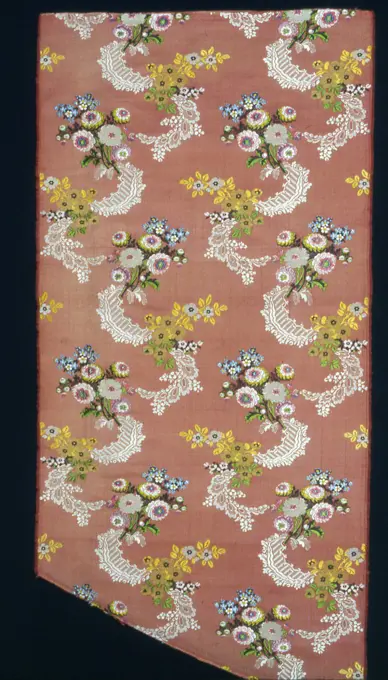
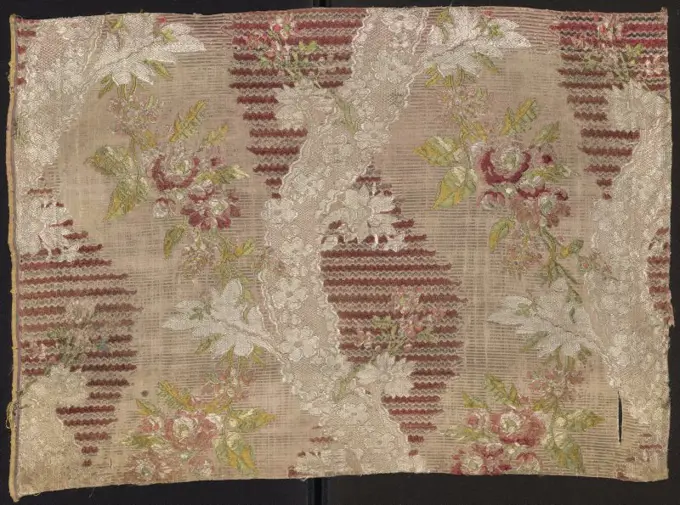
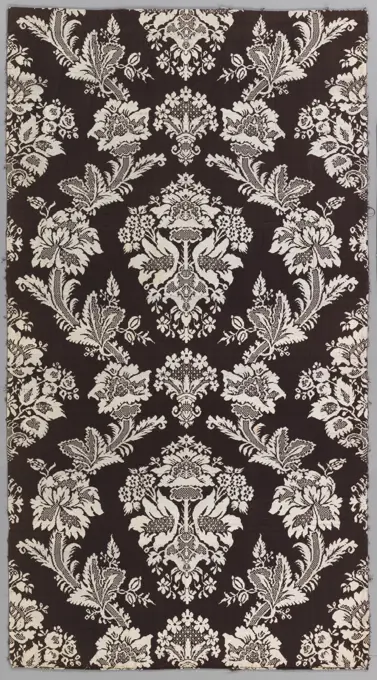
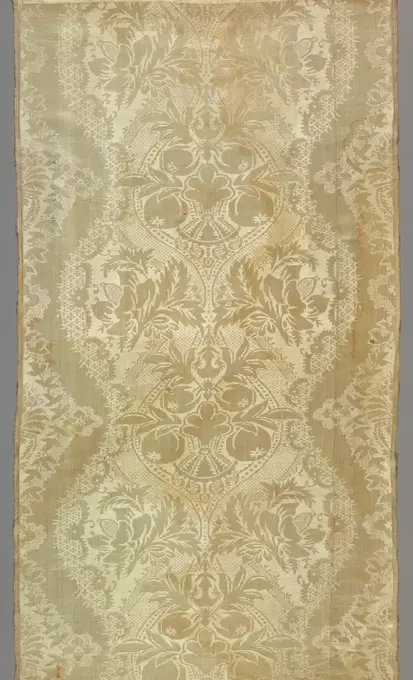
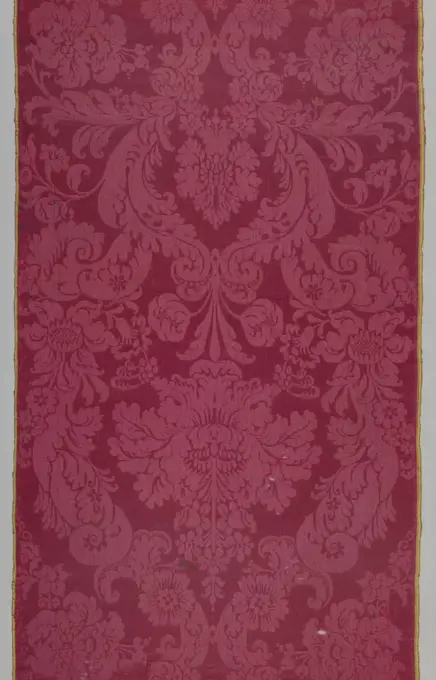
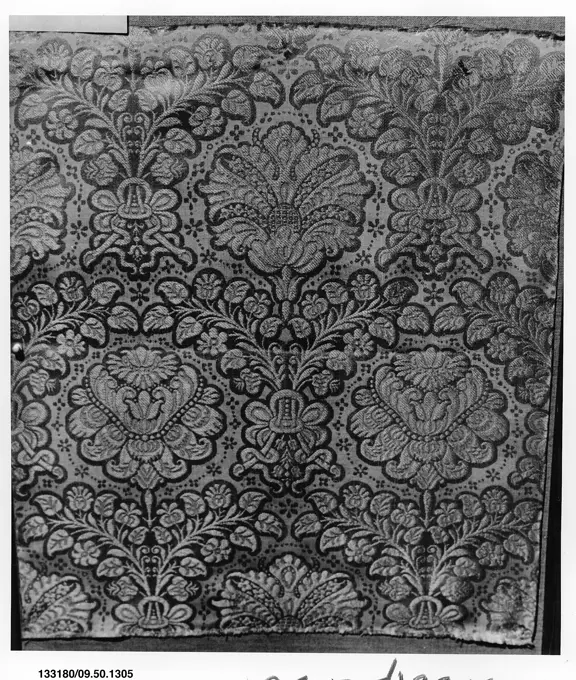
Fragment, Medium: silk Technique: 5-harness satin damask, Medium-scale design of delicate symmetrical bouquets, each diamond shaped and closely placed so that a trellis shape is created by the negative space of the pattern. Two salmon and yellow striped selvages in warp twill., France, mid-18th century, woven textiles, Fragment
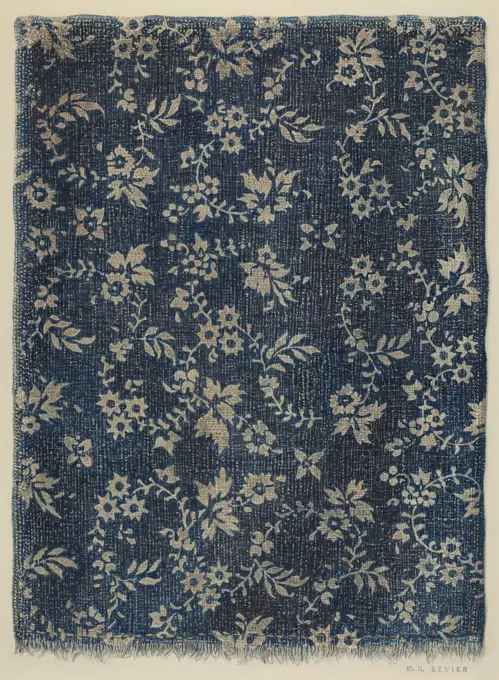
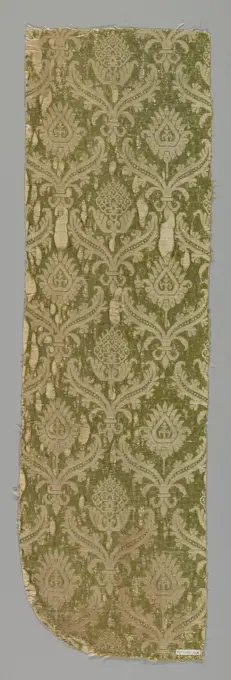
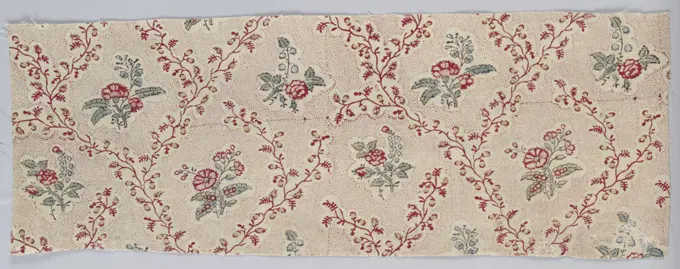
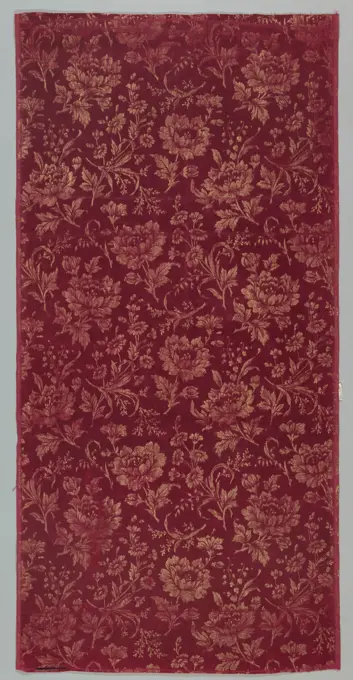
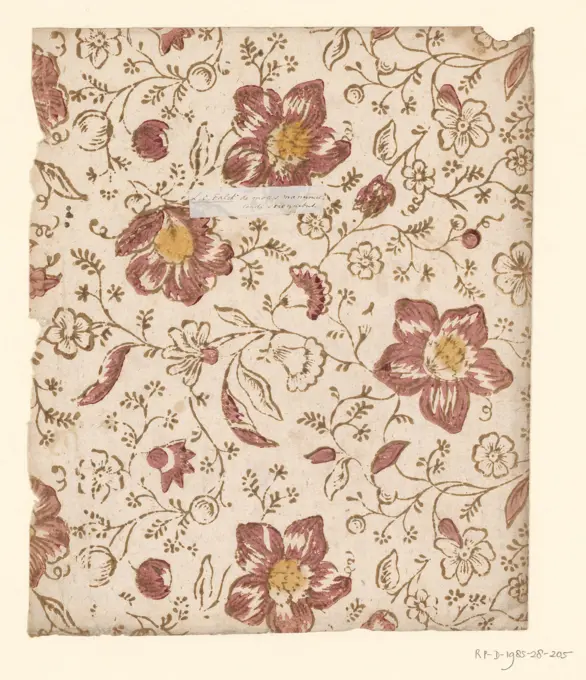
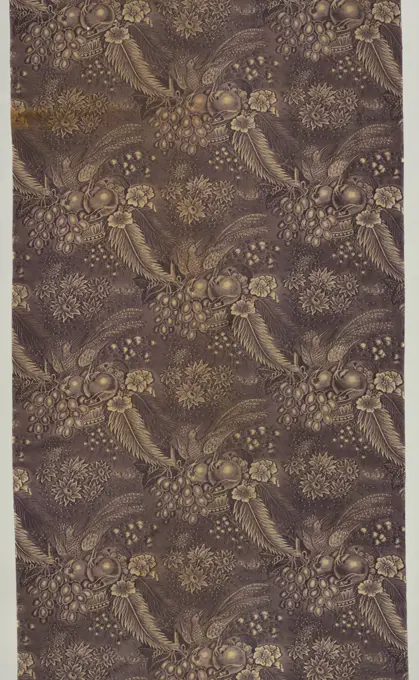
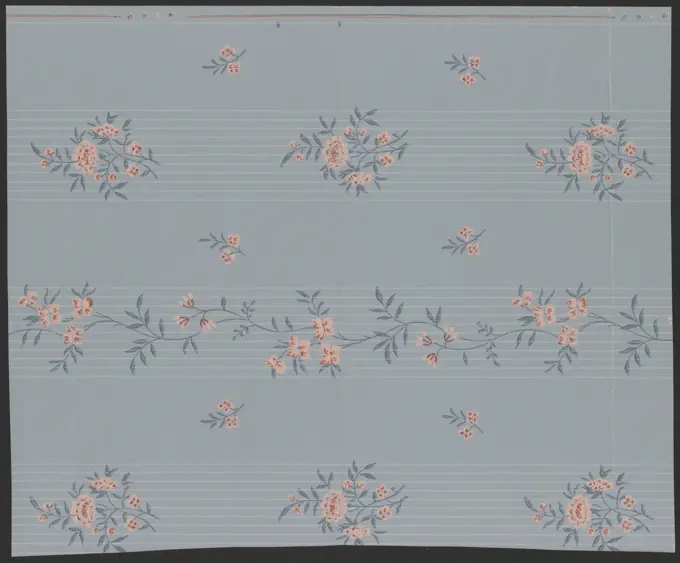
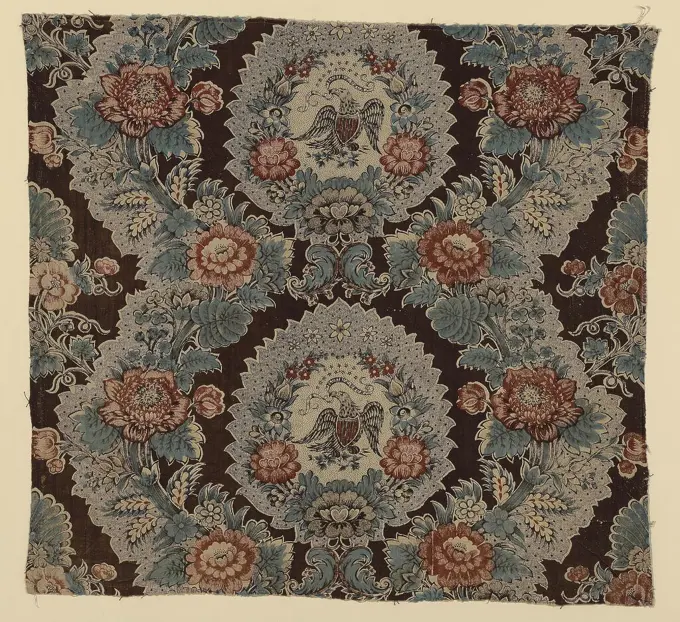
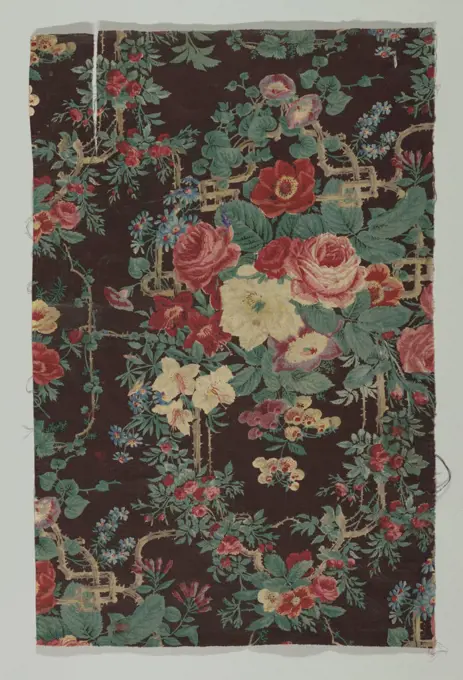
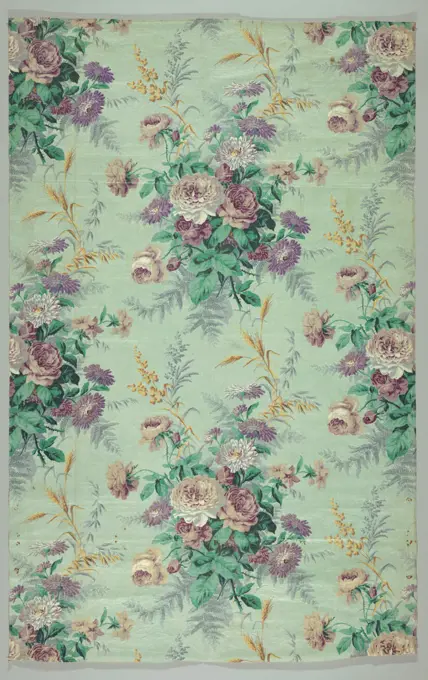
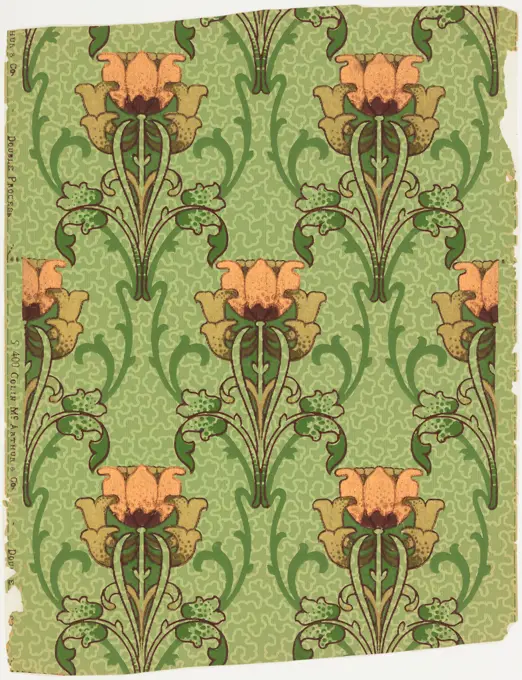
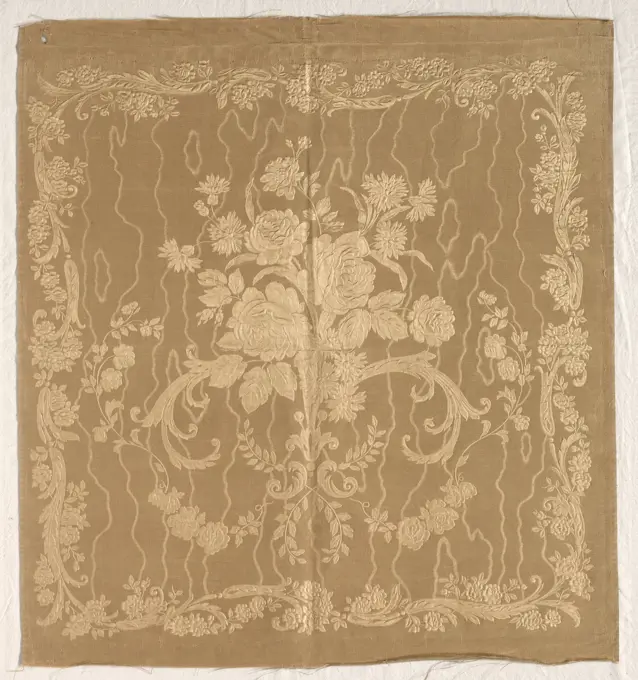
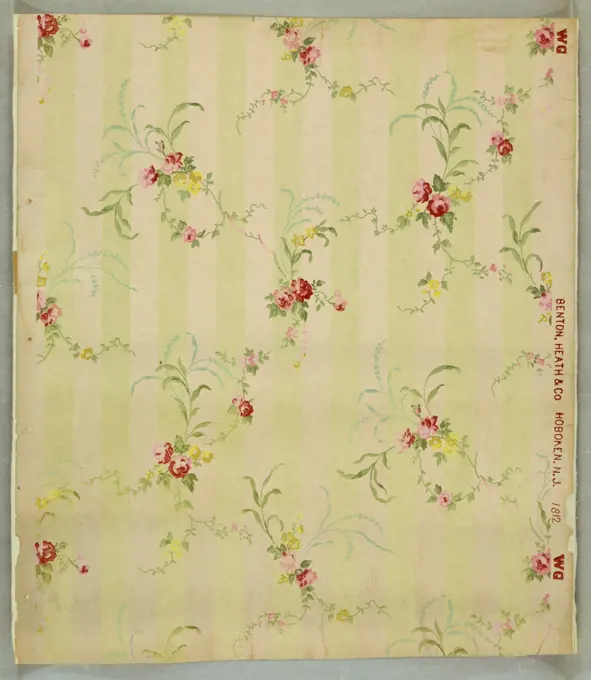
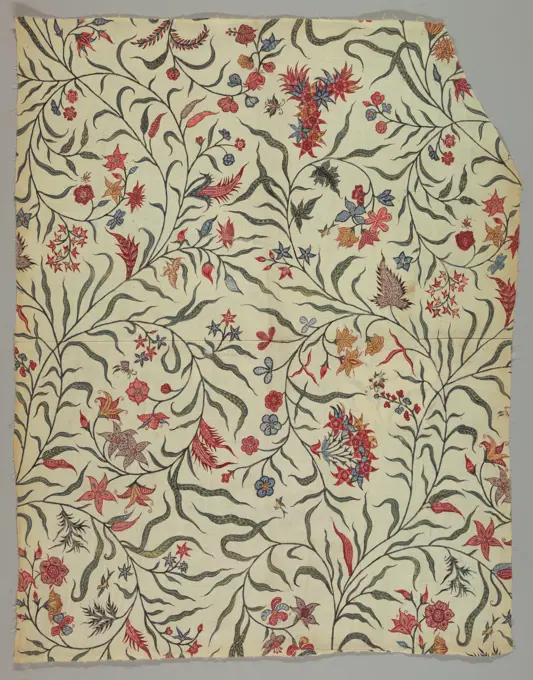
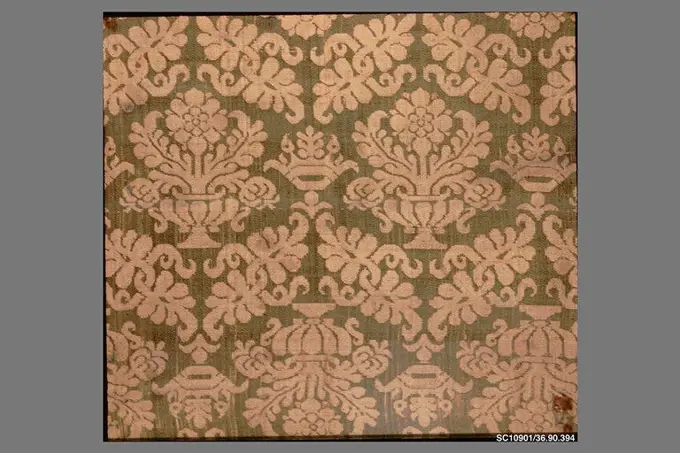
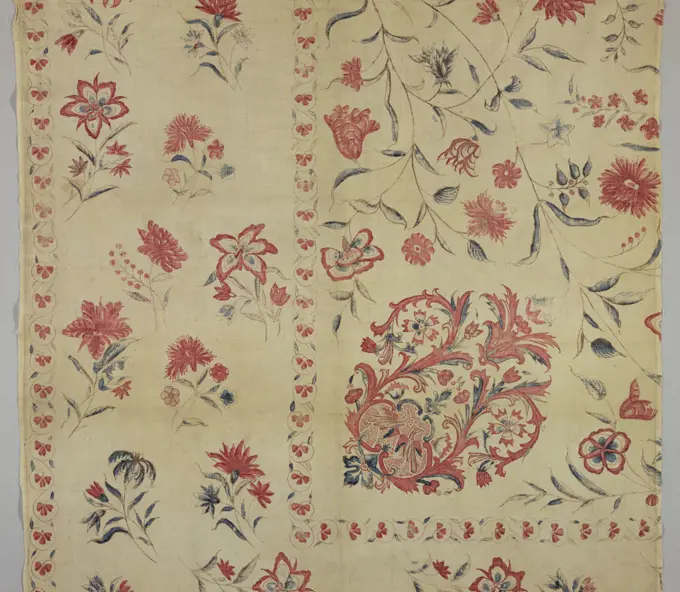
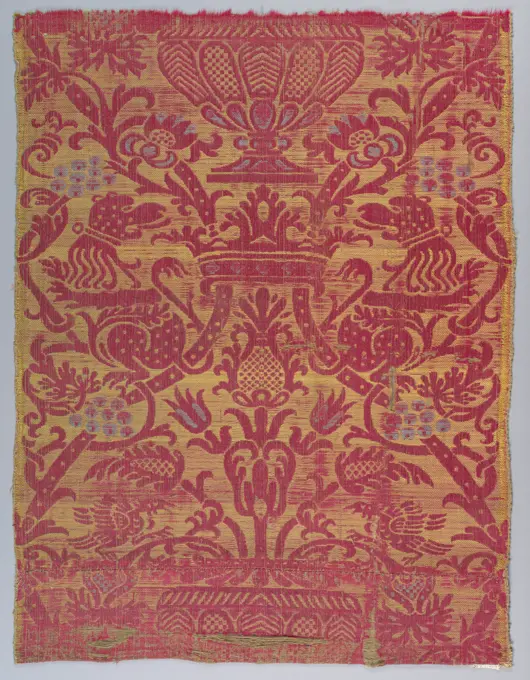
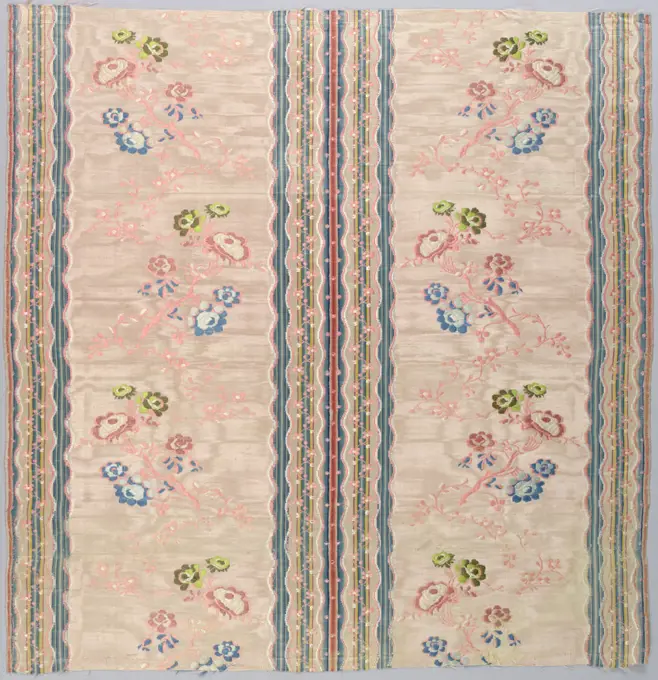
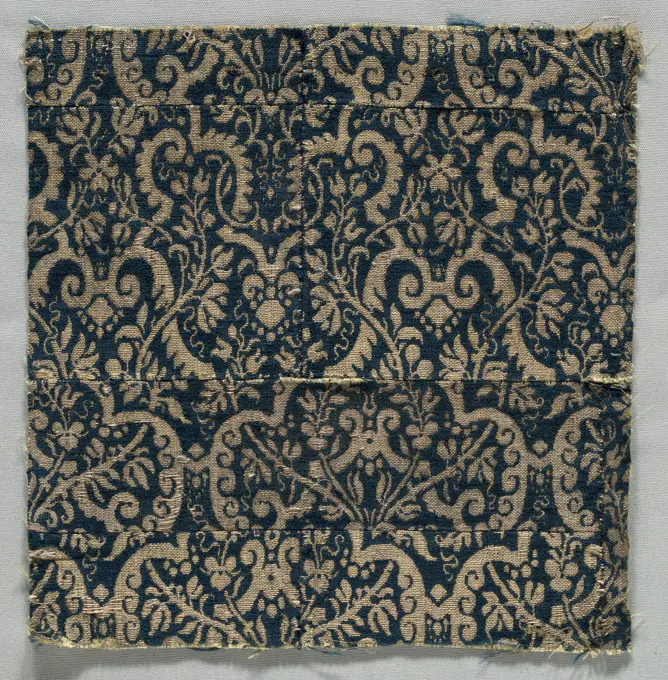
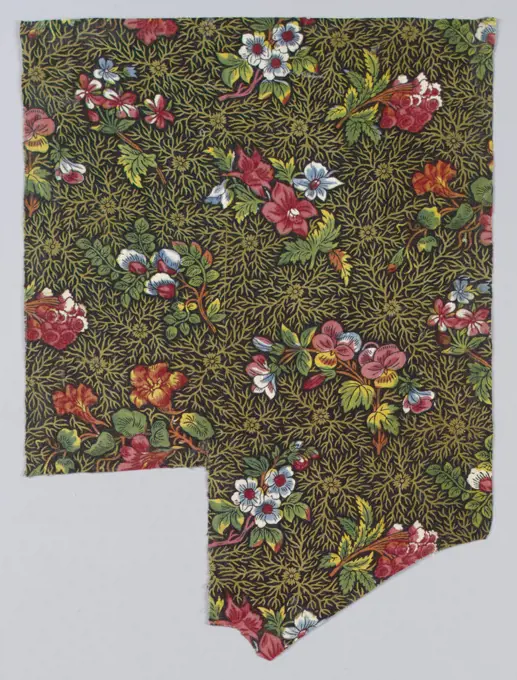
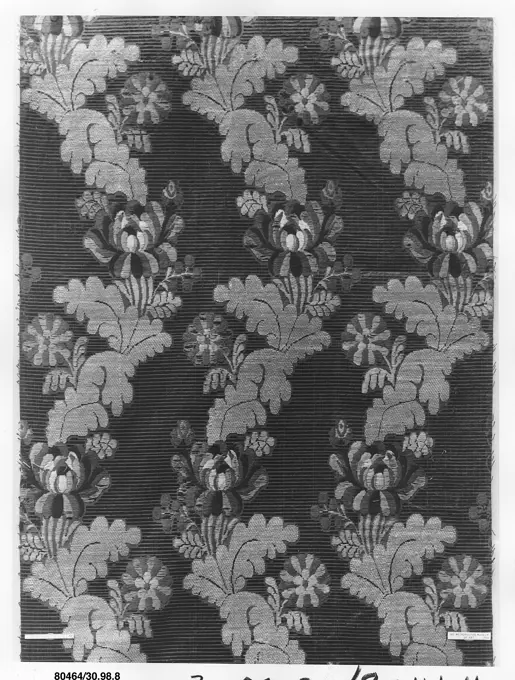
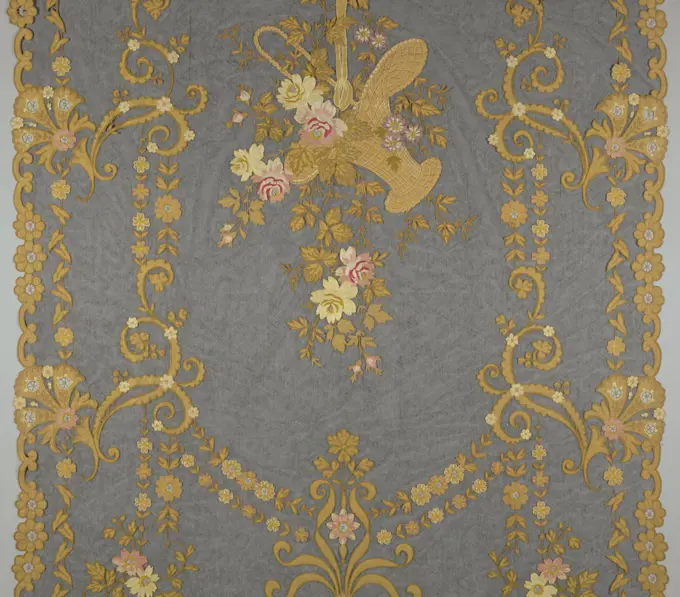
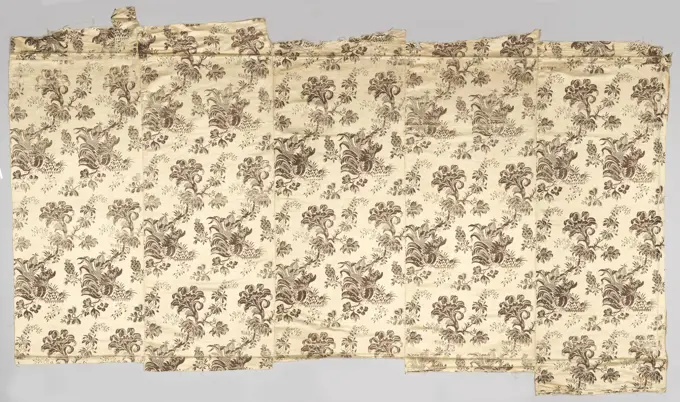
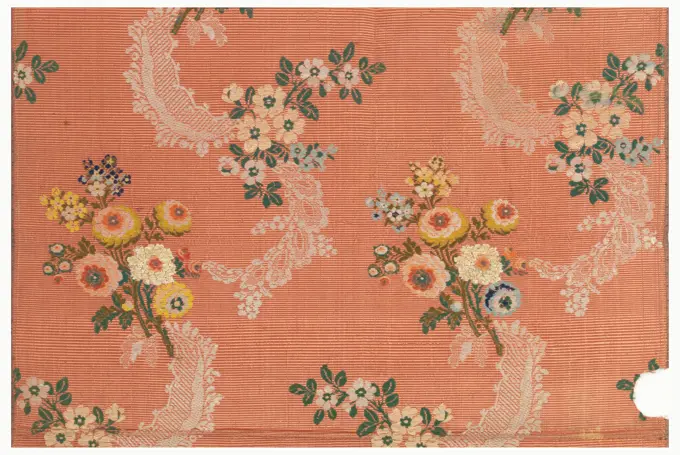
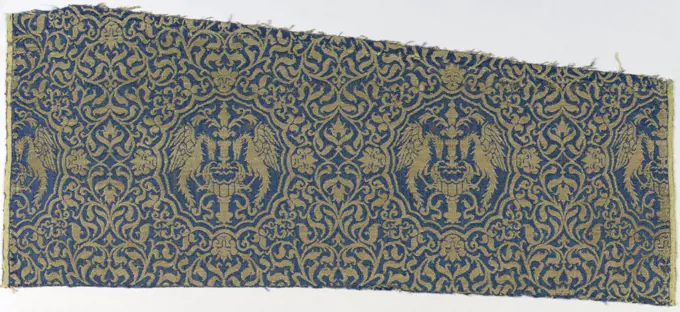
Textile, Medium: cotton Technique: relief printed on plain weave, Panel of white cotton block printed in shades of deep red, yellow, grey-violet, and light blue. Design of an irregular curving rocaille enframements, in a diamond shape, frame a basket of flowers with hunting horn, spear, etc. Garlands of ribbons surround basket and connect to the frame. Small circular medallion at intersections enclose a monkey with bow and arrow aimed at a rodent. Picotage in garlands., France, 19th century, printed, dyed & painted textiles, TextileFragment, Medium: silk Technique: bobbin lace, 'blonde', France, early 19th century, lace, FragmentPanel Made 1750-1775 France. Silk, silk chenille, and bouclÈ yarns, plain weave with supplementary patterning warps and brocading wefts .Textile (France); Company: A. Quesnel; linen warp, cotton weft; Warp x Weft: 60.5 x 28.5 cm (23 13/16 x 11 1/4 in.) Repeat H (straight): 31.1 cm (12 1/4 in.)Fragment, Medium: silk Technique: 5-harness satin damask, Medium-scale design of delicate symmetrical bouquets, each diamond shaped and closely placed so that a trellis shape is created by the negative space of the pattern. Two salmon and yellow striped selvages in warp twill., France, mid-18th century, woven textiles, FragmentFragment, Medium: linen warp, cotton weft Technique: block printed and painted on plain weave (mordants for two reds and black block-printed; yellow and blue applied by brush), Diamond lattice of vines enclosing floral sprigs on a picottage background., probably Jouy, France, mid-late 18th century, printed, dyed & painted textiles, FragmentFragment, Medium: linen warp, cotton weft Technique: block printed on plain weave, Design of geranium-like flowers and isolated sprigs on a field of meandering lines. Registration marks visible., France, 1775-80, printed, dyed & painted textiles, FragmentTextile; cottonLeaf with tifles with flowers on diamond -shaped point stock, anonymous, 1700 - 1850  Leaf with tendrils with flowers on diamond -shaped point stock. Half of a cover.  paper. block printing (relief printing process) ornament derived from plant formsLeaf with spreading pattern of flowers with fruits, anonymous, 1750 - 1900  Leaf with spreading pattern of flowers with fruits. With label with inscription: 'L.C. Falck ... Nibus. ' Half of a cover.  paper. block printing (relief printing process) ornament derived from plant formsTextile, Medium: cotton Technique: printed by engraved roller on plain weave; mordant for purple, Offset repeat of an exotic bird perched on top of a bowl of fruit. Three motifs within fabric width. Length of repeat: 38.7cm. (15 1/4'). Lengths of fabric continue repeat with 1/2' additional of pattern for seam allowance., Central Europe, ca. 1835, printed, dyed & painted textiles, TextilePiece 18th century Japan. Piece 67681Fragment, Medium: silk Technique: damask weave, Fragment of silk damask. White and coral showing a symmetrical design of flowering plants with twisting tendrils. Two pieces sewn together; one selvage present., France, mid- 18th century, woven textiles, FragmentTextile; silk; Warp x Weft: 102 x 44 cm (40 3/16 x 17 5/16 in.)Textile, Medium: linen, cotton Technique: block printed on plain weave, Offset repeat of a flowering branch surrounded by white circles containing small blossoms. Pattern is in red and black on a red picotage background., France, 1750-1800, printed, dyed & painted textiles, TextileSurahammar Brokology.ur Carl Sahlin Mountain History Collection.Fragment (Japan)Piece of fabric. unknown, authorE Pluribus Unum (From the Many, One) (Furnishing Fabric). England, Manchester. Date: 1825-1835. Dimensions: 58.6 x 62.8 cm (23 x 24 3/4 in.)Warp repeat: 30.5 cm (12 in.). Cotton, plain weave; engraved roller printed; glazed. Origin: Manchester. Museum: The Chicago Art Institute, USA.Fragment; silkTextile; cottonBedcover Made 1601-1800 Greece. Linen, plain weave; embroidered with silk and silvered-metal-strip-wrapped silk in chain, Roumanian, adn stem stitches; Bokhara couching; three panels pieces .Fragment; silk; 1900-20-2-a,bFragment early 18th century Italian, Venice. Fragment 230531Piece 18th century British. Piece. British. 18th century. Silk. Textiles-WovenFragment, Medium: silk Technique: damask weave with supplementary weft patterning (brocade), Gray silk damask fragment brocaded with polychrome silk bound in twill showing design of florals in the bizarre’ style. Both selvages present., France, early 18th century, woven textiles, FragmentLength of Silk Brocade, 18th century. Spain, 18th century. Plain cloth weave, brocaded: silk and metal; average: 100 x 54.7 cm (39 3/8 x 21 9/16 in.).Fragment Made 1750-1800 Japan. Fancy compound satin silk and gilt paper; 2 strips to m.m. .Fragment. Italy. Date: 1601-1650. Dimensions: 20.3 x 21.9 cm (8 x 8 5/8 in.)Repeat: 23.45 x 9.8 cm (9 1/4 x 3 7/8 in.). Silk, satin damask weave. Origin: Italy. Museum: The Chicago Art Institute, Chicago, USA.Textile, Medium: cotton Technique: woodblock printed, glazed, Large bouquet of roses with smaller climbing rose brances and other flowers. Background of dark brown and floral pattern in shades of red, green, blue and white., England, late 18th-19th century, printed, dyed & painted textiles, TextileFragment 16th-17th century Italian, Venice. Fragment. Italian, Venice. 16th-17th century. Silk. Textiles-VelvetsTextile, Medium: cotton Technique: mordant painted and dyed and resist dyed (chintz) on plain weave; highly glazed printed by engraved roller on plain weave, Thin, highly glazed chintz with a background of pale grey-blue showing large clusters of roses, other garden flowers and sprays of wheat in shades of rose, mauve, blue-green and pale yellow., France, ca. 1890, printed, dyed & painted textiles, TextilePiece early 18th century Italian. Piece 217304Piece 18th-19th century Japan. Piece 66064Textile with Animals late 13th-early 14th century Italian. Textile with Animals 467452Fragment of fabric unknownFleur de Lys, embossed, Large-scale fleur-de-lys, with acanthus leaf detailing, alternating with smaller unadorned fleur-de-lys. Printed in tans and white on tan ground., USA, 1900-15, Wallcoverings, Sidewall, SidewallTextile, Medium: cotton Technique: resist printed on plain weave, Dark blue resist print on a white ground. Design shows serpentine branches with ornamental foliage and perching bird. White dots used to suggest detail in the foliage and on birds., USA, 18th century, printed, dyed & painted textiles, TextileMilton Bevier, Resist Fabric, c 1939 Resist FabricCoverlet fragment, Medium: cotton, wool Technique: double cloth, In navy wool and cream cotton, large ornate pattern of acanthus pillars framing large rosettes, with thistles and branches and some diaper filling., USA, 1840, woven textiles, Coverlet fragmentSkoutari carpet unknownPanel Made 1860-1880 Lyon. Silk, satin weave, cut and uncut voided velvet . Mathevon et Bouvard (Producer)Textile, Medium: silk, metallic thread Technique: satin damask with discontinuous supplementary weft patterning (brocade), Large scale design, symmetrical around the center line of the fabric. A heavy floral form enclosed within an ogival framework of twisted ribbons and flowers. In gold on a medium blue damask ground., Europe, 18th century, woven textiles, TextileSidewall (Canada); Manufactured by Colin McArthur and Co.; machine-printed paper; 62 x 49 cm (24 7/16 x 19 5/16 in.)Carpet fragment, Medium: wool Technique: compound twill, triple cloth, Large-scale floral design in red, yellow and ivory., USA, 19th century, woven textiles, Carpet fragmentPiece ca. 1720 French. Piece 223683Fragment Made 1601-1625 Italy. Silk, cut, uncut, and voided velvet against satin weave foundation .Fragment (Dress Fabric). Iran (Persia, Isfahan). Date: 1675-1725. Dimensions: 62.2 × 53.9 cm (24 1/2 × 21 1/4 in.). Ispahan. Origin: Iran. Museum: The Chicago Art Institute, Chicago, USA.Length 1700-1733 French. Length 229472Sample (USA); Manufactured by Orinoka Mills (United States); 1989-80-67Piece 16th century Italian or Spanish. Piece 216628Square of Silk, early 1900s. France, early 20th century. Gaufré on a moire ground; overall: 55.6 x 51.4 cm (21 7/8 x 20 1/4 in.).Sidewall, Benton, Heath & Co., Hoboken, New Jersey, 1875 - 1917, Machine-printed, Sprays of small pink roses and yellow forget-me-nots with green leaves. At end of sprays are grasses in blue-green frosted work. Sprays have a scattered informal arrangement. Alternating green frosted work and plain ivory stripes form the field. On margin is printed: 'Benton, Heath & Co., Hoboken, N.J. 1812 WC'., Hoboken, New Jersey, USA, 1890-1900, Wallcoverings, SidewallChintz (India); cotton; Warp x Weft: 79 x 61 cm (31 1/8 x 24 in.) Repeat H x W: 83.8 x 47.6 cm (33 x 18 3/4 in.)Fragment of the fabric;  beginning of the 18th century (1710-00-00-1715-00-00);Dąmbska, Grażyna - collection, fragments of silk fabrics, patterned fabrics, bizarre patterns, purchase (provenance)Piece 16th-17th century Italian. Piece 223496Cover, Medium: cotton Technique: mordant and resist painted and immersion dyed on plain weave (chintz), Wide border on two sides with a shaped medallion in the inner corner. Polychrome on white., On a white field, in detached arrangement, freely drawn flower sprays in shades of red on delicate brown stems, with foliage now blue. A corner ornament of symmetrically curving leaf scrolls in red and blue forms a medallion, in which at its base a small section formed of C-scrolls in blue, frames confronted birds on dotted red ground. Birds' wings over-painted in small blue dabs. Narrow guard border frames main section, below which a border, 12 inches wide, is similarly decorated with the same flower sprays and edged with the same narrow guard border; in the latter, small three leaved red flowers suggest the form of a clover leaf., Colors: Two reds, blue, a few small areas of yellow now much faded., General character of design is very free, sketchy in style; blue in leaves unevern as though pLength of Textile, 1723-1774. France, 18th century, Period of Louis XV (1723-1774). Brocade; silk and metal; overall: 102.6 x 55.3 cm (40 3/8 x 21 3/4 in.).Textile; silk, linen; Warp x Weft: 61.6 x 49.5 cm (24 1/4 x 19 1/2 in.)Textile, Medium: silk Technique: fancy cloth, brocaded, Light rose moiré taffeta ground with floral serpentines partly brocaded in colored silks and partly created by floats of the alternate pink and white primary wefts. Taffeta ground interrupted by stripes of satin weave with superimposed blossoms., France, 18th century, woven textiles, TextileSidewall, Machine-printed paper, Multicolor bouquets of carnations printed over gray striped ground. Bouquets alternate with smaller lavender carnations., France, 1860-80, Wallcoverings, SidewallFragment seals with flowers on a green soil, anonymous, c. 1640 - c. 1700 A fragment of green silk tissue with white flowers, on which rosettes and flowers of light and dark brown. NOTE: MEERSHIP; 5 mm, 4dr Effenbinding the rest satin. Persia (possibly) silk A fragment of green silk tissue with white flowers, on which rosettes and flowers of light and dark brown. NOTE: MEERSHIP; 5 mm, 4dr Effenbinding the rest satin. Persia (possibly) silkTextile, Medium: cotton Technique: block printed on plain weave foundation, Scattered flowers on scrolling stems over faint stripes., Switzerland or France, early 19th century, printed, dyed & painted textiles, TextileTextile Fragment, 1600s. Italy, 17th century. Lampas weave (); overall: 24 x 23.3 cm (9 7/16 x 9 3/16 in.).Fragment, Medium: cotton Technique: block printed for several colors, yellow and blue applied by brush, tan by immersion() on plain weave, Flower sprays surrounded by fine leafy sprigs on a black background., Europe, ca. 1800, printed, dyed & painted textiles, FragmentFragment (Italy); silk; Warp x Weft: 215 x 150 cm (7 ft. 5/8 in. x 59 1/16 in.)Piece 18th century Russian, Moscow. Piece 222392African Marigold, Medium: cotton Technique: printed on plain weave, Two pieces of printed cotton with a large-scale design of curving leafy branches, interlacing to form circles enclosing flowers. In blue on an off-white ground., England, 1876, printed, dyed & painted textiles, Textile, TextileTapestry  leaf motif and colourful bunches (in the middle) unknownSidewall, Machine-printed paper, liquid mica, Floral bouquet set within scrolling foliate medallion. Medallions are connected by floral swags. Printed in white, red and green on pink ground., USA, 1905-1915, Wallcoverings, SidewallFragment of silk fabric, Eastern unknownPiece 18th-19th century Japan. Piece 65934Piece 1750-60 French. Piece 224370Curtains, Medium: cotton, silk Technique: appliqué on net, Curtain panels of black net with ochre cotton appliqué forming flowers and leaves outlined in chain stitch with tan and light brown silk or covered in chain stitch with white, pale and bright pink, yellow, tan or pale green silks. In center is a large basket with overflowing flowers and leaves suspended on two long ribbons from the top of the curtain. Sides and bottom are scalloped. Some of the centers of the blossoms have been cut out and filled with six threads knotted in the center to form spokes., France, 1850-99, embroidery & stitching, CurtainsFragment, Medium: silk Technique: 5-harness satin damask, Short length of red damask in a symmetrical arrangement of large and small blossoms and scrolling leaves., France, 17th-18th century, woven textiles, FragmentPiece mid-19th century British or French. Piece 229359Textile Fragment 17th-18th century. Textile Fragment 446822Textile; silk, woolFragments of silk fabric  colorful motifs of flower branches unknownFragment of five lanes of Zijddamast, including horizontal rows with large flowers ,, 1880 - 1920 Fragment of five -sewn tracks launched silk daam mast with a design of horizontal rows of large -scale flowers with an upright branch on which flowers and leaves, located on a table top, fell off with a pointed edge in brown on a creme -colored stock. Following French tissues from around 1730. France (possibly) silk damask Fragment of five -sewn tracks launched silk daam mast with a design of horizontal rows of large -scale flowers with an upright branch on which flowers and leaves, located on a table top, fell off with a pointed edge in brown on a creme -colored stock. Following French tissues from around 1730. France (possibly) silk damaskPiece ca. 1750 French. Piece 224501Piece. Culture: British. Dimensions: L. 63 1/2 x W. 36 1/2 inches. Date: late 16th century. Museum: Metropolitan Museum of Art, New York, USA.Kloskant veil with field bouquets, anonymous, c. 1840 - c. 1850 Black bobbin veil: Chantilly side. A standing rectangle has a wide edge of the ground, a narrow top edge and side edges, which floods upwards. The field is littered with hanging and standing flower exercises, symmetrically composed next to a standing axle. In the middle of the bottom is a large asymmetrical field bouquet, in the corners two overhoek bouquets, which are symmetrical compared to each other. This contains screen flowers, possibly fennel. Three tough stretchers of three deep arches move between the top of the middle bouquet and the smaller bouquets in the side edges. The scallops are thickened at the bottom with lobed and hollow scalloped medallions, between which connected C-volutes swing with open grid fillings and campane contours. Caen (possibly) silk bobbin lace Black bobbin veil: Chantilly side. A standing rectangle has a wide edge of the ground, a narrow top edge and side edges, which floods upwards. TheFragment; silkTextile, Medium: silk, metallic thread Technique: warp-faced plain weave patterned by continuous and discontinuous supplementary wefts bound on the front in 1/3 twill, Straight repeat of curving floral forms in multiple colors and metallic thread on a blue-gray background., Europe, 19th century, woven textiles, TextilePiece 1650-60 Italian. Piece 219609Textile, Medium: cotton Technique: woodblock printed on plain weave, glazed, Large-scale flowers printed in red, blue, green, purple, and yellow on a tan striped ground., England, ca. 1860, printed, dyed & painted textiles, TextileSidewall (USA); Manufactured by Maxwell & Co., S.A. (United States); machine-printed paper, liquid mica; 88.5 x 49 cm (34 13/16 x 19 5/16 in.)Textile (possibly England); cottonPiece late 18th century Italian. Piece 216431Fragment of silk fabric  pattern made of floral twigs with flower bunches in net composition unknownFragment Made 1575-1600 Italy. Silk, warp-float faced satin weave with supplementary pile warps forming uncut and voided velvet; outlined by gilt-metal-strip-wrapped silk in running and couching stitches .Cravat End (France); linenNapkin of linen damask with a flower pattern. Napkin of linen damask with a branch with large flowers and fruits. A napkin (BK-1977-291-A) belongs to the napkin.Fragment, Medium: silk, metallic thread (beaten gold on vellum wrapped around linen core) Technique: 4&1 satin patterned with plain weave (lampas), Horizontal rows of medallions edged with small incurving scallops, each containing an ornamental fountain with confronted phoenixes with spread wings and necks bent to drink on either side; small mask at top, bottom, and sides of each medallion. On a close-set ground of floral arabesques in rich gold on a deep electric blue ground. Yellow selvedge on each side; pattern reversible., Italy, 14th century, woven textiles, FragmentCeiling Paper (USA); Manufactured by Maxwell & Co., S.A. (United States); machine-printed paper, liquid mica; 92 x 49.5 cm (36 1/4 x 19 1/2 in.)Piece 18th-19th century Japan. Piece 66128Textile (France); cotton; L x W: 93.3 x 51.1 cm (36 3/4 x 20 1/8 in.); 1951-133-2Textile (Spain); silk, cotton, metallic threadNapkin with conquests of cities in the Southern Netherlands by John Churchill Hertog of Marlborough, Anonymous, in or after 1706 Napkin van Linnamast with conquests of cities in Southern Netherlands by John Churchill Hertog of Marlborough in 1706. Midfield: The symmetrically doubled pattern shows the following scenes: 1 a foot people. 2 general and gunner. 3 Cityscapes: Meenen, Denderm ONDE, AEHT and OSSTENENDEN. 4 general on horseback; DVX de Marlborovgh. 5 weapon Marlborough. Standing edges: Volutes, doubled by Stelpen. Lying edges: Volutes. Southern Netherlands linen (material) damask  Dendermonde. Ostend. Menen. ATH Napkin van Linnamast with conquests of cities in Southern Netherlands by John Churchill Hertog of Marlborough in 1706. Midfield: The symmetrically doubled pattern shows the following scenes: 1 a foot people. 2 general and gunner. 3 Cityscapes: Meenen, Denderm ONDE, AEHT and OSSTENENDEN. 4 general on horseback; DVX de Marlborovgh. 5 weapon Marlborough. Standing edges: Vo