Vintage Lace Fragments

Exquisite samples of lace from various periods, showcasing delicate patterns and historical textile artistry.

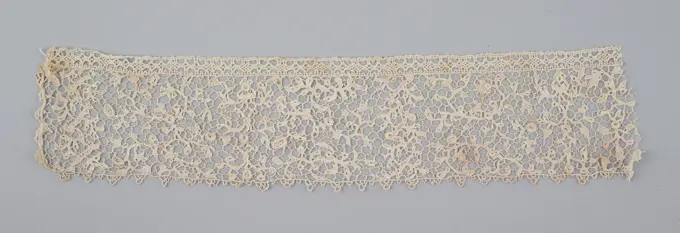
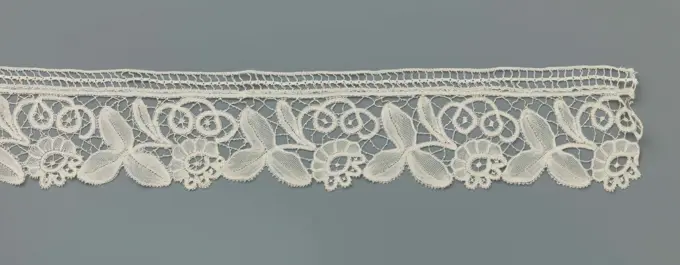
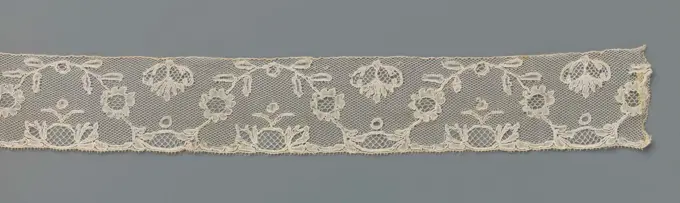
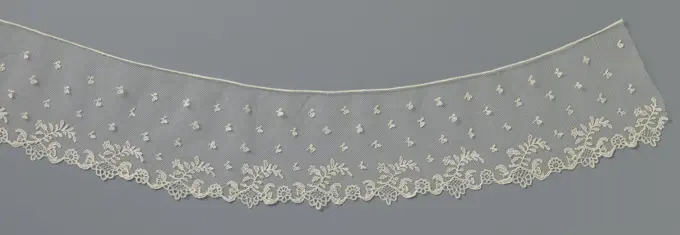
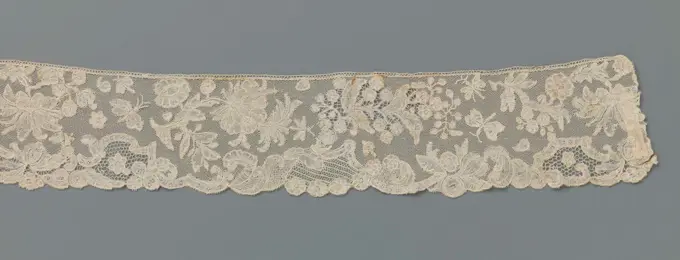
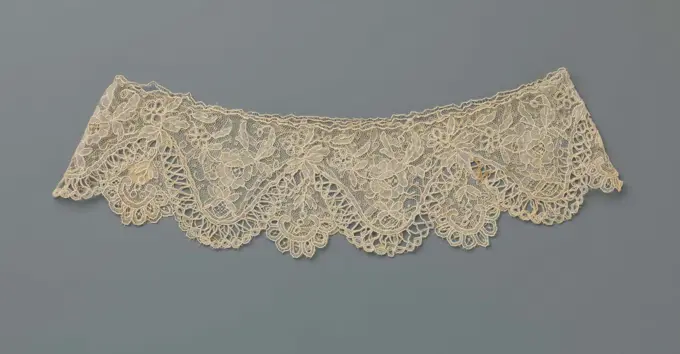
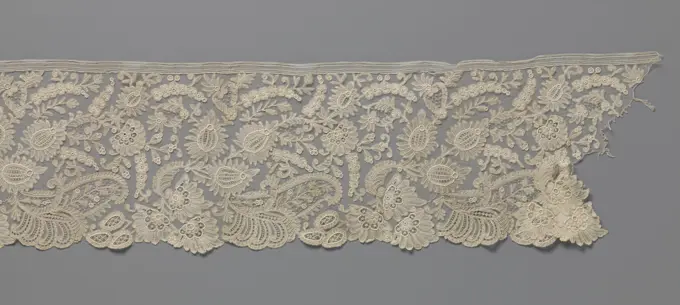
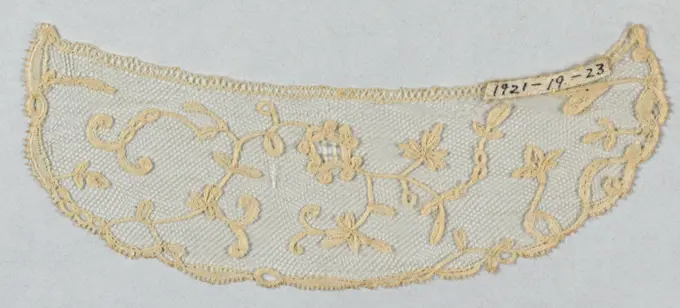
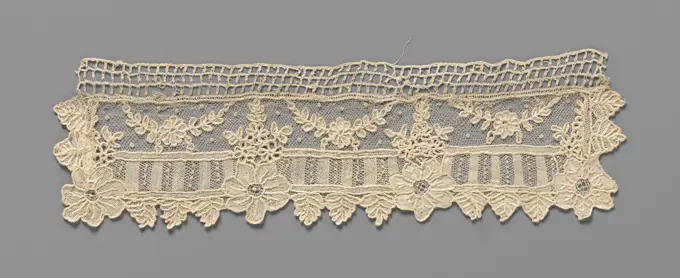
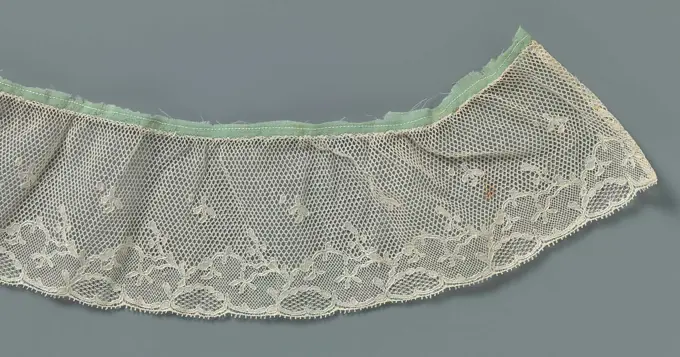
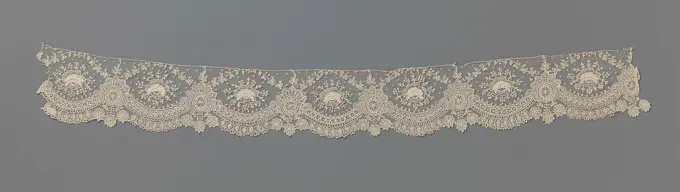
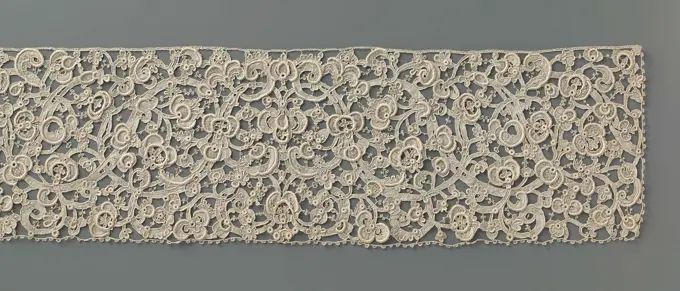
Collar of needle side with flower branch in U-shaped cartouche, anonymous, c. 1860 - c. 1880 Collar of natural -colored needle side: Brussels mesh side. The repeating pattern consists of a U-shaped cartouche with a flower branch with two rosette flowers and two chalice flowers. The 'legs' of the U are formed by two straight pillars, crowned by a rosette flower and a three -lobby leaf. There is an oval medallion with a rosette flower in the center under each pillar. Between the pillars and the successive medallions, there is a decorative frame with five lobes and below that a pendulum of three leaves between two rosette flowers. Together with this pendulum, the medallions take care of the scrap edge along the underside of the strip. The motives are equipped with contour threads, the three circles in the pillars and the rosette flower in each medallion are equipped with relief contours. The motifs are connected to each other by a fine mesh ground, a mesh side. Belgium linen (material) Br
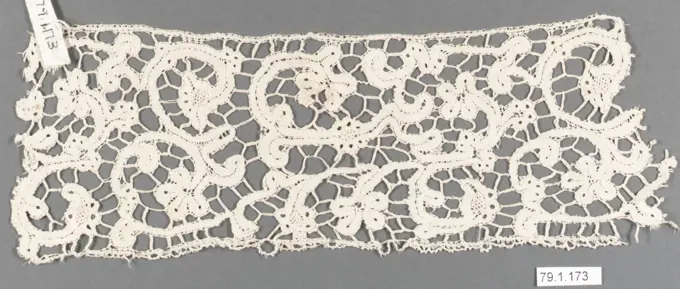
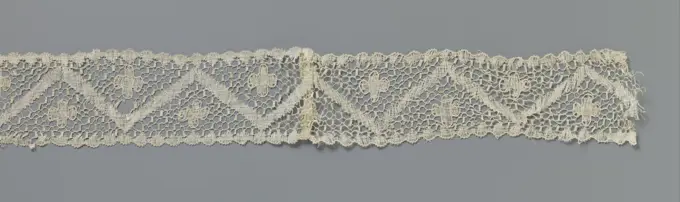
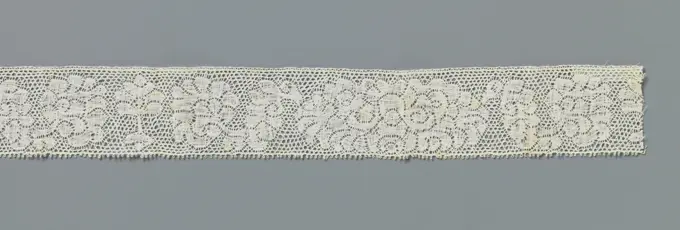
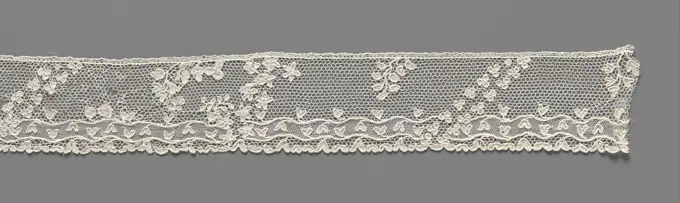
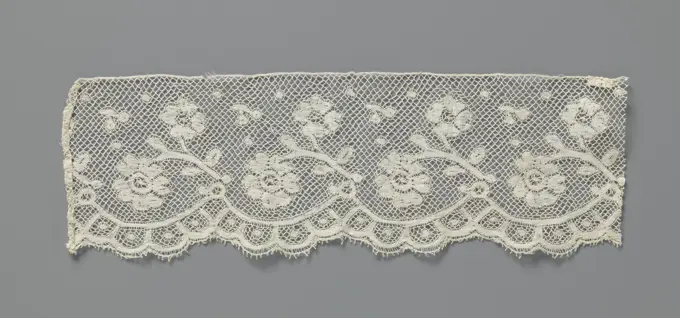
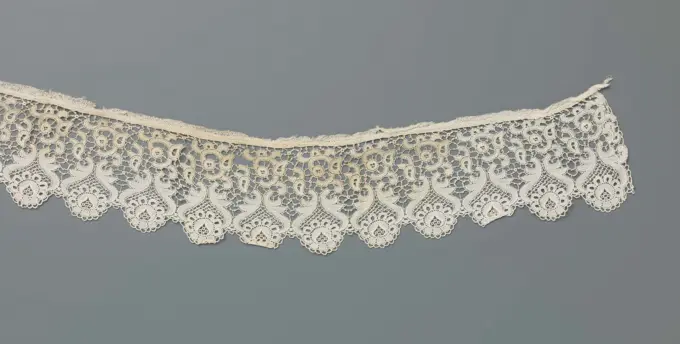
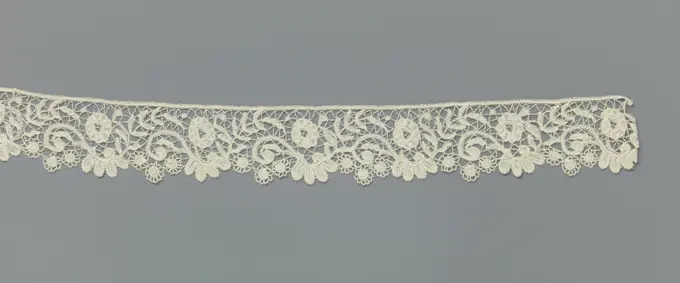
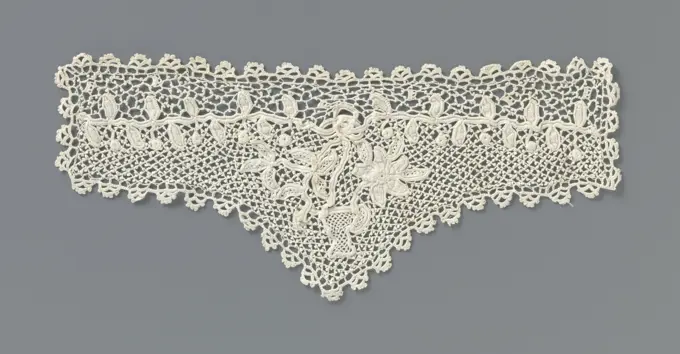
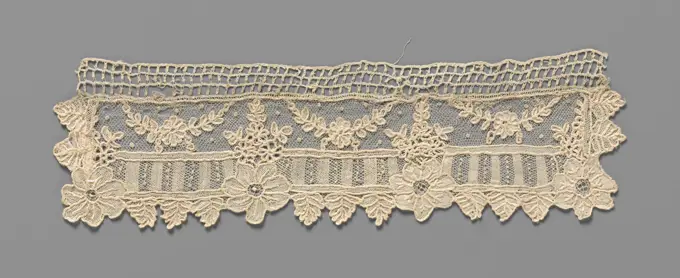
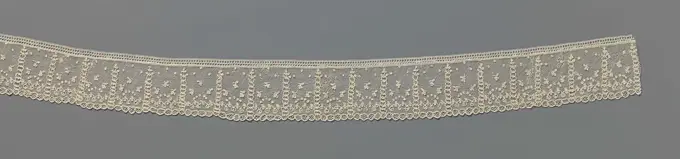
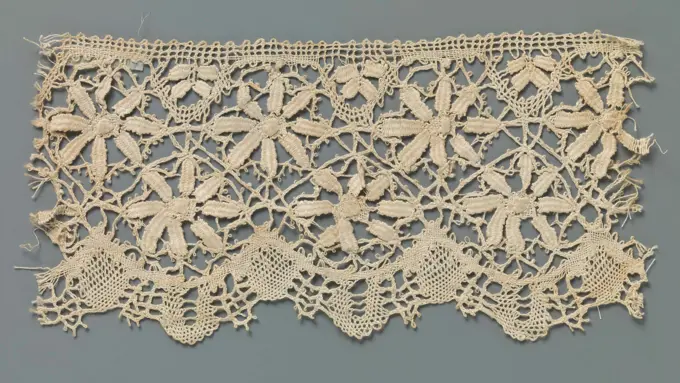
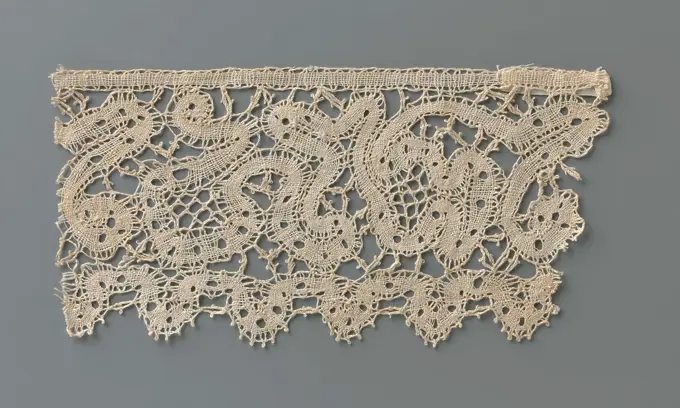
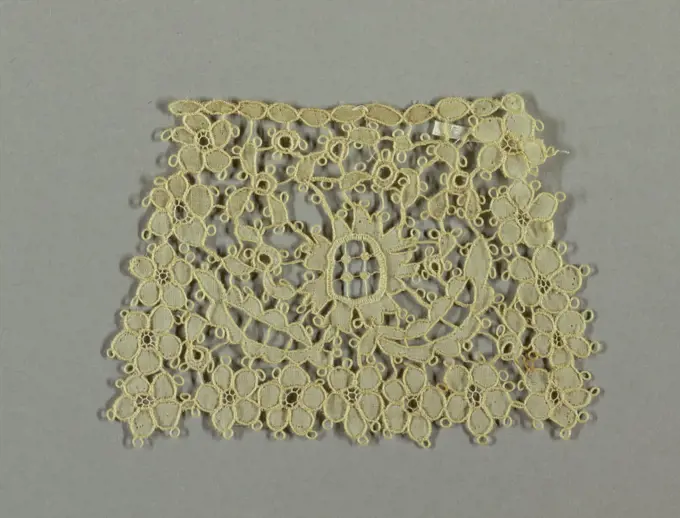
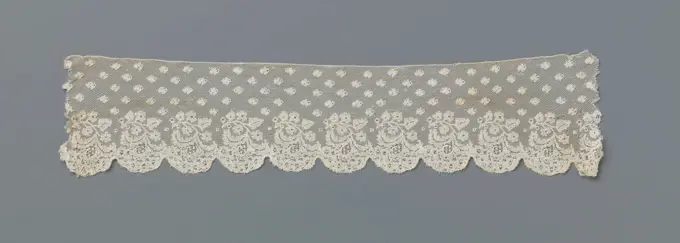
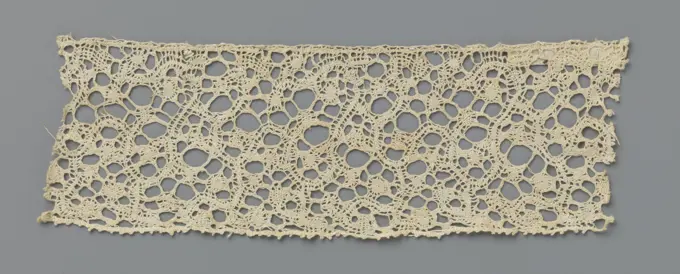
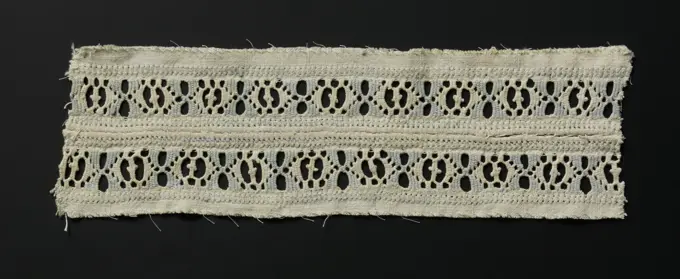
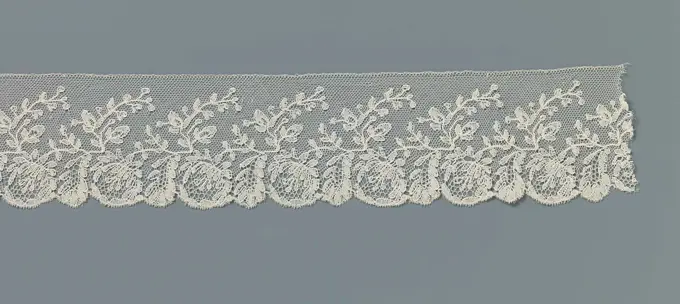
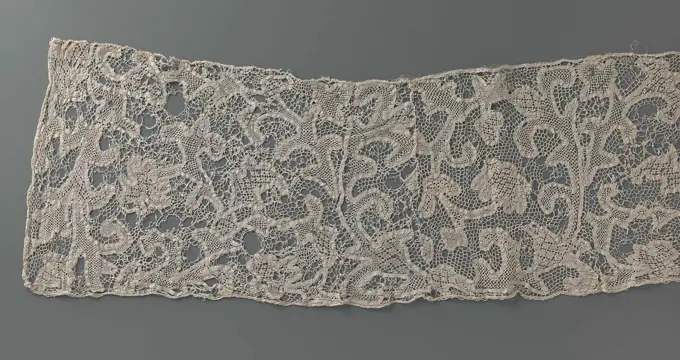
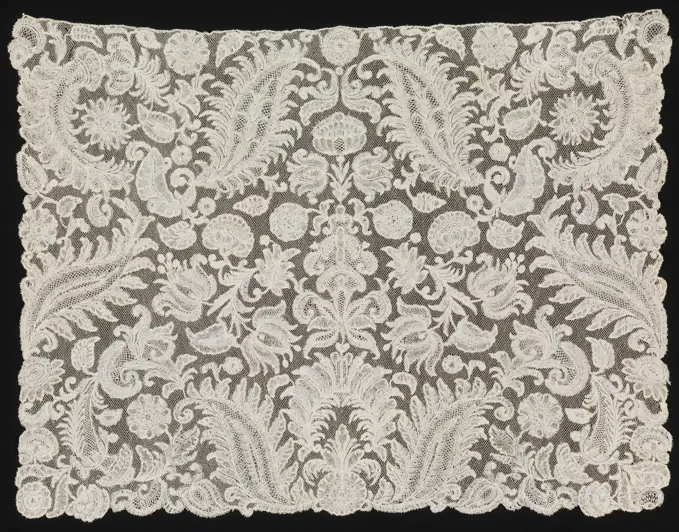
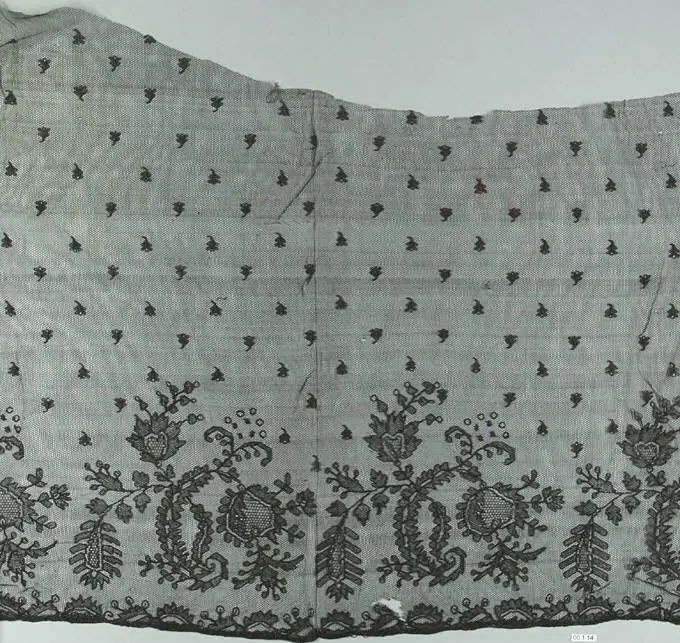
Fragment late 17th century Flemish. Fragment. Flemish. late 17th century. Bobbin lace. Textiles-LacesLace laceFragment of the lace;  after. 19th century (1840-00-00-1860-00-00);Lace, 1600s, Italy, maker unknown. Gift of Mrs G. Acland Allen, 1955.Strip bobbin with heart-shaped motifs between Occiolini loops, anonymous, c. 1900 - c. 1924 Strip of natural -colored bobbin: occhiolini. The repeating pattern consists of three inverted heart -shaped motifs in a rectangular field that is formed by a jumble of loops. The loops are formed by a narrow ribbon that has been held in linen stroke openwork edges on one side and that wriggles on themselves continuously. The hearts stem from this continuous ribbon and are partly cost in linen battle with a bow edge outside and a decorative soil on the inside with open stitches and elongated spiders in mains. The loops are connected by hiding at the places where they touch each other, a few extra connections are made with braids. The rectangular fields are connected by a vertical column, formed by a zigzagging braid and that is attached with a hook between the loops of the successive rectangular fields. Top and bottom of the strip are straight finished with the bottom with an edge with lace holePiece 18th century Flemish. Piece 214541Strip early 18th century Flemish. Strip 214512Strip bobbin with four-lobbish rosette above and below a zigzag band, anonymous, c. 1840 - c. 1860 Strip of natural -colored bobbin, blonde. The repeating and continuous pattern consists of a zigzag band, which divided the strip into triangular fields. There is a four -lobe rosette in the center of each field. Along the top and bottom of the strip runs a scallop, which consists of a succession of circles. The scallops are finished with picots. The motifs are connected by a coarse mesh soil, strewn with square moes. The zigzag band, rosettes and circling edges are made in linen stroke, with the rosettes equipped with a contour wire. unknown silk bobbin lace / blonde (lace) Strip of natural -colored bobbin, blonde. The repeating and continuous pattern consists of a zigzag band, which divided the strip into triangular fields. There is a four -lobe rosette in the center of each field. Along the top and bottom of the strip runs a scallop, which consists of a succession of circles. The scallCollar of needle side with flower branch in U-shaped cartouche, anonymous, c. 1860 - c. 1880 Collar of natural -colored needle side: Brussels mesh side. The repeating pattern consists of a U-shaped cartouche with a flower branch with two rosette flowers and two chalice flowers. The 'legs' of the U are formed by two straight pillars, crowned by a rosette flower and a three -lobby leaf. There is an oval medallion with a rosette flower in the center under each pillar. Between the pillars and the successive medallions, there is a decorative frame with five lobes and below that a pendulum of three leaves between two rosette flowers. Together with this pendulum, the medallions take care of the scrap edge along the underside of the strip. The motives are equipped with contour threads, the three circles in the pillars and the rosette flower in each medallion are equipped with relief contours. The motifs are connected to each other by a fine mesh ground, a mesh side. Belgium linen (material) BrKloskant investment piece with volutes, anonymous, c. 1910 - c. 1930 Investor of natural -colored bobbin, possibly Flemish guipure. Symmetrical pattern with volutes of which three, four and five-leaf flowers spring. A braided bar with picots around the motifs. A honeycomb land within the motives. Finishing on all sides with triangles built from arches. Belgium linen (material) bobbin lace / Flemish guipure lace Investor of natural -colored bobbin, possibly Flemish guipure. Symmetrical pattern with volutes of which three, four and five-leaf flowers spring. A braided bar with picots around the motifs. A honeycomb land within the motives. Finishing on all sides with triangles built from arches. Belgium linen (material) bobbin lace / Flemish guipure laceStrip bastard with 'tree' between oval peony motif, anonymous, c. 1900 - c. 1909 Strip of natural -colored Dutch bobbin. The repeating and symmetrical pattern consists of a stylized oval peony between two smaller and rounder peonies, which spring from the side of flower with an S-shaped leaf. There is a 'tree' between the successive peony motifs. The motifs are made in linen battle with recesses and openwork edges. They are connected by a traly land, a Paris soil. The top and bottom are straight finished, with picots on one side. Flanders (Possible) cotton (textile) bobbin lace Strip of natural -colored Dutch bobbin. The repeating and symmetrical pattern consists of a stylized oval peony between two smaller and rounder peonies, which spring from the side of flower with an S-shaped leaf. There is a 'tree' between the successive peony motifs. The motifs are made in linen battle with recesses and openwork edges. They are connected by a traly land, a Paris soil. The top and bottom are straStrook kloskant met een rij sneeuwvlokken tussen twee recht lijnen.Strip natural colosside, Buckingham side. The repeating pattern consists of a row of snowflakes in a Maas soil, a tulet. The snowflakes fill almost the entire width of the strip and are made in linen stroke. Kangs The top and bottom of the strip runs a very narrow straight band in linen stroke. The top and bottom of the strip are directly finished.Piece early 18th century Flemish. Piece 214491Strip machine side for a dressing table. Machine side for a dressing table in a boudoir.Japon strip of needle side with daisies and flowers with circular petals around a circular flower heart. Natural coniferous juuntlip: Brussels mesh edge. The repeating pattern exists along the underside of the strip from three C-voltages, which form the list of a sloping medallion. The medallion is crowned by a daisy from which a drip-shaped motif comes, which is located along the underside of the strip and also has been built up from C volutes. Between the consecutive medallions with drops there are two large daisies along the bottom of the strip. From this a flower branch with long narrow branches that bend to the left and right rises and to which different types of flowers are located, including two large flowers that are made up of circles around a circular flower heart. Flower garlands with fine flowers hang down from the top of the strip between the flower branches. The motifs are made with feston stitches and with thicker and thinner relief contours and double-layered flower heaStrip bobbin with C-shaped branches with heart-shaped flour, anonymous, c. 1750 - c. 1799 Strip of natural -colored bobbin, Lille side. The repeating pattern consists of a slender branch with small flowers and leaves and at the end one large heart -shaped flour, from which a sprig rises with three rosette flowers. The branch is located along the underside of the strip and bends, making it a letter C. A strong curly leaf forms a circle in this C. On the upper half of the strip there is a loose flower branch above each C-shaped branch. The motifs are connected by a fine Maas soil, the tuler land. The sparing fullwork is made in linen battle, with thicker and shiny contour threads. Different decorative lands have been applied, including a rose ground. The top is straight. The scalloped underside is finished with picots. Lille linen (material) bobbin lace / Lille lace Strip of natural -colored bobbin, Lille side. The repeating pattern consists of a slender branch with small flowers and leaStrip 18th century Flemish. Strip 212843Strook kloskant met grof drieblad.Natural collate strip: Duchesse-Side. On a very open braid soil, one-sided specifically directed serpentine branches with an anemone and a large three-three leaf, which alternately form the unequal shelter.Sierstuk voor een avondmantel van gemengde kant met rozenhaag.Ornamental piece (cuff) for an evening casing of natural mixed side - climbing side in combination with needle lace - Brussels Duchesse. In a widely spread braid soil there are roses that usually support two leaves. An intermediate ornament consists of a few and double voluntaries and many small flowers.Strip mixed side with wide spiral rank, anonymous, c. 1690 - c. 1699 Strip of natural -colored mixed side - Mezzo Punto - with a messing around or woven ribbon and a needley strand. On a mesh ground (needle side) is a pattern that consists of wide curling stems with exotic flowers. The contours of the flowers and stems consist of burst or woven ribbons. Different decorative land (needle side) have been used within the contours. A messing bow edge serves as a finish along the outside. Milan (possibly) linen (material) mixed lace / tape lace (mixed lace) Strip of natural -colored mixed side - Mezzo Punto - with a messing around or woven ribbon and a needley strand. On a mesh ground (needle side) is a pattern that consists of wide curling stems with exotic flowers. The contours of the flowers and stems consist of burst or woven ribbons. Different decorative land (needle side) have been used within the contours. A messing bow edge serves as a finish along the outside. Milan (possibly) lineStrip of needle side with cornflowers, anonymous, c. 1800 - c. 1820 Two -thirds of the width is filled with a spreading pattern of falling cornflowers on a coarse soil (of flooded bars). A third of the width forms a right-winged outer edge (with a single alençon soil), lined with two pearl lists, and decorated with a horizontal flank of stretched stalks, each with three cornflowers, which are always in the same direction. Alençon side. France linen (material) Alençon Lace Two -thirds of the width is filled with a spreading pattern of falling cornflowers on a coarse soil (of flooded bars). A third of the width forms a right-winged outer edge (with a single alençon soil), lined with two pearl lists, and decorated with a horizontal flank of stretched stalks, each with three cornflowers, which are always in the same direction. Alençon side. France linen (material) Alençon LaceStrook kloskant met strik en rozetbloem in golvende rank.Strip natural colosside, Lille side. The repeating and continuous pattern consists of a wavy rank with a bow and a rosette flower on the other side halfway through each wave. Along the bottom of the strip are connected sloped motifs with slightly exciging ends. The motifs are connected by a fine Maas soil, a tulet. The motifs are made in linen stroke and cut-off, with thicker and shiny contour wires. The top of the strip is straight finished. The very bland scaled underside is finished with picots.Strip of needle side with heart -shaped leaves in decorative band, anonymous, c. 1790 - c. 1799  Strip of natural needle side: Argentan side. The repeating pattern consists of a lane slanted sloping sloping, formed by a double row of flowers, each flower with three round petals. Flower and leaf branches hang down between the two following. A continuous decorative band with heart -shaped leaves in parallel along the lower edge. Immediately under the decorative belt, heart -shaped and more or less oval -shaped motifs form the shells along the straight underside of the strip. The motifs are made up of feston stitches with sparingly applied recesses. Relief contours run with picots around all the motifs. The motifs are connected by a soil of hexagonal meshes, which are close to Feston stitches, an Argentan ground. A finer Maas soil has been used in the decorative band with the heart -shaped leaves. The top is finished with a messing strap. Argentan linen (material) Argentan LaceStrip bobbin with branches on which two rosette flowers, anonymous, c. 1880 - c. 1910 Strip of natural-colored bobbin: Valenciennes side. Strooi pattern with mosjes and berry branches on a square Valenciennes ground. Above a scalloped edge with Godrons a row of sloping twigs on which two rosette flowers. The top is finished with a straight edge. Belgium linen (material) Bobbi Lace / Valenciennes Lace Strip of natural-colored bobbin: Valenciennes side. Strooi pattern with mosjes and berry branches on a square Valenciennes ground. Above a scalloped edge with Godrons a row of sloping twigs on which two rosette flowers. The top is finished with a straight edge. Belgium linen (material) Bobbi Lace / Valenciennes LaceBobbin Lace Scarf, late 19th century. France, Lille, late 19th century. Lace, bobbin: linen; average: 75 x 287 cm (29 1/2 x 113 in.).Strip bobbin so -called Pottekant, Anonymous, c. 1890 - c. 1910 On a rough grid (a Mechelen soil or ice soil) is a symmetrical pattern of two, hanging tifles, which, in pairs, are now once above a low flowerpot, then touch the straight outdoor edge and include a grid media media there. There are two types of halved crucifixes on the inside. Both the tiflets and the cross flowers surrounded any parties filled with gridwork. Mechelen side. Antwerp linen (material) bobbin lace / pot lace On a rough grid (a Mechelen soil or ice soil) is a symmetrical pattern of two, hanging tifles, which, in pairs, are now once above a low flowerpot, then touch the straight outdoor edge and include a grid media media there. There are two types of halved crucifixes on the inside. Both the tiflets and the cross flowers surrounded any parties filled with gridwork. Mechelen side. Antwerp linen (material) bobbin lace / pot laceJapon strip of application side with wavy slender and bell -flower branches, anonymous, c. 1835 - c. 1849 Japon strip of Brussels application side, bobbin with a needle side decorative stitches, attached to machine tulle. The strip is made as a middle strip of three strips for a crinoline gown. On the strip there is a continuous pattern with a wavy and open -worked leaf vend. Three rosette flowers and a large to the right bend branch with bell flowers from each golf top. There are always two richly decorated garlands under one wave, which form the deep scallops. The motifs are made in linen stroke and the motifs are largely provided with relief contours made with a thicker wire and here and there with burst relief contours (ribs). One kind of decorative land (needle side), with thickened buttons decorated meshes, fills part of the motifs. The top edge is finished with a zoompje. Brussels  Brussels Applied Japon strip of Brussels application side, bobbin with a needle side decorative stStrook machinale kant met schulpenrand van ronde rozen tussen gespiegelde s-vormige lijnen.Strip natural-colored machining. The repeating pattern consists along the underside of the strip from a round rose with nine petals and a drip-shaped recess as a flower heart. The flower is clamped between two mirrored S-shaped lines, which form a reverse heart-shaped field above the flour. The strip is above this repetitive pattern, above the center line, filled by straps that form loose motifs: the contours of a drop, a circle, C motifs. The motifs are connected by a machining braiding ground 'with picots. In the heart-shaped field a diamond-shaped ornamental soil decorated with picots has been applied. The top of the strip is finished with a straight edge to which the remains of another strip or a garment of tulle are visible. The short sides and bottom of the strip are finished with arcs that seem festonated.Fragment, Medium: linen Technique: needle lace, Fragment of a band with a very fine floral scroll and raised details., France, late 17th-early 18th century, lace, FragmentStrip bobbin with S-Ranken, Anonymous, c. 1875 - c. 1899 Strip of natural-colored bobbin: Duchesse side. There is an ongoing pattern on a braid ground. S-ranks with three daisies and a border of Campanes form the scallops and end in a volute with single rose. Netherlands (possibly) linen (material) bobbin lace Strip of natural-colored bobbin: Duchesse side. There is an ongoing pattern on a braid ground. S-ranks with three daisies and a border of Campanes form the scallops and end in a volute with single rose. Netherlands (possibly) linen (material) bobbin laceStrip bobbin with continuous wavy slender with berries and butterfly, anonymous, c. 1770 - c. 1780 Strip of natural -colored bobbin: Mechelse side. The repeating pattern consists of a continuous and wavy slender with small leaves on both sides, a single short branch with a berry on it and a few flowers. At the start of each wave top is a butterfly or butterfly -shaped flour, the slender makes a loop twice within one wave. The faintly scalloped underside is formed by a double narrow pendulum, which forms a succession of pointed -shaped cartouches. Under each wave top there is always a larger cartouche in the pattern along the lower edge, with a browse branch and a star -shaped flower. The motifs are connected by a fine Maas soil, the Mechelen soil. The motifs are made in linen battle with thicker and shiny contour threads. Different decorative lands have been applied in the cartouches along the underside, in the loops, berries and flower hearts. The faintly scalloped underside stems froStrip bobbin with three different flower branches, anonymous, c. 1725 - c. 1749  Strip of natural -colored Brussels bobbin. The pattern consists of rosette flowers and three different bending flower branches and fragments of a flower branch on both cut -offs. The motifs are connected by a fine Maas soil, a drachel soil. The motifs are made in netslag and linen battle with openwork edges and recesses. Most of the motifs have bursts of relief contours. Especially in fields along the underside, different decorative lands have been used, including snowflake soils and a lace-hole stroke-grid-founded with squares made in shape. The top is finished with a separate strap. The scalloped underside is finished with picots. Brussels linen (material) bobbin lace / Brussels bobbin laceStrip bobbin with two rows of bows and a row of flowers, anonymous, c. 1850 - c. 1899  Strip of natural -colored bobbin, Parisian side. The upper half of the pattern consists of two rows of barked bow ties, with the upper half in the opposite direction of the lower half. The lower half of the pattern consists of a row of flowers, always one flower on a slightly bent stem with a few leaves. Along the bottom runs a border that consists of a succession of whimsical motifs. The motifs are connected by a Maas soil, a Parisian soil. The sparing fullwork is made in separate linen battle, with thicker contour threads. A tulist land has been used in the Bloemharten as a decorative land. The top and bottom of the strip are straight finished, with the bottom with picots. Belgium linen (material) bobbin lace / Paris laceBorder, Medium: linen Technique: needle lace with ground of loop and twist with twist return, Border with floral forms emanating from centered motif in free-flowing arrangement., Italy, mid-18th century, lace, BorderBorder fragment 16th-17th century Italian or Sicilian. Border fragment 217774Strip Italian ca. 1600Border, Technique: bobbin lace, Bobbin lace border, floral scroll; late 18th century Maline, late 18th century, lace, BorderStrook naaldkant met kleine dichte en grote open cirkels.Strip natural-colored coniferous lace - Reticella - Between edges open sewing: work with pulled out wires. The repeating and symmetrical pattern consists of one row of squares, which are made up of four small squares. Each large square has crossed, at every intersection around and a small closed and a large openwork circle. Along the edges half circles. The top and bottom of the strip are straight finished with open diamonds (work with pulled out wires).Strook gehaakte kant met bloemen en druiventros.Spire tapering strip natural colored Irish crochet side. Pattern with flowers and grape fees and a crochet irregular maase with picots. The long sides are straight finished and deposited on one side with picoted arcs.Strook naaldkant met kleine dichte en grote open cirkels.Natural coniferous strip, reticella with edges of work with pulled out wires. Pattern with one row squares, made up of four small squares. Each large square has crossed, at every intersection around and a small closed and a large openwork circle. The top and bottom of the strip are finished with straight edges with open diamonds in work with pulled out wires.Strook kloskant met een bloempot met één rozetbloempje aan een lange steel.Strip natural colored Brussels climbing side. The repeating pattern consists of a wide variety of flowers and leaves with some flying insects and a flower pot with one rosette flower on a long handle. The motifs are connected by a fine Maas soil, a slighten ground. The motifs are made in linen battle with openwork edges, single recesses and power stuffs. Most motifs have closted relief contours. As ornamental grounds, various snowflakes are used and picoted braid forecasts. The top is finished with a separate clust strap. The scalloped underside is finished with picots.Strook kloskant met bogen van stelen met een grote ronde bloem.Strip natural colosside: Mechelen side. The repeating symmetrical pattern consists of an arc formed by two hanging flower stems, halfway through a large round flower with opened flower heart and a whimsical lobed edge. Under the arc is located along the underside of the strip an oval cartouche, flanked by pointed leaves and crowned by a V-shaped leaf with a loose flower above. The motifs are connected by a fine Maas soil, a Mechelen soil. The motifs are made in linen stroke with few recesses and with shiny and thicker contour wires. Dish-shaped ornamental flour has been used in the cartouches and flower hearts. Upper and bottom of the strip are straight finished, the underside with picots.Band; medium:; 1931-37-1Strook kloskant met v-vormige bloempjes.Natural collate strip, Valenciennes side. The repeating pattern consists of a row of loose leaves or twigs along the upper half of the strip. Below the center line is a row of V-shaped leaves with an oval flower, interspersed by one mole. An icy continuous pendulum with a flower on the tops and leaves in the valleys runs under the V-shaped leaves. And along the bottom edge a stylized straight rank with stylized leaves and flowers, which occasionally come up. The motifs are connected by a mesh soil, a diamond-shaped valenciennes ground. The motifs are made in linen stroke with openwork edges. A separate splitting strap has been sewn over the unfinished top and short sides. The underside is finished with picots.Border Made 1880-1899 France. Linen and horsehair, needle lace of a type known as Point d'Argentan with whipped mesh ground .Strip application side with waving leaves, anonymous, c. 1840 - c. 1850 Strip of natural -colored application side: needle side applicated on mechanical tulle. This type of lace is also known under the name: Point d'Angleterre. Two -thirds part is littered with leaves, a third part consists of a symmetrical scallop of a rosette and an open medallion, connected by sickle -shaped leaves. A waving, incised leaf grows from those medallions. Brussels (possibly) linen (material) Strip of natural -colored application side: needle side applicated on mechanical tulle. This type of lace is also known under the name: Point d'Angleterre. Two -thirds part is littered with leaves, a third part consists of a symmetrical scallop of a rosette and an open medallion, connected by sickle -shaped leaves. A waving, incised leaf grows from those medallions. Brussels (possibly) linen (material)Three Lengths of LaceFragment, Medium: linen Technique: bobbin lace, continuous tape with bars added, Scrolling tape pattern., 18th century, lace, FragmentBorders Made 1701-1800 Hungary. Linen, bobbin part lace .Bertha 1840s European. Bertha 120954Fragment; linen; 1933-1-239Cuff from crocheted side with flower basket and bow, anonymous, c. 1890 - c. 1909 Cuff made of natural Irish crocheted side. The cuff is rectangular and runs in the middle in a point. In the point a vase with a large flower. Next to the flour a branch with leaves. Along the top edge a horizontal slender with oval -shaped leaves and berries. In the middle, the rank is placed in a knot with large loops. The ends hang above the vase. Above the slender an irregular bar with picots. Under the slender a finer diamond -shaped Maas soil with picots. Finished on all sides with a border with triple arches and picots. Ireland cotton (textile) Cuff made of natural Irish crocheted side. The cuff is rectangular and runs in the middle in a point. In the point a vase with a large flower. Next to the flour a branch with leaves. Along the top edge a horizontal slender with oval -shaped leaves and berries. In the middle, the rank is placed in a knot with large loops. The ends hang above the vase. Above tStrip bobbin with edge of leaves, M. Schutten-Putters, c. 1920 - c. 1929 Strip of natural-colored bobbin: Cluny side. A middle part of machine tulle is completely trimmed on three sides and partly on one side with a strip. This shows a symmetrical pattern of matte triangles with ovals hanging on numerous, long braids and a four -leaf clock flower in the points. Hoorn (North Holland) Hellevoetsluis linen (material). bobbin lace / Cluny lace Strip of natural-colored bobbin: Cluny side. A middle part of machine tulle is completely trimmed on three sides and partly on one side with a strip. This shows a symmetrical pattern of matte triangles with ovals hanging on numerous, long braids and a four -leaf clock flower in the points. Hoorn (North Holland) Hellevoetsluis linen (material). bobbin lace / Cluny laceStrip 18th century Flemish. Strip 212842Strook machinale kant met kelkbloempje aan c-vormig takje.Natural-colored Machine Side Strip: Machine Valenciennes. The repeating pattern consists of a C-shaped twig from which the convex side of the c rises a chali flower and at the top of the c a leaf. Along the bottom of the strip lies a succession of a shorter and longer straight lines, which curls up slightly at the ends. Between the curling ends, a type of semicircular cartouche has been realized between the flowers in circles, in which an ornamental ground has been applied. The motifs seem to be made in linen battle with openwork edges. The motifs are connected by a machine square valenciennes ground. Upper and bottom of the strip are directly finished in which the underside is equipped with picots.Band, Medium: linen Technique: grid of withdrawn element work with needle lace, reticella style, Linen band ornamented with reticella in a geometric design., Italy, 16th century, lace, BandBorder. Belgium, Flanders, Antwerp, for Dutch Peasant market. Date: 1675-1700. Dimensions: 9.5 × 503.4 cm (5 3/4 × 198 1/8 in.)Width repeat: 12.9 cm (5 1/8 in.). Linen, bobbin straight lace. Origin: Antwerp. Museum: The Chicago Art Institute, Chicago, USA.Strip bobbin with hanging triangular cartouche with pear -shaped flour, anonymous, c. 1740 - c. 1760 Strip of natural -colored bobbin: Mechelse side. The repeating pattern consists of a hanging triangular cartouche along the top, with a pear -shaped flour between two heart -shaped leaves. The cartouche is interspersed by a rosette flower, which originates with two leaves and one large heart -shaped leaf from the continuous pattern along the underside. Under the triangle, this pattern consists of five connected circles with a four -lobe rosette flower on the left and right. The pattern from which the rosette flower originates consists of two C-volutes from which a large leaf bends sideways. The motifs are connected by a fine Maas soil, the Mechelen soil. The motifs are made in linen battle with recesses and with thicker and shiny contour threads. Ornamental grounds with large meshes, snowflakes and rosettes are used in, among other things, the cartouche and under the sideways bending shStrook kloskant met vliegende insecten tussen bloemtakken.Strip natural colored Brussels climbing side. The pattern consists of flying insects between flower branches with various larger and smaller flowers. Along the bottom, the pattern consists of a variety of curly leaves, fruits, rosette flowers and decorative tires that form A-symmetrical cartouches. The motifs are connected by a fine Maas soil, a slighten ground. The full work is largely made in linen battle with openwork edges and recesses. Single (flour) leaves and insect wings are made in scroll. Most motifs are equipped with closted relief contours. Different ornamental grounds have been applied, including fine snowflakes and picoted braid strands in the cartouches and picoted braids between the flower branches. The top is just finished. The irregular scalloped underside is finished with picots.Manchet van naaldkant met golvende zigzag-sierlijst en rozentak.Cuff from natural needle side: Brussels gauze side. The repeating pattern consists of a regularly wavy decorative frame, with a rose roof in every valley. On the rosary is one large rose in the center, including a smaller rose, on the thin branch that goes to the top two open-worked rosette flowers. Under each wave top hangs a semi-circle flower on a thin handle with two heart-shaped leaves. The flower consists of a lying c-volute with seven lobes such as petals. The wavy decorative frame consists of two contour wires placed together that form a narrow line and, including a strong winding contour wire, which ensures an open zigzag line. Under the open zigzag a concatenation of circles. The wavy decorative frame forms the sloping edge, along with the hanging circular flower. The connected circles and seven petals ensure the lobes on the slip edge. The motifs are equipped with thick contour wires and are interconnected by a Seven Borders Made 1850-1875 Belgium. Cotton, bobbin straight lace of a type known as Valenciennes with a square Valenciennes mesh ground .Manchet van naaldkant met een rechte sierband met verticale strepen en drie eenvoudige bloemslingers van blaadjes en op het laagste punt steeds één rozetbloempje.Cuff from natural needle side: Brussels gauze side. Rectangular model with a scalloped leaf edge and a straight splitting strap with a square grid along the top. Symmetrical pattern with a straight ornamental band with vertical stripes above which three simple flower garlands side by side, with leaves and at the lowest point always one rosette flower. The decorative tire with stripes is overcurated on the corners and in the middle by a total of four rosette flowers, the bottom of which forms a part of the slip edge. These rosette flowers are crowned at the top by a flower arrangement of three rosette flourishes and a few leaf branches, which pierce between the successive flower garlands to the top edge. The motifs are made with feston stitches and equipped with relief contours of widely scented thread bundles. The flower garlaFragment of the lace;  1. PO. XVIII W (1701-00-00-1750-00-00);Strip bobbin with a tire of oval and a row of truncated cones, anonymous, c. 1900 - c. 1914 Strip of natural -colored bobbin, Lille side. The pattern consists of connected ovals with smaller openwork ovals in it. On top of this continuous tire stands between the smaller ovals in one truncated cone, with two lobes turned in the top. The motifs are made with a circles forming ornamental soil, a rose soil. Thicker and shiny contour threads accentuate the shapes. At the top of the strip the motifs are connected to each other by a fine Maas soil, a tuler floor. The top of the strip is straight finished. The scums along the bottom are formed by the ovals and are finished with picots. Belgium cotton (textile) bobbin lace / Lille lace Strip of natural -colored bobbin, Lille side. The pattern consists of connected ovals with smaller openwork ovals in it. On top of this continuous tire stands between the smaller ovals in one truncated cone, with two lobes turned in the top. The motifs are made wCrocheted side with tormented stems and rosettes, anonymous, c. 1890 - c. 1909 Curved semicircular support piece of natural -colored crocheted Irish side. Pattern with three rosette flowers with large compound leaves with torped stems. A circle on either side of the middle rosette flower. Crocheted soil with irregular diamond -shaped meshes and picots. Along the entire, faint wavy circumference of the support piece a border with three -part arches. Ireland cotton (textile) Curved semicircular support piece of natural -colored crocheted Irish side. Pattern with three rosette flowers with large compound leaves with torped stems. A circle on either side of the middle rosette flower. Crocheted soil with irregular diamond -shaped meshes and picots. Along the entire, faint wavy circumference of the support piece a border with three -part arches. Ireland cotton (textile)Strook naaldkant met dubbele verticale spiralen.Strip natural-colored coniferous lace: Alençon side. Repetitive motif of double vertical spirals and a spreamotive of flowers and dots on a fine hexagonal maas soil. A horizontal winding line with bow ties and circles runs on about three-quarters of the top edge through the pattern. The top is trimmed with a border clamping side. The bottom edge is formed by a horizontal spiral with a picotted bow edge below. The space between the spiral and the arcs are filled with an ornamental ground.Strook kloskant met dubbele rij bloemen met acht bloemblaadjes.Strip natural colosside, cluny side. The repeating pattern consists of a double row of flowers with eight petals made in shape stroke. The flowers are in a network of long and shorter picoted braids, which form more or less diamond-shaped fields, with one flower in each field. Along the bottom of the strip, a regularly wavy ornamental belt, which also forms the slip edge. Each shell consists of smaller lobes that are varied by an arc in a slot stroke, made a bow with a braid, and an arc in a slot base with a cut-away center. The top of the strip is straight finished.Fragment of the lace;  18th century (1701-00-00-1800-00-00);Strook kloskant met doorgaand kronkelend lint dat grillige bloemen vormt.Strip natural colosside: Oosteuropean side. Pattern with continuous winding ribbon forming whimsy flowers. The ribbon is split into linen stroke with openwork edges and free coarse recesses. The motifs are connected by double braids with picots. A round valenciennes ground has been used as ornamental soil in the flowers. The top is finished with a straight red strap. The slump edge stems from a winding ribbon that forms semi-round shifts at regular distance and is finished with picots.Strip bobbin with pearl and rosette list, anonymous, c. 1830 - c. 1850 There is a running pattern on the traly land, a Mechelen soil (also known as ice ground), with a few stripped four -pass -shaped mulets. Along the inside there are small hanging rosette branches, a dune rose in the middle on larger volute stems, which spring with the same flower that forms the final piece of the pure circular arch -shaped scallops. The sculptes consist of a pearl and rosette list, which encloses a middle track with gridwork. Mechelen side. Belgium linen (material) bobbin lace / Mechlin (lace) There is a running pattern on the traly land, a Mechelen soil (also known as ice ground), with a few stripped four -pass -shaped mulets. Along the inside there are small hanging rosette branches, a dune rose in the middle on larger volute stems, which spring with the same flower that forms the final piece of the pure circular arch -shaped scallops. The sculptes consist of a pearl and rosette list, which encloseFragment of lace. unknown, authorLace, circa 1860, England, maker unknown. Gift of Mrs J Owen, 1961.Strip mixed side full of large flowers, anonymous, c. 1880 - c. 1899 Strip of natural -colored mixed side: bobbin with needle side additions and with a needle -sided soil, a mesh side. This type of lace is also known under the name: Point d'Angleterre. The repeating pattern consists of large flowers, which are connected to each other over the full width of the strip. Striking are the thick doughs of widely festonated wire bundles, which are mainly used around the Bloemharten. Other finer relief contours around the motifs are made with a wire that is thicker than the threads used for the motifs. The top is trimmed with a border bobbin. The short sides of the strip are finished and there are two brass hooks and on the other side two brass eyes attached to it. Brussels  mixed lace / bobbin lace Strip of natural -colored mixed side: bobbin with needle side additions and with a needle -sided soil, a mesh side. This type of lace is also known under the name: Point d'Angleterre. The repeatingFragment, Medium: linen Technique: cutwork, buttonhole stitches, Natural-colored linen with a cut-out design outlined in buttonhole stitches. Border of five-petal blossoms and a central rosette with foliage., Ireland, early 19th century, embroidery & stitching, FragmentManiple End; silk, metallicCuff (Belgium); linenNeedlepoint (Drawnwork) Lace Insertion, 16th century. Italy, Venice, 16th century. Lace, needlepoint: linen; average: 5.1 x 22.9 cm (2 x 9 in.).Cuff of needle side with a straight decorative band with vertical stripes and three simple flower garlands of leaves and at the lowest point one rosette flower, anonymous, c. 1880 Cuff of natural -colored needle side: Brussels mesh side. Rectangular model with a scalloped edge of leaves and a straight tape with a square grid along the top. Symmetrical pattern with a straight decorative band with vertical stripes above which three simple flower garlands next to each other, with leaves and at the lowest point one rosette flower. The decorative band with stripes is cut over on the corners and in the middle by a total of four rosette flowers, the bottom of which forms part of the scrap edge. These rosette flowers are crowned at the top by a flower arrangement of three rosette flowers and a few leaf branches, which cross between the successive flower garlands to the top edge. The motifs are made with feston stitches and equipped with relief contours made of wide -racing thread bundles. The Strook kloskant met hangende bladtak.Natural collate strip: Mechelen side. Under a scattering pattern of one-sided sprigs with a one-way flower-looking branch, it consists of a trickling pattern from a curved twig. A large composite flower depends on this twig between two leaf volutes. The flower consists of a drip-shaped flower heart that lies half a wreath of five rosette flowers. Every consecutive flower forms a semicircular shell in this way. The motifs are made in linen stroke and with thicker and shiny contour wires. The motifs are connected by a nice ground ground, a Mechelen soil. In the drop-shaped flower hearts, a coarse ornamental soil has been applied with cubes made in shape stroke. The sloping edge is finished with picots. The top of the strip is straight finished.Strip bobbin with a maze of oval buttons, anonymous, c. 1700 Strip Kloskant, Old Flemish side. The pattern consists of a maze of oval buttons with mostly C-shaped appendices. The motifs are connected by a braid ground. The motifs are made in linen battle with openwork edges. Top and bottom of the strip are straight finished, with the bottom with picots. Flanders linen (material). bobbin lace Strip Kloskant, Old Flemish side. The pattern consists of a maze of oval buttons with mostly C-shaped appendices. The motifs are connected by a braid ground. The motifs are made in linen battle with openwork edges. Top and bottom of the strip are straight finished, with the bottom with picots. Flanders linen (material). bobbin laceFragment; linen; Bequest of Marian Hague; 1971-50-440Strip of linen with blue and white lace plunger with extended threads, anonymous, c. 1840 - c. 1860  Strip of natural linen with lace bobbins with pulled out threads. Threads have been pulled out at the same distance from the linen in full width. The remaining threads were then grouped in bundles and felt with light blue and white threads in a stopping stitch, the weaving stitch. Two strips are sewn together until this strip. Sicily .Strook machinale kant met ovale velden en groen lint langs de bovenkant.Strip natural-colored machining: machine paris side. The repeating pattern exists along the underside of the strip of more or less oval fields that are at some distance from each other. From each oval, a branch exprceeds on one side, which goes with an arc to the next oval and thus forms a closed field. Above this edge with fields there is a row of loose leaf branches in the machine Paris soil, always with a mole next to it. In the fields, finer ornamental grounds are applied than the Paris soil at the top of the strip. Along the top is a green ribbon sewn, where the strip is turned on slightly. The very slight sloping edge along the bottom of the strip is finished with picots. The short sides are finished with a soil.Bobbin Lace Insertion, 17th-18th century. Italy, Umbria, 17th-18th century. Lace, bobbin; average: 4.2 x 18.1 cm (1 5/8 x 7 1/8 in.).Cap streamers, Medium: linen Technique: bobbin lace, Brussels style, Dense serpentine design with exotic floral forms and chinoiserie elements., Belgium, 1700-1750, lace, Cap streamersCuffs late 19th century Belgian. Cuffs 119835Fichu or Pelerine van Naaldant, Anonymous, c. 1750 - c. 1775 Fichu or pelerine of needle side with rounded back. The pattern has a flower branch in a Cartouche of C-Voluten on the middle axle. Around C-Voluten and Bloemlingers. The neck cloth is trimmed with an edge that is decorated with wavy lanes that run across the width of the edge; These are filled with decorative stitches. The edge is scooped and trimmed with picots. France . Alençon Lace Fichu or pelerine of needle side with rounded back. The pattern has a flower branch in a Cartouche of C-Voluten on the middle axle. Around C-Voluten and Bloemlingers. The neck cloth is trimmed with an edge that is decorated with wavy lanes that run across the width of the edge; These are filled with decorative stitches. The edge is scooped and trimmed with picots. France . Alençon LaceStrook kloskant met schuinstaande v-vormige bloemtak.Strip natural colosside: Lille side. The repeating pattern consists of a shaking apple v-shaped flower branch. On the lower branch two large flowers hang up to the bottom of the strip. There are two many smaller flowers and different buttons or berries on the upper branch. The shaking branches are close to each other and the hanging flowers form the tube edge. The motifs are made in linen stroke with thicker and shiny contour wires. They are connected by a tuland. In the flowers, a rose soil has been applied as ornamental ground. The top of the strip is straight finished. The slip edge along the underside is finished with picots.Strook gemengde kant voor een priesterkleed.Strip natural-colored mixed side: Venetian ribbon side. Pattern of voluntaries, whimsically shaped flowers and acanthus leaves on a coarse hexagonal mesh soil with many times twisted feston sign. The contours of the pattern are formed by a woven ribbon. Within the contours large surfaces with different open ornamental grounds. The top is trimmed with a straight edge. The underside is finished with a straight picro edge with arcs.Cravat End (Belgium); linenVeil ca. 1850 French. Veil 212649Strook naaldkant met hangende hartjes.Strip natural-colored coniferous lace: Brussels mesh side. The repeating pattern consists of large semicircular shelters formed by each other lying c-volutes. Above every whole is one loose rose with a radius of short twigs with berries. The switching points between the volutes are formed by oval medallions, which are decorated with a leaf wreath. From the leaf crown a fine pendulum that runs over the rose with an arc to the next medallion. The sloping edge is formed by hanging heart-shaped leaves under the volutes interspersed by three dependent daisies under the medallions. The motifs are made up of feston stitches and equipped with relief contours. The roses have relief leaves. The motifs are connected by a fine Maas soil, a mesh side floor, on which some mashes are applied. Decorative stitches are applied in the roses and medallions. The top of the strip is straight finished.Strip of brown needle side consisting of two strips of strips with a imperial crown -like flower between acanthus leaves, anonymous, c. 1872 - c. 1899 Strip of brown needle side. The strip consists of two strips of each other, so that the strip has doubled in width. The pattern of each of the strips sewn together consists of a emperor crown-like flower between Acanthus leaves and flanked on the right-hand side by a strip width filling, lying C-Volut. The C-Volute is formed by a narrow acanthus leaf and includes a loop-shaped flower with moon-shaped petals. This C-Volute repeats itself in mirrored shape and the pattern is then broken. The original pattern is symmetrical and repeats itself. For the complete pattern, see BK-1973-87-A. The motifs are made with feston stitches and equipped with light relief contours. The motifs are connected by a spiced -up landfill soil. The top of both strips are straight finished, with the straight top of the lower strip on the faint sculpy edge of the uStrip of needle side with asymmetrical acanthus leaves, anonymous, c. 1900 - c. 1905 Strip of natural needle side, Venetian relief side. Pattern with asymmetrical acanthus leaves in S and C-Voluten that run into palm flowers. Irregular bar with picots. The upper edge is straight with a zigzag line of picoted bars inside. A scalloped edge at the bottom. BURANO linen (material) Venetian raised work Strip of natural needle side, Venetian relief side. Pattern with asymmetrical acanthus leaves in S and C-Voluten that run into palm flowers. Irregular bar with picots. The upper edge is straight with a zigzag line of picoted bars inside. A scalloped edge at the bottom. BURANO linen (material) Venetian raised workJabot van naaldkant met elkaar doorsnijdende ranken.Jabot of natural colored Venetian needle side "Gros Point". Very open fond of bars decorated with cogs. Of symmetrical C-Volutes in the heart, broadly wavy vergroares, which swells and openings are provided to leave crossing tendrils. In the middle, on the nodes and the tops are numerous palm-to-palm flowers in lobed shapes, which are only repeated in the two symmetrical halves.Fragment 17th century Italian, Venice. Fragment 212982Fragment, Medium: linen Technique: sprang, Pattern of upright bars with projecting diagonals that meet to form lozenge shapes worked in twisted threads. The mesh is hexagonal and has two sizes., Slovakia, 18th century, non-woven textiles, FragmentLace fragment. unknown, authorLace, 1800s, maker unknown. Gift of Mary Francis, 1977.Fragment 17th century Flemish. Fragment 214481