Vintage Lace Fragments

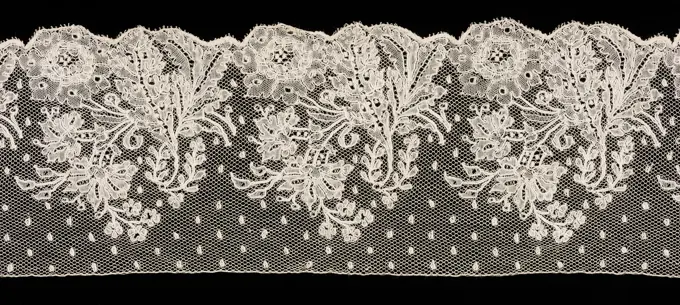
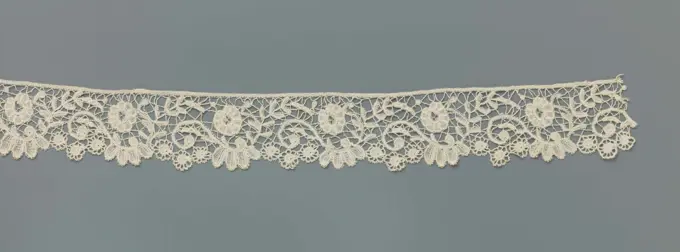
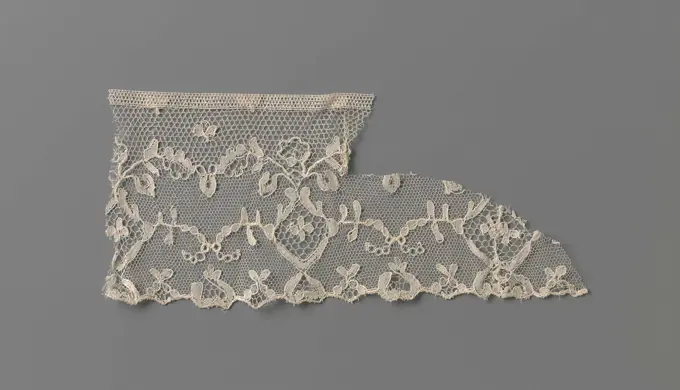
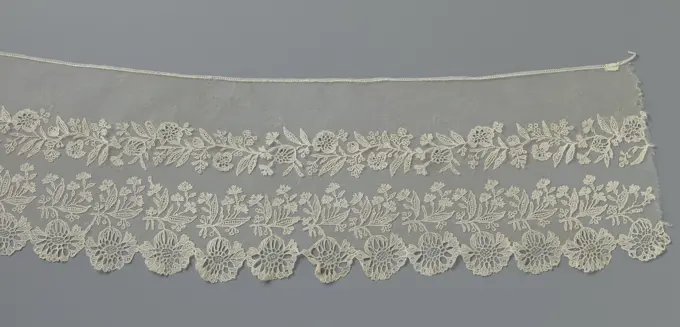
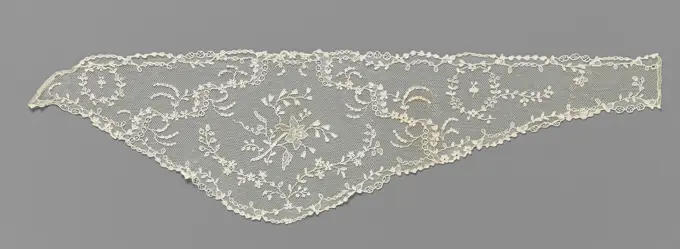
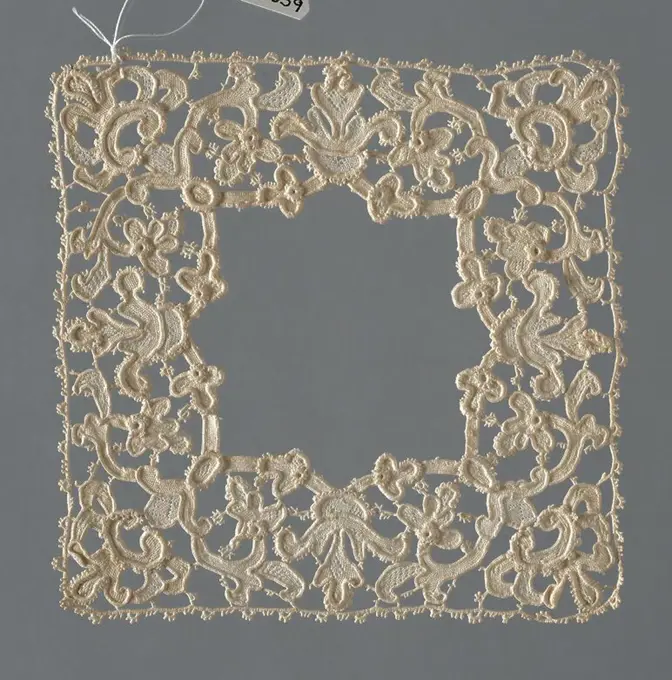
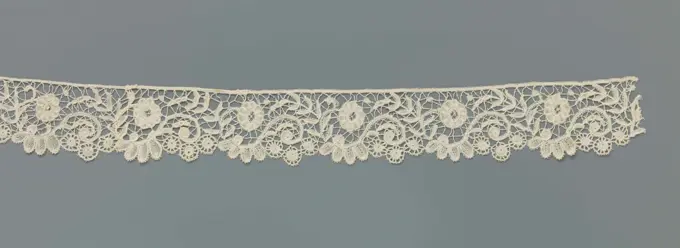
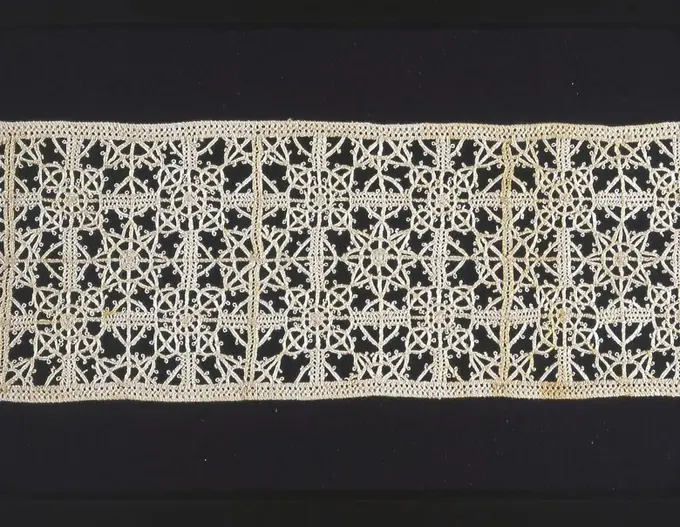
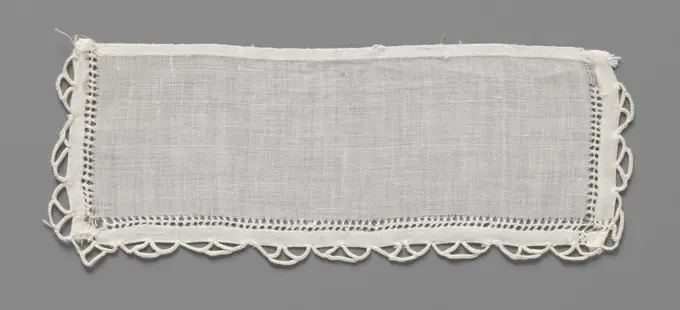
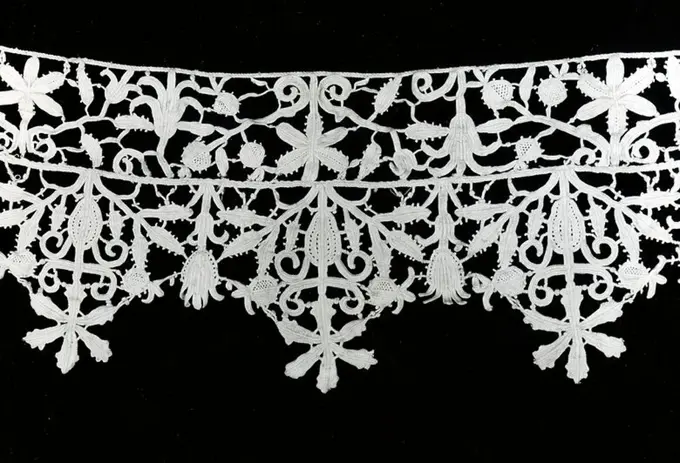
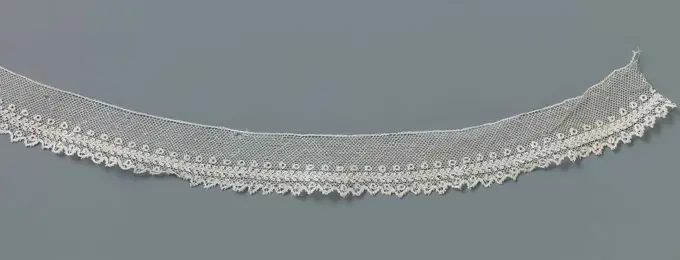
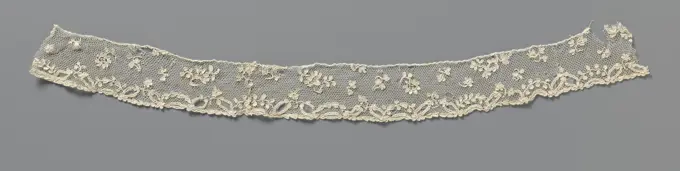
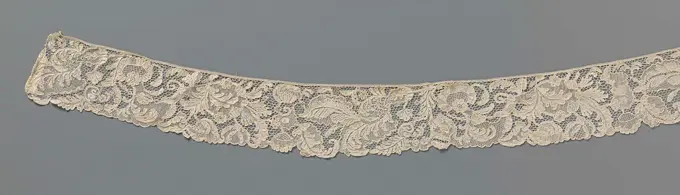
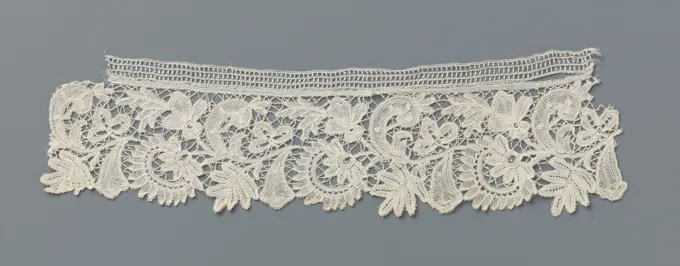
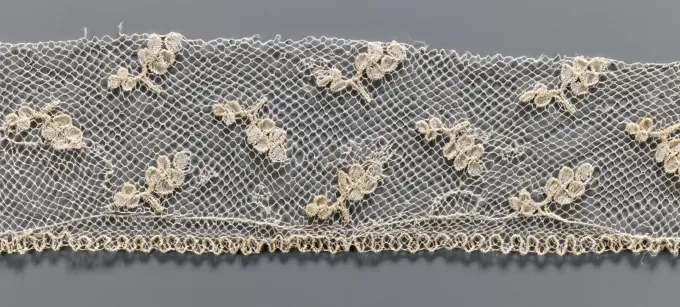
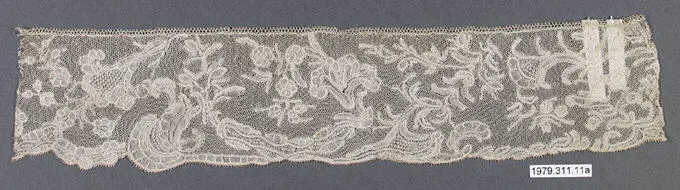
Delicate lace pieces from different centuries, featuring intricate floral and geometric designs displayed on a subtle gray background.

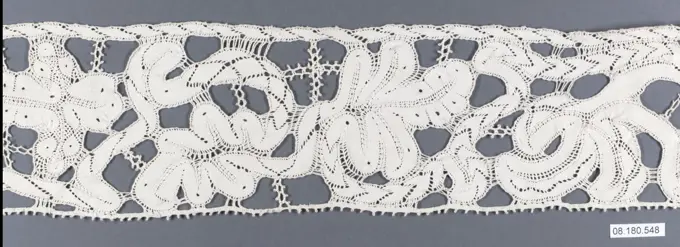
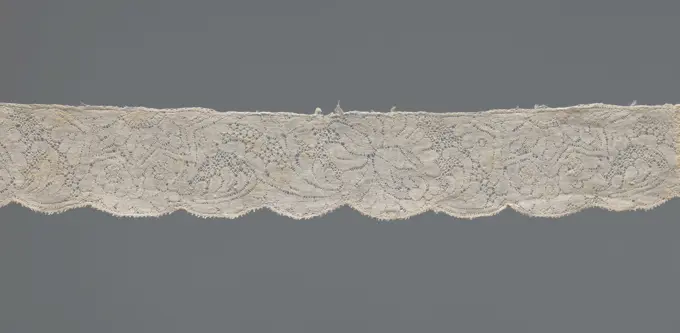
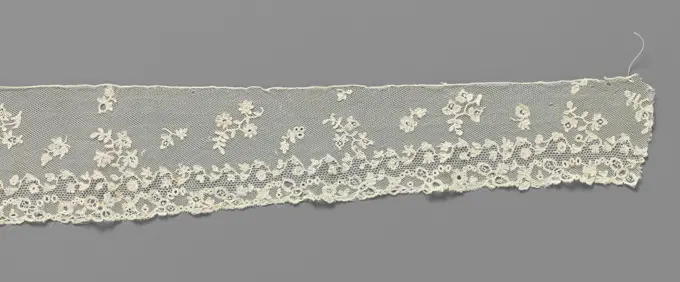
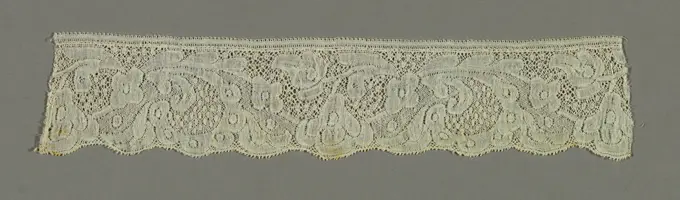
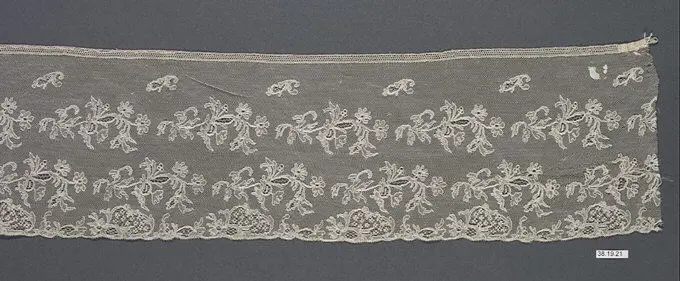
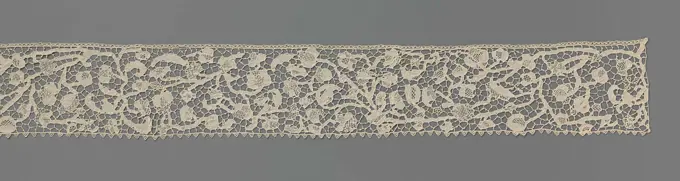
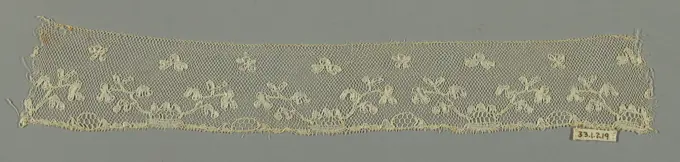
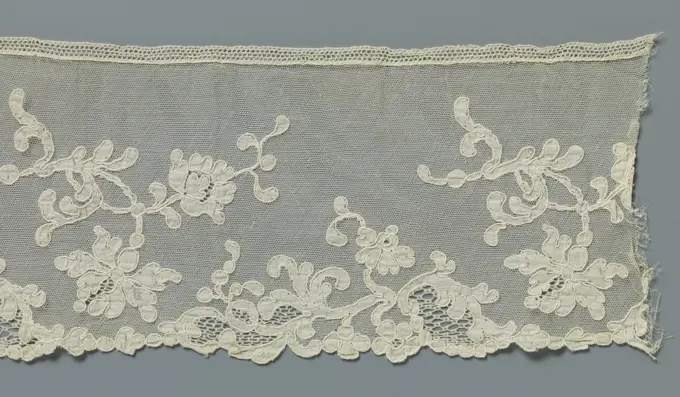
Strip bobbin with flying insects between flower branches, anonymous, c. 1740 - c. 1760 Strip of natural -colored Brussels bobbin. The pattern consists of flying insects between flower branches with different larger and smaller flowers. Along the underside, the pattern consists of a variety of curly leaves, fruits, rosette flowers and decorative tires that form as-symmetrical cartouches. The motifs are connected by a fine Maas soil, a drachel soil. The fullwork is largely made in linen battle with openwork edges and recesses. A few (flour) leaves and insect wings are made in netslag. Most motives are provided with burst relief contours. Different ornamental grounds have been applied, including fine snowflake grounds and potented braids in the cartouches and potented braids between the flower branches. The top is straight. The irregularly scalloped underside is finished with picots. Brussels linen (material) bobbin lace / Brussels bobbin lace Strip of natural -colored Brussels bobbin. Th
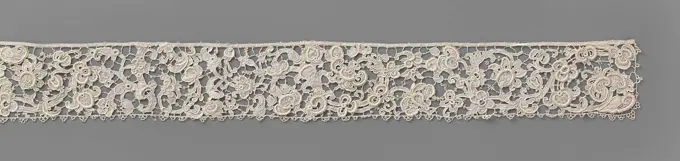
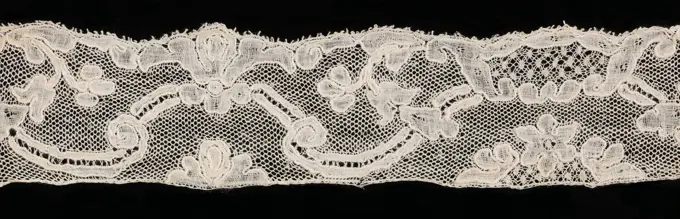
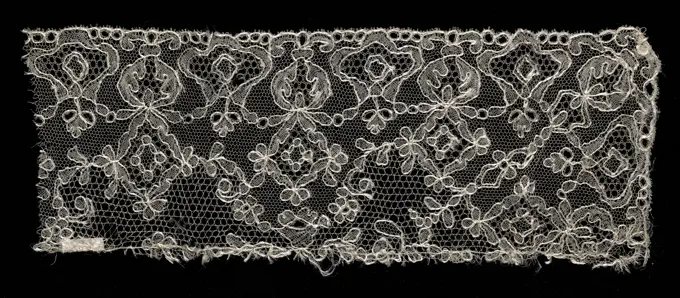
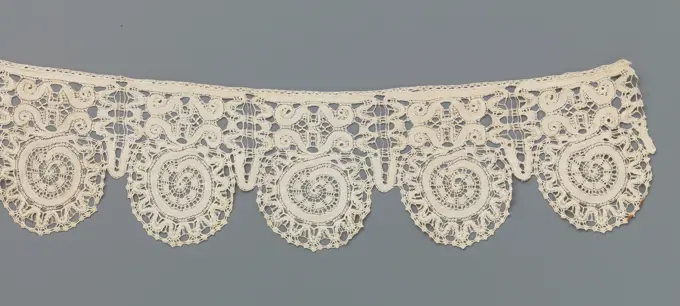
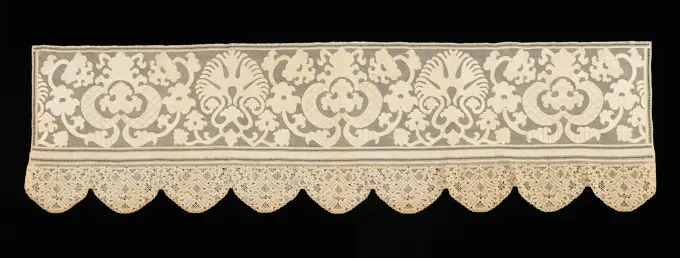
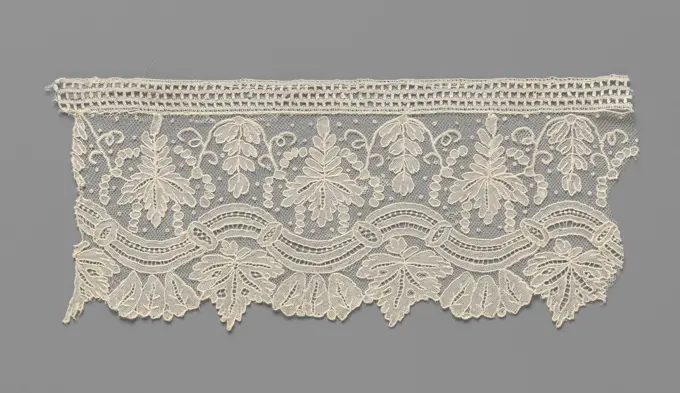
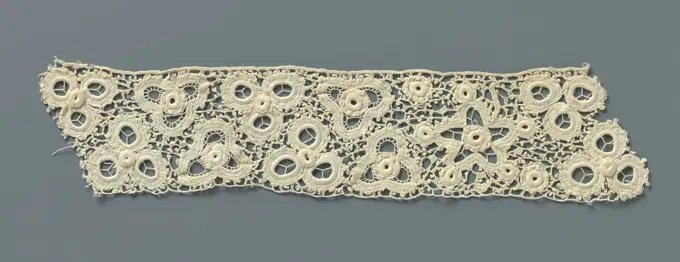
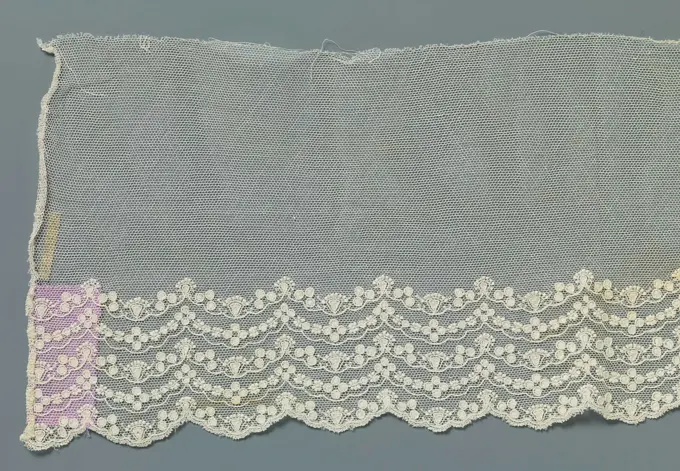
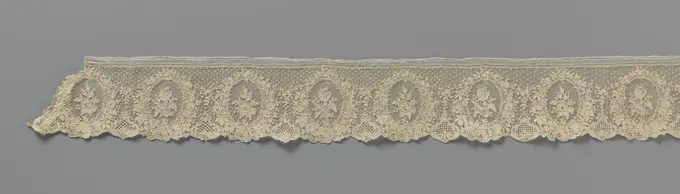
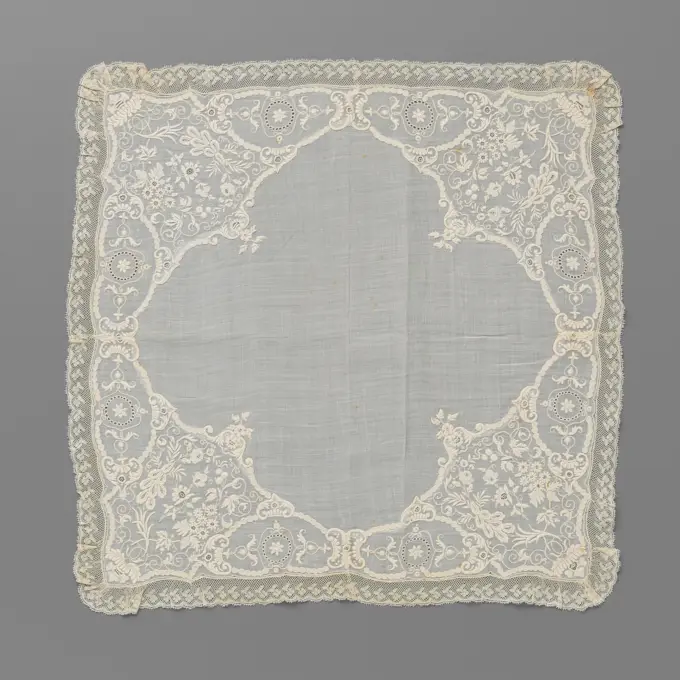
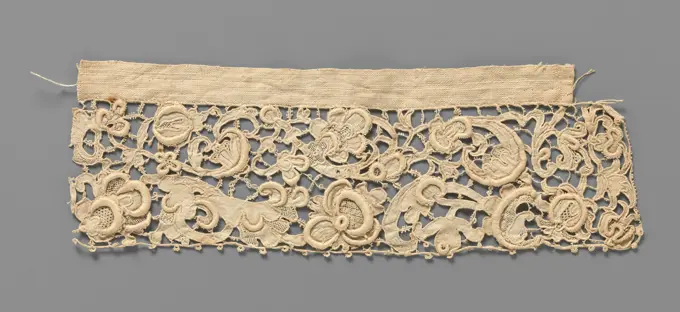
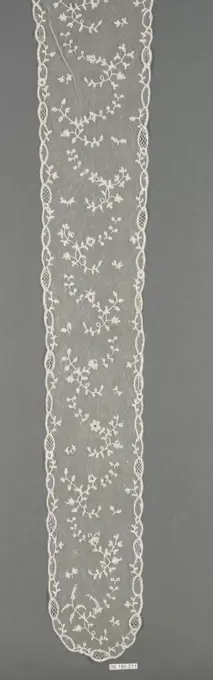
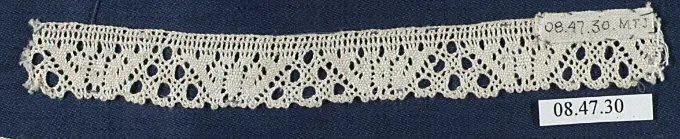
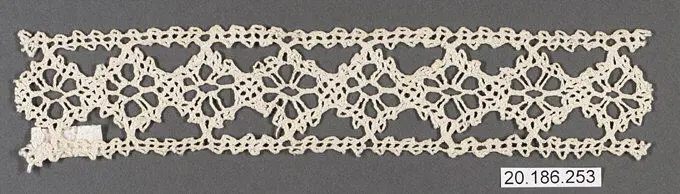
Fragment 17th century Italian, Milan. Fragment 214898Fragment 18th century Flemish, Bruges. Fragment 214515Strook naaldkant met veermotief.Strip natural needle side: Venetian relief side. On an open bars soil, they are branches with a variety of flowers, including flowers with a spring motif. It is a continuous pattern with report. The top edge is straight finished with equal triangles. The bottom edge is finished with a zigzag line with arcs and picots.Fragment of lace. unknown, authorStrook naaldkant met gespleten spiralen.Strip natural needle side: Venetian relief side. There are walking, wide spiral drinks on an open bars soil, which are split in many places. There are also large openwork centers in the flower leaves, which typifies the 19th century. Finish with a right list of over and around large and small triangles.Strip of needle side with palm motifs and feathered leaves, anonymous, c. 1720 - c. 1730 Strip of natural -colored needle side: Point de France. Pattern with symmetrical motifs including a hanging fan -shaped flour and a hanging palm with motif flanked by feathered leaves and flanked at the bottom by thick short stems placed with a fan -shaped flour on the end. The motifs are made up of feston stitches with recesses and are connected by a mesh soil of fagged and potented bars, which are arranged in series hexagons. Fillings with different decorative stitches and some motifs or parts of motifs are equipped with relief contours with or not with picots. The irregular scrap edge stems from the pattern and is finished with picots. The top of the strip is straight finished with a cloaked strap in linen battle. The short sides are finished with a picot edge for which a different yarn has been used, as far as a later addition is concerned. France linen (material) Strip of natural -colored needStrip climbing side with windows above an edge with columns. Strip natural colosside: tough or 's gravesmother side. The repetitive and geometric pattern exists along the upper half of the strip of a row of windows in slot stroke, which are linked to each other by an inverted V where a smaller window depends on a 'steming'. The smaller window is made in linen stroke. The contours of the motifs are accentuated by a thick shiny wire. The lower half of the strip consists of three rows of diamonds in the leak between which three rows of opened ovals in a closed game stroke ground. A thick shiny contour wire forms a pattern with columns around the opened ovals and diamonds. The top of the strip is straight finished in which the underside is equipped with picots.Strook kloskant met tot cirkels omkrullende ranken met pioenrozen.Strip natural-colored Dutch clamping side. The pattern consists of two to circles curling tendrils with one peony in the center. The two connected circles are flanked by a larger peony to the left and right. From one of the larger peonies, only a part can be seen because the strip has been cut here. Also along the top edge where the motif seems to be repeated with the curling tendrils, the pattern is broken. The motifs are interconnected by a very sparing used fine maas soil, with meshes of different sizes. The motifs are made in linen stroke with openwork edges. Upper and bottom are straight finished with picots at the bottom.Length of needle lace, circa 1900, Europe, maker unknown. Gift of Dr Tom Farrar, 2010.Strip bobbin with flying insects between flower branches, anonymous, c. 1740 - c. 1760 Strip of natural -colored Brussels bobbin. The pattern consists of flying insects between flower branches with different larger and smaller flowers. Along the underside, the pattern consists of a variety of curly leaves, fruits, rosette flowers and decorative tires that form as-symmetrical cartouches. The motifs are connected by a fine Maas soil, a drachel soil. The fullwork is largely made in linen battle with openwork edges and recesses. A few (flour) leaves and insect wings are made in netslag. Most motives are provided with burst relief contours. Different ornamental grounds have been applied, including fine snowflake grounds and potented braids in the cartouches and potented braids between the flower branches. The top is straight. The irregularly scalloped underside is finished with picots. Brussels linen (material) bobbin lace / Brussels bobbin lace Strip of natural -colored Brussels bobbin. ThFragment; linen; 1933-1-107Bobbin Lace (Needlepoint Design) Edging of Points, second half of 16th century. Italy, Genoa, second half of 16th century. Lace, bobbin; average: 4.8 x 22.3 cm (1 7/8 x 8 3/4 in.).Lace, 1600-1700, Italy, maker unknown. Bequest of Mrs Alice Bakewell, 1965.Bobbin Lace Edging, 18th century. Spain, Seville, 18th century. Lace, bobbin; average: 7 x 25.1 cm (2 3/4 x 9 7/8 in.).Edge, Medium: linen Technique: bobbin lace, Mechlin style with Point de Paris ground, catalogue card from 1933 says, SPRIG AND DOT PATTERN; SIX POINT STAR MESH. (point de Paris), 18th century, lace, EdgeBorder (Belgium); linenStrook kloskant met s-ranken.Natural collate strip: Duchesse-Side. There is an ongoing pattern on a braid soil. S-tanks with three daisies and an edge of Campanes form the slot and end in a simple rose.Volant van kloskant met ruitvormige medaillons.Volant of natural colosside: Parisian side. The ground has been shared in two in a paris soil with clover leaves at the top and a tulet below. In the last one is a symmetrical pattern of diamond-shaped openwork medallions with sidewalks crowned by a flower between two leaves. The leaves, the side drinks and a series of flowers and ranks in the sculpture are released in three closed garlands. The motifs are made in linen stroke and equipped with contour wires. A rose soil has been applied as ornamental ground. A portion of the top has been cut and then finished with a narrow sewn tape from side. A portion of the top is also cut off on the left, with a curve to the bottom.Japon strip of application side with hanging flowers, anonymous, c. 1820 - c. 1840 Japon strip of natural -colored application side, needle side applied on mechanical tulle. An edge of round scallops is formed by an enclosed row of large flowers that, to the right, depend on small flower branches. Loos above that, a narrow edge of a wavy branch with smaller similar flowers runs. The upper part consists of a stock of unadorned tulle. Two narrower strips have the same and a reduced pattern. Brussels linen (material) Japon strip of natural -colored application side, needle side applied on mechanical tulle. An edge of round scallops is formed by an enclosed row of large flowers that, to the right, depend on small flower branches. Loos above that, a narrow edge of a wavy branch with smaller similar flowers runs. The upper part consists of a stock of unadorned tulle. Two narrower strips have the same and a reduced pattern. Brussels linen (material)Engageante van applicatiekant met een symmetrisch strooipatroon van bloemen en bloemtakjes.ENGINEANTE OF NATURALLY APPLICATION Office: Brussels-Skiing Applied on Drachelland. Symmetrical scattering pattern of flowers and flower branches above an edge with two different garlands between which a grover of grille runs than in the rest of the side. The motifs are made in linen stroke with openwork edges and clost relief contours. Small decorative elements are used in oval in the lower pendulum and in flower hearts, including cubes in shape stroke. The top is just finished. The very flat sloping edge is finished with picots.Strip mixed side with ten different tendrils, anonymous, c. 1650 - c. 1699 Strip of natural -colored mixed side: Venetian ribbon side. Pattern with a succession of ten different shorter and longer tiflines. The tantranks do not touch each other, but they are connected by the irregular soil with potented bars. Flowers with different shapes on the branches. The contours of the pattern are formed by a round lace. Within the contours a few decorative land through recesses in the fullwork. The top is trimmed with a border bobbin. The underside and left are finished with a straight picotrand with arcs. Venice (possibly) linen (material) mixed lace / Venetian tape lace (mixed lace) Strip of natural -colored mixed side: Venetian ribbon side. Pattern with a succession of ten different shorter and longer tiflines. The tantranks do not touch each other, but they are connected by the irregular soil with potented bars. Flowers with different shapes on the branches. The contours of the pattern are fLace, 1800s, Mechelen, maker unknown. Gift of Mrs G. Acland Allen, 1955.Strip bobbin with oval flowers between three -lobe leaves and a chalice, anonymous, c. 1925 - c. 1932  Strip of natural -colored bobbin: Rosaline. The pattern consists of short curved twigs with three -lobe leaves, a few oval flowers, a single rosette flower and a chalice flower. The motifs have been hit in linen battle with open picotrand and recesses. The centers of the leaves are almost all accentuated by a thick contour thread. Within the contour wires, a tie -grid has, among other things, applied as a decorative land. The top is finished with a straight strap. The very silly outskirts of scales stems from the pattern and is finished with picots. Belgium linen (material) bobbin laceStrip of mechanical side with connected U-shaped fields with a flower branch in it and a hanging rosette flower underneath, c. 1800 - c. 1949 Strip of natural -colored machine side. The repeating pattern along the bottom half of the strip consists of a succession of U-shaped motifs made with decorative land. A rosette flower hangs down under each "leg" of a U. Together with the U-shaped fields, this flower ensures a sculpy edge along the underside of the strip. In the U-shaped field there is a flower branch with two smaller rosette flowers. Between these flowers a branch with leaves raises. There are two larger leaves under the flowers. The upper half of the strip has a wide spreading pattern of patterns between which one row hanging leaf branches. The motifs are partly equipped with contour threads and are connected by a fine machining tuler land. A narrow edge along the top is made in mechanical rose stroke. The scrap edge along the underside of the strip is finished with picots. WesStrook naaldkant met strooipatroon van verschillende bloemtakjes.Strip natural needle side: Argentan side. The strip is equipped with a scattering pattern of different flower branches. The flat sculpture along the bottom edge consists of a concatenation of elongated oval filled with a row of riderpicots, over each oval is always a half oval-shaped bow. The motifs are on a hexagonal mesh of hexagonal mesh, which are close to feston stitches. The folder is made with feston stitches without recesses and the motifs are equipped with relief contour lines, here and there provided with picots. As ornamental soil is used under the arcs in the edge pattern and a very fine maas soil in a few flower hearts. Except in the edge pattern, radar picots also occur in most flower hearts. One side is finished with a straight edge, the other side has been cut. The top is finished with a border clamping side.Strip bobbin "GripSholms Lace" with cartouches of rosette flowers and C-Voluten, Anonymous, c. 1800 - c. 1899 Strip of natural -colored bobbin, Lille side. The strip is attached to a light blue cardboard with pins, with four other strips. At the top of the cardboard is "Wadstena. Sweden." Written and under the strip is "Gripsholms Lace. (Gis Spets.)". The repeating pattern along the lower edge of the strip from connected cartouches with rosette flowers and C-volutes. The motifs are connected by a fine Maas soil, a tuler land. The motifs are made in linen battle with openwork edges, recesses and with thicker and shiny contour threads. A rose soil has been used in the cartouches as a decorative soil. In the recesses in the lower C-Voluten, square mosies are made in form. The top of the strip is straight finished. The lobed scallops on the bottom are finished with picots. On the strip hangs a yellow thread with a shower on which "W K S" stands. Vadstena linen (material) bobbin lace / LillKloskant intermediate mate with zigzag line, anonymous, c. 1875 - c. 1949 Piles of Natural -colored bobbin side: Mechelse side. In the middle of the fine grid, a Mechelen soil (also known as ice soil), an openwork band runs in Zigzaglijn, cut over by two types of rosettes. Belgium linen (material) bobbin lace / Mechlin (lace) Piles of Natural -colored bobbin side: Mechelse side. In the middle of the fine grid, a Mechelen soil (also known as ice soil), an openwork band runs in Zigzaglijn, cut over by two types of rosettes. Belgium linen (material) bobbin lace / Mechlin (lace)Strip of bobbin with lumped round shell with star or flower in it, anonymous, c. 1890 - c. 1899  Strip of natural -colored bobbin, Russian side. The pattern consists of an openwork round shell with seven lobes all around. The motifs are made in linen battle, the lobes with curved straps with square meshes. In the center of the shell, a flower or star is made with diamonds made with picoted braids. The top of the strip is straight finished. The lobes around the Schulpt are finished with picots. Russia linen (material) bobbin lace / Russian laceBorder (Italy); linenFragment, Medium: linen Technique: withdrawn element, Insertion of reticella has an interior band with adjoining four-lobed frameworks. Small circle is in the center of each framework. Outer band has small squares filled with wavy diagonals., Italy, 16th century, lace, FragmentKloskant cuff with V-shaped leaves in semicircular shell, anonymous, c. 1880 - c. 1910 Cuff made of natural-colored bobbin, Valenciennes side. The repeating pattern consists of a V-shaped leaf in a semicircular shell formed by a double tire. The motifs are connected by a Maas soil, a diamond-shaped Valenciennes ground. The motifs are made in linen battle with recesses and openwork edges. In the recesses and between the double tire along the scallops, a dash of pattern has been realized with braids. The top of the strip is straight finished. The scums along the bottom are finished with picots. Belgium linen (material) Bobbi Lace / Valenciennes Lace Cuff made of natural-colored bobbin, Valenciennes side. The repeating pattern consists of a V-shaped leaf in a semicircular shell formed by a double tire. The motifs are connected by a Maas soil, a diamond-shaped Valenciennes ground. The motifs are made in linen battle with recesses and openwork edges. In the recesses and between the double tEdge; linen; 1933-1-149Strip bobbin with forget-me-nots and two composite branches, anonymous, c. 1760 Strip of natural -colored Brussels bobbin. The repeating pattern consists of a hanging branch with a cluster of rosette flowers followed by two differently composite branches, with many leaves, a single flower and berries. The branches spring from the bottom, both with a branch to the left and right. The motifs are connected by a fine Maas soil, a drachel soil. The fullwork is largely made in linen battle with openwork edges and recesses. Some berries have a mains filling. Most motives are provided with burst relief contours. Different decorative lands have been applied, including potented braids (grounds). The top and short sides are straight. The irregularly scalloped underside is finished with picots. Brussels linen (material) bobbin lace / Brussels bobbin lace Strip of natural -colored Brussels bobbin. The repeating pattern consists of a hanging branch with a cluster of rosette flowers followed by two dStrip bobbin with spiral and mirrored volutes, anonymous, c. 1600 - c. 1649 Strip of natural -colored bobbin: Old Flemish bobbin. The repeating pattern consists of a double volute that is mirrored over the width axis and below that a semicircular shell, which is formed by a spiral. The motifs are formed by burst ribbons, made in linen battle with openwork edges. The spiral is surrounded by a regularly swinging narrower ribbon. Crosses are made with form strokes between the mirrored volutes. The motifs are connected by braids. The top edge is finished with a separate strap. Flanders linen (material) bobbin lace / tape lace (bobbin lace) / old Flemish lace Strip of natural -colored bobbin: Old Flemish bobbin. The repeating pattern consists of a double volute that is mirrored over the width axis and below that a semicircular shell, which is formed by a spiral. The motifs are formed by burst ribbons, made in linen battle with openwork edges. The spiral is surrounded by a regularly swingingBed curtain border fourth quarter 18th century Russian This object is from the collection of Natalia de Shabelsky (1841-1905), a Russian noblewoman compelled to preserve what she perceived as the vanishing folk art traditions of her native country. Traveling extensively throughout Great Russia, she collected many fine examples of textile art of the wealthy peasant class. From the 1870s until moving to France in 1902, Shabelsky amassed a large collection of intricately embroidered hand-woven household textiles and opulent festival garments with rich decoration and elaborate motifs. The Brooklyn Museum holdings include many fine examples including the majority of the garments. Portions of Shabelsky's collection are also housed at the Museum of Fine Arts, Boston, the Cleveland Art Museum, and the Russian Museum of Ethnography in St. Petersburg.The exquisite workmanship of this example displays the variety and fineness of stitches in an elegant stylization of the tree of life, the most preStrip of needle side with angular rosette and diamond shape with suns, anonymous, c. 1900 - c. 1949 Strip of natural needle, reticella and work with pulled threads. Pattern with squares that are made up of four small squares (work with pulled threads together). Alternately in one square an angular rosette and in the other a diamond shape with 'rising suns' in the corners. Around the large squares on all sides, a border with rectangles. A finished edge in linen battle on all sides. unknown cotton (textile) Strip of natural needle, reticella and work with pulled threads. Pattern with squares that are made up of four small squares (work with pulled threads together). Alternately in one square an angular rosette and in the other a diamond shape with 'rising suns' in the corners. Around the large squares on all sides, a border with rectangles. A finished edge in linen battle on all sides. unknown cotton (textile)BorderNeedlepoint Lace (Argentan Lace) Lappet, 1715-1774. France, Argentan, 18th century (Louis XV Period, 1715-1774). Lace, needlepoint: linen; average: 58.5 x 10.2 cm (23 1/16 x 4 in.).Strip cream-colored machining with a pattern of flower and leaf refints.strip cream-colored Machining with a Pattern of Flower and Leaf Drinks. The Strip Was Intended As A Neck Filling And Was Spelled On a Purple Side Dark Dress: BK-1978-282-d.Border Made 1880-1890 Denmark. Cotton and linen, bobbin straight lace .Cuff 18th century Italian. Cuff 214890Strip bobbin with trapezoidal cartouche and clover four, anonymous, c. 1700 - c. 1899 Strip of natural -colored bobbin: Mechelse side. The repeating and continuous pattern consists of a succession of a trapezoidal cartouche, elongated leaves and a clover four. The motifs are connected by a fine Maas soil, the Mechelen soil. The motifs are made in linen battle, with thicker and shiny contour threads. Two different decorative grounds, with coarse meshes, are used in the cartouches and in a room between the leaves. The very slightly scalloped underside is finished with picots. The top is straight. Mechelen linen (material) bobbin lace / Mechlin (lace) Strip of natural -colored bobbin: Mechelse side. The repeating and continuous pattern consists of a succession of a trapezoidal cartouche, elongated leaves and a clover four. The motifs are connected by a fine Maas soil, the Mechelen soil. The motifs are made in linen battle, with thicker and shiny contour threads. Two different decorative gKloskant intermediate mate with zigzag line, anonymous, c. 1875 - c. 1949 Piles of Natural -colored bobbin side: Mechelse side. In the middle of the fine grid, a Mechelen soil (also known as ice soil), an openwork band runs in Zigzaglijn, cut over by two types of rosettes. Belgium linen (material) bobbin lace / Mechlin (lace) Piles of Natural -colored bobbin side: Mechelse side. In the middle of the fine grid, a Mechelen soil (also known as ice soil), an openwork band runs in Zigzaglijn, cut over by two types of rosettes. Belgium linen (material) bobbin lace / Mechlin (lace)Strip of needle side with wavy decorative frame and wine leaves, anonymous, c. 1870 - c. 1880  Strip of natural needle side: Brussels mesh side. The repeating and largely symmetrical pattern consists at the bottom of the strip of a continuous wavy decorative band that is cut over at a regular distance by an oval. A wine leaf hangs under each wave top and three more or less heart -shaped leaves under each golf valley. Above the decorative belt hanging from the top of the strip of leaf branches straight down, alternately a branch with a wine leaf and a shorter branch with smaller leaves on either side. Around the leaves fine curling sling and swingers with connected oval (grapes). The motifs are made up of feston stitches and equipped with relief contours. The motifs are connected to each other by a fine Maas soil, a mesh side, on which a few mushes have been applied. Decorative stitches have been used in the decorative band and the largest wine leaves. The scrap edge is formed by the haFragment 17th century Italian, Venice. Fragment 218091Lappet 1700-1750 Flemish. Lappet 227246Sleeve Ruffle; linenEngageante van naaldkant met een a-symmetrische bloemtak in een symmetrische lijst.ENGINEANTE OF NATURAL CONNECTION: Argentan side. The pattern consists of an A-symmetrical flower branch in a symmetrical table. Under the flower branch two long branches that form a V. On either side of the list is an oval medallion with a flower in the center. With the exception of one larger flower in the central flower branch, the other motifs consist of thin with picots occupied branches, with small leaves, flowers, berries berries and 'cords' of openwork and picotted circles. The motifs are made up of feston stitches and equipped with relief contours. The motifs are connected by a soil with meshes that are close to feston stitches, an Argentan ground. Ornamental soils and decorative stitches are applied in different leaves, circles and in the flower leaves of the central flower. Along the edges, elongated fields are filled with a finer maas soil, the fields are defined by leaf packs, heart-shaped leFragment, Medium: linen Technique: bobbin lace, peasant style, peasant style lace or early student, 19th century, lace, FragmentFlounce 18th century Flemish. Flounce 226291Length of Lace. Belgium, Brussels, late 19th century. Textiles; textile lengths. Cotton point de gaze needle laceChalice Cover. Italy. Date: 1675-1700. Dimensions: 14.2 x 14.2 cm (5 5/8 x 5 5/8 in.). Linen, needle lace. Origin: Italy. Museum: The Chicago Art Institute, Chicago, USA.Collar of needle side and bobbin with flower vines and nine pointed sculptures, anonymous, c. 1840 - c. 1850 Collar consisting of a strip of natural -colored Venetian needle side "Gros Point", with edges of natural -colored Old Flemish bobbin side. Lightly curved strip -shaped model. The inner strip of needle side has a pattern of volute vines and composite flowers. The motives are provided with contour threads and partly with thick cordons, decorated with Pictos. Different decorative stitches have been used, mainly in the flower hearts. A strip of bobbin has been set along the underside and continuous in the short sides, with a closted intermediate slat. The bobbin side consists entirely of braids (Passions work), which form a geometric pattern of a total of nine pointed sculptures. The shrewd strap along the top of the collar is made of four rectangles in linen battle, with an octagonal motif with recesses, connected to each other with braids. The scrap edge of Kloskant is probably oStrook kloskant met s-ranken.Natural collate strip: Duchesse-Side. There is an ongoing pattern on a braid soil. S-tanks with three daisies and an edge of Campanes form the slot and end in a simple rose.Bobbin Lace (Needlepoint Design) Insertion and Edging of Points, second half of 16th century. Italy, Genoa, second half of 16th century. Lace, bobbin; average: 4.8 x 16.6 cm (1 7/8 x 6 9/16 in.).Strook gehaakte kant met vijfpuntige sterren en bloemen gemaakt met open cirkels.Part of a strip of natural-colored Irish crochet side. The original, repetitive pattern consists of a double row with a total of eight triangular floral motifs made with open circles, interspersed with one five-pointed star with a circle in the middle and a circle of each point. Crocheted irregular mesh soil with picots. Top and bottom are finished with a straight edge.Strook naaldkant met bloemen en ranken.Strip natural needle side: Flat Venetian side. Asymmetrical, angular running tendrils with knob-shaped flowers in very open grouping spring in crowd of single nodes. Straight edge of equal triangles.Strip Machine side with five rows of synchronous wavy garlands. Strip natural-colored mechanical side: Machine lust side. Five rows of synchronous wavy garlands fill the strip from the bottom to almost on the center line. Each pendulum is decorated with circles and dots and alternately awarded with dots with a kind of chali flower. The motifs are equipped with contour wires and are connected to each other by a fine toella, which extends above the center line without motifs and straight has been cut. Along the bottom of the strip the lower pendulum ensures a slip edge, which is finished with picots. One short side is finished with a soil.Strip machine side with sunflower and candelabar motif with feathered leaf curls, J. Gaillard, c. 1881 Strip machine side: Machinal Binche side. The symmetrical pattern is formed by a hanging sunflower or Margriet next to a candle-like motif that is made up of curling of feathered leaves, with a crown in the top. The motifs are equipped with openwork edges and are connected by a machine braiding ground. Various mechanical snowflake grounds have been used as a decorative land. Top and bottom of the strip are straight finished, with the bottom with picots. Calais cotton (textile) Strip machine side: Machinal Binche side. The symmetrical pattern is formed by a hanging sunflower or Margriet next to a candle-like motif that is made up of curling of feathered leaves, with a crown in the top. The motifs are equipped with openwork edges and are connected by a machine braiding ground. Various mechanical snowflake grounds have been used as a decorative land. Top and bottom of the strip are straiTwo samples of block lace (inserts)Cap streamers, Medium: linen Technique: bobbin lace, Mechlin style, Mechlin lace with diagonally placed bands of openwork with flowering sprays. Seam at center shows that two pieces have been joined to form one strip with rounded ends., Belgium, 18th century, lace, Cap streamersBand; linen; 1933-1-164-aStrip of needle side with tulip and rose branch in medallions, anonymous, c. 1850 - c. 1860 Strip of natural-colored needle side: Alençon side. Pattern with a repetitive motif of medallions on a fine hexagonal Maas soil, which is littered at the top with moes. In the medallions alternately a tulip and a rose branch. The outer edge of the medallions consists of multifaceted flowers and leaves that are getting larger downwards. On either side of the largest flower at the bottom of an acanthus leaf. Different decorative grounds in the diamond -shaped spaces between the Acanthus leaves and in a single flower. Along the lower edge flowers, leaves that form scallops. The top is trimmed with a border bobbin. Alençon linen (material) Alençon Lace Strip of natural-colored needle side: Alençon side. Pattern with a repetitive motif of medallions on a fine hexagonal Maas soil, which is littered at the top with moes. In the medallions alternately a tulip and a rose branch. The outer edge of the medInsertion. Possibly made at the Aemilia Ars Workshop, 1898-1914; Italy, Bologna. Date: 1900. Dimensions: 7.7 × 95.7 cm (3 × 37 5/8 in.)Width repeat: 6.75 cm (2 5/8 in.). Cotton, plain weave; cut work with needle lace inserts; pulled thread work in double hem and overcast stitches. Origin: Bologna. Museum: The Chicago Art Institute, Chicago, USA.Sleeve Ruffle; linenCuff of linen batist finished on three sides with open hems and an arc of crocheted side, anonymous, c. 1900 - c. 1910 Cuff of natural -colored batist finished on three sides with a narrow edge of open sewing along the homen: work with pulled out threads. Along one long and two short sides, a scrap edge is made with arcs: crocheted side. Amsterdam linen (material). batiste Cuff of natural -colored batist finished on three sides with a narrow edge of open sewing along the homen: work with pulled out threads. Along one long and two short sides, a scrap edge is made with arcs: crocheted side. Amsterdam linen (material). batisteTie. Belgium, Brussels, 1870-1890s. Costumes. Cotton point de gaze needle laceVerdubbelde strook naaldkant met hartvormige rankjes.Strip natural needle side: Flat Venetian side. On a bar soil that forms regular six-sided mesh, a fine pattern of two symmetrical, heart-shaped ranks is connected by serpentine tanks. Straight finish with large triangles.Bobbin Lace (Rose Lace) Edging, 17th century. Italy, Genoa, 17th century. Lace, bobbin; average: 5.5 x 16.5 cm (2 3/16 x 6 1/2 in.).Border. Italy. Date: 1610-1640. Dimensions: 11.3 x 87.2 cm (4 1/2 x 34 3/8 in.)Repeats: Upper band width: 19.5 cm (7 3/4 in.)Lower band width: 8.2 cm (3 1/4 in.)Upper band height: 4.1 cm (1 5/8 in.)Lower band height: 7.2 cm (2 7/8 in.). Linen, needle lace worked on a laid and plaited thread grid, Reticello pattern. Origin: Italy. Museum: The Chicago Art Institute, Chicago, USA.Strip of needle side with bows, anonymous, c. 1875 - c. 1909 Strip of natural -colored needle side: Venetian relief side. On a very open bar of land there are irregular volute vines with leaf voltuties and multifaceted flowers. On the left is a small part of old Venetian needle side with fleshy leaf voltuten and iris-shaped large flower with three thick relions that, identical, return twice in BK-BR-J-340-A. On the far left is a 19th-century copy, in which large openings in leaves and flowers indicate the 19th century, as well as the very many lobes along the contours. Incidentally, a wide running rank has been widened with a narrower one. Straight list of triangles. Venice (possibly) linen (material) Venetian raised work Strip of natural -colored needle side: Venetian relief side. On a very open bar of land there are irregular volute vines with leaf voltuties and multifaceted flowers. On the left is a small part of old Venetian needle side with fleshy leaf voltuten and iris-shaped larStrook kloskant met drie lengtestrepen.Strip natural colosside: Lille side. The continuous pattern starts under the middle line and consists of two rows of circles, with a horizontal rank in between with small leaves on the other hand. Along the bottom row of circles runs a wavy line that forms shifts, with one circle in each scallop. The motifs are connected by a fine grille, a tulet. The energy-saving fireworks is made in linen stroke, with thicker and shiny contour wires. The top of the strip is straight finished. The scivels along the underside are finished with picots.Strook kloskant met ovalen gevormd door gebogen bladeren.Strip natural colosside: Lille side. The upper half of the strip has no pattern. The repeating pattern along the lower half consists of two curved leaves that together form a broken oval with a flower in the center. This flower is fixed at the top leaf. Five flowers hang on the lower sheet, which form a fan-shaped aerator. The motifs are placed close together, wherein the flowers overlooked at the bottom. The motifs are connected by a fine grille, a tulet. The motifs are made in linen stroke with large recesses and with thicker, shiny contour wires. The top of the strip is straight finished. The shelters along the underside are finished with picots.Fragment; linenNeedlepoint (Reticella) Lace Edging, 16th century. Italy, Venice, 16th century. Lace, needlepoint: linen; average: 2.9 x 15.9 cm (1 1/8 x 6 1/4 in.).Bobbin Lace (Point d'Angleterre) Edging, late 1700s-1800s. Flanders, late 18th-19th century. Lace, bobbin: linen; average: 9 x 57.2 cm (3 9/16 x 22 1/2 in.).Strip 16th-17th century Italian. Strip 215440Strip of needle side with flower litter pattern and rush -hour, anonymous, c. 1775 - c. 1799 Strip of natural needle side, argent tank side. Strooi pattern of twigs that alternately have a small or larger flower, leaves and/or berries. Ground with meshes that are closed with buttonholes. The pattern along the lower edge consists of two pointed to each other, in between, between which a flower or berry branch rises. The oval pairs are connected by an arc of leaves and/or berries and hearts. Under these arcs along the lower edge a flat, lying oval. The oval -shaped figures in the pattern are filled with a fine hexagonal Maas soil (alençong round). Different decorative grounds in the flowers. Volwerk without recesses in flowers, leaves and berries. Schulpenrand on the underside by a succession of heart -shaped leaves, regularly interrupted by a rosette flower and the flat oval. The top is finished with a straight edge. Argentan linen (material) Argentan Lace Strip of natural needle side, Jabot of Vieux Bruxelles climbing side with cut off corners. Jabot of climbing side with cut off corners. The pattern has three palmets between which browsing leaves and flowers.Strip bobbin with windows and stars and spiders, anonymous, c. 1900  Strip of natural-colored bobbin: Cluny side. We worked with thick threads. In the wide strip, different windows, stars and spiders were made in linen and mains. The motifs are connected by picoted braids. The top of the strip is straight finished. The two unequal shells along the underside are provided with lobes, made with potented braids. Bohemia cotton (textile) bobbin lace / Cluny laceStrook naaldkant met gekrulde veervormige bladeren.Strip natural needle side: Argentan side. Repetitive motif with mainly curled spring-shaped leaves and some impeller-shaped flowers and small rosette flowers. Ground with meshes that are close to the buttonhole stitches. Full work decorated with recesses and various fine ornamental grounds. There is no separate pattern for the bottom edge, the very finely picoted sloping edge forms from the motif of flowers and leaves. The top is trimmed with a border clamping side. The strip is bland dwelled as for a Berthe.Strip bobbin with aster, anonymous, c. 1900 - c. 1924 Strip of natural-colored bobbin: Duchesse side. On an open braid ground is a unilaterally oriented running slender, which ends in a wide spiral drink and out in one and profil. Netherlands (possibly) linen (material) bobbin lace Strip of natural-colored bobbin: Duchesse side. On an open braid ground is a unilaterally oriented running slender, which ends in a wide spiral drink and out in one and profil. Netherlands (possibly) linen (material) bobbin laceFragment Swedish, Vadstena 19th centuryStrip bobbin with V-shaped motifs and Zigzag-Sculpen edge, Anonymous, c. 1900 - c. 1924  Strip of natural -colored bobbin: Stropkant with motifs in sloping mains, also called 's Gravenmoerse side. The repeating and symmetrical pattern consists of a V-shaped motif made in Netslag, with parallel under the left leg a rectangle in linen battle. The triangular fields above each V are filled with a decorative soil made of cubes made in netslag. Under the V, the field consists partly of a rose ground. The top of the strip is straight finished. Schulpenrand On the underside of the strip consists of pointed sculptes that are formed by a zigzag track in mainslag. The points are 'unkempt' because at the end of each round no extra turning pair was given. 's Gravenmoer cotton (textile) bobbin lace / 's Gravenmoer laceBorder 16th century Italian Punto in arialiterally, "stitches in the air"is one of the earliest styles of needle lace, which is itself developed from cutwork of primarily geometric design. When lacemakers transitioned to using a foundation of threads laid out according to a pattern drawn on parchment, they were able to incorporate more fluid lines and curves into their designs.. Border. Italian. 16th century. Needle lace. Textiles-LacesFragment of the lace;  2. PO. XVII century (1650-00-00-1700-00-00);Voile of edge embroidery on tulle with falling leaves. Voile of natural-colored edge embroidery: tuledo stroke on machine tulle. A rectangular tulle is filled with a row of leaves and surrounded on three sides with rosettes on close-colored stems. Straight finish with feston stitches.Fragment of lace. unknown, authorBobbin Lace (Needlepoint Design) Insertion, second half of 16th century. Italy, Genoa, second half of 16th century. Lace, bobbin; average: 4.2 x 24.2 cm (1 5/8 x 9 1/2 in.).Zakdoek van batist met borduurwerk in elke hoek met veelsoortige bloemen in een schildvormige cartouche.Natural batist's handkerchief with embroidery - white work with plugus and shadow work - and rounded around with a strip of dumplings: Valenciennes-side. The embroidery fills every corner to the center of each side, leaving a diamond-shaped piece of unprocessed batist in the center. The embroidery pattern is the same for every angle and consists of a cartouche with pearl edge in the form of a coat of arms, containing different flowers and fine curling lines. The shield is flanked on both sides by an oval cartouche with pearl edge, in which a circle with seven-leaf flower is central and around it around curling lines and curling feathered leaves. The strip of clamping has a repeating pattern of a hanging flower above a lying bow. The lying arcs form a sloping edge that is finished with picots. The motifs are made in linen stroke with openwork edges and are connected by a grille: a squStrip Machine side with crossing branches with carnations, anonymous, c. 1890 - c. 1909 Strip of natural -colored machine side. The repeating pattern consists of a double branch, with one carnation -like flower on each branch. One branch bends down and crosses the other branch that bends up. Along the underside there are curls of feathered leaves and some smaller flowers and leaves. The curling leaves form rocaille-like fields that are filled with a decorative land. The motifs suggest to be made in linen battle and are provided with shiny contour threads. The motifs are connected by a very fine machine tulip. The scrap edge along the underside of the strip stems from the pattern. The top is finished with a separate strap made of mechanical side. Europe cotton (textile) Strip of natural -colored machine side. The repeating pattern consists of a double branch, with one carnation -like flower on each branch. One branch bends down and crosses the other branch that bends up. Along the underStrook gehaakt kant met een rij vierkanten met rozetten.Strip crochet side. Reticella pattern with a row of square fields, with a rosette in each field. Upper and bottom of the strip are straight finished. One short side is sloped off.Strook naaldkant met voluutbladeren en granaatappels.Strip natural needle side: Venetian needle side "Gros Point". Pattern with two elongated running tendrils lying above each other, to which volute jar, pomegranates and variations of palmet flowers. Along the top is a wide linen band sewn. The motifs are made up of feston stitches with fine lines with recesses and with relief contours here and there. In different places the relevant contours are very strongly turned on with thick scented cordons, or not decorated with arc battles and picots. Different ornamental soils have been applied in Flower hearts. The motifs are connected by trips decorated with picots. The underside and continuous along one short side is finished with a straight edge with half riderpicots. The other short side has been cutBarbe (one end) late 18th century Flemish, Brussels. Barbe (one end). Flemish, Brussels. late 18th century. Bobbin lace. Textiles-LacesFragment Swedish, Skane 19th centuryInsertion 16th century Italian, Venice. Insertion 221063Fragment of the lace;  19th century (1801-00-00-1900-00-00);Edging mid-18th century Flemish or British The Metropolitan Museum's great lace collection was started when the Museum became the first among American museums to organize a permanent collection of lace with the acceptance of the McCallum Collection in 1879 and the bequests of Mrs. John Jacob Astor, Mrs. Robert L. Stuart, Mrs. Augustus Cleveland, and Mrs. A. W. Winters shortly thereafter. In 1893 a loan collection of antique laces shown at the World's Columbian Exposition in Chicago was assembled by a committee of New York women headed by Catharine Augusta Newbold. About 1900 Miss Newbold arranged and labeled an exhibition of laces and linenworks lent to the Metropolitan Museum by Mrs. James Boorman Johnstone and the Misses Johnstone. "Her scholarly knowledge of lace technique enabled the Museum for the first time to offer a comprehensive display of lace illustrating its historical development," wrote Miss Frances Morris, then curator of the textile department. Miss Newbold's name occurStrip 18th century Flemish. Strip 218833Kloskant cuff with hanging bunch in symmetrical frame, Leon Sacré, c. 1907 Cuff made of natural -colored bobbin: Flemish Guipure. In a symmetrical frame of S-Voluten, rosettes and C-Voluten, an asymmetrical trice with round-shaped fruits or flowers hangs. Braid soil. Finishing on all sides with unequal sculptures that arise from the pattern. The cuff is rectangular with a raised center. Brussels linen (material) bobbin lace / Flemish guipure lace Cuff made of natural -colored bobbin: Flemish Guipure. In a symmetrical frame of S-Voluten, rosettes and C-Voluten, an asymmetrical trice with round-shaped fruits or flowers hangs. Braid soil. Finishing on all sides with unequal sculptures that arise from the pattern. The cuff is rectangular with a raised center. Brussels linen (material) bobbin lace / Flemish guipure lace