Vintage Lace Strips

A variety of lace strips from different periods showcasing floral patterns and intricate designs, crafted in linen with delicate details and historical significance.

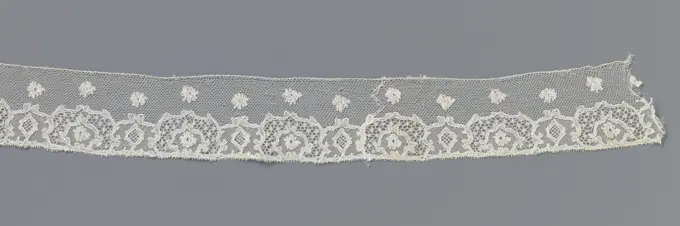
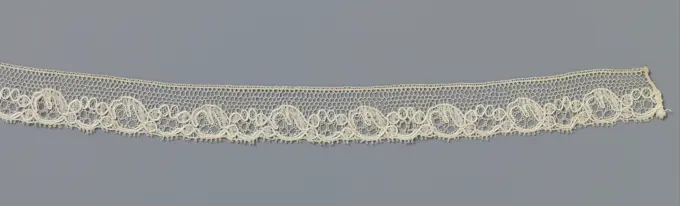
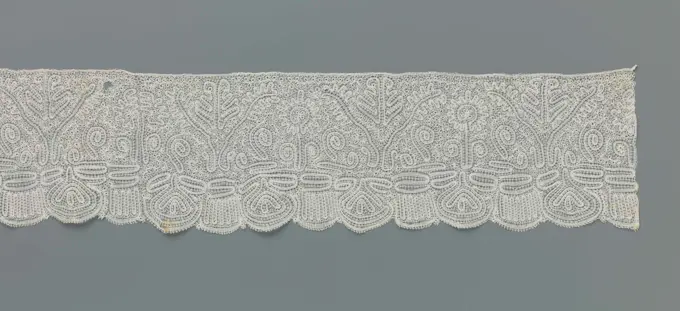
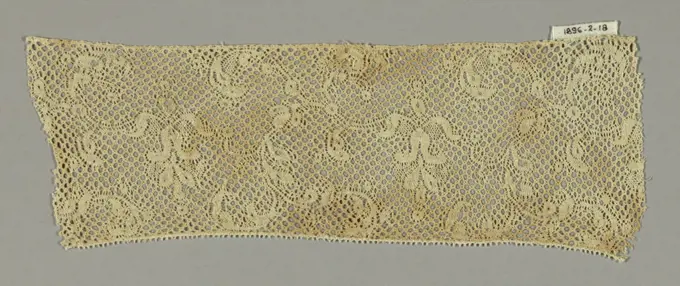
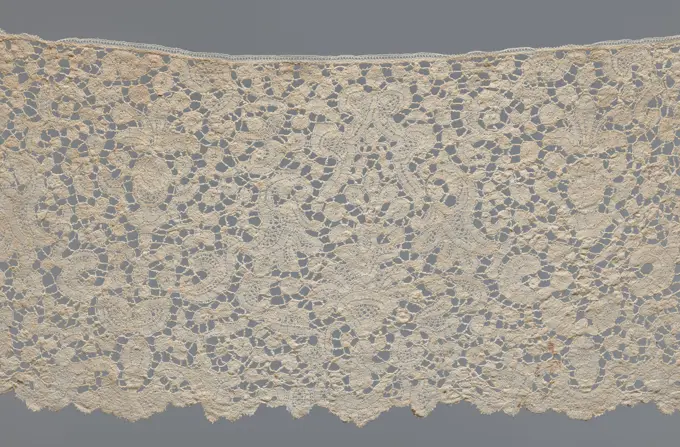
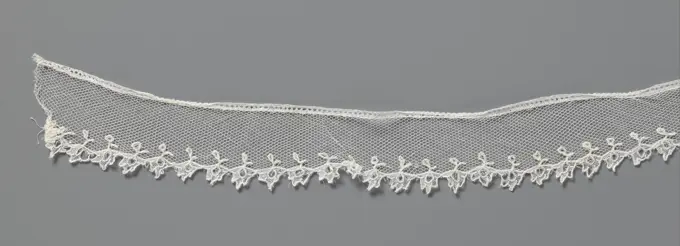
Strip bobbin with two rows of bows and a row of hanging flowers, c. 1800 - c. 1899 Strip of natural -colored bobbin, Parisian side. The upper half of the pattern consists of two rows of bows. The lower half of the pattern consists of a row of split twigs, which always bends one leaf up and one flower down. Along the bottom runs a border that consists of a succession of lying stalks with one flower and one leaf. The motifs are connected by a Maas soil, a Parisian soil. The motifs are made in linen battle with thicker and shiny contour threads. The same coarser decorative land has been used in every open -lived heart. The top and bottom of the strip are straight finished, with the bottom with picots. Flanders linen (material) bobbin lace / Paris lace Strip of natural -colored bobbin, Parisian side. The upper half of the pattern consists of two rows of bows. The lower half of the pattern consists of a row of split twigs, which always bends one leaf up and one flower down. Along the bottom
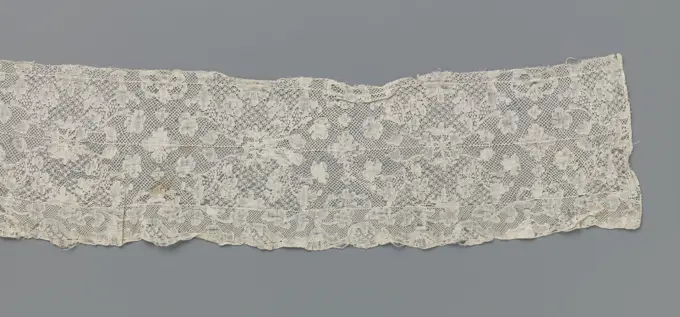
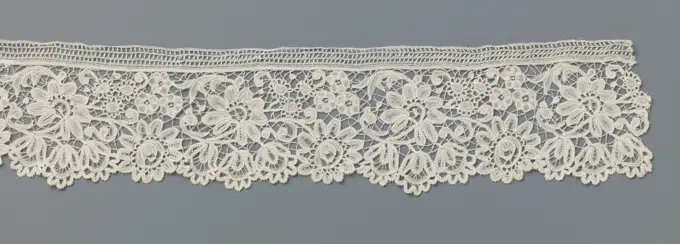
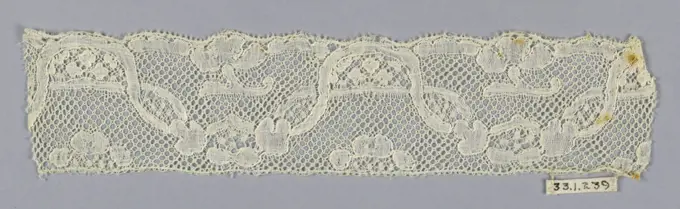
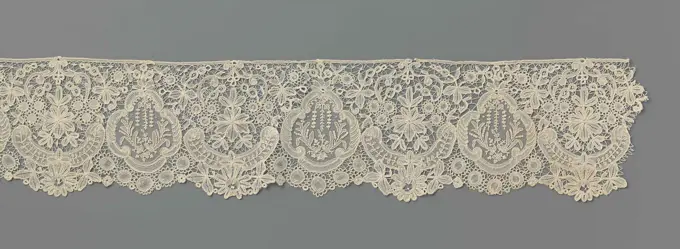
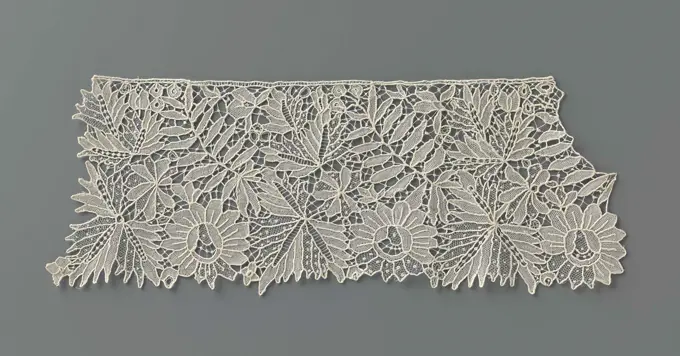
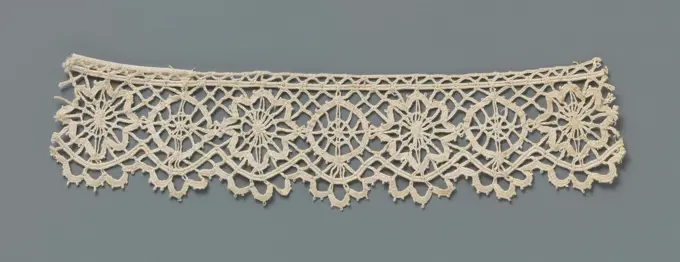
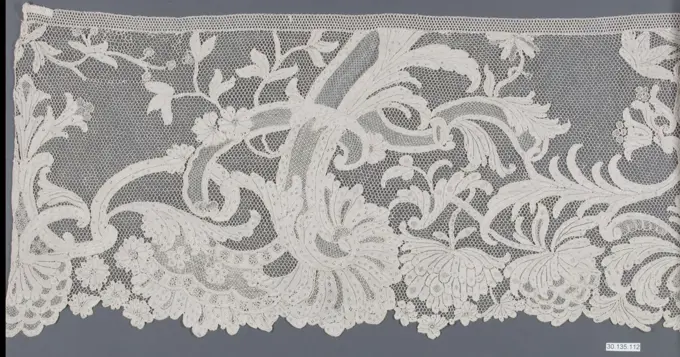
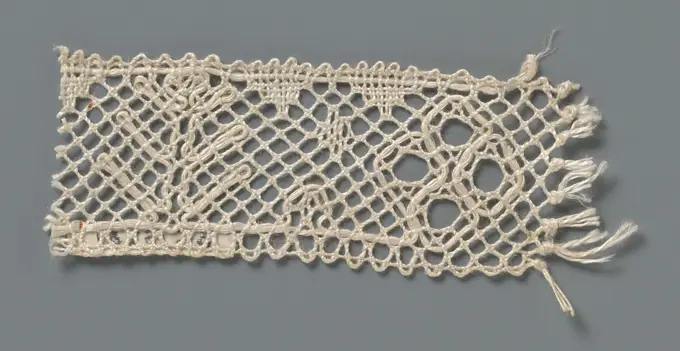
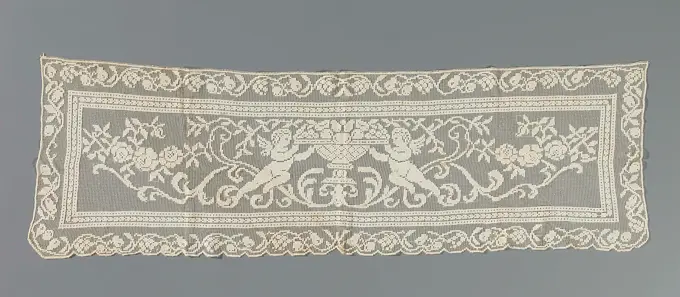
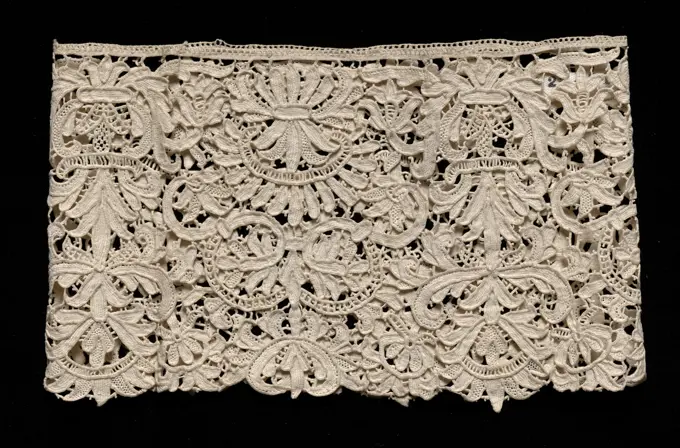
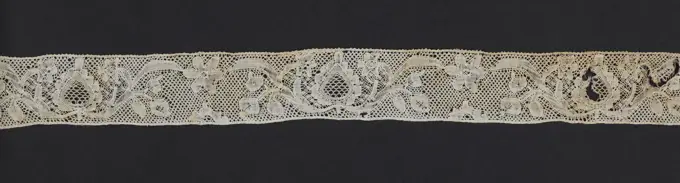
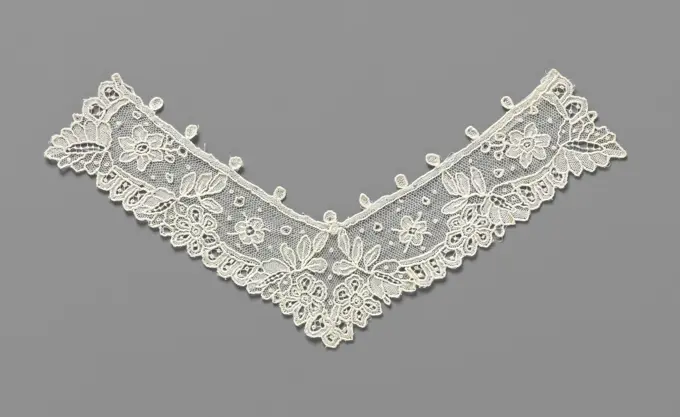
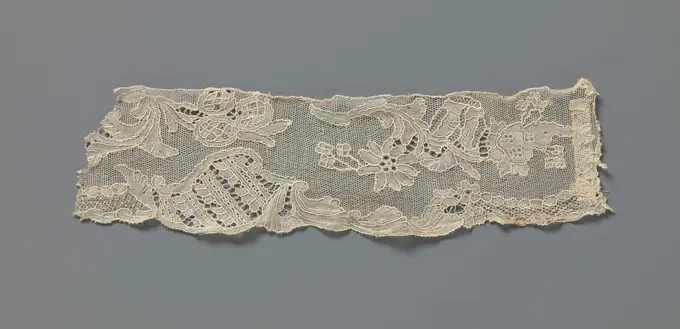
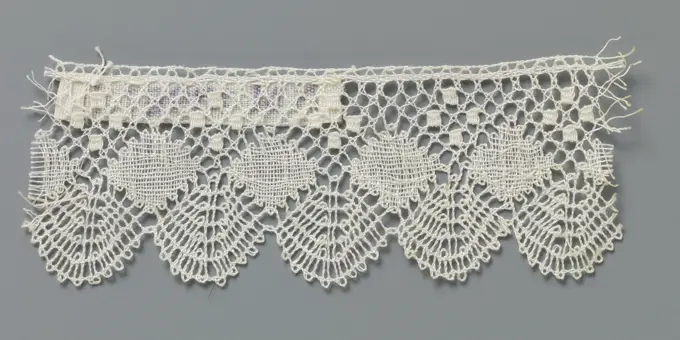
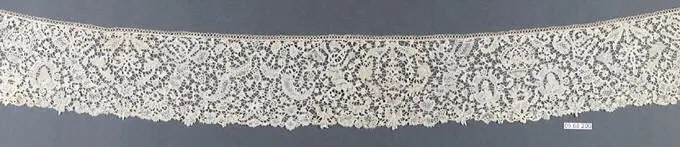
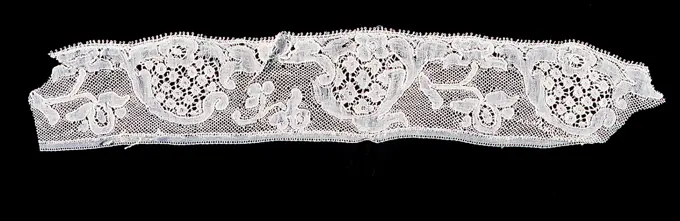
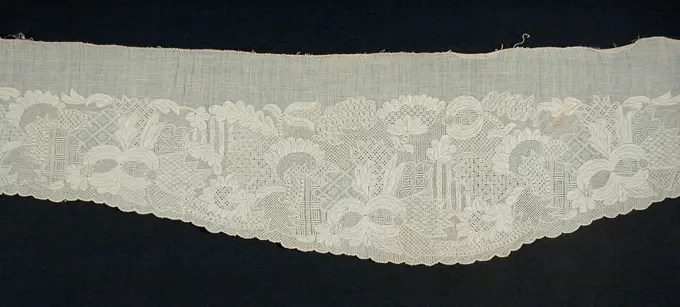
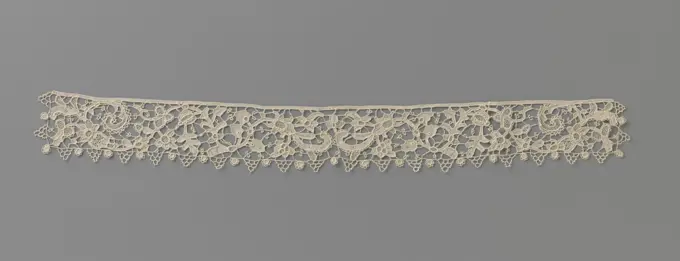
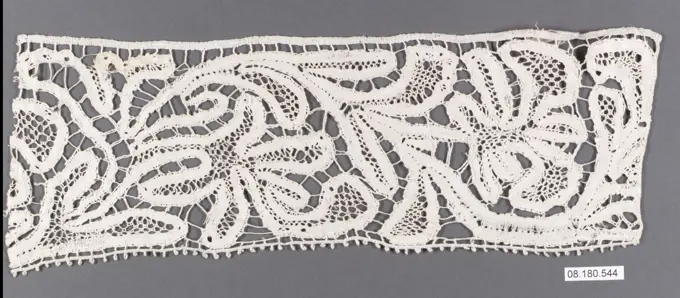
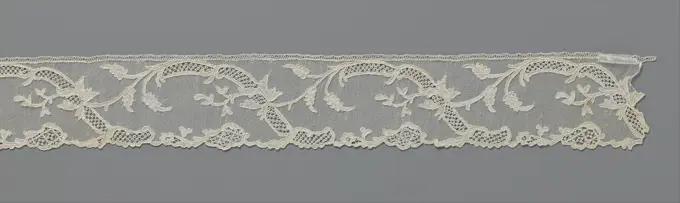
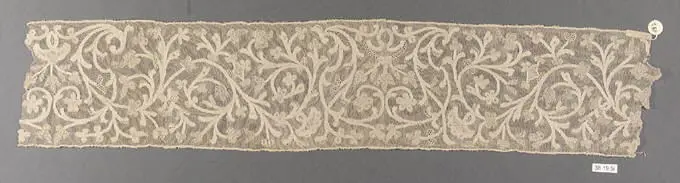
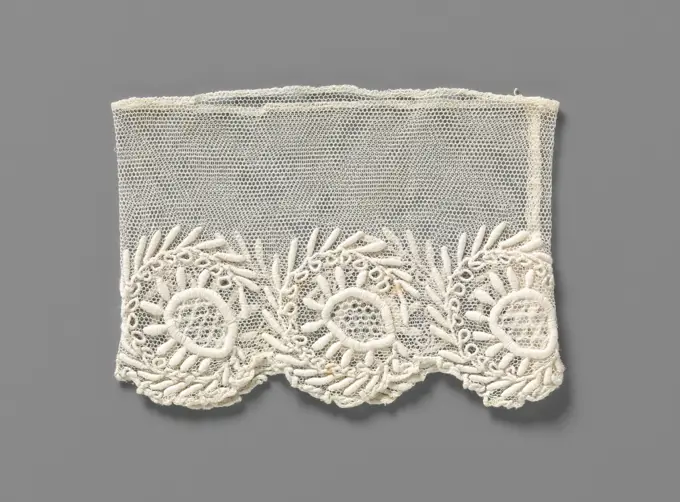
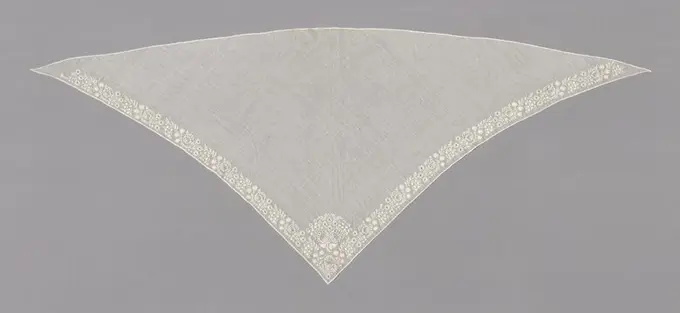
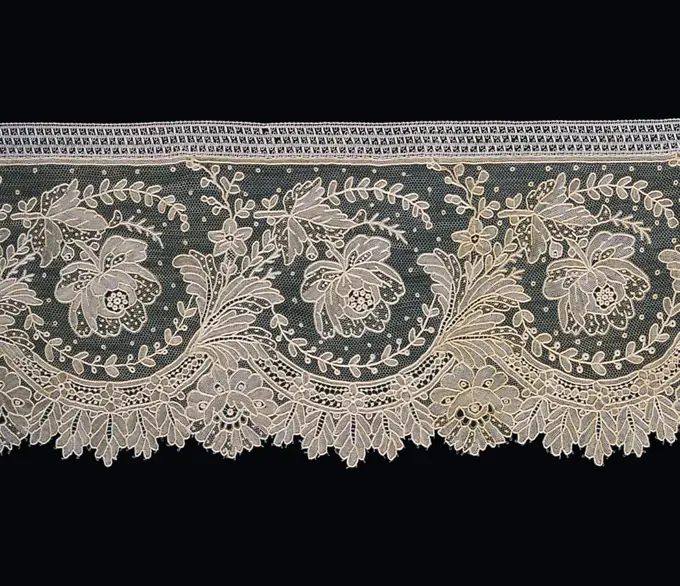
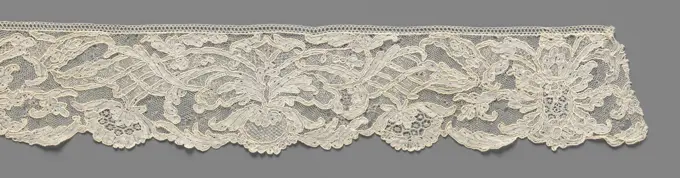
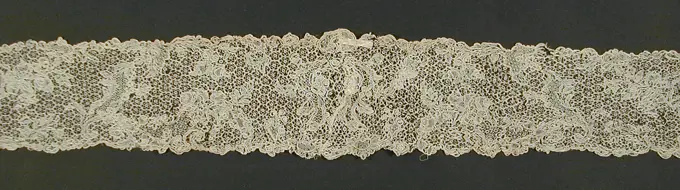
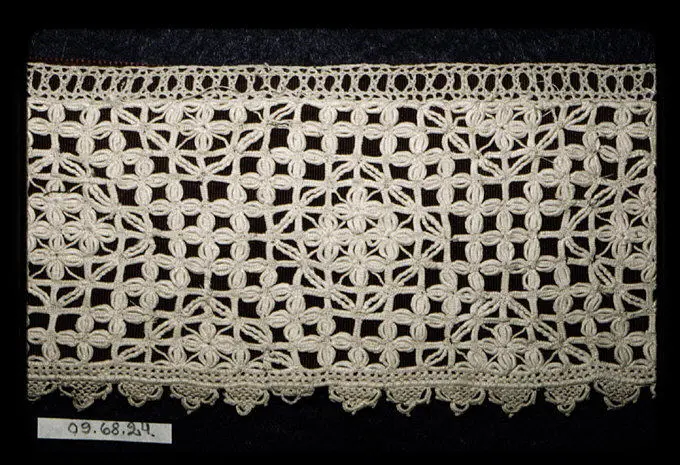
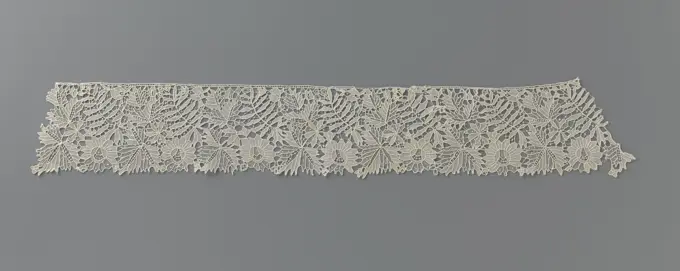
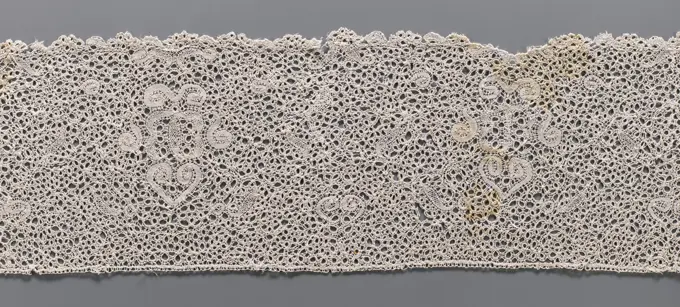
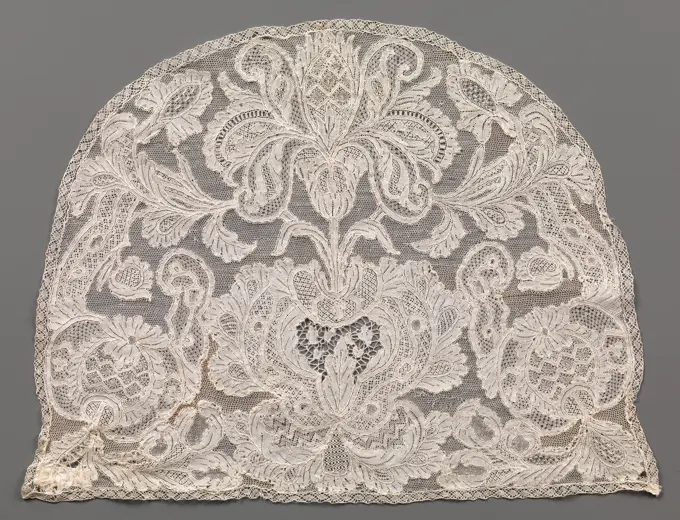
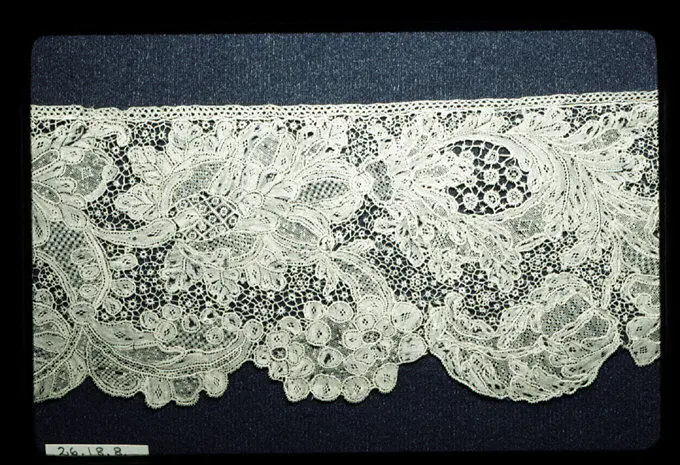
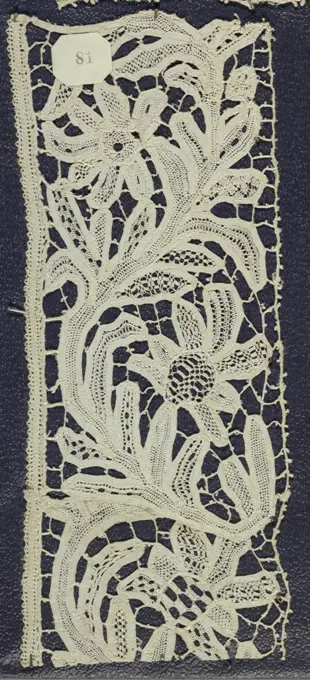
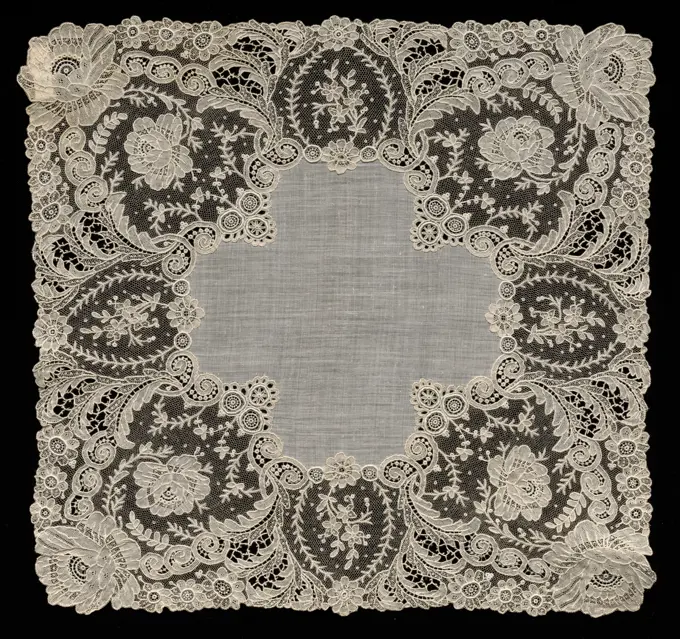
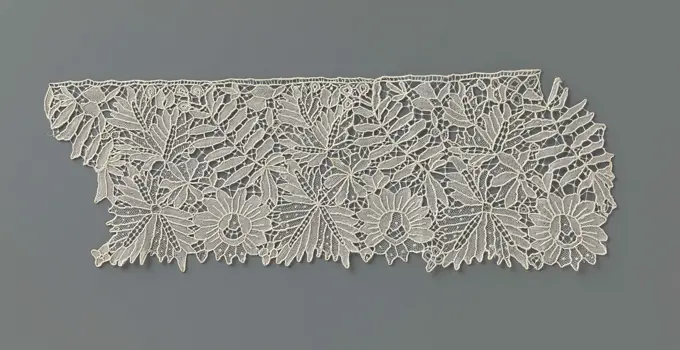
Strip bobbin with two rows of bows and a row of hanging flowers, c. 1800 - c. 1899 Strip of natural -colored bobbin, Parisian side. The upper half of the pattern consists of two rows of bows. The lower half of the pattern consists of a row of split twigs, which always bends one leaf up and one flower down. Along the bottom runs a border that consists of a succession of lying stalks with one flower and one leaf. The motifs are connected by a Maas soil, a Parisian soil. The motifs are made in linen battle with thicker and shiny contour threads. The same coarser decorative land has been used in every open -lived heart. The top and bottom of the strip are straight finished, with the bottom with picots. Flanders linen (material) bobbin lace / Paris lace Strip of natural -colored bobbin, Parisian side. The upper half of the pattern consists of two rows of bows. The lower half of the pattern consists of a row of split twigs, which always bends one leaf up and one flower down. Along the bottomStrip bobbin with cartouche from which a Margriet originates that forms a shell along the lower edge, Anonymous, c. 1725 - c. 1749 Strip of natural-colored bobbin, binche side. The repeating pattern consists of a cartouche along the top edge, with wide volute leaves that extend to the left and right. A flower stalk originates from one of the volute leaves, which bends to the underside and forms one of the sculptes with a large Margriet. Between the successive Margrites, the other sculptes are formed by an elongated volute, which is flanked on the left and right by a more or less rushally -shaped cartouche. The motifs are connected by a decorative land, a snowflake ground. The fullwork is mainly made in linen battle with openwork edges and partly in netslag. In the Cartouches and Bloemharten, among other things, decorative lands have been used at the top and bottom, with picots the underside. The strip consists of two equal parts, which are put together in the middle with a seam. SoutheKloskant interlimpse with florets, anonymous, c. 1890 Between two arched edges, with openings in front of a ribbon, a lane with square meshes runs, on which a row of roses stand on crooked twigs. Valenciennes side. Ieper (possibly) linen (material) Bobbi Lace / Valenciennes Lace Between two arched edges, with openings in front of a ribbon, a lane with square meshes runs, on which a row of roses stand on crooked twigs. Valenciennes side. Ieper (possibly) linen (material) Bobbi Lace / Valenciennes LaceStrip of needle side with lying C-Volut with five lobes, anonymous, c. 1850 Strip of natural needle side, point the gaze de bruxelles. Repetitive motive of a horizontal C-Volut with five lobes on a fine soil with single twisted meshes, which is littered with mosjes. In the cavity of the volute, always a rose from which a flower branch is raised. A succession of flowers winds along the pattern with the lobes over the centerline of the strip. Many different ornamental grounds fill the lobes, petals and spaces. The scums along the bottom are formed by the pattern with lobes. The top is finished with a straight edge. Brussels linen (material) Strip of natural needle side, point the gaze de bruxelles. Repetitive motive of a horizontal C-Volut with five lobes on a fine soil with single twisted meshes, which is littered with mosjes. In the cavity of the volute, always a rose from which a flower branch is raised. A succession of flowers winds along the pattern with the lobes over the centerlinStrip bobbin for a 'German hat' used in the Frisian gestation, Anonymous, c. 1750 - c. 1780 Strip of natural -colored bobbin, Antwerp Pottekant. The strip is composed of four strips and intended for a 'German hat' used in the Frisian gestation. The middle two strips are the same and are sewn symmetrically against each other. The pattern has interspersed with halved fourfold flowers in a wreath with halved four -fold flowers, through the seam again into a whole. The bottom strip has a racing pattern of a rocaille and a double flower branch where the rocaille and one of the flowers also form the faint edge of the scaffold. The upper strip is a cut part of the middle species and is finished with a very narrow, partly missing zoom. The motifs are connected by a Maas soil. The motifs are made in linen battle and two types of decorative land have been used, thicker contour threads run around the motifs. Flanders Frisia  bobbin lace / Antwerp pot lace Strip of natural -colored bobbin, AntwerpStrip bobbin with connected shield -shaped cartouches, anonymous, c. 1840 - c. 1849 Strip of natural -colored bobbin: Lille side. Under a row of loose rosette flowers, the lower half of strip is filled by a repeating pattern of connected shield -shaped cartouches. It concerns two different symmetrical cartouches. The motifs are connected by a fine grid, a tuler land. The motifs are made in linen battle, with thicker and shiny contour threads. Different decorative lands have been applied, alternately in the list and in the center of the cartouches. At the top and bottom are straight finished, with the bottom with picots. Lille linen (material) bobbin lace / Lille lace Strip of natural -colored bobbin: Lille side. Under a row of loose rosette flowers, the lower half of strip is filled by a repeating pattern of connected shield -shaped cartouches. It concerns two different symmetrical cartouches. The motifs are connected by a fine grid, a tuler land. The motifs are made in linen battle, wStrip of mechanical side with diamond-shaped mulets and zigzag band, anonymous, c. 1800 - c. 1899 Strip of natural -colored machine side: mechanical Lille side. Under a spreading pattern of two rows of diamond-shaped mulets, the repeating pattern consists of a zigzag band with circles along the bottom half of the strip. The tire consists of a decorative land, a mechanical rose ground, along which contour threads run. Under each point, with a mechanical rose ground, with three large meshes, a quarter of a circle is formed. These quarter circles together with a contour wire and below that a strap in linen battle form the faint edge of the scaffold along the underside of the strip. The top of the strip is straight finished. France (possibly) cotton (textile) Strip of natural -colored machine side: mechanical Lille side. Under a spreading pattern of two rows of diamond-shaped mulets, the repeating pattern consists of a zigzag band with circles along the bottom half of the strip. The tire cStrip bobbin with three hanging bell flowers, anonymous, c. 1875 - c. 1899 Strip of natural-colored bobbin, Duchesse side. On a bars stock there is a closed pattern of a thin volute drink, on which a Margriet and an anemone and three hanging clock flowers hanging in the sculpting. Sluis (Possible) linen (material) bobbin lace Strip of natural-colored bobbin, Duchesse side. On a bars stock there is a closed pattern of a thin volute drink, on which a Margriet and an anemone and three hanging clock flowers hanging in the sculpting. Sluis (Possible) linen (material) bobbin laceStrip of needle side with zigzagschulpen, anonymous, c. 1810 On a sleek, lying branch, to the right-oriented side branches, on which forget my mitaries and three types of chalid florets, the sharp zigzagschulpen show a double contour, consisting of a leaf and pearl edge, while a 'lover' has been applied to each point. In the field is a spray pattern of hanging daisies. Alençon side. France linen (material) Alençon Lace On a sleek, lying branch, to the right-oriented side branches, on which forget my mitaries and three types of chalid florets, the sharp zigzagschulpen show a double contour, consisting of a leaf and pearl edge, while a 'lover' has been applied to each point. In the field is a spray pattern of hanging daisies. Alençon side. France linen (material) Alençon LaceStrip of needle side with hanging hearts, anonymous, c. 1880 Strip of natural needle side: Brussels mesh side. The repeating pattern consists of large semicircular sculptes formed by hiding C-Voluten. Above each volute is one loose rose with a jet wreath of short branches with berries. The switching points between the volutes are formed by oval medallions, which are decorated with a leaf crown. From the leaf crown a fine pendulum rises that runs over the rose to the next medallion. The scrap edge is formed by hanging heart -shaped leaves under the volutes interspersed by always three hanging daisies under the medallions. The motifs are made up of feston stitches and equipped with relief contours. The roses have relief leaves. The motifs are connected to each other by a fine Maas soil, a mesh side, on which a few mushes have been applied. Decorative stitches have been used in the roses and medallions. The top of the strip is straight finished. Brussels linen (material) Brussels Gaze PoiLace laceFragment, Medium: linen Technique: bobbin lace, Mechlin style with five hole ground, Belgium, 18th century, lace, FragmentJaponstrook van gemengde kant met gelobde medaillons.Japon strip of mixed side - climbing side in combination with needle lace - Brussels Duchesse. Standing lobby oval medallions with fine maasing soil and, among other things, treurwilgen leaves (coniferous lace) are connected by lying c-volutes, of which a daisy depends. The remaining land is an irregular braiding ground and is filled with five and three-lawy leaves and 'daisies' (docking side).Strook naaldkant met ingesneden blad.Running pattern of incised leaves above a rose and a three-leaf, which together form the sharply toothed outside line. Cross-shaped bars with button (soil of long X-shaped bars with a spider). The REMPLIS consists of buttonhole stitches and a Fond Gazé. German side: 'Carlsbead points'.Cuff from crocheted side with four passes and square godronschulpen, anonymous, c. 1890 - c. 1899 Cuff made of natural Irish crocheted side. Rectangular model with rounded corners. The midfield consists of a diamond -shaped network with three rows of moesjes. The collar is finished on three sides with a succession of open four passes (rosettes with four petals). There is a circle in the center of every four pass. And under every four pass a square shell, filled with Godrons. The top of the cuff is straight. Ierland (possibly) cotton (textile) Cuff made of natural Irish crocheted side. Rectangular model with rounded corners. The midfield consists of a diamond -shaped network with three rows of moesjes. The collar is finished on three sides with a succession of open four passes (rosettes with four petals). There is a circle in the center of every four pass. And under every four pass a square shell, filled with Godrons. The top of the cuff is straight. Ierland (possibly) cotton (textile)Border. Hungary (Slovakia). Date: 1725-1750. Dimensions: 34.2 x 285.7 cm (13 1/2 x 112 1/2 in.)width repeat: 69.2-70.7 cm (27 1/4 x 27 7/8 in.). Linen, bobbin part lace. Origin: Hungary. Museum: The Chicago Art Institute, Chicago, USA.Fragment (Italy); linen; Bequest of Marian Hague; 1971-50-375Fragment of the lace;  18th century (1701-00-00-1800-00-00);Strook kloskant met sterren en wielen.Strip natural colosside. The repeating pattern consists alternately from a wheel and an eight-pointed star. The circumference of the motifs consists of a band made in shape stroke. There are 'spokes' with braids within the circumference. A straight band runs above the wheels. Among the wheels and stars runs a band that forms semicircular slot, with five lobes formed by bow. Bands and bowes are both made in shape stroke. The motifs are connected by a braid soil, which forms coarse diamond-shaped meshes, such as with a Valenciennes ground. The top of the strip is straight finished with a zigzagging braid. The arcs on the slot are finished with a few picots.Strip bobbin with pearls and ovals, anonymous, c. 1830 - c. 1849 Strip of natural -colored bobbin: Lille side. The repeating pattern along the bottom half of the strip consists of a succession of ovals, alternately formed by a pearl cord and a stylized incised leaf. The upper half of the strip consists of a fine grid, a tuler floor. The sparing fullwork is made in linen battle, with thicker and shiny contour threads. In the ovals, one kind of decorative land has been used that forms circles, so -called 'Punaises'. At the top and bottom are straight finished, with the bottom with picots. Belgium linen (material) bobbin lace / Lille lace Strip of natural -colored bobbin: Lille side. The repeating pattern along the bottom half of the strip consists of a succession of ovals, alternately formed by a pearl cord and a stylized incised leaf. The upper half of the strip consists of a fine grid, a tuler floor. The sparing fullwork is made in linen battle, with thicker and shiny contour threads. Strip bastard with branches of branches from triangular cartouche, c. 1750 - c. 1770 Strip of natural -colored bobbin: Mechelse side. The pattern consists of an arc formed by two branches from a triangular cartouche along the top of the strip. In the middle of the arc lies along the underside of the strip, a rush -in -shaped cartouche. This composition is interspersed with a compound flower adjacent to the top with a trapezoidal cartouche placed against the underside on it. The motifs are connected by a fine Maas soil. The motifs are made in linen battle with thicker and shiny contour threads. A few different decorative lands have been used in the cartouches and between the flower branches. Up and bottom are straight finished with picots along the bottom. Southern Netherlands linen (material) bobbin lace / Mechlin (lace) Strip of natural -colored bobbin: Mechelse side. The pattern consists of an arc formed by two branches from a triangular cartouche along the top of the strip. In the mJapon strip of mixed side with lobed medallions, anonymous, c. 1875 - c. 1899 Japonstrook made of mixed side - bobbin in combination with needle side - Brussels Duchesse. Standing lobed oval medallions with fine Maas soil and, among other things, weeping willow leaves (needle side) are connected by lying C-Voluten, a Margriet of which depends. The remaining land is an irregular braid land and is filled with five and three-lobe leaves and 'daisies' (bobbin). Belgium linen (material) mixed lace / mixed Brussels Japonstrook made of mixed side - bobbin in combination with needle side - Brussels Duchesse. Standing lobed oval medallions with fine Maas soil and, among other things, weeping willow leaves (needle side) are connected by lying C-Voluten, a Margriet of which depends. The remaining land is an irregular braid land and is filled with five and three-lobe leaves and 'daisies' (bobbin). Belgium linen (material) mixed lace / mixed BrusselsFlounce 1715-23 French. Flounce 222429Fragment of the lace;  19th century (1801-00-00-1900-00-00);Strook kloskant met spar en rozet of "gran ros".Natural collate strip, Swedish side. The strip is attached with pins on a light blue carton, with seven other strips. Above the strip is on the cardboard "Laces from Dalecarlia. (Dalarna)" written and underneath "Furtree-Rose. (Gran Ros)", where Furtrane probably should have been 'fir tree', which spruce means in English and that means that Translate to Swedish as 'Gran'. The pattern is formed by a bundle wires, which has been worked by a maas basis, a diamond-shaped nozzle ground. The wires form the contours of a stylized spar with a stylized rosette with four diamond-shaped contours around a simple ornamental land of four large round meshes. Along the top of the strip are made between these motifs in two triangles in linen stroke. Upper and bottom of the strip are straight finished and provided with picots. One short side is finished with small buttons in the wires.Kloskant collar with three -lobe fan flower, Martha Berkers, c. 1915 Collar of natural-colored bobbin, Duchesse side. The collar is formed as a circles segment. A very fine symmetrical design is on a stock of bars. A large chalice and a star -shaped five -leaf alternate with a large fan -shaped flower, which is made up of a chalice with a semicircle as a heart and three radiating lobes. Small grit from chalices, rosettes and sequins serves as a filling. Almost tight outsides, consisting of fine flowers. Lock linen (material) bobbin lace Collar of natural-colored bobbin, Duchesse side. The collar is formed as a circles segment. A very fine symmetrical design is on a stock of bars. A large chalice and a star -shaped five -leaf alternate with a large fan -shaped flower, which is made up of a chalice with a semicircle as a heart and three radiating lobes. Small grit from chalices, rosettes and sequins serves as a filling. Almost tight outsides, consisting of fine flowers. Lock linen (materStrip of cotton with lace plunger with wavy double garlands of 'pearls' and hanging flower branches, C.I. Bosch Reitz-Teding van Berkhout, c. 1860 - c. 1880 Strip of natural cotton with lace bobbins: English embroidery. The pattern has strongly wavy double 'pearls' slingers of openwork circles. On every wave top is a Margriet on which a drop -shaped 'pearl necklace' hangs down with a Margriet again in the center. In each golf valley, a sliding loose flower branch with three daisies and different leaves and leaf branches hangs sloping down. The scrap edge follows the pattern where the shell under the drop -shaped cord is slightly narrower than the shell under the golf valley with the hanging flower branch. Amsterdam cotton (textile) Strip of natural cotton with lace bobbins: English embroidery. The pattern has strongly wavy double 'pearls' slingers of openwork circles. On every wave top is a Margriet on which a drop -shaped 'pearl necklace' hangs down with a Margriet again in the centerDoek van kantborduurwerk met een schaal met vrucht gesteund door twee cupido's.Cloth of natural tilt embroidery: File side. Elongated model. In the midfield a symmetrical pattern of a shell with fruit supported by two putti, leaf volutes and rose garlands. Edge of volutes with fruits and leaves. The motifs are embroidered in the forwarding technology, on a knotted network with square meshes. The sides are rightly finished with the exception of the sloping edge at the bottom.Strip bobbin with S-Ranken, Anonymous, c. 1875 - c. 1899 Strip of natural-colored bobbin: Duchesse side. There is an ongoing pattern on a braid ground. S-ranks with three daisies and a border of Campanes form the scallops and end in a volute with single rose. Netherlands (possibly) linen (material) bobbin lace Strip of natural-colored bobbin: Duchesse side. There is an ongoing pattern on a braid ground. S-ranks with three daisies and a border of Campanes form the scallops and end in a volute with single rose. Netherlands (possibly) linen (material) bobbin laceNeedlepoint (Punto in aria) Lace Cuff, early 17th century. Italy, early 17th century. Lace, needlepoint; average: 10.9 x 17.8 cm (4 5/16 x 7 in.).Edging French, Cluny 19th centuryBand, Medium: linen Technique: bobbin lace, Binche style with snowball ground, Band with scrolling leaves and snowflake ground., Belgium, 18th century, lace, BandFragment of bobbin lace unknownVolant van kloskant met zonnebloemen.Volant of natural colosside, Russian or Eastern European side. Ground of short, irregular braids. Symmetrical pattern. A row of sunflowers, faced between V-shaped branches, is above a ribbon sculpture of folded 'ribbons', in which fan-shaped and straight ranking alternate.Piece early 18th century Flemish. Piece 214540Manchet van naaldkant met een v-vormig model.Cuff from natural needle side: Brussels gauze side. V-shaped model. Symmetrical pattern with a concatenation of a rosette flower along the underside next to a shaking placed leaf and a decorative edge with half ovals. This edge pattern forms a slip ridge with fine scallops. In the field above a row with a Christmas rose, two separate rosette flowers and another Christmas rose, decorated on a gauze side with annular meadows. The inner edge is straight, but on the straight edge is at some distance from each other circles of needle side.Cap Streamers (Belgium); linenLace, late 19th century, maker unknown. Gift of Miss MM Withers, 1963.Strook naaldkant met rocaille en rozetbloem.Strip natural-colored coniferous lace, Brussels gauze side. Pattern with a rocaille with leaves and oval flowers or fruits and also a rank with leaves and flowers, among other things a rosette flower. Fine Maas soil. Full work with relief contours and a limited amount of decorative stitches. The top is finished with a straight edge.Border (Netherlands); linenStrook gemengde kant met s-voluten.Strip natural-colored mixed side: Brussels climbing side in combination with a needle lace ground, a fine mesh side ground. This type of side is also known as the name: Point d'Angleterre. The running pattern is a rough drawing and consists of matching C and S volutes. Large roses, and face and and profil, shapes with a leaf and a c-volute deep slip. Fine leaf branches are turned to the inside.Needle's tie with symmetrical pattern with a flaming flower flanked in the middle by elongated feathered leaves including large hanging fan -shaped flowers, anonymous, c. 1725 - c. 1735 Engageante of natural-colored needle side: Alençon side. Symmetrical pattern that is interrupted because a part of the Engageante is missing on the left. In the original center, pattern consists of a flaming flower along the top, including half a wreath of rosette flowers. The flaming flour is flanked on both sides by a rocaille-like motif with grid pattern under which a lying elongated feathered leaves with a large hanging fan-shaped flour underneath. One of the other large flowers in the pattern is a carnation. The flowers are made up of feston stitches with many small recesses and relief contours. The motifs are connected by a fine Maas soil, an alençon ground. Many different types of decorative land and decorative stitches have been used in and between the flowers. The top is straight finished with Strip bobbin with windows between fan -shaped sculptes, anonymous, c. 1800 - c. 1899 Strip of natural -colored bobbin, straw side. The repeating pattern exists along the underside of the strip against each other on placed fan -shaped scumples. Above the scrap edge, one window is always placed in the space between the fans. The windows are made in linen stroke and are connected to each other at the top of the strip by a grid land: a tie. The soil is decorated with square moes, made in form. There are always four mushes in diamond -shaped configuration between the windows. The top of the strip is straight finished. Buckingham linen (material) Bobbi lace / lace cloth Strip of natural -colored bobbin, straw side. The repeating pattern exists along the underside of the strip against each other on placed fan -shaped scumples. Above the scrap edge, one window is always placed in the space between the fans. The windows are made in linen stroke and are connected to each other at the top of the Strip early 18th century Flemish, Brussels. Strip 218147Kloskant cuff decorated with three -lobe fan flowers, Martha Berkers, c. 1915 Cuff of natural-colored bobbin, Duchesse side. The cuff is formed as a circles segment. A very fine symmetrical design is on a stock of bars. A large chalice and a star -shaped five -leaf alternate with a large fan -shaped flower, which is made up of a chalice with a semicircle as a heart and three radiating lobes. Small grit from chalices, rosettes and sequins serves as a filling. Almost tight outsides, consisting of fine flowers. Lock linen (material) bobbin lace Cuff of natural-colored bobbin, Duchesse side. The cuff is formed as a circles segment. A very fine symmetrical design is on a stock of bars. A large chalice and a star -shaped five -leaf alternate with a large fan -shaped flower, which is made up of a chalice with a semicircle as a heart and three radiating lobes. Small grit from chalices, rosettes and sequins serves as a filling. Almost tight outsides, consisting of fine flowers. Lock linen (mateBorder (Italy); linen; 1918-31-3-aStrook kloskant met eenzijdig gerichte takjes met stijve rechte blaadjes.Strip natural colosside: Lille side. Under a wide spreading pattern of square moes, it consists of a repeating pattern from a crooky sprig with rigid straight leaves. The sprig exprceeds a row of connected ovals along the underside of the strip. The motifs are connected by a fine grille, a tulet. The energy-saving fireworks is made in linen stroke, with thicker and shiny contour wires. The Moeses are made in shape stroke. The top and bottom of the strip are straight finished, the underside with picots.Strook kloskant met gegodroneerde schulpen.Strip natural colosside: Valenciennes-side. Pattern with embraced semi-circlical slump, above which a hanging daisy between 'sequins'. In 1966 fitting on a strip side with pearl table and flower branch.Strip Kloskant with careless shell, company J. Minne-Dansaert, c. 1880 A wavy branch with feathered leaves and three star -shaped flowers grows from right to left. One of the flowers is aimed out and forms a small intermediate scoop between larger ones, which are constructed as a careless arch or a piped collar with an open grid filling (needle side). As a termination of the fine mesh stock (square meshes), a fine border of palms, applied as a side head, runs along the inside. Brabantse Valenciennes side. Brussels linen (material) Bobbi Lace / Brabant Valenciennes Lace A wavy branch with feathered leaves and three star -shaped flowers grows from right to left. One of the flowers is aimed out and forms a small intermediate scoop between larger ones, which are constructed as a careless arch or a piped collar with an open grid filling (needle side). As a termination of the fine mesh stock (square meshes), a fine border of palms, applied as a side head, runs along the inside. Brabantse ValPalladoon of needle side with geometric motifs and pointed points. Palsoque of needle side. Geometric motifs, edge with pointed points.Band, Medium: linen Technique: bobbin lace, continuous tape with bars added, Band of northern Italian guipure in a design using scroll tapes with brides. Design is based on a 17th-century pattern., Italy, 18th-19th century, lace, BandFragment, Medium: linen Technique: bobbin lace (discontinuous tape), Symmetrical ribbon-like carnation design., Milan, Italy, 17th century, lace, FragmentFragment of the lace;  18th century (1701-00-00-1800-00-00);Strip of needle side with stretched slender, anonymous, c. 1685 - c. 1699 Strip of natural -colored needle side: flat Venetian side. Asymmetrical. Stretched running slender with few flowers. Straight edge of triangles. Two corners were inlaid later. Venice linen (material) flat Venetian (needle point) Strip of natural -colored needle side: flat Venetian side. Asymmetrical. Stretched running slender with few flowers. Straight edge of triangles. Two corners were inlaid later. Venice linen (material) flat Venetian (needle point)Lace fragment, 1755-1775, Mechelen, maker unknown. Gift of Mrs G. Acland Allen, 1955.Border. Date/Period: 1575/1625. Medium: linen. Technique: needle lace (punto in aria). Author: UNKNOWN.Pair of Engageantes. Germany, mid-18th century. Costumes; Accessories. Linen on cotton drawnwork and feather stitch embroideryThree joined borders 18th century French. Three joined borders 226053Guimpe of needle side with miniature pomegranate, anonymous, c. 1875 - c. 1910 Guimpe of natural -colored needle side: Venetian relief side or Venetian rose side. Symmetrical, stretched tendrils protrude against an open bar of land. Miniature shelters are on the outside sides. Large triangles and roses form a straight finish. BURANO linen (material) Venetian raised work / Venetian rose point Guimpe of natural -colored needle side: Venetian relief side or Venetian rose side. Symmetrical, stretched tendrils protrude against an open bar of land. Miniature shelters are on the outside sides. Large triangles and roses form a straight finish. BURANO linen (material) Venetian raised work / Venetian rose pointTussenzetsel van kloskant met aaneengeschakelde opengewerkte ovalen.Interest of Genoese clamping side. The pattern consists of a row of connected openwork ovals. In the center of each oval hangs, as with spokes in a wheel, a network of braids with four meshes. Upper and bottom of the strip are straight finished.Strip of needle side with flower branches and star -shaped flowers, anonymous, c. 1775 - c. 1799 Strip of natural-colored needle side: Argentan side and Alençon side. Repetitive motif with two different flower branches, each flanked by two star -shaped flowers placed one above the other, on a ground with meshes that are closed with button hole stitches (argent tankant). The flower branches bend alternately to each other. Along the underside under a wavy line including a pattern of flowers and berries on a fine hexagonal Maas soil (Alençon side). Ornamental soil with road picots in the larger flowers and the circles along the lower edge. Fullwork with minimal recesses within the contours of the other motives. Schulpenrand on the bottom due to a succession of circles, interrupted at a regular distance by a rosette flower. The top is trimmed with a border bobbin. Argentan linen (material) Argentan Lace / Alençon Lace Strip of natural-colored needle side: Argentan side and Alençon side. ReFragment; linenFragment 17th century Italian. Fragment 214894Fichu van Machinale tulle with a border bobbin with stars and wreaths, anonymous, c. 1925 Fichu of natural-colored machine tulle with a border of natural-colored bobbin, Cluny side. Elongated rectangular model, with a semi -circular widening on one long side. The pattern of the chatter edge consists of three staggered rows of stars and oval wreaths. Each star consists of four 'rays' or leaves made in shape, the wreaths are made with a square grille. They are connected by a braid ground. The scrap edge along the outside consists of arches on which three smaller arches have been made with picoted braids. Netherlands (possibly) linen (material) bobbin lace / Cluny lace Fichu of natural-colored machine tulle with a border of natural-colored bobbin, Cluny side. Elongated rectangular model, with a semi -circular widening on one long side. The pattern of the chatter edge consists of three staggered rows of stars and oval wreaths. Each star consists of four 'rays' or leaves made in shape, the Strip of needle side with S-shaped decorative band and iris, anonymous, c. 1760 - c. 1770 Strip of natural-colored needle side: Alençon side. The repeating pattern consists of a flat S-shaped decorative band in mirror image. The band continues at the top in a wavy branch of pointed and feathered leaves and with an iris that lies over the next decorative band. The tires touch the top of the strip and walk downstairs with a faint S-shaped curve to finish along the underside of the strip. The motifs are made up of feston stitches where very fine cut -outs are used sparingly for decoration. The motives are provided with relief contours and are connected by a fine hexagonal Maas soil, an alençon ground. Ornamental grounds with radar picots are used in the decorative tires, rocailles and flower hearts. The flat scrap edge is finished with picots. The top of the strip is finished with a tie. France linen (material) Alençon Lace Strip of natural-colored needle side: Alençon side. The repeatingHebrew ritual lace (one of four) early 18th century Italian, Burano. Hebrew ritual lace (one of four) 226262Manchet van kantborduurwerk met sikkelvormige gevederde tak die een cirkel omvat met stralen aan één zijde.Cuff of natural-colored edge embroidery: embroidery on machine tulle. Rectangular model. The repeating pattern consists of a sickle-shaped feathered branch that includes a circle with rays on one side. Different mechanical landscapes have been set in the circles behind which the tulle has been removed or not. The sloping edge along the underside forms semi-circular shelters around the successive sickle-shaped leaves.Fichu. England or France. Date: 1775-1800. Dimensions: 34.3 × 132.1 cm (20 3/8 × 52 in.). Cotton, plain weave; embroidered with cotton in buttonhole, chain stitches, and drawn work. Origin: England. Museum: The Chicago Art Institute, Chicago, USA.Fragment, Medium: linen Technique: bobbin lace (Binche style with Binche ground), Binche-style fragment with a delicate design of palmettes and foliage. Five hole mesh (cinq trous ground) and straight edges., Belgium, 17th century, lace, FragmentEdge; linen; 1933-1-116Strook naaldkant met hoekig rozet en ruitvorm met zonnen.Strip natural-colored coniferous lace, reticella and work with coiled wires. Pattern with squares made up of four small squares (work with coiled wires). Alternately in one square an angular rosette and in the other a diamond shape with 'emerging suns' in the corners. To the large squares on all sides a border with rectangles. A finished edge in linen stroke on all sides.Flounce Made 1875-1900 Belgium. Cotton, needle lace of a type known as Point de Gaze .Fragment of the lace;  XVII century (1601-00-00-1700-00-00);Fragment 17th century Italian, Genoa. Fragment 214905Fragment 18th century French. Fragment 214628Strip of needle side with symmetrical compositions with flowers and cartouches, anonymous, c. 1725 - c. 1749 Strip of natural-colored needle side: Alençon side. The repeating pattern consists of two symmetrical floral motifs. An oval cartouche crowned by a rosette flower and with radiating feathered leaves. And a wide butterfly -shaped motif that is made up of wavy lines and curling leaves with an oval flower directly underneath, flanked on both sides by a hanging fan -shaped flour. The motifs are made up of feston stitches with recesses and equipped with relief contours. The motifs are connected by a fine Maas soil, an alençon ground. Different decorative lands have been used in the flower hearts and between leaves and other parts of the motifs, including a diamond soil. The irregular scrap edge stems from the pattern and is finished with picots. The top of the strip is straight finished with a tie. France linen (material) Alençon Lace Strip of natural-colored needle side: Alençon sidNeedlepoint Lace Edging, 1715-1774. France, Alençon, 18th century (Louis XV Period, 1715-1774). Lace, needlepoint: linen; average: 22.9 x 8.3 cm (9 x 3 1/4 in.).Woman's Lappets. France, 1725-1775. Costumes; Accessories. Linen laceBorder ca. 1600 Italian. Border 217956Strip application side with triangular flowers along the bottom, anonymous, c. 1900 - c. 1914 Strip of natural -colored application side: needle side applicated on mechanical tulle. On a fine hexagonal Maas soil, a succession of small, uniform, triangular flowers has been sewn along the underside. The flowers hang on a short stem with an oval -shaped leaf. The top is finished with a messing strap. Belgium Strip of natural -colored application side: needle side applicated on mechanical tulle. On a fine hexagonal Maas soil, a succession of small, uniform, triangular flowers has been sewn along the underside. The flowers hang on a short stem with an oval -shaped leaf. The top is finished with a messing strap. BelgiumKraag van gehaakte kant met losse stengels met aan weerszijden een gelaagd rozetbloempje.Collar of natural-colored Irish crochet side. Pattern with a loose stem with three-piece leaves interspersed by a loose stem with a layered rosette flower on either side. The ground with square mesh is reminiscent of the knotted network of filet lace. The top is finished with a straight edge. The regular semicircular slot on the underside are trimmed with picoted arcs.Strip of needle side with incised leaves, anonymous, c. 1900 Walking pattern of incised leaves above a rose and a three -leaf, which together form the sharply toothed outside line. Cross-shaped bars with button (soil of long X-shaped bars with a spider). The Remplis consists of buttonholes and a long distance gazé. German side: 'Carlsbader Points'. Karlsbad (Germany) linen (material) Walking pattern of incised leaves above a rose and a three -leaf, which together form the sharply toothed outside line. Cross-shaped bars with button (soil of long X-shaped bars with a spider). The Remplis consists of buttonholes and a long distance gazé. German side: 'Carlsbader Points'. Karlsbad (Germany) linen (material)Fragment of the lace;  XVII/18th century (1690-00-00-1710-00-00);Border Made 1760-1769 Valenciennes. Linen, bobbin straight lace of a type known as Valenciennes with round Valenciennes mesh ground .Sjaal van kloskant met golfrand.Natural climbing side scarf, Russian or osteuropean side. Ground of irregular short braids. Two-sided symmetrical pattern made of longitudes and in deep garlands branches with sunflowers, carnations and palm branches, three times separated by an oval. Deep wave lines form the edges that run virtually straight, because the waves are always filled with a playful ribbon slinger.Black bobbin gloss strip with three spring -shaped leaves under oval cartouches and roslingers, anonymous, c. 1860 - c. 1880 Black bobbin jelly strip: Chantilly side. The strip is intended or used for under a skirt, the two short sides are sewn together. The repeating pattern consists of an oval cartouche around the center line of the strip, crowned by two roses and a few leaf branches. At the bottom of the cartouche, three long spring -shaped leaves are hanging. The underside of these leaves form part of the scrap edge. The successive oval cartouches are connected by a wide V-shaped decorative band. In the field littered with square Mosjes above, there is a bouquet with roses of which side branches touch the roses above the cartouche and thus the top of the pattern with a rose garland. Three garlands hang between the cartouches under the decorative band. From top to bottom: three large roses with leaves in between; a succession of simple rosette flowers; A succession of five heart -shLace, 1800s , maker unknown.Cap crown first half 18th century Italian, Venice or Flemish, Brussels Making extensive use of decorative zigzags and other geometric designs, this type of extremely fine needle lace, which was made during the first half of the eighteenth century, is rare and highly prized. The seemingly endless array of effects is achieved by using one basic buttonhole stitch but varying the grouping and spacing of the stitches.. Cap crown 227611Strip second quarter 18th century French. Strip 221702Border, Medium: linen Technique: bobbin lace, continuous braid-like and needle lace, Needle lace reticello edged in continuous braid like bobbin lace. Fine modern copy of an older type ()., Italy, lace, BorderStrip bobbin with wavy feathered leaves and plume flowers, anonymous, c. 1740 - c. 1760 Strip of natural-colored bobbin: binche side. The repeating and continuous pattern consists of wavy feathered leaves, with a plume -shaped flour under each wave top with an elongated pointed pointed center and between the wave tops a thick feather -shaped flour. The motifs are connected by a decorative land, a snowflake ground. The motifs are made in linen battle and mains with openwork edges. One type of decorative land has been used around the wavy leaves. Top and bottom of the strip are straight finished, with the bottom with picots. Southern Netherlands linen (material) Bobbi Lace / Binche Lace Strip of natural-colored bobbin: binche side. The repeating and continuous pattern consists of wavy feathered leaves, with a plume -shaped flour under each wave top with an elongated pointed pointed center and between the wave tops a thick feather -shaped flour. The motifs are connected by a decorative laEdging fragment, A .G. Jennings & Sons, American, Medium: cotton Technique: machine made lace, Green lace edging in a floral pattern., USA, 1884, lace, Edging fragmentBorder Made 1775-1800 Europe. Linen, needle lace with woven tapes .Border, Technique: tape lace, Tape lace mixed lace sample, floral vine; mid-18th century Flemish., mid-18th century, lace, BorderNeedlepoint (Point de Gaze) Lace Handkerchief, 19th century. Flanders, 19th century. Needlepoint lace; overall: 32.3 x 30.6 cm (12 11/16 x 12 1/16 in.).Bobbin Lace (Rose Lace) Edging with Bell Points, 17th century. Italy, Genoa, 17th century. Lace, bobbin; average: 6.7 x 19.1 cm (2 5/8 x 7 1/2 in.).Strook naaldkant met ingesneden blad.Running pattern of incised leaves above a rose and a three-leaf, which together form the sharply toothed outside line. Cross-shaped bars with button (soil of long X-shaped bars with a spider). The REMPLIS consists of buttonhole stitches and a Fond Gazé. German side: 'Carlsbead points'.Strip bobbin with a row of windows and a wavy edge of scales, anonymous, c. 1915  Strip bobbin: Stropkant. The repeating pattern consists of a row of windows made in linen battle with an open -worked center. At the top between the windows there are smaller windows in netslag and at the bottom always a reverse V between the successive windows, also made in Ovenlag. The motifs are connected by a tough grid. The scrap edge consists of a wavy or zigzagging track made in linen battle with openwork edges. The top is straight. The description made of this strip around 1933 states that the common straight underside at the Stropkant in the 's Gravenmoerse side school from the founding in 1914 was often replaced by a wife's edge. 's Gravenmoer linen (material) Bobbi lace / lace clothTie. Belgium, Grammont for French market, 1870-1890s. Costumes. Silk Chantilly bobbin laceStrip of needle side with spreading pattern of rosette flowers on steel with leaf garland along bottom edge with openly worked oval and round flower, anonymous, c. 1785 - c. 1799 Strip of natural -colored Brussels Application side: Needle side Applicated on Drochelgrond. Under a stray pattern of rosette flowers on a handle and at a regular distance a somewhat larger flower branch and a loose star flower runs along the bottom edge of the strip, a continuous pattern of a wavy thin tenders. On the pendulum always an ascending open -up oval flower and a hanging rounder flower. This rounder flower is also open and, like the oval flower, has an ornamental filling of some radar picots. The motifs are connected by a fine hexagonal grid, a drachel soil. The top is straight. The straight underside consists of small motifs, which form very silly shells and are finished with picots. Brussels linen (material) Brussels Applied Strip of natural -colored Brussels Application side: Needle side Applicat