Vintage Lace Strips

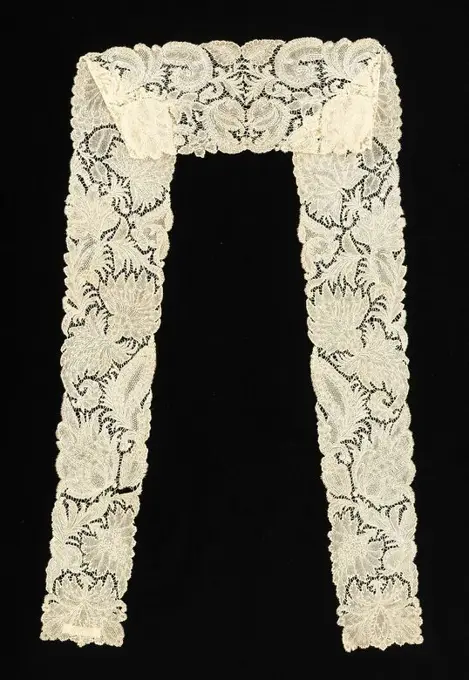
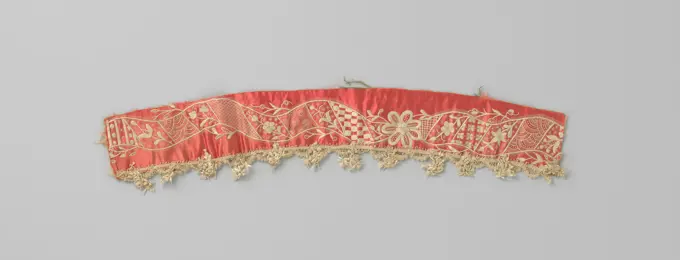
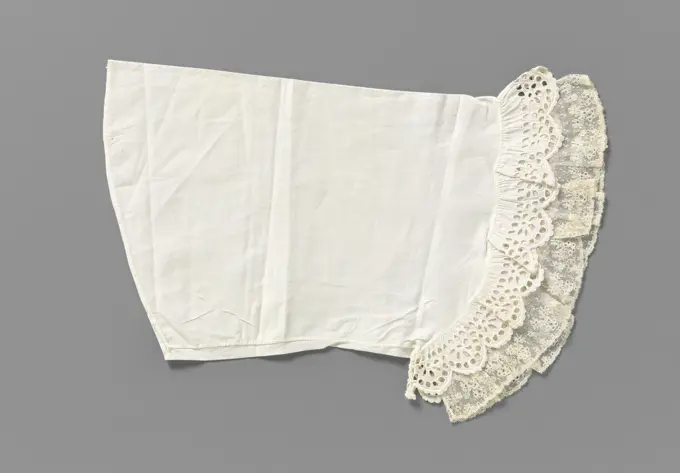
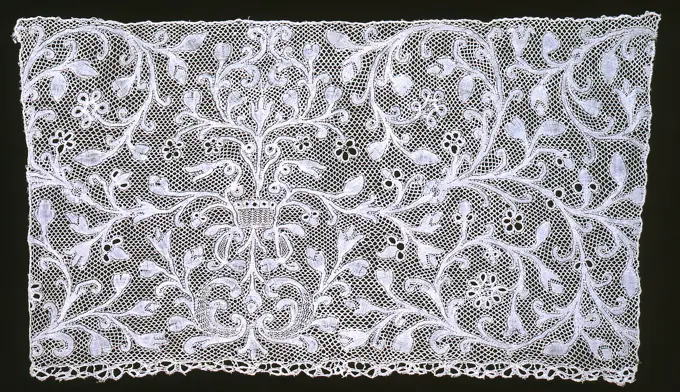
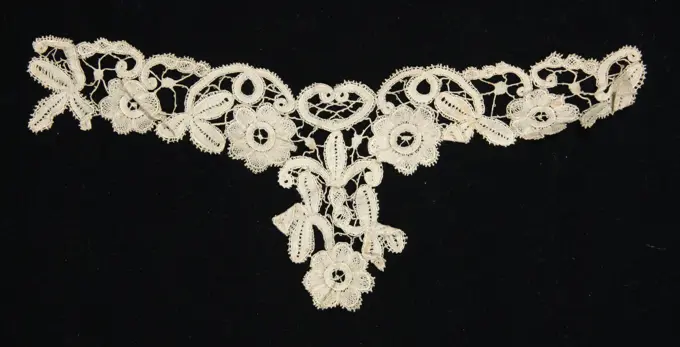
A variety of lace strips from different periods showcasing floral patterns and intricate designs, crafted in linen with delicate details and historical significance.

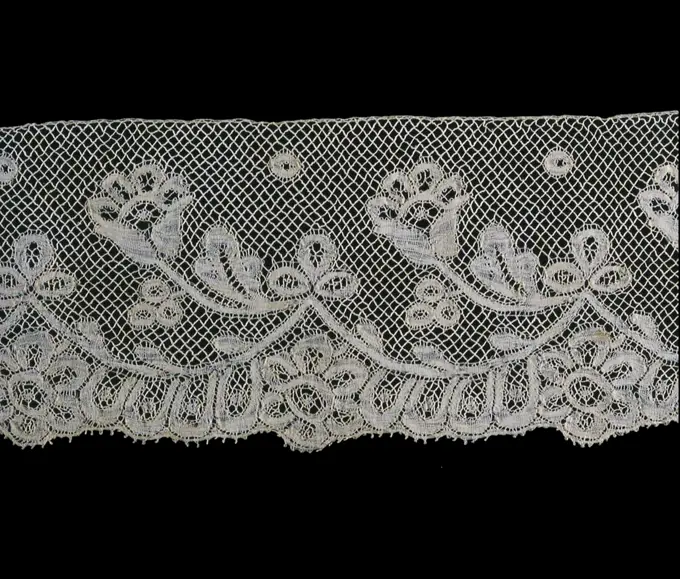
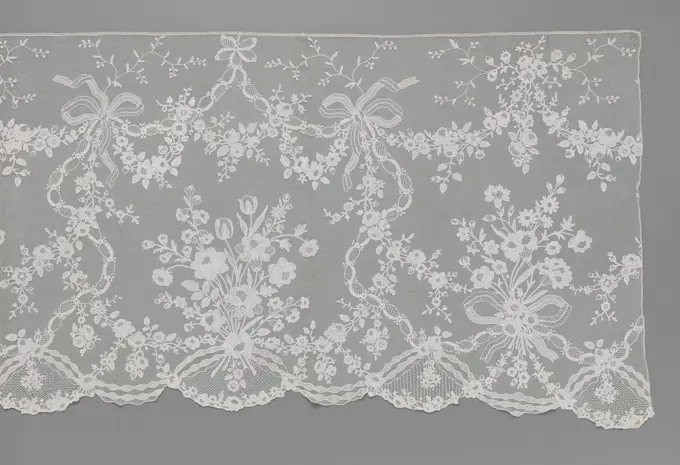
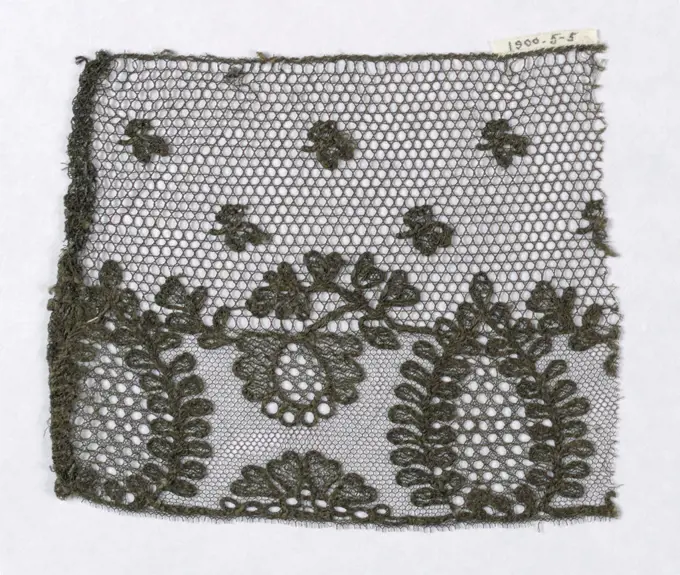
Strip bobbin with two rows of bows and a row of hanging flowers, c. 1800 - c. 1899 Strip of natural -colored bobbin, Parisian side. The upper half of the pattern consists of two rows of bows. The lower half of the pattern consists of a row of split twigs, which always bends one leaf up and one flower down. Along the bottom runs a border that consists of a succession of lying stalks with one flower and one leaf. The motifs are connected by a Maas soil, a Parisian soil. The motifs are made in linen battle with thicker and shiny contour threads. The same coarser decorative land has been used in every open -lived heart. The top and bottom of the strip are straight finished, with the bottom with picots. Flanders linen (material) bobbin lace / Paris lace Strip of natural -colored bobbin, Parisian side. The upper half of the pattern consists of two rows of bows. The lower half of the pattern consists of a row of split twigs, which always bends one leaf up and one flower down. Along the bottom
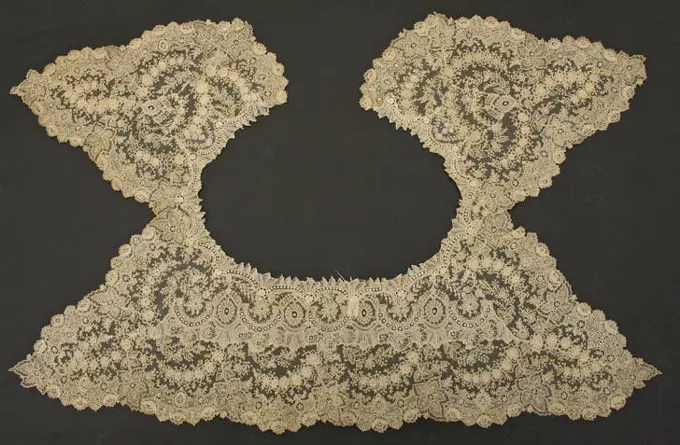
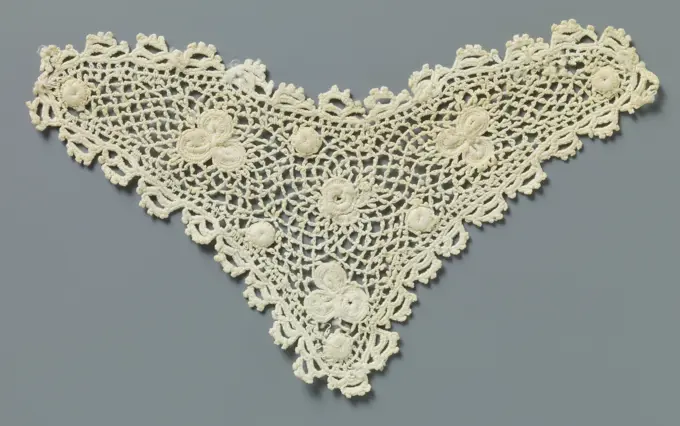
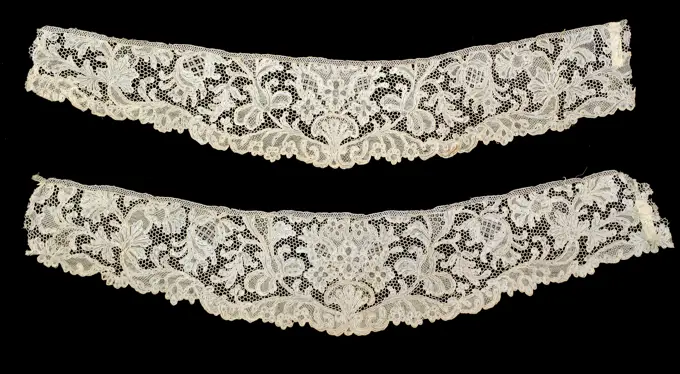
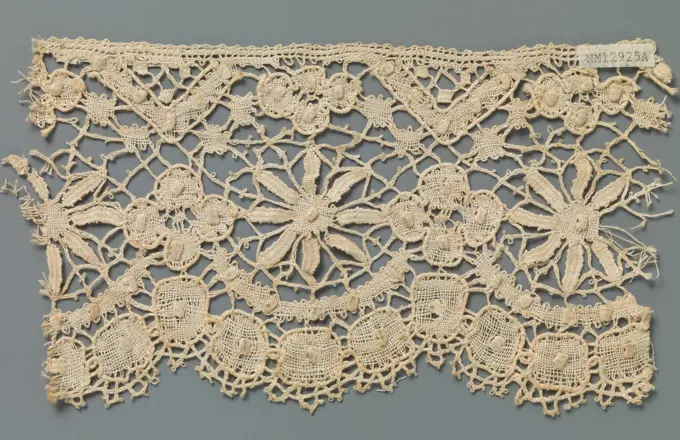
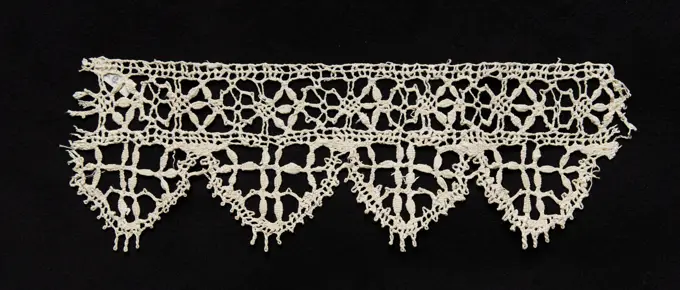
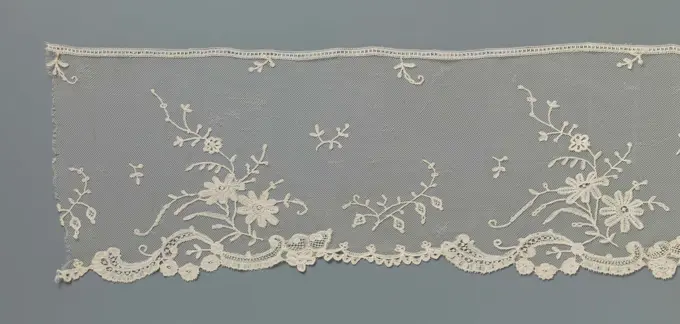
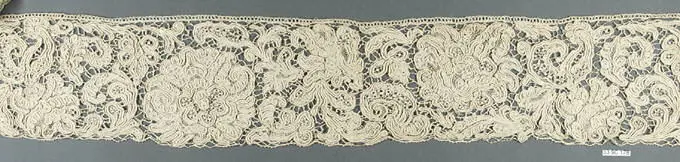
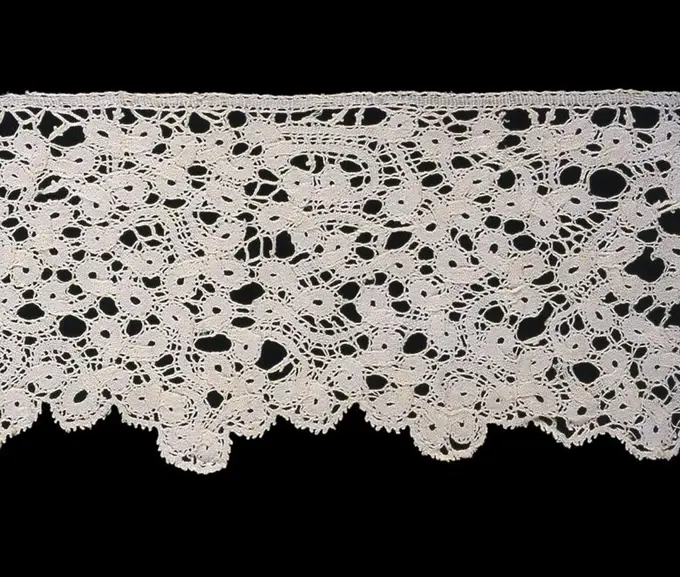
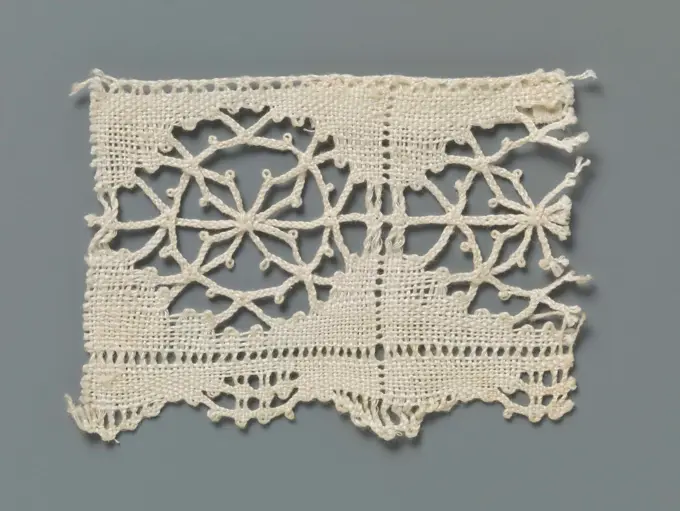
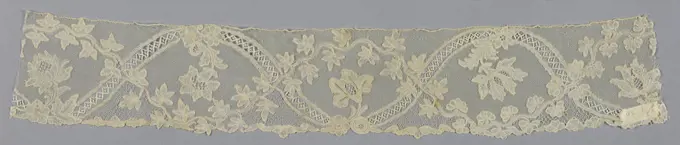
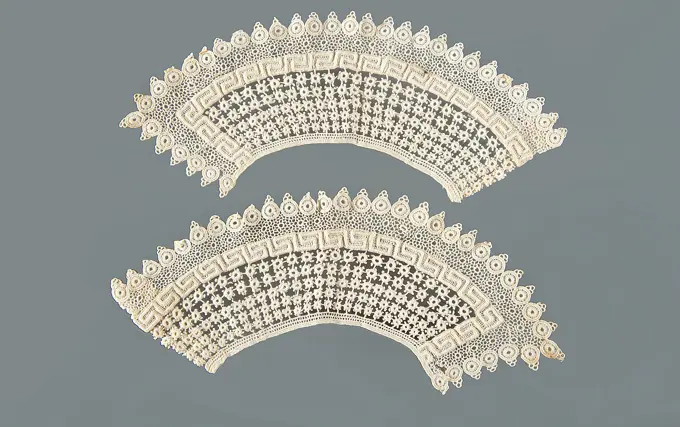
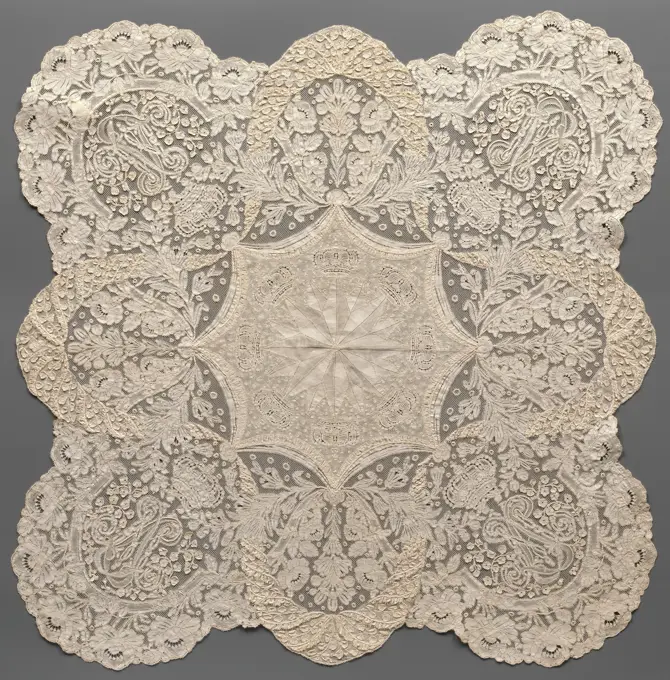
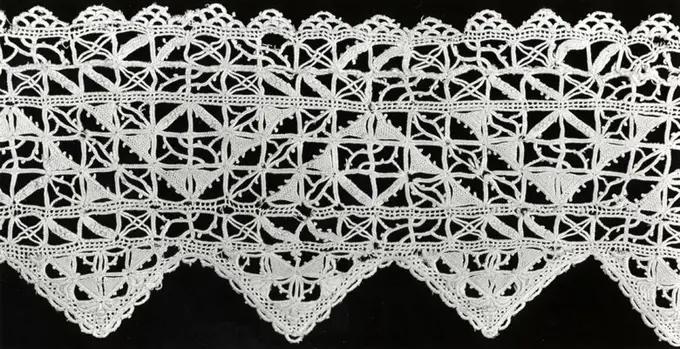
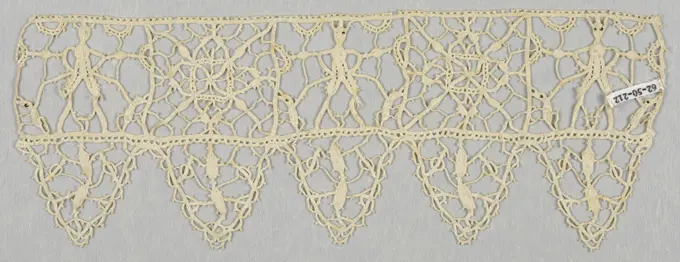
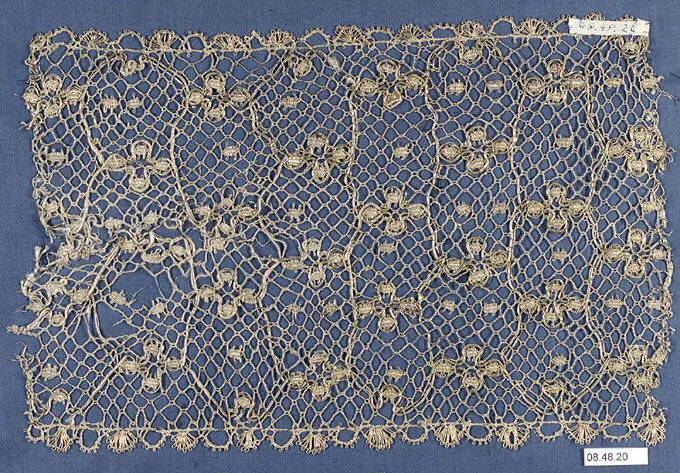
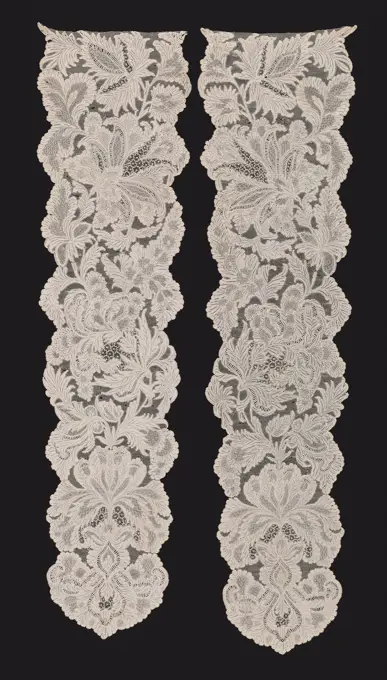
Fragments (From a Border). Northern Italy, possibly Venice. Date: 1601-1625. Dimensions: a: 8.6 x 117.4 cm (3 3/8 x 46 3/8 in.)Width repeat: 13.4 cm (5 3/8 in.)b: 7.3 x 39.8 cm (2 7/8 x 15 5/8 in.)Width repeat: 13.5 cm (5 3/8 in.). Linen, bobbin part lace made in sections; cloth work tapes. Origin: Northern Italy. Museum: The Chicago Art Institute, Chicago, USA.Bertha late 19th century Belgian. Bertha 118935Fragment, A .G. Jennings & Sons, American, Medium: cotton Technique: machine made lace, Edging lace in Mechlin-style with one scalloped border formed by flower., USA, ca. 1884, lace, FragmentBorder Made 1865-1885 Belgium. Cotton, bobbin straight lace of a type known as Valenciennes with a square Valenciennes mesh ground .Manchet van naaldkant met grote palmetbloem.Cuff of natural needle side: Venetian relief side. On a barrier ground, some richly branched feathered leaves and a very large palmet flower together are grouped.Bobbin Lace (Rose Lace) Edging with Bell Points, first half of 17th century. Italy, Genoa, first half of 17th century. Lace, bobbin; average: 6.7 x 23.5 cm (2 5/8 x 9 1/4 in.).Crocheted side with rose and clover leaves, anonymous, c. 1890 - c. 1909 Triangular support piece of natural -colored Irish crocheted side. Central to the triangle a layered rose with a spray pattern around it with a cloverleaf and dots. Crocheted soil with potente diamond -shaped meshes. Finished along all sides with picoted three -part arches. Ierland (possibly) cotton (textile) Triangular support piece of natural -colored Irish crocheted side. Central to the triangle a layered rose with a spray pattern around it with a cloverleaf and dots. Crocheted soil with potente diamond -shaped meshes. Finished along all sides with picoted three -part arches. Ierland (possibly) cotton (textile)Edging 18th century Flemish. Edging 223078Lappet 1730-50 Flemish. Lappet 156504Border late 18th century Flemish. Border 218195Cuff, Medium: linen Technique: bobbin lace appliqué on machine-made net, Cuff with applied floral spray and border., Belgium, 19th century, lace, CuffCuffs mid-18th century French. Cuffs 168701Alstriple of dick edge with bouquets and bows. Almost sudden of natural colored Brussels climbing side. Symmetrical pattern with bouquets, bows and garlands on dirchel soil. Full work in linen stroke and scroll, with clost relief contours (ribs). Numerous ornamental grounds made with partrice eyes. The pattern along the bottom edge is formed by intersecting double ribbons and a sling of roses. The tubes formed by this pattern are filled with ornamental soil. The top edge is finished with a scrossed edge.Edging with fringe 16th century Italian. Edging with fringe 220962Fragment; linen; 1897-8-210Barbe of two sewing mirrored strips of Mechelse side, anonymous, c. 1725 - c. 1750 Barbe of two sewns mirrored strips of Mechelen side. The hat -slip is slightly sculpted and has a point -shaped end. The whole is trimmed with picots. Mechelen linen (material) Mechlin (lace) Barbe of two sewns mirrored strips of Mechelen side. The hat -slip is slightly sculpted and has a point -shaped end. The whole is trimmed with picots. Mechelen linen (material) Mechlin (lace)Band, Medium: linen Technique: bobbin made continuous tape with net added (Valenciennes style net), Band of Milanese-style lace in a scroll pattern., Italy, 18th century, lace, BandStrip Application side with one flower on curly branch, anonymous, c. 1900 - c. 1915  Strip natural -colored application side: bobbin - Bruges flower arrangements - Applicated on mechanical tulle. Lying branch with curly side branch and one flower attached to a fine hexagonal Maas soil with a regular scatter motif of open mouses. A long stretched pattern with bows and ovals forms the potented outskirts on the underside. The motifs seem to have been made from ribbon side, but they are made from a coarse Brugse side, whereby the fashionable ribbon side may have been used as inspiration at the time. The top is trimmed with a border bobbin. Brussels cotton (textile). Bruges flower laceStrip of a climbing side with flower with point petals and squaby rosette. Strip natural colosside, cluny side. The repeating pattern consists on the center line of the strip alternately a flower with eight long point petals and a quadruped rosette made with four connected circles. Along the top of the strip lies straight above the flour a similar but flatter quadruped rosette. And straight above each rosette on the center line is a triangular field along the top of the strip. Along the underside, circles form a slip edge. Most motifs are made in linen stroke and largely equipped with thick contour wires. The petals are made in shape stroke. Form layers are also used to make thick dots in the linen work, in the flower heart and the circular motifs in the rosettes and the edge along the underside, among other things. The motifs are connected by picoted braids. The top of the strip is straight finished. Along the underside braid braces are made with boards with which the slip edge is finBobbin Lace (Needlepoint Design) Insertion with Edging of Points, second half of 16th century. Italy, Genoa, second half of 16th century. Lace, bobbin; average: 8.3 x 23.6 cm (3 1/4 x 9 5/16 in.).Hat of Tulle Doorstop, Anonymous, c. 1860 Tulle hat through. The pattern has a palm with two symmetrical branches on a ground of mechanical tulle strewn with flowers. Netherlands . Tulle hat through. The pattern has a palm with two symmetrical branches on a ground of mechanical tulle strewn with flowers. Netherlands .Needlepoint (Reticella) Lace Insertion, 17th century. Italy, 17th century. Lace, needlepoint: linen; overall: 3.8 x 26 cm (1 1/2 x 10 1/4 in.).Kraag van gehaakte kant met klaverbladen en vijfbladige rozen met een hart in reliëf.Collar of natural crochet side: Irish crochet side. Model with a point in the back and straight corners from the front. The pattern is symmetrical and assumes a centerpiece, where clover leaves start, to the end of which five-leaf roses with a flower heart embossed.Fragment of a Band with Abstract Pattern, 1500s-1600s. Italy, 16th-17th century. Needle lace, filet/lacis (knotted ground and darned in one and two directions); unbleached and bleached linen (est.); overall: 6.4 x 26.4 cm (2 1/2 x 10 3/8 in.).Kloskant motif in the form of an oval with a circle and three flowers, Sophia Gerardine Cenijn-Smit, c. 1914 Motif in the form of an oval of natural-colored bobbin: Cluny side. The very narrow contour of the oval is made in linen battle with an openwork outer edge. Within the contour there is a circle made in mains stroke with a cross or flower with four petals made in the center. On either side of the circle, in the points of the oval a similar flower with six petals. Diagonal lines of concatenated leaves in shape form a hexagonal frame around the circle. Connections between motifs with potented braids. Amsterdam linen (material) bobbin lace / Cluny lace Motif in the form of an oval of natural-colored bobbin: Cluny side. The very narrow contour of the oval is made in linen battle with an openwork outer edge. Within the contour there is a circle made in mains stroke with a cross or flower with four petals made in the center. On either side of the circle, in the points of the oval a simStrook applicatiekant met margrietentakken.Strip natural colored application side, climbing side applicated on machine tulle. On a fond decorated with twigs, along the scalloped side, alternately a large branch with daisies and a small branch with bells flowers. The stretched shelters exhibit broken C-Volutes and with raster work-filled seed beads.Strip of needle side with three different flower vessels, anonymous, c. 1650 - c. 1699 Strip of natural -colored needle side: flat Venetian side. The repeating pattern consists of three different tendrils with flowers. The tenders spring from the top edge with a bend down and up again. The motifs are connected by an open and irregular bar of bar with hexagonal meshes and picots. The top is trimmed with a woven band. The bottom is finished with a straight picotrand. Italy (possibly) linen (material) flat Venetian (needle point) Strip of natural -colored needle side: flat Venetian side. The repeating pattern consists of three different tendrils with flowers. The tenders spring from the top edge with a bend down and up again. The motifs are connected by an open and irregular bar of bar with hexagonal meshes and picots. The top is trimmed with a woven band. The bottom is finished with a straight picotrand. Italy (possibly) linen (material) flat Venetian (needle point)Border (Belgium); linenFragment, Medium: linen Technique: bobbin lace, Mechlin style, Belgium, 18th century, lace, FragmentFragment 17th century Italian. Fragment 214832Doubled strip of needle side with heart -shaped slens, anonymous, c. 1690 - c. 1699 Strip of natural -colored needle side: flat Venetian side. On a bar of land that forms regular six -sided meshes, there is a fine pattern of two symmetrical, heart -shaped slens connected by Serpentinerankjes. Straight finish with large triangles. Venice linen (material) flat Venetian (needle point) Strip of natural -colored needle side: flat Venetian side. On a bar of land that forms regular six -sided meshes, there is a fine pattern of two symmetrical, heart -shaped slens connected by Serpentinerankjes. Straight finish with large triangles. Venice linen (material) flat Venetian (needle point)Insertion and edging 17th century Italian, Genoa. Insertion and edging 218024Strip crocheted side with pointed sculptes such as Punto in Aria, Anonymous, c. 1875 - c. 1899 Strip natural -colored crocheted side with which Punto is imitated in Aria (needle side). The repeating and symmetrical pattern consists of triangular scallops with an arc around a rosette in each point. The pattern is based on needle side patterns from the beginning of the 17th century. The top of the strip is finished with a woven linen strap. Netherlands linen (material) crocheting Strip natural -colored crocheted side with which Punto is imitated in Aria (needle side). The repeating and symmetrical pattern consists of triangular scallops with an arc around a rosette in each point. The pattern is based on needle side patterns from the beginning of the 17th century. The top of the strip is finished with a woven linen strap. Netherlands linen (material) crochetingEdging 18th century possibly Spanish. Edging 222865Strip mixed side for a superplie with volute bines, anonymous, c. 1640 - c. 1660 Strip of natural -colored mixed side: mezzo punto. The strip is intended for a Superplie and has a symmetrical pattern of volutes, with rosette flowers, fan -shaped flowers and acanthus leaves on a hexagonal mesh ground (needle side). The contours of the pattern are formed by a messing ribbon with holes. Within the contours different needle side decorative land. The top is wrinkled on a straight linen tire. The underside is trimmed with a straight border bobbin with picoted arches. Venice (possibly) linen (material) mixed lace / tape lace (mixed lace) Strip of natural -colored mixed side: mezzo punto. The strip is intended for a Superplie and has a symmetrical pattern of volutes, with rosette flowers, fan -shaped flowers and acanthus leaves on a hexagonal mesh ground (needle side). The contours of the pattern are formed by a messing ribbon with holes. Within the contours different needle side decorative laFragment 17th century Italian. Fragment 214903Flounce mid-18th century French. Flounce 227033Japon strip of application side with the pear -shaped medallions, anonymous, c. 1850 Japon strip of natural -colored application side, bobbin and needle side Applicated on mechanical tulle. Against a background, which is widely littered with moesjes, closed -worked Schulpen in turn filled with a pear -shaped medallion with violets and a circle arch with a flower branch. The pear shape is surrounded by a flower wreath with a flower branch in the top. The branch above the circle arc is C-shaped and shows two large hanging chalice, a dune rose and an anemone (both of the needle side) and hanging bells. Brussels linen (material) Japon strip of natural -colored application side, bobbin and needle side Applicated on mechanical tulle. Against a background, which is widely littered with moesjes, closed -worked Schulpen in turn filled with a pear -shaped medallion with violets and a circle arch with a flower branch. The pear shape is surrounded by a flower wreath with a flower branch in the topCap crown. Culture: Italian. Dimensions: L. 7 x W. 6 inches (17.8 x 15.2 cm). Date: early 18th century.The Metropolitan Museum's great lace collection was started when the Museum became the first among American museums to organize a permanent collection of lace with the acceptance of the McCallum Collection in 1879 and the bequests of Mrs. John Jacob Astor, Mrs. Robert L. Stuart, Mrs. Augustus Cleveland, and Mrs. A. W. Winters shortly thereafter. In 1893 a loan collection of antique laces shown at the World's Columbian Exposition in Chicago was assembled by a committee of New York women headed by Catharine Augusta Newbold. About 1900 Miss Newbold arranged and labeled an exhibition of laces and linenworks lent to the Metropolitan Museum by Mrs. James Boorman Johnstone and the Misses Johnstone. "Her scholarly knowledge of lace technique enabled the Museum for the first time to offer a comprehensive display of lace illustrating its historical development," wrote Miss Frances Morris, thenBobbin Lace Edging, 17th-18th century. Italy, Abruzzi, Pescocostanzo, 17th-18th century. Lace, bobbin; average: 8 x 56.8 cm (3 1/8 x 22 3/8 in.).Border 17th century Italian, Venice. Border 218081Volant Van Kloskant with diamond -shaped medallions, anonymous, c. 1870 - c. 1920 Volant of natural -colored bobbin: Parisian side. The soil is divided in two in a Paris soil with clovers at the top and a tuler ground underneath. In the latter is a symmetrical pattern of diamond -shaped openwork medallions with side vines crowned by a flower between two leaves. The leaves, the side ranks and a series of flowers and sling in the scallops are loose on the other in three closed garlands. The motifs are made in linen stroke and provided with contour threads. A rose soil has been applied as a decorative land. BK-BR-J-375-H and -J are sewn together in length. The lower edge is cut in both strips. At -j the side is cut diagonally. Belgium linen (material) bobbin lace / Paris lace Volant of natural -colored bobbin: Parisian side. The soil is divided in two in a Paris soil with clovers at the top and a tuler ground underneath. In the latter is a symmetrical pattern of diamond -shaped openwork mBand, Medium: linen Technique: bobbin lace, Binche style with snowball ground, Band with symmetrical blossoms., Belgium, 18th century, lace, BandBand 17th-18th century Flemish. Band 212336Mitaine Van Kloskant with C-Voluten with zigzag lines and heart-shaped leaves with a double heart, anonymous, c. 1850 - c. 1899 Mitaine of natural -colored bobbin: fine bridge flower arrangements. The pattern exists along the edge at the part where the hand sticks out of the mitaine at the front and back from a C-volute from which two heart-shaped leaves spring. The heart of these leaves is double layer, made with an application from Kloskant. In every volute a zigzag line and pearl edge. This zigzag with pearl edge returns along the edge at the bottom. The remaining pattern includes tibbles with triple leaves and flowers with a closed oval flower heart and open worked oval petals. At the top and bottom edge of the Mitaine are finished with these flowers. The motifs are made in linen and mains with thick contour threads and relief contours. The motifs are connected by a braid ground. In a single rosette flower, a block is made in the flower heart, made in form. Belgium linen (material)Cap Streamers (Belgium); linenStrip bobbin with cartouches along the lower edge interspersed by halved flowers along the upper edge, c. 1775 Strip of natural -colored bobbin: Mechelse side. The repeating pattern consists of a continuous and regularly wavy pendulum, which forms cartouches along the underside of the strip. The pendulum consists of oval, which turn into three connected flowers along the top of the cartouches and along the bottom of the cartouches consists of a succession of five smaller ovals. A large halved flower hangs down from the top of the strip, always between the cartouches and fitting in the golf valley. The motifs are connected by a fine Maas soil, the Mechelen soil. The motifs are made in linen stroke and with thicker and shiny contour threads. A few different decorations have been used in the center of the ovals, in the flower hearts and a snowflake land in the cartouches. The faintly scalloped underside is finished with picots. The top is straight. The short sides are slightly cut away anFragment (possibly France); cottonCollar with English embroidery and a strip of Valenciennes side, anonymous, c. 1880 Lying collar with square corners and a scalloped edge. A circle is embroidered in the sculptures between which an ornament. The collar is trimmed with a strip of Valenciennes side. Netherlands . Embroidering / Valenciennes lace Lying collar with square corners and a scalloped edge. A circle is embroidered in the sculptures between which an ornament. The collar is trimmed with a strip of Valenciennes side. Netherlands . Embroidering / Valenciennes laceLace laceBorder. Italy, probably Abruzzi. Date: 1701-1750. Dimensions: 10.4 x 371.1 cm (4 1/8 x 146 1/4 in.). Line bobbin part lace. Origin: Italy. Museum: The Chicago Art Institute, Chicago, USA.Border Made 1875-1900 Unknown Place. Cotton, knitting; attached at top to cotton, twill woven tape .Strip of a climbing side with windows between double zigzag band. Strip natural colosside, sling. The pattern consists of excellent tires that go with a zigzag movement over the strip, creating windows and triangles. One band is made in poetry linen, the excellent decorative tire is made in slot stroke with snowflakes in between. Immediately below two narrower and continuous zigzag courts with larger snowflakes are the triangular shelters along the bottom of the strip. The zigzag jobs are connected to each other along the top of the strip by a maas soil. The top of the strip is straight finished. The shelters are finished with picots.Fragment; linen; 1897-8-303Collar mid-19th century American or European. Collar 118937Strip bobbin with decorative tires and hanging carnation, anonymous, c. 1725 - c. 1749 Strip of natural-colored bobbin, binche side. The repeating pattern consists of decorative tires that create two different lobed fields. In one field there is a loose curved branch, with a large hanging carnation, two up -to -face rosette flowers and a bunch of five berries. In the other field, from a halved fan -shaped flour on the top, a chalice flower down on a bent stem down. The motifs are connected by a grid, a five -part ground. The motifs are made in linen battle with recesses and openwork edges. Two different decorative lands have been used in the decorative tires, with rosette patterns and circular motifs in it, whether or not in a checkered pattern. The top of the strip is finished with a separate stretched strap, with coarser threads. The very faintly scalloped underside is messy and does not seem to be part of the original pattern, the wire with picots on it differs greatly from the threStrip of a climbing side with circle and diamond-shaped spokes in cutter linen work. Strip natural colosside, cluny side. The repeating pattern consists of rigid linen work with a large cut-away circular field, in which a circle has been made with a horizontal center line with a horizontal braiding. Four diamond-shaped spokes. With small recesses in the linen work, the contours of a square are made around this field. Along the bottom of the strip is straight under this square a glulip opened in the linen work and at a short distance thereof, right under the dividing line between the squares Another cut-off scallop. The top of the strip is right off.Cuff (one of a pair) 16th century Italian. Cuff (one of a pair). Italian. 16th century. Bobbin and needle lace. Textiles-LacesBandBorder, Medium: linen Technique: bobbin lace, Brussels style, Border with a wide serpentine ribbon running the width of the border and crossed at intervals by floral garland., Belgium, 1750-99, lace, BorderEmbroidered Handkerchief, 18th century. Switzerland, 18th century. Embroidery: linen; average: 33.3 x 33.3 cm (13 1/8 x 13 1/8 in.).Bobbin Lace Collar, early 19th century. Belgium, Brussels , early 19th century. Lace, bobbin; overall: 14 x 35 cm (5 1/2 x 13 3/4 in.).Lappet. Culture: Flemish. Date: 1730-39. Museum: Metropolitan Museum of Art, New York, USA.Double strip crocheted side with flowers and grapes, anonymous, c. 1890 - c. 1909 Two strips of natural -colored Irish crocheted side. Pattern with flowers and grape bunches and a crocheted irregular mesh soil with picots. The right -finished sides of the two strips are sewn together. The opposite edges have semi -circle -shaped scumples that are trimmed with potente arches. The edges on the side are not finished or cut. Ierland (possibly) cotton (textile) Two strips of natural -colored Irish crocheted side. Pattern with flowers and grape bunches and a crocheted irregular mesh soil with picots. The right -finished sides of the two strips are sewn together. The opposite edges have semi -circle -shaped scumples that are trimmed with potente arches. The edges on the side are not finished or cut. Ierland (possibly) cotton (textile)Collar (England); linenBand (Belgium); linenCutslip from Binchekant, Anonymous, c. 1740 - c. 1750 Cutslip from Binchekant with a pattern from one -rays placed above each other with a flower vase, interspersed with pointed rosettes. Both sides have a scalloped edge that is trimmed with picots. Binche linen (material). Binche Lace Cutslip from Binchekant with a pattern from one -rays placed above each other with a flower vase, interspersed with pointed rosettes. Both sides have a scalloped edge that is trimmed with picots. Binche linen (material). Binche LaceFragment kloskant met omgekeerde waaiervormig motief in schulpenrand.Fragment black climbing side: Chantilly side. The fragment is an elongated shape, with a slow edge on one long side, the other sides are irregularly cut. The repeating pattern consists of a diamond-shaped configuration of four rosette flowers, including a more or less fan-shaped motif. The consecutive impellers are connected by bows with leaves. There are four rosette flowers under each arc, which form the suspension points of the continuous ornamental belt that also forms the slip edge. The decorative belt consists of two garlands between which are loose round motifs. The motifs are made in cut-off with contour wires. They are connected by a fine Maas soil, a tulet. A rose soil has been applied as ornamental ground. The sloping edge is finished with picots.Strip of black bobbin with broken C-voluten, anonymous, c. 1850 Strip of black bobbin: chantilly side. A running pattern shows alternately broken C-volutes with a leaf sculpt and a hanging flower branch, of which a side branch with four roses forms the other shell. Belgium silk bobbin lace Strip of black bobbin: chantilly side. A running pattern shows alternately broken C-volutes with a leaf sculpt and a hanging flower branch, of which a side branch with four roses forms the other shell. Belgium silk bobbin laceCollar of mixed side with rosette caught in S lines and a vase with seven leaves, anonymous, c. 1890 Collar of natural -colored mixed side - bobbin in combination with a needle -seal - Brussels Duchesse. Round model. The repeating and radially set pattern consists alternately of a rosette contained in symmetrical S lines and a vase with a seven-leaf. The motifs have been hit in linen and mains. The motifs are partially accentuated by bursting relief contours and the rest by wide -founded wire bundles. A few florets are made of needle side. The motifs are connected by a needle -sided soil with single -fested meshes. There have been various needle lace stitches and decorative grounds with very fine and coarser meshes. The scrap edge along the outer edge consists of large shallow scales and the inner edge consists of connected rosettes. Brussels linen (material) mixed lace / Brussels bobbin lace / Brussels point de gaze Collar of natural -colored mixed side - bobbin in combination with a Embroidered Interior Textile, anonymous, c. 1750 - c. 1760  France (possibly) silk. braid embroidering  France (possibly) silk. braid embroideringPagodemouw van Batist dropped off with an edge edge emphasis and a border. The Strip of English Embroidery is Partly Covered in The Edge.Band (Italy); linen; Bequest of Marian Hague; 1971-50-374-a,bBand, 18th century, 73 3/4 x 7 1/4 in. (187.33 x 18.42 cm), Silk; bobbin lace, Italy, 18th centuryRabat fragment. Date/Period: Early 18th century. Rabat fragment. Medium: linen. Technique: needle lace. Author: UNKNOWN.Collar;  the twenties of the 20th century (1920-00-00-1929-00-00);Magdalena, Witwińska, Dar (provenance)Collar, Medium: linen Technique: needle lace with ground of loop & twist with loop & twist return, technique commonly called Point de Gaza, Belgium, late 19th century, lace, CollarBorder (Italy); linen; Bequest of Richard Cranch Greenleaf in memory of his mother, Adeline Emma Greenleaf; 1962-50-308Handkerchief ca. 1865 Convent of Notre Dame de Visitation While most lace handkerchiefs consist of a woven fabric with a wide lace border, this example is made entirely of bobbin lace, a specialty of the Convent of Notre Dame de Visitation in Ghent. In 1852 Sister Marie-Joseph patented a new style of lace, now called Ghent Lace with Varied Ground, making it possible to employ workers of varying skill levels and to assemble large pieces quickly using motifs that could be prepared ahead of time. The use of the royal monogram of King Leopold II and the repetition of the crown motif suggest that this handkerchief was made in celebration of his ascent to the throne in 1865. It may have been a presentation piece for his wife, Marie-Henriette, who was a patroness of both the convent and the Belgian lace industry.. Handkerchief 221626Border (From a Cover). Italy. Date: 1550-1600. Dimensions: 10.4 x 98.7 cm (4 1/8 x 38 7/8 in.)Point width: 6.0 cm (2 3/8 in.)Upper band width: 6.8 cm (2 5/8 in.)Lower band width: 11.3 cm (4 1/2 in.). Linen, needle lace worked on plain weave cut and drawn thread grid; embroidered in double hem and overcast stitches; two portions joined. Origin: Italy. Museum: The Chicago Art Institute, Chicago, USA.Collar of needle side with flower vines and pointed sculptures, anonymous, c. 1675 - c. 1699 Collar of natural -colored needle side: Reticella and Venetian rose side. The collar consists of two strips of two strips and is finished with a messing edge. The outer strip (reticella) consists of ten U-shaped sculptes that are pointed with potente arches. The inner strip (Venetian rose side) has a pattern of floral vines. The strips differ greatly in color. Venice linen (material) Venetian rose point Collar of natural -colored needle side: Reticella and Venetian rose side. The collar consists of two strips of two strips and is finished with a messing edge. The outer strip (reticella) consists of ten U-shaped sculptes that are pointed with potente arches. The inner strip (Venetian rose side) has a pattern of floral vines. The strips differ greatly in color. Venice linen (material) Venetian rose pointFragment, Medium: linen Technique: bobbin lace (Lille style with heavy thread), Fragment of Lille-style lace with oval conventionalized blossom and leaves in eyelets. Beading top and bottom edge., France, 19th century, lace, FragmentCuffs (Ireland); linenFragment, Medium: linen Technique: bobbin lace (Lille-style with heavy outlining thread), Fragment of Lille type bobbin lace., early 19th century, lace, FragmentInsertion 16th century Italian. Insertion 221127Bobbin Lace Insertion, mid 16th century. Italy, Venice, mid 16th century. Lace, bobbin; average: 2.9 x 20.4 cm (1 1/8 x 8 1/16 in.).Fragments (Germany); linenFragment, Medium: silk Technique: embroidery on net, Black silk thread hand run on net. Border design of a cone pattern with smaller blossoms scattered over ground., France, 19th century, lace, FragmentStrip bastard with bouquet in cartouche, anonymous, c. 1700 - c. 1749 Strip of natural -colored bobbin: old Brabant side. The strip was probably made for a rochet, which is a choir shirt that falls to the knee and is worn over a soutane. The pattern consists of two different cartouches with alternating a bouquet with three flowers and a bouquet with five flowers. The motifs are connected by a grid, the Paris soil. The fullwork is largely made in separate linen battle with openwork edges and/or with burst relief contours. Parts of motifs, including the Bloemharten, are made in Netslag. A braid soil with picots has been used as a decorative land in the lists and between the flowers. The top of the strip is finished with a separate strap. The scalloped underside stems from the pattern and is finished with picots. Southern Netherlands linen (material) bobbin lace / old Brabant lace Strip of natural -colored bobbin: old Brabant side. The strip was probably made for a rochet, which is a choiBorder, Medium: linen Technique: grid of laid cords with needle lace (reticella style), edge of punto in aria, Border with geometric pattern of squares showing alternating human shapes and star motif. Edged with triangular pendants., Italy, 16th century, lace, BorderGalloon 17th-18th century Italian or French. Galloon 214080Border, Medium: silk () Technique: needle lace, Design of flowers and leaves work in relief and connected with ornamental brides., Greece, 19th century, lace, BorderFragment 18th century French. Fragment 213357Cap Streamers (France); linenBand; linen; Bequest of Marian Hague; 1971-50-238Bobbin Lace (Rose Lace) Edging of Round Points, 17th century. Italy, Genoa, 17th century. Lace, bobbin; average: 8.3 x 18.5 cm (3 1/4 x 7 5/16 in.).Bobbin Lace (Needlepoint Design) Edging of Round Points, second half of 16th century. Italy, Genoa, second half of 16th century. Lace, bobbin; average: 2.9 x 19.1 cm (1 1/8 x 7 1/2 in.).Fragment of Lace. Probably France or Italy, 18th century. Textiles; fragments. Silver and gilded silver thread with silk core bobbin laceLace, 1800s, maker unknown. Gift of Mary Francis, 1977.Flounce (Spain); silk