Vintage Lace Strips

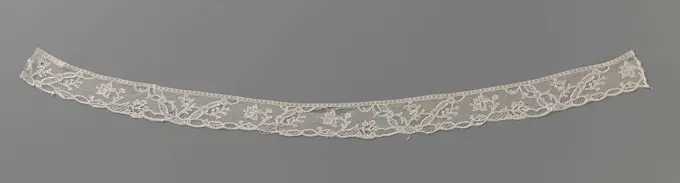
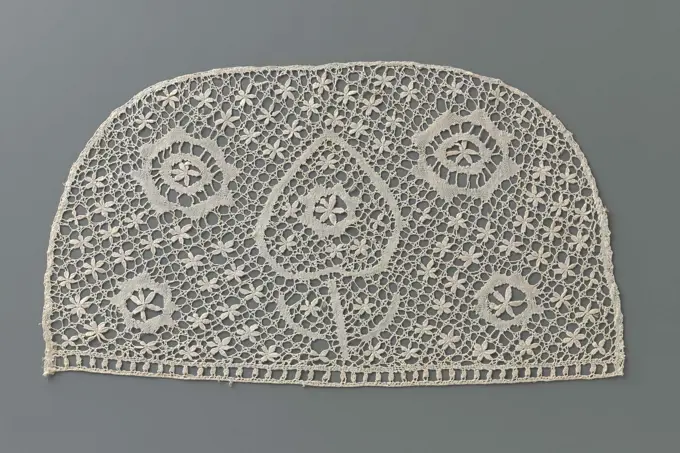
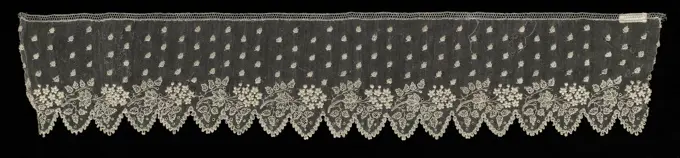
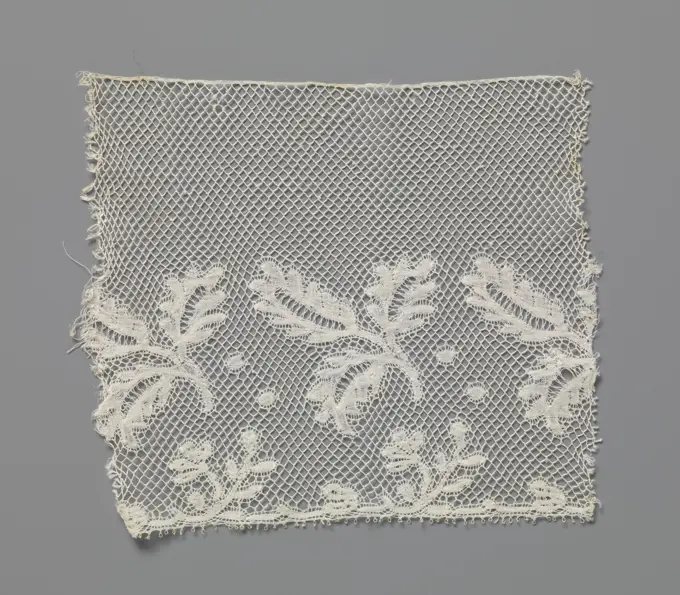
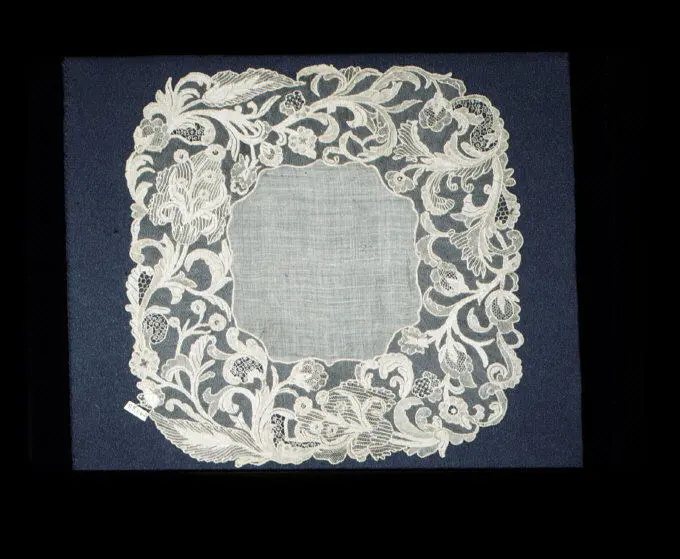
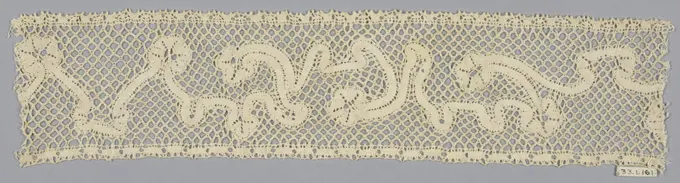
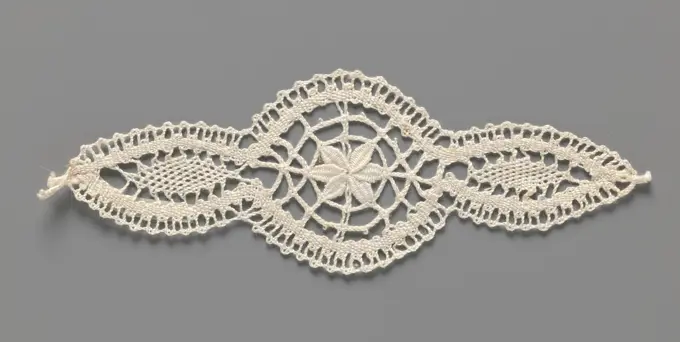
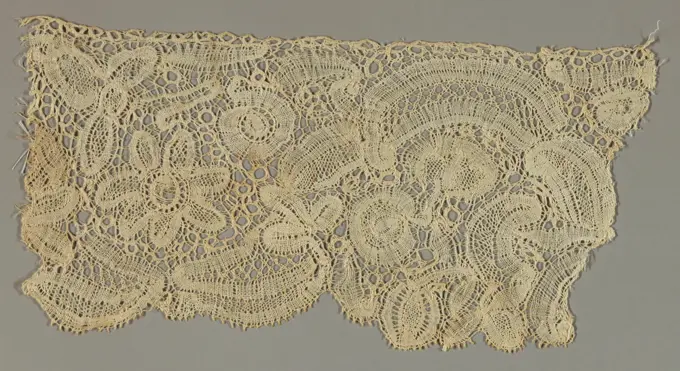
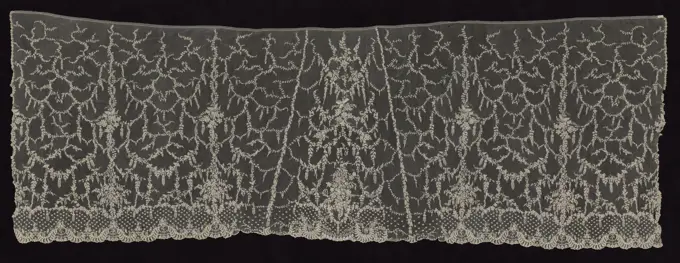
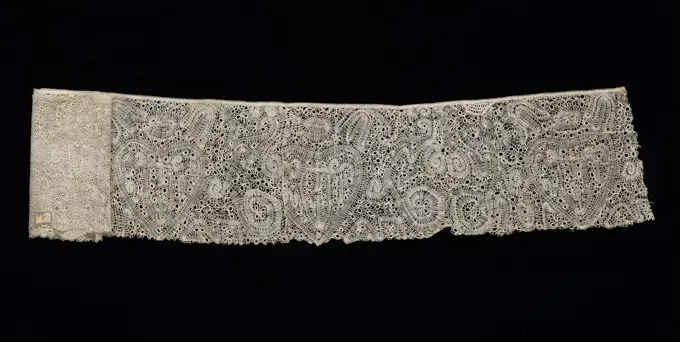
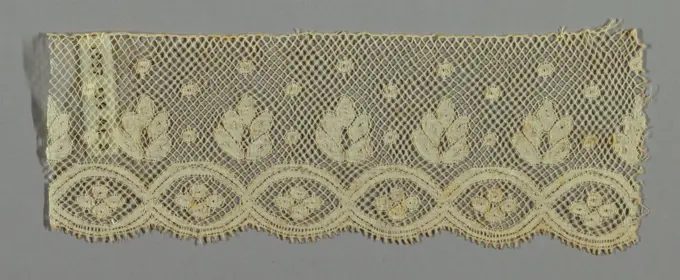
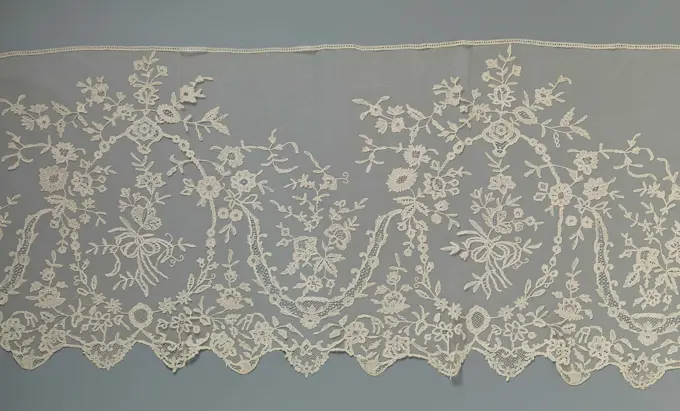
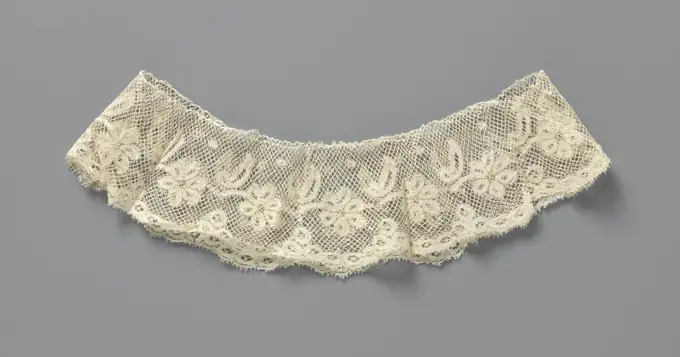
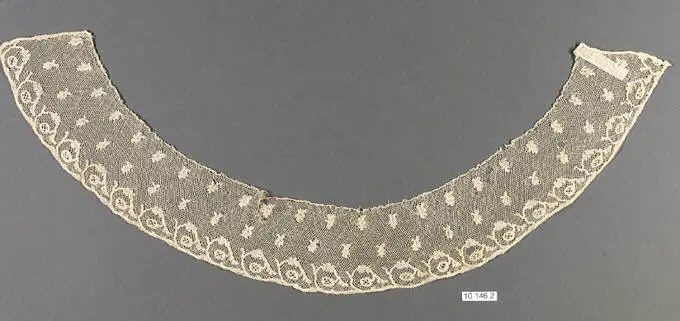
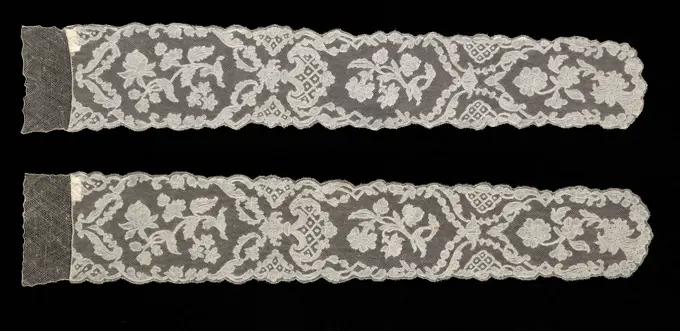
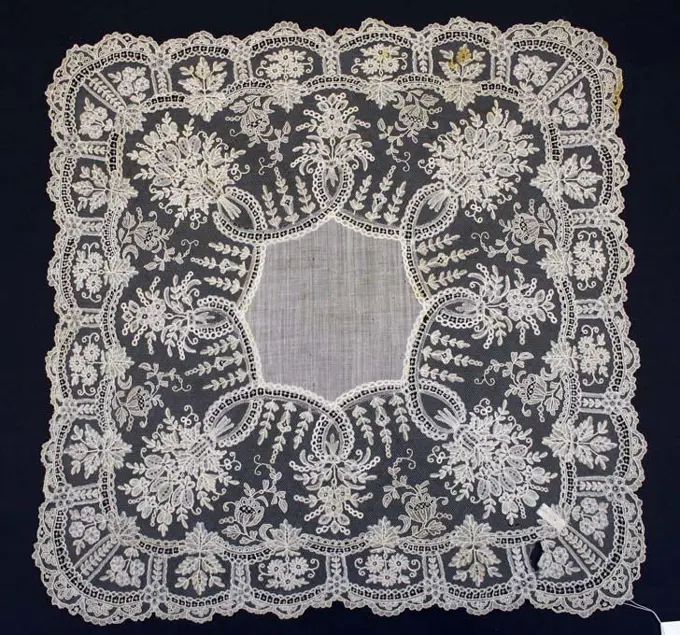
Intricate lace strips featuring floral and vine patterns, showcasing craftsmanship from the 17th to 19th centuries in natural linen shades.

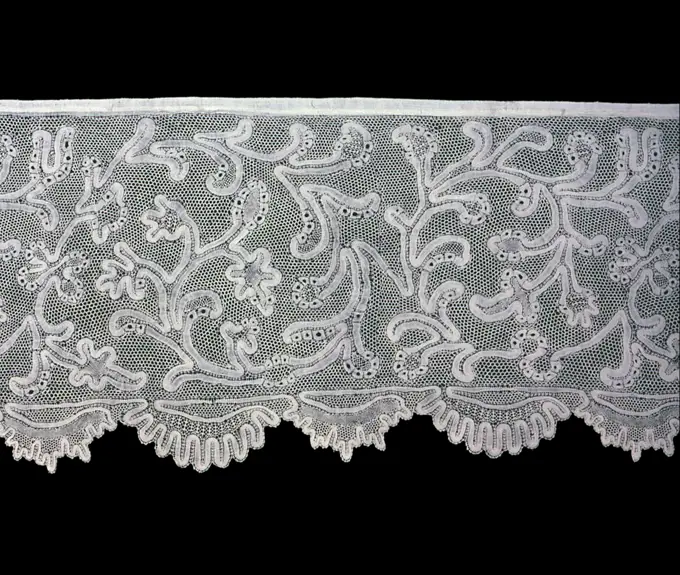
Border (Belgium); linen
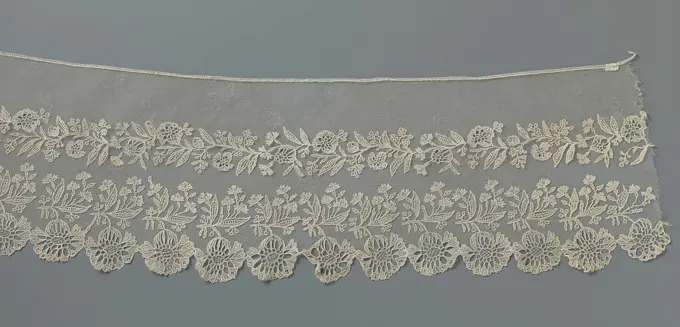
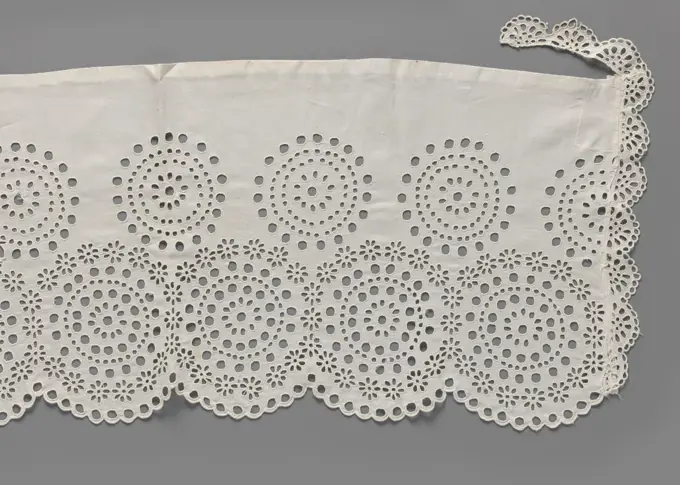
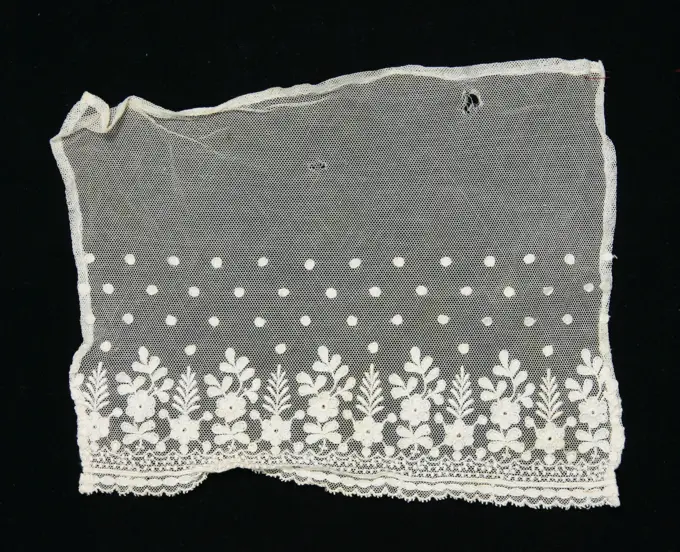
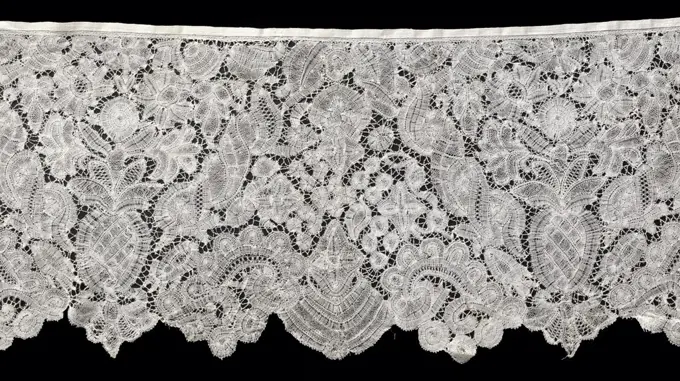
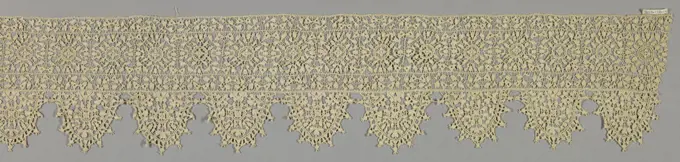
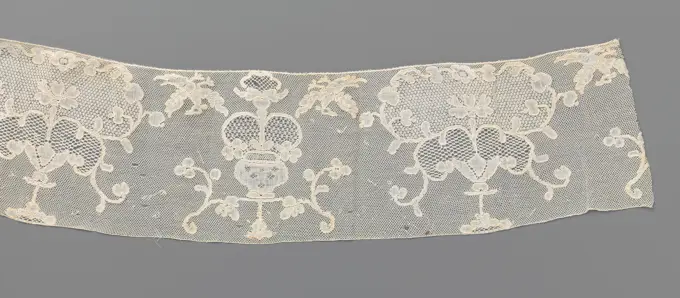
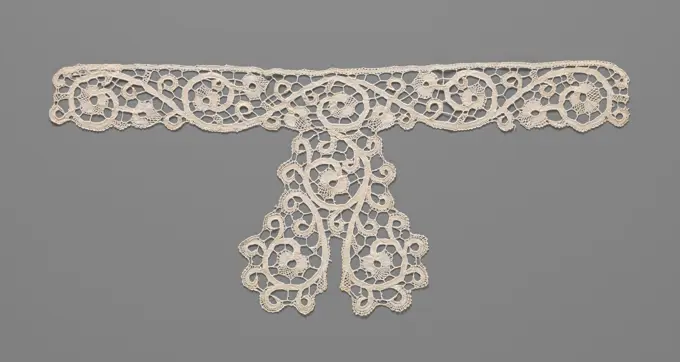
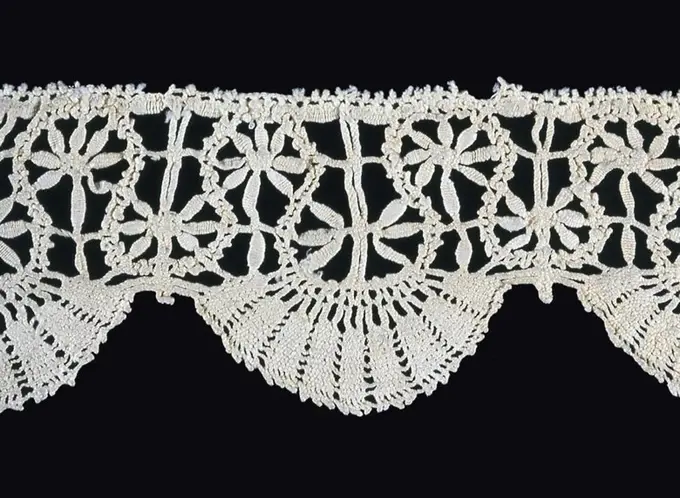
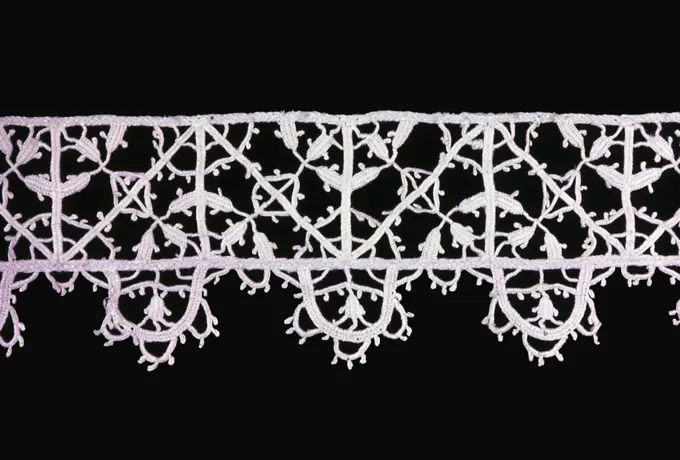
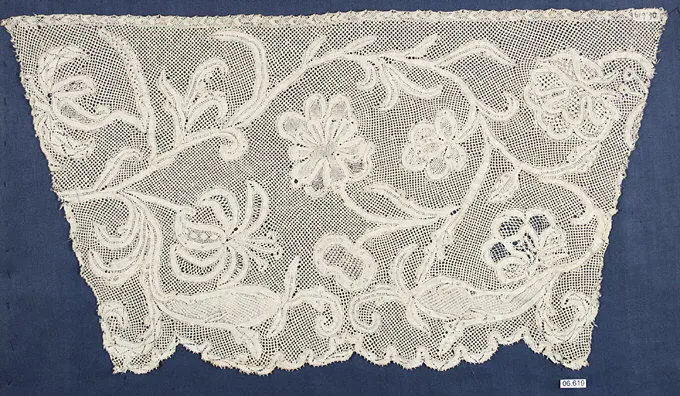
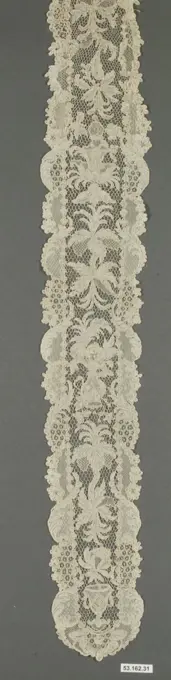
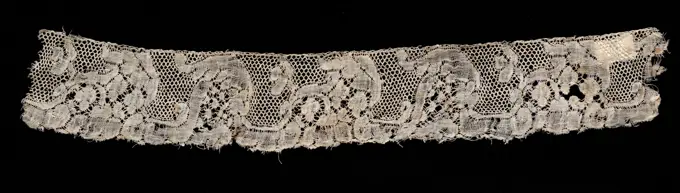
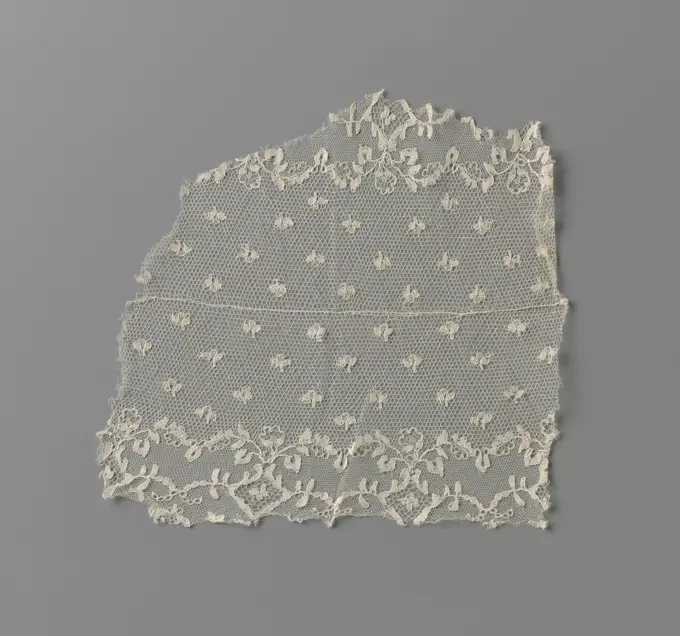
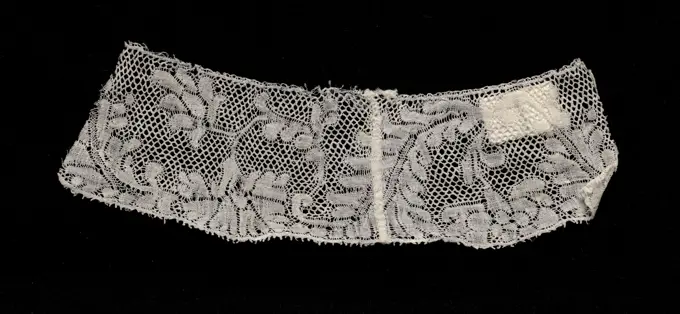
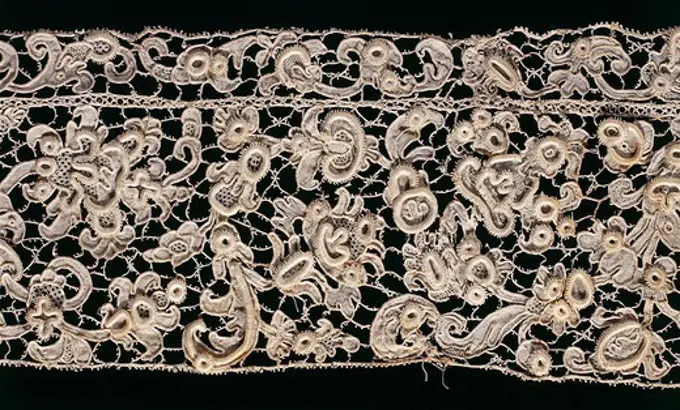
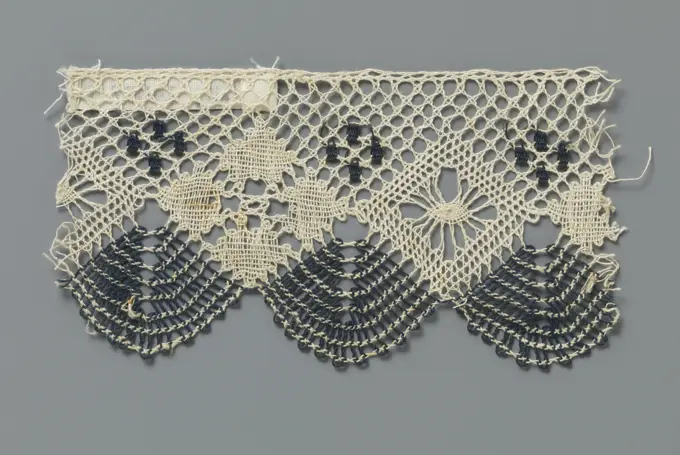
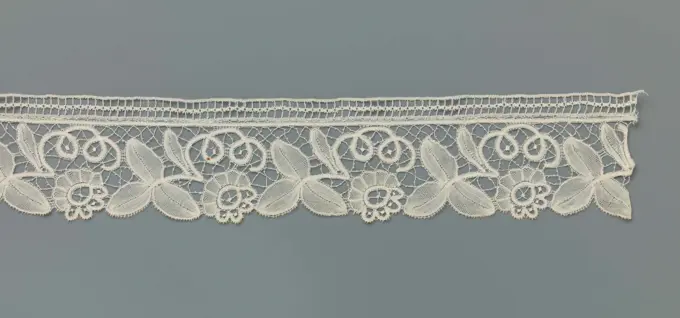
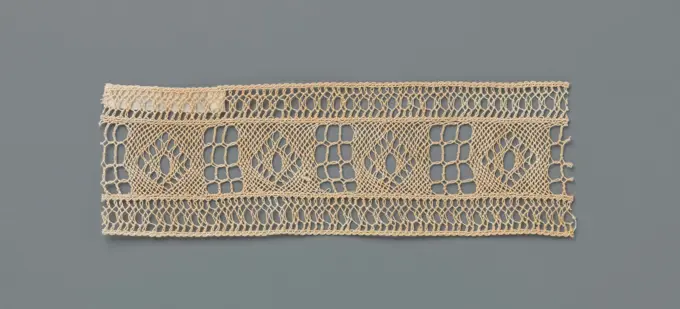
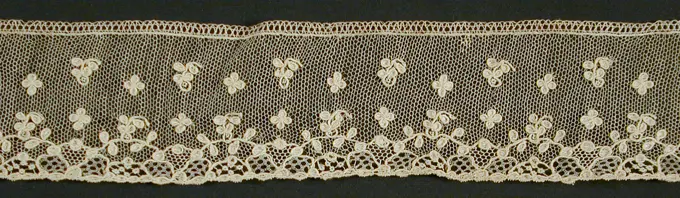
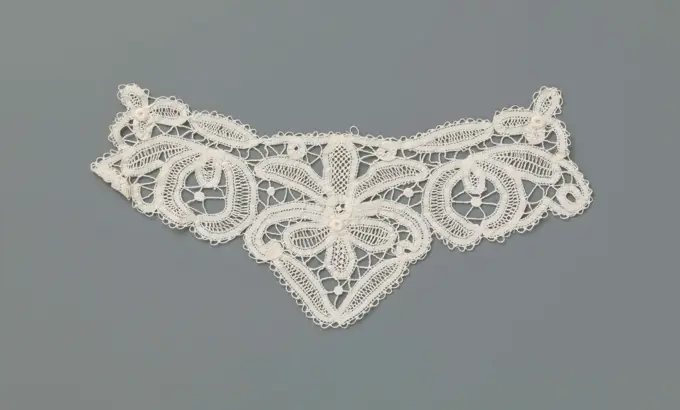
Border Made 1725-1750 Italy. Linen, bobbin part lace (continuous clothwork tapes with decorative openings) .Border; linenJaponstrook van applicatiekant met hangende bloemen.Japon strip of natural-colored application side, needle side applicated on machine tulle. An edge of round shelters is formed by a rigged row of large flowers that depend on the right, from small flower branches. Loose up there is a narrow edge of a wavy branch with smaller similar flowers. The upper part consists of a part of an unmarmed tulle. Two narrower strips have the same, and a reduced pattern.Cuff 18th century Danish. Cuff 215493Border (From a Cover) Made 1525-1600 Italy. Linen, plain weave; cut and drawn work embroidered in double faggot, double hem, overcast and padded overcast stitches; needle lace inserts (of buttonhole, darned and overcast bars decorated with buttonhole collar and bullion picots); edged with needle lace points (of six-element plait, buttonhole, double buttonhole, and overcast bars) .Fragment, Medium: linen Technique: needle lace, Fragment of Argentan lace with a complete flower and a small bit of ground attached at one side., France, 18th century, lace, FragmentStrip of cotton with lace plunger with openwork concentric circles, C.I. Bosch Reitz-Teding van Berkhout, c. 1860 - c. 1880 Strip of natural cotton with lace bobbins: English embroidery. Schulpenrand with large scales above which two staggered rows of concentric circles, made up of three ever -increasing circles and a daisy in the middle. The bottom row also has an extra circle on the outside that consists of small daisies. The other circles are made up of openwork small and larger circles. A continuous list of openwork circles runs along the scrap edge. Along one of the short sides is a sculpy strip sewn with smaller sculptures. Amsterdam cotton (textile) Strip of natural cotton with lace bobbins: English embroidery. Schulpenrand with large scales above which two staggered rows of concentric circles, made up of three ever -increasing circles and a daisy in the middle. The bottom row also has an extra circle on the outside that consists of small daisies. The other circles are made up oCap crown early 18th century Flemish. Cap crown 218154Fragment of bobbin lace unknownFragment; linenBobbin Lace Edging, 18th century. Belgium, Mechelen, 18th century (Regency period). Lace, bobbin: linen; average: 6.4 x 49.6 cm (2 1/2 x 19 1/2 in.).Fragment, Medium: linen Technique: grid of withdrawn element with needle lace, reticella style, A narrow panel with repeat of a scroll., Italy, 16th-17th century, lace, FragmentShawl. Culture: Belgian. Date: 1860-70. Museum: Metropolitan Museum of Art, New York, USA.Fragment; medium:Fragment, Medium: linen Technique: plain weave embroidered with deflected element work, Fragment of a woven linen border showing design of flowers, sprigs and leafy scrolls forming a scalloped edge., possibly Italy, possibly France, 18th century, embroidery & stitching, FragmentLace piece, 1800s, maker unknown. Gift of Mary Crone, 2008.Strip bobbin lace with seed beads and pineapples, Anonymous, c. 1700 - c. 1724white doily with lace white doily with lace Copyright: xZoonar.com/AndreyxGuryanovx 1952604Fragment Swedish, Dalarna 19th century View more. Fragment. Swedish, Dalarna. 19th century. Bobbin lace. Textiles-LacesBorder, Medium: linen Technique: grid of laid cords with needle lace (reticella style); edge of punto in aria, Deeply scalloped border with a horizontal band of circular ornaments within squares., Italy, late 16th-early 17th century, lace, BorderStrip bobbin with flying birds between flower pots on tables, anonymous, c. 1750 - c. 1799 Strip of natural -colored bobbin, stuck side. The strip runs around slightly. The repeating pattern consists of two different flower pots, both on tables. A bird flies between the successive bouquets. The bouquets are strongly stylized, with a kind of clouds, or lobed oval carthoughes, splitting and curling flower branches. There is a carnation in the largest 'cloud', with a rosette flower above it. The motifs are connected by a Maas soil. The motifs are made in linen battle, with thicker and shiny contour threads. Different decorative lands have been applied, including a snowflake land. At the top and bottom are straight finished, with one of the sides finished with picots. Antwerp linen (material) bobbin lace / pot lace Strip of natural -colored bobbin, stuck side. The strip runs around slightly. The repeating pattern consists of two different flower pots, both on tables. A bird flies between tBobbin Lace Insertion, mid 16th century. Italy, Venice, mid 16th century. Lace, bobbin; average: 6.1 x 24.2 cm (2 3/8 x 9 1/2 in.).Collar with attached jabot. Collar with attached Jabot of natural colored Venetian climbing side. Strip-shaped model including a heart-shaped jabot. The predominantly symmetrical pattern consists of a wavy rank with five strong curling side branches with a three or five-spinny flower at each end. The heart-shaped jabot is formed by three of such curly tendrils with this flower to each end. Around the heart, on the curling tendrils several short side branches that are all in curl. The motifs are largely made in linselag with edges opened here and there. Another stroke is used for single (flour) leaves. The motifs are connected by braids. The top of the whole is straight finished. The curling tendrils and side branches form a slip edge along the other edges.Strip of needle side with deer and dogs, anonymous, c. 1740 - c. 1760 Strip of natural-colored needle side: Alençon side. The repeating pattern consists of a deer that is hunted by dogs. The animals are surrounded by ranks with multifaceted flowers. The motifs are made up of feston stitches with recesses and equipped with relief contours. The motifs are connected to each other by a fine hexagonal Maas soil, an alençon ground, mazen worked with across. A few spaces between the tenders are filled with decorative grounds. The scalloped top is created from the pattern with the flower ines and is finished with very fine picots. The underside is trimmed with a border bobbin. France linen (material) Alençon Lace Strip of natural-colored needle side: Alençon side. The repeating pattern consists of a deer that is hunted by dogs. The animals are surrounded by ranks with multifaceted flowers. The motifs are made up of feston stitches with recesses and equipped with relief contours. The motifs areFragment (Border). Italy, probably Genoa. Date: 1601-1650. Dimensions: 8.2 x 27.3 cm (3 1/4 x 10 3/4 in.)Weft repeat: 9.2 cm (3 5/8 in.). Linen, bobbin straight lace. Origin: Italy. Museum: The Chicago Art Institute, Chicago, USA.Japon strip of application side with flower branches and napkin. Japanese strip of Brussels application office: dick edge with needle lace standards appliqued on machining tulet. The repeating pattern consists of flower branches and napkin. Soil strewn with moes. The motifs are made in a cut-off and linselag with openwork edges and equipped with contour wires. The sloping edge along the bottom of the strip stems from the pattern and is finished with picots. The top is finished with a separate clust strap. The strip includes a note with the text: 'Coba van Hare Mother. Later giving to Anneke '.Fragment Swedish, Skane 19th centuryPiece 18th century Italian, Abruzzi. Piece 214914Strook kloskant met anjer tussen v-vormige velden.Strip natural colosside: Mechelen side. The pattern consists of a double narrow pendulum, which forms a succession of spindle-shaped cartouches along the underside and also forms a regular distance with sloping lines to the top of the strip V-shaped fields. A large carnation at a curved stem releases from the pendulum along the bottom edge and is always in the space between two consecutive V-shaped fields. The motifs are connected by a fine Maas soil. The motifs are made in linen stroke with very thick contour wires. Different ornamental grounds have been applied in the cartouches and in residual areas. The bland scalloped underside stems from the pattern with the double garland and is finished with picots. The top is finished with a separate splitting straight band.Border Made 1730-1749 Mechelen. Linen, bobbin straight lace of a type known as Mechlin with a double torchon mesh ground .Half teaside tea hat with a reverse heart-shaped flower on a stem with two leaves. Half tea hat. Trapezoidal with strongly rounded corners at the top. It probably concerns Chinese work, conducted led by French sisters Franciscanessen in Shanghai. The half tea hat is strewn with six-leaf flowers, with petals made in shape stroke. The flowers are connected by an open grille. Five larger flowers, two on either side and one in the center, are surrounded by oval lists in linen. The central flower has also been a simple list in the form of an inverted heart at some distance, on a stem with a narrow up bending leaf on either side. Heart, stalk and leaves are all made in linen stroke, in more or less the same width. Along the straight bottom, a decorative edge with square shape strokes runs between two narrow straps. Along the outside of the rest of the half tea hat is a border in linen stroke.Investment with rose bouquet. A symmetrical leaf follower encloses a bouquet of roses. A corned list along three sides. Venise flat.Needlepoint (Punto in aria) Lace Insertion, 19th century. Italy, 19th century. Lace, needlepoint; average: 5.1 x 23.2 cm (2 x 9 1/8 in.).Band, Medium: linen Technique: bobbin lace, continuous tape with net added (Valenciennes-style net), Band of northern Italian, Milanese-style lace in a scroll pattern with openwork spots along the path of the continuous tape., Italy, 17th century, lace, BandBand, Medium: linen Technique: grid of withdrawn element with needle lace, reticella style, Panel with a row of geometric shapes., Italy or Spain, 16th-17th century, lace, BandNeedlepoint (Burano Point) Lace Edging, late 18th century. Italy, Burano, late 18th century. Lace, needlepoint; average: 12.4 x 62.9 cm (4 7/8 x 24 3/4 in.).Strip of bobbin with trapezoidal fields by double sities, anonymous, c. 1770 - c. 1790 Strip of natural -colored bobbin: Mechelse side. The repeating and symmetrical pattern consists of two trapezoidal fields, which are created by oblique lines that are directed to the left and to the right. The lines are created from the bottom and are formed by double thin tifles, with a few berries in the top. At the top hangs alternately half a palm leaf and a small cartouche, a flower surrounded by leaves. A somewhat similar cartouche is located along the bottom right under the half -palm leaf. The motifs are connected by a Maas soil, the Mechelen soil. The motifs are made in linen battle with thicker and shiny contour threads. Two different decorative lands have been used in the cartouches and between the double tifles. The top is straight. Southern Netherlands linen (material) bobbin lace / Mechlin (lace) Strip of natural -colored bobbin: Mechelse side. The repeating and symmetrical pattern consStrook applicatiekant met driehoekige bloemen langs onderzijde.Strip natural-colored application side: needle side applicated on machine tulle. On a fine hexagonal maas soil, a concatenation of small, uniform, triangular flowers is sewn along the underside. The flowers hang on a short stem with an oval-shaped leaf. The top is finished with a splitting strap.Strip bobbin with Drieblad, Anonymous, c. 1820 On a fine mesh network there is a stiff row of three-part leaves in the outer half, which are one-sided. A straight edge shows smaller, opposite oriented flower branches. Valenciennes side. Ieper (possibly) linen (material) Bobbi Lace / Valenciennes Lace On a fine mesh network there is a stiff row of three-part leaves in the outer half, which are one-sided. A straight edge shows smaller, opposite oriented flower branches. Valenciennes side. Ieper (possibly) linen (material) Bobbi Lace / Valenciennes LaceHandkerchief ca. 1875 Italian, Burano. Handkerchief 212539Batik sample, 20th century, 52 3/4 x 18 3/8 in. (133.99 x 46.7 cm), Cotton; printed, China, 20th centuryBorderBand, Medium: linen Technique: bobbin made continuous tape with net added, Scrolling tape pattern in field of square mesh., possibly Russia, 18th-19th century, lace, BandWoman's ScarfBobbin Lace Insertion, mid 16th century. Italy, Venice, mid 16th century. Lace, bobbin; average: 4.5 x 7.1 cm (1 3/4 x 2 13/16 in.).Kloskant motif in the shape of a circle with a rush-on, Sophia Gerardine Cenijn-Smit, c. 1914 Motif in the shape of a circle with a rush-in peak of Natural Kloskant: Cluny side. The contour of the motif is made in linen battle with an openwork outer edge. Within the contour in each Spitsovaal a field in Netslag. Within the circle contour are two concentric circles made with braids and in the center a flower with six petals made in form. Amsterdam linen (material) bobbin lace / Cluny lace Motif in the shape of a circle with a rush-in peak of Natural Kloskant: Cluny side. The contour of the motif is made in linen battle with an openwork outer edge. Within the contour in each Spitsovaal a field in Netslag. Within the circle contour are two concentric circles made with braids and in the center a flower with six petals made in form. Amsterdam linen (material) bobbin lace / Cluny laceEdging Hungarian-Slovak 19th centuryPanel late 16th or early 17th century Spanish or Italian. Panel 230799Band (Belgium); linenFragment, Medium: linen Technique: bobbin lace, Binche style with snowflake and snowball ground, Belgium, 18th century, lace, FragmentHalf altitude of climbing side with impeller and French lily. Half anxiety of natural-colored bobbin side. Richly nuanced light side with a repeating pattern, which consists of two types of symmetrical compositions of flowers, leaves and architectural forms. One composition consists of a ball die-line including a range or palm-shaped vase, surrounded with flowers and standing on a hob-shaped border with diamond filling. The other pattern consists of a scale from which a pomegranate and an obelisk-like pine shape rice, crowned by a French lily. The motifs are connected to each other with a picoted braid soil, here and there the braids run behind the motifs. The motifs are made in a separate clusted linen stroke and is sporadically equipped with clost relief contours. A wide variety of ornamental grounds is used within the motifs. The shelters along the lower edge stem from the pattern. The top edge is finished with a straight edge, as well as the side edges that are also equipped with pNeedlepoint (Point d'Alençon) Lace Flounce, mid 19th century. France, Alençon, mid 19th century. Lace, needlepoint; average: 254 x 92.8 cm (100 x 36 9/16 in.).Belgian lace with naive pattern, 18th century, maker unknown. Gift of Dr Tom Farrar, 2010.Flounce (France); silkStrip early 18th century Flemish. Strip 218831Fragment; linen; Bequest of Marian Hague; 1971-50-253Fragment; linenStrip 17th century Italian. Strip 220965Japonstrook van applicatiekant met slinger en ovaal.Japon strip of natural colored application side, dick edge and needle side applicated on machine tulle. A thin, oval flower and leaf garrier, asymmetrical, but with symmetrical medallions in the top and at the foot, alternates with a deeply considering pendulum with grid work filling. Within the oval a stretched bouquet is a single flower branch above the garland. Only the foundation above the oval is filled with flower branches. Deep, three-sided shelters with a symmetrical reserve with a raster filling, under the pendulum, flanked by reserves with crested leaves. The strip consists of two parts that are turned around.Border (one of a pair) 17th century Italian. Border (one of a pair). Italian. 17th century. Needle lace. Textiles-LacesBorder Made 1601-1625 Italy. Linen, needle lace worked on a laid and plaited thread grid .Border; linenHalf Shawl. England or France. Date: 1860-1869. Dimensions: 141.1 × 278.2 cm (55 1/2 × 109 1/2 in.). Silk and mohair, Pusher machine lace. Origin: England. Museum: The Chicago Art Institute, Chicago, USA.Strip bobbin with a straight orbit of double V-shaped branches, anonymous, c. 1800 - c. 1815 Strip of natural -colored bobbin: Mechelse side. Under a spreading pattern of six rows of circles, a straight track with lying, double V-shaped branches is along the underside of the strip. The motifs are connected by a fine Maas soil, a Mechelen soil. The sparing fullwork is made in linen battle with thicker and shiny contour threads. The top is finished with a separate strap. The underside of the strip is straight finished and provided with picots. Mechelen linen (material) bobbin lace / Mechlin (lace) Strip of natural -colored bobbin: Mechelse side. Under a spreading pattern of six rows of circles, a straight track with lying, double V-shaped branches is along the underside of the strip. The motifs are connected by a fine Maas soil, a Mechelen soil. The sparing fullwork is made in linen battle with thicker and shiny contour threads. The top is finished with a separate strap. The underside ofJaponstrook met rozenboeket in een ovaal en in een klokvormig cartouche.Natural-colored juuntlip: Brussels mesh edge. The repetitive and partly symmetrical pattern consists alternately from an oval cartouche and a clock-shaped cartouche, both with a bouquet in the center. The oval cartouche consists of three C volutes, filled with circles in which densely scented relief circles form rosettes. These circles also come back in an edge under the bell-shaped cartouche. In the bell-shaped cartouche there is one rose between leaves and twigs with berries. In the oval cartouche is an Asmetric bouquet with two roses and fuchsias. The motifs are made up of feston stitches and are equipped with relief contours of widely scented wire bundles. The roses and some leaves are double layer or triple layer. The motifs are connected to each other by a mesh edge soiled with moes. The top of the strip is straight finished with a splitting or machine-made strap. The tubular edge follows the forms of the carLace, 1800s , maker unknown. Gift of Watt, 1989.Fragment ; silkSleeve piece 18th century Flemish. Sleeve piece 212839Fragment, Medium: linen Technique: bobbin lace (Mechlin-style), Fragment has a pattern of openwork ovals linked by a scrolling floral vine. Slightly scalloped edge., Belgium, late 18th century, lace, FragmentPair of joined lappets 18th century French. Pair of joined lappets 227679Bobbin Lace Edging, 18th century. France, Valenciennes, 18th century. Lace, bobbin: linen; average: 3.9 x 25.4 cm (1 9/16 x 10 in.).SampleVolant Van Kloskant with diamond -shaped medallions, anonymous, c. 1870 - c. 1920 Volant of natural -colored bobbin: Parisian side. The soil is divided in two in a Paris soil with clovers at the top and a tuler ground underneath. In the latter is a symmetrical pattern of diamond -shaped openwork medallions with side vines crowned by a flower between two leaves. The leaves, the side ranks and a series of flowers and sling in the scallops are loose on the other in three closed garlands. The motifs are made in linen stroke and provided with contour threads. A rose soil has been applied as a decorative land. BK-BR-J-375-H and -J are sewn together in length. The lower edge is cut in both strips. At -j the side is cut diagonally. Belgium linen (material) bobbin lace / Paris lace Volant of natural -colored bobbin: Parisian side. The soil is divided in two in a Paris soil with clovers at the top and a tuler ground underneath. In the latter is a symmetrical pattern of diamond -shaped openwork mBobbin Lace Edging with Points, mid 16th century. Italy, Venice, mid 16th century. Lace, bobbin; average: 5.8 x 24.2 cm (2 5/16 x 9 1/2 in.).Bobbin Lace Edging, 18th century. France, Valenciennes or Flanders, 18th century. Lace, bobbin: linen; average: 3.2 x 10.2 cm (1 1/4 x 4 in.).Lappet mid-18th century Flemish. Lappet 156453Kloskant cuff with Margrietjes, Anonymous, c. 1900 - c. 1924 A coarse mesh stock (square Maas) with daisies above scoops of pearls. Valenciennes side. Sluis (Possible) linen (material) Bobbi Lace / Valenciennes Lace A coarse mesh stock (square Maas) with daisies above scoops of pearls. Valenciennes side. Sluis (Possible) linen (material) Bobbi Lace / Valenciennes LaceBorder. Italy. Date: 1675-1725. Dimensions: 10 x 417.4 cm (4 x 164 1/2 in.)Needle width repeat: 8.8 cm (3 1/2 in.)Bobbin width repeat: 2.5 cm (1 in.). Linen, needle lace worked on a plain weave; cut and drawn thread work grid; edged with bobbin straight lace (probably a 19th century addition). Origin: Italy. Museum: The Chicago Art Institute, Chicago, USA.Cuff of crocheted side with fan shaped flowers. Cuff of natural colored Irish crochet side, imitation coarse Venetian side. Pattern with impeller-shaped flowers with stems and a crocheted irregular maase ground with picots. The top is finished with a straight edge. The semi-circular shelter on the lower edge are deposited with picoted arcs.Laces, 17th century. Venice stitch (Punto Venezia) needle lace hems with high relief foliage, approximately 1650. Detail.Strip of bobbin with windows and dark blue fan scales, anonymous, c. 1860  Strip -colored bobbin: straw side. The colors used are natural and dark blue, with the natural color dominating. The repeating pattern exists along the underside of the strip against each other on placed dark blue fan -shaped sculptures. Above the scrap edge, one window is always placed in the space between the fans. There are two variations in windows that alternate. One window is made in Netslag and has a rush -hour stole in the openwork center. The other window is built with four corner points in Linnenlag, which are interconnected by crossing couples and in the center by a contemporary Flanders battle. At the top of the strip, the windows are connected by a grid land: a tie. The soil is decorated with dark blue mosies, made in shape. There are always four mushes in diamond -shaped configuration between the windows. The top of the strip is straight finished. France linen (material) Bobbi lace / lace clothHat of embroidered tulle and machine Rijssel side, Anonymous, c. 1900 Hat of embroidered tulle. The smooth hat has a round rear edge. The hat has a smoothly laid canopy strip of mechanical Rijssel hat side. At the bottom the hat has loose tires. The pattern of the embroidery consists of feathered leaves, moes and plumes. Netherlands (possibly) . Lille lace Hat of embroidered tulle. The smooth hat has a round rear edge. The hat has a smoothly laid canopy strip of mechanical Rijssel hat side. At the bottom the hat has loose tires. The pattern of the embroidery consists of feathered leaves, moes and plumes. Netherlands (possibly) . Lille laceFragment late 17th century Italian. Fragment 212564Cap crown. Date/Period: Mid- 18th century. Cap crown. Medium: linen. Technique: needle lace with ground of loop and twist with twist return. Author: UNKNOWN.Japon decoration of application side with mimosataks, anonymous, c. 1890 - c. 1909 Japon decoration of natural -colored application side, Kloskant Applicated on machine tulle. A rectangular piece of tulle is finished on the two short sides with flat scallops. On the short axle is an almost symmetrical wavy branch with three bunches of mimosataks and wide -spread side branches with feathered leaves. The branch starts with a bow above a horizontal C-Volut. Belgium (possibly) linen (material) Japon decoration of natural -colored application side, Kloskant Applicated on machine tulle. A rectangular piece of tulle is finished on the two short sides with flat scallops. On the short axle is an almost symmetrical wavy branch with three bunches of mimosataks and wide -spread side branches with feathered leaves. The branch starts with a bow above a horizontal C-Volut. Belgium (possibly) linen (material)Fragment, Medium: linen Technique: grid of withdrawn element with needle lace (reticella style), Insertion of reticella with large central circle with outer rim formed by triangles. Flanked by semicircles., Italy, 16th century, lace, FragmentKloskant cuff with Margrietjes, Anonymous, c. 1900 - c. 1924 A coarse mesh stock (square Maas) with daisies above scoops of pearls. Valenciennes side. Sluis (Possible) linen (material) Bobbi Lace / Valenciennes Lace A coarse mesh stock (square Maas) with daisies above scoops of pearls. Valenciennes side. Sluis (Possible) linen (material) Bobbi Lace / Valenciennes LaceStrip 18th century Flemish. Strip 218896Sample, Technique: appliqué and embroidery on net, Sample, applique and embroidery on net, branched leaf motif; late 19th century Carrick-McCross, late 19th century, embroidery & stitching, SampleBobbin Lace Lappets, mid 18th century. France, Valenciennes, mid 18th century. Lace, bobbin: linen; average: 52.1 x 9.9 cm (20 1/2 x 3 7/8 in.).Handkerchief 1850-69 American. Handkerchief 109891Strook kloskant met grof drieblad.Natural collate strip: Duchesse-Side. On a very open braid soil, one-sided specifically directed serpentine branches with an anemone and a large three-three leaf, which alternately form the unequal shelter.Fragment (northeastern Italy); cottonCollar with embroidery and needle side, c. 1850 - c. 1930  Collar with embroidery and needle side, the edge is slightly toothed. West-Europa linen (material)Fragment of the lace;  End of the 18th century (1791-00-00-1800-00-00);Strook geknoopte kant met een rij vierkanten tussen twee rechte banen.Strip natural-colored knotted side: Chebka. Between two straight tracks there is a repeating pattern of a row of squares with a cutter window in each square. A column with a rectangular grid between the squares. Upper and bottom of the strip are straight finished.Fragment; linen; 1933-1-100Edging 16th-17th century Italian, Genoa. Edging 220812Fragment of Lace. France, 1810-1820s. Textiles; fragments. Linen point d'Alençon needle laceManchet van gemengde kant met een flauw v-vormig model.Cuff from natural ribbon side (mixed side): luxury owl, with a woven ribbon and coniferous folers. FIND V-shaped model, with rectangular ends and a widened triangular center. The symmetrical pattern consists of motifs whose contours are formed by a narrow woven ribbon. In the middle is the largest flower with a Drielobig center, flanked by volutes under which a triangular point hangs. And crowned by a circle from which three leaves spring. In addition to this central palmet flower, there is an open-worked oval flower on each side, made with two oval leaves set against each other, two oval leaves and a triple flower in each top corner. The triple flowers and the central flower have an increased (relief) and festonated circular flower heart. Within the contours with which the motifs are formed, ornamental grounds are applied (needle side) with grover yarn than used to make the ribbon. The motifs are connected by a bars soil (needle s