Vintage Lace Strips

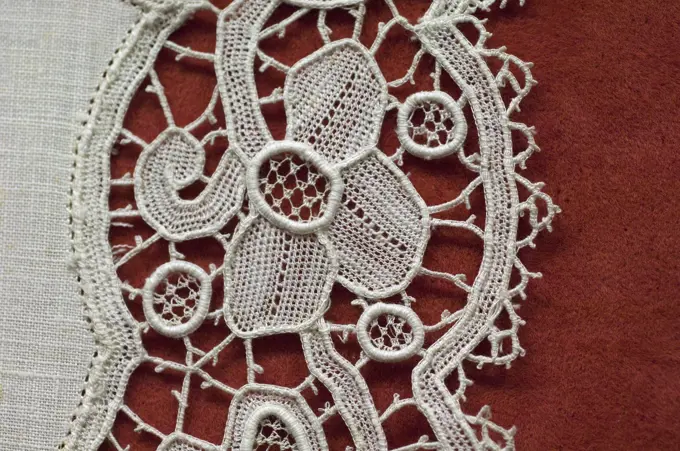
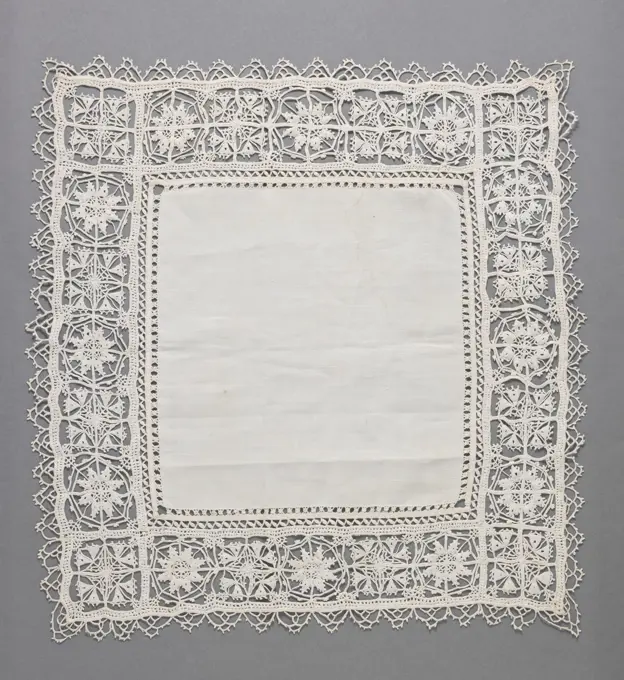
A variety of lace strips from different periods showcasing floral patterns and intricate designs, crafted in linen with delicate details and historical significance.

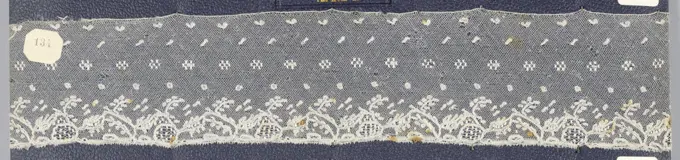
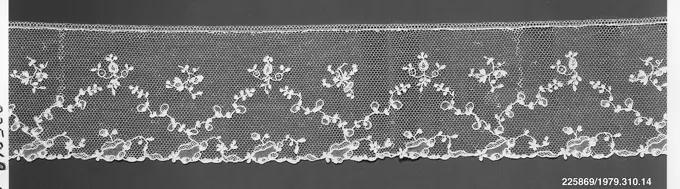
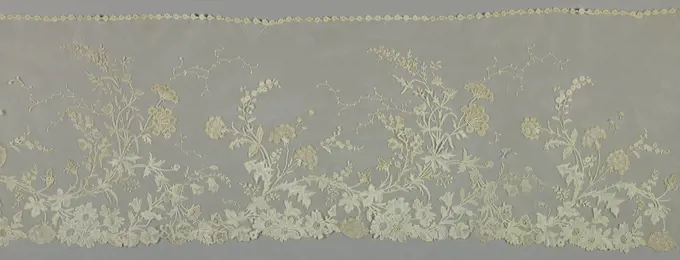
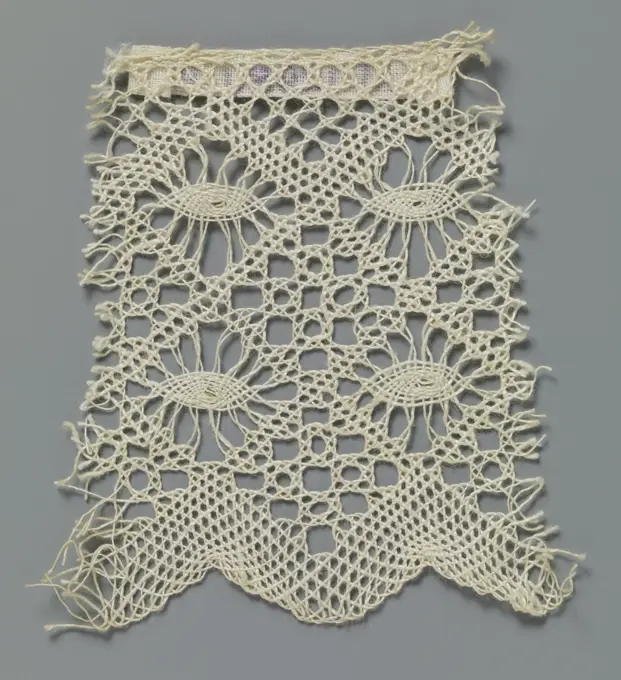
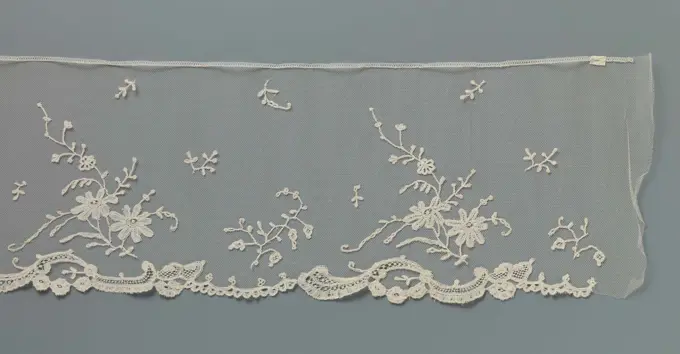
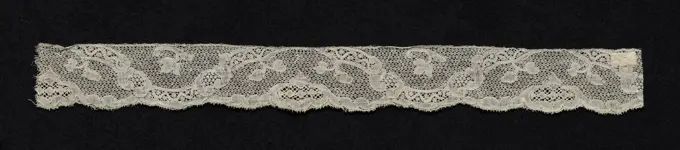
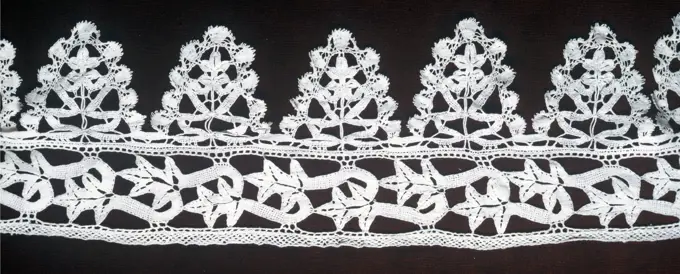
Strip bobbin with two rows of bows and a row of hanging flowers, c. 1800 - c. 1899 Strip of natural -colored bobbin, Parisian side. The upper half of the pattern consists of two rows of bows. The lower half of the pattern consists of a row of split twigs, which always bends one leaf up and one flower down. Along the bottom runs a border that consists of a succession of lying stalks with one flower and one leaf. The motifs are connected by a Maas soil, a Parisian soil. The motifs are made in linen battle with thicker and shiny contour threads. The same coarser decorative land has been used in every open -lived heart. The top and bottom of the strip are straight finished, with the bottom with picots. Flanders linen (material) bobbin lace / Paris lace Strip of natural -colored bobbin, Parisian side. The upper half of the pattern consists of two rows of bows. The lower half of the pattern consists of a row of split twigs, which always bends one leaf up and one flower down. Along the bottom
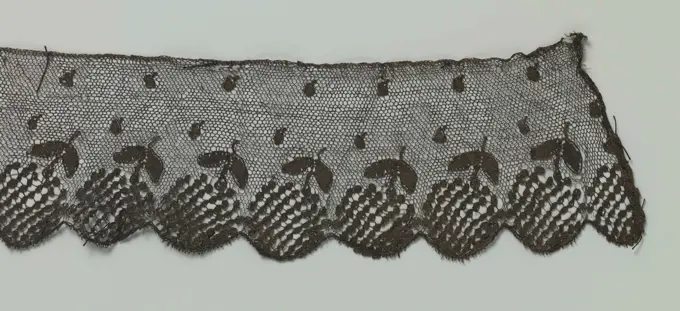
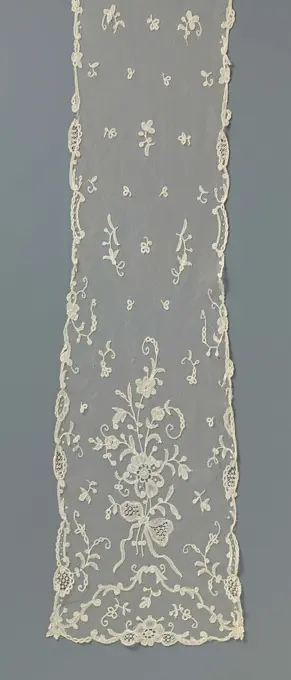
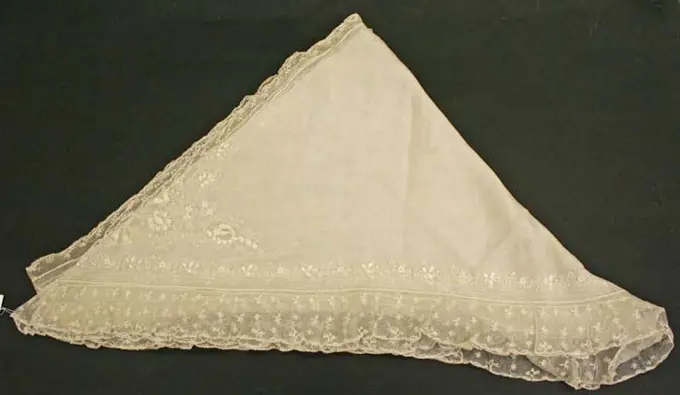
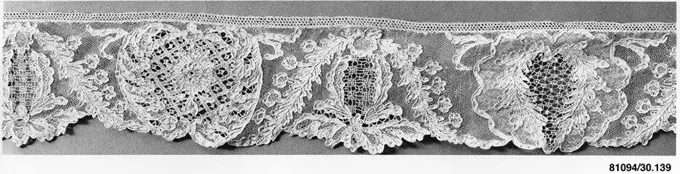
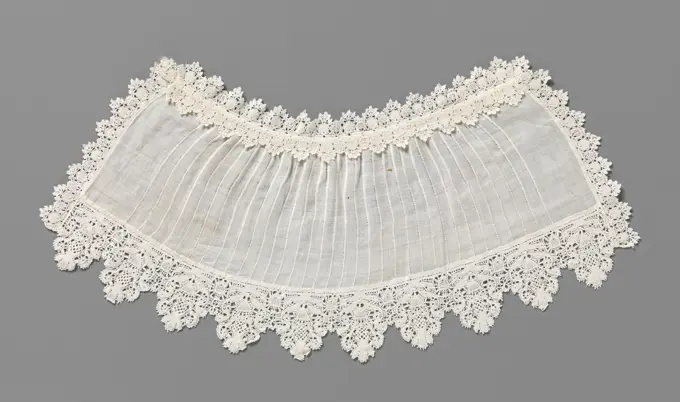
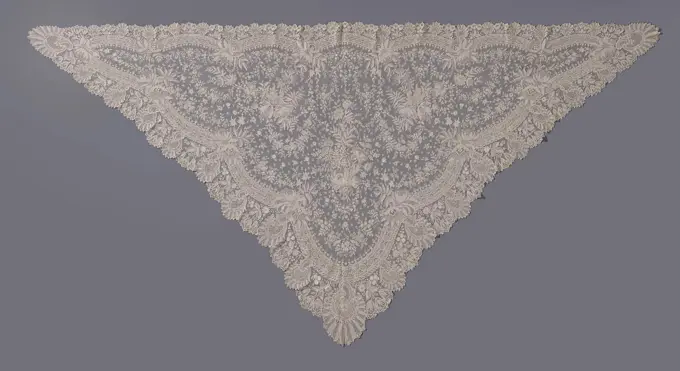
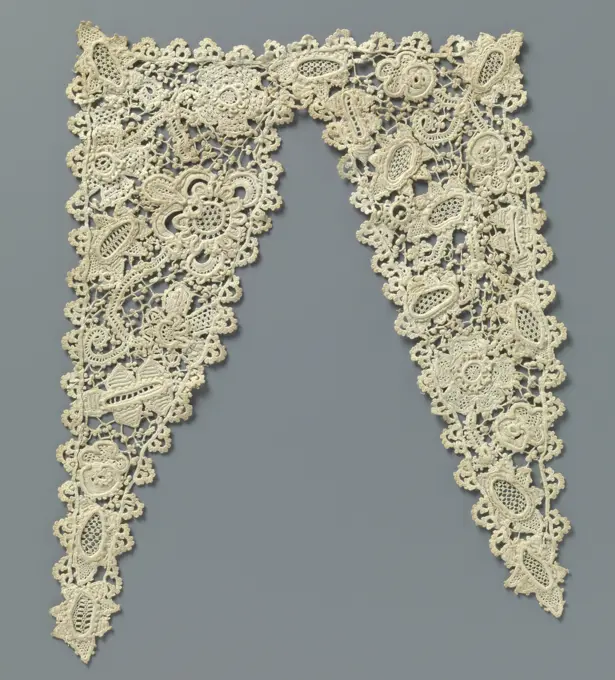
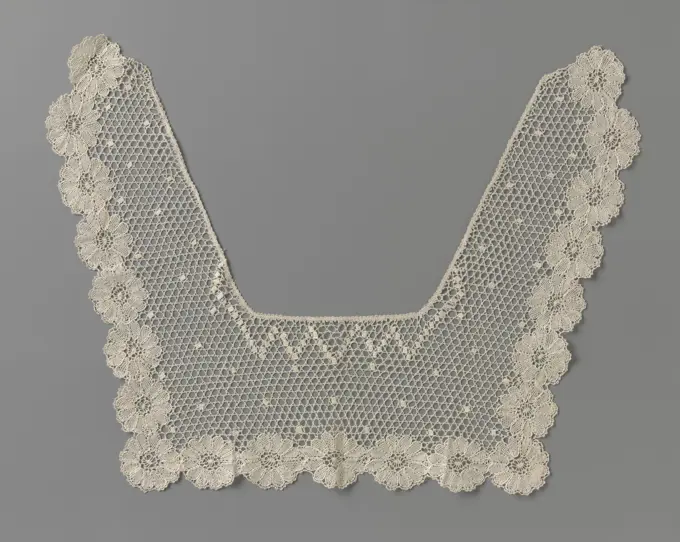
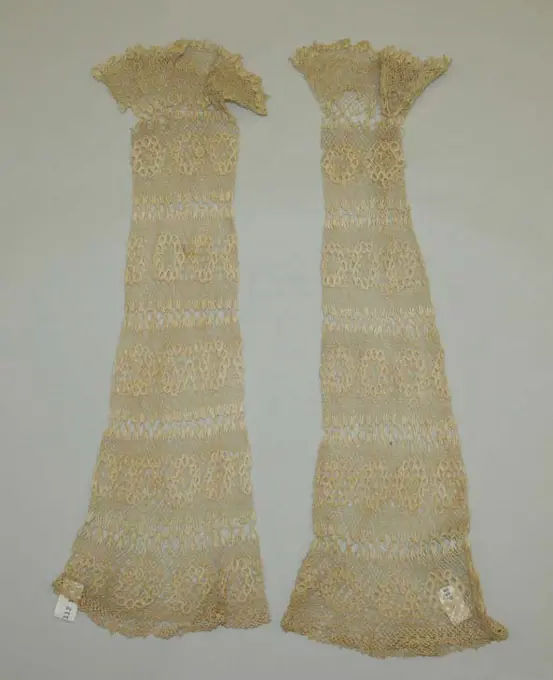
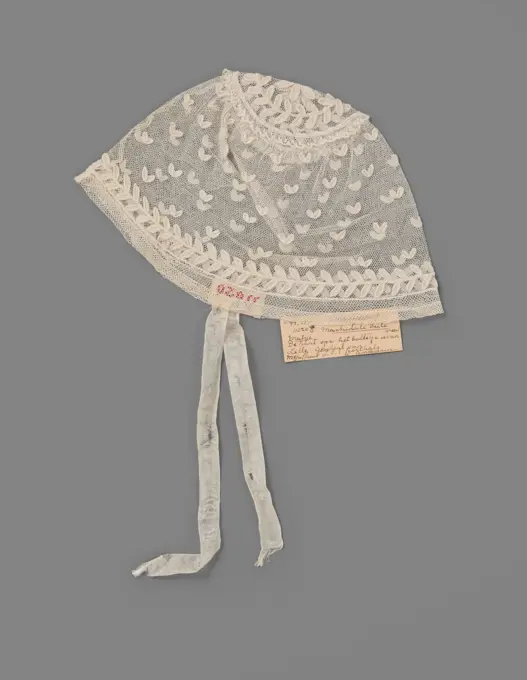
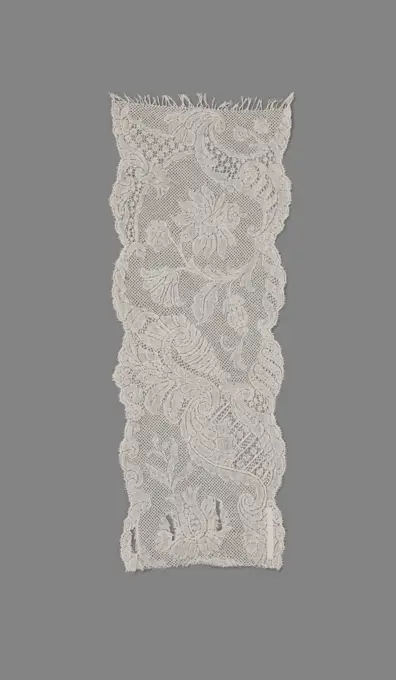
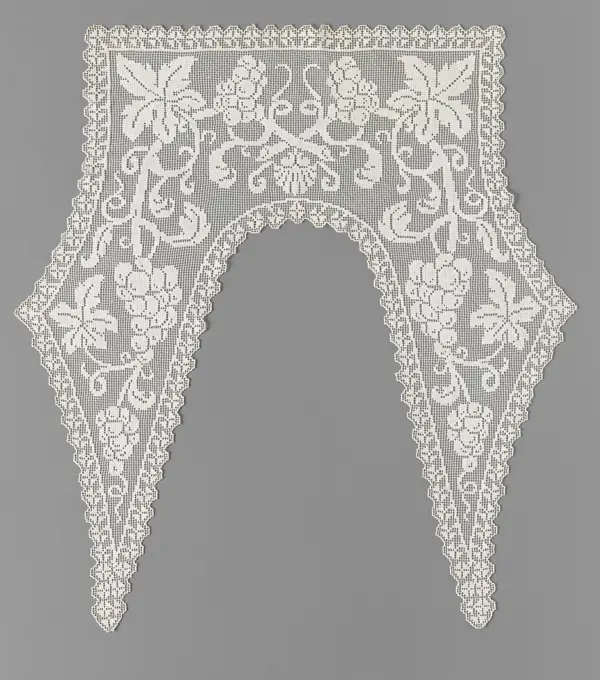
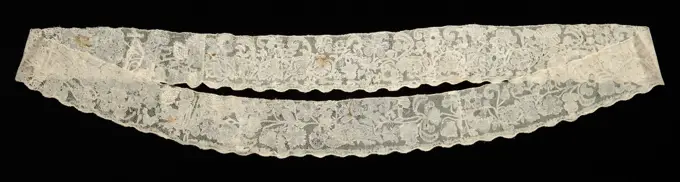
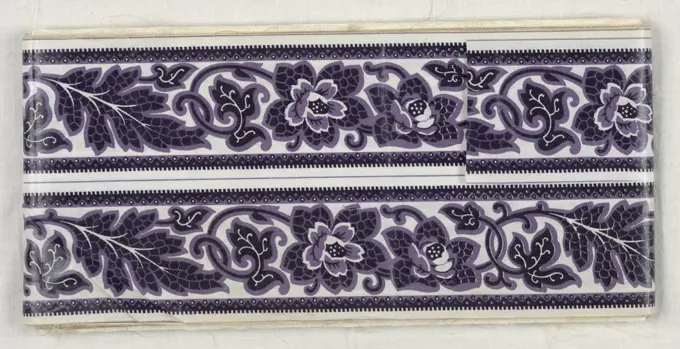
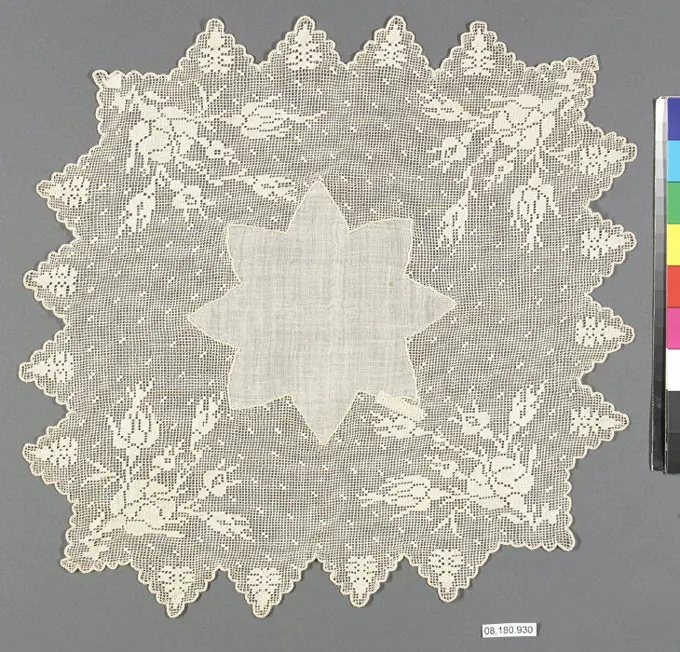
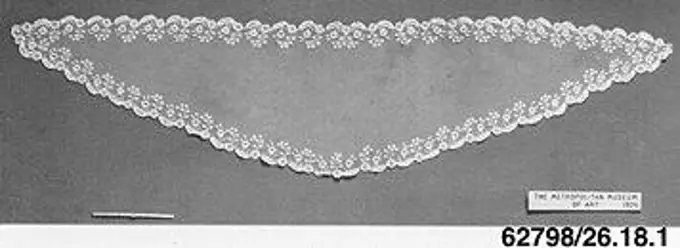
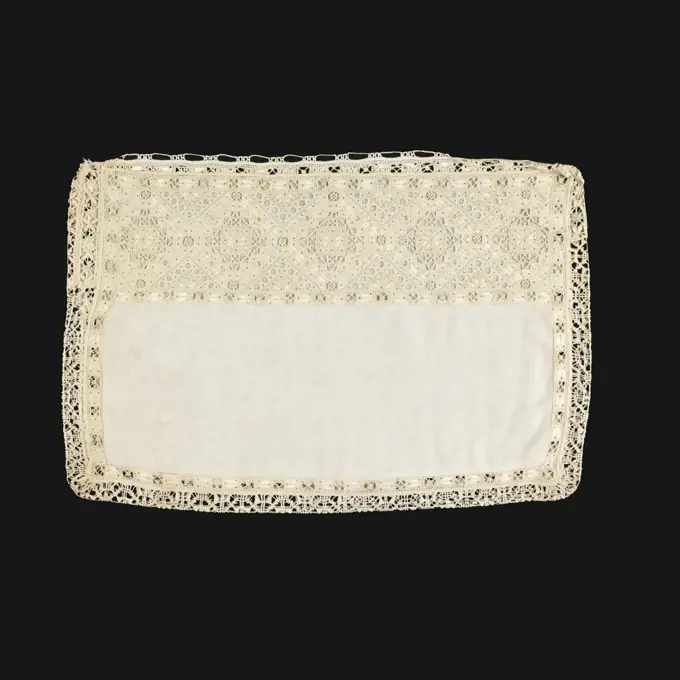
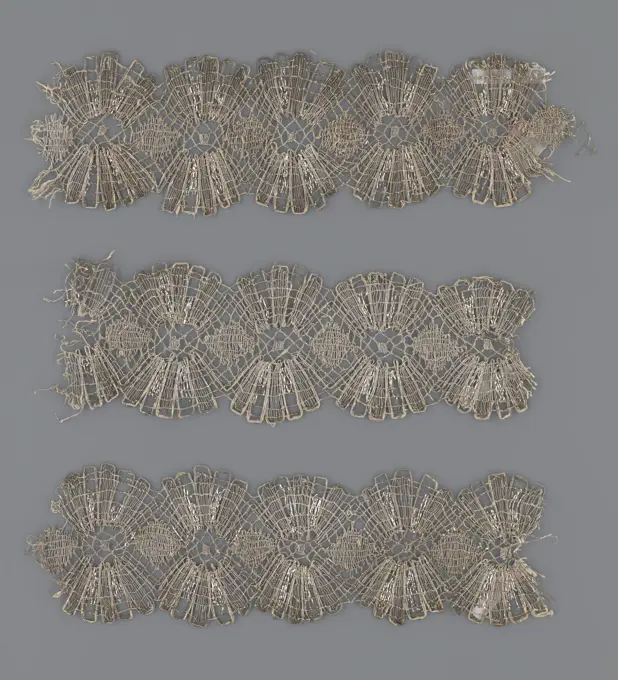
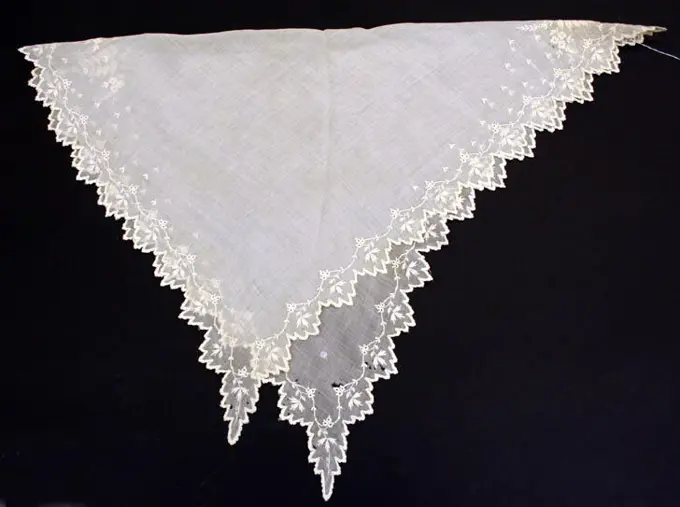
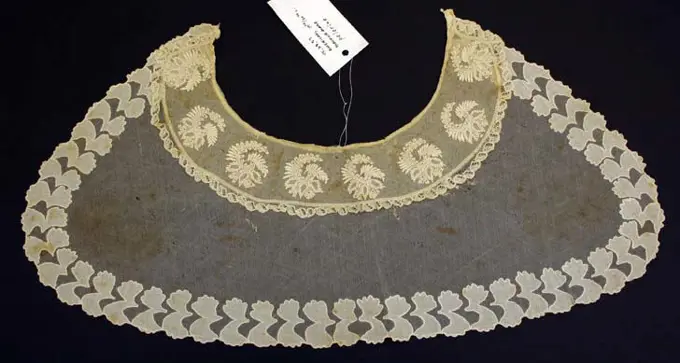
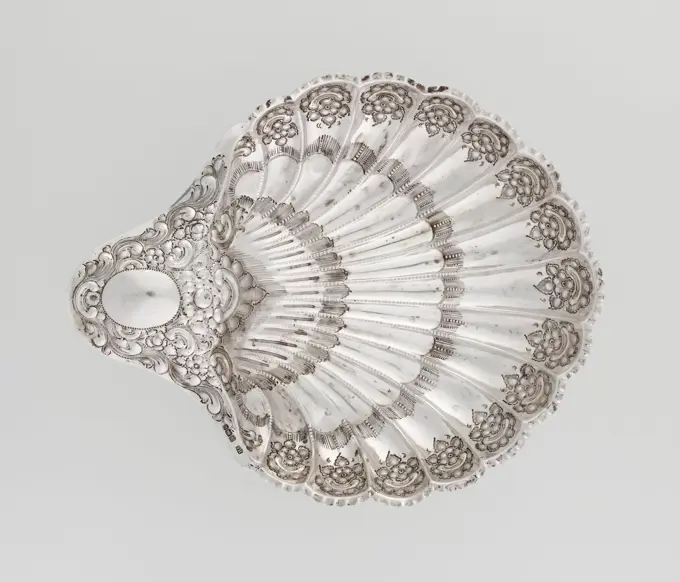
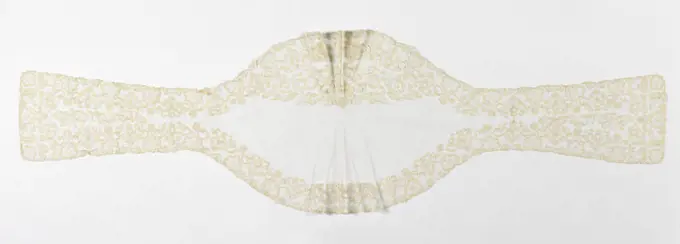
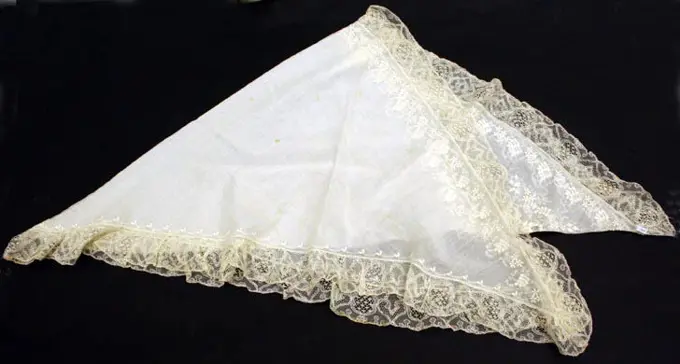
Fichu van Linnenbatist, three -handed, tagged with cotton spreading bookets and trimmed along two sides with a partially wrinkled strip of Mechelse side, anonymous, c. 1775 - c. 1800  Fichu van Linnenbatist, three -handed, tagged with cotton sprayed bookets and trimmed along two sides with a wrinkled strip of Mechels Kloskant. Decoration: Spread motif of fantasy flower and bouquets, some of which are hearts with a needle side. Half of the strip of bobbins are wrinkled (on the back) and where the foris in the front depends unpinct. Part of Zaans costume. Zaanstreekmechelen whole: Linen (Material). Decoration: Cotton (textile). Side: Silk Mechlin (lace)Border 17th century Italian. Border. Italian. 17th century. Macrame. Textiles-LacesEdging 17th century Italian, Genoa. Edging 221022Handkerchief 1840-80 French or Swiss. Handkerchief 236972Strook kloskant met hangende ronde trosbloemen.Strip of black climbing side, blonde. The repeating pattern consists along the underside of the strip from connected round bunch of bunch, which hang down with two leaves on a crook of two leaves and shaping semicircular tub. Above the flowers there is a spreading pattern of two rows of round motifs. The flowers are made with an ornamental land of shouted rows connected round motifs, connected by crossing couples. The leaves and (connected) round motifs are made in linen stroke and equipped with thicker contour wires. The motifs are connected by a fine Maas soil, a tulet. The top of the strip is straight finished. The tube edge on the underside is finished with picots.Border early 18th century Italian, Burano. Border 221799Strook zwarte machinale kant met libellen.Strip black machine side: machining chantilly-side. The repeating pattern consists of two, almost straight placed, flying dragonflies. The wings of the upper dragonfly are more upright and those of the lower dragonfly sideways. A thin, split rosary with a few flowers and leaves exprceeds at the bottom of the strip of a wavy line, which consists of a concatenation of rose branches. Under each wave top hangs a curved short decorative tire with a square grid. The motifs are equipped with contour wires and are interconnected by a machining tulet, which is strewn with mashes. As ornamental ground, machine rose soil has been applied in the curved decorative tire and in the flower hearts. The curved decorative tire forms the slip edge under the tops of the through wavy rosary branches, which is finished with picots. The top of the strip is straight cut and not finished.Strip of gold side with fans and circles around a V-shape, anonymous, c. 1920  Strip bobbin, gold side. The symmetrical pattern consists of a V-shape with fans and circles, largely connected by leaves made in shape and along the upper edge with a lace-hole strel-grid. We worked with gold lamal wire, smooth filé yarn and ribbed filé yarn, in different thicknesses. The side is made to use for furniture. Lyon . bobbin laceBertha ca. 1890 Philippine The production of pineapple cloth is specific to the Philippines and West Indies. Woven by hand from the leaf fiber of the pineapple plant, and embellished with intircate embroidery, this highly valued fabric was fashioned into clothing and accessories that were a part of the traditional Filipino hertitage for centuries. Exportation to Europe and America started early, but became widespread during the 19th century, when it was promoted by Christian missionaries. The exported items, fashioned for both men and women, were highly prized for their beauty and novelty.. Bertha 156779Lace, 1800s , Ireland, maker unknown.Border, Technique: bobbin lace, Bobbin lace border, floral borders; late 18th century Point de Lille, late 18th century, lace, BorderMutsenslip van applicatiekant met gestrikt toefje.Barbe of application edge, dick edge and some details in needle side applicated on machine tulle. Sprinkle with small and larger leaf branches is in a row of a rectangular fond, the ends of which exhausted slightly wider. In the straight tips there is a dash of flour branches above a 'hill' of C-Volutes, together by a cut-away bow. There are some medallions with grid work filling in the bland scaled edge.Fichu ca. 1785 French. Fichu 119020Border early 18th century French. Border 222508Tassel; linenCap streamer, Medium: linen Technique: needle lace with bobbin-lace ground, Point d'Alencon, with Brussels ground, seme with sprigged ovals, and worked with a festoon border, with fern and dot motifs; an irregular edge., France, late 18th century, lace, Cap streamerEdging late 18th century French The Metropolitan Museum's great lace collection was started when the Museum became the first among American museums to organize a permanent collection of lace with the acceptance of the McCallum Collection in 1879 and the bequests of Mrs. John Jacob Astor, Mrs. Robert L. Stuart, Mrs. Augustus Cleveland, and Mrs. A. W. Winters shortly thereafter. In 1893 a loan collection of antique laces shown at the World's Columbian Exposition in Chicago was assembled by a committee of New York women headed by Catharine Augusta Newbold. About 1900 Miss Newbold arranged and labeled an exhibition of laces and linenworks lent to the Metropolitan Museum by Mrs. James Boorman Johnstone and the Misses Johnstone. "Her scholarly knowledge of lace technique enabled the Museum for the first time to offer a comprehensive display of lace illustrating its historical development," wrote Miss Frances Morris, then curator of the textile department. Miss Newbold's name occurs again in Lace laceFragment, Medium: linen Technique: punto in aria needle lace, Band fragment with symmetrical flowers and scrolling leaves., Italy, 17th century, lace, FragmentFichu van Linnenbatist, triangular, embroidered with a floral and geometric edge in whitework, c. 1800 - c. 1830 Fichu van Linnenbatist, triangular, embroidered with a floral and geometric edge in whitework. Model: triangular. Equipped with a narrow hem all around. Decoration: A border motif with alternating flower and leaf motif in an irregularly shaped circle and a rectangular checkerboard from which a bouquet rises at the top. Spread motif of leaves. Netherlands (possibly) whole: Linen (Material). Embroidery: Cotton (textile) embroidering Fichu van Linnenbatist, triangular, embroidered with a floral and geometric edge in whitework. Model: triangular. Equipped with a narrow hem all around. Decoration: A border motif with alternating flower and leaf motif in an irregularly shaped circle and a rectangular checkerboard from which a bouquet rises at the top. Spread motif of leaves. Netherlands (possibly) whole: Linen (Material). Embroidery: Cotton (textile) embroideringManchet van linnen batist en rondom afgezet met schulpen van kloskant.Cuff from natural colored linen batist, finished around with natural colosside: old trembling side. Model: Rectangular linen, laid with fine pleats in a curved shape. One long side is finished with a wide strip of lace, with a deep slip edge. The other three sides are finished with narrower strips, with finer shelters. Along the long side with the narrower strip side, a mirrored narrow strip side is also sewn, which falls over the linen. The wide strip has a pattern with ten symmetrical slips in which a flowerpot inside voluntaries, with heart motifs in between. Around 1630 the flowerpot motif came a lot in the Flemish Clasps and was originally from Bartolomeo Danieli pattern books. The side is 'composed': the small motifs were broken piece and then sewn together. This technique came up at the end of the 16th century and is only associated with Brussels side. The Flemish lace clasps had a very fine linen thread at thCap Streamers; linenEnd;  19th century (1801-00-00-1900-00-00);Fontaneldoek of white linen with lace; marked in Red Cross stitch: HS12, Anonymous, c. 1750 - c. 1900 12 linen fontanelletjes with different side deposited, 4 marked LH8, 3 gem. H8, 5 Gem. HVS (Gr. Hoogenhuize "1772-1852" tr. 1802 S.E. von Schmid "1771-1843"). 1 of Damast gem. HH6 (W.R. Hoogenhuize "1747-1804" TR 1787 W. Helmerich "1752"). Europe linen (material). 12 linen fontanelletjes with different side deposited, 4 marked LH8, 3 gem. H8, 5 Gem. HVS (Gr. Hoogenhuize "1772-1852" tr. 1802 S.E. von Schmid "1771-1843"). 1 of Damast gem. HH6 (W.R. Hoogenhuize "1747-1804" TR 1787 W. Helmerich "1752"). Europe linen (material).Strip bobbin with zigzag track, anonymous, c. 1900 - c. 1924 Strip of natural -colored bobbin: Parisian side. On a closed pin stroke ground is a double symmetrical zigzag track of slanted s-s-sen. There are loose cloud tires between the lanes. The underside of the strip is formed by hooking up accolade motifs with more or less fan-shaped motifs underneath. Most motifs are made in linen battle. The circles in the upper zigzag track and motifs along the underside of the strip are made in netslag. All motifs are surrounded by a thicker and shiny contour thread. A rose soil has been applied as a decorative land. The top of the strip is straight finished. The accolade motifs with fan-shaped motifs underneath form the scrap edge along the underside of the strip, which is finished with picots. Vadstena (possilly) linen (material) bobbin lace / Paris lace Strip of natural -colored bobbin: Parisian side. On a closed pin stroke ground is a double symmetrical zigzag track of slanted s-s-sen. TherThree-old Shawl of needle side with lilies and poppies. Natural mixed side scarf: Brussels side. Triangular model. Along the three sides, a wide, wavy frame, surrounded by an edge of alternately bowl flowers and asymmetrical medallions of C-Volutes; The latter increases in size to the tip of the back. The list consists of five jobs, the middle of which is busy with large wheels. The golf tops are bouquets of a very large lily and a poppy. In the field there are three bouquets, the middle, largest, composed of poppies, screen flowers and spirea, the outer contain a poppy and lilacs. The fond is strewn with fine winds (dick edge), which limits a roots sown with meadows. Numerous petals and leaves are divided into a bright white and a blurred fond. Point the Gaze de Bruxelles.Lace handkerchief early 19th century Mexican. Lace handkerchief 212906Europe, Belgium, Brugge (aka Brug or Bruge). Historic Brugge, UNESCO World Heritige Site. World famous Belgium lace.Shawl;  XIXW. (1860-00-00-1890-00-00);Piece 18th century () European. Piece 225161Border Fragment (Italy); linen; 23 x 15 cm (9 1/16 x 5 7/8 in. )Fragment (France); linenCollar. Culture: Belgian, Brussels. Dimensions: L. 44 x W. 9 1/2 inches111.8 x 24.1 cm. Date: ca. 1850. Museum: Metropolitan Museum of Art, New York, USA.Strip bobbin without painted flowers and leaves in a series of strips that are painted, anonymous, c. 1740 - c. 1760 Strip of natural-colored bobbin, binche side, with a few stitches sewn to a blue and green painted strip with the same pattern. The pattern consists of feathered leaves, bent and curled, with a plume flower and a flower in the shape of a pine cone. The motifs are connected by a decorative land, a snowflake ground. The fullwork is largely made in linen battle with openwork edges. A mains filling has been used between some leaves and in the flowers. The underside of the strip is straight. The top is finished with a separate strap. A border on one short side is strongly brown. Southern Netherlands linen (material) Bobbi Lace / Binche Lace Strip of natural-colored bobbin, binche side, with a few stitches sewn to a blue and green painted strip with the same pattern. The pattern consists of feathered leaves, bent and curled, with a plume flower and a flower in the shape of a pFlounce, Medium: linen Technique: needle and bobbin lace motifs appliquéd to machine made net, Part of a narrow flounce in an Art Nouveau pattern of floral sprays., Belgium, late 19th century, lace, FlounceSection of crocheted side imitation coarse Venetian needle side, anonymous, c. 1890 - c. 1909 Spread piece with two pointed points of natural -colored Irish crocheted side, imitation coarse Venetian needle side. Finished on all sides with a picoted bow edge. Ireland cotton (textile) Spread piece with two pointed points of natural -colored Irish crocheted side, imitation coarse Venetian needle side. Finished on all sides with a picoted bow edge. Ireland cotton (textile)Cover 17th century Italian. Cover 218793Kloskant collar with edge of Margrits, Anonymous, c. 1900 - c. 1924 Collar of natural -colored bobbin: Parisian side. The square back piece goes to the front in two points. A coarse Parisian soil is strewn with mosies made in form and along the outer edge surrounded by a chain of Margrits. The petals are made in netslag. Every flower heart is decorated with a spider. The petals are surrounded by thicker and shiny contour threads. Belgium (possibly) linen (material) bobbin lace / Paris lace Collar of natural -colored bobbin: Parisian side. The square back piece goes to the front in two points. A coarse Parisian soil is strewn with mosies made in form and along the outer edge surrounded by a chain of Margrits. The petals are made in netslag. Every flower heart is decorated with a spider. The petals are surrounded by thicker and shiny contour threads. Belgium (possibly) linen (material) bobbin lace / Paris laceStrip bobbin with rushed in four rows of open worked windows, anonymous, c. 1800 - c. 1899 Strip of natural -colored bobbin, straw side. The repeating pattern consists of a surface distribution of four rows of windows pushed against each other, with a rush -in in each window in the top. In the row under that, the windows are filled with a traly land, a cross -stroke ground with recesses. These two rows repeat themselves below. A tie -grid has been applied above the windscreen pattern. The top of the strip is straight finished. A job runs along the bottom row of windows, with which a sculpt is formed under each window. Buckingham cotton (textile) Bobbi lace / lace cloth Strip of natural -colored bobbin, straw side. The repeating pattern consists of a surface distribution of four rows of windows pushed against each other, with a rush -in in each window in the top. In the row under that, the windows are filled with a traly land, a cross -stroke ground with recesses. These two rows repeat Mitts 1850-1900 American or European. Mitts 119637Children's hat of Machinale Tulle with ornaments in line fabric and a strip of Rijssel side, Anonymous, c. 1800 - c. 1900 Children's hat from Machinale Tulle on which an ornament has been fested in line fabric. A strip of Rijssel side runs around the ball. West-Europa linen (material). Lille lace Children's hat from Machinale Tulle on which an ornament has been fested in line fabric. A strip of Rijssel side runs around the ball. West-Europa linen (material). Lille laceSidewall, Machine printed on paper, Neoclassical pattern of columns of flower bouquets with roses and ears of wheat alternating with vertical ribbons with simple lace-like borders; vertical pattern in ribbon of songbirds alternating in three poses on entwined white wreaths; interiors of ribbons are grey with gold highlighting of birds and ribbon edges; flowers marked in white with some sprigs highlighted in gold; ground is light gray., USA, ca. 1880, Wallcoverings, SidewallSaddle cover, 16th century. The Arts of the Middle Ages and at the Period of the Renaissance by Paul Lacroix, 1874Strook applicatiekant met margrietentakken.Strip natural colored application side, climbing side applicated on machine tulle. On a fond decorated with twigs, along the scalloped side, alternately a large branch with daisies and a small branch with bells flowers. The stretched shelters exhibit broken C-Volutes and with raster work-filled seed beads.Cutslip from Binchekant, Anonymous, c. 1750 - c. 1760 Cutslip from Binchekant. The pattern consists of flowers and various grid fillings. The scalloped edge is trimmed with picots. The slip is cut in half and has three cut buttonholes. Binche linen (material). Binche Lace Cutslip from Binchekant. The pattern consists of flowers and various grid fillings. The scalloped edge is trimmed with picots. The slip is cut in half and has three cut buttonholes. Binche linen (material). Binche LaceCollar of fillet side with grape bunches of vines, anonymous, c. 1915 - c. 1920 Collar of natural -colored lace -ups: fillet side. Model with rectangular back piece and long points for. The pattern is symmetrical and has two short and crossed vines on the back piece with a grape voucher each. Two bunches of grapes hang on a vine in each point. The entire edge consists of small stylized carnations. Netherlands (possibly) cotton (textile) Collar of natural -colored lace -ups: fillet side. Model with rectangular back piece and long points for. The pattern is symmetrical and has two short and crossed vines on the back piece with a grape voucher each. Two bunches of grapes hang on a vine in each point. The entire edge consists of small stylized carnations. Netherlands (possibly) cotton (textile)Fragment; linen; Bequest of Marian Hague; 1971-50-310Fragment 18th century Spanish. Fragment 215127Band (Italy); linen, black glass beadsNeedlepoint (Drawnwork) and Embroidery Lace Flounce for Alb, 18th century. Unassigned, 18th century. Lace, needlepoint and embroidery: linen; average: 17.8 x 193.3 cm (7 x 76 1/8 in.).Borders, Medium: cotton Technique: roller printed on plain weave and glazed, Two borders of abstracted floral pattern partially cut apart at the start. In purple and black on white., England, mid-19th century, printed, dyed & painted textiles, BordersKraag van batist met machinaal borduurwerk en vierkante tussenzetsels van machinale kant.Collar with natural-colored slipping of batist with machined embroidery and machine side. To a narrow straight strip hanging at the angles on the corners two straight slips that end in bell-shaped items. Between two squares of machining on the corners and one in the middle are twice two strips of batist with a cut-away indoor table between which a rectangular approach to side. The slips consist of once Tweer strips of batist with lace incurrence. Each slip end consists of shifting segments, which together forms a clock with clapper.Christmas Greeting, Chromolithograph, silk on embossed paper, Simulated envelope with chromolithograph of flowers in center. Double flap on back opens to reveal a white silk cushion on which is printed: 'Wishing a happy Christmas to You'., United States, ca. 1865, Greeting Card, Greeting CardHandkerchief Cuban 19th centuryFichu ca. 1820 British, Honiton. Fichu. British, Honiton. ca. 1820. Applied. Textiles-LacesFlounce. Italy. Date: 1701-1750. Dimensions: 57 x 327.3 cm (22 1/2 x 128 3/4 in.)Width repeat: 84.7 cm (33 3/8 in.). Linen, bobbin part lace (made in large sections). Origin: Italy. Museum: The Chicago Art Institute, Chicago, USA.Fragment of edging 17th century Italian. Fragment of edging 221096Embroidery fabric handcraft art tablecloths and curtainsSampler 19th century German. Sampler. German. 19th century. Cotton, knitted lace. Textiles-LacesBobbin lace unknownEngageantes (pair). Germany, mid-18th century. Costumes; Accessories. Single sleeve ruffles of white cotton Dresden work on white linenMitts ca. 1889 probably European. Mitts 108550Cuff of linen batist decorated with whitework with needle fillings, anonymous, c. 1850 - c. 1900 Cuff of linen batist with an embroidery insert. The pattern consists of circles within which rosettes of sand stitches and needle edges fillings. The cuff has three knots and three buttonholes. West-Europa linen (material). Cuff of linen batist with an embroidery insert. The pattern consists of circles within which rosettes of sand stitches and needle edges fillings. The cuff has three knots and three buttonholes. West-Europa linen (material).Fragment; linen; 1933-1-92Cotton batist cuff, decorated with English embroidery and a strip of Rijssel side, anonymous, c. 1875 - c. 1900 Cotton batist cuff that is decorated with English embroidery in the form of leaves. The cuff is trimmed with a scallop. A strip of Lillese side is attached to the sculpin. Netherlands whole: Cotton (textile). strip: Lille lace Cotton batist cuff that is decorated with English embroidery in the form of leaves. The cuff is trimmed with a scallop. A strip of Lillese side is attached to the sculpin. Netherlands whole: Cotton (textile). strip: Lille laceCollar fourth quarter 17th century probably British The beautiful fluidity, rhythm and extraordinary detail of this design attest to the early date and fine workmanship of this rare piece. Superimposing flowers over fillings as seen here requires the highest degree of skill, as do the extravagant number of fillings and the intricately decorated brides. It is, moreover, rare to have figures integrated into a design of gros point lace. The free-standing female figure with a front and back is even rarer. It indicates English origins, as figures very much like it are found in embroidered English pictures of the same period.. Collar 156839Fragment of semi silksemi silk fabric, Eastern unknownBobbin Lace Edging, mid 18th century. Belgium, Mechelen, mid 18th century. Lace, bobbin: linen; average: 4.8 x 41.6 cm (1 7/8 x 16 3/8 in.).Batist's doily with wavy edge bobbin, anonymous, c. 1900 - c. 1949 DOILY, a round rug, from batist with a border of bobbin side. The repeating pattern consists of one row of spiders, with braids connected to a simple inner edge and the scrap edge on the outside, which is formed with a narrow wavy track in mains. Netherlands cotton (textile). batiste bobbin lace DOILY, a round rug, from batist with a border of bobbin side. The repeating pattern consists of one row of spiders, with braids connected to a simple inner edge and the scrap edge on the outside, which is formed with a narrow wavy track in mains. Netherlands cotton (textile). batiste bobbin laceLengths of Lace. France and Italy, mid-18th century. Textiles; textile lengths. Linen point d'Alençon or Argentan needle lace, linen Burano laceFragment; linenBobbin Lace (Chantilly) Shawl, mid 19th century. France, Chantilly , mid 19th century. Lace, bobbin: silk; overall: 141 x 280.7 cm (55 1/2 x 110 1/2 in.).Pillow cover, Medium: linen Technique: cutwork and embroidery with bobbin lace, Pillow cover with upper and lower sections ornamented with embroidery and cutwork borders. Upper section with a band in lozenge design. Joined by bobbin in three designs. Pillow covered in purple silk., USA, ca. 1900, lace, Pillow coverFragment, Medium: linen Technique: bobbin lace (discontinuous tape), Fragment showing a large-scale open floral design., Italy, 17th century, lace, FragmentMitaine of white knitted cotton with openly horizontal strip, scrap edge and hole edge for driving slipper, anonymous, c. 1800 - c. 1825 Mitaine made of white knitted cotton with openwork horizontal stripes, scoops and hole edge for a row for baby or child. Netherlands whole: Cotton (textile) knitting Mitaine made of white knitted cotton with openwork horizontal stripes, scoops and hole edge for a row for baby or child. Netherlands whole: Cotton (textile) knittingKloskant collar with applications along the inner edge of an embroidered oval flower and an embroidered leaf, anonymous, c. 1800 - c. 1849 Collar of natural -colored bobbin side - Mechelen side - with a narrow strip of mechanical Valenciennes side along the inner edge. On the seam between the two strips of side, a row of applications is sewn from alternately an embroidered oval flower and an embroidered leaf. Half -round model. The wide strip of Mechelse side has a sculpy edge under a spray pattern of berry branches, with a hanging flower in each shell on a sloping branch. Mechelen linen (material) bobbin lace / Mechlin (lace) Collar of natural -colored bobbin side - Mechelen side - with a narrow strip of mechanical Valenciennes side along the inner edge. On the seam between the two strips of side, a row of applications is sewn from alternately an embroidered oval flower and an embroidered leaf. Half -round model. The wide strip of Mechelse side has a sculpy edge under a spray pattern Headdress 1790-1820 French. Headdress 102430Fragment, Medium: linen Technique: bobbin lace, Fragment of Binche lace with symmetrical floral design. 'Fond de neige' ground., Belgium, 18th century, lace, FragmentFragment, Medium: linen Technique: needle lace, Fragment with a design of a large central flower with flanking buds. Minute superimposed rosettes. Outer petals of large flower in a diamond diaper pattern., Venice, Italy, 17th century, lace, FragmentInsertion from a Table Cloth Made 1601-1625 England. Linen, plain weave; ink drawing; embroidered with silk and linen in chain and running stitches; cut and drawn work embroidered with linen in buttonhole, overcast, and Russian overcast stitches; with needle lace filling stitches .Needle-lane of the Needle Side with Carnation and Rose Branch, Anonymous, c. 1860 - c. 1870 Clocking. Alternately large and small scallops are closed on the top by fine swingers. In the large scallops there is a branch with two carnations and a rose branch. The small bell-shaped shell has an oval in the top and an asymmetrical rocaille medallion in the heart. The petals alternately have a very matte and a thinner foundation. Point the Gaze de Bruxelles. Brussels linen (material) Clocking. Alternately large and small scallops are closed on the top by fine swingers. In the large scallops there is a branch with two carnations and a rose branch. The small bell-shaped shell has an oval in the top and an asymmetrical rocaille medallion in the heart. The petals alternately have a very matte and a thinner foundation. Point the Gaze de Bruxelles. Brussels linen (material)Fragment of the lace;  18th century (1701-00-00-1800-00-00);Border; linen; Bequest of Marian Hague; 1971-50-353Border, Technique: bobbin lace, Bobbin lace edge, floral unit border; early 18th century Maline, early 18th century, lace, BorderBorder Made 1601-1650 Italy. Linen, needle lace worked on a laid and plaited thread grid .Pair of Half SleevesKerchief 18th century American or European. Kerchief 118812Neckpiece 1700-1945 American or European. Neckpiece 119275Stomacher ca. 1720 British. Stomacher 107920Dress of a knotted square network with a border knotted side. Dress of a knotted square network with an edge of natural-colored knotted side: Frivolité. Rectangular model. The edge consists of ten circular rosettes made up of loops and finished with picots around.Godet or collar of mixed side with a rivière from Rococo Velden, Anonymous, c. 1890 - c. 1909 Godet or collar of natural -colored mixed side: bobbin in combination with needle side on a needle -sided soil. This type of lace is also called Point d'Angleterre. A rivière of Rococo fields with fill patterns runs along the scalloped lower edge. Flowers and leaves above and down. Brussels (possibly)  mixed lace Godet or collar of natural -colored mixed side: bobbin in combination with needle side on a needle -sided soil. This type of lace is also called Point d'Angleterre. A rivière of Rococo fields with fill patterns runs along the scalloped lower edge. Flowers and leaves above and down. Brussels (possibly)  mixed laceCollar of climbing side with hanging tulip. Collar of natural colosside: Valenciennes side. U-shaped model, made from a strip side with along the legs of the u a sewn triangular piece of lace with a fine square grille, without further ornament. Description of the strip: on a coarse grille (square grating), which is strewn with 'sequins', is a running pattern. Single-sided pending tulips are separate from a garland from a firm berry apart from a garland.Collar (Made from a Border) Made 1675-1700 Venice. Linen, raised needle lace .Patera in the shell shape; Atkin Brothers (Silversmith) Ltd (Sheffield; company Z Otnicz and Platernicza; 1826-1958); 1893/94 (1893-00-00-1894-00-00);Collar 1860s American. Collar 119252Mitaine of white knitted cotton, anonymous, c. 1730 - c. 1765 Mitaine of white knitted cotton. Elbow, with one seam. Triangular ridge with triangular scallops. Increased pattern of a grid work of triple ridges. Cross with a standing and a hanging flower. Netherlands whole: Cotton (textile) knitting Mitaine of white knitted cotton. Elbow, with one seam. Triangular ridge with triangular scallops. Increased pattern of a grid work of triple ridges. Cross with a standing and a hanging flower. Netherlands whole: Cotton (textile) knittingCollar 19th century British. Collar 102591Mantilla, Medium: silk Technique: bobbin lace, white silk, Shaped mantilla of Spanish blonde lace with a stylized floral pattern along the edges., Spain, 19th century, lace, MantillaFontaneldoek van Linen with Mechels Kloskant; marked in Red Cross stitch: FR4, Anonymous, c. 1740 - c. 1760 Brain pan - fontan cloth () - of linen with lace strips. Europe linen (material). bobbin lace / Mechlin (lace) Brain pan - fontan cloth () - of linen with lace strips. Europe linen (material). bobbin lace / Mechlin (lace)Fichu ca. 1770 British. Fichu 119050