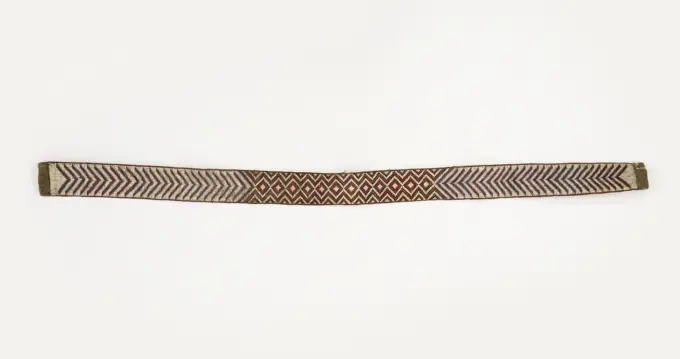
Vintage Textile Fragments

A variety of textile artifacts including lace trims and embroidered samplers from various historical eras and cultures.

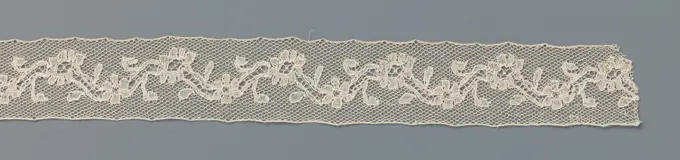
Strip bobbin with wavy feathered leaves and plume flowers, anonymous, c. 1740 - c. 1760 Strip of natural-colored bobbin: binche side. The repeating and continuous pattern consists of wavy feathered leaves, with a plume -shaped flour under each wave top with an elongated pointed pointed center and between the wave tops a thick feather -shaped flour. The motifs are connected by a decorative land, a snowflake ground. The motifs are made in linen battle and mains with openwork edges. One type of decorative land has been used around the wavy leaves. Top and bottom of the strip are straight finished, with the bottom with picots. Southern Netherlands linen (material) Bobbi Lace / Binche Lace Strip of natural-colored bobbin: binche side. The repeating and continuous pattern consists of wavy feathered leaves, with a plume -shaped flour under each wave top with an elongated pointed pointed center and between the wave tops a thick feather -shaped flour. The motifs are connected by a decorative la
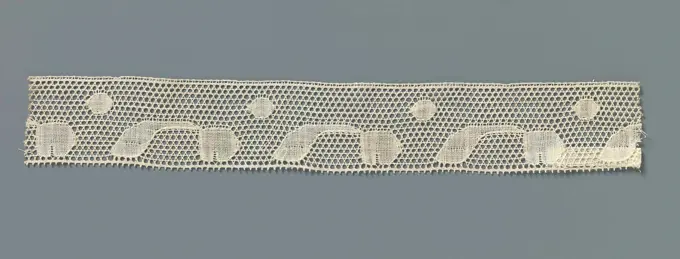
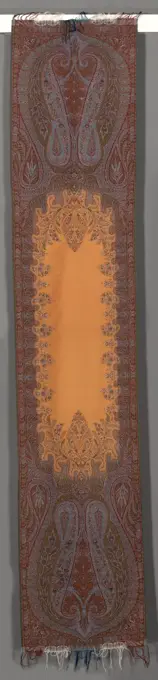
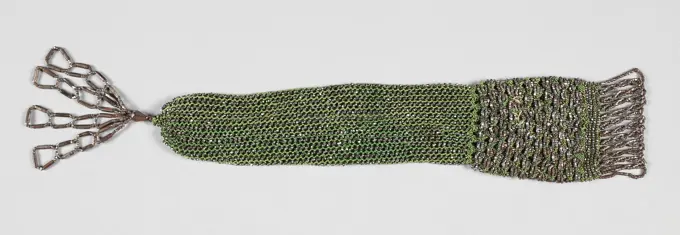
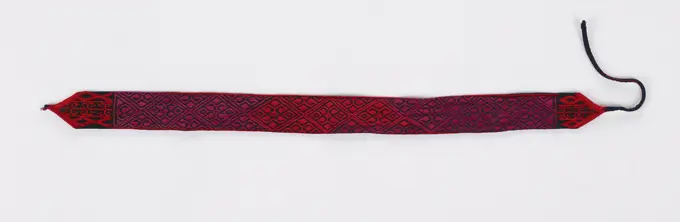
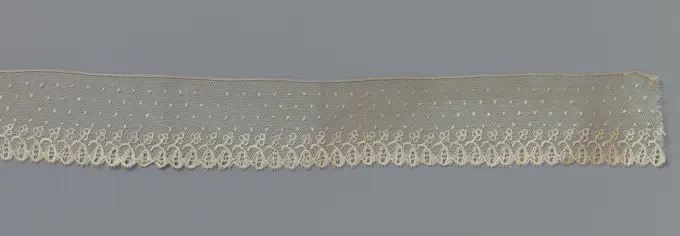
Galloon 17th-18th century French. Galloon 213906Hebrew ritual lace (one of four) early 18th century Italian, Burano. Hebrew ritual lace (one of four) 226255Needlepoint Lace Lappet, 18th century. France, Alençon, 18th century. Lace, needlepoint: linen; average: 57.2 x 9 cm (22 1/2 x 3 9/16 in.).Galloon 18th century French. Galloon. French. 18th century. Silk and cotton. Textiles-TrimmingsKloskant intermediate mate with zigzag line, anonymous, c. 1875 - c. 1949 Piles of Natural -colored bobbin side: Mechelse side. In the middle of the fine grid, a Mechelen soil (also known as ice soil), an openwork band runs in Zigzaglijn, cut over by two types of rosettes. Belgium linen (material) bobbin lace / Mechlin (lace) Piles of Natural -colored bobbin side: Mechelse side. In the middle of the fine grid, a Mechelen soil (also known as ice soil), an openwork band runs in Zigzaglijn, cut over by two types of rosettes. Belgium linen (material) bobbin lace / Mechlin (lace)Strip bobbin with wavy feathered leaves and plume flowers, anonymous, c. 1740 - c. 1760 Strip of natural-colored bobbin: binche side. The repeating and continuous pattern consists of wavy feathered leaves, with a plume -shaped flour under each wave top with an elongated pointed pointed center and between the wave tops a thick feather -shaped flour. The motifs are connected by a decorative land, a snowflake ground. The motifs are made in linen battle and mains with openwork edges. One type of decorative land has been used around the wavy leaves. Top and bottom of the strip are straight finished, with the bottom with picots. Southern Netherlands linen (material) Bobbi Lace / Binche Lace Strip of natural-colored bobbin: binche side. The repeating and continuous pattern consists of wavy feathered leaves, with a plume -shaped flour under each wave top with an elongated pointed pointed center and between the wave tops a thick feather -shaped flour. The motifs are connected by a decorative laDasslip van naaldkant met een symmetrisch patroon van vele ranken met kleine bladeren en bloemen.Natural Carriage Dasslip: Flat Venetian side. Apparently trigger but symmetrical pattern with a vertical axis in the middle from which many curling flower and leaf refines move. The motifs are made with feston stitches, where simple patterns have been realized with recesses in different flowers and leaves. The motifs are connected by a picoted bars soil. The top of the strip is finished with a splitting strap. The underside and two short sides are finished with a bow edge.Strip 18th century Flemish, Mechlin. Strip. Flemish, Mechlin. 18th century. Bobbin lace. Textiles-LacesBorder (Italy); linenBandBeltBobbin Lace Edging, 18th century. France, Valenciennes, 18th century. Lace, bobbin: linen; average: 3.9 x 96.6 cm (1 9/16 x 38 1/16 in.).Trimming (France); silkBobbin Lace Edging, 18th century. France, Valenciennes, 18th century (Louis XV period). Lace, bobbin: linen; average: 6.4 x 47 cm (2 1/2 x 18 1/2 in.).Galloon late 18th-early 19th century European. Galloon 224956Strip of needle side with fine spiral ornament, anonymous, c. 1690 - c. 1710 Strip of natural -colored needle side: Point de France. Pattern with a fine spiral ornament on a hexagonal bar with picots. The top is trimmed with a border bobbin. The straight underside is finished with picoted arches, which shows motifs. France linen (material) Strip of natural -colored needle side: Point de France. Pattern with a fine spiral ornament on a hexagonal bar with picots. The top is trimmed with a border bobbin. The straight underside is finished with picoted arches, which shows motifs. France linen (material)Galloon 17th-18th century probably European. Galloon 213868Fragment early 16th century Italian, Venice. Fragment 230591Strip bobbin with V-forming branches on which a ear of ears, anonymous, c. 1805 - c. 1815 Strip of natural -colored bobbin: Lille side. The repeating pattern only covers the lower half of the strip and consists of VE-forming branches placed next to each other, with small oval leaves and one ear of ears. The thin branches spring on a line along the underside of the strip, which always forms one oval between the branches. The motifs are connected by a fine grid, a tuler land. The motifs are made in linen battle, with thicker and shiny contour threads. The corners are filled with a row of cubes made in form. The top and bottom of the strip are straight finished, with the bottom with picots. Lille linen (material) bobbin lace / Lille lace Strip of natural -colored bobbin: Lille side. The repeating pattern only covers the lower half of the strip and consists of VE-forming branches placed next to each other, with small oval leaves and one ear of ears. The thin branches spring on a line alongStrook naaldkant met golvende bladerrank.Strip natural-colored coniferous lace: Alençon side. Repetitive, continuous motif with a wavy leaf right along the bottom edge, on a fine hexagonal maas soil. Under the rank a finer Maas soil. Above the rank a spream dilla with flower branches. At a regular distance, two shorter and two longer branches are increasing from the leaves that deflect in opposite direction. The longest branch has a wide base with an ornamental ground in it. In all leaves of full work with feston stitches without recesses. Big scalloped edge with ragfine picots on the bottom, along an elongated spiral rank. The top is trimmed with a border clamping side.Trimming, Medium: metallic, silver Technique: bobbin lace, metallic, France, 1700-1750, lace, TrimmingBand, Medium: linen Technique: needle lace, Needlepoint lace border of Venetian Point. Curving intertwining vine and foliage flower design., Venice, Italy, 1740-55, lace, BandStrip of bobbin with spirals, c. 1875 - c. 1899 Strip bobbin of natural -colored bobbin, Russian or Eastern European side. On a ground of irregular braids is an asymmetrical pattern of coarse spirals of smooth frame, accompanied by edges of loops and swinging ribbon. Straight (tree)-Ornaments form transverse dividing lines between the spirals. The strip may be intended as an intermediary. Eastern Europe cotton (textile) bobbin lace / Russian lace / East European lace Strip bobbin of natural -colored bobbin, Russian or Eastern European side. On a ground of irregular braids is an asymmetrical pattern of coarse spirals of smooth frame, accompanied by edges of loops and swinging ribbon. Straight (tree)-Ornaments form transverse dividing lines between the spirals. The strip may be intended as an intermediary. Eastern Europe cotton (textile) bobbin lace / Russian lace / East European laceCapslip from the needle side with coral vines and roses, anonymous, c. 1650 - c. 1699 Capslip of natural -colored needle side: Venetian relief side. Model with round end. The pattern consists of random random-arranged coral ranks with small flowers and leaves and here and there relief roses with sewn thick cordons with picots. The motifs are made with feston stitches and scantily applied decorative stitches. The motifs are connected to each other with few bars, the irregular bars of bar is decorated with picots. Along three sides, the hat -slip is finished with a bow edge. Venice linen (material) Venetian raised work Capslip of natural -colored needle side: Venetian relief side. Model with round end. The pattern consists of random random-arranged coral ranks with small flowers and leaves and here and there relief roses with sewn thick cordons with picots. The motifs are made with feston stitches and scantily applied decorative stitches. The motifs are connected to each other with few bBorder Italian, Venice 19th century View more. Border. Italian, Venice. 19th century. Needle lace. Textiles-LacesStrip second quarter 18th century Flemish. Strip 212388Fragment (Italy); linen, cotton; Warp x Weft: 18.7 x 66.1 cm (7 3/8 x 26 in.)Border, Medium: linen Technique: bobbin lace (Mechlin style), Mechlin lace worked with an undulating flower-edged ribbon motif with branching sprays., Belgium, mid-18th century, lace, BorderTrimmingMutsenstrook van kloskant met zigzag-rivière.Strip natural colored Brussels climbing side. A river in zigzag line is crossed by spiral raft, enclosing impeller-shaped medallions. The motifs are connected by a draft ground. A coarse hexagonal soil has been applied in the Rivieres. On the fields that are bounded by the Rivier are twigs, to which flowers in the form of pomegranates, pears or winged insects. The strip is probably used or made for a hat.Galloon late 18th-early 19th century European. Galloon 224985Strip of needle side with hearts, anonymous, c. 1790 - c. 1799 Strip Eco -colored needle side decorated with a regular pattern of heart -shaped mosques on a fine hexagonal mesh ground. The lower edge consists of arches with alternating one loose flower and the same flower connected to a lying flower branch. The row lying flower branches forms the transition from the mushroom pattern to the bottom edge. The top is finished with a straight edge. Alençon side. France linen (material) Alençon Lace Strip Eco -colored needle side decorated with a regular pattern of heart -shaped mosques on a fine hexagonal mesh ground. The lower edge consists of arches with alternating one loose flower and the same flower connected to a lying flower branch. The row lying flower branches forms the transition from the mushroom pattern to the bottom edge. The top is finished with a straight edge. Alençon side. France linen (material) Alençon LaceStrip of bobbin with chalice of rosette, anonymous, c. 1700 - c. 1749 Strip of natural-colored bobbin, binche side. The repeating and continuous pattern consists of a highly curved stem on the top of the strip on which a chalice flower hangs. Below is a slightly curved stem along the underside of strip with a rosette flower upwards, which crowned the chalice flower. The two flower stalks with feathered leaves together form the shape of a comma. The successive commas are connected by a hanging Margriet or Chrysanthemum. The motifs are connected by a decorative land, a snowflake ground. The motifs are made in linen battle with openwork edges. Cover fillings are decorated with snowflakes. Top and bottom of the strip are straight finished, with the bottom with picots. Flanders linen (material) Bobbi Lace / Binche Lace Strip of natural-colored bobbin, binche side. The repeating and continuous pattern consists of a highly curved stem on the top of the strip on which a chalice flower hangs. BRibbon of white rips side with linen slant, decorated with brochure work in the form of diamond -shaped ornaments of blue silk, anonymous, c. 1700 - c. 1800 Ribbon of white rips side with linen slant, decorated with brochure work in the form of diamond -shaped ornaments of blue silk. Possibly Langet or Longcro from a Hindeloper Wentke. West-Europa linen (material). silk Ribbon of white rips side with linen slant, decorated with brochure work in the form of diamond -shaped ornaments of blue silk. Possibly Langet or Longcro from a Hindeloper Wentke. West-Europa linen (material). silkTrimming, Medium: silk Technique: uncut supplementary warp pile (velvet), Design of a conventionalized figure in blue and red on a cream ground., Italy, 19th century, trimmings, TrimmingBand; natural linen; Bequest of Marian Hague; 1971-50-372Pleated fan and case, Linen bobbin lace leaf, sticks of unidentified material, Pleated fan. Leaf of cream-colored Milanese bobbin lace, probably 18th century; it has been cut to make a fan with picot edge added to it.The reverse side of the lace has been used for the obverse of the fan leaf. Bail and sticks of a clear orange-colored material resembling shell., late 19th century, costume & accessories, Pleated fan and caseFragment of bobbin lace unknownFragment 16th-17th century Italian. Fragment 230266Strook machinale kant met stippen en boogjes van een blad met knol.Strip natural-colored mechanical side: Flanders side. The repeating pattern consists of a row of large dots and below it from a row of arcs that are formed by a curved sheet with a more or less heart-shaped tap at the end. The motifs are equipped with a machining paris soil. The top of the strip is straight finished, the underside with picots.Fringe, Medium: silk Technique: woven, Blue fringe with a plain-woven heading and thread skirt., Italy, 16th century, trimmings, FringeFragment of printed tripe with whimsical shapes and stylized deer, in black on reddish -brown fond, Jaap Gidding, c. 1920 - c. 1925 Fragment of printed Trijp in black to reddish -brown fond, consisting of four fragments sewn together. Upholstery or spancing material. The pattern consists of expressive and whimsical shapes between which stylized deer. Netherlandsmanufacturer: Eindhoven Pool layer: mohair. Ground tissue: Cotton (textile) printing Fragment of printed Trijp in black to reddish -brown fond, consisting of four fragments sewn together. Upholstery or spancing material. The pattern consists of expressive and whimsical shapes between which stylized deer. Netherlandsmanufacturer: Eindhoven Pool layer: mohair. Ground tissue: Cotton (textile) printingPiece early 17th century Spanish. Piece 219936Fragment, Medium: silk Technique: supplementary warp forming pile (velvet); then stamped, Fragment of blue-green velvet with stamped pattern of 'S' shapes., 17th century, woven textiles, FragmentNeedlepoint (Venetian Rose Point or variation of) Lace Edging, late 17th or 18th century. France or Italy , late 17th or 18th century. Lace, bobbin; average: 8.3 x 248.6 cm (3 1/4 x 97 7/8 in.).Trimming (France); silkPiece 18th-19th century Japan. Piece 67778Fragment; linen; 1897-8-152Strip of needle side with loose spiral ranks, anonymous, c. 1660 - c. 1690 Strip of natural needle side, venise flat. Pattern with non -continuous spiral vines and palm flowers on a coarse hexagonal Maas soil. Straight finish on two long and on one short side. Venice linen (material) flat Venetian (needle point) Strip of natural needle side, venise flat. Pattern with non -continuous spiral vines and palm flowers on a coarse hexagonal Maas soil. Straight finish on two long and on one short side. Venice linen (material) flat Venetian (needle point)Strip bobbin with elongated wavy acanthus leaf and chalice flower in horn -shaped motif, anonymous, c. 1725 - c. 1749 Strip of natural-colored bobbin, binche side. The repeating and continuous pattern consists of an elongated wavy acanthus leaf, flanked on both sides by a chalice in a horn -shaped motif. Walked between the successive horns is always a small bowl, formed by a one -sided feathered leaf, with a dot in it under a shelter. The motifs are connected by a decorative land, a snowflake ground. The motifs are made in linen battle with openwork edges and partly in netslag. The scalloped underside follows the pattern, the scallops are finished with picots. The top is straight. Brussels linen (material) Bobbi Lace / Binche Lace Strip of natural-colored bobbin, binche side. The repeating and continuous pattern consists of an elongated wavy acanthus leaf, flanked on both sides by a chalice in a horn -shaped motif. Walked between the successive horns is always a small bowl, formed by aAccessory, Medium: linen Technique: needle lace with ground of loop & twist with loop & twist return, Belgium, 1850-1900, lace, AccessoryFragment of silk fabric unknownEngageante mid-18th century Flemish, Brussels. Engageante 227626Bobbin Lace (Bride Ground) Edging, 16th-17th century. Italy, Milan, 16th-17th century. Lace, bobbin; average: 6.4 x 123.2 cm (2 1/2 x 48 1/2 in.).Piece 16th century Japan. Piece 71030wooden sign board isolated on white backgroundBorder (Italy); linenFragments; silkApplique; bronze (gilt)Strook naaldkant met bloemen en bladeren aan voluutranken.Strip natural colored Venetian needle side "Gros Point". Pattern with flowers and leaves to voluntaries. The motifs are made with feston stitches with fine cutouts in mainly the flowers and leaves. The motifs are equipped with relief contours. In the flower hearts and around the outside of some larger leaves, cordons decorated with picots are used for extra relief. The motifs are connected by a picoted bars soil. The top of the strip is straight finished with a splitting strap. The underside is finished with a bow edge.Cap streamers, Medium: linen Technique: bobbin lace made in Lille style with heavy outlining thread, 18th century, lace, Cap streamersFragment, Medium: cotton Technique: painted on plain weave with dye, gold powder on gum or wax base, Strip of very sheer, loosely woven undyed plain weave cotton with small-scale design of hatched stripe in gold leaf alternating with stripe with central black line with pairs of small leaves drawn in black and painted pale lavender springing on either side of gold dots close-set on the central line., Rajasthan, India, 17th-18th century, printed, dyed & painted textiles, FragmentBand (Italy); silk, metal-wrapped silk, coiled metal strips on linenStrip bobbin with horn with abundance closed by an acanthus leaf, anonymous, c. 1740 - c. 1749 Strip of natural-colored bobbin: binche side. The repeating pattern consists of a horn of abundance, which is closed by an acanthus leaf. Apparently from the edge of the horn a pest glaard from the edge of the horn, which hangs a three -lobby flower from the edge of the horn. These flowers, possibly carnations, form scallops along the underside of the strip. The scrap edge along the underside of the strip is formed between the 'flower abuse' by a leaf that lies under the horn of abundance. The motifs are made in linen battle with openwork edges and recesses. The motifs are connected by a grid, a five -part ground. A few different decorative lands have been applied, including a snowflake land in the horn of abundance and in the field above the hanging flower. The top of the strip is straight finished. The scrap edge is finished with picots. France (possibly) linen (material) bobbin lace / BincBand, Medium: linen, black beads Technique: bobbin lace, discontinuous tape, Image of sirens in a floral band., Italy or Spain, late 16th century, lace, BandSidewall, Leather, stamped, silvered, painted, Diapered field, varnished silver. Rococo vine, in green, with flowers in red and blue., Holland, ca. 1750, Wallcoverings, SidewallRibbon (Spain); silk and silver foil; 1909-12-15Needlepoint and Bobbin Lace Scarf, 19th century. Belgium, Brussels , 19th century. Lace, point and bobbin: linen; average: 242.6 x 63.5 cm (95 1/2 x 25 in.).Barbe 1700-1750 French. Barbe 222557Conciliate belt;  II PO. 18th century (1751-00-00-1800-00-00);Shawl or head cover, 20th century, 61 5/16 x 14 1/2 in. (155.73 x 36.83 cm) (irregular, without fringe), Cotton, nuts or seeds; needlework, Myanmar (Burma), 20th centuryInsertion 16th century Italian, Genoa. Insertion 220886Long Stole with Botehs and Orange Center, 1850-1855. Austria, England, France, or Scotland, 19th century. Supplementary weft pattern, wool; overall: 308.6 x 57.1 cm (121 1/2 x 22 1/2 in.).Fragment. Spain. Date: 1501-1600. Dimensions: . Silk, satin damask weave. Origin: Spain. Museum: The Chicago Art Institute, Chicago, USA.Lace fragment. unknown, authorCarpet Fragment (USA); wool, bast fiberBorder, Medium: Technique: needle lace, Needle lace edge joined, floral pattern; early 18th century Alencon, early 18th century, lace, BorderTrimming (France); silk, metallic threadMutsenslip van naaldkant met hangende bloemen.Hatslip of natural needle side: Alençon side. Elongated slopes of a wavy ribbon, interspersed by medallions with grid work, form the outer edges of a ground, on which there are an evenings a wavy branch with hanging flowers and pomegranates and a short flower branch. In the strip, the pattern is symmetrical with respect to a standing center branch.Bourse. 1850. GAL1994.222.XBreast cover, 28 1/2 x 3 7/8 in. (72.39 x 9.84 cm) (without beads), Cotton, beads; needlework, Myanmar (Burma)Belt, from a set of three, 19 15/16 x 1 3/8 in. (50.64 x 3.49 cm) (without tie), Cotton, ChinaPassement of linen and yellow side in complex window pattern, anonymous, c. 1700 - c. 1899 Passement of linen and yellow side in a complex diamond pattern, with a pattern in the middle of it that consists of four heart -shaped figures. Europe silk. linen (material) Passement of linen and yellow side in a complex diamond pattern, with a pattern in the middle of it that consists of four heart -shaped figures. Europe silk. linen (material)Striping closen with hanging sepals, anonymous, c. 1820 Strip of natural -colored bobbin: Lille side. Under a spreading pattern of square mouses, the repeating pattern consists of a hanging chalice flower, on a curved stalk with three round leaves. The chalice flowers are placed against each other and form the shells along the underside of the strip. The motifs are connected by a fine grid, a tuler land. The fullwork in the Kelkbloem is made in linen battle, with an openwork center track and equipped with thicker and shiny contour threads. The stalk and the leaves are made with contour threads where a decorative land has been used in the leaves. The Mosjes are made in form. The top of the strip is straight finished. The shells along the bottom are finished with picots. Southern Netherlands linen (material) bobbin lace / Lille lace Strip of natural -colored bobbin: Lille side. Under a spreading pattern of square mouses, the repeating pattern consists of a hanging chalice flower, on a cuBorder, Medium: linen Technique: needle lace, Border edged on one side by a serpentine garland of floral sprays., France, early 19th century, lace, BorderStrip bobbin with continuous wavy slender with berries and butterfly, anonymous, c. 1770 - c. 1780 Strip of natural -colored bobbin: Mechelse side. The repeating pattern consists of a continuous and wavy slender with small leaves on both sides, a single short branch with a berry on it and a few flowers. At the start of each wave top is a butterfly or butterfly -shaped flour, the slender makes a loop twice within one wave. The faintly scalloped underside is formed by a double narrow pendulum, which forms a succession of pointed -shaped cartouches. Under each wave top there is always a larger cartouche in the pattern along the lower edge, with a browse branch and a star -shaped flower. The motifs are connected by a fine Maas soil, the Mechelen soil. The motifs are made in linen battle with thicker and shiny contour threads. Different decorative lands have been applied in the cartouches along the underside, in the loops, berries and flower hearts. The faintly scalloped underside stems froRectangular cardboard box with lid, c. 1850 box Reht canaly box made of cardboard, with lid. On the inside of the lid is stamped: factory/ from/ golden & silver embroidery galoons/ military ormins etc./ a.a.knuyver/ Gedempte Raam no. 11 's Hage. The Hague cardboardPanel, 19th century, 13 1/4 x 90 in. (33.66 x 228.6 cm), Silk, cotton ikat, Uzbekistan, 19th centuryOranjelint ,, 1700 - 1800 ribbon (material) On the left the ribbon is turned around a small stick. V.l.n.r.: Flower motifs with red-white-blue tracks, the first part of the inscription. The coat of arms of Orange worn by two crowned lions, the second part of the inscription followed by flower motifs with red-white-blue tracks. Orange apples in the floral motifs. Inscription: L.: Welemoedt Oranje Stam, to spyt the geens who hate you, Mr Sy you banners, loving prince. R.: From Dutch god tog noooyt abandoned ......... etc Netherlands silk. wood (plant material) sewingDuchesse side with roses and leaves, anonymous, c. 1900 Collar of Duchesse side with roses and leaves. The pattern has a row lying rose branches with two stems and a three -leaf. Belgium knoop: mother of pearl bobbin lace Collar of Duchesse side with roses and leaves. The pattern has a row lying rose branches with two stems and a three -leaf. Belgium knoop: mother of pearl bobbin laceBorder (Fragment) Made 1801-1850 Flanders. Cotton, bobbin straight lace .Priest's Stole Japan. Priest's Stole. Japan. Silk, metallic thread. Edo period (1615-1868). Textiles-CostumesElongated Kasmis scarf with cream -colored mirror on which spreading motif of multicolored botas, framed by ditto edges, anonymous, c. 1825 - c. 1835 Elongated palm shell made of woven wool and silk with a full pattern in red, blue, beige and yellow on a white stock. In the middle an infinite report of slanting small botas, which are in the left and right left. They transfer, two by two, rising tenders with volute bonges. In the botarand standing in a running pattern ten botas. In the narrow side and transverse edges a white stock on which a angular, red slender with three blue flowers. France Mirror: Silk. Decoration: Wool twill Elongated palm shell made of woven wool and silk with a full pattern in red, blue, beige and yellow on a white stock. In the middle an infinite report of slanting small botas, which are in the left and right left. They transfer, two by two, rising tenders with volute bonges. In the botarand standing in a running pattern ten botas. In the narrow side and transvSampler (Germany)Strip of batist with lace plunge from a blouse, C.I. Bosch Reitz-Teding van Berkhout, c. 1870 Strip natural -colored batist with lace bobbins: English embroidery. The pattern consists of a row of contiguous and openwork circles with an openwork Margriet in each circle. On the batist is a spread pattern of embroidered leaves. The strip is cut out of a blouse. Amsterdam cotton (textile). batiste Strip natural -colored batist with lace bobbins: English embroidery. The pattern consists of a row of contiguous and openwork circles with an openwork Margriet in each circle. On the batist is a spread pattern of embroidered leaves. The strip is cut out of a blouse. Amsterdam cotton (textile). batisteStrip -Ferret 7th century Frankish. Ferret 465648 Frankish, Ferret, 7th century, Copper alloy, Overall: 3 3/4 x 13/16 x 1/4 in. (9.6 x 2 x 0.7 cm). The Metropolitan Museum of Art, New York. Gift of J. Pierpont Morgan, 1917 (17.193.313)Piece 18th century Japan. Piece 71638Piece 19th century Japan. Piece 70404Pendent (For Bed Curtain) Made 1701-1750 China. Silk, gold-leaf-over-lacquered-paper strips, and gold-leaf-over-lacquered-paper-strip-wrapped silk, warp-float faced 7 1 satin weave with supplementary brocading wefts bound in weft-float faced 1 3 'S' twill interlacings . Manchu