Vintage Textile Fragments

A variety of textile artifacts including lace trims and embroidered samplers from various historical eras and cultures.

Strip bobbin with wavy feathered leaves and plume flowers, anonymous, c. 1740 - c. 1760 Strip of natural-colored bobbin: binche side. The repeating and continuous pattern consists of wavy feathered leaves, with a plume -shaped flour under each wave top with an elongated pointed pointed center and between the wave tops a thick feather -shaped flour. The motifs are connected by a decorative land, a snowflake ground. The motifs are made in linen battle and mains with openwork edges. One type of decorative land has been used around the wavy leaves. Top and bottom of the strip are straight finished, with the bottom with picots. Southern Netherlands linen (material) Bobbi Lace / Binche Lace Strip of natural-colored bobbin: binche side. The repeating and continuous pattern consists of wavy feathered leaves, with a plume -shaped flour under each wave top with an elongated pointed pointed center and between the wave tops a thick feather -shaped flour. The motifs are connected by a decorative la
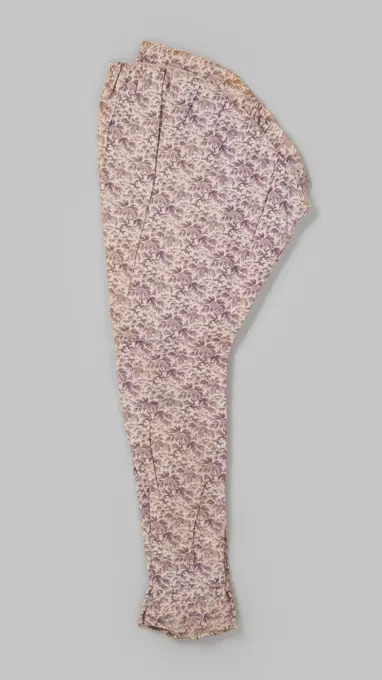
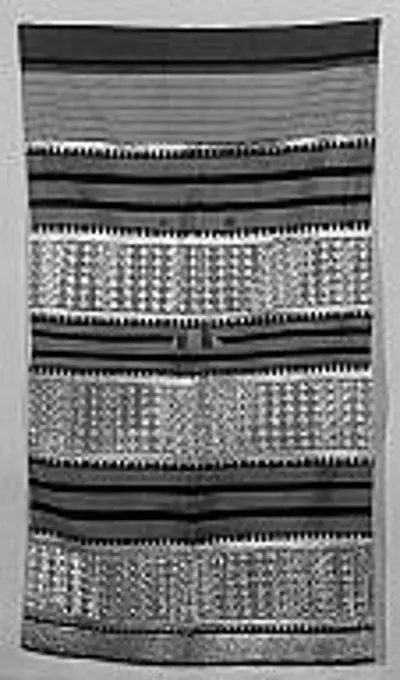
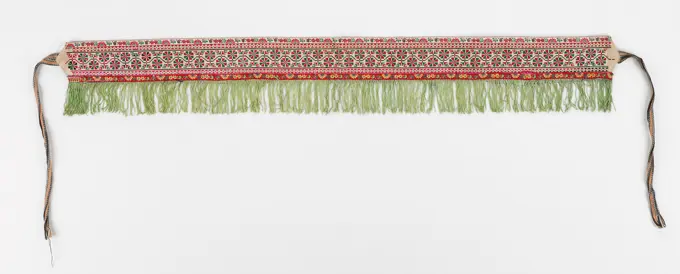
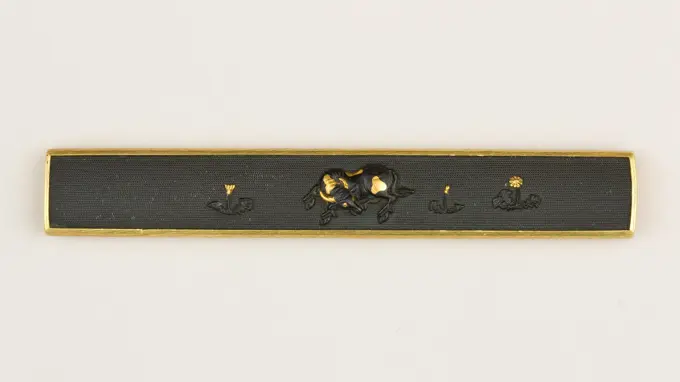
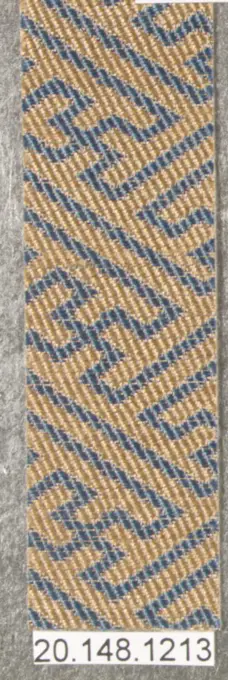
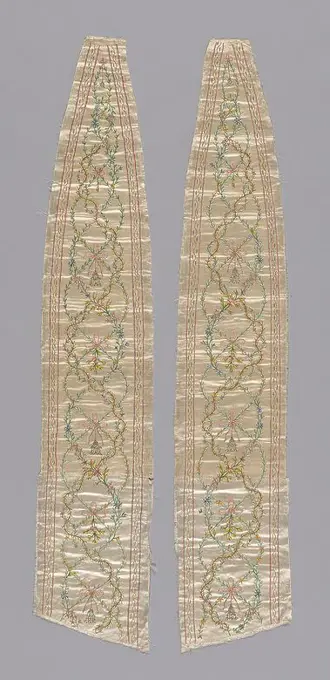
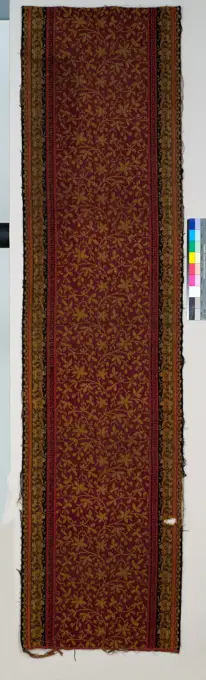
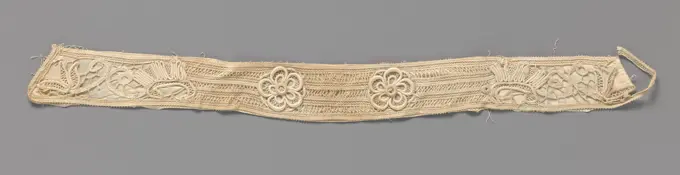
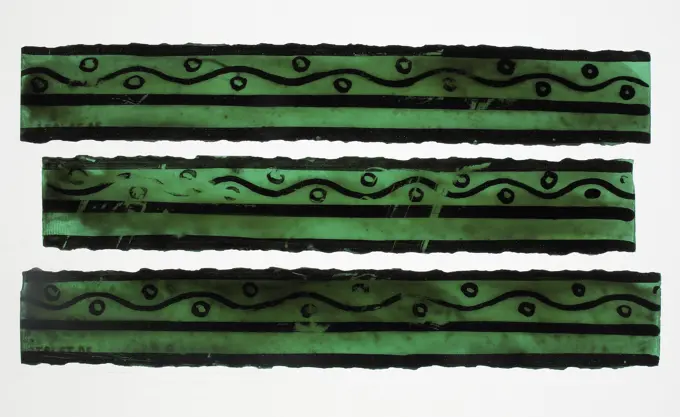
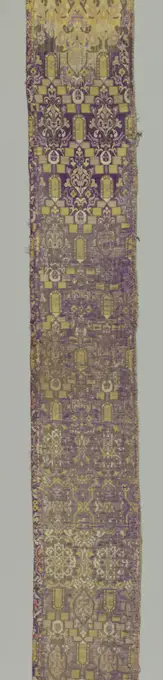
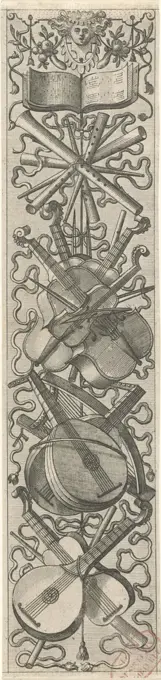
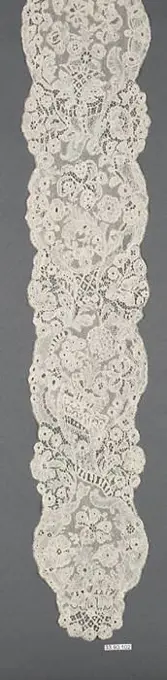
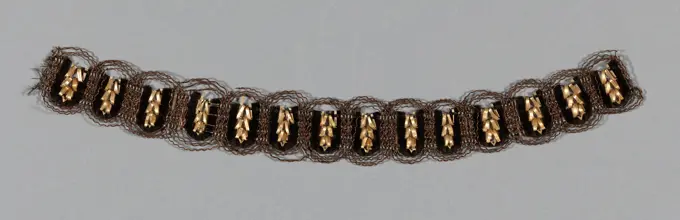
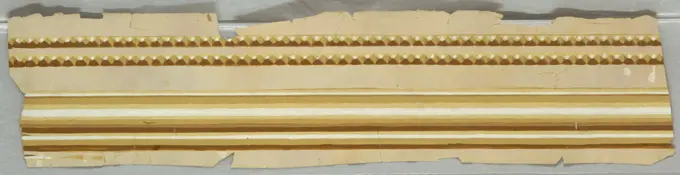
Border, Borders, polished colors. All with beading, some marbleized., France, 1860-1900, Wallcoverings, BorderSample. France. Date: 1825-1850. Dimensions: 9.4 × 11.7 cm (3 3/4 × 4 5/8 in.)Repeat: 1.65 × 4.8 cm (5/8 × 1 7/8 in.). Silk and straw, stripes of plain weave with supplementary facing wefts bound in twill interlacings with stripes self-patterned by warp-faced plain weave of complementary warps and inner wefts. Origin: France. Museum: The Chicago Art Institute, Chicago, USA.Fixed side of mixed side on machine tulle with round ends, anonymous, c. 1880 Fixed side of mixed side on machine tulle with round ends. The edges are sculpted and potentially. The decoration consists of leaf motifs, medallions and moesjes. Brussels . mixed lace Fixed side of mixed side on machine tulle with round ends. The edges are sculpted and potentially. The decoration consists of leaf motifs, medallions and moesjes. Brussels . mixed laceFringe early 19th century Italian. Fringe 225076Sling, Medium: maguey fibers Technique: braided Label: braided maguey fiber, Knotted cords attached to diamond-shaped panel formed of braided cord; loop at end of one cord; end of other cord fringed., Peru, 700-900, knotted, knitted and crocheted textiles, SlingBelt -Fragment of IInen unknownGreen ribbon for a festive decor, isolated on a white background Green ribbon for a festive decor, isolated on a white background Copyright: xZoonar.com/OleksandrxKostiuchenkox 10044606Indian Trade Cloth(Patolu)Sari-length textile Bangladesh, Dacca 19th-early 20th century View more. Sari-length textile. Bangladesh, Dacca. 19th-early 20th century. Muslin with in-weave design. TextilesKnife Handle (Kozuka) late 18th-early 19th century Japanese A kozuka is a handle of a by-knife that is part of a sword mounting. It is kept in a slot on the reverse of a katana scabbard, often with a matching kgai (hairdressing tool).. Knife Handle (Kozuka). Japanese. late 18th-early 19th century. Copper-gold alloy (shakud), gold, copper, silver. Sword Furniture-KozukaSleeve lace (engageante), Medium: linen Technique: needle lace, Shaped band with a design of floral and foliated forms emphasized at intervals by cordonnet. Pattern balanced and almost classic., France, early 18th century, lace, Sleeve lace (engageante)Embroidered Strip of Velvet, 16th century. Spain, 16th century. Embroidery: silk and gold thread on velvet, fringe border; average: 285.8 x 52.7 cm (112 1/2 x 20 3/4 in.).Bracelet of two rows of silver dimes, c. 1940 - c. 1950 Bracelet of two rows of silver dimes. For the hook, the bracelet rejuvenates one dime. In total, the bracelet consists of twenty -one dimes with the portrait of Wilhelmina. Netherlands silver (metal) Bracelet of two rows of silver dimes. For the hook, the bracelet rejuvenates one dime. In total, the bracelet consists of twenty -one dimes with the portrait of Wilhelmina. Netherlands silver (metal)Piece 16th century Japan. Piece 71394Piece 18th century Japan. Piece 72094Border (Fragment) Made 1720-1730 Flanders. Linen, bobbin part lace of a type known as Brussels with a Droschel mesh ground .Trimming (France); silk, metallic threadCap Streamers (France); linenPassement light pink in color and with picots, gustav schnitzler, c. 1920 Passement light pink in color and with picots. NijmegenFrance (possibly) cardboard Passement light pink in color and with picots. NijmegenFrance (possibly) cardboardBlower box of thick paper covered with sit paper, c. 1800 - c. 1943   paper printing   paper printingHead Wrap, 36 5/8 x 4 7/8 in. (93.03 x 12.38 cm) (including fringe), Cotton, rayon, ChinaShoulder cloth; Kamben. Shoulder draft with semen and uncoloured diamond.Fragments; silkTrimming, Medium: silk Technique: uncut supplementary warp pile in a satin foundation (velvet), Trimming fragment in a design of alternating red and yellow diagonal bands in uncut velvet and satin weave., France, 19th century, trimmings, TrimmingFringe early 19th century Italian. Fringe 224865Border, Block-printed and flocked, Maroon flock rope with metallic gold clasps and beading with twine, cut out., possibly France, 1850-75, Wallcoverings, BorderFragment (Braid) Made 1725-1750 Europe. Gold-gilt-silver strips and gilt-metal and gold-gilt-silver-strip-wrapped silk, bobbin straight lace .Trimming (France); silkBorder Fragment (France); linenKnife Handle (Kozuka) 19th century Gotō Mitsuyoshi (Shinjō) Japanese A kozuka is a handle of a by-knife that is part of a sword mounting. It is kept in a slot on the reverse of a katana scabbard, often with a matching kōgai (hairdressing tool).. Knife Handle (Kozuka) 25325Piece 19th century Japan. Piece 72199Printing Block For Embroidery (USA); wood, copper, brass; 1941-87-1-fBlades jewelry with tibbler from Klaverblad, Anonymous, c. 1850 - c. 1950 decorated paper Fragments of blades decorative paper printed with a tibar pattern of clover blades and clover flowers. Four fragments (one very large, three small) printed in brown.  paper  ornament derived from plant forms. plants and herbs: cloverDress Insert. France. Date: 1780. Dimensions: 97.8 × 18.4 cm (38 3/8 × 7 1/4 in.)height repeat: 26.6 cm 10 1/2 in. Silk, warp-float faced satin weave; underlaid with linen, plain weave; embroidered with silk floss and silk ribbons in back, running, satin, stem and surface satin stitches; couching and French knots. Origin: France. Museum: The Chicago Art Institute, Chicago, USA.Cap streamers, Medium: linen Technique: bobbin lace, Binche ground, Cap streamers of Binche lace in a dense, symmetrical floral and foliated pattern. Surrounding compartments containing asymmetrical bouquets of carnations. Similar pattern, grounds are changed and shapes are different., Belgium, 1700-1750, lace, Cap streamersSleeve of white cotton printed with purple leaf branches, anonymous, c. 1700 - c. 1800 Sleeve of a female jacket of white cotton printed with purple leaf branches. Netherlands Cotton (textile). hook: Metal printing Sleeve of a female jacket of white cotton printed with purple leaf branches. Netherlands Cotton (textile). hook: Metal printingold Arab door sign . old wooden frame for a picture isolated on white backgroundFruit knife, F. Nicoud, French, active 1890, Silver, steel, mother-of-pearl, gilding, One of twelve fruit knives with mother-of-pearl handles and engraved and gilt decoration on blades., ca. 1890, cutlery, Decorative Arts, Fruit knifeIngrain carpet runner piece ca. 1880 American. Ingrain carpet runner piece. American. ca. 1880. WoolSampler 19th century probably Dutch. Sampler 228429Fringe 18th century probably European. Fringe 213670Galloon 18th century French. Galloon 213834Collar 1700-1945 American or European. Collar. American or European. 1700-1945. linenKnife Handle (Kozuka) ca. 1615-1868 Japanese A kozuka is a handle of a by-knife that is part of a sword mounting. It is kept in a slot on the reverse of a katana scabbard, often with a matching kgai (hairdressing tool).. Knife Handle (Kozuka). Japanese. ca. 1615-1868. Copper-silver alloy (shibuichi), gold, copper-gold alloy (shakud), silver, copper. Sword Furniture-KozukaBelt, one of a pair, late 20th century, 23 13/16 x 1 7/8 in. (60.48 x 4.76 cm) (without ties), Cotton, China, 20th centuryRibbon, 1800s. France, 19th century. Silk; overall: 129.5 x 14 cm (51 x 5 1/2 in.).Trimming, Medium: silk, metallic thread Technique: bobbin lace, metallic, Gold lace border with one scalloped edge formed by fan-shaped pieces extending beyond semi-circles. In yellow silk and metallic thread., Italy, 17th century, lace, TrimmingMachine side with two thick relief rosettes, anonymous, c. 1900 - c. 1910 Passement of natural -colored machine side with two thick relief rosettes. The strip is fed with cream -colored satin.  silk Passement of natural -colored machine side with two thick relief rosettes. The strip is fed with cream -colored satin.  silkFringe (Italy); silkFragment, Medium: linen Technique: bobbin lace, Edging lace fragment with small points, each containing five radiating spokes., Italy, 16th century, lace, FragmentNeedlepoint (Cutwork) Lace Swaddling Band, 16th century. Italy, Sicily, 16th century. Lace, needlepoint: linen; average: 13.1 x 246.4 cm (5 3/16 x 97 in.).Trimming (France); silkStrip British first half 19th centuryEmbroidered Strip, late 20th century, 47 3/4 x 2 1/2in. (121.3 x 6.4cm), Cotton, embroidery, China, 20th centuryFringe (France); silkFragment (Italy); linenHindu ornamentStrip of needle side with mirrored S-shaped decorative band and iris, anonymous, c. 1760 - c. 1770 Strip of natural-colored needle side: Alençon side. The repeating pattern consists of a flat S-shaped decorative band in mirror image. The band continues at the top in a wavy branch of pointed and feathered leaves and with an iris that lies over the next decorative band. The tires touch the top of the strip and walk downstairs with a faint S-shaped curve to finish along the underside of the strip. The motifs are made up of feston stitches where very fine cut -outs are used sparingly for decoration. The motives are provided with relief contours and are connected by a fine hexagonal Maas soil, an alençon ground. Ornamental grounds with radar picots are used in the decorative tires, rocailles and flower hearts. The flat scrap edge is finished with picots. The top of the strip is finished with a tie. France linen (material) Alençon Lace Strip of natural-colored needle side: Alençon side. The Textile Fragment 17th century. Textile Fragment 454500Trimming (Italy); silk dyed red, silk dyed green, silver metallic foil wound onto white silkScapular, Medium: silk, metallic thread Technique: tapestry weave, Two silk green ribbons attached to square end pieces mounted on brown wool. Each square is woven in gold and green. On one is a sacred monogram, and on the other, a crown., Italy, 17th century, costume & accessories, ScapularFragment of embroidery  symmetrical twigs of pomegranate and rose unknownTrimming British 19th centuryBand; silk, metallicBusk 17th century French The decoration on this busk includes women playing musical instruments, a bird lighting on a branch, and foliate scrolls on the front. On the back, clasped hands, flames, and a heart pierced by an arrow are represented.. Busk 85399Trimming, Medium: silk, silver metallic thread, silver strips Technique: woven, Design of stylized heart and leaf forms with scalloped borders forming serpentine bands. In white with silver thread and strips., France, 18th century, trimmings, TrimmingSample, Medium: silk Technique: knotted hairpin lace, Lace fragment in a radiating linear design attached to narrow silk border., Paraguay, early 20th century, knotted, knitted and crocheted textiles, SampleTwo Insertions. Italy. Date: 1601-1700. Dimensions: a: 6.3 x 178.5 cm (2 1/2 x 70 3/8 in.)b: 5.9 x 133.2 cm (2 3/8 x 52 1/2 in.)Width repeat: 5 cm (2 in.). Linen, bobbin straight lace. Origin: Italy. Museum: The Chicago Art Institute, Chicago, USA.Wool livreiband, black with white diamonds on a stock of beakers in yellow and red, anonymous, c. 1700 - c. 1900 Wool livreiband, black with white diamonds on a stock of twigs in yellow and red. Netherlands loop tissue: wool. Stramien: Linen (Material)   Amsterdam Wool livreiband, black with white diamonds on a stock of twigs in yellow and red. Netherlands loop tissue: wool. Stramien: Linen (Material)   AmsterdamBorder (France); block-printed on machine-made paper; 37 x 5 cm (14 9/16 x 1 15/16 in.)Lappet early 18th century European. Lappet 169667Glass Fragment 14th century French. Glass Fragment. French. 14th century. Pot metal glass. Made in Rouen (), France. Glass-StainedPiece 18th-19th century Japan. Piece. Japan. 18th-19th century. Silk. Edo (1615-1868). Textiles-WovenSash, Medium: silk, linen Technique: woven, Geometric motifs and palmettes in yellow, maroon, brown and purple., North Africa, possibly 19th century, woven textiles, SashBorder 18th century Italian. Border 212270Strip of needle side with triangular shells, anonymous, c. 1600 - c. 1610  Strip of natural -colored needle side: Punto in Aria or Gothic Venetian side. The strip or scrap edge consists of triangular shells made up of arches and triangles on a narrow straight top. Italy linen (material)Galloon 18th century French. Galloon 214044Trimming (France); silkTrophy of musical instruments, 1572 print Various string instruments, including a lute and a prawn. From series, consisting of a title page and 16 magazines. Netherlands (possibly) paper etchingManipelago of yellow silk satin with embroidery in silk and in high relief with gold and silver thread with representation of Greek cross. Manipelago is part of a couple (BK-2008-176-A to E).Strip of needle side with bouquet and double garlands, anonymous, c. 1850 Strip of natural-colored needle side: Alençon side. Repetitive motif of a bouquet, multifaceted flower branches and double garlands on a fine hexagonal mesh ground. The slanted bouquet with standing and hanging flower branches is crowned by a branch with six hanging clock flowers. On the garlands many leaves, moesjes and roadpicots. The fullwork decorated with recesses and different decorative lands. At the bottom a scrap edge that arises from a repetitive motif of volute vines, rosette -shaped flowers and chalice flowers. The top is trimmed with a border bobbin. Alençon linen (material) Alençon Lace Strip of natural-colored needle side: Alençon side. Repetitive motif of a bouquet, multifaceted flower branches and double garlands on a fine hexagonal mesh ground. The slanted bouquet with standing and hanging flower branches is crowned by a branch with six hanging clock flowers. On the garlands many leaves, moesjesLappets mid-18th century Flemish, Brussels. Lappets 222791Necktie late 1880s American or European. Necktie. American or European. late 1880s. cottonScarf, Medium: cotton, metallic thread Technique: embroidered, Narrow scarf of cream muslin with sides embroidered in silver thread in a design showing detached group of flowers., 19th century, embroidery & stitching, ScarfFragment (Bonnet Trim) Made 1840-1850 Europe. Silk, straw, and cotton (pile ribbon), plain weave with wrapping wefts .Silver side strip with fan, anonymous, c. 1700 - c. 1709 Strip bobbin, silver side. The repeating pattern consists of range of silver lamin threads and ribbed filé threads. The fanes are connected by a mesh ground, a lace-hole stroke-grid. The top is straight. The scallops along the underside are formed by the fan. Spain (possibly) silver thread bobbin lace Strip bobbin, silver side. The repeating pattern consists of range of silver lamin threads and ribbed filé threads. The fanes are connected by a mesh ground, a lace-hole stroke-grid. The top is straight. The scallops along the underside are formed by the fan. Spain (possibly) silver thread bobbin laceEmbroidered canvas, 19th century, 18 x 19 in. (45.7 x 48.3 cm), embroidered canvas, Morocco, 19th centuryFoliated Scrolls Inhabited by Birds and Monkeys ca. 1500 India (Orissa). Foliated Scrolls Inhabited by Birds and Monkeys 38576Bobbin Lace Fringe, 19th century. Russia, 19th century. Lace, bobbin; average: 3.9 x 24.8 cm (1 9/16 x 9 3/4 in.).Border; 28.5 x 11.5 cm (11 1/4 x 4 1/2 in.)Border, Block-printed paper, Baguette motif with vivid blue ground. Printed in red, greys and blue., France, 1850-90, Wallcoverings, BorderDress trimming, Medium: silk Technique: woven, Woven heading with a cord forming scallops on one edge and ornaments of colored silks knotted and fringed on the other., France, 19th century, trimmings, Dress trimmingHindu ornamentFragment, Medium: silk, metallic Technique: plain weave patterned by supplementary warp floats and supplementary weft floats, Alternating red and green stripes ., India, 17th century, woven textiles, FragmentEmbrasse of red -white checkered silk, anonymous, 1776 - 1800 Embrasse of red-white checkered silk, lined with white linen and with two set metal hooks and eyes. Northern Netherlands silk. linen (material) Embrasse of red-white checkered silk, lined with white linen and with two set metal hooks and eyes. Northern Netherlands silk. linen (material)Strip -Woman's Ceremonial Skirt (Tapis) 19th century Lampung. Woman's Ceremonial Skirt (Tapis). Lampung. 19th century. Cotton, gold wrapped thread. Indonesia, Sumatra, Lampung. Textiles-WovenBorder, Block-printed and flocked on handmade paper, Floral design with turquoise-colored chrysanthemums and brown flocked leaves, printed on hand-brushed taupe ground., France, ca. 1810, Wallcoverings, BorderFringe, Medium: silk Technique: woven, Fringe in green, yellow, red, blue, and white striped heading. Skirt threads are looped for a polychrome effect., Spain, 17th century, trimmings, Fringe