Vintage Textile Fragments Collection

A variety of ornate textile fragments featuring floral patterns, intricate designs, and rich colors, showcasing craftsmanship from Italy and France in the 17th and 18th centuries.
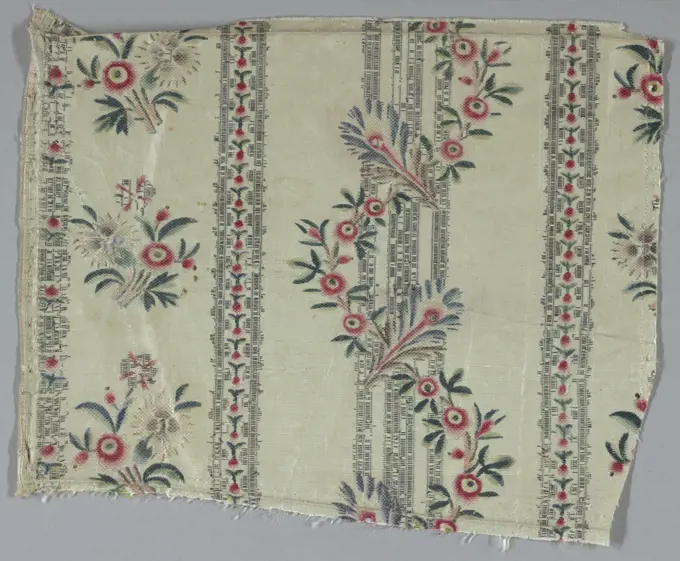
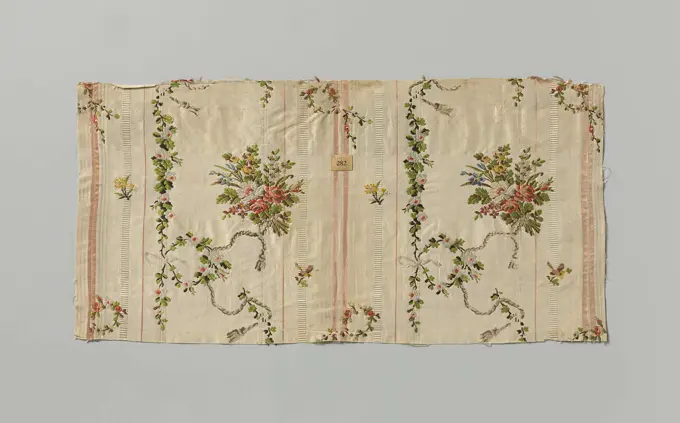
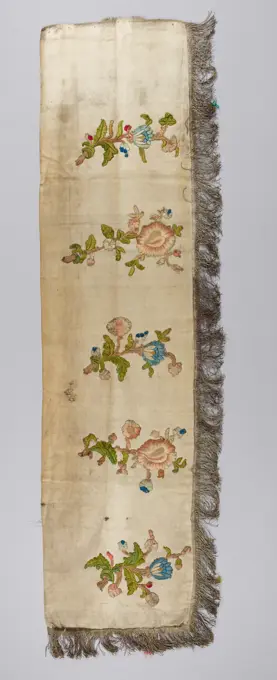
Fragment, Medium: silk, metal threads, some paint Technique: plain weave with discontinuous supplementary weft patterning (brocade), White taffeta ground with vertical stripes of flat silver brocade. Meandering stripes of floral designs both painted and woven., France, late 18th century, woven textiles, Fragment
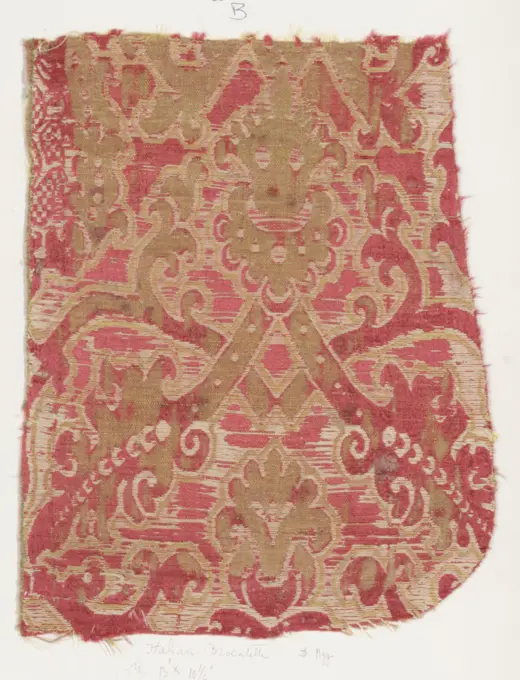
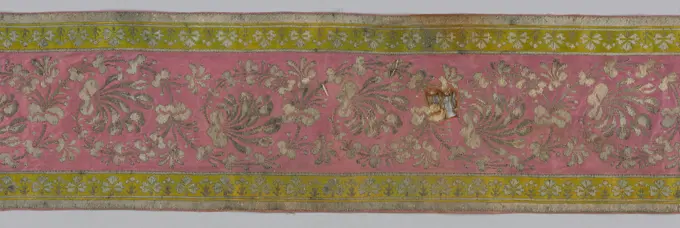
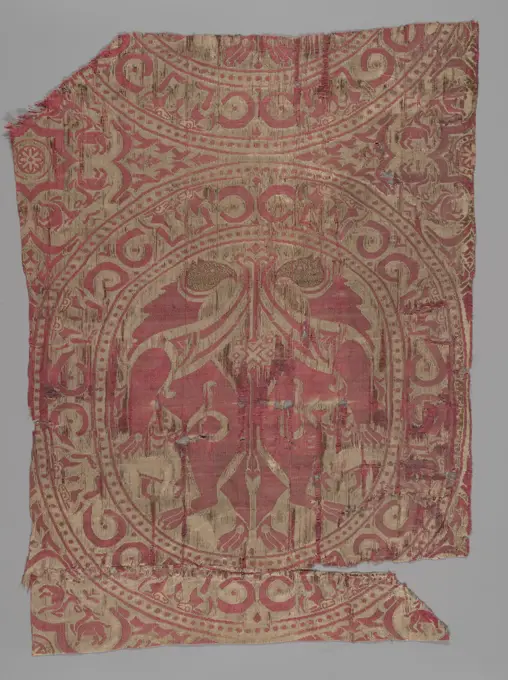
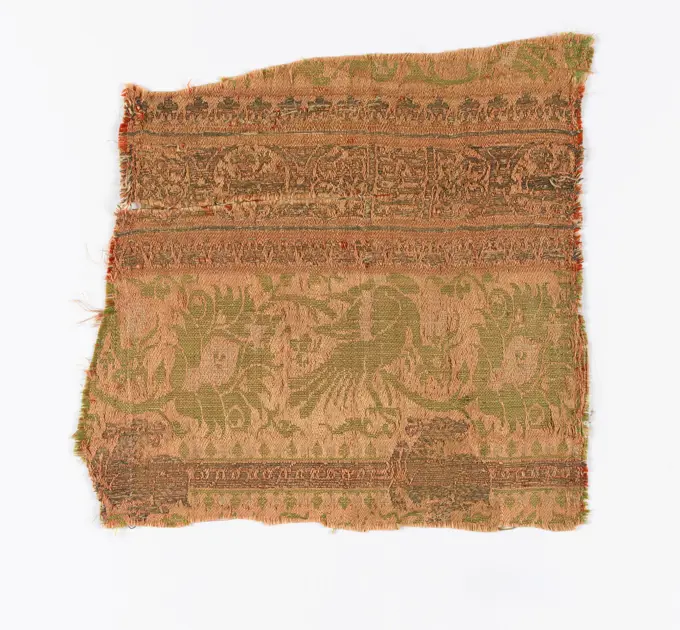
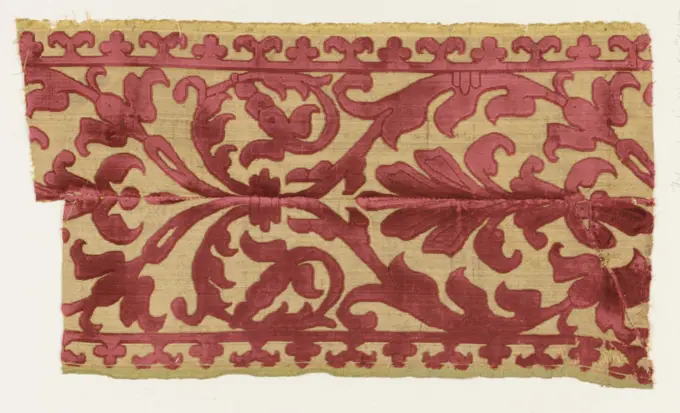
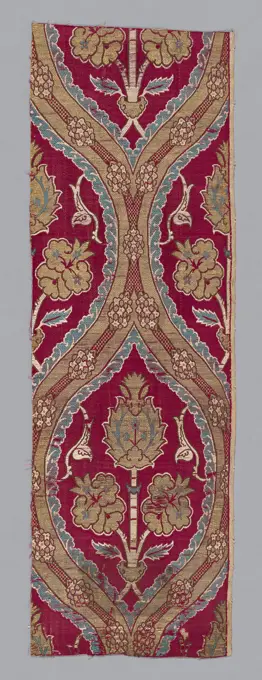
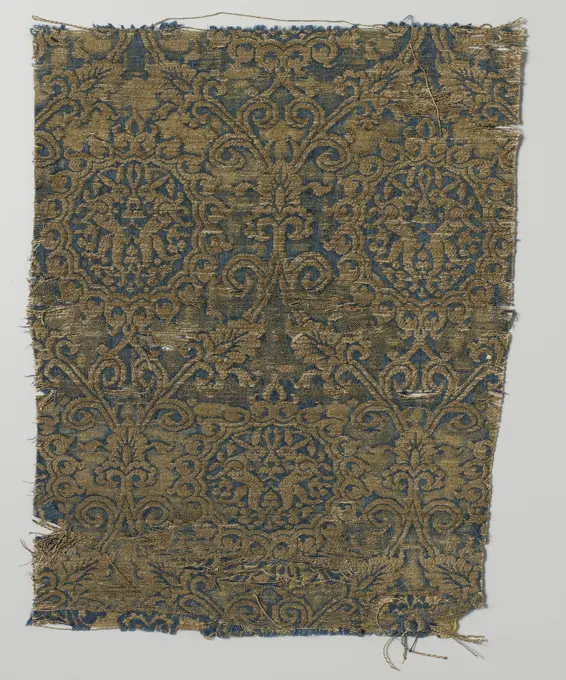
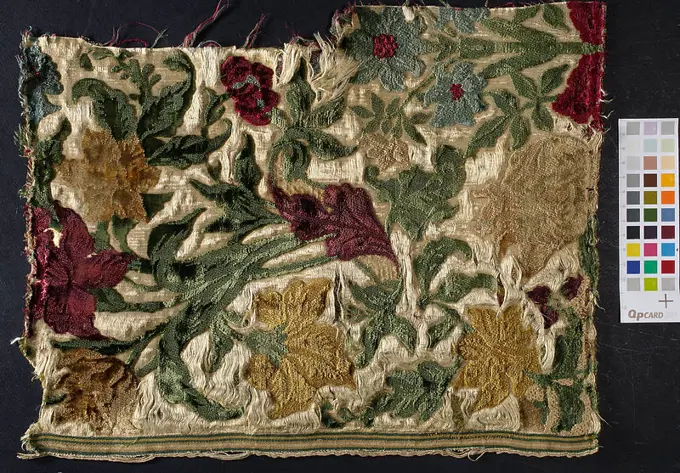
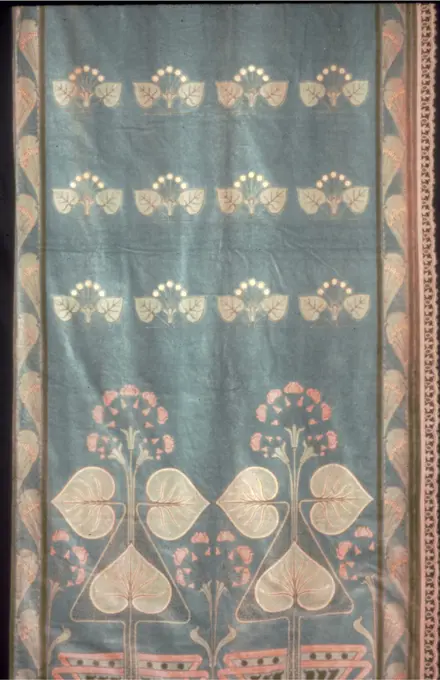
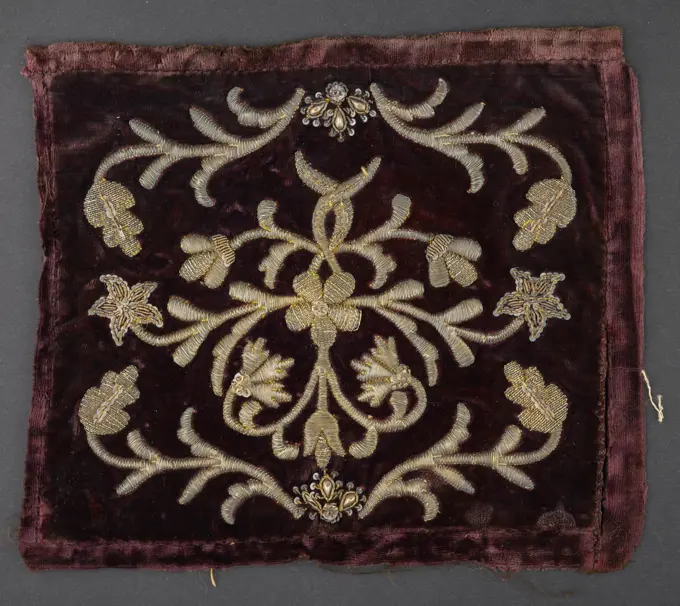
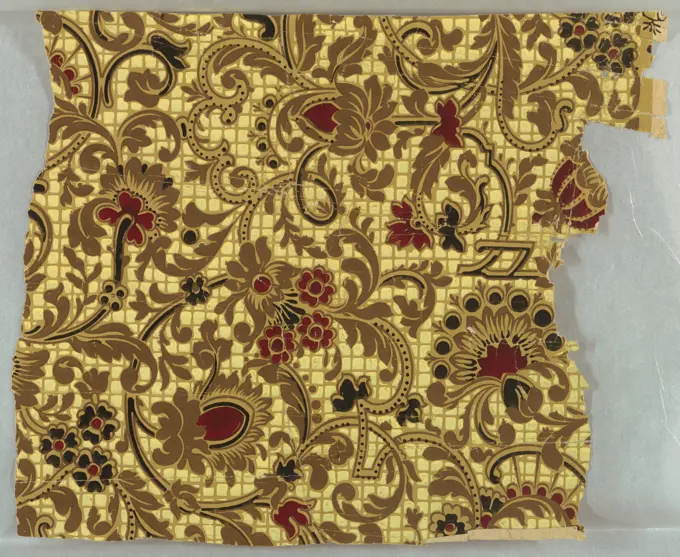
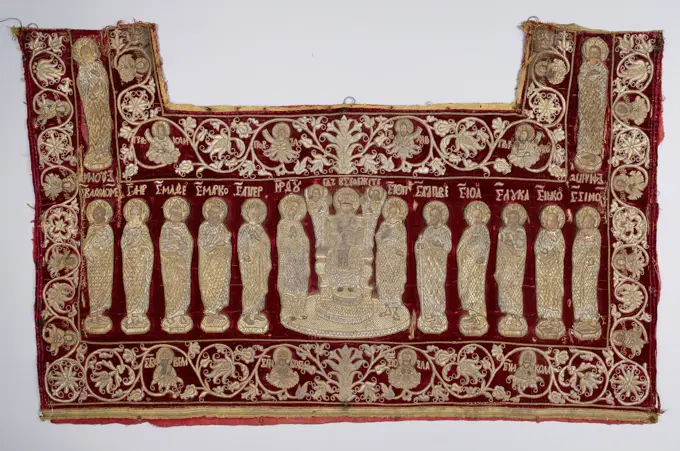
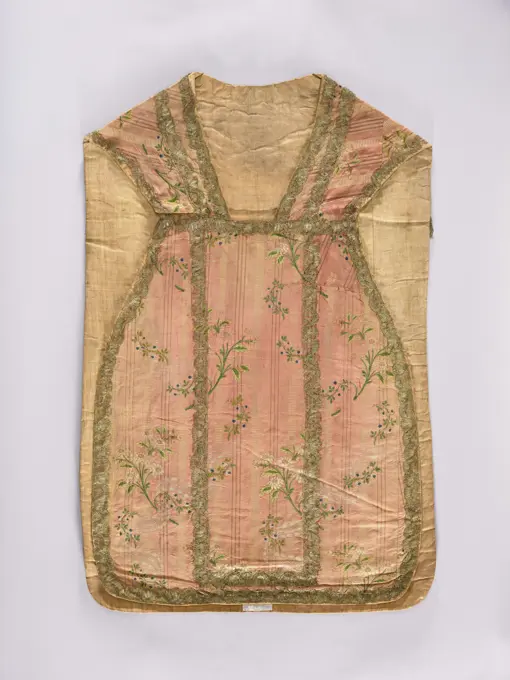
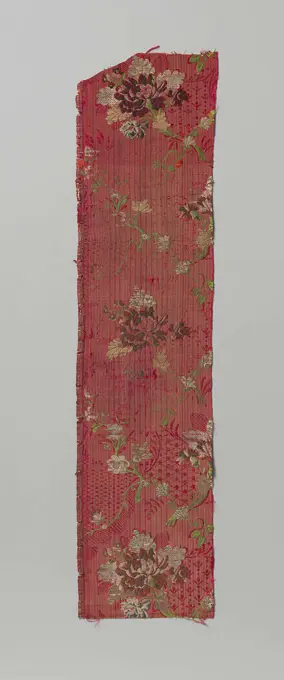
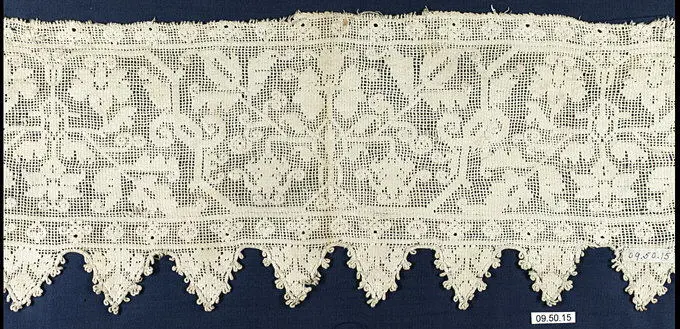
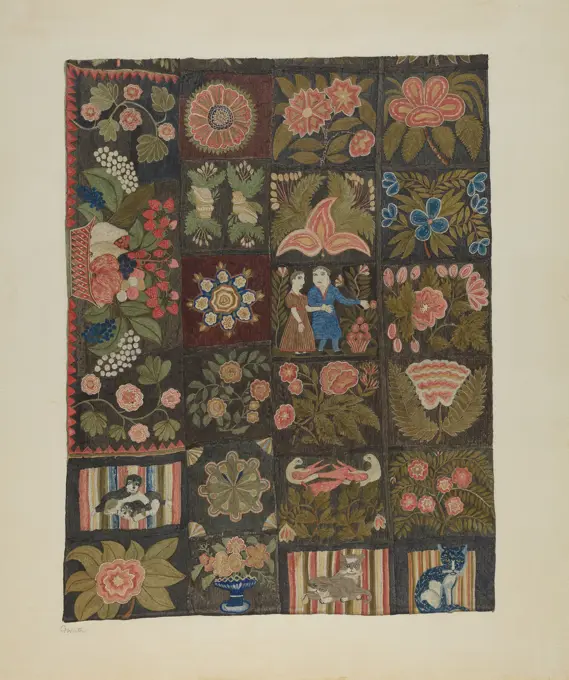
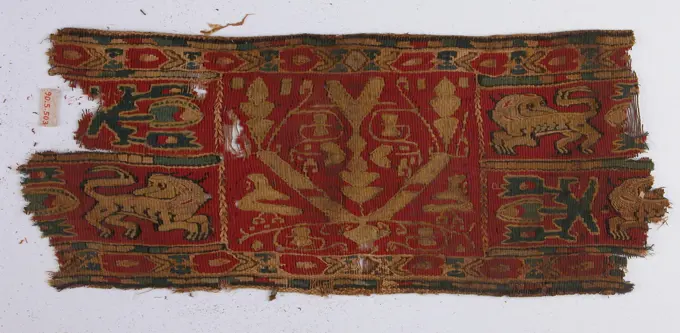
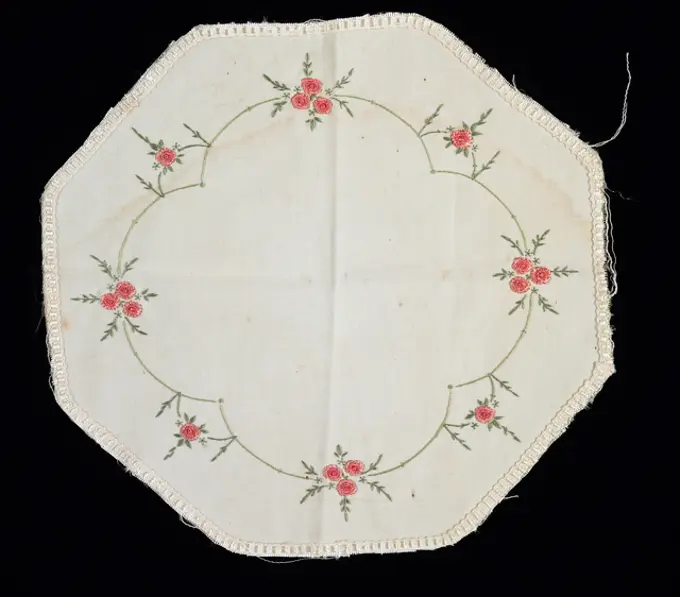
Sample (USA); Manufactured by Orinoka Mills (United States); Warp x Weft: 13 x 129 cm (5 1/8 x 50 13/16 in.)Textile, Medium: silk, metal-wrapped silk thread Technique: compound satin with supplementary weft, Large pomegranates and baroque scrolls are decorated with colorful small blossoms in shades of blue, rose, pink and green., Italy, 18th century, woven textiles, TextileFragment 17th century Italian. Fragment 230318Fragment, Medium: silk, metal threads, some paint Technique: plain weave with discontinuous supplementary weft patterning (brocade), White taffeta ground with vertical stripes of flat silver brocade. Meandering stripes of floral designs both painted and woven., France, late 18th century, woven textiles, FragmentDrie fragmenten veelkleurig gestreept zijdeweefsel.Three fragments of white and pink striped silk, on which colored bouquets and garlands. Note: Self edors (3) 0.4 cm wide.Textile, Medium: cotton Technique: block printed on plain weave; blue applied by brush, Straight repeat of two floral stripes separated by two narrow ribbon-like stripes; three repeats fill the width of the fabric., France, 1750-1800, printed, dyed & painted textiles, TextileBand; silk, metallicRibbon; silk; Bequest of Richard Cranch Greenleaf in memory of his mother, Adeline Emma Greenleaf; 1962-56-36Merklap with embroidery. The embroidery has a scene from the Commedia Dell 'Arte and an Amsterdam weapon at the top right. All corners have different embroidery., Anonymous Merklap with embroidery. The embroidery has a scene from the Commedia Dell 'Arte and an Amsterdam weapon at the top right. All corners have different embroidery.  linen (material). silk embroidering Merklap with embroidery. The embroidery has a scene from the Commedia Dell 'Arte and an Amsterdam weapon at the top right. All corners have different embroidery.  linen (material). silk embroideringPyx veil unknownFragment oriental textile; Mexicainian. Stripes with light salmon rosettes between blue flower branches, or red rosettes between light-green branches separated by white stripes with a blue center line.Border, Medium: cotton Technique: block printed, Narrow band with a dark brown ground showing tightly clustered flowers and leaves in red, light brown, blue, yellow, and 'double green' (blue printed with yellow). Border on both edges showing a row of small red wishbone shapes., England, 1790-1811, printed, dyed & painted textiles, BorderFragment multicolored brochure silk, c. 1740 - c. 1760 A fragment silk tissue. A white soil has a pattern of Kantlingers that form medallions in which multi -colored flower bouquets. France silk A fragment silk tissue. A white soil has a pattern of Kantlingers that form medallions in which multi -colored flower bouquets. France silkFragment late 18th century possibly Italian. Fragment 213107Apron Made 1701-1800 Italy. Blue silk, embroidered in conventional leade pattern with lace insets. .Textile Fragment from the Shrine of San Librada, Sigüenza Cathedral, Spain first half 12th century This textile fragment displays a pattern of roundels bearing addorsed griffins with gazelles below their forelegs, within a border of pairs of fantastic animals. The interstitial motif consists of an eight-pointed star enclosing a rosette, and surrounded by pairs of confronted quadrupeds. The pattern, popular in both Muslim and Byzantine worlds, recalls earlier silks of the eastern Mediterranean and, ultimately, of Central Asia. Silks of this type have been found in reliquaries of churches in Spain; they may be the "patterns with circles" of Almeria referred to in historical documents. These Islamic textiles were most likely brought to Sigüenza by Alfonso VII, in 1147 on the occasion of the victory over the Almoravids and the capture of Almeria.. Textile Fragment from the Shrine of San Librada, Sigüenza Cathedral, Spain 451472Fragment of embroidery  floral twig motif unknownTable Cover (Italy); silk on linen; Bequest of Marian Hague; 1971-50-94Excerpt Eastern textile; Silk tissue, anonymous, c. 1800 - c. 1850 A fragment Eastern textile, on green silk with gold thread. A green soil with green branches has a stray pattern of golden flowers. In the silk. A fragment Eastern textile, on green silk with gold thread. A green soil with green branches has a stray pattern of golden flowers. In the silk.Textile; cotton; Warp x Weft: 140 x 60.5 cm (55 1/8 x 23 13/16 in.) Repeat H x W (minimum unit): 15.8 x 13 cm (6 3/16 x 5 1/8 in.)Valance Made 1701-1800 England. Cotton, twill weave; embroidered .Sidewall - Fragment (USA); block-printed on handmade paper; 31 x 38 cm (12 3/16 x 14 15/16 in.)Embroidery, Medium: silk, cotton Technique: silk embroidered on plain weave, Horizonal panel with deep border embroidered in row of large flowering wreaths in blues, blue-greens, shades of rust; touches of white, black and yellow whithin the guard strips; similar wreath with cerise central flower in each corner of the plain central field on finely spun and woven dark cotton., Ioannina, Greece, late 19th century, embroidery & stitching, EmbroideryFragment (Italy); silk, metal wrapped linenFragment red and yellow silk tissue with stylized flower and leaf motifs, anonymous, c. 1550 - c. 1600 Fragment yellow side with pattern in red and yellow of stretched oval formed by curled volutes and filled with leaf work. Italy silk Fragment yellow side with pattern in red and yellow of stretched oval formed by curled volutes and filled with leaf work. Italy silkVeil. unknown, authorCover. Turkey. Date: 1675-1725. Dimensions: 91.4 x 101.8 cm (36 x 40 1/8 in.). Linen, plain weave, embroidered in silk in polychrome in large scale floral motif (backed in cotton, plain weave; pieced in center). Origin: Turkey. Museum: The Chicago Art Institute, Chicago, USA.Purse (France); silkFragment, Medium: linen, silk Technique: appliqué and embroidery on gauze weave, Fragment of a floral band with linen appliqué and multi-colored silk embroidery on red gauze weave., Italy, 16th-17th century, embroidery & stitching, FragmentPillow Cover. Greece, Northern Sporades Islands, Skíros. Date: 1601-1700. Dimensions: 39.8 x 38.9 cm (15 5/8 x 15 1/4 in.). Linen, plain weave; embroidered with silk in running (pattern darning), satin, and stem stitches; border of cut and drawn work embroidered with silk in darning stitches and overcast bars; edged with silk in buttonhole picots with attached tassels; backed with linen, plain weave. Origin: Skíros. Museum: The Chicago Art Institute, Chicago, USA.Embroidered wall hanging unknownEmbroidered wall hanging unknownFragment 17th century Italian. Fragment 230481Fragment silk tissue with pattern of fan -shaped bouquet surrounded by flower wreath, anonymous, c. 1695 - c. 1705 Fragment silk tissue of 3 pieces lined together with pattern of fan -shaped bouquet Iomal by a flower wreath. Spain Ketting an element: Silk lampas (textile material) Fragment silk tissue of 3 pieces lined together with pattern of fan -shaped bouquet Iomal by a flower wreath. Spain Ketting an element: Silk lampas (textile material)Fragment Made 1575-1600 Turkey. Silk; lampas technique .Table cover. Culture: Italian, possibly Sicily. Dimensions: L. 78 1/2 x W. 47 inches199.4 x 119.4 cm. Date: 16th century. Museum: Metropolitan Museum of Art, New York, USA.Fragment Lampas with floral pattern in yellow, gold and blue with hares in medallions, anonymous, c. 1300 - c. 1399 Rectangular fragment Lampas in blue and yellow side with gold thread. A pattern of winding tendrils forms spits-ovale fields in which round-lined round work are rounded and rounded. It contains two hares back with surrounding heads. Yellow fringe in satin binding visible at the rear. Iran Ketting an element: Silk. lampas (textile material) Rectangular fragment Lampas in blue and yellow side with gold thread. A pattern of winding tendrils forms spits-ovale fields in which round-lined round work are rounded and rounded. It contains two hares back with surrounding heads. Yellow fringe in satin binding visible at the rear. Iran Ketting an element: Silk. lampas (textile material)Fragment, Medium: silk, metal wrapped linen Technique: two integrated fabric structures (plain weave plus plain weave), Repeating pattern of a vase with pseudo-Arabic writing flanked by addorsed parrots above affronted monsters. Gold, orange and green on purple., Italy, 14th century, woven textiles, FragmentFragment. Spain. Date: 1601-1625. Dimensions: 22.9 x 19.1 cm (9 x 7 1/2 in.). Brocaded silk. Origin: Spain. Museum: The Chicago Art Institute, Chicago, USA.Piece of fabric. unknown, authorHanging (France); cottonEmbroidered Sampler 1685 German or Dutch This sampler includes multiple alphabets and floral motifs in a green, brown, and tan color scheme. The motifs include acorns, birds, bunches of grapes and both sprigs and potted flowers. The letters IEO and the year 1685 are stitched onto the linen foundation fabric, most likely the initials of the samplers maker and the year in which she completed her work.. Embroidered Sampler 227938Piece 18th-19th century Japan. Piece. Japan. 18th-19th century. Silk. Textiles-WovenTable Cover (India); cottonU.S. Grant Coverlet. Dated: 1939. Dimensions: overall: 53.4 x 60.4 cm (21 x 23 3/4 in.) Original IAD Object: 17" wide; 18 1/2" long. Medium: watercolor and graphite on paper. Museum: National Gallery of Art, Washington DC. Author: John Thorsen.Top of a pall, embroidered, violet unknownEmbroidered kerchief unknownRug;  around 1800 (1799-00-00-1802-00-00);rugSampler, Medium: silk on cotton Technique: cross, aztec (surface satin over withdrawn element work) and long armed cross stitch on plain weave foundation; counted stitches, Two separate pieces of cloth containing floral and geometric motifs and one alphabet joined together with decorative stitchery., Mexico, 19th century, embroidery & stitching, SamplerFragment; silk; Warp x Weft: 17 x 52.3 cm (6 11/16 x 20 9/16 in.)Sampler. Date/Period: 1813. Sampler. Medium: silk embroidery on linen foundation . Technique: embroidered in satin and cross stitches on plain weave foundation. Height: 540 mm (21.25 in); Width: 425 mm (16.73 in). Author: Elizabeth Funk.Zakdoek van batist met witwerk dat doorloopt in een rand kantborduurwerk met zigzag-patroon en rondom een rand kloskant.Natural batist's handkerchief with embroidery - whiteware - with a wide-worked edge of edge embroidery: work with joined wires that flows from the batters and has been poured out. Open sewing gives through the square grid that appears on a knotted network the impression of a filet side. At this whole is sewn around a border of clamping: Binche-Kant. Square model with straight edges. The white on white embroidery stands in a contiguous pattern along the edge of the batist and consists of ijle curling tendrils with small leaves and clusters of three rosette flowers between which some larger flowers stand, different in shape and with opened flower hearts. The corners each have three hollow slots. The work with merchanded wires has a square grid in which a zigzag pattern with florets is made with stroke. The zigzag is interrupted here and there by three embroidered rosettTowel Made 1801-1900 Turkey. Eembroidered .Kazuifel of gold brocade with flower pattern, so -called "bizarre" design, anonymous, c. 1706 - c. 1707 Kazuifel of gold brocade with flower pattern, so -called "bizarre" design. France (possibly) textile materials. Kazuifel of gold brocade with flower pattern, so -called "bizarre" design. France (possibly) textile materials.Square, Medium: linen Technique: bobbin made continuous tape with bars added, Small square with blossoms surrounding a central circle., Italy, 18th century, lace, SquareFragment 17th century Italian. Fragment 230485Table cover, Medium: silk on linen Technique: stem, running, satin and knot stitches on plain weave; deflected element border; bobbin lace border, Seventeen embroidered gnomes walking on vines and leaves. Each carrying a different fruit, vegetable or objects such as: radishes, grapes, a wine cup, foaming beer mug, sausage, egg, carrots or turnips, cherries, wheat, mushrooms, strawberries, raspberries, lobster, and a barrel of wine dated 1890., Cologne, Germany, 1890, embroidery & stitching, Table coverChasuble, white, with appIIqué unknownFragment shaved velvet. Fragment velvet with pattern of acanthus leaves in the colors green and blue on cream colored soil. Note: Fragment is probably at the chair with inv.nr BK-KOG-1443-A.Strip of needle side on a red textile piece of cardboard, Johanna E. van Nierop, 1910 - 1911 Strip of natural -colored needle side: Venetian relief side. The side is put on a piece of cardboard that is covered with red textile. The repeating lace pattern consists of wide curly tifles with different types of flowers on it. One flower is somewhat smaller than the other but the flowers are all fairly large, almost every flower heart is oval. The motifs are connected by a potente soil. Decorative lands have been used in the flowers. Top and bottom of the strip are straight and both finished with one row of fested arches, which are attached to the right edge at some distance from each other. Netherlands linen (material) Venetian raised work Strip of natural -colored needle side: Venetian relief side. The side is put on a piece of cardboard that is covered with red textile. The repeating lace pattern consists of wide curly tifles with different types of flowers on it. One flower is somewhat Piece ca. 1725 British or French. Piece 229347Fragment (Spain); linen; Bequest of Marian Hague; 1971-50-157Rug. Dated: c. 1938. Dimensions: overall: 30.9 x 47 cm (12 3/16 x 18 1/2 in.) Original IAD Object: 74" long; 29 1/2" wide. Medium: watercolor and graphite on paper. Museum: National Gallery of Art, Washington DC. Author: Eva Wilson.Textile, China, 19th century, woven textiles, TextileTextile Fragment. Dimensions: L.: 9 in (22.9 cm) x W: 6 in (15.2 cm). Date: late 17th century. Museum: Metropolitan Museum of Art, New York, USA.Embroidered finger;  18th century (1701-00-00-1800-00-00);Breastplate unknownTextile; leather; 1956-14-1Towel or Napkin (Altered) Made 1775-1825 Turkey. embroidered .Sampler 19th century Spanish. Sampler 228199Manipel of gold brocade, c. 1700 - c. 1725 Manipel of gold bracat. Two manipels with invnrs belong to the manipel. BK-1972-1-G and BK-1972-1-I. The manipels belong to nine ecclesiastical tissues with embroidery with invnrs. BK-1972-1-A to BK-1972-1-I and a non-corresponding stock market with invnr. BK-1972-1-J. France brocade (textile) embroidering Manipel of gold bracat. Two manipels with invnrs belong to the manipel. BK-1972-1-G and BK-1972-1-I. The manipels belong to nine ecclesiastical tissues with embroidery with invnrs. BK-1972-1-A to BK-1972-1-I and a non-corresponding stock market with invnr. BK-1972-1-J. France brocade (textile) embroideringSidewall (USA); machine-printed on machine-made paper; 24.5 x 28.5 cm (9 5/8 x 11 1/4 in.). Elongated scarf of wool and silk, with an ecru-colored fond. On the short side ten elongated standing botas in red and blue, a narrower border where a red bota is interspersed with a yellow palm. A narrowly mounted edge with pattern of ornaments along the entire edge. Short, ecru-colored fringes along the short side.Fragment; silk, cottonFlounce, Medium: linen Technique: needle lace, Repeating design of two alternating vase-shapes under canopies with foliate and floral arabesques and scrollwork. Lower long side of shaped outline; upper long side and two short sides are straight and finished with picots., France, 1720-30, lace, FlounceHeaddress fourth quarter 18th century Russian. Headdress 173382IIturgical embroidery, Ruthenian unknownAltar frontal, Medium: silk, metallic thread, metal sequins Technique: silk embroidery on silk foundation, Altar frontal of red silk grosgrain embroidered in multicolored silks, gold and silver thread and sequins. Central motif of the dove with an allover design of flowers, fruit, and grain. Edged with gold lace and lined with red taffeta., France or Italy, 1700-1750, embroidery & stitching, Altar frontalBack of a chasuble with embroidered sides unknownChasuble. unknown, authorFragment red brochet side with a multicolor pattern with bouquet and flower garlands and so-called edge edge.fragment of Red Silk Soil With Ditto Darker Figures, Interwoven With Multicolored Bouquets and Flower Garlands and So-Called Lace Edge.Sampler. Date/Period: Late 18th century. Sampler. Medium: silk embroidery on linen foundation. Technique: cross stitch on plain weave. Author: UNKNOWN.Textile, Medium: piña (pineapple) fiber Technique: plain weave with discontinuous supplementary weft, Square doily of piña cloth with brocaded pattern of floral motifs around a center circle., Philippines, 19th century, woven textiles, TextileCharlotte Winter, Bedspread, c 1940 BedspreadFragment Multicolored browed Zijddamast, Anonymous, 1730 Fragment silk tissue with a green soil with a pattern of zig-zag lines consisting of a stylized flower pattern. Slingers consisting of leaves and fruits run on the motif. The garlands form fields in which leaves, flowers and fruits. Spain (possibly) silk damask Fragment silk tissue with a green soil with a pattern of zig-zag lines consisting of a stylized flower pattern. Slingers consisting of leaves and fruits run on the motif. The garlands form fields in which leaves, flowers and fruits. Spain (possibly) silk damaskChasuble after 1750, goldsmithing and textile art from the 16th to the 20th century, St., Sankt, SaintOrphrey Made 1501-1600 Spain. Velvet with design in applique and couched gold cord .Towel End, c. 1700s-1800s. Russia, Orel province, 18th-19th century. Cotton or linen (est.) straight (continuous) bobbin lace; ground with interspersed motifs of plant and animal forms in plain weave outlined with gimp (heavy cord); applied silk (est.) ribbon; overall: 26.5 x 41 cm (10 7/16 x 16 1/8 in.). This Russian lace panel was likely used to embellish the end of a bathing towel. Textiles of this type are valuable for their fine lace work including ancient folk motifs, ritual significance, exemplification of the role of textiles in their society, and in this case, connection to a prominent woman collector, Natalia de Shabelsky, without whom this textile and others like it might have been lost.Towel End 19th century. Towel End 443062Towel End early 19th century. Towel End. early 19th century. Linen, silk, metal wrapped thread; plain weave, embroidered. Attributed to Turkey. Textiles-EmbroideredDemolition of Linen, dated 1766 ,, 1766 Demolition of linen with red -embroidered initials D.P. and the year 1766. Friesland linen (material) Demolition of linen with red -embroidered initials D.P. and the year 1766. Friesland linen (material)Textile (England or United States); cottonFragment 17th century German. Fragment 215417Embroidered altar-cloth. unknown, authorCharlotte Winter, Caswell Carpet, c 1939 Caswell CarpetFragment of a Saf Carpet. Date/Period: 1600 - 1650. Carpet. Author: India unknown.Fragment of a Sleeve 6th-7th century. Fragment of a Sleeve 443989Tray cloth, 1917-1918, United Kingdom, by William Hansen. Gift of Eileen Tiller, 2008.Two Pieces of Embroidery, 1723-1774. Philippe de Lasalle (French, 1723-1805). Embroidery, silk; overall: 23.7 x 40.2 cm (9 5/16 x 15 13/16 in.).Fragments, 1700s. Iran, 18th century. Silk, brocaded, with metal thread weft; overall: 18.5 x 19.1 cm (7 5/16 x 7 1/2 in.).