Vintage Textile Fragments

A collection of historical fabric pieces featuring floral designs, varying in colors and textures from silk to linen, evoking a sense of timeless elegance.

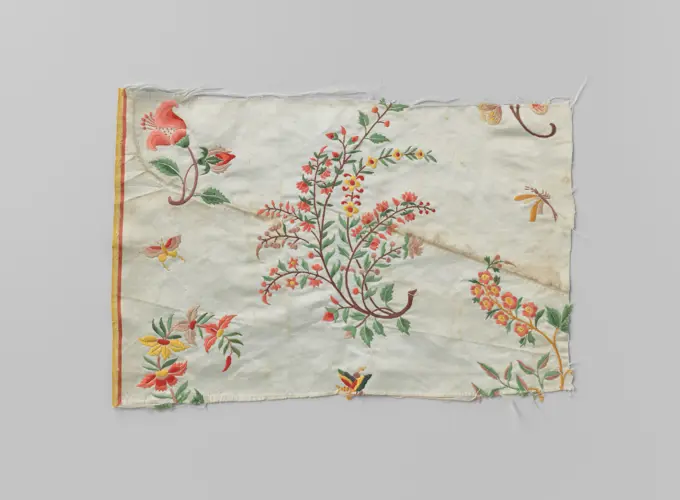
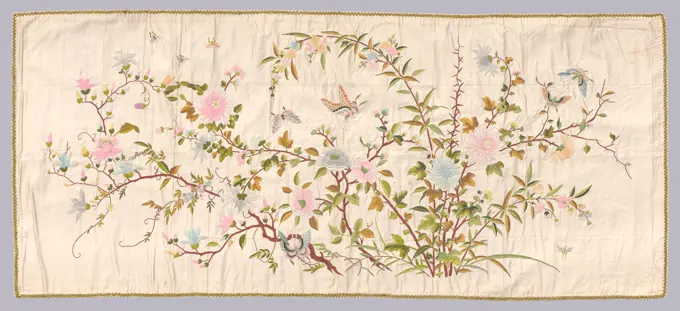
Fragment of a bedspread of Eastern textile with embroidery ,, 1690 - 1710 Fragment of a multi-colored tambourated Indo-Persian bedspread, decorated with volutes and flowers. India cotton (textile). silk embroidering Fragment of a multi-colored tambourated Indo-Persian bedspread, decorated with volutes and flowers. India cotton (textile). silk embroidering
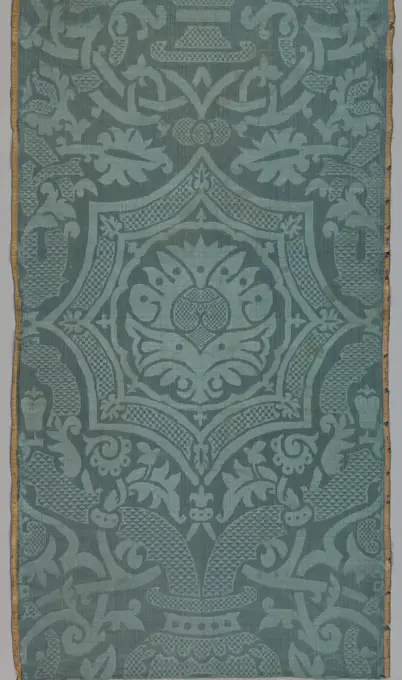
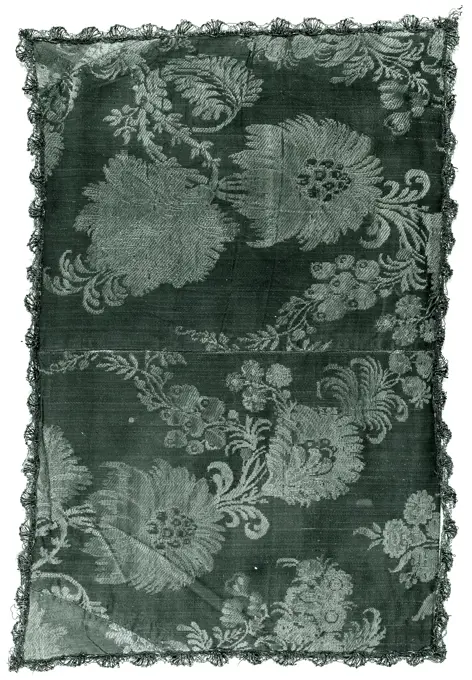
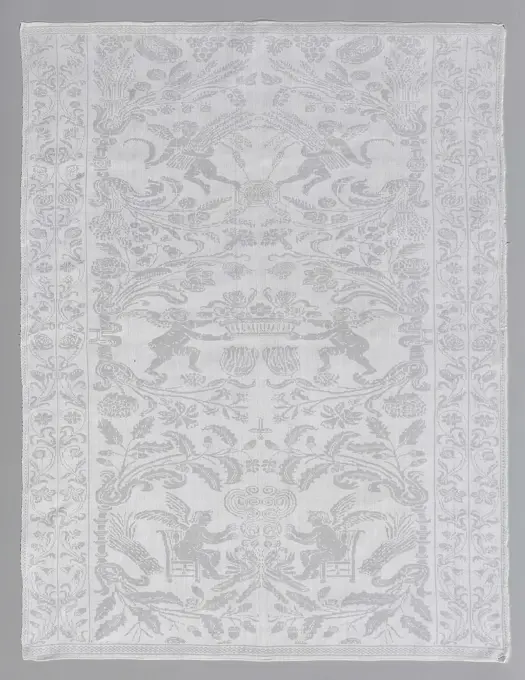
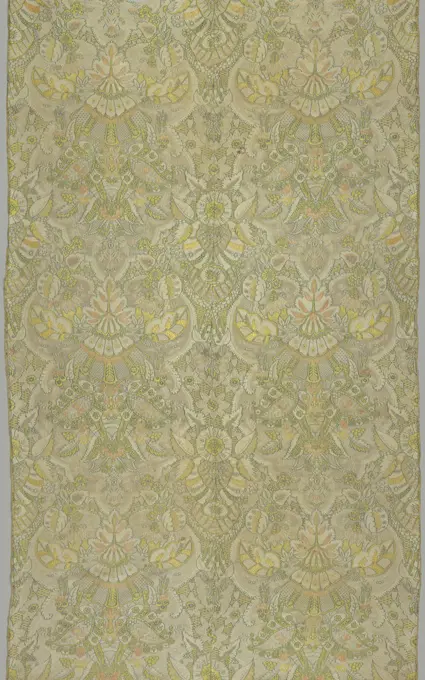
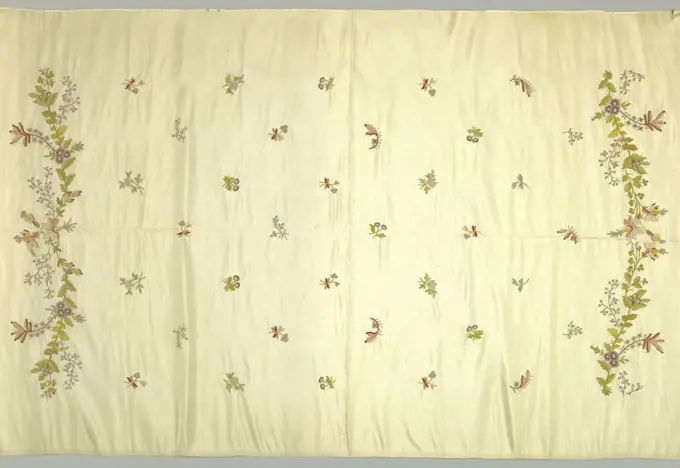
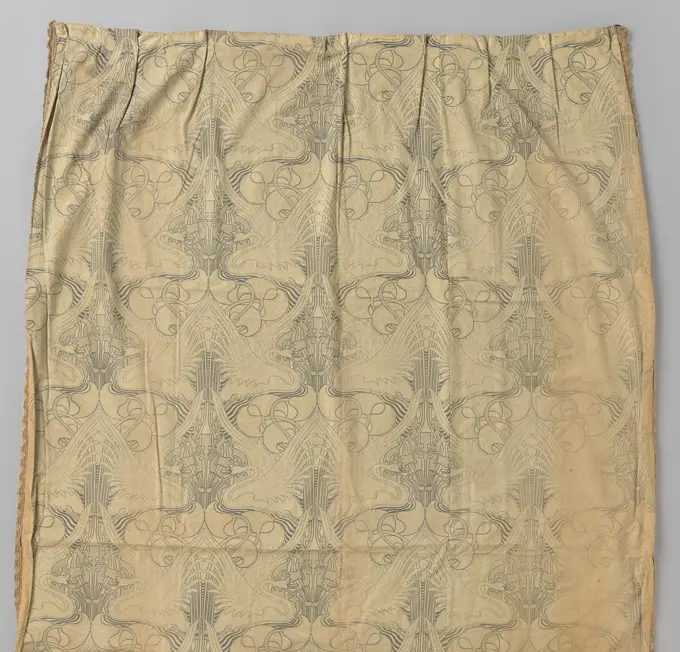
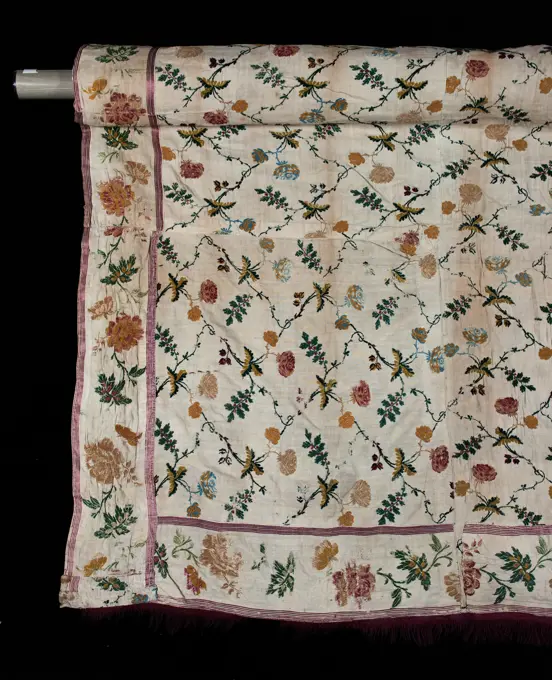
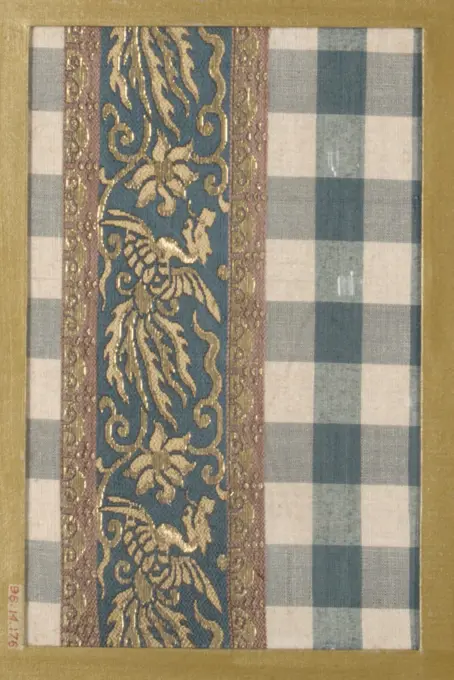
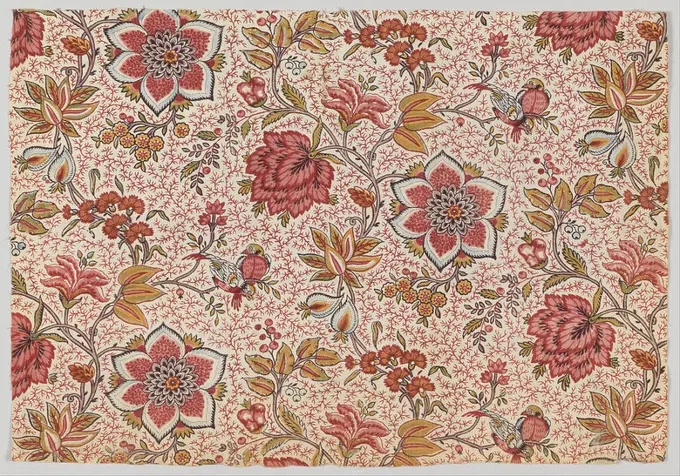
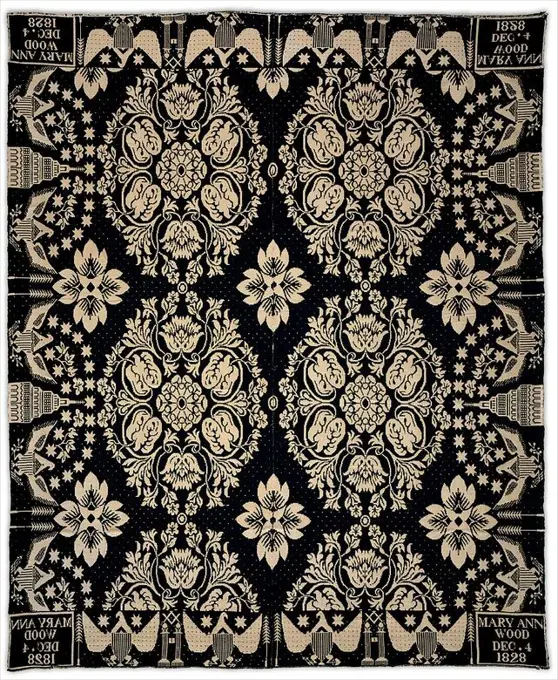
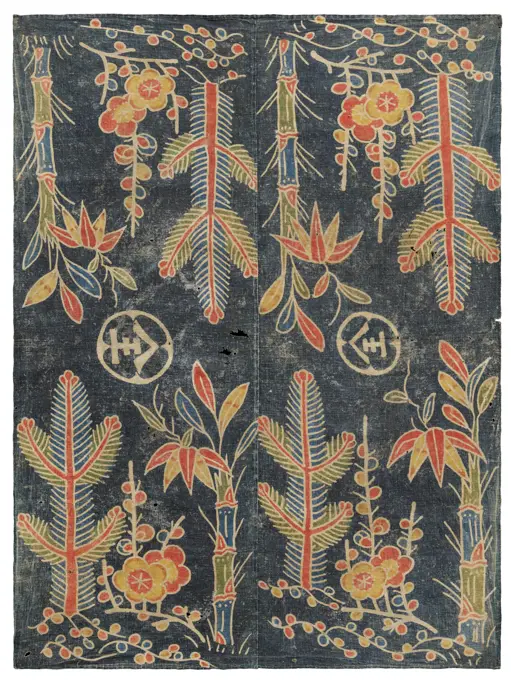
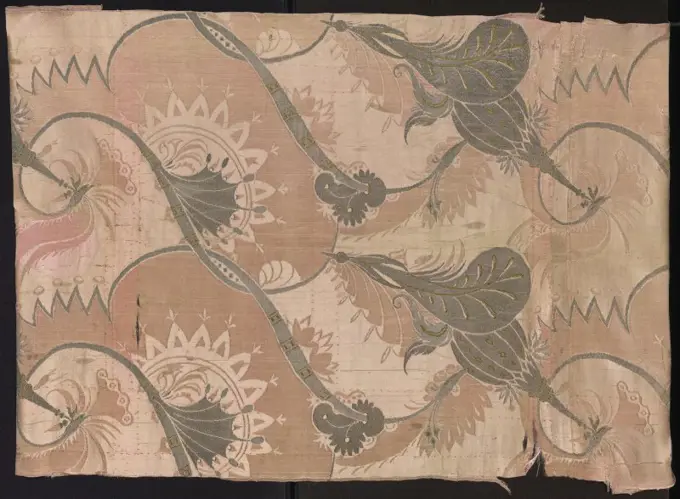
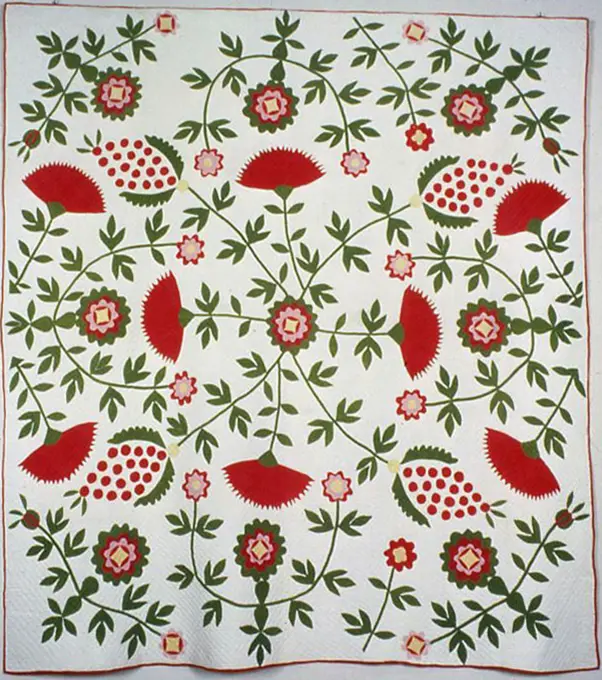
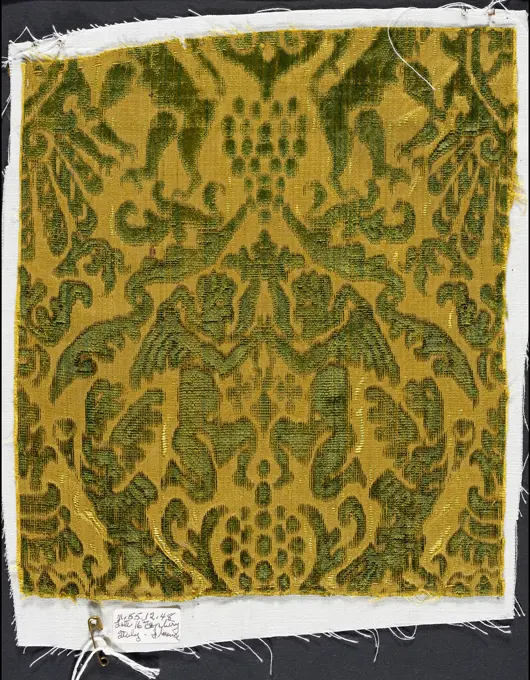
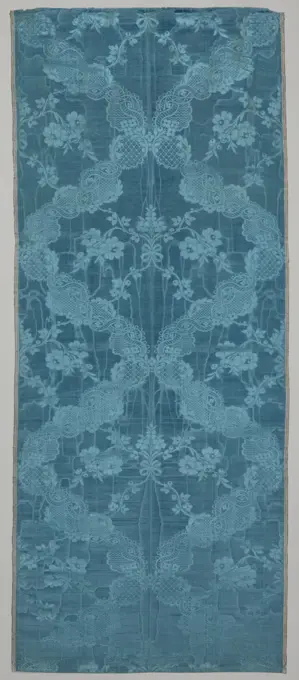
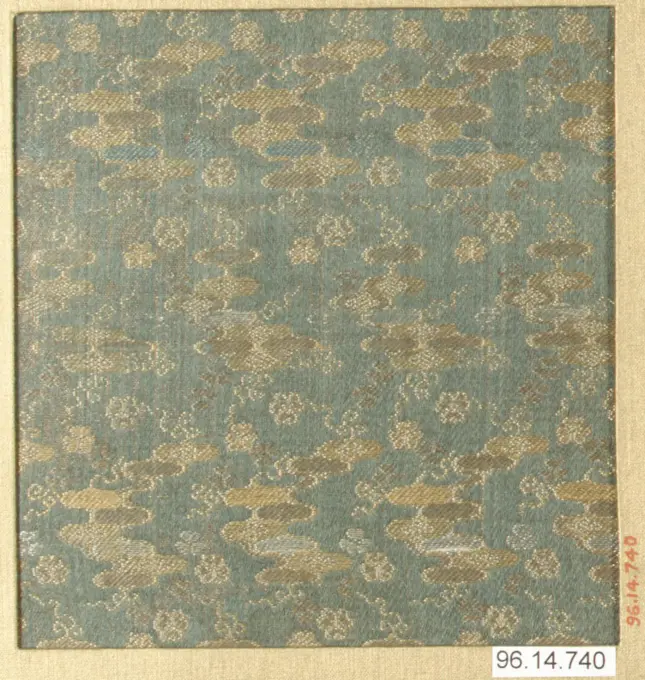
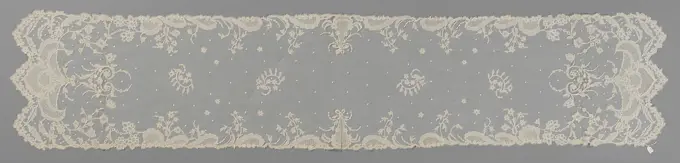
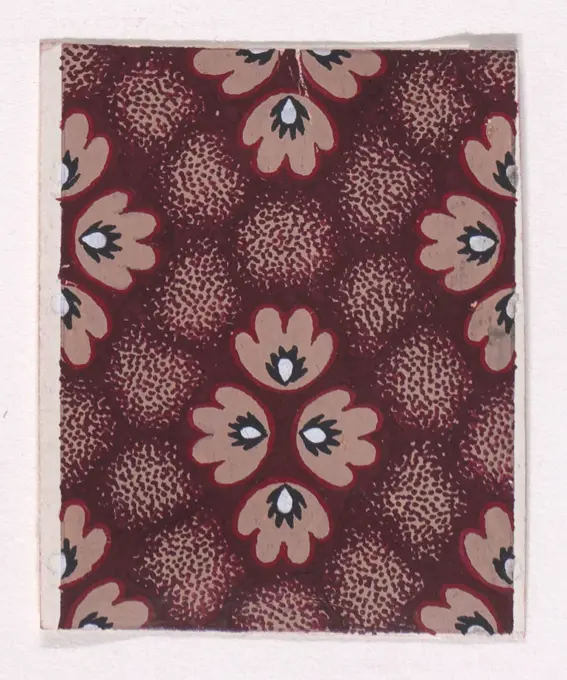
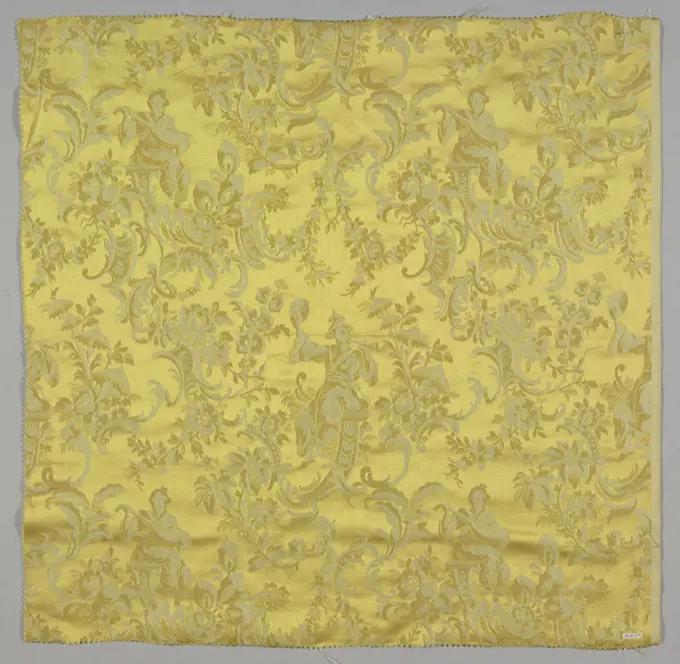
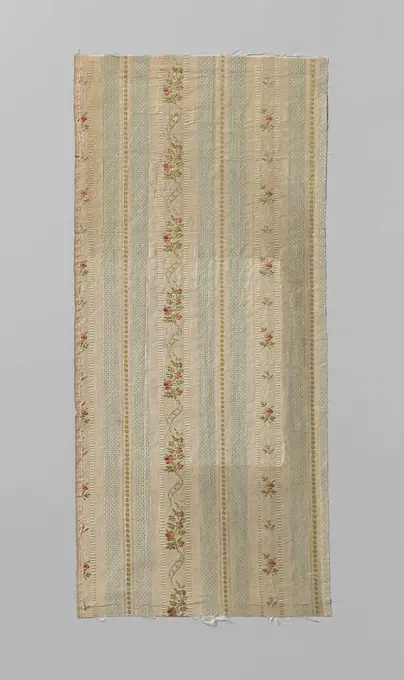
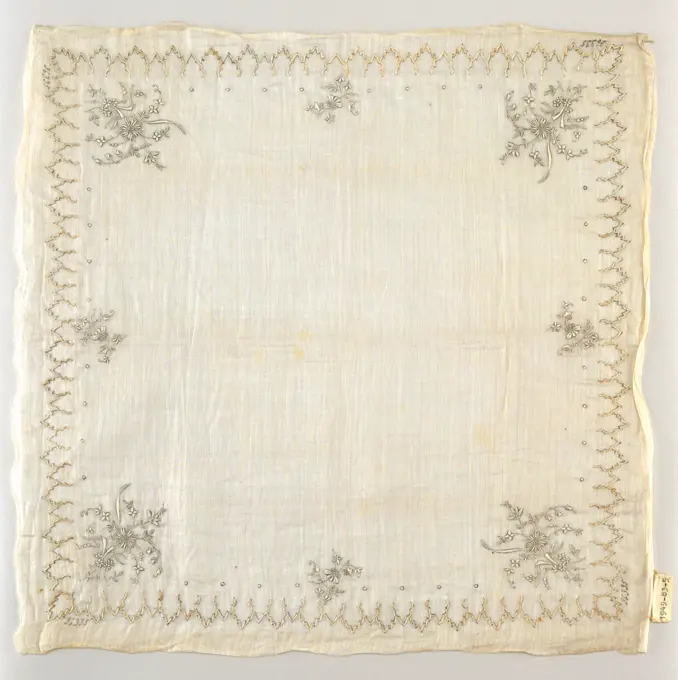
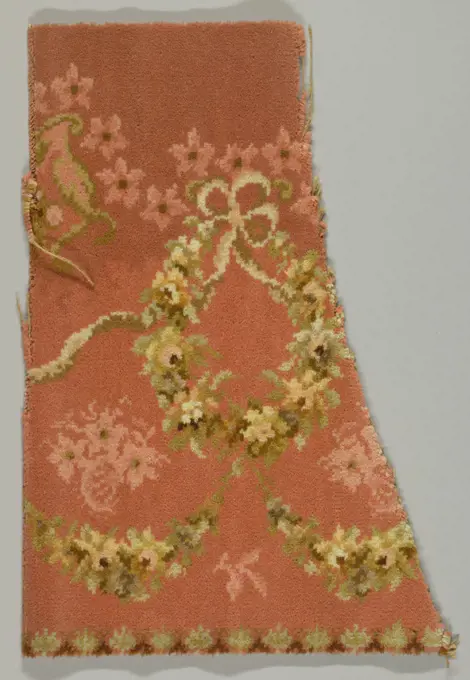
Carpet, Medium: wool, hemp Technique: cut pile on plain weave ground, Section of field with Louis XVI wreath repeat and section of border. In shades of light brown on pinkish-orange pile., USA, 1849-1900, woven textiles, CarpetTextile, Medium: cotton Technique: block printed (reds, yellows and black), blue may have been applied by brush on plain weave, Curving stems with roses surrounded by a tiny leaf pattern on a dark background., Jouy, France, ca. 1800, printed, dyed & painted textiles, TextileFragment (Spain); silk; Warp x Weft: 155.5 x 56 cm (5 ft. 1 1/4 in. x 22 1/16 in.); 1955-34-1Textile, Medium: silk Technique: cut and uncut loops of a supplementary warp (green) in a 7 & 1 satin foundation (white), Vase and scroll pattern in green on cream., Italy, 17th century, woven textiles, TextileFigural tapiser;  Ok. PO. 18th century (1710-00-00-1780-00-00);Leaf with branches with flowers, anonymous, 1700 - 1800  Leaf with tibaries with flowers. Left and right identical halves. Used as a cover.  paper. block printing (relief printing process) ornament derived from plant formsFragment, Medium: linen Technique: block printed using resist, vat dyed in indigo on plain weave. Every third weft is twice as thick as the other wefts giving the fabric a ribbed appearance., Corner of a table cover. Border design of tassels alternate with flowers, field of intersecting circles., France, late 18th century, printed, dyed & painted textiles, FragmentFragment multicolor silk tissue. A fragment. Ground of pink silk with lighter stripes, garlands of white flowers and colored bouquets. Note: The two corners are cut off. Pay attention to the regular mistakes with the blue bouquetjes (may point to JacquardW).Textile (England); cottonFragment, Medium: silk, gold foil on silk core Technique: plain twill with supplementary weft, Design of floral units brocaded in colored silk and gold and on a background design of undulating lines in gold. The ground fabric is in plain twill weave; it is tan and at top and bottom changes to brown and orange-red respectively. This change is produced by chine dyeing of the warps and change of color of wefts., Japan, 19th century, woven textiles, FragmentSidewall (USA); Manufactured by Becker, Smith & Page, Inc.; machine-printed; 84.5 x 49 cm (33 1/4 x 19 5/16 in.)Fragment 18th century Italian or French. Fragment 461442. Napkin of Linnendamast. Midfield: mirrored pattern and persons who symbolize three of the four seasons. From top to bottom: 1 putti with ears of corn and sickle; 2 putti with flowers and floral basket; 3 putti on chairs, warmly warming their hands to a fire. Including branches with oak leaves. Running edges: double edges with winding flower rans. No landed edges. Damboard pattern on the four sides.Piece 1788-90 Chinese, for French market. Piece. Chinese, for French market. 1788-90. Cotton. Textiles-PrintedTextile; Manufactured by Schwartz-Huguenin; cottonFragment 18th century French. Fragment 230252Textile, Medium: silk Technique: 7&1 satin weave with continuous (green and yellow) and discontinuous (2 reds, yellow and textured blue) supplementary wefts. The continuous wefts are bound into the structure in twill binding; the discontinuous wefts float on the back., Vertically symmetrical design of elaborate plant forms with detailed fillings in lace-like pattern. Soft shades of ivory, green, yellow, blue, pink. orange and tan., France, ca. 1730, woven textiles, TextileTextile, Medium: silk on silk Technique: embroidered on plain weave, Cream silk plain cloth ground with polychrome silk embroidery in chain stitch. Ground powdered with flower springs. -a: has garland of flowers at either side. See n-t-624, but it does not appear to be chain stitch., 1850-1900, embroidery & stitching, TextileDoor curtain of printed cretonne with swans and lissen. Door curtain of printed cretonne with swans and lisses and on three sides provided with passing element and with metal rings.Textile; silk; Warp x Weft: 149 x 99 cm (58 11/16 x 39 in.); Bequest of Richard Cranch Greenleaf in memory of his mother, Adeline Emma Greenleaf; 1962-56-68-a/cCarpet fragment, Medium: wool Technique: machine made, Floral design in shades of brown, cream, gray, and dull orange., USA, 1860-70, woven textiles, Carpet fragmentTextile; silkEmbroidered shawl unknownTextile (England); cottonFragment, 17th century; silk; Warp x Weft: 16.5 x 19 cm (6 1/2 x 7 1/2 in.)Fragments Of A Dress (probably France); silkBed curtain Linen and cotton canvas, embroidery in the past, polychrome wool threads. 1700-1750. Galliera, fashion museum of the city of Paris. Detail, edofe, fabricFragments (France); silk, metallicTextile (England or United States); linenCeiling Paper (USA); Manufactured by W.N. Peak; machine-printed paper, liquid mica; 91 x 49 cm (35 13/16 x 19 5/16 in.)Ceiling Paper (USA); Manufactured by Robert Graves Co. (United States); machine-printed paper, applied mica flakes; 91 x 47 cm (35 13/16 x 18 1/2 in.)Silk embroidered fragment of a dress, anonymous, c. 1750 - c. 1800 A heath branch is in the middle of two scattered butterflies, a Libelle and four other medium -sized flower branches. Indonesia (possibly) silk embroidering A heath branch is in the middle of two scattered butterflies, a Libelle and four other medium -sized flower branches. Indonesia (possibly) silk embroideringFragment (Japan)Cover for card case, Medium: silk, paper, paillettes Technique:, Cover is ornamented by bits of brocade showing three openings in paper, which has been cut in floral design. Edges of cover are shaped and bound with pink paper., Italy, 18th century, costume & accessories, Cover for card caseFragment 18th century Italian. Fragment 230255Fragment of white silk damask with colored flowers, anonymous, 1730 Fragment of white silk damask with colored flowers. The Netherlands.  silk damask Fragment of white silk damask with colored flowers. The Netherlands.  silk damaskFragment of silk fabric  naturaIIstic flower pattern unknownTextile fragment with pattern of checks with band of phoenixes and flowers 18th-19th century Japan. Textile fragment with pattern of checks with band of phoenixes and flowers 65902Piece 19th century Japan. Piece. Japan. 19th century. Silk. Textiles-WovenPiece 18th-19th century Japan. Piece 67629Sidewall, Machine-printed paper, On gray ground with allover white and black specks, staggered medallions composed of framed white scrolls, beaded frame and inside burgundy ground with lavender scroll motif., USA, 1905-1915, Wallcoverings, SidewallTextile, Medium: cotton Technique: roller and block printed, glazed, Textile showing a stippled salmon-colored ground with a design of scattered grasses, leaves and flowers in red, brown, lavender, solid green and bright blue. Printed using blocks from between 1830-1850., England, 1870-1910, printed, dyed & painted textiles, TextileTextile; Designed by Arthur Wilcock; cottonSampler (Mexico); cotton, silk and wool embroidery on cotton foundationFleurs et Oiseaux sur Fond Brindilles Pointillées. Date/Period: Ca. 1785. Textile. Medium: linen warp, cotton weft. Technique: block printed on plain weave foundation. Height: 420 mm (16.53 in); Width: 610 mm (24.01 in). Author: Oberkampf & Cie.Fragment of Kurdyban;  XVII/18th century (1690-00-00-1810-00-00);gift (provenance), kurdybans, flowers, butterflies, fruitRibbon French 19th century View more. Ribbon. French. 19th century. Textiles-TrimmingsSample, Orinoka Mills, (Philadelphia, Pennsylvania, USA), Dark red morie effect ground with tone on tone flowers on a vine., USA, ca. 1910, woven textiles, SampleShawl (Philippines); piña (pineapple) fiber, cottonFragment, Medium: silk; tempera Technique: painted on satin weave, White ground with a design of slender serpentine stems with side stems curving horizontally across the piece, with small blossoms, buds and berries. Painted in green, red, blue, yellow and purple., China, 18th century, printed, dyed & painted textiles, FragmentPiece late 18th century Japan. Piece 67155Fragment. Italy. Date: 1601-1700. Dimensions: 13 x 18.9 cm (5 1/8 x 7 7/16 in.). Cisele voided twill velvet. Origin: Italy. Museum: The Chicago Art Institute, Chicago, USA.Coverlet. Culture: American. Dimensions: 96 1/4 x 81 in. (244.5 x 205.7 cm). Maker: Workshop of James Alexander (1770-1870). Date: 1828.This dark blue wool and undyed cotton double cloth coverlet is woven in two panels and seamed at the center. It has large floral medallions in the center and borders of eagles with outspread wings alternating with Masonic symbols. The eagles on the top and bottom edges are more clumsily designed than those along the right and left sides. Museum: Metropolitan Museum of Art, New York, USA.Fragment textile. Textile fragment, embroidery of golden rain.Wall hanging made of fragments of embroidered tail coat unknownFragment of a Lappet. Belgium, 1750-1760. Costumes. Linen and silk lace (Mechlin)Textile (England); silkLength of Brocade, 1700s. Italy, Venice, 18th century. Brocade; silk and metal; overall: 193.1 x 55.3 cm (76 x 21 3/4 in.).Fragment of embroidery unknownWrapping cloth (uchikui) with pine, bamboo, and plum (shōchikubai) motif, 19th century, Unknown Ryukyuan, 43 x 32 in., Cloth: ramie; tsutsugaki (freehand resist), Japan, 19th centuryPiece of fabric. unknown, authorBedcover (Cockscomb, Rose Tree and Pineapple Quilt) Made 1830-1850 United States. The increased availability of less costly fabrics during the early 19th century expanded the appliquÈ quilt tradition beyond the upper classes, who were the only ones who could previously afford the expensive fabric associated with this type of textile. The popularity of appliquÈd quilts started around the 1840s and continued over the next few decades. Although appliquÈd quilts often used repeated patterns laid out on a grid pattern, appliquÈ offered the maker the freedom and ability to create narrative and pictorial images, not easily achieved in pieced quilts often made from remnants of saved fabric.. Cotton, plain weave; appliquÈd with cotton, plain weave, printed; backed with cotton, plain weave; quilted .Carpet - pillow cover. unknown, authorTextile Fragments. 1560-1580. Textiles; textile lengths. Silk cut, uncut, and voided velvet (ciselé)Tapestry;  Unspile (0-00-00-0-00-00);Hand Made Quilt. Dated: c. 1938. Dimensions: overall: 35.7 x 26.7 cm (14 1/16 x 10 1/2 in.) Original IAD Object: 78" wide; 96" long. Medium: watercolor and graphite on paper. Museum: National Gallery of Art, Washington DC. Author: Florence Hastings.Piece 18th-19th century Japan. Piece 67429Fragment; silk; Bequest of Richard Cranch Greenleaf in memory of his mother, Adeline Emma Greenleaf; 1962-56-96Fragment (Italy); silk; Bequest of Richard Cranch Greenleaf in memory of his mother, Adeline Emma Greenleaf; 1962-56-5Fragment silk daamast, blue, with pattern of flowers, anonymous, c. 1760 - c. 1770 Baan waved, blue -gray silk tissue with side garlands and tied flower vines in two large, interchangeable diamond patterns. Possible covering fabric. France (possibly) silk damask Baan waved, blue -gray silk tissue with side garlands and tied flower vines in two large, interchangeable diamond patterns. Possible covering fabric. France (possibly) silk damaskFragment, Medium: silk Technique: satin weave with discontinuous supplementary weft patterning (brocade), Square textile fragment. Green plain weave with discontinuous supplementary weft patterning (brocade) in rust, green, cream and blue. Design shows basket of flowers with diaper pattern. Below and to the left, a scrolling pattern. Five-harness satin patterned by one and two extra wefts and brocaded supplementary wefts bound by an extra warp in 3/1 twill. Selvage at one edge intact., possibly France, possibly Italy, late 17th-mid- 18th century, woven textiles, FragmentMachine-made Openwork Samples (USA); cardboard, linen, silk, metallic; 1971-26-2-34Length of Textile, 1600s. Italy, 17th century. Plain cloth, brocaded; silk and metal; average: 99.7 x 50.2 cm (39 1/4 x 19 3/4 in.).Fragment (France); wool, linenBand, Medium: silk on linen Technique: embroidered, Border of red silk on linen showing a branch with leaves and flowers., Italy, 17th century, embroidery & stitching, BandFragment Made 1600-1650 Italy. cisele voided cloth velvet .Piece 18th-19th century Japan. Piece 66464Piece 18th-19th century Japan. Piece 65981Application side scarf with heart-shaped motif at the tips. Scallop of natural application office, Carrickmacross side. Elongated, rectangular model. On a toelland, the motifs are partly applicated in batist and surrounded with cordons and partially poured out with grid workshine. At the ends there is a symmetrical motif in the shape of a heart, made with a voluntary drink and flower garlands. The ends have three points of rosettes and a large leaf palm with garlands. The edge along the long sides consist of a succession of reserves, branches with rosette flowers, palmet flowers and bells flowers. Halfway through the long sides, a motif can be seen in the shape of a basket that is hung up a two garlands with rosette flowers, with a bow at the top. In midfield are some curved branches with rosette flowers, various loose rosette flowers and a spreading pattern of Moesjes.Piece 18th-19th century Japan. Piece 67117Textile (France); cotton, linen, woolTextile (Italy); silk, metal; Warp x Weft (selvedge to selvedge): 57.3 x 59.3 cm (22 9/16 x 23 3/8 in.)Fragment, 17th centurySidewall (possibly France); machine-printed; 196 x 57 cm (77 3/16 x 22 7/16 in.)Textile; Manufactured by Schwartz-Huguenin; cottonTextile Design with Rosettes with Pearls as Pistils Grouped Together to Form Stylized Flowers over an Abstract Honeycomb Pattern in the Background 1840 Anonymous, Alsatian, 19th century Rectangular sheet of paper with a textile design from a group, dated 1840, made in Mulhouse, Alsace, which was an important nineteenth-century center for textile production in the Haut-Rhin region of France. The design consists of groups of four rosettes of light tan color with outlines of red color and pearls of white color as pistils over a background of an abstract honeycomb pattern rendered with stipples of dark reddish-brown color over a light tan base. The rosettes have the form of stylized petals, so that the groups of four rosettes look like larger stylized flowers.. Textile Design with Rosettes with Pearls as Pistils Grouped Together to Form Stylized Flowers over an Abstract Honeycomb Pattern in the Background. Anonymous, Alsatian, 19th century. 1840. GouacheCeiling Paper (USA); Manufactured by Maxwell & Co., S.A. (United States); machine-printed paper, liquid mica; 91 x 48 cm (35 13/16 x 18 7/8 in.)Fragment silk tissue with multi -colored embroidery ,, c. 1680 Fragment white silk tissue with multi -colored embroidery. On the rectangular fragment, a V-shape is embroidered that is filled with thrown flowers and leaves and along the legs of the V a flower drink. Outside the V-shape, the pattern also has stripped flowers and leaves. Netherlands silk. linen (material). satin embroidering Fragment white silk tissue with multi -colored embroidery. On the rectangular fragment, a V-shape is embroidered that is filled with thrown flowers and leaves and along the legs of the V a flower drink. Outside the V-shape, the pattern also has stripped flowers and leaves. Netherlands silk. linen (material). satin embroideringSample, Cheney Brothers, (South Manchester, Connecticut, USA), Medium: silk Technique: compound satin weave, Reproduction textile with an adapted design from the Louis XV period with rocaille work, foliage, blossoms and figures in Chinese costumes. Design inspired by the Cooper Union Museum collection., USA, ca. 1915, woven textiles, SampleFragment Made 1775-1825 Japan. Silk and gilded paper strip, twill weave with supplementary patterning wefts bound by secondary binding warps in twill interlacings .Rug fragment, Medium: worsted wool, jute Technique: machine-made uncut tapestry pile, Dyed worsted wool woven under a surface weft. There is a bottom weft and two filler warps held together by jute 'chains.' Design consists of large-scale allover repeat with only small areas of the ground visible. Predominating are the large red and blue flowers with green leaves., USA, 1850-1900, woven textiles, Rug fragmentFragment blue silk tissue with leaf motifs in ojeforms. Fragment with a pattern of squares crossed four passes in staggered rows. Diagonal-oriented sickle leaves divide the foundation in ogive fields that are covered with cross-wise palmets and tawned towers.Paperbehangsel puts Patroon van Bloemen, Jules Desfossé (Workshop of), Société Anonyme des Anciens Etablissements Desfossé & Karth, c. 1860 - C. 1920 Paper litter with a pattern of beige flowers on a brown/beige brushed stock with so-called faux-forest effect (wood effect). Block pressure with continuous pattern on a matted stock. Paris paper block printing (relief printing process) Paper litter with a pattern of beige flowers on a brown/beige brushed stock with so-called faux-forest effect (wood effect). Block pressure with continuous pattern on a matted stock. Paris paper block printing (relief printing process)Textile, Medium: silk, metallic thread Technique: woven, Fragment heavily brocaded with metallic thread in a design of fantastical animals, plants and architectural elements outlined in red., France, 18th century, woven textiles, TextilePiece 16th century Italian. Piece 224453Velum of yellow sides of embroidery, anonymous, c. 1800 - c. 1849 Velum of yellow sides of the embroidery in silk and in high-relief with gold and silver thread with a representation of Greek cross. Velum is part of a couple (BK-2008-176-A to E). Netherlands silk. silver thread. Velum of yellow sides of the embroidery in silk and in high-relief with gold and silver thread with a representation of Greek cross. Velum is part of a couple (BK-2008-176-A to E). Netherlands silk. silver thread.Fragment gestreepte, veelkleurige mexicaine.A fragment of white and blue speckled striped silk. In which colored bouquets. Note: Self side; 0.7 cm, solid bond, striped.Handkerchief (Switzerland); linenPiece 18th-19th century Japan. Piece 67434Border, Block-printed paper, Wide central band of four different stylized flowers on vine, all printed in shades of green. Narrow pinstriped bands along top and bottom edge. Printed on a green ground., USA, 1880-90, sample books, Wallcoverings, Border