Woven Textile Artifacts

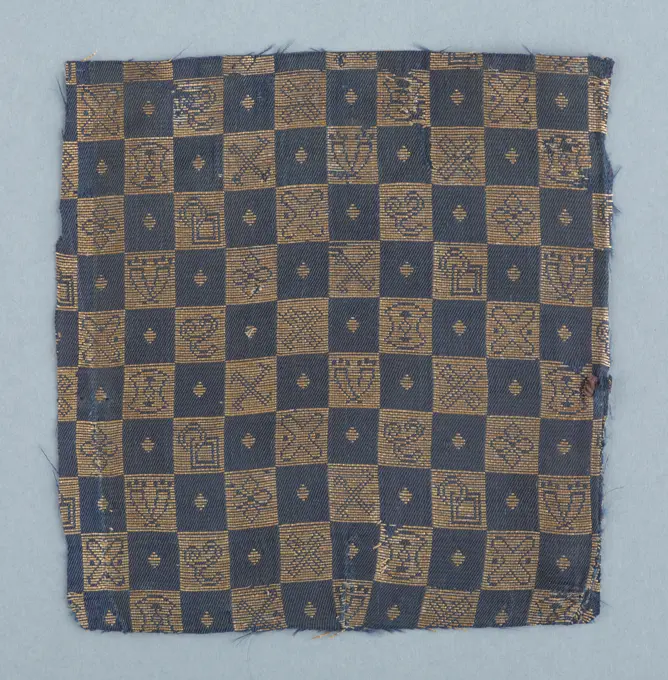
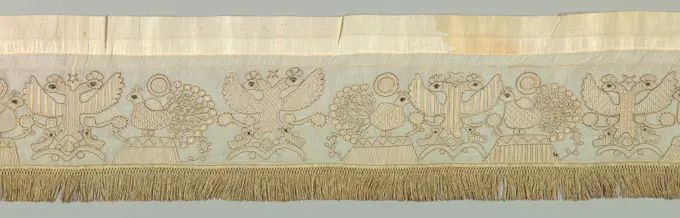
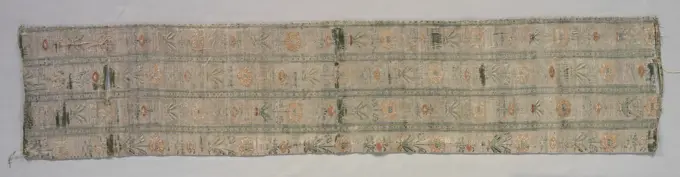
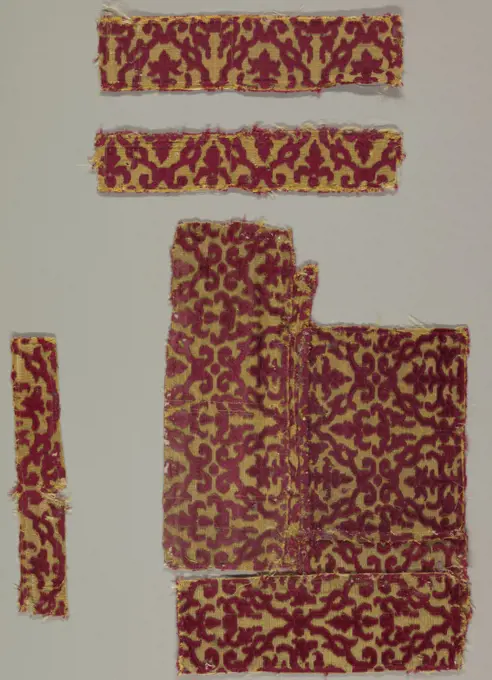
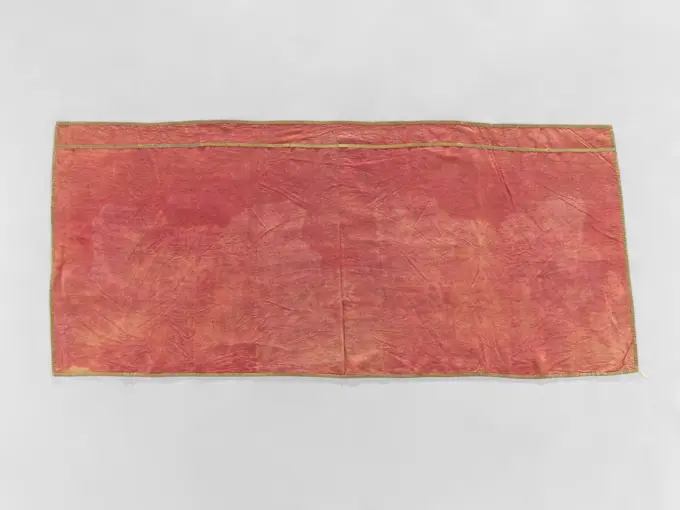
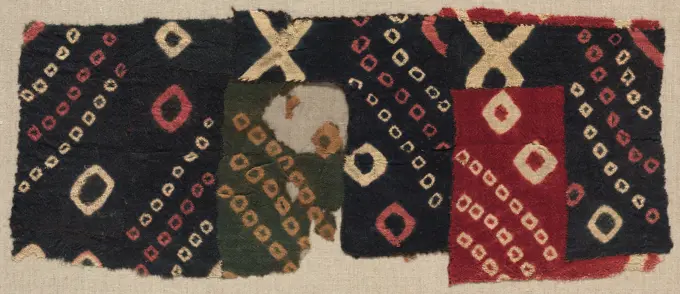
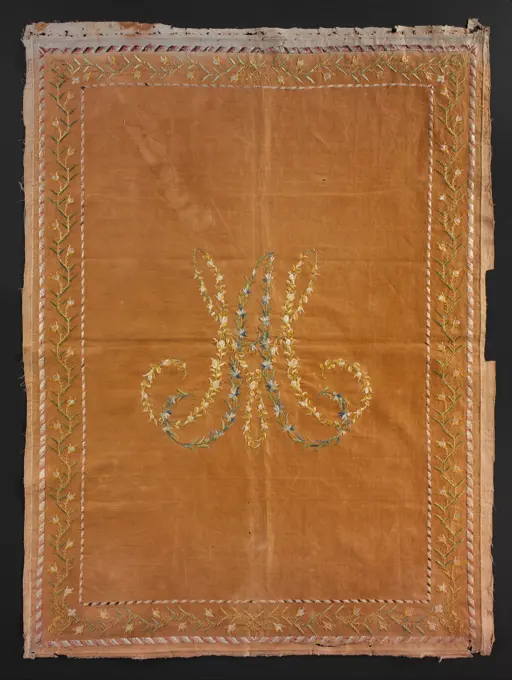
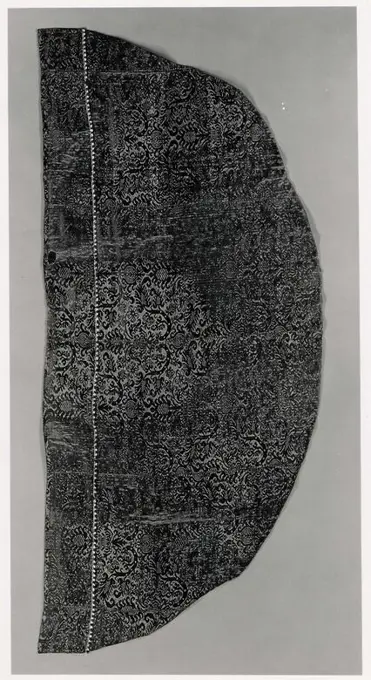
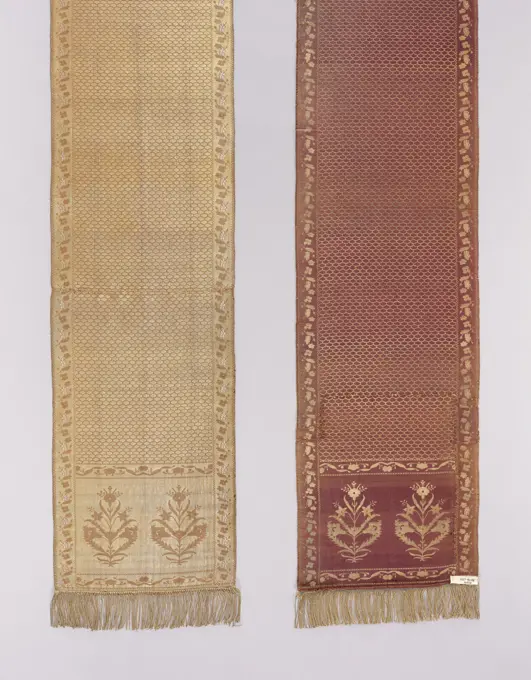
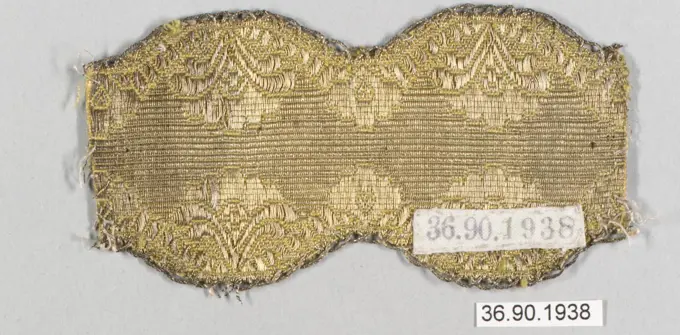
A selection of woven textile fragments from different periods, highlighting intricate designs in silk and metallic threads, showcasing textile artistry.

Textile, China, 18th-19th century, woven textiles, Textile
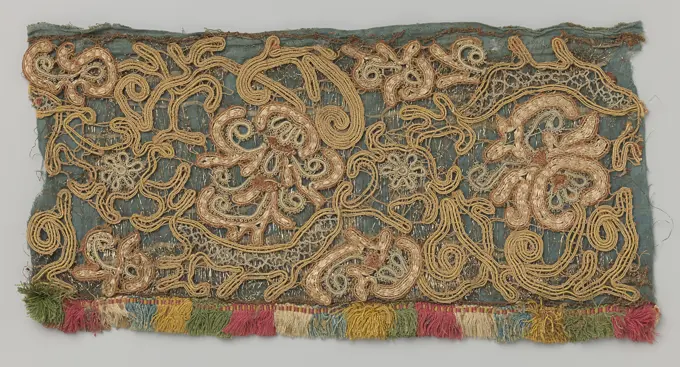
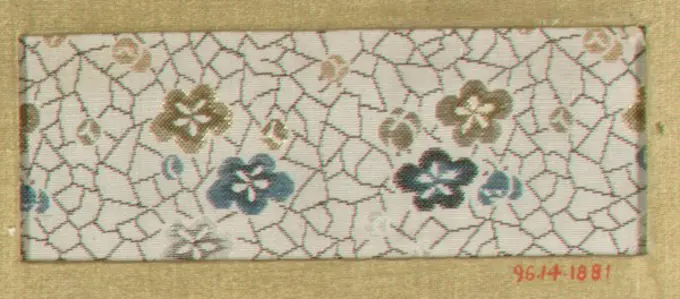
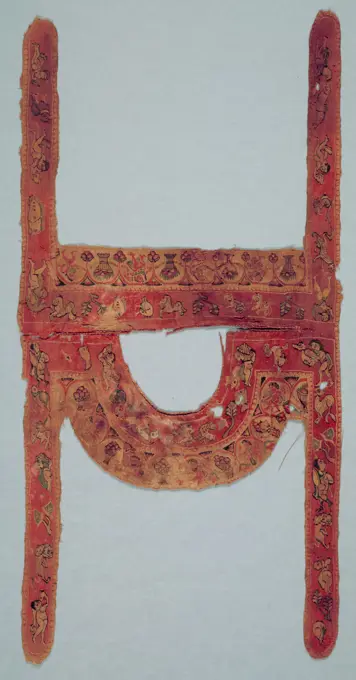
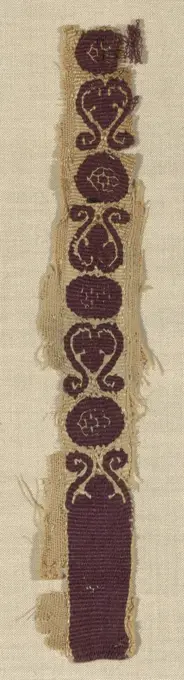
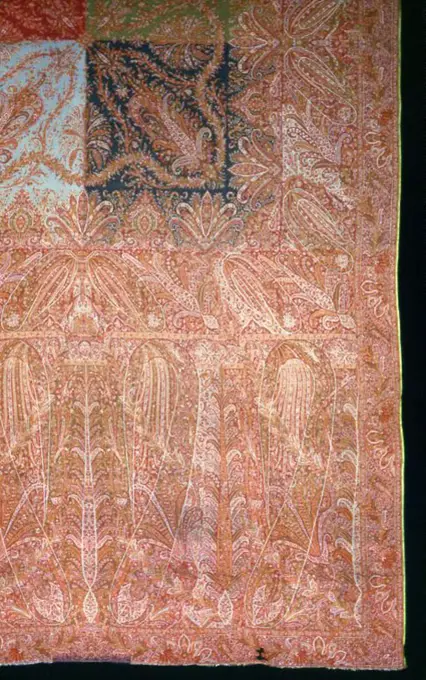
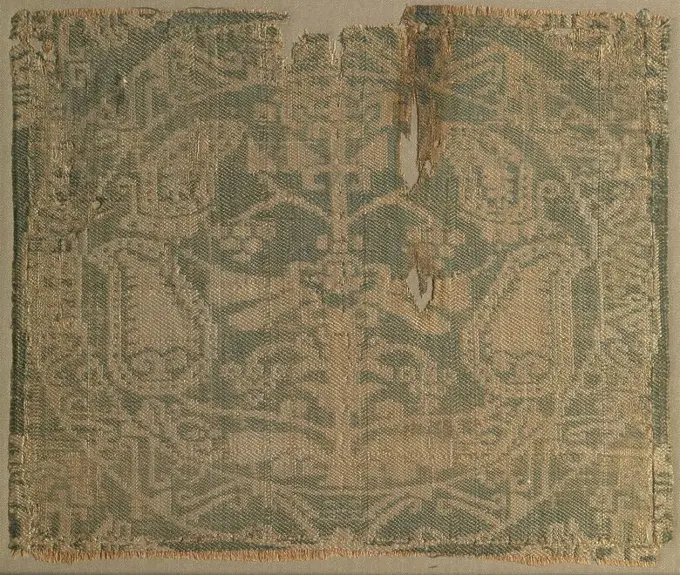
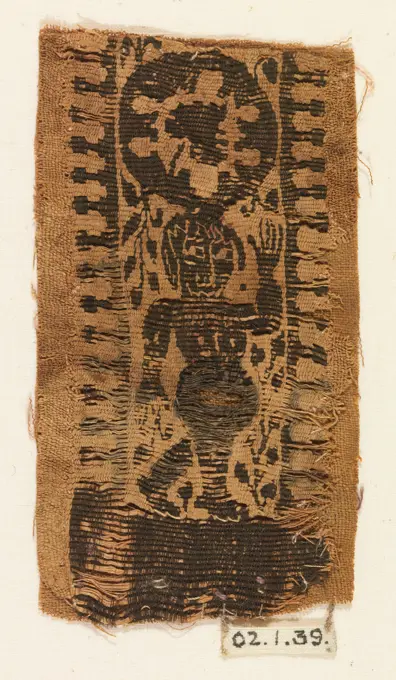
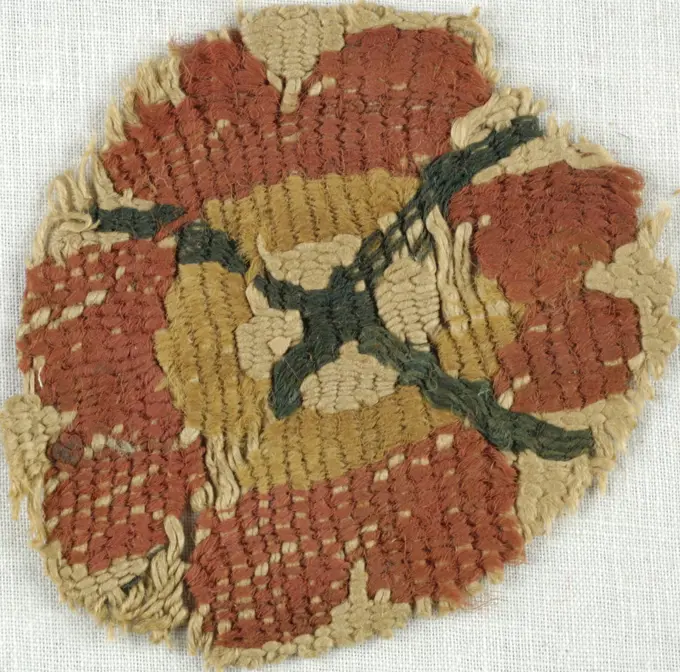
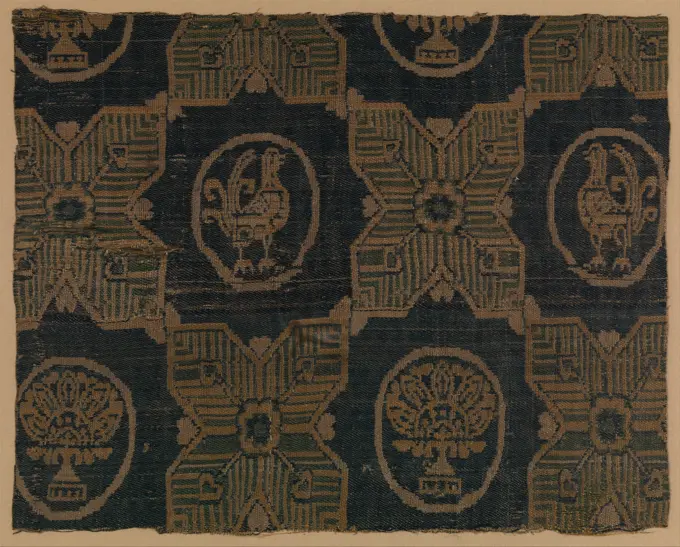
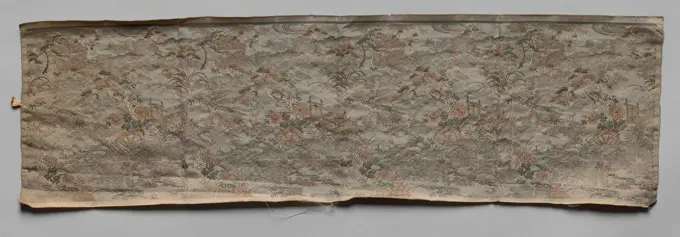
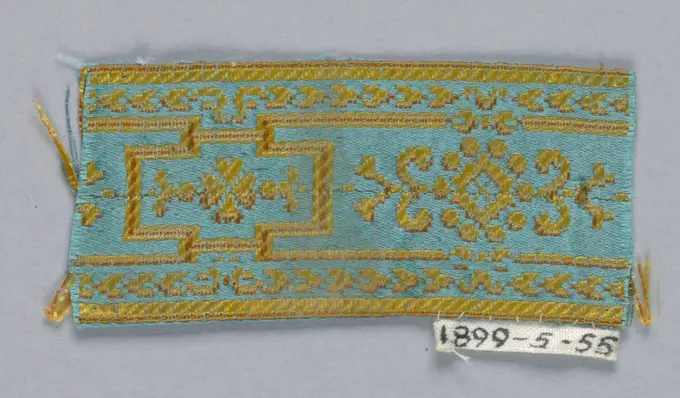
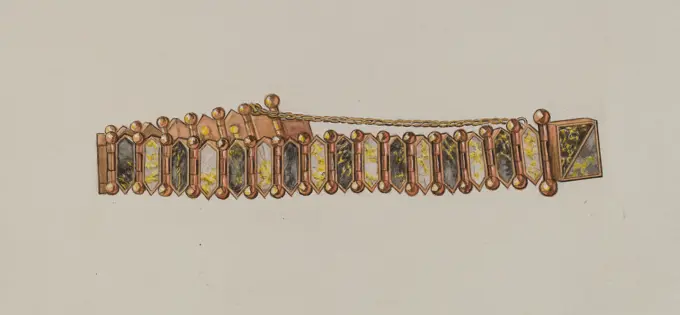
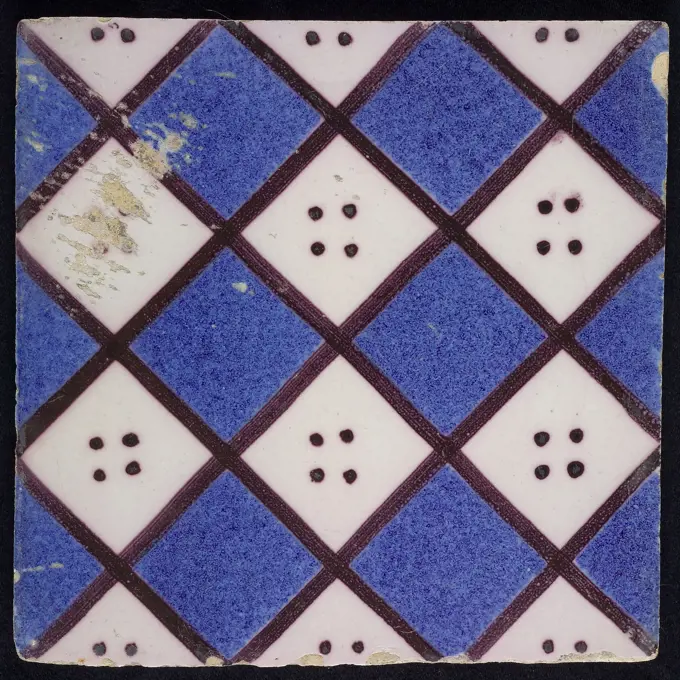
Square Fragment with Animal and Botanical Decoration Coptic. , 5th-7th century C.E. Wool, 3 3/4 x 4 1/2 in. (9.5 x 11.4 cm).   Egyptian, Classical, Ancient Near Eastern Art 5th-7th century C.E.Fragment of fabric unknownFragment, Medium: silk Technique: supplementary warp forming raised pile (velvet), then embossed., Stamped pattern of fleur-de lys within a trellis in green velvet, 16th-17th century, woven textiles, FragmentPanel, 19th century, L.58 x W.25-3/8 in., silk, gold and silver threads, gilt discs; needlework, India, 19th centuryCover fragment. Culture: Spanish. Dimensions: Overall: 30 x 17 3/4 in. (76.2 x 45.1 cm). Date: 16th century. Museum: Metropolitan Museum of Art, New York, USA.Fragment; silk, metallic yarnsStrip of needle side with suns why a decorative frame with angular curling lines that form rectangles, anonymous, c. 1700 - c. 1799 Strip of natural-colored solar side (needle side): Tenerife side. The repeating pattern consists of a square field with a 'sun' in it: a circular center from which bundled wires form the rays of sunshine. There are narrow concentric decorative frames around the center, which are becoming more and more wider. Halfway through, a list of angular curling lines stands out, which form a succession of rectangular motifs. A succession of dots in the outer decorative frame. In the square field standing in every corner, outside the circle, three circles of which the middle circle forms a sun, with a dot at the end of each sunbeam. The top of the strip is finished with a narrow linen strap, with an openwork edge. The strip shows semi-and-half sun. Spain linen (material) sun lace / Tenerife lace Strip of natural-colored solar side (needle side): Tenerife side. The repFringe probably European 19th centuryFragments, Medium: silk, metallic thread Technique: 8-harness satin patterned by a 3/1 twill supplementary fabric structure and brocaded supplementary wefts bound with the supplementary fabric structure, one of the wefts of the supplementary fabric is bound by the warps of the foundation fabric for a change in surface effect, the foundation fabric is entirely covered by the wefts of the supplementary fabric-it acts as a support for the gold, Fragment of a formal, symmetrical pattern of long pointed leaves framing a stem with three globe-like blossoms. The pattern is in shades of gold outlined in deep red., Russia, 19th century, woven textiles, FragmentsPiece 19th century Japan. Piece 72193Border (Russia); cotton, silk, metallic threadBand 3rd-4th century. Band 445685Surround for Turkish Silk Cushion Cover, early 1600s. Iran, Safavid period, late 17th - 18th c.. Plain weave with inner warps and with continuous and discontinuous supplementary wefts bound in plain and 1/3 Z twill order; silk, silver-metal thread; overall: 110.2 x 23.7 cm (43 3/8 x 9 5/16 in.).Band Fragment (Italy); linen, silk; Bequest of Marian Hague; 1971-50-200Fragment of Coptic fabric unknownTextile Fragment 3rd-4th century. Textile Fragment 443922End of a Stole Made 1801-1900 Italy. .Piece 18th-19th century Japan. Piece 66503Fragments, Medium: silk, metallic Technique: supplementary warp forming cut and uncut raised pile in plain weave foundation (velvet) with supplementary wefts, Scrolling lattice in red on gold., 16th-17th century, woven textiles, FragmentsWedding veil, Medium: cotton muslin, White work veil embroidered all over with tiny dots in white cotton., USA, 1820, costume & accessories, Wedding veilLinnen, fragment, blauw.Linen, fragment, blue, why silver wire tense and with silk flowers as side with frills from silk. Germany.Fragment; silk, metallicA Jain Manuscript Cover. Western India, 16th century. Manuscripts. Red and green cloth, metallic threadsFragment; silk on linen; Bequest of Marian Hague; 1971-50-15Piece 18th-19th century Japan. Piece. Japan. 18th-19th century. Silk. Textiles-WovenFragments from a Child's Tunic, 600s-700s. Egypt, Umayyad period (661-750). Wool and linen: tabby weave, inwoven tapestry ornament;Fragment of fabric unknownThe particular foraging sisters of the most famous ingesters. Draw by Charles. 1751.Piece 17th century Japan. Piece 71611Piece 19th century Japan. Piece. Japan. 19th century. Silk / Compound weave. Textiles-WovenSampler (USA); Embroidered by Mary C. Myers (American); linen embroidery on cotton net, backed with silkFragment Made 301 CE-500 CE Egypt. Linen and wool, slit tapestry weave . CopticBag in a flat, rectangular model, whole of sharpened blue, gold and silver beads in geometric pattern, with copper-colored bracket in relief. Bag in a flat, rectangular model, entirely of sharpened blue, gold and silver beads in symmetrical and geometric pattern that is equal to the front and back. The rectangular copper-colored bracket has a shells and leaves relief and opens with a push button. On top of two copper eyes, possibly for a handle. The inside consists of a gray-colored quilted in diagonal stitched lining.Fragment (Italy); silkFragment. Northwest China. Date: 401 AD-600 AD. Dimensions: 68 × 40.9 cm (26 3/4 × 16 in.)Repeat: 7.2 × 21.8 cm (2 7/8 × 8 5/8 in.). Silk, complementary warp plain weave with inner wefts. Origin: China. Museum: The Chicago Art Institute, Chicago, USA.Long Shawl Made 1840-1860 France. Silk and wool, center of weft-float faced 1 3 'Z' twill weave; patterned areas of warp-float faced 3 1 'Z' twill weave with supplementary patterning wefts bound in weft-float faced 1 3 'Z' twill interlacings; woven on loom with Jacquard attachment .Roundel with Central Asian-style "Candelabra Tree". Dimensions: Textile: H. 6 1/8 in. (15.5 cm) W.7 5/16 in. (18.5 cm)Mount: H. 9 7/8 in. (25.1 cm)W. 10 3/4 in. (27.3 cm)D. 1 1/4 in. (3.2 cm). Date: 7th-9th century.This beige and green silk textile fragment displays a roundel with a border of scrolling vines and leaves, at the center of which a stylized tree of life appears, bearing flowers, leaves, and fruit. The composite tree, as well as the fragmentary abstract floral designs around it, can be understood as an Islamic interpretation of the composite tree motifs popular in pre-Islamic Sasanian art. This fragment may have originally been part of a tunic or other garment, and is stylistically related to similar textiles found in Egypt. Museum: Metropolitan Museum of Art, New York, USA.Steel bobbin with Mechelen soil, anonymous, c. 1875 - c. 1899 Steel or short piece of a strip of natural -colored bobbin side: Mechelen bastard. Coming from a lifted side school in Turnhout. Turnwood cotton (textile) bobbin lace / Mechlin (lace) Steel or short piece of a strip of natural -colored bobbin side: Mechelen bastard. Coming from a lifted side school in Turnhout. Turnwood cotton (textile) bobbin lace / Mechlin (lace)Piece China. Piece 71737Fragment Of A Band; warp; s-spun linen. wefts; z-spun linen, z-spun woolCeremonial Textile (Pua Kumbu). Culture: Iban people. Dimensions: H. 94 1/2 x W. 42 1/2 in. (240 x 108 cm). Date: probably 18th century. Museum: Metropolitan Museum of Art, New York, USA.Fragment Made 1700-1800 Japan. Silk, and silver-leaf-over-lacquered-paper, twill weave with supplementary patterning wefts bound by secondary binding warps in twill interlacings .Fragment of a Chasuble Orphrey Cross Band, 1000s. Italy, 11th century. Tablet weave; gold metallic thread and silk; overall: 16.5 x 17.1 cm (6 1/2 x 6 3/4 in.).Textile 19th century Japan. Textile 68064Rosette Fragment Coptic. , 5th-7th century C.E. Flax, wool, 2 1/2 in. Diam. (6.4 cm).   Egyptian, Classical, Ancient Near Eastern Art 5th-7th century C.E.Fragment of a Tunic 6th-7th century. Fragment of a Tunic 443688Textile Fragment 8th-9th century This silk textile fragment displays a repeating design executed in green, yellow, and tan against a dark blue ground. The design consists of joined rows of four-pointed stars, in between which are roundels bearing stylized floral and bird forms in alternating rows.. Textile Fragment 450723Textile, late 1800s-early 1900s. Japan, late 19th - early 20th century. Silk, metallic thread; average: 19.7 x 66.2 cm (7 3/4 x 26 1/16 in.).DETALLE DE LA CULATA DE LA PISTOLA DE CARLOS V - SIGLO XVI. Location: PALACIO REAL-REAL ARMERIA DE MADRID. MADRID. SPAIN.Trimming Fragment; silk:Piece 18th-19th century Japan. Piece 67051Fragment, Medium: silk Technique: cut and uncut supplementary warp pile (velvet), Fragment of blue cut and uncut velvet on tan silk ground. Design of tiny flowering branches. Alternate horizontal rows pointing right and left., Italy, late 16th century, woven textiles, FragmentGordena Jackson, Bracelet, c 1936 BraceletTextile Fragment 5th century. Textile Fragment 443935Church tablecover. unknown, authorTextile Swatches Onondaga Silk Company, Inc. (1925-1981). , 1948-1959. 72 silk; 28 metal, 23 x 18 in. (58.4 x 45.7 cm).    1948-1959Towel 19th century. Towel. 19th century. Silk; embroidered. Country of Origin Turkey. Textiles-EmbroideredTrimming early 19th century probably European. Trimming 214191Tie-Dyed Fragment, c. 700-1100 A.D.. Peru, South Coast, Wari Culture, Middle Horizon, 8th-12th Century. Discontinuous warp and weft, tie-dyed; wool; average: 21.6 x 52.1 cm (8 1/2 x 20 1/2 in.).Piece 18th century China. Piece 71882Fragment, Medium: linen Technique: block printed pigment on plain weave, Fragment of printed linen with gazelles in tear-shaped medallions, with crossed plant forms in interstices, in gold on an off-white ground., Germany, 13th century, printed, dyed & painted textiles, FragmentFirescreen panel ca. 1788 Embroidered by Marie Antoinette, Queen of France French, born Austria In 1785 Louis XVI purchased the Chteau de Saint Cloud in Marie Antoinette's name from the duc d'Orléans. The chteau, situated on a hillside overlooking the Seine not far from Paris, became the queen's favorite summer residence. Built in the sixteenth century and rebuilt during the seventeenth, the palace was in need of renovation. The architect Richard Mique (1728-1794) enlarged and altered it, and appropriate furnishings were ordered for the queen's apartment.Many pieces of furniture were commissioned from Jean-Baptiste-Claude Sené (1748-1803), a member of an important dynasty of Parisian chair makers who received a royal appointment in 1784. Sené provided a set of seat furniture for the queen's dressing room, called her cabinet particulier ox cabinet de toilette that is described in the 1789 inventory of Saint Cloud. The daybed (41.205.1), the bergère (a comfortable chair upholstered betStrip -Arnów. Forged door - front view on a 1:10 scale; Pretty, Szymon (Ca 1864-1942); 1918 (not after 3/04/1918) (1918-00-00-1918-00-00);Siapo mamanu (tapa cloth), 1890s, Smoa, maker unknown. Gift of Alexander Turnbull, 1913.Kontusz sash/belt. Królewska manufaktura jedwabna w Grodnie (Grodno; wytwórnia tkanin jedwabnych i pasów; 1768-1780), manufactureEJ Reynolds, Footstool Top, c 1941 Footstool TopKontusz sash/belt. unknown, authorFragment, Medium: silk Technique: machine made, Black lace with scattered flowers above narrow floral edge., France, 1850-99, lace, Fragment. Letter bag in rectangular envelope model of red leather whose front, the valve and the back, on the edges, completely embroidered with silver thread: a diagonally shaded list includes a diamond pattern, each cross is caught in four circles, the intermediate spaces are with vertical arrangements stuffed. The edge of the bag has been dropped off with a golden yellow hem, which is secured with embroidery stings. On the inside of the valve, 'Constantinople', '1754' and on the front of the bag the name 'Jean Abraham Grill' embroidered in gold thread. On the back a crown monogram with the letters jag. The inside is lined with red silk and is divided three compartments of equal size. The valve closes with a metal closure attached to the tip, which has the shape of a lily.Cope. Culture: Italian or Spanish. Dimensions: Center back neck to hem: 43 1/4 x 154 in. (109.8 x 391.2 cm). Date: late 16th or early 17th century. Museum: Metropolitan Museum of Art, New York, USA.Costume Fragment ; silk, metallic threadTextile, Medium: linen, silk Technique: warp printed satin weave, Linen weft concealed by silk warps in satin weave. Warps chiné dyed. Vertical stripes of red and tan with groups of narrow short stripes in blue, yellow and tan., Europe, 17th century, printed, dyed & painted textiles, TextileFragment, Medium: linen, wool Technique: float patterned plain weave, Fragment made of threee pieces of fabric sewn together, The design of all is a small-scale diaper., Spain, 17th century, woven textiles, FragmentKontusz sash/belt. unknown, authorTrimming (France); silkBand Fragment (Egypt); warp; s-spun linen. wefts; z-spun linen, z-spun woolWoven Fragment 6th-7th century Moche. Woven Fragment 315791Five Fragments from a Waistcoat, 19th century, 18 x 7 in. (45.72 x 17.8 cm) (each, approx.), Silk, embroidery, France, 19th centuryTextile; silkTrimming, White, black, and colored silk in uncut velvet weave., Two crowned shields; one shows two lions () standing up with forefeet against a tree which separates them. The other shield is of diagonal bands. A row of the fleurs-de-lis appears between the shields. Colors are black, brown, and yellow and blue on a white ground., Italy, 18th century, trimmings, TrimmingFragment, Medium: linen Technique: bobbin made (continuous braid-like), Border fragment of deep points and insertion. Each large point edged with minute points. Alternating points have flower-filled urn, and a minute flower pot above a rosette., Italy, 17th century, lace, FragmentConciliate belt;  2nd half 18th century (1751-00-00-1800-00-00);Strip embroidery., Anonymous, 1700 - 1725 Strip with golden embroidery on karmozijnrode, velvet soil.  velvet (fabric weave). Strip with golden embroidery on karmozijnrode, velvet soil.  velvet (fabric weave).Field of five edge tiles with marigolds and leaves, anonymous, c. 1600 - c. 1630 Field of five edge tiles (1 x 5) with a multicolored (blue, green, yellow and orange) ornament of marigolds and leaves. Netherlands earthenware. tin glaze majolica Field of five edge tiles (1 x 5) with a multicolored (blue, green, yellow and orange) ornament of marigolds and leaves. Netherlands earthenware. tin glaze majolicaPiece 18th century China. Piece 71966Byzantine ornamentSaltillo Sarape, c. 1820. Mexico, Coahuila state, Saltillo Region. Wool, cotton; tapestry weave; overall: 245.5 x 151.2 cm (96 5/8 x 59 1/2 in.). The sarape (wearing blanket) is a classic Mexican mens garment that became a symbol of national identity and pride after Mexico achieved independence from Spain in 1821. Examples woven between about 1750 and 1875 in Saltillo, a town in northern Mexico, are the sarapes most famous representatives, prized for their design, color, and technical refinement.Model or a topsail. Model of a marc sail from one and twenty sailing upstairs and one and thirty downstairs, with crucial tires, four results, three popst tops, boelijn sprouts and chop horns, reinforced with leather. The revenues consist of rifles instead of reefseizing: the rifles are on the rifles running ropes that are stitched at the reef holes; Through this rope, sevels are achieved at the revenue, which are attached to the RA on a rope or iron rod. Six vertical ropes, which, where they cross the reef bands, must be stitched to pick up the sail when revenues. Scale 1:10 (derived).Galloon late 18th-early 19th century European. Galloon 225019Fragment, Medium: cotton Technique: resist-printed on plain weave, Unbleached plain weave cloth. Design in blue and red. Two circles, approximately 21 cm in diameter: one in blue with white detail, red center with blue heart-shaped detail; the other, similar framing smaller circle with crossed bars in center. Above and below, borders of blue stripes. Printing crude., India, 12th-13th century, printed, dyed & painted textiles, FragmentFragment, Medium: linen Technique: bobbin lace (continuous braid-like), Fragment of braid-like bobbin lace. Insertion with eight-pointed star motif., Italy, 16th century, lace, FragmentBaby carrier for baby of white cotton, satin, lace and embroidery, anonymous, c. 1880 - c. 1890 A baby carrier for a baby "in the Pak", from white cotton, lace and embroidery and blue satin, "brasserie" or "lit portatif". Netherlands (possibly) cotton (textile). satin A baby carrier for a baby "in the Pak", from white cotton, lace and embroidery and blue satin, "brasserie" or "lit portatif". Netherlands (possibly) cotton (textile). satinTextile Fragment 5th-6th century. Textile Fragment 443297Velvet Fragment, 1500s. Italy, 16th century. Velvet (cut and uncut); silk; overall: 29 x 10.7 cm (11 7/16 x 4 3/16 in.).Fragment; linenBand. Date/Period: Late 16th-early 17th century. Band. Medium: silk embroidery on linen foundation. Technique: embroidered in counted back and stem stitches on plain weave foundation; bobbin lace edging. Author: UNKNOWN.Piece 19th century Japan. Piece 72114F.J. Kleyn, Ornament tile with checkerplate motif, wall tile tile sculpture ceramic earthenware glaze, baked 2x painted glazed sprinkled Square yellow shard two nail holes Two-color: purple and blue on white fond tile bakery Piet HeijnFragment rękawa tuniki. warsztat egipski, workshop