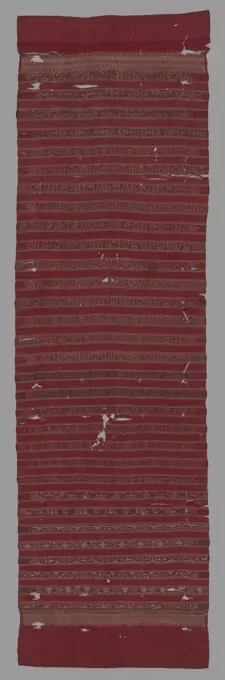
Woven Textile Fragments

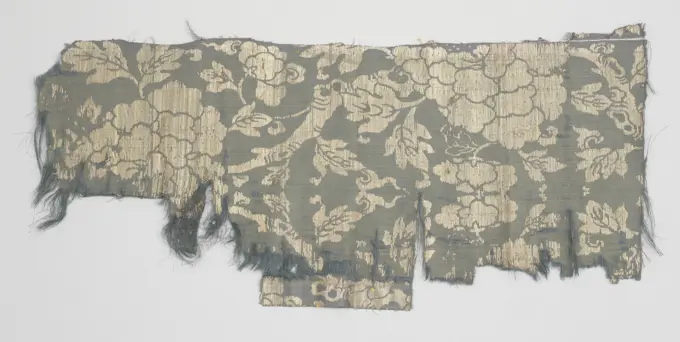
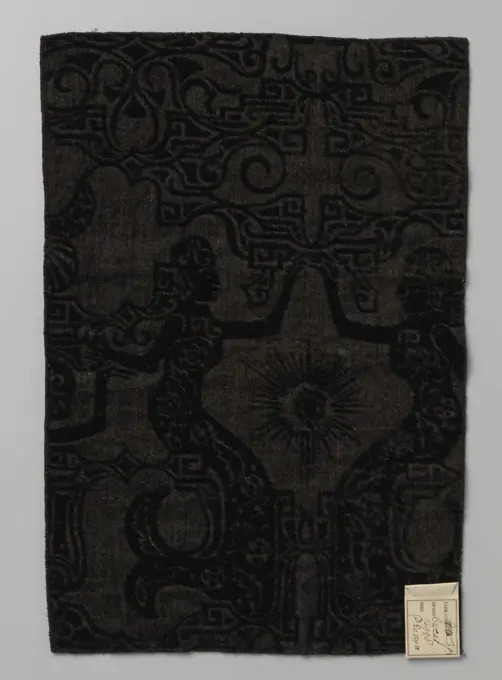
Historical textile fragments showcasing intricate designs with floral patterns and colors, representing various weaving techniques from different eras.
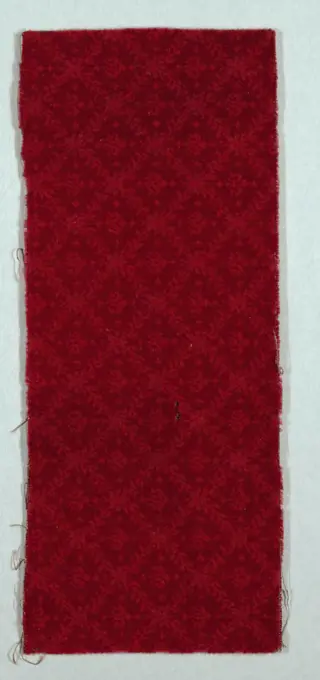
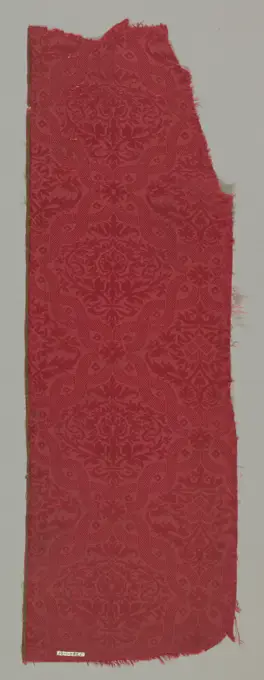
Carpet fragment, Medium: wool, bast fiber Technique: cut pile, Sample of red carpet with small scale diamond lattice enclosing a floral form. The pattern is in light red on a dark red background and entirely in cut pile of one height., USA, ca. 1870, woven textiles, Carpet fragment
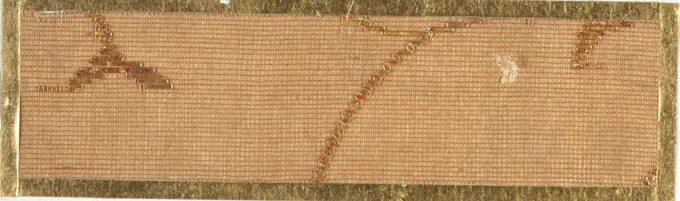
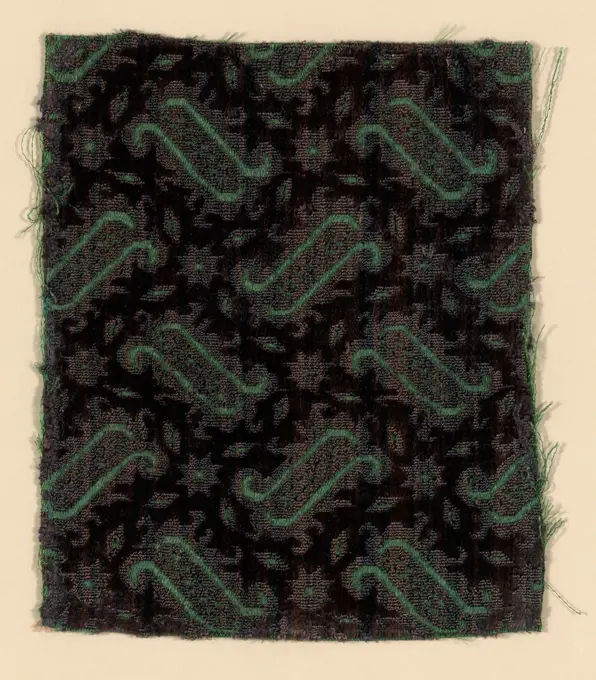
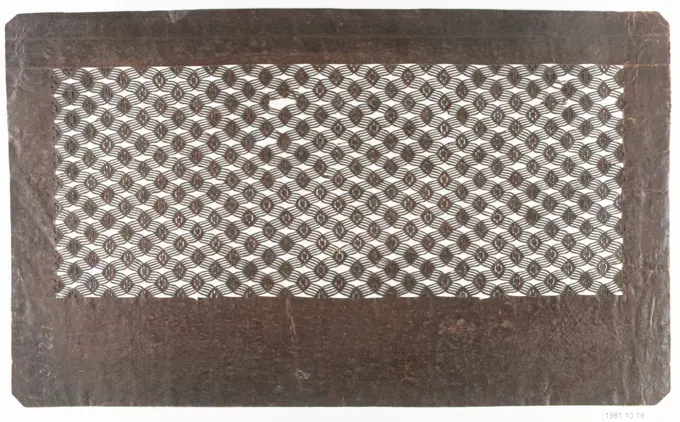
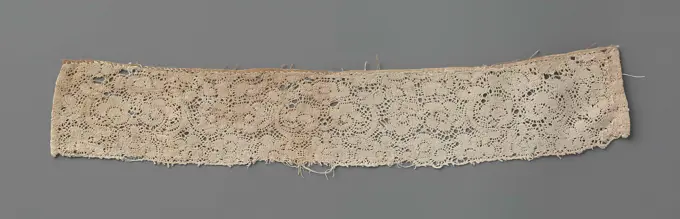
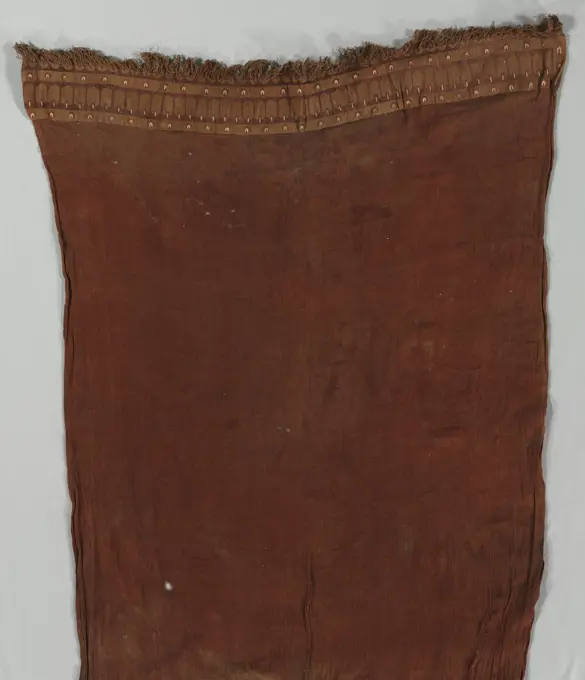
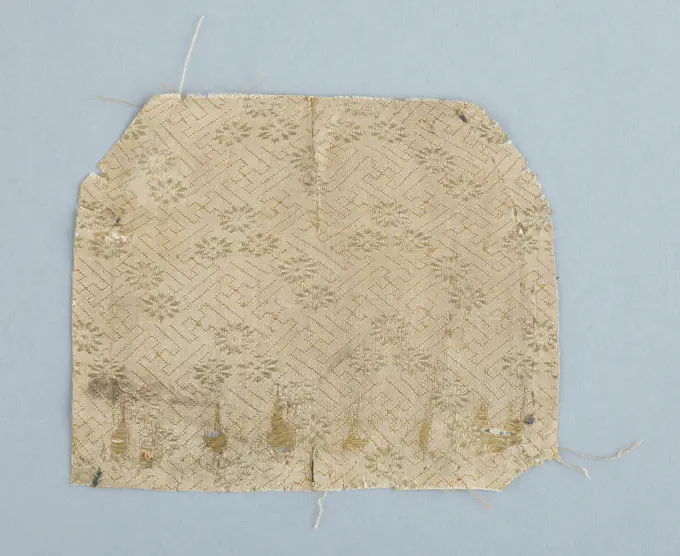
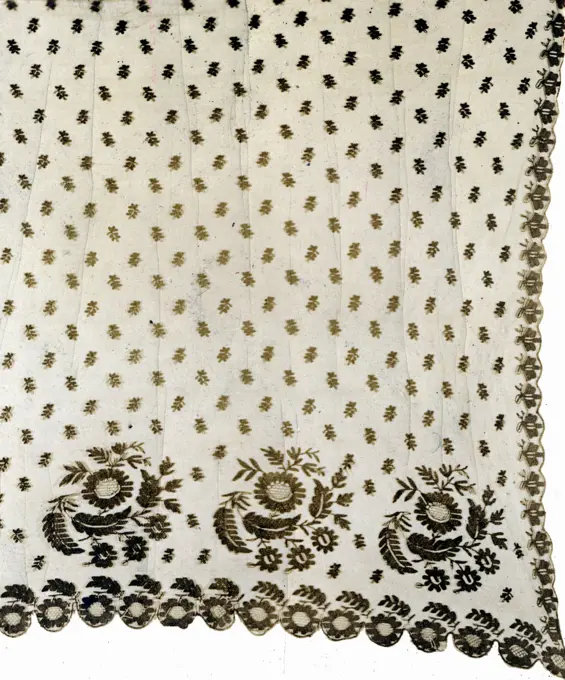
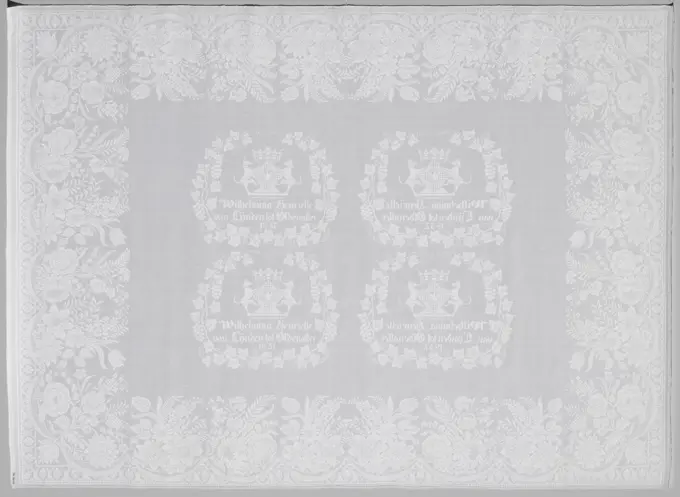
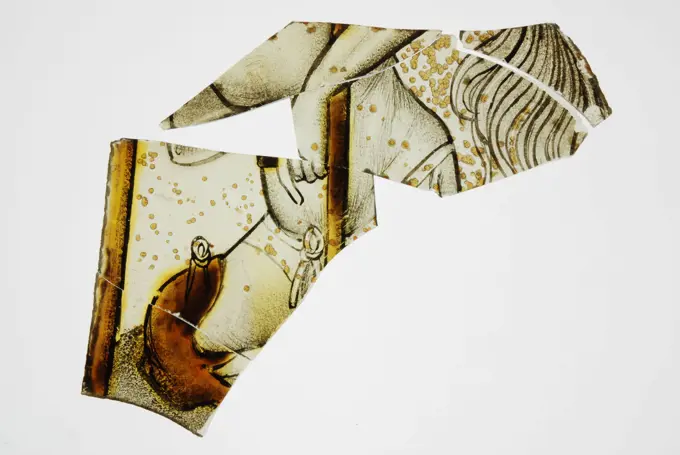
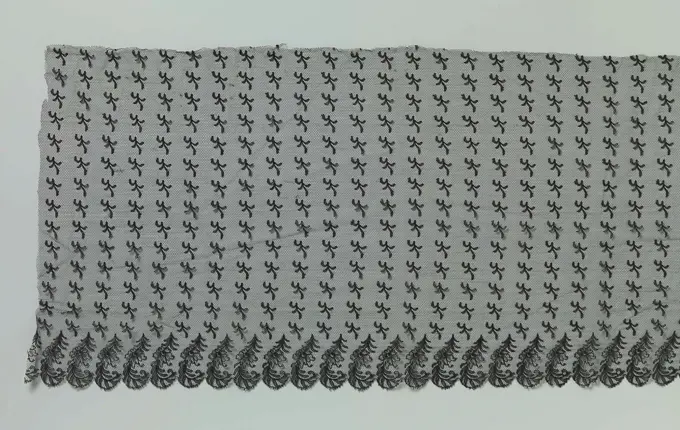
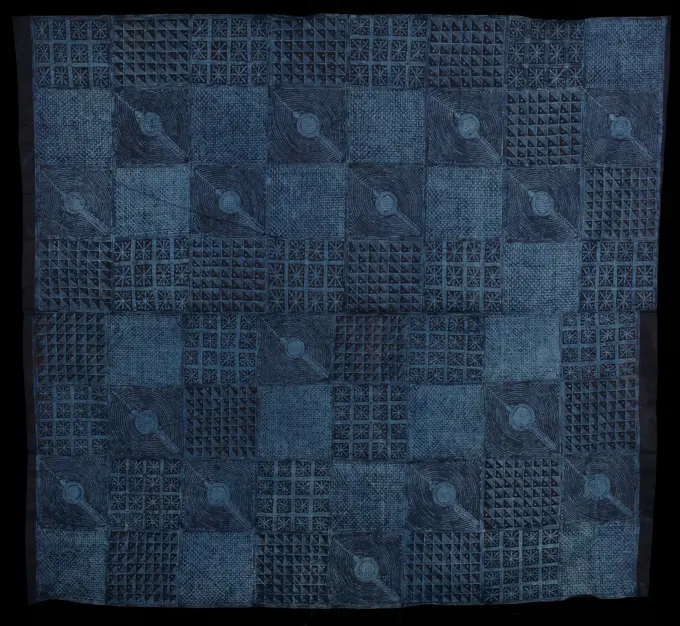
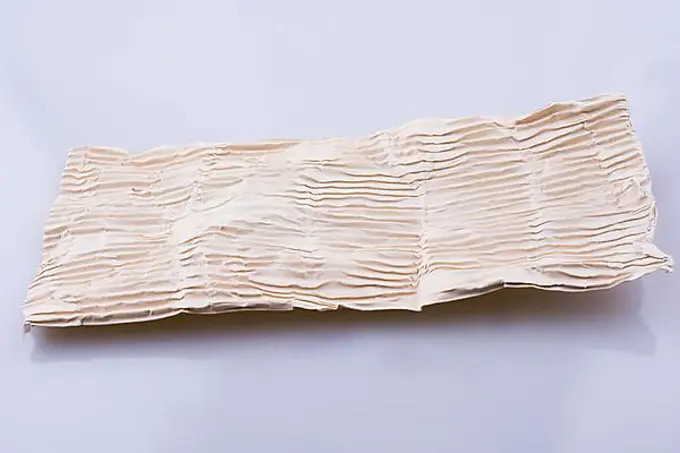
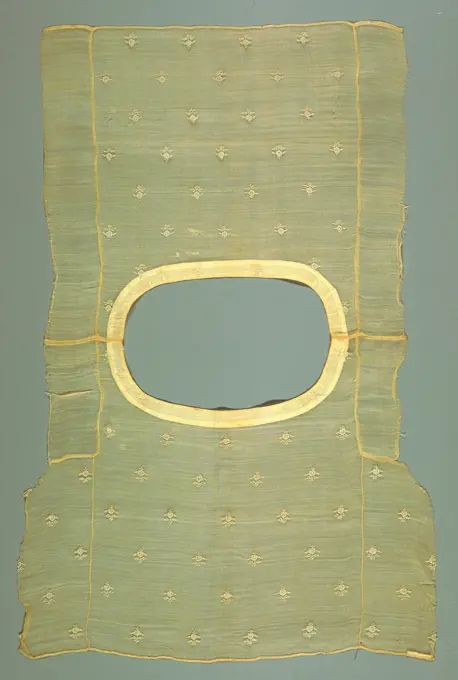
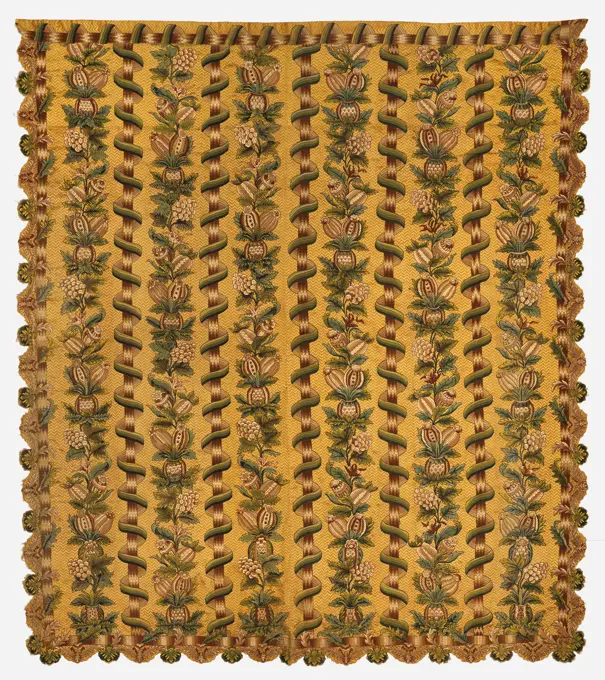
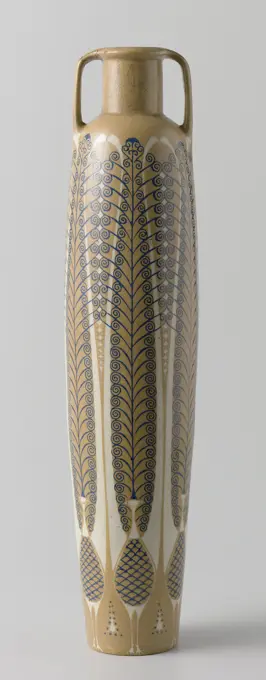
Fragment of a black lace embroidered with sequins;  k. 19th century (1891-00-00-1900-00-00);Sprocket from a bridal rug of application office with field bouquets. Introw from natural applicationant: dick side with needle lace ornamental stitches - Brussels Duchesse - applicated on machine tulle. Round straight model, without seam. The overrun belongs to a lace bridal rug. The pattern increases from top to bottom density. At the top of the skirt can be seen a spreading pattern of flower branches and short flower garlands. There is a zigzag line under the scattering pattern, with similar flowers from the spreading pattern. Under the zigzag line a wavy, double ribbon. On each wave top, the ribbon forms a bow, to which a large field bouquet hangs. The field bouquets are interspersed by standing field bouquets, which spring from the golf tops of the floral drink along the bottom edge of the skirt. This flower rank shows a rich variety of large flowers and leaves. The slot edge along the bottom of the skirt is formed, among other things, by large winger leaves and daisies. The top iFragment of the lace;  18th century (1701-00-00-1800-00-00);Edging Fragment (USA); Manufactured by A .G. Jennings & Sons; cottonFragment (Japan)Fragment Made 1601-1635 Italy. Silk, cut, uncut, voided velvet against satin weave foundation .Napkin from white Linnamast ,, c. 1680 - c. 1690 White linen dams napkin, decorated with sprinkled flower branch and woven crowned mirror monogram. Northern Netherlands (possibly) linen (material) damask White linen dams napkin, decorated with sprinkled flower branch and woven crowned mirror monogram. Northern Netherlands (possibly) linen (material) damaskStencil 19th century Japan. Stencil 70677Petticoat 1890s American. Petticoat 86304Cover Fragment; woolPiece 18th-19th century Japan. Piece 66492Fragment Made 1650-1675 Italy. Silk, plain weave with supplementary pile warps forming cut and uncut voided velvet .Strook kloskant met naar elkaar toe buigende bloemstengels.Strip natural colosside: Old cravings. Symmetrical pattern with, among other things, two to each other bending flower stems with a branch on the convex side with a flour towards the other. The motifs are made in linen stroke with openwork edges. They are connected by a very sparingly used and irregular grille. Straight finished and bottom.Fragment; woolTextile Sample from Sample Book 19th century Japan. Textile Sample from Sample Book. Japan. 19th century. Silk. Textiles-WovenBedcover Made 1801-1900 United States. Cotton, crochet; knotted cut fringe .Ribbon French 19th century View more. Ribbon. French. 19th century. Textiles-TrimmingsPiece 18th-19th century Japan. Piece. Japan. 18th-19th century. Silk. Textiles-WovenFragment, Medium: linen Technique: bobbin lace (Lille-style with heavy outlining thread), Fragment of Lille type bobbin lace, with tiny branches and quatrefoils., 19th century, lace, FragmentLoincloth with Feather() Motifs, 1000-1532. Peru, Central Andes, Chimú or Chimú-Inka, 11th-16th century. Plain weave, tapestry weave; cotton, camelid fiber; overall: 204.5 x 91.4 cm (80 1/2 x 36 in.).Fragment of fabric unknownTextile Swatches Onondaga Silk Company, Inc. (1925-1981). , 1948-1959. Silk, 23 1/2 x 15 1/4 in. (59.7 x 38.7 cm).    1948-1959Back of a chasuble. unknown, authorFamily album with 45 photos, anonymous, diverse manufacturers, 1860 - 1900  Family album with a total of 45 photos; all cartes-de-visiting. The album contains portraits of men, women and children.  photographic support. iron (metal). cardboard. mother of pearl. metal Printing album / gelatin Silver Print / Ferrotyping historical persons. adult man. adult woman. girl (child between toddler and youth). boy (child between toddler and youth)Fragments; silkShawl Sample early 19th century. Shawl Sample 447760Handkerchief 1840-60 American. Handkerchief 169245Shawl (Pano), c. 1920, 54 x 28 in. (137.16 x 71.12 cm), Cotton ikat, Ecuador, 20th centuryVeil Made 1800-1820 United States. Silk, machine-made net; embroidered with silk in darning, running, and wave filling stitches . Mary N. KeithCurtain panel ca. 1880-1910 American. Curtain panel 20473Textile Swatches Onondaga Silk Company, Inc. (1925-1981). , 1948-1959. 41 silk, 30 rayon, 15 nylon, 14 metal, a: 22 x 17 3/4 in. (55.9 x 45.1 cm).    1948-1959Small Section of a Landscape (from Sketchbook) 1890 Albert Bierstadt American. Small Section of a Landscape (from Sketchbook). Albert Bierstadt (American, Solingen 1830-1902 New York). American. 1890. Graphite on wove paperNapkin with weapon Wilhelmina Henriette van Lynden to Oldenaller with year 1857, Anonymous, 1857 Napkin from Wit Linnamast with four times the name and weapon of JKVR. Wilhelmina Henriëtte from Lynden to Oldenaller and the year 1857 within a wreath of grape vines; Edges with flower bouquets, garlands and palmets.  linen (material) damask Napkin from Wit Linnamast with four times the name and weapon of JKVR. Wilhelmina Henriëtte from Lynden to Oldenaller and the year 1857 within a wreath of grape vines; Edges with flower bouquets, garlands and palmets.  linen (material) damaskMan's ceremonial llacota (mantle), 18th century, 47 7/8 x 38 1/4 in. (121.6 x 97.16 cm), Alpaca, Bolivia, 18th centuryTextile (France); cotton, metallic threadPiece 18th-19th century Japan. Piece 67503Fragment, Medium: silk Technique: 4&1 satin damask, Small detached leaves in olive green., 17th century, woven textiles, FragmentFragment. Pativilca Valley, north-central coast, Peru. Date: 1000-1476. Dimensions: 32.7 x 32.7 cm (12 7/8 x 12 7/8 in.). Cotton, plain weave double cloth; edged with cotton, plain weave. Origin: Peru. Museum: The Chicago Art Institute, Chicago, USA.Needlepoint Lace (Argentan Lace) Cap Crown, late 18th century. France, Argentan, late 18th century. Lace, needlepoint; average: 21.7 x 27.1 cm (8 9/16 x 10 11/16 in.).Square Shawl, c. 1870s. England, Norwich or France, Nimes, 19th century. Wool, compound weave, additional weft; overall: 170.2 x 172.7 cm (67 x 68 in.).very old gray vintage kitchen towel on gray cement background, top view, copy spaceFragment rood damastbrokaat.A fragment of red damask brochat with flowers of gold thread. NOTE: Cut an angle. Self side; 0.7 cm, plain bond.paper tag label isolated over white a paper tag or label or sticker for product information isolated over white background Copyright: xZoonar.com/adminx 10959664Kosode Japan. Kosode 73683Fragment spray velvet with design "Zeenymphen", dark blue on gold, Eindhovensche Trijp factories Schellens and Marto, in or after 1918 - c. 1925 Fragment sinking velvet with design "Zeenymphen", dark blue on gold. Eindhoven ketting: mohair. inslag: cotton (textile). Fragment sinking velvet with design "Zeenymphen", dark blue on gold. Eindhoven ketting: mohair. inslag: cotton (textile).Front wrapper. Photographs, Photograms, Book covers. 1849-11 - 1850-06. Spencer Collection. Plants in artFragment of silk fabric unknownFragment shaved velvet with design "Zee symphen", dark blue on gold. Fragment shaved velvet with design "Zee symphen", dark blue on gold.Textile Swatches Onondaga Silk Company, Inc. (1925-1981). , 1948-1959. wool, silk, 48 1/4 x 16 1/2 in. (122.6 x 41.9 cm).    1948-1959Skirt, 1980-1985, Micaela Diaz, 39 x 80in. (99.1 x 203.2cm), Cotton, silk, Mexico, 20th centuryShowing board pattern of rosette and stripes, Anonymous, 1750 - 1900  Leaf with chessboard pattern of rosette and stripes. Used as a cover, with label.  paper. block printing (relief printing process) ornament derived from plant formsFragments of green window glass with stained-glass decoration, beggar with loincloth, window glass building material soil find glass, w 5.8 cast drawn cut painted baked Fragments of green tinted window glass. Stained glass Fragment of beggar leaning on two crutches He is dressed in loincloth His right knee is protected by an attached leather cap Right of him fragment of ponytail Possible remains of an image of St. Maarten sharing his cloak with the beggar archeology Landpoortstraat Geervliet Bernisse indigenous glasswork adorn living build dress undergarments glazier court of Putten archaeological find in the soil Geervliet pit Landpoortstraat 1 September 1983.Fragment (England); black horsehair; Bequest of Marian Hague; 1971-50-456Fragment, Medium: silk warp, cotton, silk and metallic wefts Technique: woven, Floral forms arranged in rows, red and green on off-white background., India, 19th century, woven textiles, FragmentPiece 18th-19th century Japan. Piece 67815Strook zwarte machinale kant met een onderzijde van j-vormige gevederde bladeren met bloem.Strip black machine side: machining chantilly-side. The repeating pattern consists of fourteen rows of straight among each other branches and a row hanging feathered leaves with always one flower along the bottom edge. The feathered leaves hang like a j down, the flower is located halfway between the stick of the J and oversours the leaf. The bends of the J-shaped leaves form the slip edge along the bottom of the strip, which is finished with picots. The top of the strip is straight cut and not finished.Textile Swatch , 1950s to 1960s. Silk, 19 x 15 in. (48.3 x 38.1 cm).    1950s to 1960sAboriginal shield from Western Australia. Dated 19th CenturyChoir of velvet brocate ,, 1600 - 1625 Choir of velvet brocade. The pattern has placed rows of leaves on a comma-shaped branches right above each other; one side from a lobed palm motif and palmet; The other from a three -sheet and jerk. The choir hood is made of several fragments and is lined with blue linen. The outer hem and the back shield are finished with frills. The back shield also has a brush. Italy silk. silver thread. linen (material). brocade (textile) Choir of velvet brocade. The pattern has placed rows of leaves on a comma-shaped branches right above each other; one side from a lobed palm motif and palmet; The other from a three -sheet and jerk. The choir hood is made of several fragments and is lined with blue linen. The outer hem and the back shield are finished with frills. The back shield also has a brush. Italy silk. silver thread. linen (material). brocade (textile)band aid bandage isolated over white a medical self adhesive bandage band aid isolated over white background Copyright: xZoonar.com/ClaudioxDiviziax 12592676Screen, 20th century, 12 x 12 in. (30.48 x 30.48 cm) (approx.), Linen warp, Jamaican fibers, Jamaica, 20th centuryValance (France); cottonAdire (wrap), 20th century, 75 5/8 x 69 3/8 in. (192.09 x 176.21 cm), Cotton, Nigeria, 20th centuryMedieval ornamentFragment, Medium: silk Technique: cut and uncut supplementary warp pile (velvet) in a woven foundation, Fragment of cut and uncut dark green velvet in pattern of vertical stripes and cross hatching with voided rosettes., Italy, 16th-17th century, woven textiles, FragmentHandkerchief; linenb. From the cycle "towards Heaven", ref. purple-black; Przybylski, Janusz (1937-1998); 1987 (1987-00-00-1987-00-00);Crumbled Paper on a white backgroundSampler, Medium: silk embroidery, linen foundation Technique: counted satin, double running and cross stitches on plain weave, Unfinished sampler. Top reads 'Ni me p...' Cross borders along bottom in geometric and floral patterns., Mexico, 18th century, embroidery & stitching, SamplerPiece 18th-19th century Japan. Piece 66802Door (kapi) suzani, 1920, 100 x 73 in. (254 x 185.42 cm), Cotton, silk; needlework, Uzbekistan, 20th centuryMachinale sleeve with rush -in medallions for an evening gown, anonymous, c. 1915 - c. 1925 Sleeve of natural -colored machine side for an evening gown. Rectangular model with one sloping lace and a scrap edge. The pattern consists of a row of rush -in medallions, outlined by a flower garland above garlands of chalice with a diamond pattern and some flower garlands with hanging leaves. Above are garlands of ribbons and branches with bows above and below and in between a motif of volutes and branches with leaves and buds. West-Europa cotton (textile) Sleeve of natural -colored machine side for an evening gown. Rectangular model with one sloping lace and a scrap edge. The pattern consists of a row of rush -in medallions, outlined by a flower garland above garlands of chalice with a diamond pattern and some flower garlands with hanging leaves. Above are garlands of ribbons and branches with bows above and below and in between a motif of volutes and branches with leaves and buds. West-EuroBlouse Pieces (Philippines); piña (pineapple) fiber, cottonline in morocco africa old tile and colorated floor ceramic abstractCurtain for Hemelbed van Point de Hongria ,, 1700 - 1725 Curtain for Hemelbed van Point de Hongria. Technology: On a pattern of linen, a full embroidery in wool and silk is applied in vertical flat stitch, both radically and with zig-zag intervals. Pattern: on a yellow stock with zig-zag effect stands five times a pole with spiral tape, interspersed by an upright branch with leaves and thick fruits: pomegranates in various shapes and grape bunches, nuanced of green, brown, blue and white and fluent of light To dark. The pole with spiral has a lightning bolt pattern. On the left, right and below the pole is wound with a leaf spiral. At the top is turned on a three -quarter pole with spiral tape in the length. Finished on three sides with scallops. A medium seam points to a later form change. England (possibly) wool. silk. linen (material) Curtain for Hemelbed van Point de Hongria. Technology: On a pattern of linen, a full embroidery in wool and silk is applied in vertical flat stitch, bRolsloop, , 1830 - 1870 Rolloop with a closed end and a separate final piece. Northern Netherlands linen (material) Rolloop with a closed end and a separate final piece. Northern Netherlands linen (material)Textile Fragment 3rd-4th century. Textile Fragment 444259Textile Fragment 5th century. Textile Fragment 444240BOOK;  beginning of the 18th century (1701-00-00-1710-00-00);Shopping Bag, Issey Miyake; print on semi-transparent cloth; 41.9 x 30.5 cm (16 1/2 x 12 in. )Sash of the Presidium of the Committee of the anniversary of May 3 in Warsaw in 1916. unknown labelROCKDRILLE - 1996-1997. Author: JOSE MARIA SICILIA. Location: PRIVATE COLLECTION.Trimming Fragment; silk:Iznik tiles on the walls of a palace, Topkapi Palace, Istanbul, TurkeyCylindrical vase with stylized lyre birds in white and blue on yellow -brown fond, Chris van der Hoef, 1902 Vase of earthenware, cylindrical, upwards slightly wider, with indented short neck; Two ears between shoulder and mouth edge. Decorated with stylized Liervogels in white and blue on yellow -brown stock. Amsterdam, Amstelhoek, designed by C.J. van der Hoef. Marked. Ca. 1902. Amsterdam earthenware. glaze Vase of earthenware, cylindrical, upwards slightly wider, with indented short neck; Two ears between shoulder and mouth edge. Decorated with stylized Liervogels in white and blue on yellow -brown stock. Amsterdam, Amstelhoek, designed by C.J. van der Hoef. Marked. Ca. 1902. Amsterdam earthenware. glazeNgatu (tapa cloth), 1800s, Tonga, maker unknown.Silk fabric, Eastern unknownFragment (Japan)Cylinder Seal. Mesopotamia, Early Dynastic Style of Mesopotamia, about 2750-2350 B.C.. Tools and Equipment; seals. White marbleSilk Damask Textile, 1450-1599. Italy, second half of the 15th century. Damask, silk; overall: 51.1 x 60 cm (20 1/8 x 23 5/8 in.).Fragment veelkleurig geborduurd weefsel.Fragment white silk tissue with an embroidered pattern of small, multicolored flowers.Wholecloth quilt ca. 1830 American or British This chintz quilt is notched at its bottom corners to accommodate bedposts. The quill is bound with cotton tape striped in tan, white, black, and blue. The chintz top fabric is decorated with floral trails, roller printed in red and block overprinted in blue, yellow, and green on a tan ground. The backing chintz has a flora/ stripe, roller printed in red and brown. The piece is quilted overall with a shell pattern.. Wholecloth quilt. American or British. ca. 1830. Cotton. Possibly made in England; Possibly made in United StatesFragment 16th century Italian. Fragment 230213Fragment multicolored brochure side. Five fragments of pink satin, in which flowers and houses are woven. Note: Self side; 0.6 cm 4 coarse self-board wires, multicolored.Pattern ca. 1840 British. Pattern. British. ca. 1840. Parchment. Textiles-Methods and MaterialsOld grunge postage stamp. Clean postage stamp template. Postage stamp border. Mockup postage stamp with shadow. Blank postage stamp. Vector illustrationTextile Swatches Onondaga Silk Company, Inc. (1925-1981). , 1948-1959. Silk, 47 1/2 x 17 3/4 in. (120.7 x 45.1 cm).    1948-1959Piece 18th-19th century Japan. Piece 66690ShoulderClothSample Book (France); paper, silk